John 18:33
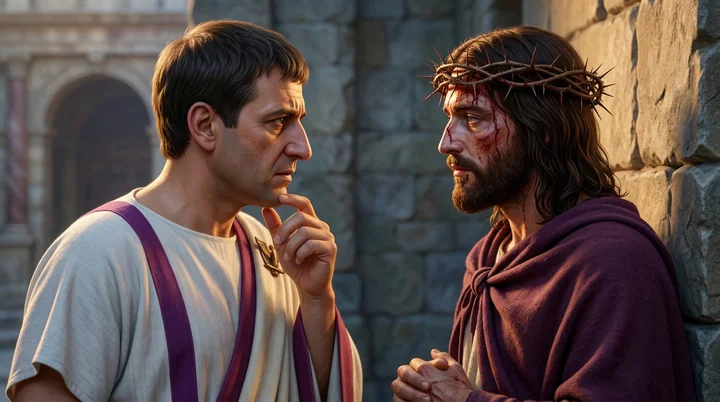
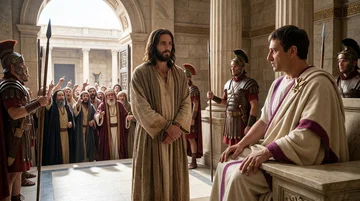
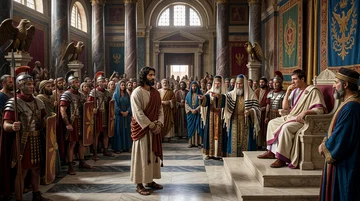
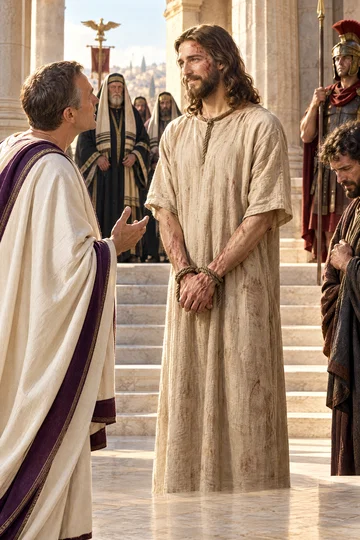
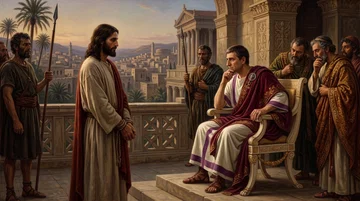
Then Pilate entered into the judgment hall again, and called Jesus, and said unto him, Art thou the King of the Jews?
Translations
Then Pilate entered into the judgment hall again, and called Jesus, and said to him, Are you the King of the Jews?
King James Version, KJV Cambridge Paragraph Bible
Then Pilate entered into the judgment hall again, and called Jesus, and said unto him, Art thou the King of the Jews?
Then Pilate entered into the judgment-hall again, and called Jesus, and said to him, Art thou the King of the Jews?
Pilate therefore entered again into the palace, and called Jesus, and said unto him, Art thou the King of the Jews?
Pilate therefore entered again into the Prætorium, and called Jesus, and said unto him, Art thou the King of the Jews?
Pilate, therefore, entered into the praetorium again, and called Jesus, and said to him, 'Thou art the King of the Jews?'
Pilate therefore entered again into the praetorium and called Jesus, and said to him, Thou art the king of the Jews?
Pilate, therefore, entered again into the judgment-hall; and addressed Jesus, and said unto him—Art, thou, the king of the Jews?
Berean Standard Bible, Majority Standard Bible
Pilate went back into the Praetorium, summoned Jesus, and asked Him, “ Are You the King of the Jews?”
Pilate therefore entered again into the Praetorium, called Jesus, and said to him, “ Are you the King of the Jews?”
Then Pilate went back into the Praetorium and sent for Jesus and said to him, Are you the King of the Jews?
So Pilate entred into the common hall againe, and called Iesus, and sayde vnto him, Art thou the king of the Iewes?
Douay-Rheims (Challoner revision)
Pilate therefore went into the hall again, and called Jesus, and said to him: Art thou the king of the Jews?
Pictures
Cross-references 20 of 25
- John 18:37
Pilate therefore said unto him, Art thou a king then? Jesus answered, Thou sayest that I am a king. To this end was I born, and for this cause came I into the world, that I should bear witness unto the truth. Every one that is of the truth heareth my voice.
Jesus affirms his kingship and says he came to bear witness to the truth.
- Mark 15:2-5
And Pilate asked him, Art thou the King of the Jews? And he answering said unto him, Thou sayest it.
Pilate questions Jesus about his kingship and accusations, but Jesus remains silent before his accusers.
- Luke 23:2-3
And they began to accuse him, saying, We found this fellow perverting the nation, and forbidding to give tribute to Cæsar, saying that he himself is Christ a King.
The accusers charge Jesus with claiming kingship, prompting Pilate to ask whether he is King of the Jews.
- Matthew 27:11
And Jesus stood before the governor: and the governor asked him, saying, Art thou the King of the Jews? And Jesus said unto him, Thou sayest.
Pilate asks Jesus whether He is King of the Jews.
- John 19:1-7
Then Pilate therefore took Jesus, and scourged him.
Pilate declares Jesus faultless as the Jews demand his death for claiming divine Sonship.
- John 19:14-16
And it was the preparation of the passover, and about the sixth hour: and he saith unto the Jews, Behold your King!
Pilate presents Jesus as King, but the crowd demands his crucifixion.
- John 18:39-40
But ye have a custom, that I should release unto you one at the passover: will ye therefore that I release unto you the King of the Jews?
The crowd rejects Pilate’s offer to release Jesus and chooses Barabbas.
- John 18:38
Pilate saith unto him, What is truth? And when he had said this, he went out again unto the Jews, and saith unto them, I find in him no fault at all.
private questioning led to no-fault verdict
- Mark 15:2
And Pilate asked him, Art thou the King of the Jews? And he answering said unto him, Thou sayest it.
Pilate asks Jesus whether he is King of the Jews.
- Luke 23:3
And Pilate asked him, saying, Art thou the King of the Jews? And he answered him and said, Thou sayest it.
Pilate questions Jesus about being King of the Jews.
- John 19:2-3
And the soldiers platted a crown of thorns, and put it on his head, and they put on him a purple robe,
Soldiers crown Jesus with thorns and mock him as king.
- John 19:12
And from thenceforth Pilate sought to release him: but the Jews cried out, saying, If thou let this man go, thou art not Cæsar’s friend: whosoever maketh himself a king speaketh against Cæsar.
The Jews press a treason charge against Jesus by invoking Caesar.
- Matthew 27:2
And when they had bound him, they led him away, and delivered him to Pontius Pilate the governor.
A parallel account of Jesus’ trial before Pilate.
- John 19:4
Pilate therefore went forth again, and saith unto them, Behold, I bring him forth to you, that ye may know that I find no fault in him.
Pilate declares that he finds no fault in Jesus.
- John 19:9-11
And went again into the judgment hall, and saith unto Jesus, Whence art thou? But Jesus gave him no answer.
Pilate questions Jesus about his authority.
- Luke 23:4
Then said Pilate to the chief priests and to the people, I find no fault in this man.
Pilate declares that he finds no fault in Jesus.
- Luke 23:7-11
And as soon as he knew that he belonged unto Herod’s jurisdiction, he sent him to Herod, who himself also was at Jerusalem at that time.
Jesus is sent from Pilate to Herod and mocked there.
- John 6:15
When Jesus therefore perceived that they would come and take him by force, to make him a king, he departed again into a mountain himself alone.
Jesus previously avoided being made an earthly king.
- John 19:16-18
Then delivered he him therefore unto them to be crucified. And they took Jesus, and led him away.
Pilate’s proceedings lead to Jesus being crucified.
- Luke 23:1
And the whole multitude of them arose, and led him unto Pilate.
The leaders bring Jesus before Pilate.
Commentary
Each commentary is drawn from primary sources: the writings of Ellen G. White and Adventist pioneers and periodicals. Each commentary is separate. Its own words are not a quotation; follow the references to read the source passages.
Ellen G. White
17 sources
Pilate took Jesus inside for private questioning because a Roman sentence was still needed after the Sanhedrin's condemnation, unwilling to condemn on worthless testimony after seeing His calm and noble bearing.Ms 51, 1897, par. 29–30DA 723.1–724.1Ms 107, 1893, par. 2 His question about kingship repeated the leaders' charge of rivalry with Caesar, though he already saw no sedition or deception in Him and was convinced He was innocent and handed over from hatred.Ms 51, 1897, par. 29–303SP 130.2–131.2Ms 112, 1897, par. 26–30 Jesus owned Himself as king yet claimed no earthly throne or revolt against Caesar, and pressed Pilate to ask from his own conviction rather than from hearsay.3SP 130.2–131.25RED 50.2–51.1ST Jul 4, 1878 He explained that His reign is not worldly nor upheld by force, but He was born and came to bear witness to the truth that all who are of the truth hear, a truth able to restore ruined humanity.ST Jan 24, 1900COS 140.1–5Lt 290, 1906, par. 6–7 His standing in that hall was the climax of Satan's hatred from the manger to the cross, an ordeal His followers must also pass through while clinging to Jesus and the platform of eternal truth.Lt 290, 1906, par. 6–7Lt 100, 1910, par. 16Ms 72, 1902, par. 15
Pilate Questions Jesus
After the Sanhedrin had condemned Him, execution required Roman confirmation, so He was brought before Pilate and taken inside the judgment hall for private examination.Ms 51, 1897, par. 29–30DA 723.1–724.1Ms 107, 1893, par. 2 Pilate had resolved to hear the charges himself rather than condemn on contradictory and worthless testimony.DA 723.1–724.1Ms 107, 1893, par. 2 His first impression of the prisoner's calm, noble bearing made him hesitate to condemn without investigating.Ms 51, 1897, par. 29–30DA 723.1–724.1
The question, Art thou the King of the Jews, came from the leaders' accusation that He claimed kingship as a rival to Caesar.3SP 130.2–131.25RED 50.2–51.1ST Jul 4, 1878 Pilate already knew He was innocent and had been handed over from hatred and prejudice, yet feared a public disturbance.Ms 51, 1897, par. 29–30 He saw no sign of sedition, doubted the accusations, and was convinced He was no pretender, with no deception in word or deportment, while seeking to set Him free.Ms 51, 1897, par. 29–303SP 130.2–131.2Ms 112, 1897, par. 26–305RED 50.2–51.1 His calm, dignified bearing and silence before the accusations convinced Pilate He was not a seditious man and moved him to question Him privately and respectfully in order to learn the truth.5RED 50.2–51.1ST Jul 4, 1878
He affirmed that it is as Pilate says, owning His kingship without claiming an earthly throne or rebellion against Caesar.3SP 130.2–131.25RED 50.2–51.1ST Jul 4, 1878 The priests treated the answer as an admission that He meant to set up a throne in Judah in opposition to Caesar.3SP 130.2–131.25RED 50.2–51.1 He then asked Pilate whether the kingship question came from Pilate himself or only from what others had said, giving him opportunity to examine his own heart, recognize the conviction stirring in him, and seek truth for himself.3SP 130.2–131.25RED 50.2–51.1COS 139.1–6DA 726.1–4 Pilate understood the appeal and felt conviction, but pride kept him from admitting it and overcame that conviction.5RED 50.2–51.1COS 139.1–6DA 726.1–4 He deflected by saying His own nation and chief priests had delivered Him up and asking what He had done, and, pressed by the crowd and the demands of the moment, he asked what is truth without waiting for the answer.COS 140.1–5Ms 112, 1897, par. 26–30COS 139.1–6
He went out declaring he found no fault in Him, thereby rebuking the rulers' false accusations.COS 140.1–5Ms 112, 1897, par. 26–30Ms 107, 1893, par. 2 He offered to release Him at the Passover, but the crowd demanded Barabbas the robber instead.Lt 290, 1906, par. 6–7 His efforts to release Him were overcome by the leaders' accusation that claiming kingship opposes Caesar, while he later acknowledged that his authority to condemn or release comes from above.Ms 51, 1897, par. 33–34 The trial led to condemnation, with the crowd that had hailed Him as king turning to cry for His crucifixion.Ms 51, 1897, par. 33–344RED 102.2–103.1
Christ's Kingdom of Truth
In answer to Pilate's question about being King of the Jews, Jesus explained that His kingdom is not of this world and not from hence.ST Jan 24, 1900COS 140.1–5Lt 290, 1906, par. 6–7 It is not worldly in nature nor maintained by force.ST Jan 24, 1900COS 140.1–5 That is why His servants did not fight to keep Him from being delivered to the Jews.Lt 290, 1906, par. 6–7
As a king He was born and came into the world to bear witness to the truth.ST Jan 24, 1900COS 140.1–5Lt 290, 1906, par. 6–7Lt 100, 1910, par. 12–15Ms 112, 1897, par. 26–30 Everyone who is of the truth hears His voice.ST Jan 24, 1900COS 140.1–5Lt 290, 1906, par. 6–7Ms 112, 1897, par. 26–30 His word has power to open the truth to those ready to receive it.ST Jan 24, 1900 Receiving that truth can restore ruined human nature.ST Jan 24, 1900 Though innocent, He was treated as a criminal and bore a shameful death as humanity's substitute and surety.Lt 100, 1910, par. 12–15
Trial's Wider Meaning
Jesus standing in the judgment hall is the climax of Satan's hatred for Him because of His position in the courts of God, a hatred that grew when Satan was dethroned and because Jesus pledged Himself to redeem sinners.Ms 72, 1902, par. 15 From the manger to the cross Satan followed Him striving to gain mastery over Him, and filled the hearts of priests and rulers with hatred until the Saviour was in the hands of a lawless mob filled with violence that only Satan can inspire.Ms 72, 1902, par. 15 Satan's agents disguised in priests' and rulers' robes joined hands with the lowest and most degraded to take the life of the Son of God.Ms 72, 1902, par. 15 It exposes how deeply wicked the beings He created could sink, beings He loved so much that He left His heavenly home to come to this earth for them, that they would personate Satan in fighting against Him.Ms 72, 1902, par. 15
This trial is the very experience God's people will have to pass through, while Christ watches and takes account of every circumstance of life and sustains those who accept Him as personal Saviour.Lt 290, 1906, par. 6–7 The account of His suffering and death matters to believers because His suffering strengthens those who suffer for faith and His death enables His followers to remain faithful, so that those who hold fast the faith receive His righteousness.Lt 290, 1906, par. 6–7Lt 100, 1910, par. 16 Therefore believers are to stand on the elevated platform of eternal truth that will remain when every false platform is shaken, trust no man, and cling to Jesus with faith and assurance.Lt 290, 1906, par. 6–7 They are to walk humbly before God in His Word which is truth and power, and become strong by continually repeating their steadfast certainty in the truth as it is in Jesus.Lt 290, 1906, par. 6–7
The coming reversal in which the crowd that had hailed Him as king would turn against Him and cry for His crucifixion was part of the ordeal Jesus prepared His disciples to face.4RED 102.2–103.1
Sources
Pioneers and periodicals
25 sources
Pilate went back inside the judgment hall away from the priests, elders and crowd and began his civil examination by asking Jesus privately and directly whether He is the King of the Jews, because His own nation had delivered Him on the false charge of setting up a rival kingdom against Caesar.ST May 6, 1897ST Jun 14, 1905ST May 10, 1905ST May 25, 1904
Jesus first asked whether Pilate spoke from his own desire to know or only repeated what others had told him, giving him opportunity to respond for himself rather than answering directly at first.ST May 10, 1905ST May 10, 1905
He then affirmed that He was born to be King, the King Messiah of heavenly origin, but not in the sense His accusers meant, for His kingdom is not of this world and not maintained by force, as shown because His servants did not fight to keep Him from being delivered to the Jews.ST Jan 24, 1900ST Jul 4, 1878ST May 25, 1904ST Jun 7, 1899RH Mar 25, 1875
He came into the world to bear witness to the truth as the power of God unto salvation, and His kingdom is made up of those who are of the truth, hear His voice and willingly submit to His word.ST Jan 24, 1900RH Jul 31, 1900
He made no defense and submitted to undeserved injury and death as the world's Redeemer with calm and dignified bearing, and His patience when His life depended on His answer sets an example for His followers not to abandon faith to escape suffering or death.ST May 25, 1904ST Jun 7, 1899ST Sep 30, 1886ST Oct 31, 1916RH Aug 25, 1859
Trial Setting and Question
This question stands at the beginning of the trials before the high priest and Pilate, during which Pilate made an effort to release him.ST Sep 24, 1912 It belongs to the morning appearance before Pilate, after the chief priests and elders had condemned him the night before.ST Oct 26, 1882 It falls amid the repeated transfers among rulers that preceded the crucifixion, when he was mocked as King of the Jews while enduring suffering and giving his life as the world's Redeemer.ST Oct 31, 1916
After the Jews outside refused to judge Jesus themselves, Pilate went back into the palace or judgment hall and called Jesus to him to begin the civil examination.ST May 6, 1897 He brought Jesus inside the judgment hall away from the priests, elders, crowd and uproar, and asked directly whether he is the King of the Jews.ST May 10, 1905ST Sep 30, 1886ST Dec 1, 1898 The questioning was private, apart from the crowd, beginning the exchange in which Jesus explains that his kingdom is not worldly and that he came to bear witness to the truth.ST Oct 26, 1882 It was a direct, private, respectful question about kingship, put after Pilate demanded the nature of the offense because Roman law allowed no condemnation without cause.ST Dec 1, 1898
Pilate was willing to hear the case fairly, but had no personal interest in who was king of the Jews.ST Jun 18, 1912 He asked because Jesus' own nation had delivered him and accused him, and the issue of his kingdom was the charge Pilate considered.ST Jun 18, 1912 He ultimately found no fault in Jesus.ST Jun 18, 1912ST Dec 1, 1898
Pilate doubted the priests' accusations because he saw no sign that Jesus was seditious.ST Oct 26, 1882ST Sep 30, 1886 He was impressed by Jesus' calm, dignified bearing and silence under accusation, which showed he was not a seditious man.ST Jul 4, 1878 He had heard much about Jesus and his work, knew the Jews acted from envy in delivering him to the Roman judgment-seat, marveled that Jesus made no attempt to vindicate himself against charge after charge, and hoped to learn the truth for himself by seeking it privately.ST Oct 26, 1882ST Sep 30, 1886ST Dec 1, 1898 Though cruel by nature he wanted from the outset to release him from the power of Rome's enemies, and afterward brought him out before the crowd with the verdict that no fault could be found in him.ST Dec 1, 1898
The question was driven by the false charge that Jesus intended to establish a rival kingdom and civil government as rival to Caesar.ST Jun 14, 1905ST Oct 4, 1910 The Jews charged him with perverting the nation and forbidding tribute to Caesar by saying he himself is Christ a King.ST May 25, 1904 That tribute charge was false because he taught giving Caesar all that was due him.ST May 25, 1904
The morning proceedings appeared to follow the rule that judicial proceedings take place by day.ST Oct 26, 1882 But trial and sentence had already occurred on the same Jewish day, contrary to the rule against pronouncing sentence in a capital case on the day of trial.ST Oct 26, 1882
The exchange shows Jesus speaking directly with Pilate in a language common to them, the Greek of the time.RH May 20, 1915 It shows he had sufficient acquaintance with other current tongues beyond west-Aramaic, the common language in which he thought and commonly spoke, to speak with Pilate in the language of official life.ST Mar 10, 1881
The trial before Pilate, together with the following chapter, is part of the record that Christ was sacrificed as the Passover on the fourteenth day of the first month.RH Oct 30, 1855 That sacrifice on the fourteenth day of the first month was in fulfillment of the Passover type.RH Dec 15, 1868
Kingdom, Truth and Example
Jesus met the question with a counter-question, asking whether Pilate spoke from his own desire to know or only repeated what others had told him, calling on him to say whether he asked on his own or merely because of the Jews' accusations.ST May 10, 1905ST May 10, 1905 He did not answer directly at first, but gave Pilate opportunity to acknowledge him and respond to the Spirit. His later reply was a direct affirmation of his kingship, in the words Thou sayest, yet not kingship in the sense his accusers meant.ST May 25, 1904 That affirmation acknowledged his kingship without claiming an earthly throne or rebellion against Caesar.ST Jul 4, 1878ST May 25, 1904 He did not deny that he is a king, but declared that to this end he was born and for this cause he came into the world, which points to his royal identity as of heavenly origin, the King Messiah and royal helper.RH Mar 25, 1875ST Mar 4, 1897
He explained that his kingdom is not worldly, not maintained by force, and not from here.ST Jan 24, 1900ST May 25, 1904RH Mar 25, 1875 If it were earthly his servants would have fought to keep him from being delivered to the Jews, but neither he nor his subjects resisted.ST May 25, 1904ST Jun 7, 1899RH Mar 25, 1875 His willingness to suffer himself to be put to death when he had power to prevent it proves his kingdom was not of this world.ST May 25, 1904 His calm indifference under threat came from trusting the Father's purpose that the success of Messiah's kingdom depended on the death of the King.ST May 25, 1904 Claims that he would be recognized as king of an existing earthly government were futile, for he did not deny his kingship but declared his kingdom was not of this world in response to the false charge that he intended to establish a rival kingdom.ST Jun 14, 1905
He is now on the throne of grace and will establish his glorious kingdom on earth in his own time, superseding all other kingdoms.ST Jun 14, 1905 His entering upon his reign as King was not to happen on earth at his first advent in ruling over any nation in its present sinful state, which is why he would not let his disciples crown him, but will take place in heaven at his Father's time. He came into the world to bear witness to the truth.ST Jan 24, 1900RH Jul 31, 1900RH Mar 25, 1875 The truth he spoke of is the truth as it is in him, the power of God unto salvation to everyone who believes it.RH Jul 31, 1900 His word has power to open the truth to those ready to receive it, and receiving that truth can restore ruined human nature.ST Jan 24, 1900
His kingdom is made up of people who are of the truth, hear his voice, and willingly submit to his word. This left Pilate asking in astonishment what truth is.RH Jul 31, 1900 He made no defense and submitted to undeserved injury, insult and mocking as King of the Jews.ST Jun 7, 1899ST Oct 31, 1916 While enduring suffering he gave his life as the world's Redeemer, in his real coming in human nature to suffer and die for the rescue of his people.ST Oct 31, 1916RH Aug 25, 1859 His noble, composed and cheerful bearing amid abuse shows humility and dignity before earthly rulers.RH Aug 25, 1859
When directly challenged about his kingship and relationship with God he did not deny it, even though speaking could make his death certain.ST May 25, 1904ST Sep 30, 1886 His patience under threat sets an example for all his followers not to abandon faith to escape suffering or death.ST May 25, 1904ST Sep 30, 1886
Sources