Luke 23:51
(The same had not consented to the counsel and deed of them;) he was of Arimathæa, a city of the Jews: who also himself waited for the kingdom of God.
Translations
(The same had not consented to the counsel and deed of them;) he was of Arimathaea, a city of the Jews: who also himself waited for the kingdom of God.
(The same had not consented to the counsel and deed of them;) he was of Arimathæa, a city of the Jews: who also himself waited for the kingdom of God.
(the same had not consented to the counsel and deed of them;) he was of Arimathea, a city of the Jews: who also himself waited for the kingdom of God.
(The same had not consented to the counsel and deed of them) he was of Arimathea, a city of the Jews; who also himself waited for the kingdom of God.
( he had not consented to their counsel and deed), a man of Arimathaea, a city of the Jews, who was looking for the kingdom of God:
( he had not consented to their counsel and deed), a man of Arimathæa, a city of the Jews, who was looking for the kingdom of God:
— he was not consenting to their counsel and deed — from Arimathea, a city of the Jews, who also himself was expecting the reign of God,
( this [ man] had not assented to their counsel and deed), of Arimathaea, a city of the Jews, who also waited, [ himself also,] for the kingdom of God
(the same had not consented unto their plan and deed),—from Arimathaea, a city of the Jews, who was awaiting the kingdom of God,
who had not consented to their decision or action. He was from the Judean town of Arimathea, and was waiting for the kingdom of God.
who had not consented to their decision or action. He was from the Judean town of Arimathea and himself was waiting for the kingdom of God.
( he had not consented to their counsel and deed), from Arimathaea, a city of the Jews, who was also waiting for God’s Kingdom.
( He had not given his approval to their decision or their acts), of Arimathaea, a town of the Jews, who was waiting for the kingdom of God:
Hee did not consent to the counsell and deede of them, which was of Arimathea, a citie of the Iewes: who also himselfe waited for the kingdome of God.
Douay-Rheims (Challoner revision)
( The same had not consented to their counsel and doings;) of Arimathea, a city of Judea; who also himself looked for the kingdom of God.
Pictures
Cross-references
- John 19:38-42
And after this Joseph of Arimathaea, being a disciple of Jesus, but secretly for fear of the Jews, besought Pilate that he might take away the body of Jesus: and Pilate gave him leave. He came therefore, and took the body of Jesus.
Joseph and Nicodemus prepare and bury Jesus’ body.
- Mark 15:43-46
Joseph of Arimathaea, an honourable counsellor, which also waited for the kingdom of God, came, and went in boldly unto Pilate, and craved the body of Jesus.
Joseph, who awaited God’s kingdom, requests Jesus’ body and buries him.
- Matthew 27:57-60
When the even was come, there came a rich man of Arimathæa, named Joseph, who also himself was Jesus’ disciple:
Joseph obtains Jesus’ body and lays it in his own tomb.
- Luke 24:1
Now upon the first day of the week, very early in the morning, they came unto the sepulchre, bringing the spices which they had prepared, and certain others with them.
contrasts Sabbath rest with first-day anointing
- John 7:51
Doth our law judge any man, before it hear him, and know what he doeth?
Nicodemus objects to judging Jesus without first hearing him.
- John 19:38
And after this Joseph of Arimathaea, being a disciple of Jesus, but secretly for fear of the Jews, besought Pilate that he might take away the body of Jesus: and Pilate gave him leave. He came therefore, and took the body of Jesus.
Joseph’s secret discipleship leads him to ask Pilate for Jesus’ body.
- Luke 23:46
And when Jesus had cried with a loud voice, he said, Father, into thy hands I commend my spirit: and having said thus, he gave up the ghost.
Jesus gives up his life before his body is buried.
- John 19:31
The Jews therefore, because it was the preparation, that the bodies should not remain upon the cross on the sabbath day, ( for that sabbath day was an high day,) besought Pilate that their legs might be broken, and that they might be taken away.
Jesus’ death occurred on the preparation day before the Sabbath.
- Matthew 27:63-66
Saying, Sir, we remember that that deceiver said, while he was yet alive, After three days I will rise again.
The tomb is sealed and guarded after Jesus’ burial.
- Luke 23:56
And they returned, and prepared spices and ointments; and rested the sabbath day according to the commandment.
The women rest on the Sabbath after preparing spices for Jesus’ burial.
- Isaiah 53:9
And he made his grave with the wicked, and with the rich in his death; because he had done no violence, neither was any deceit in his mouth.
Joseph’s tomb fulfills the prophecy of a grave with the rich.
- Mark 15:42
And now when the even was come, because it was the preparation, that is, the day before the sabbath,
same proof preparation is day before Sabbath
- John 19:42
There laid they Jesus therefore because of the Jews’ preparation day; for the sepulchre was nigh at hand.
same proof preparation is day before Sabbath
- John 12:42
Nevertheless among the chief rulers also many believed on him; but because of the Pharisees they did not confess him, lest they should be put out of the synagogue:
both Joseph and Nicodemus believed but feared to confess
- John 19:30
When Jesus therefore had received the vinegar, he said, It is finished: and he bowed his head, and gave up the ghost.
Jesus’ finished work precedes his tomb rest.
Commentary
Each commentary is drawn from primary sources: the writings of Ellen G. White and Adventist pioneers and periodicals. Each commentary is separate. Its own words are not a quotation; follow the references to read the source passages.
Ellen G. White
16 sources
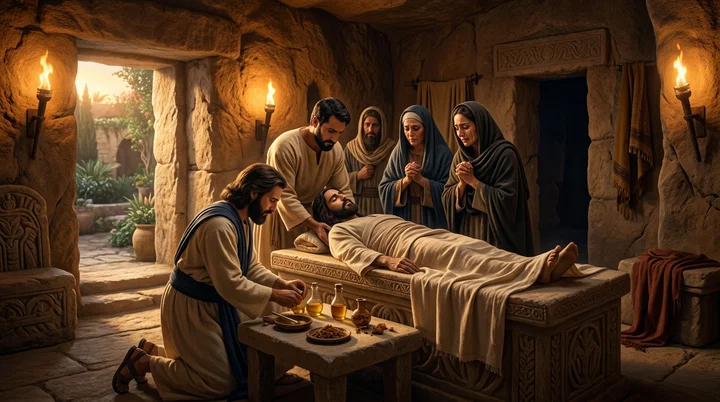
Joseph was of Arimathea, a rich, honorable and influential member of the Jewish council, described as good and just and acquainted with Pilate.Ms 111, 1897, par. 59–62SG1 64.1EW 148.2 He was a true believer in Jesus who waited for the kingdom of God, yet while Jesus lived he kept his discipleship secret with Nicodemus for fear of the Jews, lest he lose his place and power that might aid and protect Jesus in the councils.Ms 111, 1897, par. 59–6212MR 418.2–419.1SG1 64.1ST Aug 1, 1878ST Aug 1, 1878 His refusal to consent means he did not agree to the plan, arrest and condemnation of Jesus, but repeatedly exposed the fallacy of the charges and protested, for a time helping to prevent condemnation which required unanimous consent.Ms 111, 1897, par. 59–6212MR 418.2–419.1EW 148.2 The priests set that protection aside by calling a secret council to plan Jesus’ death to which he and Nicodemus were not summoned, so he had no part in condemning Him though present at the crucifixion without power to change the sentence.Ms 111, 1897, par. 59–62ST Aug 1, 1878DA 773.3–43SP 175.1–2 After Jesus was slain, when the acknowledged disciples were too fearful to act openly, he no longer hid his attachment but boldly obtained the body from Pilate by official order, and with Nicodemus gave it an honored burial in his own new tomb with about one hundred pounds of myrrh and aloes, saving it from a dishonored grave with criminals and fulfilling what the Scriptures had foretold of the Messiah.Ms 111, 1897, par. 59–6212MR 418.2–419.1SG1 64.1EW 148.2
Joseph's Standing and Faith
Joseph was of Arimathea, a member of the Jewish council or Sanhedrin, described as a counsellor who was good and just, honorable, rich, and influential in position.Ms 111, 1897, par. 59–62SG1 64.1EW 148.2ST Aug 1, 1878DA 772.4–773.1 He was a wealthy and influential ruler, one of two such councilors with Nicodemus, and was acquainted with Pilate, with his riches giving him influence with the governor.Ms 111, 1897, par. 59–62ST Aug 1, 1878DA 772.4–773.1COS 166.3–5ST Aug 1, 1878 His wealth, honor, and influential standing were greatly needed after Jesus was slain, enabling what was impossible for the poorer disciples to do.ST Aug 1, 1878DA 772.4–773.1COS 166.3–5
He was a true disciple and believer in Jesus who himself waited for the kingdom of God.Ms 111, 1897, par. 59–6212MR 418.2–419.1SG1 64.1EW 148.25RED 94.3–95.1 Yet while Jesus lived he did not openly identify himself with Him or attach himself to Him, but acted privately.Ms 111, 1897, par. 59–62SG1 64.1EW 148.2ST Aug 1, 1878DA 773.3–4 The reason was fear of the Jews, their hatred, hostility, and prejudice toward Jesus.Ms 111, 1897, par. 59–62SG1 64.1EW 148.2ST Aug 1, 1878
He kept his faith secret together with Nicodemus, the other wealthy and influential councilor and fellow member of the Sanhedrin.ST Aug 1, 1878ST Aug 1, 1878DA 773.3–4ST Aug 1, 1878 Open acceptance would have excluded them from the Sanhedrin and cut them off from place, power, and all power to aid and protect Jesus by influence in its councils.ST Aug 1, 1878DA 773.3–43SP 175.1–25RED 94.3–95.1 They therefore hoped instead to protect Him by their influence in its councils, avoiding exclusion on account of the prejudice of the priests and elders.ST Aug 1, 1878DA 773.3–43SP 175.1–2
Dissent and Honorable Burial
Joseph had not agreed to the counsel, plan, decision, arrest and condemnation of Jesus by the priests and rulers.Ms 111, 1897, par. 59–6212MR 418.2–419.1EW 148.2DA 772.4–773.1DA 773.3–4 He several times exposed the fallacy of the grounds brought for condemnation and protested against arrest, so that the council broke up without accomplishing what it had been called together to do.ST Aug 1, 18783SP 175.1–2 For a time he thus helped prevent condemnation, since condemnation was impossible without unanimous consent of the Sanhedrin.ST Aug 1, 1878DA 773.3–4
The priests saw his favor to Christ and thwarted his protection by calling a secret council to plan Jesus' death to which Joseph and Nicodemus were not summoned.ST Aug 1, 1878DA 773.3–43SP 175.1–2DA 538.3–539.1 In his absence Jesus was condemned and delivered to be crucified, so Joseph had no part in condemning Him.DA 773.3–45RED 69.13SP 149.1 He was present at the crucifixion but was unable to change or soften the terrible sentence.5RED 69.13SP 149.1
After Jesus was slain, when the acknowledged disciples were too disheartened, intimidated and fearful to show themselves openly as His followers, Joseph no longer concealed his attachment but came boldly forth to Pilate with Nicodemus to the aid of the disciples.Ms 111, 1897, par. 59–62SG1 64.1EW 148.2ST Aug 1, 1878DA 773.3–4 He was a rich man, which gave him influence with the governor, and by his wealth, honor and influential standing he obtained an official order and commission that the body should be given to him.Ms 111, 1897, par. 59–62ST Aug 1, 1878DA 772.4–773.1 John was anxious and troubled about the sacred remains of his Master while Joseph returned with the governor's commission to receive it.ST Aug 1, 1878
With Nicodemus he thus secured an honored burial in his own new tomb, and in death Jesus was shown as much respect as the most honored in Jerusalem could have been shown.SG1 64.1EW 148.2ST Aug 1, 1878DA 772.4–773.1 Nicodemus, anticipating that Joseph's request would be granted, brought a costly mixture of myrrh and aloes of about one hundred pounds weight.ST Aug 1, 1878 His prompt action kept the Saviour's body from being taken down by common soldiers and placed with the bodies of the thieves in a dishonored grave or in the burial ground for criminals executed for opposition to Roman rule.Ms 111, 1897, par. 59–62 Their wealth, honor and influential standing supplied for His burial what the poor disciples could not do and in great measure protected them from censure, remonstrance and malice of the priests and rulers.ST Aug 1, 1878DA 773.3–4 The verse stands among the evidence that the Scriptures concerning the Messiah had been fulfilled.12MR 418.2–419.1
Sources
Pioneers and periodicals
34 sources
Joseph of Arimathaea was a good and righteous man of wealth, honor and influential standing as a member of the Jewish council, who had not consented to its counsel and deed in condemning Jesus to death, and who himself waited for the kingdom of God.ST Aug 1, 1878ST Dec 3, 1894ST Mar 20, 1901ST Sep 20, 1899ST Apr 8, 1903 His refusal meant protesting the arrest and showing the fallacy of the grounds of condemnation, so that condemnation was impossible without unanimous consent until the priests gained their object by a secret council to which he and Nicodemus were not summoned, yet withholding his vote was right even though Jesus was destined to die.ST Aug 1, 1878RH Apr 18, 1871ST May 27, 1897 In the darkest hour he went boldly to Pilate to beg the body of Jesus and obtained the official order for it, and then with Nicodemus and a few friends gave Him an honorable burial in his own new rock-hewn tomb instead of an ignominious burial with criminals, sparing no cost in linen and spices.ST Aug 1, 1878ST Aug 1, 1878ST Aug 17, 1904ST Feb 1, 1899 The burial was hurried on Friday the preparation day as the Sabbath drew on, and the women who saw it rested the Sabbath day according to the commandment before coming on the first day to anoint Him, proving the seventh day is the true Sabbath and the first day is the day after it.ST Apr 21, 1914ST Sep 20, 1899ST Aug 17, 1904ST May 11, 1904ST Jan 24, 1884 Having finished the work of redemption in dying, He rested the Sabbath in the tomb in harmony with His disciples, forever linking the Sabbath with redemption as with creation, while Joseph's bold and loving fidelity when acknowledged disciples drew back stands worthy of imitation and remembrance at Christ's return.ST Aug 1, 1878RH Jul 1, 1902ST May 13, 1908
Joseph's Identity and Standing
Luke 23:51 identifies Joseph as from Arimathaea, a city of the Jews, and describes him as a good and righteous man of honorable standing who was a member of the council, the Sanhedrin.ST Mar 20, 1901ST Sep 20, 1899ST Mar 20, 1901 He is the man from Arimathaea who did not agree with the council's counsel, decision, plan and deed against Jesus, and who himself waited for the kingdom of God.ST Dec 3, 1894ST Mar 20, 1901ST Sep 20, 1899ST Aug 17, 1904ST Sep 23, 1913 In the account of Jesus' burial the verse helps locate the events on the preparation day before the Sabbath, when Joseph asked Pilate for Jesus' body and laid it in a tomb, without calling the first day a Sabbath or describing a change in Sabbath observance.ST Sep 20, 1899ST Aug 17, 1904
He was a rich and honored councilor of wealth, honor, and influential standing, acquainted with Pilate and having great influence with him.ST Aug 1, 1878ST Aug 1, 1878RH Oct 29, 1914 He was one of two such councilors together with Nicodemus, who was also a member of the Sanhedrin and a man of wealth and influence.ST Aug 1, 1878ST Aug 1, 1878 As a wealthy man of Jesus' own nation he joined his other wealthy friend in asking the governor for Jesus' body, and their wealth, honor, and influential standing were greatly needed to do for Jesus what was impossible for the poorer disciples to do while protecting them in great measure from censure and remonstrance.ST Aug 1, 1878ST Apr 8, 1903 Joseph as a wealthy ruler of Israel stepped out boldly in the darkest hour for Christ's followers, and with a few near friends was moved to brave public sentiment to spare Jesus an ignominious burial with criminals and give Him honorable burial, possibly obtaining the body from Pilate with money which Pilate readily granted.ST Feb 1, 1899RH Oct 29, 1914
He was the owner of his own new tomb cut out of rock a short distance away that had never been used and never before been used, where Jesus was laid.ST Apr 8, 1903ST Feb 1, 1899RH Oct 29, 1914 After Jesus was taken down from the cross He was buried in Joseph's new tomb, which was closed with a great stone, so that Joseph is identified as the councilor whose sepulcher held Jesus after the crucifixion and as the owner of the new tomb where Jesus was buried who loved Him even to death.ST Nov 15, 1910 With the help of Nicodemus he buried the body there at the moment when the whole typical system that had pointed forward to the cross expired with Christ.
Dissent from Council Decision
Joseph had not consented to or agreed with the counsel and deed, the decision and actions, of the others in condemning Jesus and conspiring to put Him to death.ST Dec 3, 1894ST Mar 20, 1901ST Sep 20, 1899ST Aug 17, 1904ST Sep 23, 1913 He was a good and righteous man who withheld agreement from the council's plan against Jesus.ST Dec 3, 1894ST Mar 20, 1901ST Sep 20, 1899ST Aug 17, 1904ST Mar 20, 1901
His refusal meant several times showing the fallacy of the grounds of condemnation and protesting against arrest.ST Aug 1, 1878ST May 27, 1897 Because condemnation was impossible without unanimous consent of the Sanhedrin, the council broke up without accomplishing what it had been called together to do.ST Aug 1, 1878 The priests finally obtained their object by calling a secret council to which Joseph and Nicodemus were not summoned.ST Aug 1, 1878
Withholding his vote, or voting against the decision, was right even though Jesus' death was destined to occur.RH Apr 18, 1871 He was a disciple who had kept his faith secret together with Nicodemus to avoid exclusion from the council and loss of place, power, and influence to aid and protect Jesus.ST Aug 1, 1878RH Jul 1, 1902ST May 27, 1897 They had not openly attached themselves to the Saviour while He lived and had not openly joined His followers, because of the prejudice of the priests and elders toward Jesus and from fear of losing place and influence on the council, which would have cut them off from all power to aid and protect Him by influence in the council.ST Aug 1, 1878ST May 27, 1897 Christ's suffering and death did not weaken his faith but strengthened it, and he remained faithful.RH Jul 1, 1902
Waiting for God's Kingdom
Joseph himself waited for the kingdom of God.ST Dec 3, 1894ST Mar 20, 1901ST Sep 20, 1899ST Aug 17, 1904ST Mar 20, 1901 He is identified as Joseph of Arimathea and of Arimathaea, a good and righteous man and a member of the council who had not agreed with its counsel, decision, plan and deed against Jesus.ST Dec 3, 1894ST Mar 20, 1901ST Sep 20, 1899ST Aug 17, 1904ST Mar 20, 1901 His waiting belongs to the account surrounding Jesus' death and burial, in which he asks Pilate for Jesus' body and lays it in a tomb on the preparation day before the Sabbath, which marks the sealing of the new covenant by His blood.ST Sep 20, 1899ST Aug 17, 1904ST Sep 23, 1913 The record of the women resting on the Sabbath and returning to the tomb on the first day locates these burial events without calling the first day a Sabbath or describing a change in Sabbath observance.ST Sep 20, 1899
His waiting places him among the people of God who waited for the coming of the Redeemer.ST Dec 13, 1883 That waiting belonged to the earnest, agonizing prayers of the church of God before Christ came.ST Dec 13, 1883 Those prayers before Christ came are signified by the travail of the woman clothed with the sun.ST Dec 13, 1883
Burial of Jesus
After Jesus died Joseph went boldly to Pilate in the darkest hour for Christ's cause to beg and ask for Jesus' body.ST Aug 17, 1904RH Oct 29, 1914 He obtained an official order and commission from the governor that it should be given to him, and returned with that commission to receive it while John was anxious and troubled about the sacred remains of his Master.ST Aug 1, 1878RH Oct 29, 1914 Such release at the request of friends was customary under Roman rule unless the executed person was infamous.RH Feb 11, 1862 Some held that the body was obtained possibly with money.ST Feb 1, 1899
Nicodemus, anticipating that the grant would be made, brought a costly mixture of myrrh and aloes of about one hundred pounds weight.ST Aug 1, 1878 With Joseph and a few near friends he with tender, loving hands took Jesus from the cross and cared for the body.ST Mar 16, 1904ST Feb 1, 1899RH Oct 29, 1914 The nails were gently removed from the hands, the cruel cords and bands loosened, the mangled body straightened, the rough crown taken from the pale bleeding temple, the dark stains washed from the sacred head and the wounds bathed with tearful weeping, the hands that had healed human woe folded tenderly over the loving, pulseless, still heart and bosom, and the form wrapped in soft pure linen and tenderly borne from Calvary's hill to rest in the tomb, because the heavenly Watcher waits to call Him to life from the tomb.ST Aug 1, 1878ST Feb 1, 1899RH Oct 29, 1914
They were determined that the body should have an honorable burial and not be taken down by common soldiers.ST Aug 1, 1878 In this they spared Him the ignominious burial given to Jewish criminals in the Valley of Hinnom among the unclean dust heaps and ashes outside the common burial place, and the design to make His grave with the wicked by casting Him out without burial with criminals.ST Feb 1, 1899RH Oct 29, 1914 Their wealth, honor, and influential standing were greatly needed at that time, enabling them to do for Jesus what was impossible for the poorer disciples to do and protecting them in great measure from censure and remonstrance.ST Aug 1, 1878 So in death He was shown as much respect as the most honored in Jerusalem could have been shown, and although poor in life He was laid in the tomb of the wealthy ruler with no greater honor that could have been shown to the dead.ST Aug 1, 1878RH Oct 29, 1914
The burial was hurried because the shadows of the Sabbath were drawing on, and He was laid in the tomb before the Sabbath began.ST Mar 16, 1904ST Feb 1, 1899 After He was taken down from the cross He was buried in Joseph's new tomb, which was closed with a great stone, and mourners lingered at the tomb until Sabbath requirements drew them home.ST Feb 1, 1899ST Nov 15, 1910 There He was left to sleep through God's appointed rest after winning for the world the way into eternal joy.ST Feb 1, 1899 Yet the grave could not hold Him because He was the Son of God, and He rose and went to heaven in a cloud.RH Dec 5, 1865
Sabbath Timing and Witness
Luke 23:51 stands in the record that proves Christ was crucified on Friday, the sixth day of the week, the preparation day before the Sabbath.ST Apr 21, 1914ST Aug 17, 1904 In the afternoon of that day His body was taken to the tomb as the Sabbath drew on, with the close of the day marked by sunset, in the sight of the women disciples who followed.ST Apr 21, 1914 Joseph asked Pilate for the body and laid it in a tomb, and the surrounding events locate that burial on the preparation day before the Sabbath.ST Aug 17, 1904 In that setting the day called the Sabbath in the New Testament is the day enjoined in the fourth commandment, succeeded by the first day of the week as one week follows another, without calling the first day a Sabbath or describing any change in Sabbath observance.ST Sep 20, 1899ST Jan 24, 1884
The remaining moments of Friday left time on the way home to buy sweet spices and to prepare spices and ointments, but not to perform the anointing without trespassing on the sacred hours of the Sabbath.ST Apr 21, 1914 Rather than violate God's holy law, the women rested the Sabbath day according to the commandment, which is the fourth of the Decalogue specifying that the seventh day of each week is the Sabbath of Jehovah.ST Apr 21, 1914ST Oct 15, 1902 The work of preparing the body could not be done then, so it was deferred until the next convenient day, Sunday.RH Aug 1, 1912ST Jan 31, 1911 They came very early on the first day of the week expecting to anoint Him and found the stone rolled away and Jesus risen.ST Apr 21, 1914
The sequence proves that the preparation was the day before the Sabbath and the first day of the week was the day after the Sabbath, so Saturday is the right Sabbath and Sunday is the day after it.ST May 11, 1904ST Jun 3, 1908 The account identifies the Sabbath according to the commandment as the day before the first day of the week.ST Sep 20, 1899ST Jun 3, 1908 Jesus' most intimate earthly associates gave the seventh-day Sabbath the same careful regard He gave it, refraining on the seventh day from anointing His body though they felt free to do that manual labor on the first day.ST Apr 21, 1914RH Aug 1, 1912ST Jan 31, 1911 That the account never calls the first day a Sabbath nor describes a change, while they performed that work on the first day but not on the seventh, proves the seventh-day Sabbath had not disappeared.ST Sep 20, 1899RH Aug 1, 1912
The Sabbath then observed was the true seventh day in true succession from Creation, because Christ its Author kept it with the Jews in the flesh and would have corrected any wrong reckoning.ST Feb 1, 1905 The reckoning of Jews, Christians, and other peoples agrees from the cross to the present, with the first day and the seventh traveling side by side ever since, so the identity of the seventh day between the crucifixion and the present has not been lost.ST Feb 1, 1905 The burial in the councilor's new tomb that held Jesus after the crucifixion is also described as on the Sabbath following the day of the crucifixion, at the coming of the midst of the week.ST Jan 31, 1911
Redemption Covenant and Example
The death that surrounds the man from Arimathaea marks the sealing of the new covenant by blood.ST Sep 23, 1913 At that same moment the whole typical system that had pointed forward to the cross expired with Christ, as Joseph went to Pilate after Jesus died to beg the body and with Nicodemus laid it in his own new tomb.
Having finished the plan of redemption in dying, Christ's body was placed in Joseph's new tomb where it rested the Sabbath day from the work of redemption.ST May 13, 1908 The disciples who saw how the body was laid returned and prepared spices and rested in their homes on the Sabbath day according to the commandment, so that God, Christ, angels, and disciples were in harmony in keeping the Sabbath.ST May 13, 1908 This rest links the Sabbath ever after with redemption as with creation.ST May 13, 1908 There was grief on earth but joy in heaven, because Satan's fate was sealed and a restored creation and the salvation of a redeemed race were eternally secured.ST May 13, 1908
Joseph had not consented to the counsel and deed of those who conspired to put Jesus to death, but remained a faithful disciple waiting for the kingdom of God whose faith was strengthened rather than weakened by Christ's suffering and death.RH Jul 1, 1902 He and Nicodemus had believed but had kept faith secret as members of the Sanhedrin for fear of losing place and influence, and had protested the arrest and condemnation.ST May 27, 1897 When the acknowledged disciples were too disheartened and intimidated to show themselves openly, Joseph with the other councilor came boldly forth to their aid and acted his noble part for the slain Saviour.ST Aug 1, 1878 As rich and honored councilors of influential standing they could do for Jesus what was impossible for the poorer disciples, and their wealth, honor, and standing protected them in great measure from censure.ST Aug 1, 1878 In the darkest hour for Christ's cause Joseph went boldly to Pilate to ask for the body as a man of honorable standing waiting for the kingdom of God, and it was laid in his rock-hewn tomb.ST Mar 12, 1894 He was one who loved Jesus even to death and owned the new tomb where Jesus was buried. He honored Jesus in death by helping take the body from the cross and lay it in the tomb, and this loving service will be remembered when Christ returns in glory.RH Oct 4, 1870 His course of clear faith, bold conviction, and fidelity despite fear of men and concern for reputation is worthy of imitation, like the honor shown at Stephen's burial.RH Jul 1, 1902
Sources