Translations
American King James Version, King James Version, KJV Cambridge Paragraph Bible, Webster Bible
And that day was the preparation, and the sabbath drew on.
Revised Version, American Standard Version
And it was the day of the Preparation, and the sabbath drew on.
And the day was a preparation, and sabbath was approaching,
And it was preparation day, and [ the] sabbath twilight was coming on.
And it was a day of preparation, and, a Sabbath, was about to dawn.
Berean Standard Bible, Majority Standard Bible
It was Preparation Day, and the Sabbath was beginning.
It was the day of the Preparation, and the Sabbath was drawing near.
Now it was the day of making ready and the Sabbath was coming on.
And that day was the preparation, and the Sabbath drewe on.
Douay-Rheims (Challoner revision)
And it was the day of the Parasceve, and the sabbath drew on.
Pictures
Cross-references 20 of 43
- Exodus 20:8-11
Remember the sabbath day, to keep it holy.
The commandment identifies the Sabbath as the seventh day and grounds it in God’s rest.
- Luke 24:1
Now upon the first day of the week, very early in the morning, they came unto the sepulchre, bringing the spices which they had prepared, and certain others with them.
The women return with spices on the first day after the Sabbath.
- Matthew 28:1
In the end of the sabbath, as it began to dawn toward the first day of the week, came Mary Magdalene and the other Mary to see the sepulchre.
Places the tomb visit on the first day after the Sabbath.
- Mark 16:1-2
And when the sabbath was past, Mary Magdalene, and Mary the mother of James, and Salome, had bought sweet spices, that they might come and anoint him.
The women come to the tomb after the Sabbath, early on the first day of the week.
- Genesis 2:2-3
And on the seventh day God ended his work which he had made; and he rested on the seventh day from all his work which he had made.
Christ’s rest in the tomb echoes God’s rest after creation.
- Mark 15:42
And now when the even was come, because it was the preparation, that is, the day before the sabbath,
Identifies the day of Jesus’ burial as preparation day, the day before the Sabbath.
- John 19:31
The Jews therefore, because it was the preparation, that the bodies should not remain upon the cross on the sabbath day, ( for that sabbath day was an high day,) besought Pilate that their legs might be broken, and that they might be taken away.
Identifies the approaching Sabbath as a high day on Jesus’ preparation day.
- John 20:1
The first day of the week cometh Mary Magdalene early, when it was yet dark, unto the sepulchre, and seeth the stone taken away from the sepulchre.
Mary finds the tomb empty early on the first day of the week.
- John 19:42
There laid they Jesus therefore because of the Jews’ preparation day; for the sepulchre was nigh at hand.
Jesus was buried before the Sabbath because the preparation day was near.
- Matthew 27:62
Now the next day, that followed the day of the preparation, the chief priests and Pharisees came together unto Pilate,
Identifies the day after the preparation as the Sabbath, when the leaders secured the tomb.
- Exodus 16:22-23
And it came to pass, that on the sixth day they gathered twice as much bread, two omers for one man: and all the rulers of the congregation came and told Moses.
Identifies the preparation day as the sixth day before the Sabbath.
- Exodus 16:5
And it shall come to pass, that on the sixth day they shall prepare that which they bring in; and it shall be twice as much as they gather daily.
Israel was instructed to prepare extra food on the sixth day before the Sabbath.
- Exodus 31:15-17
Six days may work be done; but in the seventh is the sabbath of rest, holy to the LORD: whosoever doeth any work in the sabbath day, he shall surely be put to death.
Both identify the seventh day as the Sabbath and describe its covenant significance.
- Leviticus 23:6-7
And on the fifteenth day of the same month is the feast of unleavened bread unto the LORD: seven days ye must eat unleavened bread.
dates fifteenth as Passover sabbath before it
- John 19:14
And it was the preparation of the passover, and about the sixth hour: and he saith unto the Jews, Behold your King!
Both identify the crucifixion day as the preparation before the Sabbath during Passover week.
- Matthew 27:57-61
When the even was come, there came a rich man of Arimathæa, named Joseph, who also himself was Jesus’ disciple:
Describes Jesus’ burial before the Sabbath and the women watching the tomb.
- John 19:30
When Jesus therefore had received the vinegar, he said, It is finished: and he bowed his head, and gave up the ghost.
Christ finished His work before resting on the Sabbath.
- Matthew 27:63-66
Saying, Sir, we remember that that deceiver said, while he was yet alive, After three days I will rise again.
The authorities secure Jesus’ tomb on the Sabbath after his burial.
- Leviticus 23:32
It shall be unto you a sabbath of rest, and ye shall afflict your souls: in the ninth day of the month at even, from even unto even, shall ye celebrate your sabbath.
defines Sabbath from evening to evening
- 1 Corinthians 15:4
And that he was buried, and that he rose again the third day according to the scriptures:
States that Christ rose on the third day.
Commentary
Each commentary is drawn from primary sources: the writings of Ellen G. White and Adventist pioneers and periodicals. Each commentary is separate. Its own words are not a quotation; follow the references to read the source passages.
Ellen G. White
6 sources
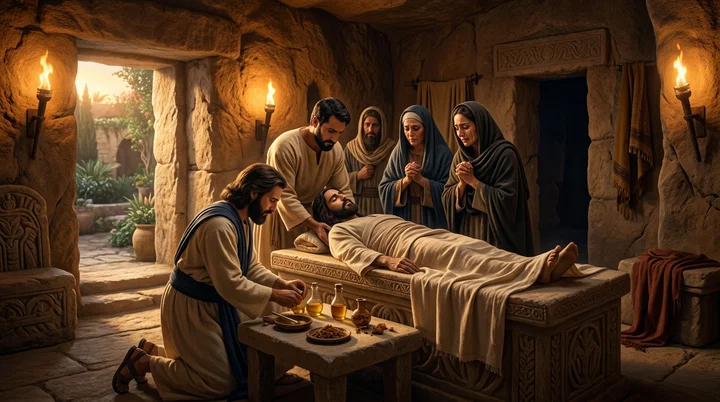
The day was the preparation day, the day before the Sabbath, and Jesus was buried as evening came and the Sabbath was about to begin.Ms 111, 1897, par. 63–643SP 176.1ST Aug 22, 18783SP 186.3–187.15RED 95.2 Because the Sabbath was near He was placed hastily in the tomb, so that His disciples could keep the day according to the commandment.3SP 186.3–187.1 He was laid before the Sabbath began in a new tomb, Joseph's tomb.3SP 186.3–187.15RED 95.2
The women then observed the Sabbath according to the commandment.Ms 111, 1897, par. 63–643SP 186.3–187.1 The women who had followed Jesus saw Him laid in the tomb and stayed near it there in sorrow.3SP 176.15RED 95.2 The two Marys were the last at the sepulcher.3SP 186.3–187.1 The women prepared spices before the Sabbath and went to the tomb early on the first day of the week to anoint His body.ST Aug 22, 1878
That Sabbath fell during the Passover observance, while Jesus, the antitypical Lamb prefigured by the Passover, lay slain in the tomb.3SP 186.3–187.1 The timing calls for beginning Sabbath preparations on Friday morning.Lt 5a, 1865, par. 2 All work is to be finished one hour before sundown, so one is ready for Sabbath reading.Lt 5a, 1865, par. 2
Sources
Pioneers and periodicals
84 sources
That day was the sixth day of the week, Friday, and as it ended at sunset the seventh-day Sabbath, Saturday, was beginning.ST Dec 3, 1894ST Apr 21, 1914RH Aug 14, 1868ST May 1, 1884ST Mar 24, 1887 Jesus had been crucified and was laid in the tomb in haste before that Sabbath began, and the women who saw the burial stopped their work, rested on the Sabbath, and came to the tomb early on the first day of the week, Sunday, when He rose.ST Jan 17, 1911RH Jan 1851ST Jul 11, 1916RH Dec 24, 1861ST Oct 20, 1914 That Sabbath is the same seventh day blessed at creation and enjoined in the fourth commandment as part of the perpetual moral law, not a ceremonial sabbath that expired at the cross.ST Jan 17, 1911RH Apr 7, 1851ST Sep 16, 1880ST Sep 20, 1899RH Mar 1, 1864 His followers rested on that Sabbath according to the commandment even to leave His anointing unfinished, proving the Sabbath remained authoritative and binding after the cross, and Luke still calls it the Sabbath nearly thirty years afterward while calling Sunday only the first day of the week.RH Apr 7, 1851ST Aug 22, 1916ST Sep 20, 1899 No change to Sunday had occurred, and the order of preparation day, Sabbath, and first day shows the weekly cycle was preserved and correctly known.ST Aug 22, 1916ST Nov 14, 1878ST Jun 3, 1908 Having finished His work of redemption on the sixth day, Christ rested in the tomb through the seventh day as God rested after creation, making the Sabbath a memorial of both creation and redemption.RH Jan 24, 1907RH Aug 13, 1857ST May 13, 1908RH Mar 21, 1865
Language and Time Reckoning
The expression for drawing on rests on a word that literally means to grow light, used here in a Jewish idiom for the commencement of the day rather than for daylight approaching.ST Aug 12, 1880ST Mar 27, 1879RH Jan 24, 1871 In that figurative sense it marks the beginning of the Sabbath as the preparation day ended.ST Aug 12, 1880RH Feb 13, 1866ST Mar 27, 1879
By Bible reckoning the day begins and ends at sunset, so the Sabbath drew on at sunset as the preparation day closed, beginning Friday evening.ST Apr 21, 1914ST Apr 2, 1912RH Nov 15, 1906 That day is identified as the day of burial, when time was too short to prepare spices without working during sacred hours.ST Apr 21, 1914RH Mar 1, 1906ST Apr 2, 1912 It was the sixth day of the week immediately before the Sabbath, fixing beyond error the order of the three days as preparation, Sabbath, and first day of the week.ST May 1, 1884ST Apr 2, 1912 The Sabbath approaching was the seventh-day Sabbath enjoined in the fourth commandment and identified with the creation Sabbath, the only weekly Sabbath ever given, with the first day following it.ST May 1, 1884ST Apr 2, 1912 The crucifixion day was the fifteenth of Nisan, the first festival Sabbath of Passover, which that year fell on Friday as preparation for the weekly Sabbath of the Lord, with Christ taken down about the time the wave sheaf was cut as the firstfruit.RH Mar 1, 1906ST Apr 2, 1912RH Nov 15, 1906
The preparation day is the sixth day of the week, Friday, the day immediately before the Sabbath in the sequence of burial and resurrection.ST Dec 3, 1894RH Aug 14, 1868ST Mar 24, 1887ST Apr 21, 1914ST Mar 16, 1915 It was called the preparation because food and other things were made ready on it for the coming Sabbath, after which the followers rested according to the commandment.RH Aug 14, 1868RH Oct 14, 1915ST Mar 16, 1915 Saturday itself is not the preparation day but the Sabbath that follows it, distinct from it in the distinction between preparation day, Sabbath, and first day of the week.RH Aug 14, 1868ST Apr 21, 1914RH Oct 14, 1915
The preparation named is for the weekly seventh-day Sabbath about to begin, not for the Passover as such, since the Passover preparation had already been made before the Passover was eaten.ST Oct 7, 1930RH Jun 24, 1873ST Jul 11, 1911 It is also called the preparation of the Passover because it fell in Passover week when the paschal lamb had to be prepared and eaten, with necessary food still permitted to be prepared on the feast day so that its observance did not prevent it from being preparation for the weekly Sabbath.RH Jun 24, 1873RH Feb 5, 1914RH Jun 24, 1873 That year the weekly Sabbath coincided with the Passover Sabbath, making that Sabbath a high day, with the crucifixion on Friday the sixth day and the Passover eaten the day before on Thursday as the first day of unleavened bread when the sheaf of firstfruits was waved.ST Oct 7, 1930RH Jun 24, 1873RH Jun 24, 1873ST Apr 26, 1905ST Jul 11, 1911
Burial Setting and Sequence
Jesus was crucified, taken down, and laid in the tomb on the preparation day, with the burial done in haste before the Sabbath began at its close.RH Jan 1851ST Oct 20, 1914ST Aug 17, 1904ST Sep 12, 1900 That day was the day before the Sabbath kept according to the commandment, and the Sabbath followed the crucifixion.RH Jan 1851ST Aug 17, 1904ST Dec 10, 1902 Those who had secured permission from Pilate prepared the body and placed it in a tomb because the Sabbath was drawing on, and the women rested on it according to the commandment.RH Jan 1851ST Oct 20, 1914ST Sep 12, 1900ST Dec 10, 1902 He had eaten the Passover with His disciples the night before being crucified the preceding day and buried on the preparation day.
The women from Galilee who followed Jesus saw where His body was laid and where He was buried on the preparation day as the Sabbath drew near.ST Jan 17, 1911ST Apr 29, 1913STST Jul 11, 1916 They returned and prepared spices and ointments, and in one account bought sweet spices on the way home, then stopped that work because the Sabbath drew on.ST Jan 17, 1911ST Apr 29, 1913RH Dec 24, 1861 They regarded anointing His body as work impermissible on the Sabbath and treated that day as too sacred for it, so they rested on the Sabbath according to the commandment.ST Apr 29, 1913STRH Dec 24, 1861 Then they came to the tomb very early in the morning on the first day of the week to anoint Him, finding the stone rolled away.STST Jul 11, 1916RH Dec 24, 1861
Joseph of Arimathea asked Pilate for the body and procured it, and with Nicodemus and a few near friends tenderly bore Jesus to Joseph's nearby new tomb cut out of rock that had never been used.ST Feb 1, 1899RH Dec 5, 1865 This decent burial spared Him the ignominious burial of Jewish criminals in the Valley of Hinnom among the unclean dust heaps and ashes, and it was hurried because the deepening shadows of the Sabbath were drawing on.ST Feb 1, 1899 Some lingered as mourners before the tomb until Sabbath requirements drew them to their homes, reluctantly leaving Jesus to sleep through God's appointed rest.ST Feb 1, 1899 The very same Jesus the Jews crucified was begged by Joseph and laid in the tomb, and that burial account is chanted during a Saturday-night Easter ceremony that continues until the announcement of the resurrection at midnight.RH Dec 5, 1865 The chief priests in hatred were willing to profane that Sabbath to obtain a guard and secure the tomb, in contrast to the women's reverence and longing delayed by Sabbath observance.RH Aug 12, 1875 The visit of the chief priests to Pilate to ask for a guard took place on that weekly seventh-day Sabbath of the commandment, not a merely ceremonial sabbath.RH Aug 12, 1875 The verse does not state that the burial itself was at sunset, for if He was laid in the tomb at sunset on the sixth day the Sabbath had already begun so nothing could have been done afterward to prepare spices before it.ST Mar 15, 1883
Identity of the Sabbath
The Sabbath that drew on was the seventh day of the week, Saturday, coming immediately after the preparation day of burial and immediately before the first day of the week, Sunday, when the women came to the tomb and Jesus rose.ST Jul 11, 1916RH Dec 24, 1861ST Sep 16, 1880ST May 24, 1883ST Oct 22, 1902 The burial day was the preparation, the next day was the Sabbath on which the women rested according to the commandment, and the following day was the first day of the week, which places the Sabbath on the seventh day.RH Dec 24, 1861ST Sep 16, 1880ST Sep 2, 1889 That order shows the day the followers kept after the crucifixion was Saturday, and the commandment requiring its observance remained in force.ST May 24, 1883ST Oct 22, 1902ST Sep 2, 1889 It is the inspired name of the seventh day in the Christian dispensation, the seventh day of the fourth commandment and of the New Testament week.ST Jul 11, 1916RH Dec 24, 1861
That Sabbath is the same day Christ blessed and sanctified at creation, kept by the disciples in their return to prepare spices before their rest.ST Jan 17, 1911RH Apr 7, 1851ST Sep 20, 1883 It is enjoined in the fourth commandment which says the seventh day is the Sabbath of the Lord, proved by the women resting the Sabbath day according to the commandment after the burial and coming again to the sepulchre the very next day, which was the first day of the week.RH Dec 24, 1861ST Jan 15, 1885ST Feb 10, 1898ST Sep 20, 1883 It belongs to the perpetual moral Decalogue given before sin and before types, not to the sacrifices that ended at the cross, and not to a ceremonial, festival, or land sabbath that expired at the cross.ST Jan 17, 1911RH Apr 7, 1851ST Jan 15, 1885 It is the same day upon which God rested and which He blessed and hallowed, to be kept holy by resting upon it, so that keeping any other day, however strictly, does not fulfill it, and the record still calls Sunday simply the first day of the week with no sacred title as an ordinary working day.ST Sep 20, 1899ST Feb 10, 1898ST Sep 20, 1883
The sequence of preparation, Sabbath, and first day shows the Sabbath had not been lost or shifted, but was the commandment's Sabbath, the day on which God rested, and the day of the week was correctly known at that time.RH Jun 11, 1872 The New Testament week follows the same sequence as the Old Testament week, with the Sabbath according to the commandment coming just before the first day of the week, and the weekly count preserved from Christ's time.ST Jun 3, 1908ST May 25, 1915 Calendar changes affect the dates of the month and year, not the weekly cycle, so they do not alter which day is the Sabbath.ST Jun 3, 1908 Its identity at the crucifixion is certain, with no time lost between its institution at creation, its confirmation in the commandment and manna miracles, and the crucifixion, and with Jesus observing it in the customary places of worship confirming that the seventh day kept in His time was the true Sabbath from creation.ST May 25, 1915ST Feb 1, 1905
That Sabbath was also a high day, either because the Passover Sabbath on Nisan 15 coincided with the weekly Sabbath, or because the weekly Sabbath fell on Nisan 16 when the wave sheaf of firstfruits was offered.RH Mar 1, 1906RH Feb 12, 1914 Jesus was buried Friday afternoon and remained in the tomb through the Sabbath, the sixteenth day of Abib, and rose early Sunday, the seventeenth day, counting part of Friday as the first day and part of Sunday as the third.ST Mar 11, 1886RH Feb 12, 1914RH Feb 12, 1914 The weekly Sabbath drew on at sunset as Christ was taken down from the cross, about the time the wave sheaf was cut, showing Christ as the firstfruit, when the crucifixion day was the fifteenth of Nisan, the first festival sabbath of the Passover, falling that year on Friday the preparation for the weekly Sabbath.RH Mar 1, 1906RH Feb 12, 1914ST Jul 11, 1911 The sixteenth day always followed the first Passover sabbath on the fifteenth, and in the year of the crucifixion the wave sheaf was presented on the weekly seventh-day Sabbath, with the count toward Pentecost beginning on the sixteenth so that Pentecost that year fell on the seventh-day Sabbath.ST Mar 11, 1886RH Feb 12, 1914ST Jul 11, 1911
Sabbath After the Cross
Christ's followers, including the holy women and the founders of the Christian church, rested on that Sabbath according to the commandment after seeing where His body was laid on the preparation day.RH Apr 7, 1851ST Oct 22, 1902 They stopped preparing spices and ointments even though embalming Jesus remained unfinished and anointing Him would have seemed a commendable Sabbath work.ST Aug 22, 1916ST Oct 22, 1902ST Sep 20, 1899 Their observance after the crucifixion proves the Sabbath and the fourth commandment remained authoritative, binding, and in force after the cross.RH Apr 7, 1851ST Oct 22, 1902RH Mar 1, 1864 The sacrifices that ended at the cross were distinct from the Sabbath, which was not abolished with the typical system, the sacrifices, or the Fall.RH Apr 7, 1851ST Oct 22, 1902RH Jan 24, 1907 This is presented as a clear record of Christians observing the Sabbath in A.D. 31.ST Oct 22, 1902
Luke's record, written about twenty-eight to thirty-three years after the resurrection, still calls that day the Sabbath and the women's rest according to the commandment.ST Aug 22, 1916ST Sep 20, 1899RH Mar 1, 1864RH Jan 24, 1907 It still gives Sunday no sacred title but only first day of the week, proving the first day was regarded as an ordinary working day.ST Aug 22, 1916ST Sep 20, 1899ST Nov 14, 1878RH Oct 7, 1873ST Jul 8, 1930 The account refers to the commandment as existing and in force and shows the Sabbath did not disappear from the week.ST Aug 22, 1916ST Sep 20, 1899RH Mar 1, 1864RH Jan 24, 1907 Together with Matthew 28:1 and Mark 16:2 it shows the evangelists writing after the crucifixion still spoke familiarly of the Sabbath as an existing institution, and supports that the seventh day was the only Sabbath observed from Sinai to the crucifixion.ST Aug 22, 1916RH Jan 24, 1907RH Mar 4, 1875 The day they kept was Saturday, the day before the first day of the week, the same seventh day God sanctified in Eden and enjoined in the fourth commandment.ST Aug 22, 1916ST Oct 22, 1902ST Sep 20, 1899RH Mar 4, 1875
No change of the Sabbath from Saturday to Sunday had occurred, and the first day cannot honestly be called the Sabbath.ST Aug 22, 1916ST Sep 20, 1899ST Nov 14, 1878ST Sep 23, 1913ST Jul 8, 1930 The order of preparation day leading into the Sabbath which is then followed by the first day proves the Sabbath is not the first day and always comes the day before the first day.ST Aug 22, 1916ST Sep 20, 1899ST Nov 14, 1878ST May 11, 1904ST Jul 8, 1930 To begin the count on Monday to make Sunday the seventh day makes Luke's order false, and Christ died and sealed the new covenant with His blood on Friday before the first day of the week so the first day cannot be the Sabbath of the new covenant.ST Aug 22, 1916ST Sep 20, 1899ST Sep 23, 1913 Christ declared He came not to destroy even a jot or tittle of the law, leaving no ground for the claim that He changed the day to honor the resurrection or because the Sabbath became unsuitable.ST May 11, 1904RH Mar 4, 1875ST Jul 8, 1930 Sunday observance as a festal day arose only afterward by a gradual human process among Gentile Christians with no positive authority from Christ, the apostles, prophets, ecclesiastical law, or prophecy, but as an antichristian institution.ST Aug 22, 1916ST Sep 20, 1899RH Mar 4, 1875
On a differing understanding, the mere designation of the seventh day as the Sabbath does not by itself establish its permanent obligation for the church, which must be considered alongside later apostolic teaching.RH Feb 21, 1854
Christ's Rest in Tomb
Having finished the work of redemption and re-creation on the sixth working day, Christ was laid to rest in Joseph's new tomb as the Sabbath was about to begin on the preparation day, and rested there through the seventh-day Sabbath just as God had rested after finishing creation.RH Jan 24, 1907RH Aug 13, 1857ST May 13, 1908ST Oct 10, 1906 He had finished His earthly work on the cross and then rested in the grave on the seventh day before rising on the first day, making the seventh day Christ's Sabbath distinct from the first day on which He rose.RH Jan 24, 1907RH Aug 13, 1857 His rest makes the Sabbath a memorial of redemption as well as of creation, a day of rest for both, honored by the Saviour in death as in life and hallowed by the Creator and recognized in the Bible as the weekly Sabbath.ST May 13, 1908ST Oct 10, 1906ST Jul 1, 1908 He kept the Sabbath in death as in life, sleeping calmly in the grave through God's appointed rest, and that rest proves the Sabbath remains binding and blessed by God forevermore and is not a Jewish day of naught to be ignored for another day.ST May 13, 1908ST Oct 10, 1906ST Jul 1, 1908 The disciples who saw where His body was laid rested in their homes on that Sabbath according to the fourth commandment, after His blood had sealed the new covenant and after all types and shadows had ceased at the cross.RH Jan 24, 1907ST May 13, 1908
While He lay there there was grief among those who loved Him on earth but joy in heaven, because Satan's fate was sealed, the promise of a restored creation was secured beyond doubt, and the salvation of a redeemed race was eternally secured.ST May 13, 1908 These events were ever after to be linked with Sabbath observance, so that God, Christ, angels, and the disciples were in harmony in keeping the Sabbath.ST May 13, 1908 That Jesus lay dead in Joseph's tomb during a seventh-day Sabbath does not mean that those who keep the seventh day now have a dead Saviour before them.RH Mar 21, 1865 With Matthew 28:1 and Mark 16:2 this shows that the evangelists writing after the crucifixion still spoke familiarly of the Sabbath as an existing institution.RH Jan 24, 1907
Death and Resurrection Timing
Jesus died on the day before the Sabbath and was raised on the day after it, on the first day of the week.ST Feb 8, 1883RH Sep 16, 1902 The day of His crucifixion and burial was the preparation day with the Sabbath approaching, placing the crucifixion on Friday and, with the women resting on the Sabbath and His prediction that He would rise on the third day, placing the resurrection on the first day of the week.ST Feb 8, 1883ST Mar 15, 1883ST Jul 25, 1911 That third-day rising is reckoned inclusively as part of the preparation day, the Sabbath, and part of the first day of the week, not as exactly seventy-two hours or three full days.ST Apr 2, 1912ST Jul 25, 1911RH Feb 12, 1914 He was arrested Thursday night as the first part of Friday, crucified later that same day, rested in the tomb on the Sabbath, and rose in the middle of the third day, which was the first day of the week.ST Jul 25, 1911RH Feb 12, 1914 Buried Friday afternoon, He remained in the tomb through the Sabbath, the sixteenth of Abib, and rose early Sunday, the seventeenth, with part of Friday counted as the first day and part of Sunday as the third.ST Apr 2, 1912ST Mar 15, 1883RH Feb 12, 1914
His body was placed in the tomb before the Sabbath, the Sabbath then passed before the resurrection, and the women who had rested on the Sabbath according to the commandment came to the tomb early on the first day of the week.ST Dec 8, 1898RH Oct 7, 1873ST Apr 8, 1903 The burial was therefore on the preparation day as the Sabbath drew near, and the resurrection day was the day after the commanded Sabbath.ST Dec 8, 1898RH Oct 7, 1873RH Sep 16, 1902 The accounts distinguish the Sabbath from the first day of the week and say the Sabbath had ended when the women came to the tomb early on the first day.ST Dec 8, 1898RH Oct 7, 1873 They do not state the exact hour of the resurrection.RH Oct 7, 1873
The weight of the teaching holds that the day Jesus was crucified and died was the sixth day of the week, commonly known as Friday.ST Oct 7, 1930ST Jul 25, 1911ST Oct 7, 1930 That preparation was for the weekly Sabbath, the seventh day about to begin, and had nothing to do with the Passover preparation, which had already been made before Jesus ate the Passover, thus distinguishing the Lord's Sabbath from the Passover holy days and answering the Wednesday-crucifixion view.ST Oct 7, 1930ST Oct 7, 1930 Those who held the opposite taught that the verse shows Christ was buried on the preparation day as the Sabbath drew on but does not name that day Friday and does not by itself state a Friday burial or specify the exact weekday.RH Oct 4, 1864ST Feb 8, 1905 In that opposite reckoning the timing of the crucifixion is said to have occurred earlier in the week than Friday.RH Oct 4, 1864ST Feb 8, 1905
Preparing for the Sabbath
The day of the burial was the preparation day with the Sabbath drawing near, which shows that necessary work must be finished beforehand because Sabbath rest leaves no place for deferring it until the Sabbath.RH Jul 21, 1874RH Oct 15, 1861RH Jul 16, 1901 The sixth day, Friday, is therefore to be set apart to prepare for the Sabbath rather than treated as an ordinary overburdened workday.RH May 12, 1863RH Oct 15, 1861 That preparation was still observed before the Sabbath in the New Testament period, including preparing food to eat on the Sabbath.RH Jul 30, 1861RH Oct 15, 1861 On Friday baking, mending, cooking, and other work are to be finished, with food made ready to eat on the Sabbath.RH Oct 15, 1861 Friday should be used thoughtfully and not spent rushing work to the last moment, so that as the Sabbath nears work leaves the mind free to turn toward sacred things.RH Jul 16, 1901 This readiness matters because the Sabbath brings the presence of the Lord of the Sabbath and calls for preparation to meet with Him, with the family clean.RH Jul 16, 1901
The Sabbath is the seventh day of the week, commonly called Saturday, and its only proper observance is rest from own labor and worship of God on that day.ST Nov 19, 1885ST Jul 9, 1894 No matter how strictly another day is kept with rest and worship, that cannot be proper observance of the Sabbath, and the only proper regular observance of Sunday and the five days following is labor.ST Nov 19, 1885 Saturday is the Sabbath, not the preparation day, since the preparation day is the sixth day before the seventh-day Sabbath began, so that by the time Saturday begins part of the seventh day has already passed.ST Jul 9, 1894 The seventh-day Sabbath belongs to the regular weekly cycle as the day just before the first day of the week, and it is part of God's perpetual covenant, not a temporary requirement.ST Nov 19, 1885RH May 26, 1853 It is the day God commands people to keep wherever they are, wherever people live, beginning when its appointed time reaches their part of the earth when that day is present.RH May 26, 1853
Sources