John 20:7
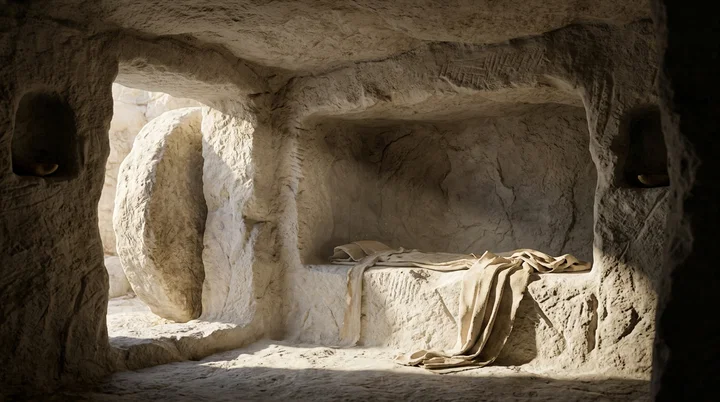
And the napkin, that was about his head, not lying with the linen clothes, but wrapped together in a place by itself.
Translations
American King James Version, King James Version
And the napkin, that was about his head, not lying with the linen clothes, but wrapped together in a place by itself.
and the napkin, that was about his head, not lying with the linen clothes, but wrapped together in a place by itself.
And the napkin that was about his head, not lying with the linen cloths, but wrapped together in a place by itself.
Revised Version, American Standard Version
and the napkin, that was upon his head, not lying with the linen cloths, but rolled up in a place by itself.
and the napkin that was upon his head, not lying with the linen clothes, but apart, having been folded up, in one place;
and the handkerchief which was upon his head, not lying with the linen cloths, but folded up in a distinct place by itself.
and the napkin, which was upon his head, not, with the linen-bandages, lying, but apart, folded up into one place.
Berean Standard Bible, Majority Standard Bible
The cloth that had been around Jesus’ head was rolled up, lying separate from the linen cloths.
and the cloth that had been on his head, not lying with the linen cloths, but rolled up in a place by itself.
And the cloth, which had been round his head, not with the linen bands but rolled up in a place by itself.
And the kerchiefe that was vpon his head, not lying with the linnen clothes, but wrapped together in a place by it selfe.
Douay-Rheims (Challoner revision)
And the napkin that had been about his head, not lying with the linen cloths, but apart, wrapped up into one place.
Pictures

Cross-references
- Luke 24:12
Then arose Peter, and ran unto the sepulchre; and stooping down, he beheld the linen clothes laid by themselves, and departed, wondering in himself at that which was come to pass.
Peter finds the linen clothes laid by themselves in the empty tomb.
- Mark 16:1-6
And when the sabbath was past, Mary Magdalene, and Mary the mother of James, and Salome, had bought sweet spices, that they might come and anoint him.
Women visit Jesus’ tomb early on the first day and hear that he is risen.
- Matthew 28:1-10
In the end of the sabbath, as it began to dawn toward the first day of the week, came Mary Magdalene and the other Mary to see the sepulchre.
A parallel Gospel account of the resurrection.
- Luke 24:1-3
Now upon the first day of the week, very early in the morning, they came unto the sepulchre, bringing the spices which they had prepared, and certain others with them.
The women visit on the first day and find Jesus’ tomb empty.
- Matthew 27:59-60
And when Joseph had taken the body, he wrapped it in a clean linen cloth,
Describes Jesus being wrapped in linen and laid in a tomb.
- John 20:11-12
But Mary stood without at the sepulchre weeping: and as she wept, she stooped down, and looked into the sepulchre,
identifies the men as angels
- John 19:40
Then took they the body of Jesus, and wound it in linen clothes with the spices, as the manner of the Jews is to bury.
Jesus’ burial cloths and wrapping correspond to the linen and napkin found in the tomb.
- Psalms 16:10
For thou wilt not leave my soul in hell; neither wilt thou suffer thine Holy One to see corruption.
Jesus’ resurrection fulfills the promise that God’s Holy One would not see corruption.
- Luke 23:53
And he took it down, and wrapped it in linen, and laid it in a sepulchre that was hewn in stone, wherein never man before was laid.
Describes Jesus being wrapped in linen and laid in a tomb.
- Mark 15:45-46
And when he knew it of the centurion, he gave the body to Joseph.
Describes Jesus being wrapped in linen and laid in a tomb.
- Matthew 28:13
Saying, Say ye, His disciples came by night, and stole him away while we slept.
The guards claim the disciples stole Jesus’ body, contrasted with the orderly burial cloths.
- Matthew 28:1
In the end of the sabbath, as it began to dawn toward the first day of the week, came Mary Magdalene and the other Mary to see the sepulchre.
A parallel account of the first-day resurrection discovery.
- John 20:1
The first day of the week cometh Mary Magdalene early, when it was yet dark, unto the sepulchre, and seeth the stone taken away from the sepulchre.
The account places the discovery of the empty tomb on the first day of the week.
- Luke 24:9-11
And returned from the sepulchre, and told all these things unto the eleven, and to all the rest.
The women report the empty tomb, but the disciples do not believe them.
- Mark 16:8
And they went out quickly, and fled from the sepulchre; for they trembled and were amazed: neither said they any thing to any man; for they were afraid.
The women flee the tomb in fear.
- 1 Corinthians 15:20
But now is Christ risen from the dead, and become the firstfruits of them that slept.
golden text affirming same resurrection
- Luke 24:36-43
And as they thus spake, Jesus himself stood in the midst of them, and saith unto them, Peace be unto you.
Jesus revealed himself to the disciples as risen.
Commentary
Each commentary is drawn from primary sources: the writings of Ellen G. White and Adventist pioneers and periodicals. Each commentary is separate. Its own words are not a quotation; follow the references to read the source passages.
Ellen G. White
18 sources
When Jesus rose His body was gone but the burial linens remained in the tomb, with the cloth that had covered His head lying apart by itself neatly folded together.Ms 155, 1904, par. 1–2Ms 115, 1897, par. 4–6Lt 106, 1896, par. 31–36 He Himself arranged them with care, leaving each piece deliberately placed in order rather than cast aside.Ms 115, 1897, par. 4–6DA 789.2–33SP 200.2COL 357.2–358.1Ms 41, 1910, par. 4–6 Left in this way they stood as proof that He had risen and had not been taken away, and seeing them the other disciple believed that He was alive.Ms 155, 1904, par. 1–2Ms 115, 1897, par. 4–6ST Dec 14, 1882DA 789.2–33SP 200.2 The careful folding shows that order and attention to small things matter, revealing habits that were never careless or disorderly.Lt 106, 1896, par. 31–36DA 789.2–3COL 357.2–358.115MR 40.1–2Ms 63, 1899, par. 32–34 It was done to teach His followers courtesy and faithfulness in little things, to do thorough, conscientious work that can stand trial rather than working carelessly or shabbily.COL 357.2–358.1Ms 41, 1910, par. 4–615MR 40.1–2Ms 63, 1899, par. 32–34
Cloths Left in Tomb
The cloth that had been about the head lay apart from the linen burial clothes, folded or wrapped together in a place by itself, while the body was gone and the linen clothes remained in the tomb.Ms 155, 1904, par. 1–2Ms 115, 1897, par. 4–6ST Dec 14, 1882ST Aug 22, 18786RED 18.3 After the resurrection the napkin that had been about the head lay in its own place, wrapped together and set separately from the linen clothes.Ms 155, 1904, par. 1–2Ms 115, 1897, par. 4–6Lt 106, 1896, par. 31–36 The detail belongs to the discovery of the empty tomb, when the disciples found the tomb as it had been reported to them.ST Dec 14, 1882ST Aug 22, 18786RED 18.3
The burial wrappings were not carelessly discarded but were left in order, each piece placed deliberately, the head cloth folded and set apart.Ms 115, 1897, par. 4–6DA 789.2–33SP 200.2 Christ Himself folded the grave-clothes and put them carefully in their proper place, folding up the cloth that had been bound about His head and putting it away by itself.DA 789.2–3COL 357.2–358.1Ms 41, 1910, par. 4–615MR 40.1–2Ms 63, 1899, par. 32–34 His deliberate care in this small detail shows His habits and work were orderly and free from disorder, not careless or haphazard.15MR 40.1–2Ms 63, 1899, par. 32–34
An angel removed the cloth covering the head inside the tomb before or as the resurrection took place, after which Jesus walked out of the tomb victorious over death.EW 149.2–3SG1 66.1 This is the teaching of those who held it, while the weight of the passages holds that Christ Himself did the folding and placing.DA 789.2–3EW 149.2–3COL 357.2–358.1SG1 66.1Ms 41, 1910, par. 4–6 Likewise the weight of the passages holds that the verse describes the napkin and its arrangement, while those who held the other view taught that the account of the empty tomb leaves the napkin undescribed and unexplained, and that seeing the clothes did not immediately lead to belief in the report that Jesus had risen.Ms 155, 1904, par. 1–2Ms 115, 1897, par. 4–6ST Dec 14, 1882SG1 71.2
Testimony to Resurrection
Together with the empty tomb, the linen clothes remaining with the head cloth folded apart and lying by itself are evidence that Jesus had risen and that His body had not been taken or stolen.ST Dec 14, 1882DA 789.2–33SP 200.2Ms 94, 1897, par. 28–30Ms 203, 1898, par. 9 The wrappings were not carelessly discarded but left in order, and this orderly arrangement testifies that He had risen, contrary to the thought that someone had removed Him.ST Dec 14, 1882DA 789.2–3ST Aug 22, 18786RED 18.33SP 200.2 After seeing the burial cloths, the other disciple entered, saw, and believed that Jesus was alive and risen, trusting Jesus' own words.Ms 155, 1904, par. 1–2ST Dec 14, 1882ST Aug 22, 18786RED 18.33SP 200.2
At that time the disciples had not yet understood the Scripture and the Old Testament prophecies that Jesus must rise from the dead.Ms 155, 1904, par. 1–2ST Dec 14, 1882ST Aug 22, 18786RED 18.33SP 200.2 The disciples testified that they had seen and spoken with Him, confirming that He had risen and that His body had not undergone corruption.Ms 94, 1897, par. 28–30Ms 203, 1898, par. 9 This evidence defeated the priests' false account and supported the truth of the resurrection.Ms 203, 1898, par. 9
In its wider setting the verse belongs to the proof that Jesus is not still buried in Joseph's new tomb behind the great stone but has risen and is alive.Ms 3, 1890, par. 29–30 He is a living Saviour, the Head of the church and the Good Shepherd whose voice His sheep know and follow.Ms 3, 1890, par. 29–30 To act as if He were still buried is unbelief that brings discouragement and doubt, while knowing He is risen gives courage and faith to hope and trust in God when things become entangled and cannot be easily adjusted.Ms 3, 1890, par. 29–30
Lesson in Carefulness
The folded head-cloth lying apart from the linen clothes, wrapped together in its own place, shows that attention to little things matters.Lt 106, 1896, par. 31–36DA 789.2–3 The burial wrappings were not carelessly discarded but each piece was placed in order, and Christ Himself folded them and put them carefully in their proper place, showing that order and care matter even in small things.Lt 106, 1896, par. 31–36DA 789.2–3 When He rose from the tomb by His own mighty power He did not disdain this simple act of folding the grave-clothes, noticing the most simple things in life even while the great work of redemption weighed upon Him.COL 357.2–358.1
His deliberate care in this small detail demonstrates that His habits had nothing careless or haphazard and His work was orderly and free from disorder, not done haphazardly.15MR 40.1–2Ms 63, 1899, par. 32–34 It was done deliberately to teach a lesson in true courtesy and faithfulness in little things.Ms 41, 1910, par. 4–6 That means His followers are to reveal courtesy in association with all, to avoid rudeness and selfishness and carelessness about little things, and to show kind words and courteous conduct as witnesses for Christ.Ms 41, 1910, par. 4–6
It gives Christians an example of faithful and conscientious attention to little things to follow in their work of cooperating with Christ for the salvation of souls.COL 357.2–358.1 Their work must be thorough and solid and never done carelessly or shabbily, but built on a sure foundation to stand the test of trial, just as character is to appear in perfection.15MR 40.1–2Ms 63, 1899, par. 32–34 Such faithfulness in little things is the secret of success in every line of Christian effort and influence.COL 357.2–358.1 He is not still buried but has risen and is alive, and knowing this gives courage and faith to hope and trust in God when things become entangled and cannot be easily adjusted, while to act as if He were still buried is unbelief that brings discouragement and doubt.Ms 3, 1890, par. 29–30
Sources
Pioneers and periodicals
53 sources
The cloth that had covered the head was left behind in the tomb, not lying with the linen burial clothes but folded and set apart in its own place while the body was gone.ST Oct 21, 1886ST Oct 21, 1886 Peter entered and beheld the linen cloths lying and the head cloth kept separate, and the other disciple saw and believed that Jesus was alive, though neither yet understood the Scripture foretelling the resurrection.ST Dec 14, 1882ST Apr 3, 1901ST May 27, 1897RH Jun 5, 1913 Together with the empty tomb the orderly, carefully arranged clothes show that he had risen, for thieves would not have taken time to remove and fold them in the dark.ST Dec 14, 1882ST Oct 21, 1886ST Feb 8, 1899ST Aug 12, 1880 It belongs to the record of the first day of the week when he rose, yet it appoints no Sunday worship and gives no command or sign that the seventh-day Sabbath was changed.ST Sep 9, 1880ST Dec 15, 1881ST Jun 2, 1909ST Apr 8, 1903 His rising as conqueror over death confirms that the atonement is complete and pledges that those who die trusting in him will also rise.ST Apr 8, 1903RH Aug 8, 1907RH Dec 5, 1865ST Aug 12, 1880
Tomb Scene Described
The cloth that had been about the head was not lying with the linen burial clothes but was wrapped together in a place by itself, folded separately and laid in its own place apart from the linen cloths.ST Dec 14, 1882ST Oct 21, 1886ST Oct 21, 1886ST May 27, 1897 After rising from the dead the burial cloths were folded and laid separately from the linen clothes, with the head covering distinct and set apart.ST Dec 14, 1882ST Oct 21, 1886ST Oct 21, 1886ST Sep 13, 1905 The body was gone while the linen clothes and the head cloth remained left behind in the tomb, the grave clothes staying while their wearer had risen. The burial linens and the napkin that had covered the head were left in separate places in the tomb while the body was gone, and the tomb otherwise appeared empty.RH Jun 5, 1913RH Oct 21, 1862
Before the Sabbath the body had already been wrapped in linen with a linen napkin bound about the head, buried tenderly and with great expense.RH May 5, 1874ST Feb 16, 1882 The burial preparations before the Sabbath began were not necessary acts of mercy or necessity that could justify further work on the Sabbath.RH May 5, 1874ST Feb 16, 1882 Simon Peter came next after the other disciple, entered inside the tomb, and beheld the linen cloths lying and the cloth that had been upon the head kept separate from the linen cloths, folded up in its own place by itself.ST May 27, 1897RH Jun 5, 1913RH Mar 30, 1916 John’s observation of the grave cloths is connected with his believing that Jesus was alive, on the basis of Jesus’ own words, while Peter departed wondering and remained afraid, not yet believing the resurrection until he saw Jesus himself.ST Dec 14, 1882ST Apr 3, 1901RH Oct 21, 1862RH Mar 30, 1916 Peter looked among the linen clothes and became convinced that the body was not there, though he did not believe in the resurrection until he saw Jesus himself.RH Oct 21, 1862RH Mar 30, 1916 Peter and John entering the tomb saw the linen clothes and the head napkin but did not see the angels or Jesus who were present there.RH Jun 5, 1913
John’s account of the resurrection includes particulars about the tomb not given by the other Gospel writers, and differences between the accounts do not by themselves mean they contradict one another.ST Mar 5, 1912 The parallel account of the resurrection morning belongs together, in which the women find the tomb empty, angels announce that Jesus is risen, the disciples disbelieve the report, and Peter runs to the tomb and sees the linen cloths left by themselves and departs wondering, showing Peter did not go to the tomb alone.ST Apr 3, 1901 After the tomb was secured, an angel entered it and unbound the napkin before Jesus was called forth.RH Aug 5, 1873 The grave clothes remained in the tomb and were not what was worn after the resurrection, which raises the question where the garments afterward seen were obtained.RH Nov 26, 1872
Evidence of Resurrection
The empty tomb with the body gone and the burial clothes left behind in careful order, the cloth that had covered the head set apart from the linen wrappings and rolled up neatly folded by itself in its own place, is evidence that Jesus had risen.ST Dec 14, 1882ST Oct 21, 1886RH Aug 8, 1907ST Dec 21, 1882 The grave clothes remained in good order as a witness to the resurrection, and their careful arrangement showed familiar habits that helped convince the beholder that Jesus was alive.ST Dec 21, 1882 If the body had been stolen the cloths would not likely have been left behind in such order, which argues against the claim that the disciples stole the body.ST Dec 21, 1882 In the empty tomb this detail accompanies the proclamation that Christ had risen as conqueror of death and not its captive, assuring that those who die trusting in him will also rise.RH Aug 8, 1907
The arrangement convinced beholders that grave robbers had not taken the body and that its removal had not been hurried or indiscriminate.ST Feb 8, 1899ST Aug 12, 1880 Body-snatchers would not have taken time to remove and arrange the grave clothes with such time and care, even in the dark, which makes the story of a hurried theft implausible.ST Feb 8, 1899ST Aug 12, 1880ST Dec 21, 1882 The folded napkin and linen clothes left in the tomb are tokens that the price for sin was accepted and the prisoner was discharged.ST Aug 23, 1899 The separate, orderly place of the napkin points to victory over death and to release from death's pains for those who died in Christ.ST Aug 23, 1899
The leaving of the linens and the head cloth in separate places while the body was gone belongs to the testimony that the one who was buried rose from the dead, that the same body that died and was laid in the tomb rose.RH Apr 14, 1874 His resurrection body is the pattern for the resurrection, in which those who belong to him will rise with their own bodies, changed from mortal and corruptible to immortal and incorruptible. Peter looked among the linen clothes and became convinced that the body was not there, though he did not believe in the resurrection until he saw Jesus himself.RH Oct 21, 1862 Mary also met this evidence at the sepulcher on the morning of the resurrection when she found the tomb open and the body gone, yet she still came seeking what she believed was his dead body and did not expect to find him alive, though he was close beside her and she thought she had lost him.ST Mar 23, 1915RH Oct 21, 1862ST Apr 10, 1901
The sight of the body gone while the linen clothes remained, with the head cloth folded separately, accompanied John's belief that Jesus had risen.ST Dec 14, 1882ST Aug 22, 1878 The orderly arrangement showed him Jesus' familiar habits and convinced him that Jesus was alive. That belief rested on Jesus' own words, although he and the other disciples did not yet understand the Old Testament prophecies and Scriptures that foretold the resurrection.ST Dec 14, 1882ST Aug 22, 1878
Disciples Seeing and Believing
The head cloth lay apart from the linen cloths, rolled up in a place by itself, while the body was gone and the burial clothes remained in the empty tomb.ST Dec 14, 1882ST Aug 22, 1878 Peter and John both saw this sight, and the other disciple then saw and believed that Jesus was alive.ST Dec 14, 1882ST Aug 22, 1878 His belief rested on Jesus' own words, for he and the other disciples did not yet understand the Old Testament prophecies and scriptures that foretold the resurrection.ST Dec 14, 1882ST Aug 22, 1878
On the first day of the week Jesus rose and later appeared to the assembled disciples.ST Dec 15, 1881RH Apr 14, 1874 At that appearing they had not yet believed that he had risen, so he showed them his hands and his side to convince them.ST Dec 15, 1881RH Apr 14, 1874 If the apostles had changed the Sabbath that day, they would have done so while still disbelieving the resurrection.RH Apr 14, 1874
When Peter and John entered the tomb after the resurrection they saw the linen clothes and the head napkin while the tomb otherwise appeared empty.RH Jun 5, 1913RH Jun 5, 1913 They did not see the angels or Jesus, who were present there.RH Jun 5, 1913RH Jun 5, 1913 The scene shows that God's presence and work may be real even when people do not perceive them.RH Jun 5, 1913 Sight needs to be opened, and people should seek Jesus rather than focus on earthly things and troubles.RH Jun 5, 1913
The women who visited the tomb early in the morning learned from angels that Jesus had risen.ST Nov 11, 1908 They were entrusted with the message to carry to the sorrowing disciples.ST Nov 11, 1908 The sepulcher where Peter looked for his Lord stands after the cross and before the explanation on the way to Emmaus, the evening proof of identity by the yet open wounds, the comforting, instructing and establishing work in Galilee, and the majestic ascent with ransomed captives until the return as conqueror.RH Aug 13, 1872 It is to be gazed upon with rapt devotion, wonder and joy, fixed upon the mind not as mere opinion but as living reality, much thought of and realized so as to leaven the whole character and life, renewing and strengthening all that is holy and pure and uprooting all that is wicked.RH Aug 13, 1872
First Day and Sabbath
The verse belongs to the record of events on the first day of the week, when Jesus rose as he had promised and was discovered in the empty tomb, later appearing to the disciples.ST Sep 9, 1880ST Jun 2, 1909ST Apr 8, 1903ST Feb 8, 1883ST Jun 3, 1897 It is part of the story of the first day after the resurrection and of the account of Jesus' resurrection from the tomb as the mighty Conqueror over sin and death, giving hope to all who trust in him.ST Jun 2, 1909ST Apr 8, 1903ST Jun 3, 1897 The discovery of the empty tomb is placed on the first day of the week, supporting the conclusion that Christ had risen by then.ST Feb 8, 1883
That account does not present that day as a Sabbath or as a replacement for the seventh-day Sabbath.ST Sep 9, 1880 It contains no appointment of Sunday for the solemn celebration of public worship and no example of the church at Jerusalem setting Sunday apart for divine worship, so furnishes no support for Sunday observance as resting on express appointment of the apostles, and reading the Gospel account of Christ's resurrection gives no suggestion that the Sabbath was changed at the resurrection.RH Mar 18, 1862ST Jan 27, 1904 It does not show that the apostles changed the Sabbath that day, for on that first day when Jesus rose and later appeared to the assembled disciples they had not yet believed he had risen, and Jesus showed them his hands and side to convince them; if they had changed it that day they would have done so while still disbelieving the resurrection, and that resurrection-day reference does not establish that Christ intended to change the Sabbath from the seventh day to the first.ST Dec 15, 1881RH Apr 14, 1874RH Jun 20, 1871
Christ's resurrection on the first day does not make that day the Sabbath or establish it as sacred, because there is no command or indication changing the Sabbath, which the disciples continued to observe as before.ST Feb 8, 1883 Jesus had been buried tenderly and with great expense before the Sabbath began, with the linen burial clothes left in the tomb and the napkin that had been around his head wrapped together and set apart, and those burial preparations were not necessary acts of mercy or necessity that could justify further work on the Sabbath.ST Feb 16, 1882 The visit of the disciples to the tomb after the Sabbath, finding that he had risen, is identified with the day after the Sabbath, which has been observed weekly in commemoration of the resurrection.RH May 3, 1864 That first-day resurrection is put forward as support for observing the first day and as the most important reason for substituting the first day of the week as the Sabbath, but the verse itself is not given as a command to keep it.ST Mar 22, 1883ST Jul 24, 1884 The argument for the change is not profound, and declaring the whole moral law abolished leaves observance without reason.ST Jul 24, 1884
Risen Christ Revealed
The chapter presents Christ in his resurrection state appearing to his disciples as one born of the Spirit, moving like the wind that is heard but cannot be traced in its coming and going.RH Sep 15, 1874 This immortal, spirit-born condition displayed in his appearances is the condition that will belong to every immortalized saint at the resurrection.RH Sep 15, 1874 The burial linens and the napkin that had covered his head were left in separate places in the tomb while his body was gone, showing that the same body that died and was laid in the tomb rose from the dead. That resurrection body is the pattern for the resurrection, for those who belong to him will rise with their own bodies, changed from mortal and corruptible to immortal and incorruptible.
The scene at the sepulchre is bright with angelic forms and with the presence of the one who brought life and immortality to light.RH Sep 4, 1855 The empty tomb proclaims his conquering power and proves that he is the Life, so that those who put their trust in him will not be harmed by death or hell.ST Nov 11, 1886 The stone tomb wherein the Lord of life rested is an empty sepulcher, a tomb of death that no longer holds him.ST Oct 24, 1895 No tomb of death and no empty sepulchre of stone is to be the quest; breaking and bleeding Christian hearts pleading for avenging pity are to wake the crusading spirit, sheathe speech and unsheathe swords.ST Oct 24, 1895
After the tomb was secured, an angel entered it and unbound the napkin before Jesus was called forth.RH Aug 5, 1873 His resurrection in this manner shows that God has power to save and to raise the dead.RH Aug 5, 1873
Victory and Hope Assured
The tomb was not the end, for Jesus rose from it as the mighty Conqueror over sin and death.ST Apr 8, 1903RH Aug 8, 1907RH Dec 5, 1865 He rose as the first and final conqueror bursting the bars of death, not as its captive, leaving the cloth that had covered His head set apart from the linen burial clothes and folded in its own place.RH Aug 8, 1907RH Nov 13, 1860 The empty tomb with its ordered grave clothes accompanies and displays that conquering rising.RH Aug 8, 1907RH Dec 5, 1865
His victory confirms that the atonement is complete and opens the way for people to return to God through penitence and faith, with sin checked, Satan conquered, and heaven opened.ST Aug 12, 1880 It assures that those who die trusting in Him will also rise.RH Aug 8, 1907 The cast-off grave clothes and the empty tomb point to His resurrection as the firstfruits and pledge of the resurrection of those who sleep in death.RH Aug 8, 1907
The resurrection is an actual event and not merely a belief that death is vanquished.ST Jan 25, 1905 As evidence of that fact, the empty tomb the disciples hurried to see makes life endurable and its burdens bearable, giving hope to all who trust in Him.ST Apr 8, 1903ST Feb 28, 1911 In conquering death He carefully folded the head napkin apart from the linen clothes, showing that nothing dear to God's people will be overlooked in the resurrection, but cherished memories and even seemingly small things will be sacredly preserved and restored.RH Sep 8, 1859
Lessons for Christian Life
The care with which the grave clothes were left behind, with the cloth that had covered the head wrapped and placed separately from the linen clothes, is an example for caring properly for baptismal robes.RH Mar 11, 1909RH Mar 11, 1909 Baptism commemorates burial, and the robes are worn by those who are buried with Christ in baptism, so the careful order left in the tomb teaches carefulness toward them.RH Mar 11, 1909RH Mar 11, 1909 The one who did this was the first and final conqueror bursting the bars of death, yet He folded the linen clothes and the napkin and laid them in order apart by themselves.RH Nov 13, 1860 That act shows lowliness of manner and attention to humble things, proving that in redemption there was set purpose concerning the smallest things as well as the greatest.RH Nov 13, 1860
Having risen, He left the tomb and its grave clothes behind, with the napkin that had been around His head folded separately. That leaving behind serves as a lesson not to cling to old customs when they are not matters of God's revealed will, but to seek the best way to do God's work. At the supreme moment of arising from the sleep of death, He Himself, or some leisurely heavenly agent, found time to fold and lay aside the napkin that loving hands had wrapped around His thorn-scarred head.ST May 20, 1897 That careful, complete act shows the method of activity in creation and in redemption is not to hurry events at the expense of completeness but to give ample time for preparation and performance.ST May 20, 1897
The same unhurried completeness belongs with tarrying at Nazareth until thirty and, though charged with a work greater than the creation of a universe, showing in three years of public work no incompleteness from hurry.ST May 20, 1897 It belongs with finding time to spend entire nights in prayer, to heal and to teach and to give Himself to every humble suppliant, to learn from nature the materials for parables, to heal smitten Malchus when betrayed, and while dying to pray for enemies, to commit His mother to John, and to save the penitent thief.ST May 20, 1897 It teaches earnest, complete work done in calm rest without needless hurry, worry, fever and fret.ST May 20, 1897
The napkin that had been wrapped around the head has no merit or power as a relic, and neither it nor the tomb where He was laid contains life or power, because He is risen and is not there. The mention of linen burial cloths lying in the sepulcher does not establish that any surviving winding sheet is genuine.ST Aug 25, 1898 The stone tomb wherein the Lord of life rested is an empty sepulcher, a tomb of death that no longer holds Him.ST Oct 24, 1895 No tomb of death and no empty sepulchre of stone is to be the quest, and breaking and bleeding Christian hearts pleading for avenging pity are not to wake a crusading spirit to sheathe speech and unsheathe swords.ST Oct 24, 1895
Sources