Luke 24:9
And returned from the sepulchre, and told all these things unto the eleven, and to all the rest.
Translations
American King James Version, Webster Bible
And returned from the sepulcher, and told all these things to the eleven, and to all the rest.
And returned from the sepulchre, and told all these things unto the eleven, and to all the rest.
and returned from the sepulchre, and told all these things unto the eleven, and to all the rest.
Revised Version, American Standard Version
and returned from the tomb, and told all these things to the eleven, and to all the rest.
and having turned back from the tomb told all these things to the eleven, and to all the rest.
and, returning from the sepulchre, related all these things to the eleven and to all the rest.
and, returning [from the tomb], reported all these things unto the eleven, and unto all the rest.
Berean Standard Bible, Majority Standard Bible
And when they returned from the tomb, they reported all these things to the Eleven and to all the others.
returned from the tomb, and told all these things to the eleven and to all the rest.
And they went away from that place and gave an account of all these things to the eleven disciples and all the others.
And returned from the sepulchre, and tolde all these things vnto the eleuen, and to all the remnant.
Douay-Rheims (Challoner revision)
And going back from the sepulchre, they told all these things to the eleven, and to all the rest.
Pictures
Cross-references 20 of 39
- Luke 24:13-35
And, behold, two of them went that same day to a village called Emmaus, which was from Jerusalem about threescore furlongs.
Emmaus disciples confirm the women's report
- Mark 16:9-11
Now when Jesus was risen early the first day of the week, he appeared first to Mary Magdalene, out of whom he had cast seven devils.
Mary reports seeing the risen Jesus, but the disciples do not believe her.
- John 20:19
Then the same day at evening, being the first day of the week, when the doors were shut where the disciples were assembled for fear of the Jews, came Jesus and stood in the midst, and saith unto them, Peace be unto you.
Jesus appears to the disciples that evening on the resurrection day.
- Matthew 28:1-10
In the end of the sabbath, as it began to dawn toward the first day of the week, came Mary Magdalene and the other Mary to see the sepulchre.
The women find the empty tomb and carry the resurrection news.
- Mark 16:7
But go your way, tell his disciples and Peter that he goeth before you into Galilee: there shall ye see him, as he said unto you.
The women are told to report Jesus’ resurrection to his disciples.
- John 20:18
Mary Magdalene came and told the disciples that she had seen the Lord, and that he had spoken these things unto her.
Mary tells the disciples she has seen the risen Lord.
- Mark 16:12-13
After that he appeared in another form unto two of them, as they walked, and went into the country.
Parallels the Emmaus report and the disciples’ disbelief.
- Luke 23:56
And they returned, and prepared spices and ointments; and rested the sabbath day according to the commandment.
The women rested on the Sabbath before going to the tomb.
- Matthew 28:9-10
And as they went to tell his disciples, behold, Jesus met them, saying, All hail. And they came and held him by the feet, and worshipped him.
Jesus meets the women as they return from the tomb and sends them to report.
- John 20:1
The first day of the week cometh Mary Magdalene early, when it was yet dark, unto the sepulchre, and seeth the stone taken away from the sepulchre.
Mary Magdalene visits the empty tomb and reports what she found.
- Luke 24:1
Now upon the first day of the week, very early in the morning, they came unto the sepulchre, bringing the spices which they had prepared, and certain others with them.
Begins the account of the women’s visit to the tomb early on the first day of the week.
- Luke 24:36-43
And as they thus spake, Jesus himself stood in the midst of them, and saith unto them, Peace be unto you.
The risen Jesus appears to the gathered disciples after the reports.
- Luke 24:21
But we trusted that it had been he which should have redeemed Israel: and beside all this, to day is the third day since these things were done.
Cleopas states it is the third day
- Mark 16:14
Afterward he appeared unto the eleven as they sat at meat, and upbraided them with their unbelief and hardness of heart, because they believed not them which had seen him after he was risen.
Records an appearance to the disciples.
- Luke 24:23
And when they found not his body, they came, saying, that they had also seen a vision of angels, which said that he was alive.
The women report the angels’ message that Jesus was alive.
- Matthew 28:8
And they departed quickly from the sepulchre with fear and great joy; and did run to bring his disciples word.
The women leave the tomb to announce Jesus’ resurrection.
- Matthew 28:6
He is not here: for he is risen, as he said. Come, see the place where the Lord lay.
The angel tells the women that Jesus has risen.
- John 20:3-8
Peter therefore went forth, and that other disciple, and came to the sepulchre.
Peter and another disciple inspect the empty tomb after the women’s report.
- Mark 16:8
And they went out quickly, and fled from the sepulchre; for they trembled and were amazed: neither said they any thing to any man; for they were afraid.
The women flee the tomb in fear and initially remain silent.
- 1 Corinthians 15:20
But now is Christ risen from the dead, and become the firstfruits of them that slept.
Christ’s resurrection assures the resurrection of the dead.
Commentary
Each commentary is drawn from primary sources: the writings of Ellen G. White and Adventist pioneers and periodicals. Each commentary is separate. Its own words are not a quotation; follow the references to read the source passages.
Ellen G. White
11 sources
It was the first day of the week after the crucifixion, a day that should have filled hearts with rejoicing but for some was a day of uncertainty, confusion and perplexity.Ms 113, 1897, par. 1 The telling was heard by the eleven and all the rest gathered together in the upper chamber in Jerusalem, where Jesus had spent the last night before His death and where the disciples had spent the Sabbath mourning their Lord.ST Sep 26, 18783SP 216.2 The company was awake at night behind a barred door opened with caution, assembled and excited and relating stirring events, with hope and faith struggling for ascendency in their minds.ST Sep 26, 18783SP 216.2
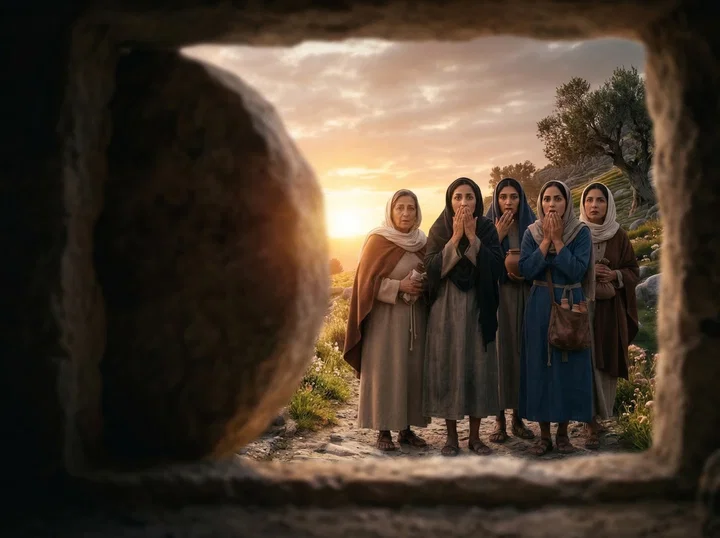
Those who brought the report were Mary Magdalene, Joanna, Mary the mother of James, and the other women with them.Ms 115, 1897, par. 1–2 They had come to the tomb early before light with sweet spices to anoint the body of Jesus and found the heavy stone rolled away and the body gone, leaving the tomb empty.SG1 71.2Ms 203, 1898, par. 9 They remembered His words that He would be delivered, crucified, and rise on the third day, which brought His predictions of His resurrection back to mind.Ms 115, 1897, par. 1–23SP 205.2–3 Two angels in bright shining white apparel appeared to them, showed them the place where He lay, told them they were seeking Jesus and that He was not there but had risen, and told them to go tell His disciples that He would go before them into Galilee.SG1 71.2
The tidings they carried were that a vision of angels had positively affirmed that Christ had risen, that His body was gone, and that they themselves had seen Jesus alive and met and spoken with Him in the garden.Ms 113, 1897, par. 1Ms 113a, 1897, par. 1DA 795.1Ms 203, 1898, par. 9 They hurried frightened and astonished from the sepulchre to disciples who were mourning and could not be comforted because their Lord had been crucified, and told them all they had seen and heard.SG1 71.2 The report astonished the disciples, but grief, hopelessness, weak and sunken faith, and expectations unlike the resurrection news kept them from believing; they dismissed the women's words as idle tales and thought the women were mistaken.Ms 115, 1897, par. 1–23SP 205.2–3ST Sep 26, 1878Ms 113, 1897, par. 13SP 216.2
Their doubt showed how unsure they were of what resurrection from the dead meant, influenced in part by the Sadducees' teaching.Ms 113a, 1897, par. 1 They still rejected even Mary Magdalene's testimony that she had seen and spoken with Jesus, while Peter's ardent and assured testimony of his interview with the risen Lord carried more weight with the brethren and began to revive their faith.3SP 205.2–3ST Sep 26, 18783SP 216.2 Some of the disciples ran hastily with the women to the sepulchre and found truly that Jesus was not there, only His linen clothes, and returned home marveling at what they had seen and at the report.SG1 71.2
The women's report was then followed by the joyful tidings of the two travelers returned from Emmaus, who were met by many voices saying the Lord is risen indeed and has appeared to Simon, and it belongs with the evidence that Christ had risen, for the disciples later testified that they had seen and spoken with Him.ST Sep 26, 1878Ms 203, 1898, par. 9 The verse belongs to a chapter teaching that Christ's suffering and death made salvation possible, so that those who repent, are converted, and come to the Father through faith in Christ may receive forgiveness of sins and be sanctified through belief of the truth.Lt 100, 1910, par. 18 The chapter teaches that Christ's followers are to carry the gospel as witnesses, first locally and then to all nations, with witness empowered by the Holy Spirit calling people to salvation and spreading the truth.RH Jan 26, 1905
Sources
Pioneers and periodicals
51 sources
Luke 24:9 reports that very early on the first day of the week, after resting on the Sabbath according to the commandment, Mary Magdalene, Joanna, Mary the mother of James and the other women with them returned from the sepulchre to Jerusalem and told all they had seen and heard to the eleven and to all the rest with them.ST Oct 21, 1886RH Jun 6, 1865RH Oct 21, 1862RH Feb 11, 1858RH Sep 11, 1860 What they told was that the body was gone, that they had seen angels saying he is risen, that they remembered his words that the Son of man must be crucified and rise the third day, and that he was alive.ST Oct 21, 1886ST Dec 3, 1894ST Apr 3, 1901 The eleven and the others dismissed their words as idle tales and disbelieved them, spending much of that day mourning and weeping in hopelessness because they had expected him to redeem Israel from Rome and did not understand his death and resurrection.ST Oct 21, 1886RH Jun 6, 1865RH Oct 23, 1856RH Dec 8, 1874ST Dec 3, 1874 The testimony is placed on the first day of the week as distinct from the seventh-day Sabbath the day before, but gives that day no sacredness, appointment, or observance.RH Jan 1851RH Jan 17, 1856ST Mar 18, 1889RH Dec 16, 1858ST Jan 2, 1879 What was done on that day was ordinary going, traveling to Emmaus, and reporting, not worship or Sabbath keeping, so it provides no example of Sunday sacredness and no argument against the seventh-day Sabbath.RH Oct 23, 1856ST Mar 12, 1894ST Jul 2, 1894ST Sep 10, 1896ST Jul 22, 1908 The one reported risen is the identical Jesus who died wholly and was buried, now risen bodily on the third day, and his resurrection assures the resurrection of the dead and is to be carried as gospel witness to all nations.RH Jan 26, 1905RH Jun 6, 1865RH Nov 21, 1854ST Jun 26, 1901
Words and Setting
The return from the tomb took place very early on Sunday morning, on the first day of the week, after the women had rested on the Sabbath according to the commandment.ST Oct 21, 1886RH Jun 6, 1865RH Feb 11, 1858ST Oct 28, 1913 It belongs to the events of that first day when Jesus made himself known to his disciples, and it carried the resurrection news to the eleven apostles and to all the rest of the disciples who were mourning and weeping.ST Oct 21, 1886ST Oct 28, 1913 Christ rose on the morning of the first day of the week, on the third day since his sufferings, and the women came to the sepulchre, found the body gone, and then returned to tell all these things.RH Jun 6, 1865
The women who returned were Mary Magdalene, Joanna, Mary the mother of James, and the other women with them, including the other Galilean women.ST Oct 21, 1886RH Oct 21, 1862RH Sep 11, 1860 They obeyed by reporting everything they had seen and heard to the eleven apostles and to the others.RH Oct 21, 1862RH Sep 11, 1860 Mary Magdalene and the other women told what they had seen at the tomb to the eleven and to the rest gathered with them.ST Sep 26, 1878
They spoke to no one on the way from the tomb, but on arriving returned to Jerusalem and told everything to the eleven apostles and to all the rest of the disciples with them.ST Oct 21, 1886ST Dec 3, 1894ST Apr 3, 1901RH Oct 21, 1862ST Mar 12, 1894 The place was the upper chamber in Jerusalem where Jesus had spent the last night before his death and where the disciples had passed the Sabbath mourning for their Lord.ST Sep 26, 1878 After the women remembered Jesus' words about his resurrection, they reported everything they had seen and heard, carrying the news that Jesus had risen.ST Dec 3, 1894ST Apr 3, 1901
All these things were what they had seen and heard at the sepulchre: they found the body gone, saw two men in shining garments or a vision of angels who said he is not here but is risen, remembered how he spoke in Galilee saying the Son of man must be delivered into the hands of sinful men and be crucified and rise again the third day, and learned that Mary had seen the Lord alive.ST Oct 21, 1886ST Dec 3, 1894RH Jun 6, 1865RH Nov 21, 1854ST Feb 22, 1899 Their report carries the angels' message that Jesus had risen, in keeping with his earlier words, and becomes one of the testimonies confronting the disciples as they try to understand the empty tomb.ST Feb 22, 1899 It told that the identical Jesus of Nazareth who died and was buried had risen, the same personage with no transition to another being.RH Nov 21, 1854
Jesus himself met the other women on the way, greeted them, received their worship at his feet, and told them not to fear but to tell his brethren to go to Galilee where they would see him.ST Oct 21, 1886 The women's report included finding the tomb empty, speaking with an angel, and seeing the risen Jesus, and the report circulated widely.ST Feb 7, 1911 By later that day the two disciples on the road to Emmaus had heard the women's report, as news of the event spread through Jerusalem prompting people to hear, gather, and share what they learned.ST Jul 29, 1908ST Mar 9, 1882
That telling became part of the reports that amazed the two disciples going to Emmaus, that certain women of their company had been early at the tomb, had not found his body, had seen a vision of angels saying he was alive, and that others had gone to the tomb and found it as the women said but did not see him, which reports the two then rehearsed to Jesus as they walked.ST Apr 4, 1900 The women's joyful message of true news that Jesus was risen and that they had seen him was told to the disciples gathered in Jerusalem and was repeated that night by the two disciples from Emmaus to dispel gloom and doubt.ST Mar 8, 1905 The women's report was then followed by the joyful tidings of the two travelers returned from Emmaus, who were met by many voices saying the Lord is risen indeed and hath appeared to Simon.ST Sep 26, 1878
The Jewish custom behind the reckoning names the days of the week from the Sabbath, with Sunday called the first day of the Sabbath, that is the first day of the week, and Monday the second day of the Sabbath, and so on, proving that sabbaton means a week, a period of seven days.RH Dec 13, 1870 The chapter places the Emmaus journey late in the day, with the two disciples reaching Emmaus late, eating with Jesus, recognizing him, and returning to Jerusalem that same hour on a journey back long enough that the day had passed by the time they arrived.ST May 24, 1910 Its evening language can refer to the closing part of the first day before sunset, with Jesus meeting the gathered disciples after sunset when the second day of the week had begun, so the return from Emmaus and the first meeting with the eleven fall near the day's close, possibly after the second day had begun.ST May 24, 1910ST Mar 24, 1909RH Feb 25, 1862
Disciples' Unbelief and Sorrow
The eleven and all the rest dismissed the women's words as idle tales and disbelieved them even after hearing that he was alive and had been seen.ST Oct 21, 1886RH Jun 6, 1865RH Oct 23, 1856RH Oct 21, 1862ST Mar 12, 1894 The women who brought the report were Mary Magdalene, Joanna, Mary the mother of James, and the other women with them, telling what the angels had said, that the body was gone, that he had risen, and that Mary had seen the Lord alive.ST Oct 21, 1886RH Jun 6, 1865RH Oct 21, 1862 They had remembered his words in Galilee that the Son of man must be delivered into the hands of sinful men and be crucified and rise again the third day.RH Jun 6, 1865 Their telling therefore does not show that the disciples had gathered to celebrate the resurrection.RH Oct 23, 1856ST Mar 12, 1894
The majority of the disciples went through the whole first day still unbelieving that Jesus was risen.ST Oct 21, 1886ST Mar 12, 1894ST Jul 1, 1880 They were mourning and weeping, utterly disheartened, hopeless, faithless, and filled with doubts, fears, gloom and sadness.ST Sep 26, 1878ST Oct 21, 1886ST Jul 1, 1880ST Dec 3, 1874ST Mar 8, 1905 Hope and faith were only struggling for ascendency in their minds, and the report was met with sad astonishment rather than joyous hope for the third day.ST Sep 26, 1878ST Dec 3, 1874 Their joyful message was the truth, and it was repeated that night by the two disciples from Emmaus to dispel the gloom and doubt.ST Mar 8, 1905
Their sorrow meant they had no faith in his resurrection and did not understand God's plan of salvation for lost men through Christ's death and intercession, for if they had understood they would not have mourned.ST Dec 3, 1874 Their trust that he would redeem Israel meant they supposed he would free them from under the hand of the Romans by then establishing his literal kingdom.ST Dec 3, 1874 They were sorely disappointed when Jesus whom they expected to crown as king was crucified on the cross, but that disappointment did not prove Christianity false because he afterward showed them that all this was only a fulfillment of prophecy.RH Dec 8, 1874 So likewise the disappointment of the Millerites does not prove the doctrine of Christ's soon coming false, and his resurrection revived the hopes of his disciples after they had been cast down by his unexpected crucifixion.RH Dec 8, 1874ST Feb 9, 1882
The telling took place at night while the company was awake, assembled, and excited in the upper chamber in Jerusalem where he had spent the last night before his death and where they had passed the Sabbath mourning for their Lord, behind a barred door opened with caution and relating stirring events.ST Sep 26, 1878 Some were too hopeless to believe the women's testimony when it was heard by all.ST Sep 26, 1878 The testimony of Peter about his interview with the risen Lord was given with ardor and assurance, had more weight with the brethren, and began to revive their faith.ST Sep 26, 1878 The women's report was then followed by the joyful tidings of the two travelers returned from Emmaus, who were met by many voices saying the Lord is risen indeed and hath appeared to Simon, in the locked upper room where the disciples were gathered on that Sunday night.ST Sep 26, 1878ST Mar 8, 1905
The meeting with the women was a sudden encounter, not an appointed worship assembly.RH Sep 10, 1857 Christ's early appearance was followed by the disciples' doubt and perplexity.ST Jul 22, 1908 He did not manifest himself to them all together again until near the close of the day.ST Jul 22, 1908
Sabbath and Sunday
The testimony was given on the first day of the week, yet the day is not called a Sabbath or holy day and is not presented as appointed for observance, but is treated as distinct from the seventh-day Sabbath which was the day before.RH Jan 17, 1856ST Mar 18, 1889ST Jan 2, 1879 What is recorded shows how that first first day after the resurrection was kept, in ordinary going and reporting by the women to the eleven and to all the rest, in secular activity and business travel, and in anxiety and unrest rather than in rest and worship, so it supplies no example of Sunday keeping and no argument against the seventh-day Sabbath of Jehovah.ST Jul 2, 1894ST Sep 10, 1896ST Jul 22, 1908 The disciples did not regard the first day as a Sabbath as they had regarded the day before, for on it they ran about the city and two went seven and a half miles to Emmaus on business with Jesus going with them and not rebuking them for breaking a Sabbath but allowing them to return that afternoon, while those at Jerusalem did not shut themselves in an upper chamber to keep the day, because they had kept the day before, and Jesus himself traveling that distance shows he was not resting on that day so it cannot be called the Lord's day on the ground that the Lord rested on it.RH Jan 1851ST Mar 18, 1889RH Dec 16, 1858
The disciples did not believe the women's report but dismissed it as idle tales, and the majority went through the whole first day still unbelieving that Jesus was risen, which proves they had not gathered to honor the first day for the resurrection and their telling does not show a gathering to celebrate it.RH Oct 23, 1856ST Mar 12, 1894 What happened was things done on the first day of the week, not things done to the first day itself, for Christ arose from the dead, expounded the Scriptures concerning himself, showed himself to be the very one who had been slain, and gave the commission and invested the apostles with authority while the witnesses returned and told these things, yet he performed no act of a Sabbatical character on the day, set it apart in no way, and did not even take the day into his lips.RH Nov 21, 1871 The appearances on that day to the women at the sepulchre, to the two at Emmaus, and to Peter at Jerusalem just before sunset, with the manifestation to all the disciples together only in the evening after the day had closed, show only that he was alive and give no sacredness to the first day, and to claim holiness from them is presumption, since his most important manifestation at the ascension was on Thursday forty days later and he said nothing on any of these occasions about the sacredness of the day.ST Aug 6, 1912ST Apr 13, 1882
The new covenant was finished and sealed by Christ's blood late Friday afternoon on the cross when he said It is finished, and since a confirmed testament cannot be disannulled or added to after the death of the testator, Sunday observance claimed from the resurrection morning three days afterward came three days too late and cannot be added as part of the new covenant.ST Sep 23, 1913 Those who keep Sunday give Christ's rising from the dead on the first day of the week as the reason for keeping Sunday holy rather than the seventh-day Sabbath.RH Apr 14, 1874 The resurrection reported is given to bring remembrance not of any day but of Christ's mighty power to save from all sin, whose special memorial is the Lord's Sabbath in which believers truly rejoice, leaving one who professes Christianity with only two choices, to keep the seventh-day Sabbath or give up all claim to Christianity, obeying God rather than yielding to opposed relatives and friends.ST Mar 12, 1894ST Dec 10, 1902
Resurrection and Christ
The verse belongs to the account that Christ rose from the dead on the morning of the first day of the week in A.D. 31.RH Jun 6, 1865RH Apr 14, 1874ST Sep 22, 1909 Very early on that first day the women came to the sepulchre, found the body gone, saw two men in shining garments who told them Jesus had risen, and remembered how he had spoken in Galilee saying the Son of man must be delivered into the hands of sinful men and be crucified and rise again the third day.RH Jun 6, 1865 They then returned and told all these things to the eleven and to all the rest, to whom the words of the women seemed as idle tales.RH Jun 6, 1865 It was the third day since his betrayal, sufferings, and crucifixion, a count that includes the days of those events and does not require three complete periods of twenty-four hours. That resurrection on the first day is the reason given by those who keep Sunday, rather than the seventh-day Sabbath, holy.RH Apr 14, 1874
The one reported risen is the identical Jesus of Nazareth who died and was buried, with no transition to another being.RH Nov 21, 1854 His death on the cross, when he commended his spirit, meaning his life, to the Father and gave up the ghost, was a literal, matter-of-fact death of the whole man with no soul or spirit or intelligent part surviving.RH Nov 21, 1854 His body was laid by Joseph in the stone sepulchre, and the one whose body was then found missing on the first day of the week, of whom the angels said he is not here but is risen on the third day as he had said in Galilee, is that same personage.RH Nov 21, 1854 Afterward he appeared himself with flesh and bones and showed his hands and feet to prove it is I myself.RH Nov 21, 1854
Their report of returning from the tomb to the eleven disciples and the others forms part of the Gospel testimony to his bodily resurrection, whose credibility cannot be separated from the credibility of the Gospel witnesses.RH Jan 1, 1914 The empty-tomb story is evidence for the resurrection but was already believed and preached before the Gospels were written and is not presented as its primary proof.RH May 11, 1916 Differences in which resurrection details each Gospel mentions or omits do not make the accounts contradictory.ST Mar 5, 1912 The chapter's account helps identify the gathering at which Jesus later appeared to the disciples as the same interview described in Mark and John.
This resurrection testimony belongs to the Gospel's hope, for Christ's resurrection assures the resurrection of the dead.ST Jun 26, 1901 It revived the hopes of his disciples after they had been cast down by his unexpected crucifixion, with the women's report of what they found at the tomb part of that account.ST Feb 9, 1882 The verse is included in the resurrection-day narrative in which he showed himself to the women, to the disciples on the road to Emmaus, and then to the eleven with Thomas absent.RH Feb 13, 1872 It stands there as part of the resurrection narrative, not as a command to observe that day as sacred.RH Feb 13, 1872
Witness and Gospel Mission
The chapter to which the verse belongs sets the pattern for carrying the gospel as witness, beginning in the immediate locality and then extending to all nations.RH Jan 26, 1905 That witness is empowered by the Holy Spirit, calling people to salvation and spreading the truth abroad.RH Jan 26, 1905
The carrying of true news of the risen Lord from the tomb to the sorrowing disciples was an early shower of blessing that brought encouragement.ST Nov 11, 1908 It prepared the church for the fuller baptism of Pentecost, with the lesser refreshing coming before the greater outpouring.ST Nov 11, 1908 Their returning with joy to tell the tale of him who rose remains the work and joy of myrrh-bearers still, at home and abroad.ST Aug 26, 1880 They go forth by twos and threes without regard for ease, pressing through darkness wherever the faintest promise appears, burdened with gifts whose chief worth is that their spices have been bruised for Christ.ST Aug 26, 1880 That women reported the news of the resurrection upholds the proclamation by women of a risen or coming Saviour.ST Aug 26, 1880RH Sep 10, 1857 Their haste to the tomb and their witness, set against the sorrow of the disciples on the way to Emmaus, exemplify an eagerness to be imitated, as in sisters traveling to the conference.
Sources