Luke 24:12
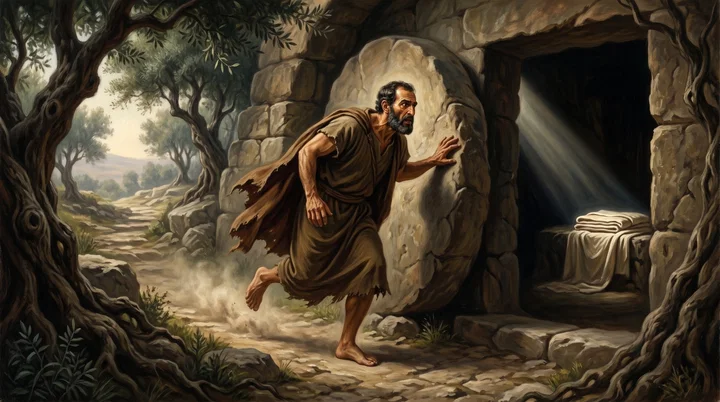
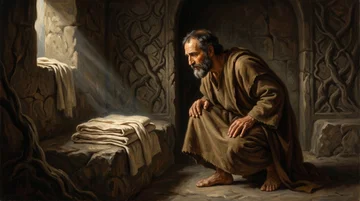
Then arose Peter, and ran unto the sepulchre; and stooping down, he beheld the linen clothes laid by themselves, and departed, wondering in himself at that which was come to pass.
Translations
Then arose Peter, and ran to the sepulcher; and stooping down, he beheld the linen clothes laid by themselves, and departed, wondering in himself at that which was come to pass.
King James Version, KJV Cambridge Paragraph Bible
Then arose Peter, and ran unto the sepulchre; and stooping down, he beheld the linen clothes laid by themselves, and departed, wondering in himself at that which was come to pass.
Then Peter arose, and ran to the sepulcher, and stooping down, he beheld the linen clothes laid by themselves, and departed, wondering in himself at that which had come to pass.
Revised Version, American Standard Version
But Peter arose, and ran unto the tomb; and stooping and looking in, he seeth the linen cloths by themselves; and he departed to his home, wondering at that which was come to pass.
And Peter having risen, did run to the tomb, and having stooped down he seeth the linen clothes lying alone, and he went away to his own home, wondering at that which was come to pass.
But Peter, rising up, ran to the sepulchre, and stooping down he sees the linen clothes lying there alone, and went away home, wondering at what had happened.
[[But, Peter, arising, ran unto the tomb,—and, bending near, beholdeth the linen bandages, alone; and departed, unto himself, marvelling at the thing that had happened.]]
Peter, however, got up and ran to the tomb. And after bending down and seeing only the linen cloths, he went away, wondering to himself what had happened.
Peter, however, got up and ran to the tomb. And after bending down and seeing only the linen cloths lying there, he went away, wondering to himself what had happened.
But Peter got up and ran to the tomb. Stooping and looking in, he saw the strips of linen lying by themselves, and he departed to his home, wondering what had happened.
But Peter got up and went to the place where the body had been put, and looking in he saw nothing but the linen cloths, and he went to his house full of wonder at what had taken place.
Then arose Peter, and ran vnto the sepulchre, and looked in, and saw the linnen clothes laide by themselues, and departed wondering in himselfe at that which was come to passe.
Douay-Rheims (Challoner revision)
But Peter rising up, ran to the sepulchre, and stooping down, he saw the linen cloths laid by themselves; and went away wondering in himself at that which was come to pass.
Pictures
Cross-references 20 of 29
- John 20:3-8
Peter therefore went forth, and that other disciple, and came to the sepulchre.
Peter and John visit the empty tomb and see the linen clothes.
- Matthew 28:1-10
In the end of the sabbath, as it began to dawn toward the first day of the week, came Mary Magdalene and the other Mary to see the sepulchre.
The women find the empty tomb and hear the angel announce that Jesus is risen.
- Mark 16:1-6
And when the sabbath was past, Mary Magdalene, and Mary the mother of James, and Salome, had bought sweet spices, that they might come and anoint him.
The women find the tomb open and are told Jesus has risen.
- Luke 24:34
Saying, The Lord is risen indeed, and hath appeared to Simon.
The disciples report that the risen Jesus appeared to Simon Peter.
- Mark 16:11-14
And they, when they had heard that he was alive, and had been seen of her, believed not.
The disciples disbelieve reports that Jesus has risen before he appears to them.
- Luke 23:56
And they returned, and prepared spices and ointments; and rested the sabbath day according to the commandment.
contrasts Sabbath rest with next-morning work
- John 20:11-18
But Mary stood without at the sepulchre weeping: and as she wept, she stooped down, and looked into the sepulchre,
Jesus appears to Mary Magdalene at the tomb after his resurrection.
- John 20:1
The first day of the week cometh Mary Magdalene early, when it was yet dark, unto the sepulchre, and seeth the stone taken away from the sepulchre.
Both place the discovery of the empty tomb on the first day of the week.
- 1 Corinthians 15:5
And that he was seen of Cephas, then of the twelve:
Names Cephas among those who saw the risen Jesus.
- Matthew 28:11-15
Now when they were going, behold, some of the watch came into the city, and shewed unto the chief priests all the things that were done.
Bribed guards spread the false claim that the disciples stole Jesus’ body.
- Luke 24:39-40
Behold my hands and my feet, that it is I myself: handle me, and see; for a spirit hath not flesh and bones, as ye see me have.
The risen Jesus shows his hands and feet, confirming his bodily resurrection.
- Luke 24:21
But we trusted that it had been he which should have redeemed Israel: and beside all this, to day is the third day since these things were done.
The disciples’ words place their account on the third day.
- Luke 24:1
Now upon the first day of the week, very early in the morning, they came unto the sepulchre, bringing the spices which they had prepared, and certain others with them.
Places the women’s visit to the tomb on the first day.
- Luke 24:5-7
And as they were afraid, and bowed down their faces to the earth, they said unto them, Why seek ye the living among the dead?
The angels announce that Jesus has risen on the third day.
- Luke 24:22-23
Yea, and certain women also of our company made us astonished, which were early at the sepulchre;
women's report of empty tomb and angels astonished them
- Mark 16:7
But go your way, tell his disciples and Peter that he goeth before you into Galilee: there shall ye see him, as he said unto you.
The message tells the disciples—and Peter—that Jesus is risen and will meet them.
- Luke 23:50-53
And, behold, there was a man named Joseph, a counsellor; and he was a good man, and a just:
Jesus’ body is taken down and laid in a tomb.
- 1 Corinthians 15:20
But now is Christ risen from the dead, and become the firstfruits of them that slept.
Christ’s resurrection assures the hope of the dead rising.
- Matthew 27:63
Saying, Sir, we remember that that deceiver said, while he was yet alive, After three days I will rise again.
The priests recalled Jesus’ prediction that he would rise after three days.
- 1 Corinthians 15:16-18
For if the dead rise not, then is not Christ raised:
Without Christ’s resurrection, faith is vain and the dead in Christ have perished.
Commentary
Each commentary is drawn from primary sources: the writings of Ellen G. White and Adventist pioneers and periodicals. Each commentary is separate. Its own words are not a quotation; follow the references to read the source passages.
Ellen G. White
8 sources
Luke 24:12 belongs to the morning news of resurrection day, given early on the first day of the week, concerning the removal of Christ's body from the tomb and the report of the women who had seen the angels and had met Jesus.DA 795.1Ms 203, 1898, par. 9 The disciples were mourning inconsolably because their Lord had been crucified, and they disbelieved the women's report that Jesus had risen.SG1 71.2 After hearing the women's report, Peter ran hastily to the sepulchre.SG1 71.2EW 153.2–154.1 At the tomb he found Jesus gone and the tomb empty, with only the linen burial clothes lying by themselves.SG1 71.2EW 153.2–154.13SP 200.2ST Dec 14, 1882Ms 203, 1898, par. 9 He departed wondering, perplexed and amazed at what he had seen and at the women's report, without yet believing that Jesus had risen.SG1 71.2EW 153.2–154.13SP 200.2ST Dec 14, 1882
John, by contrast, believed that Jesus had risen because he remembered Jesus' own words, though the disciples as a whole had not yet understood the Old Testament scriptures that Christ would rise from the dead.3SP 200.2ST Dec 14, 1882 By late in the afternoon the same news had left two earnest believing disciples, who had come to Jerusalem to keep the Passover and were walking eight miles to Emmaus to meditate and pray, greatly perplexed, sad, utterly disheartened, hopeless and faithless as they talked over the trial and the crucifixion.DA 795.1 The verse belongs to the account of the disciples' response to the empty tomb and the reports of the resurrection, and Peter's later testimony about his encounter with the risen Jesus was given with great assurance, carried weight with the other disciples, and helped revive their faith.ST Sep 26, 1878
The evidence of the empty tomb and the linen cloth supported the disciples' witness that Christ had risen and made the priests' falsehood ineffective.Ms 203, 1898, par. 9 The chapter to which the verse belongs presents salvation as made possible by Jesus' suffering and death, in which those who repent, are converted, come to the Father through faith in Christ, and follow His example may receive forgiveness and be sanctified through belief in the truth.Lt 100, 1910, par. 18
Sources
Pioneers and periodicals
41 sources
On the first day of the week, the morning after the Sabbath, Peter ran to the sepulchre at Jerusalem after the women reported the tomb empty and that Jesus was risen and alive.ST Dec 3, 1894ST Oct 21, 1886 Stooping to look into the low entrance, he beheld the linen clothes laid by themselves with the head napkin rolled up apart by itself, and departed wondering to his own home.ST Oct 21, 1886RH Sep 11, 1860ST Nov 17, 1898 He departed perplexed and bewildered because he did not yet understand from Scripture that Jesus must rise from the dead, sharing the disciples' mourning and disappointed hope of an earthly kingdom.ST Dec 3, 1894RH Dec 8, 1874ST Dec 3, 1874 The grave-clothes left behind apart from the body show that the same Jesus who died and was buried rose bodily with flesh and bones and left the sepulchre alive.RH Nov 21, 1854RH Jan 1, 1914 That first day is distinguished from the seventh-day Sabbath and given no sacred title or purpose, and the running about, labor, and uncertainty of that day show it was treated as an ordinary working day and not made holy by the resurrection or by Christ meeting the disciples.RH Jan 1851ST Mar 18, 1889RH Feb 11, 1858ST Jul 22, 1908ST Aug 6, 1912
Tomb Visit Circumstances
On Sunday morning, the first day of the week, the day Jesus rose, at Jerusalem, Peter ran to the sepulchre after the women reported the empty tomb and the angels' message that Jesus was alive and risen.ST Dec 3, 1894ST Oct 21, 1886RH Sep 11, 1860ST Mar 18, 1889 In one telling he ran together with the other disciple.ST Oct 21, 1886 Reports of the women finding the tomb empty and speaking with an angel and seeing the risen Lord circulated alongside the other resurrection accounts.ST Dec 3, 1894ST Oct 21, 1886RH Sep 11, 1860RH Feb 25, 1862 After the women reported the empty tomb, the disciples later met Jesus following his appearance to the two travelers from Emmaus near the close of the day.RH Feb 25, 1862
They ran together and John outran Peter and came first to the tomb and stooped and looked in and saw the linen cloths lying but did not enter.ST Oct 21, 1886 Then Peter following him entered and beheld the linen cloths lying by themselves and the napkin that was on Jesus' head not lying with the linen cloths but rolled up in a place by itself.ST Oct 21, 1886 Then he departed wondering at what had come to pass to his own home, and John then entered and saw and believed, for as yet they did not know the Scripture that Jesus must rise again from the dead.ST Oct 21, 1886
Peter stooped down to look inside the tomb.ST Oct 21, 1886RH Sep 11, 1860 Its entrance was low enough that a person had to stoop to look in.RH Sep 11, 1860ST Nov 17, 1898 One telling describes him as stooping to look inside without entering.RH Sep 11, 1860
The visit belongs to Luke's closing account of Jesus' suffering, crucifixion, and resurrection.ST Mar 24, 1909ST Sep 22, 1909 It was three days after Christ's death on Friday afternoon.ST Sep 23, 1913 The Emmaus meeting at the close of the first day calls it the third day since his suffering, betrayal, and crucifixion, showing third day counts inclusively and does not require three complete twenty-four-hour periods. The disciples gathered near the end of that first day of the week, but Jesus met with them after the day had passed into the second day.ST Mar 24, 1909 The resurrection and the ascension occurred in A.D. 31.ST Sep 22, 1909
Peter's Wonder and Unbelief
Peter ran to the tomb after hearing the women's report and, stooping to look inside, saw the linen cloths lying by themselves and went away wondering and amazed and perplexed and bewildered at what had happened.ST Dec 14, 1882ST Dec 3, 1894 His bewilderment came because he and the disciples did not yet understand from Scripture that Jesus must rise from the dead. John believed because he remembered Jesus' own words, though the disciples as a whole did not understand the Old Testament scriptures that taught Christ would rise from the dead.ST Dec 14, 1882
On the morning of the resurrection the disciples were mourning and weeping instead of looking forward with joyous hope to the third day, and they were astonished at the report of the women who were early at the sepulcher and found not his body but saw a vision of angels saying he was alive.ST Dec 3, 1874 They had trusted he would redeem Israel, meaning they supposed he would redeem them from under the hand of the Romans by establishing his kingdom, and they expected him to be crowned as king, so they were sorely disappointed and cast down when they saw him crucified in an unexpected crucifixion.RH Dec 8, 1874ST Dec 3, 1874ST Feb 9, 1882 They did not understand the plan of God for the salvation of lost man through his death and intercession and did not have faith in his resurrection, requiring Jesus himself afterward to begin at Moses and all the prophets and expound in all the Scriptures the things concerning himself to show that his suffering was only a fulfillment of prophecy.RH Dec 8, 1874ST Dec 3, 1874
Peter's inspection of the empty sepulcher and seeing Jesus' linen clothes there without his body convinced him that the Lord was no longer in the tomb and added testimony that Jesus was not there.ST Feb 22, 1899RH Oct 21, 1862 Yet the sight of the empty tomb and the cloths, together with the reports of the resurrection and the women's account of the angels and of meeting Jesus and the explanation given for the empty tomb, still left the disciples confused and perplexed.ST Jul 29, 1908ST Feb 22, 1899 He did not believe in the resurrection until he saw the risen Jesus himself.ST Dec 14, 1882RH Oct 21, 1862
Peter hastened to the open tomb after receiving the news that Jesus had risen, and his grief and the message sent especially to him explain his urgent response and his hope of forgiveness and renewed acceptance by Christ.RH Dec 2, 1909 His testimony about his encounter with the risen Jesus was afterward given with great assurance, carried weight with the other disciples, and helped revive their faith.ST Sep 26, 1878 Their disappointment over unfulfilled expectation did not prove Christianity false any more than disappointment proves the doctrine of Christ's soon coming false.RH Dec 8, 1874 The verse recounts Peter going to the tomb, seeing the linen clothes lying by themselves, and wondering what had happened, but it does not say that Peter met Jesus there, and when, where, or how Peter saw Jesus is not related in it.RH Sep 10, 1857
Witness to Bodily Resurrection
Peter finding the linen clothes laid by themselves apart from the body belongs to the evidence that Jesus' own body was raised, that the same person who died and was buried appeared alive afterward with flesh and bones.RH Nov 21, 1854 That finding stands within the Gospel record of his bodily resurrection, which stands together with the accounts of his birth, so that rejecting its witnesses on one great event undermines confidence in the others.RH Nov 21, 1854RH Jan 1, 1914
Christ left the grave-clothes behind in the tomb and rose and left the sepulcher, so the empty tomb directs attention to the living Christ who has gone out where people need him. His resurrection assures the Gospel hope that the dead will rise.ST Jun 26, 1901 The empty tomb story itself is not the primary evidence pointed to, for the New Testament and the spiritually vital Christian church are pointed to as evidence that the resurrection occurred.RH May 11, 1916
The day of his resurrection included a great earthquake and the angel rolling away the stone and Christ arising and many saints coming out of their graves and appearing to many and Christ showing himself to the Marys, to those on the way to Emmaus, and then to the eleven, Thomas excepted.RH Feb 13, 1872 His resurrection was necessary to his glorification, but his great act for man was his death and his exaltation was at his ascension, not at his resurrection.RH Feb 13, 1872
First Day Not Made Sabbath
The visit was on the first day of the week, the day Jesus rose, the day after the Sabbath, but that day is distinguished from the seventh-day Sabbath and is given no sacred title, no sacred purpose, and is not called a Sabbath or holy day.ST Mar 18, 1889ST Jul 22, 1908ST Mar 9, 1882 The resurrection appearances on that first day showed the disciples that Jesus was alive, yet they did not declare the day holy or institute it as a holy day, and the New Testament gives no command or example making the first day sacred.ST Jul 22, 1908ST Aug 6, 1912ST Mar 9, 1882 On that morning the disciples were running about the city and came to the sepulchre to do the labor of anointing the body that they had refused to do the previous day because they rested on the Sabbath day according to the commandment, which proves they treated the first day as an ordinary working day and not as a holy day.RH Jan 1851RH Feb 11, 1858 The day is described as a time of activity and uncertainty rather than as a holy day or day of worship, and Christ meeting them that same day and saying peace be unto you did not make the first day holy.RH Jan 1851RH Feb 11, 1858ST Sep 10, 1896
The resurrection account is cited as the reason some give for keeping Sunday, but it does not show that the Sabbath commandment was changed, the order of the week was not changed to require rest on the first day with or instead of the seventh day, and the seventh day remains the Sabbath named in Scripture.ST Dec 15, 1881RH Jan 1851 Peter was at the tomb on the first day of the week, three days after Christ's death on Friday afternoon, and the new covenant had been sealed by Christ's blood at His death, so the first day came too late to be added as a Sabbath of that covenant.ST Sep 23, 1913 The verse gives no indication that Peter or the disciples treated that day as a Sabbath or observed it in honor of the resurrection, and meetings of the risen Jesus with His disciples on the first day of the week do not establish a first-day Sabbath.RH Jan 17, 1856ST Oct 21, 1897ST Aug 6, 1912
The disciples did not yet believe Christ had risen when He appeared to them that day, so their gathering was not evidence that the apostles had changed the Sabbath, for if they had done so then they would have acted in unbelief.RH Apr 14, 1874 What was done on the first day of Christ's resurrection, including His rising, His exposition of the Scriptures concerning Himself, His proof that He was the very one who had been slain, and His commission and authority given to the apostles, was something done on the first day, not something done to the first day.RH Nov 21, 1871 None of these acts was of a Sabbatical character, made no Sabbath of the day, expressed no intention to institute a new Sabbath, did nothing to the day itself, and gives no decisive indication of a change of the Sabbath preferable to the Sabbath made by God's rest, blessing, and appointment to holy use.RH Nov 21, 1871 That day of resurrection, the day after the Sabbath, included a great earthquake and the angel rolling away the stone and Christ arising and many saints coming out of their graves and appearing to many and Christ showing Himself to the Marys, to those on the way to Emmaus, and then to the eleven, Thomas excepted, yet the Scriptures do not say the resurrection makes that day the Lord's day or set it apart for sacred purpose.RH Feb 13, 1872 The crucifixion and the resurrection each have their own memorials, not the days on which they occurred, for Christ's great act for man was His death and not His resurrection, and His exaltation was at His ascension and not at His resurrection, though His resurrection was necessary to His glorification.RH Feb 13, 1872
The resurrection record does not say that the Sabbath was changed or that the day of the resurrection was made sacred or appointed as its commemoration.ST Jan 2, 1879ST Jul 22, 1908 Those who held the other position taught that Christ's resurrection is the end of the true rest foreshadowed by the ancient Sabbath, so the resurrection brings the Sabbath's shadows to an end.ST Jan 2, 1879 Christ was seen three times on resurrection day, by the women at the sepulchre, by the two disciples at Emmaus, and by Peter at Jerusalem just before sunset, and He ascended from the Mount of Olives at Bethany on Thursday forty days after, yet neither that manifestation on the first day nor the ascension made a day sacred.ST Apr 13, 1882
Agreement With Other Scriptures
Luke 24:12 belongs to Luke's resurrection account, one of the differing Gospel accounts that includes details the other evangelists omit.ST Mar 5, 1912ST Jun 14, 1877 The differing accounts stand alongside each other without editorial harmonizing to explain them.ST Jun 14, 1877 Their differences show the Gospels to be separate memoirs of Christ's life rather than narratives revised into a uniform whole.ST Jun 14, 1877 Those differences do not necessarily contradict one another.ST Mar 5, 1912
The chapter containing the verse helps identify Jesus' appearance to the disciples as the same interview described in John 20:19. The verse itself records Peter going to the tomb, seeing the linen clothes lying by themselves, and leaving in wonder. The resurrection account establishes the sequence on the first day of the week, in which after the women reported the empty tomb the disciples later met Jesus following his appearance to the two travelers from Emmaus near the close of the day.RH Feb 25, 1862
Lessons for Christian Life
Christ left the grave-clothes lying by themselves in the tomb when he rose, and as he did not carry them with him so his followers are not to cling to old customs but to seek the simplest and most effective way to do God's work while still following God's revealed will. The women hastening to the tomb after the resurrection, in contrast to the sadness and discouragement of the disciples on the way to Emmaus, stands as an example of zeal and devotion. The resurrection belongs with his birth, death, ascension, and many incidents of his life as a story simply yet beautifully told whose lessons are inspiring and helpful, holding children's interest and acquainting them with the Saviour's life and character to lead them to make him their personal friend and to desire to be more like him.ST Nov 21, 1906
Sources