Luke 15:23
And bring hither the fatted calf, and kill it; and let us eat, and be merry:
Translations
And bring here the fatted calf, and kill it; and let us eat, and be merry:
King James Version, Webster Bible
And bring hither the fatted calf, and kill it; and let us eat, and be merry:
and bring hither the fatted calf, and kill it; and let us eat, and be merry:
Revised Version, American Standard Version
and bring the fatted calf, and kill it, and let us eat, and make merry:
and having brought the fatted calf, kill [it], and having eaten, we may be merry,
and bring the fatted calf and kill it, and let us eat and make merry:
And be bringing the fatted calf, sacrifice! and let us eat and make merry:
Berean Standard Bible, Majority Standard Bible
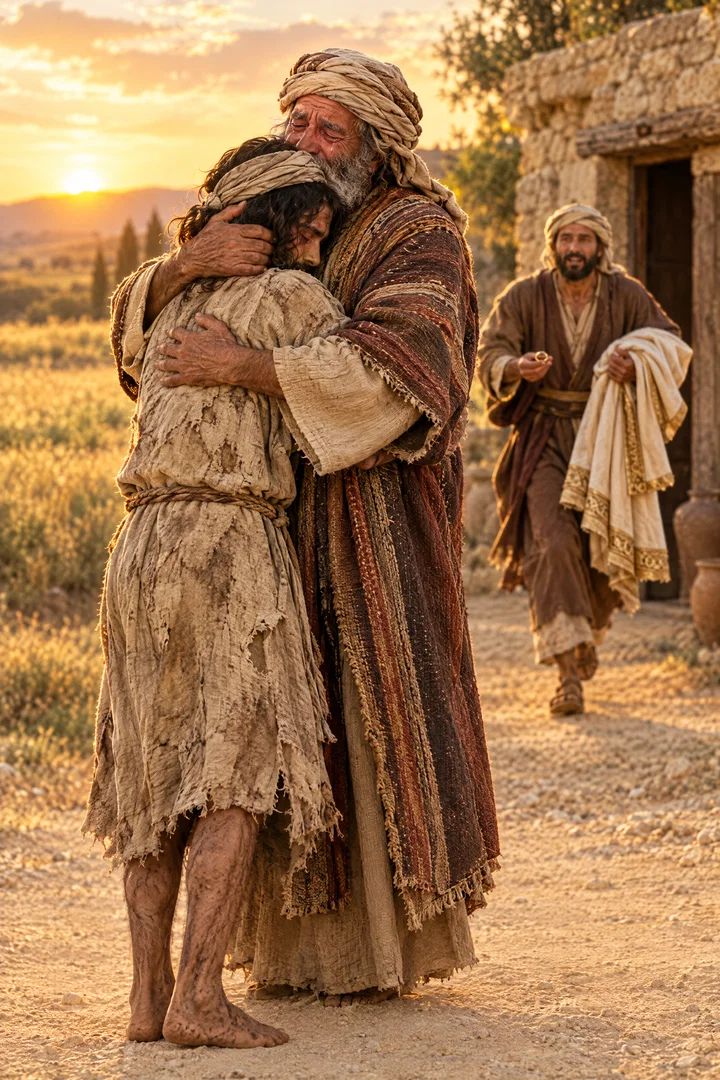
Bring the fattened calf and kill it. Let us feast and celebrate.
Bring the fattened calf, kill it, and let’s eat and celebrate;
And get the fat young ox and put it to death, and let us have a feast, and be glad.
And bring the fat calfe, and kill him, and let vs eate, and be merie:
Douay-Rheims (Challoner revision)
And bring hither the fatted calf, and kill it, and let us eat and make merry:
Pictures
Cross-references
- Luke 15:7
I say unto you, that likewise joy shall be in heaven over one sinner that repenteth, more than over ninety and nine just persons, which need no repentance.
Heaven rejoices over a sinner who repents.
- Luke 15:10
Likewise, I say unto you, there is joy in the presence of the angels of God over one sinner that repenteth.
Angels rejoice in heaven over a sinner who repents.
- Luke 15:32
It was meet that we should make merry, and be glad: for this thy brother was dead, and is alive again; and was lost, and is found.
The father says celebrating the restored son is right.
- Luke 15:29-30
And he answering said to his father, Lo, these many years do I serve thee, neither transgressed I at any time thy commandment: and yet thou never gavest me a kid, that I might make merry with my friends:
The elder brother’s anger and complaint contrast with the father’s joyful welcome of the returning son.
- Luke 15:17
And when he came to himself, he said, How many hired servants of my father’s have bread enough and to spare, and I perish with hunger!
The speaker recalls the prodigal’s turning point.
- Luke 15:18
I will arise and go to my father, and will say unto him, Father, I have sinned against heaven, and before thee,
golden text of same prodigal son lesson
- Luke 15:16
And he would fain have filled his belly with the husks that the swine did eat: and no man gave unto him.
Hunger among the swine contrasts with the father’s welcome and feast.
- Luke 15:2
And the Pharisees and scribes murmured, saying, This man receiveth sinners, and eateth with them.
Jesus’ welcome of sinners is answered by the father’s joyful feast for his returning son.
- Luke 15:4-6
What man of you, having an hundred sheep, if he lose one of them, doth not leave the ninety and nine in the wilderness, and go after that which is lost, until he find it?
The shepherd rejoices over the found sheep, like the father over his son.
- Matthew 18:13
And if so be that he find it, verily I say unto you, he rejoiceth more of that sheep, than of the ninety and nine which went not astray.
Both texts rejoice when the lost is found.
- Luke 15:27
And he said unto him, Thy brother is come; and thy father hath killed the fatted calf, because he hath received him safe and sound.
The killed calf celebrates the son’s safe return.
- Luke 15:19
And am no more worthy to be called thy son: make me as one of thy hired servants.
The son confesses he is unworthy to be called his father’s son.
- Luke 15:13-14
And not many days after the younger son gathered all together, and took his journey into a far country, and there wasted his substance with riotous living.
The son wastes his inheritance in a distant land and falls into want before the feast.
- Luke 15:12
And the younger of them said to his father, Father, give me the portion of goods that falleth to me. And he divided unto them his living.
Both describe the younger son’s demand for his portion before the feast.
- Luke 15:6
And when he cometh home, he calleth together his friends and neighbours, saying unto them, Rejoice with me; for I have found my sheep which was lost.
Both celebrate joyfully when what was lost is found or restored.
- Luke 14:21
So that servant came, and shewed his lord these things. Then the master of the house being angry said to his servant, Go out quickly into the streets and lanes of the city, and bring in hither the poor, and the maimed, and the halt, and the blind.
The poor and disabled are brought in to share a feast.
Commentary part 1 of 2
Each commentary is drawn from primary sources: the writings of Ellen G. White and Adventist pioneers and periodicals. Each commentary is separate. Its own words are not a quotation; follow the references to read the source passages.
Ellen G. White
88 sources
The father commands the best the house can give to be prepared for a glad feast of welcome for his returned son.ST Jan 29, 1894Ms 76, 1903, par. 21–22ST Jun 2, 1909 The merriment is his joy that the lost is found and the dead is alive again, restored not as a servant but to full sonship at the family table.COL 198.4–199.1ST Jan 29, 1894ST Jan 29, 1894ST Jun 2, 1909COL 203.2–205.1 The father stands for God, whose tender pitying love welcomes straying returners with free full pardon without reproach or reminder of unworthiness.Ms 76, 1903, par. 21–223T 101.3–102.2ST Jan 29, 1894COL 203.2–205.1GW 157.3 That feast reflects the joy of God Himself and all heaven over one sinner who repents, greater than over ninety-nine who need no repentance.COL 197.2ST Jan 29, 1894Lt 80, 1898, par. 9–13Lt 71, 1895, par. 25 Those who serve Him must share that joy and never take the cold complaining part of the elder brother toward the returning prodigal.Lt 45, 1894, par. 21–24GW 140.2Lt 71, 1895, par. 27
Parable Setting and Purpose
The command to bring the fatted calf belongs to the parable of the prodigal son, spoken to answer the complaints of the scribes and Pharisees against receiving and eating with sinners, to set forth mercy and forgiveness.Ms 102, 1894, par. 12–14 That parable reveals pitying love toward those who once knew the Father's love but were led captive and turned away into misery and exposure to temptation, yet are not left abandoned, for He remains kind and tender toward them in their straying.COL 198.1COL 198.2–311MR 367.1Lt 80, 1898, par. 1
The lesson is drawn from facts of daily life and experience familiar to the hearers, using the homely surroundings of the father's house and the return home to make unseen spiritual truth plain and to brighten ordinary work with constant reminders of the spiritual.3MR 333.2–3ED 102.3–4ST Nov 30, 1915 It is set forth as a pathetic, touching scene of a father rejoicing that a son thought dead is alive again, reaching the heart and awakening sympathy.19MR 259.1–3Ms 24, 1891, par. 88 Truth both new and old is drawn from the treasure-house and commended to the conscience directly, without long, farfetched, complicated reasoning, leaving hearers free to accept or reject and forcing none to believe.19MR 259.1–3
The picture given is tender yet incomplete, for infinite compassion cannot be fully told: while the sinner is still far off the Father yearns for him, and every longing to return is awakened by the Spirit drawing the wanderer back. So the parable is encouragement to despondent and distrustful sinners, showing that God takes the first step to seek the rebellious and welcomes the wanderer who returns.ST Jan 22, 1894 The companion parables of the lost sheep and the lost coin carry the same assurance, that heaven rejoices when the lost are restored.ST Jan 22, 1894
Prodigal's Fall and Return
The son selfishly demanded his portion when he could rightfully claim nothing and should have had nothing, bracing his selfish rebellious spirit with the thought that part of the property belonged to him in order to separate his interest from his father and manage his share according to his own inclination and pleasure without advice, restraint, counsel, reproof, or mutual obligation.3T 100.3–101.2 Having undeservedly received the treasure he withdrew far from his father even to forget him, despising restraint and determined to have pleasure in any way he chose, then by sinful indulgences spent all his father gave him until famine brought pinching want and destitution and regret for his extravagant course, bringing him down to the low business of feeding swine.3T 100.3–101.2 In this he pictures one ruined by selfish indulgence and needing tender sympathy, whose separation from his father through sin brought him to hunger and destitution and led him to return in humble confession.TCBMP 124.1Ms 22, 1898, par. 19 The parable is given for the instruction of youth, because many youth do as the prodigal did, living a careless, pleasure-loving, spendthrift life in a strange friendless condition of rags and hunger, forsaking the fountain of living waters and true pleasure to hew out broken cisterns which can hold no water.MYP 408.1
Prodigals are made such by indulgence and parental neglect, as children led into wrongdoing through indulgent home training.11MR 40.3–41.2Lt 117, 1898, par. 4–5 Separation through sin brings hunger and destitution that leads to return in humble confession.TCBMP 124.1 The sinner who had sinned and neglected filial duties becomes sensible of great sin and neglect, suffers and feels need, appreciates the father's love and acknowledges his claims, recognizes his need and returns to the father as the only one able to meet it and supply that need.TCBMP 128.1TCBMP 124.1
The story illustrates a backslider's return to God and to the service he had abandoned.Lt 59, 1886, par. 1–5 Its history is applied to a man who once loved and served the Lord but left his Father's house, and it pictures people who have left their Father's house and blessing as prodigals who need to return to Jesus, confess their backsliding, and turn toward heaven.Lt 52, 1899, par. 1Lt 27, 1890, par. 1 It also represents someone who has neglected the invitation to return to God and is still away from the Father, yet those who turn toward the Father can be saved.Lt 200, 1902, par. 8–10Lt 15, 1899, par. 9–11
Father's Feast and Restoration
The father commands the fatted calf to be killed and calls the whole household to eat and be merry in glad welcome for the returned son.ST Jan 29, 1894Ms 76, 1903, par. 21–223T 103.1–4 The feast honors him with the best the household affords and with the service of the household itself.ST Jun 2, 1909COL 203.2–205.1ST Apr 20, 1915 It is a joyful celebration prepared for his reception, marking his safe return.ST Jan 29, 1894ST Jun 2, 1909
The celebration restores him to sonship and not to servanthood, though he had been willing to be made as a hired servant.ST Jun 2, 1909COL 203.2–205.1ST Apr 20, 1915 He is given again his place and privileges in the household, with his seat at the family table, living as a son in the father's house.ST Jun 2, 1909ST Apr 20, 1915Lt 164, 1900, par. 21–23 Return is held out as an offered privilege, with the father inviting him home, yet enjoying those privileges requires complying with the conditions and obligations of sonship.Lt 164, 1900, par. 21–23Ms 183, 1901, par. 12Ms 98, 1901, par. 17–20 That means receiving Christ, renouncing the world's favor and friendship, obeying His word, remaining under the father's care, and not resuming wandering.Ms 183, 1901, par. 12Ms 98, 1901, par. 17–20
The feast expresses the father's joy that his son who was lost is found, that one who was dead is alive again, and that he has come back safe and sound.COL 198.4–199.1ST Jan 29, 1894ST Jun 2, 1909COL 203.2–205.1ST Apr 20, 1915 It is joy over restoration to place in the family and over repentance that makes the lost alive again to the father.COL 198.4–199.1ST Jan 29, 18943T 103.1–4 That rejoicing belongs to heaven as well as to the household, for heaven rejoices over the restored soul.ST Jan 29, 1894ST Apr 20, 1915
The welcome carries no reproach, taunt, contempt, or reminder of past unworthiness.Ms 76, 1903, par. 21–223T 101.3–102.2ST Jan 29, 1894ST Jan 29, 1894COL 203.2–205.1 Pardon is free and full, in which the past is forgiven and forgotten, met with tender pity and signs of sonship again.Ms 76, 1903, par. 21–223T 101.3–102.2RH Jan 19, 1911 The completeness of the forgiveness does not make the sin less grievous.Ms 76, 1903, par. 21–22RH Jan 19, 1911
God's Love and Pardon
The father in the feast is God, and the killing of the fatted calf and call to eat and be merry is His tender, loving, pitying care and compassion for those who have strayed and come back to Him.Ms 76, 1903, par. 21–22COL 203.2–205.118MR 113.511MR 370.2–371.1Ms 132, 1902, par. 9 It is yearning love welcoming the repentant sinner with joy and celebration, honoring him with the best the household affords, not receiving him as a servant but as a son.Ms 76, 1903, par. 21–22COL 203.2–205.118MR 113.5 There is no contempt, no accusation of wrath, no reproach or taunt for the past, for the past is forgiven and forgotten.Ms 76, 1903, par. 21–22COL 203.2–205.1GW 157.3 The celebration is God's rejoicing over restoration when the sinner returns to Him.18MR 113.511MR 370.2–371.1Ms 132, 1902, par. 9
That welcome flows from infinite and boundless love in giving His beloved Son Jesus as a sacrifice and in assuming humanity in the person of His Son, thereby opening a channel for His love to reach the fallen race.Lt 85, 1886, par. 17–18ST May 8, 1901Ms 41, 1890, par. 45–51 At Calvary He sent His Son to be the propitiation for sins, not for some only but also for the sins of the whole world, with regard for wandering sinners far from His house and perishing with hunger.RH Nov 26, 1901ST May 8, 1901 The purpose is that souls may be saved from sin, that man may be made one with God, and that wandering people may be brought back to the Father.Lt 85, 1886, par. 17–18RH Nov 26, 1901Ms 41, 1890, par. 45–51 Infinite benevolence pours out its treasures for this saving, and Christ became poor and left His home to die that through His poverty the perishing might come into possession of eternal riches.RH Nov 26, 1901
The love manifested on Calvary is the sinner's assurance of acceptance, peace, and love, and Christ's dying love assures the sinner of the same.Ms 82, 1894, par. 22–24Lt 15a, 1890, par. 9–113MR 32.1–3 God in Christ daily beseeches men to be reconciled to God, ready with outstretched arms to receive and welcome not only the sinner but the prodigal.3MR 32.1–3 Christ has undertaken the work of saving all who trust in Him for salvation, seeking and saving the lost, seeing the wrongs that need to be righted and the evils that need to be repressed, and restoring the sinner to divine favor through goodness and mercy.3MR 32.1–3 He casts out none who come to Him.Ms 82, 1894, par. 22–24Lt 15a, 1890, par. 9–113MR 32.1–3
Those who return to God are received and covered with the robe of Christ's righteousness, clothed in His righteousness and restored to favor.Lt 80, 1898, par. 9–13Lt 85, 1886, par. 17–18Lt 76, 1898, par. 18–20 They are forgiven their sins, reconciled with the Father, received into fellowship with Him, and welcomed to the family table, and their restoration brings rejoicing in heaven.Lt 80, 1898, par. 9–13Lt 76, 1898, par. 18–20Lt 59, 1898, par. 12–14
The Majesty of Heaven even now meets the prodigal who has separated from Him and stayed away long, and invites him to come that he may have life, with all things ready.2T 295.1 Christ is ready to cleanse him from sin when he lays hold upon Him, if he will but come to be accepted and pardoned.2T 295.1 Serving sin and serving the flesh and the devil brings no profit but poor wages.2T 295.1 To go on neglecting this mercy is to perish in sins with no certain hope of eternal life, so the sinner must turn and live.2T 295.1
All who believe on Jesus Christ are restored to favor, and believing on Him brings obedience to all of God's commandments and life in Jesus Christ.Lt 85, 1886, par. 17–18ST May 8, 1901 Enjoying the privileges of a son requires complying with the conditions of sonship, for Christ will freely cooperate with and gladly receive all who receive Him as Saviour, renounce the favor and friendship of the world, and make Him their all and in all.ST May 8, 1901 Friendship with Him is measured by His dominion over them as they walk in accordance with His Word and do whatever He commands.Lt 85, 1886, par. 17–18ST May 8, 1901
The good the father prepared shows the heart of Jesus toward His own sons and daughters who are acting as the prodigal son.Ms 75, 1898, par. 13–14 They claim to be commandment keepers yet transgress the law, living unthankful and unholy lives and using their entrusted talents to counterwork God, with no light in them and an influence that does not lead to sanctification or holiness.Ms 75, 1898, par. 13–14 Jesus yearns after them and longs to do them the good He delights to do, as the father prepared good for the returned son, but the perversity of their characters prevents Him from doing it.Ms 75, 1898, par. 13–14 The same loving care in welcome and feast was shown for Israel, though Israel had rejected repeated offers of mercy.ST Feb 27, 1896 In that fatherly dealing with a wayward son, God was willing to suffer for His people's sins and bear their guilt.ST Feb 27, 1896Ms 56, 1902, par. 5
Heaven's Joy Over Repentance
The killing of the fatted calf and the call to eat and be merry pictures the joy in heaven and among the heavenly host when one who was lost is brought back to God.COL 197.2ST Jan 29, 1894Lt 80, 1898, par. 9–13Ms 19, 1890, par. 21STA 14.1 There is greater joy over one sinner who repents than over ninety-nine who need no repentance, for the father's feast and gladness over his lost son found answers to the joy in heaven over the restored soul.COL 197.2ST Jan 29, 1894Lt 80, 1898, par. 9–13ST Jan 22, 1894Ms 19, 1890, par. 21 The joyful welcome given to the repentant sinner who returns to the Father is without reproach, taunt, or reminder of past unworthiness, and those who return are received and clothed in His righteousness.ST Jan 29, 1894Lt 80, 1898, par. 9–13Ms 19, 1890, par. 21 The parable is thus encouragement to despondent and distrustful sinners, because God takes the first step to seek the rebellious and welcomes the wanderer who returns, as the lost sheep and the lost coin show heaven rejoicing when the lost are restored, and penitence is required.ST Jan 29, 1894Lt 80, 1898, par. 9–13ST Jan 22, 1894
That merriment is the joy of God Himself and of all heaven over a lost sheep found.Lt 71, 1895, par. 25 It reveals God as the true Shepherd who seeks the wandering, calls the distressed soul to return to Him, and promises to heal backsliding and love freely.Lt 71, 1895, par. 25 Those who serve God are to partake of that spirit by rejoicing at the return of the repentant, since indifference or careless disregard toward those ready to die, refusing to rejoice and welcome them, manifests the spirit of the elder brother.Lt 71, 1895, par. 25
When wanderers like Edson and his wife turn back and obtain a rich experience as the Lord leads them step by step in submission to His will and way, their return brings joy that breaks out in praise to the Lord and weeping.Ms 89, 1893, par. 1–2 The return of the lost is part of God's work to reclaim them, and the joys of heaven, angelic company, and communion with God and His Son are rewards that encourage a loving response to the Creator and Redeemer.ST Oct 31, 1916
Conditions for Remaining Sons
The killing of the fatted calf and the call to eat and be merry is the joyful welcome prepared for the repentant sinner who returns to the Father's house, received without reproach, taunt, or reminder of past unworthiness.ST Jan 29, 1894MYP 97.1Lt 1a, 1890, par. 1Lt 18f, 1890, par. 2Lt 33, 1896, par. 12 Coming back means coming humbled and penitent, telling mistakes and failures, asking for strength for fresh endeavor, and knowing confidence will never be disappointed or abused.MYP 97.1Lt 1a, 1890, par. 1Lt 18f, 1890, par. 2 It means grasping Christ by faith with the eye fixed upon Him, casting oneself helpless upon His mercy, turning to Jesus, ceasing known sin, giving heart and soul and the little remnant of life to Him in full decision of soul, linking with God, and relying on Jesus' strength rather than one's own, because heaven must not be lost and delay must not be allowed.MYP 97.1Lt 1a, 1890, par. 1Lt 18f, 1890, par. 2Lt 33, 1896, par. 12 One so accepted is blessed and then worked with to help other youth give their hearts to God and be converted.Lt 33, 1896, par. 12
The restored place at the table is sonship and not servanthood, and enjoying the privileges of a son requires complying with the conditions and obligations of sonship.Lt 164, 1900, par. 21–23Ms 183, 1901, par. 12Ms 98, 1901, par. 17–20ST May 8, 190110MR 110.3–5 That means receiving Christ as Saviour, renouncing the favor and friendship of the world, making Him all and in all, walking in accordance with His Word and doing whatever He commands, with friendship with Him measured by His dominion.Ms 183, 1901, par. 12ST May 8, 190110MR 110.3–5 The returned wanderer must remain under the Father's care, guided by God's word and submissive to His control in unreserved surrender of the whole life in order to keep deliverance from sin, repaying love by obedience and not resuming wandering to the devil's side in disobedience.Lt 164, 1900, par. 21–23Ms 98, 1901, par. 17–2010MR 110.3–5 The welcome itself rests on boundless love in assuming humanity in the person of His Son and on Christ's propitiation for the sins of the whole world, and Christ freely cooperates with and gladly receives all who so receive Him.ST May 8, 1901
A thorough backslider returns in the same way, leaving the service of Satan and of sin and turning square about at once to be a Christian before God and angels and witnesses, even if keeping the Sabbath costs position and trade.3MR 64.5–65.3 Severity of brethren toward youthful indiscretions is no reason to stay away and grieve the heart of Christ who died to redeem him.3MR 64.5–65.3 When he returns with earnest prayer and tears he comes into a new channel with purified thoughts and changed purposes and a solemn sense of responsibility, rejoicing with thankfulness and sleepless happiness at the evidenced pardon and love of the Lord in the joy and feast of the Father's house and the Father's service.3MR 64.5–65.3
Those who turn toward the Father in this way can be saved, for the feast is a picture of the joy of receiving one who comes back.Lt 200, 1902, par. 8–10Lt 27, 1890, par. 8 There is hope if one believes and takes Jesus as personal Saviour, as Arthur was invited to return to God and to his father's house.Lt 200, 1902, par. 8–10Lt 27, 1890, par. 8
Church and Family Duty
Those who serve God are to share the father's gladness at the killing of the fatted calf and the call to eat and be merry, and never to take the complaining elder brother's attitude toward a returning prodigal.Lt 45, 1894, par. 21–24GW 140.2Lt 71, 1895, par. 27 Coldness, reproach, jealousy, resentment, indifference and careless disregard toward those ready to perish, refusing to rejoice and welcome them, is manifesting his spirit in contrast to the father's tender love and compassion.Lt 45, 1894, par. 21–24Lt 16a, 1887, par. 4Lt 71, 1895, par. 25 His complaints against such a welcome are natural but not right, and brother must not pursue that course toward brother.3T 103.5–104.1TCBMP 128.2 Poor Christian character that wounds and drives prodigals away can keep them from the kingdom, while carefully studying and practicing this lesson of seeking the lost and rejoicing over the repentant involves eternal interests.Lt 71, 1895, par. 27Lt 16, 1887, par. 7–14
Those who have erred and repented need pity, help, sympathy, and above everything else free forgiveness.3T 103.5–104.1TCBMP 128.2 They are not to be met with efforts to make them feel where they erred and with constant reminders of their mistakes.3T 103.5–104.1TCBMP 128.2 They already suffer in feeling and are often desponding and discouraged, having become sensible of great sin and neglect after suffering and feeling need, and coming back appreciating the father's love and acknowledging his claims as the only one who can supply that need.3T 103.5–104.1TCBMP 128.2 Those who have received God's mercy must show the same mercy to others, receiving the repentant sinner with compassion and joy.3T 103.5–104.1Lt 45, 1894, par. 21–24
A parent is to receive an erring child who returns and confesses with full pardon and pitying love in the welcome and restoration pictured by the feast.21MR 429.3Lt 18e, 1890, par. 2 That free and full pardon does not make the sin less grievous.21MR 429.3Lt 18e, 1890, par. 2
The elder brother's resentment of the celebration pictures those who should rejoice when the wandering are brought back to God but instead become envious when attention and labor are given to them.21MR 296.5–6Ms 49, 1898, par. 24–25 It pictures church members who resent labor to save the lost when they want constant sermons for themselves.Ms 49, 1898, par. 24–25 Those who truly know God and have Christ formed within as the hope of glory share the father's spirit and pleasure when the lost are recovered by seeking to save the lost, carrying the message of salvation, bearing light, praying sincerely for others, and witnessing by precept and example.Ms 49, 1898, par. 24–25 They do this instead of gossiping, planting doubt and questioning, envying, and expecting to be fed.Ms 49, 1898, par. 24–25
The lessons of the prodigal son and the lost sheep call for having the Spirit of Jesus Christ in councils and for going into the wilderness of darkness and confusion to search for straying sheep who cannot find their way back without help.Lt 16, 1887, par. 7–14Ms 81, 1893, par. 61–63 The search endures storm, cold, and roughness of the way to find them and bring them back to the fold.Ms 81, 1893, par. 61–63 The restoration is by tender, merciful efforts to welcome and rejoice over one who returns after going astray, rather than by coldly condemning or abandoning him.Lt 16, 1887, par. 7–14Ms 81, 1893, par. 61–63
The return of the prodigal pictures sinners being brought back to God, and many prodigals can likewise be brought to the Father.MH 179.1–2RH Nov 26, 1901 The joy of the feast calls those chosen as laborers together with God to cooperate with Him in His great purpose by sympathy with the gospel plan, by denying self, by refraining from needless and selfish spending, and by bringing an offering in righteousness.RH Nov 26, 1901 That offering, large if possible and blessed if small when it is their best, is that souls perishing with hunger far from His house may be brought to a saving knowledge of the truth and His work may go forward with power until the whole world is encircled with an atmosphere of grace.RH Nov 26, 1901
The story welcomes the erring son with love rather than rejecting him, and makes the celebration a cause for rejoicing in contrast to contempt and to the contempt shown by those who should help him.Ms 40, 1899, par. 10–12RH Nov 25, 1902 It presents the one far from his father and perishing with hunger as someone to be met with compassion.Ms 40, 1899, par. 10–129T 50.2 It is to be used to encourage those who have left the Father's house to return, showing that a backslidden young man comes back to his father's house through labor in Christ for him unto restoration to God and His service, and inviting particular wanderers to return and receive God's continuing love as His children.RH Nov 25, 1902STB 147.5STB 620.1–2Lt 59, 1886, par. 6
Sources