Mark 15:42
And now when the even was come, because it was the preparation, that is, the day before the sabbath,
Translations
American King James Version, King James Version, KJV Cambridge Paragraph Bible
And now when the even was come, because it was the preparation, that is, the day before the sabbath,
And now, when the evening was come, (because it was the preparation, that is, the day before the sabbath)
Revised Version, American Standard Version
And when even was now come, because it was the Preparation, that is, the day before the sabbath,
And now evening having come, seeing it was the preparation, that is, the fore-sabbath,
And when it was already evening, since it was [ the] preparation, that is, [ the day] before a sabbath,
And evening, already, having begun, since it was a preparation, that is, the eve of a Sabbath,
Berean Standard Bible, Majority Standard Bible
Now it was already evening. Since it was Preparation Day ( that is, the day before the Sabbath),
When evening had now come, because it was the Preparation Day, that is, the day before the Sabbath,
And when it was evening, because it was the time of getting ready, that is, the day before the Sabbath,
And nowe when the night was come (because it was the day of the preparation that is before the Sabbath)
Douay-Rheims (Challoner revision)
And when evening was now come, ( because it was the Parasceve, that is, the day before the sabbath,)
Pictures
Cross-references 20 of 35
- Luke 23:56
And they returned, and prepared spices and ointments; and rested the sabbath day according to the commandment.
The women rested on the Sabbath according to the commandment.
- Mark 16:1-2
And when the sabbath was past, Mary Magdalene, and Mary the mother of James, and Salome, had bought sweet spices, that they might come and anoint him.
The Sabbath had passed before the women came to the tomb on the first day of the week.
- Luke 23:54
And that day was the preparation, and the sabbath drew on.
Both identify the day before the Sabbath as the preparation day.
- John 19:31
The Jews therefore, because it was the preparation, that the bodies should not remain upon the cross on the sabbath day, ( for that sabbath day was an high day,) besought Pilate that their legs might be broken, and that they might be taken away.
Identifies the approaching Sabbath after Jesus’ death as a high day.
- Exodus 20:8-11
Remember the sabbath day, to keep it holy.
The commandment identifies the seventh day as the Sabbath, observed after Jesus’ burial.
- John 19:42
There laid they Jesus therefore because of the Jews’ preparation day; for the sepulchre was nigh at hand.
Jesus was buried on the preparation day because the Sabbath was about to begin.
- Matthew 28:1
In the end of the sabbath, as it began to dawn toward the first day of the week, came Mary Magdalene and the other Mary to see the sepulchre.
The women came to the tomb after the Sabbath, at dawn on the first day of the week.
- Matthew 27:57-60
When the even was come, there came a rich man of Arimathæa, named Joseph, who also himself was Jesus’ disciple:
Both describe the evening burial of Jesus in Joseph’s tomb.
- Genesis 2:2-3
And on the seventh day God ended his work which he had made; and he rested on the seventh day from all his work which he had made.
God rested on and sanctified the seventh day as the Sabbath.
- Luke 24:1
Now upon the first day of the week, very early in the morning, they came unto the sepulchre, bringing the spices which they had prepared, and certain others with them.
The women came to Jesus’ tomb with spices on the first day after the Sabbath.
- Exodus 16:23
And he said unto them, This is that which the LORD hath said, To morrow is the rest of the holy sabbath unto the LORD: bake that which ye will bake to day, and seethe that ye will seethe; and that which remaineth over lay up for you to be kept until the morning.
Both identify the day before the Sabbath as a time of preparation.
- John 19:14
And it was the preparation of the passover, and about the sixth hour: and he saith unto the Jews, Behold your King!
Identifies the day of Jesus’ trial as Passover preparation.
- John 20:1
The first day of the week cometh Mary Magdalene early, when it was yet dark, unto the sepulchre, and seeth the stone taken away from the sepulchre.
Describes the women coming to the tomb on the first day after the Sabbath.
- 1 Corinthians 5:7
Purge out therefore the old leaven, that ye may be a new lump, as ye are unleavened. For even Christ our passover is sacrificed for us:
Christ is identified as the Passover sacrifice, linking his crucifixion to the Passover lamb.
- John 18:28
Then led they Jesus from Caiaphas unto the hall of judgment: and it was early; and they themselves went not into the judgment hall, lest they should be defiled; but that they might eat the passover.
Places Jesus’ trial on the day associated with Passover, connecting it to the crucifixion date.
- Luke 23:50-53
And, behold, there was a man named Joseph, a counsellor; and he was a good man, and a just:
Describes Joseph requesting and burying Jesus’ body.
- Mark 15:46
And he bought fine linen, and took him down, and wrapped him in the linen, and laid him in a sepulchre which was hewn out of a rock, and rolled a stone unto the door of the sepulchre.
Jesus is placed in the tomb before the Sabbath.
- Matthew 27:62
Now the next day, that followed the day of the preparation, the chief priests and Pharisees came together unto Pilate,
The chief priests approach Pilate on the Sabbath after the preparation day.
- Mark 16:6
And he saith unto them, Be not affrighted: Ye seek Jesus of Nazareth, which was crucified: he is risen; he is not here: behold the place where they laid him.
Jesus rose from the tomb where he had rested.
- 1 Corinthians 15:4
And that he was buried, and that he rose again the third day according to the scriptures:
Both texts place Christ’s resurrection in the context of the third day.
Commentary
Each commentary is drawn from primary sources: the writings of Ellen G. White and Adventist pioneers and periodicals. Each commentary is separate. Its own words are not a quotation; follow the references to read the source passages.
Ellen G. White
4 sources
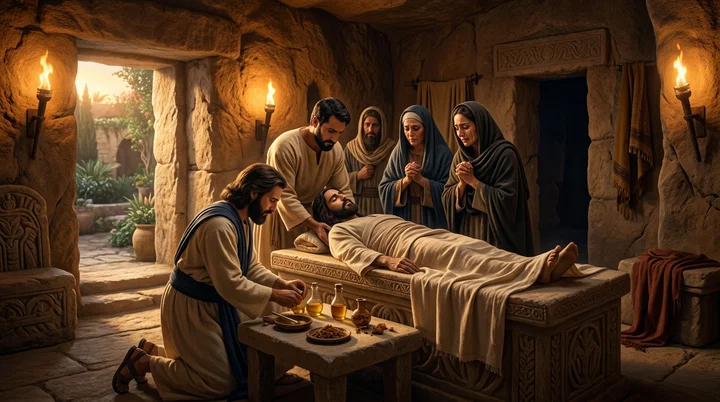
The burial took place in the evening at the close of the preparation day, the day before the Sabbath.ST Aug 1, 18785RED 95.2COS 166.1–2 By the time evening came His body had already been placed in a tomb, and He was left at rest there as the Sabbath began.5RED 95.2 This belongs to the account of His death and burial in which, after He had died, Joseph asked Pilate for His body so it could be buried.ST Aug 1, 1878
He died as the mysterious darkness ended.ST Aug 1, 1878 His unusually early death surprised Pilate.ST Aug 1, 1878 There was a risk that His burial would be dishonorable, and His followers feared it.ST Aug 1, 1878COS 166.1–2 The dishonored place that was feared was one reserved for those executed for opposing Roman rule.COS 166.1–2 That fear was answered by an honorable burial.ST Aug 1, 1878COS 166.1–2 Joseph and Nicodemus determined to give Him that honorable burial.ST Aug 1, 1878
Sources
Pioneers and periodicals
59 sources
The evening was the close of the preparation day, the sixth day of the week, the day before the seventh-day Sabbath.ST Jan 17, 1911ST Aug 22, 1916RH Nov 30, 1916 It is called the preparation because it was used to make ready food and other necessities for the Sabbath.ST Mar 16, 1915 The Sabbath that followed was the weekly seventh-day Sabbath of the Lord kept according to the commandment, not a merely ceremonial sabbath.RH Feb 7, 1871ST Feb 3, 1881RH Aug 12, 1875 Christ was crucified on that sixth day before the Sabbath and rose the third day on the first day after the Sabbath, and that Sabbath was a high day because the Passover sabbath and the weekly Sabbath fell together.RH Mar 15, 1860RH Aug 5, 1852ST Apr 26, 1905RH Jan 10, 1871 Those who held a differing reckoning taught that the burial at even was before a ceremonial Sabbath with the crucifixion on the fourth day of the week, proving two Sabbaths while He lay in the tomb.RH Apr 12, 1860RH Oct 4, 1864ST Jan 31, 1911 The sixth day remains the preparation for the Sabbath, when ordinary work is finished and food is prepared so the holy time can be entered without confusion.RH May 12, 1863ST Apr 19, 1877RH Oct 15, 1861
Evening and Preparation Meaning
The day is called the preparation because it was used to make ready for the Sabbath, and preparation means making ready food and other necessities for the Sabbath.ST Mar 16, 1915 The even was the close of the preparation day, the sixth day of the week and the day before the Sabbath, supplying the timing of the events surrounding the crucifixion and burial.ST Jan 17, 1911RH Nov 30, 1916ST May 1, 1884ST Sep 11, 1893 In the burial account this preparation day before the seventh-day Sabbath is Friday before Saturday, with the crucifixion on the day before the Sabbath and the Sabbath that followed the seventh day, Saturday.ST Aug 22, 1916ST May 1, 1884ST Mar 11, 1886
Preparation work was made toward the close of the sixth day, and labor ceased about the time of the evening sacrifice at 3 p.m., with all working from that hour until sunset to get completely ready so the holy time could be entered without confusion and with reverence and respect.RH Sep 13, 1864RH Nov 4, 1858 Food was prepared because there was no cooking on the Sabbath, and personal and household needs were attended to, including washing of face, hands and feet, trimming the beard, and other care for orderly and decent appearance.RH Sep 13, 1864RH Nov 4, 1858 A little before sunset the Sabbath candle was lighted in each house in gladness at the approach of God's day, followed after dark by a better than common supper begun by blessing God over wine and hallowing the Sabbath.RH Sep 13, 1864RH Nov 4, 1858
Evening here is the first of the two evenings reckoned by the Jews, beginning about the ninth hour or 3 p.m. and continuing until sunset, covering the hours between 3 and 6 p.m. devoted to special Sabbath preparation.RH Jan 17, 1856RH Jan 9, 1872 The word when is not in the original, the phrase being simply evening being come.RH Jan 9, 1872 Joseph obtained the body at that hour and the burial occurred on the same crucifixion day before sunset and the beginning of another day, in keeping with the law that a criminal must not hang on the cross till another day, so the verse does not decisively establish that the day begins at sunset.RH Jan 17, 1856RH Jan 9, 1872
The Bible does not name that burial day Friday, though it places the burial on the sixth day, the day before the weekly Sabbath.ST Apr 26, 1905 The sixth day was named in relation to the Sabbath and was called Sabbath Eve, the Preparation Day, the Sixth Day to the Sabbath.STST Jun 18, 1902 The Bible names the days First Day, Second Day, and so on to the Sabbath, so the sixth day by its name points to the commanded holy day.ST Jun 18, 1902
Burial Circumstances Described
The burial took place at the approach and close of the preparation day as the Sabbath drew on, so it was hurried.ST Aug 1, 1878ST Feb 1, 1899ST Jan 31, 1911 The body was taken down from the cross, wrapped in clean linen with spices, laid in a tomb, and rested there only until called back to life.ST Aug 1, 1878 It still lay resting there after midnight.ST Jan 31, 1911
Two rich and honorable friends and countrymen, Joseph and Nicodemus, braved public sentiment to give an honorable and decent burial and to spare him the ignominious burial given to Jewish criminals in the Valley of Hinnom among the unclean dust heaps and ashes of burned temple offal, where culprits were not permitted to lie in the common burial place.ST Aug 1, 1878ST Apr 8, 1903ST Feb 1, 1899 They begged the governor for the body, and Joseph waited on Pilate and procured it, possibly by offering money for it.ST Apr 8, 1903ST Feb 1, 1899 They bought a linen cloth and about a hundred pounds of aloes, myrrh and other aromatic substances, wrapped the body in them, and laid it in Joseph's own new rock-hewn tomb at no great distance away that had never been used.ST Apr 8, 1903ST Feb 1, 1899 The grave was closed with a great stone and officially sealed with the government seal, and a few near friends tenderly bore him there while some lingered as mourners until Sabbath requirements drew them reluctantly home to let him sleep through God's appointed rest after winning for the world the way into eternal joy.ST Apr 8, 1903ST Feb 1, 1899 The burial seemed to close the matter forever, but it was only just begun.ST Apr 8, 1903
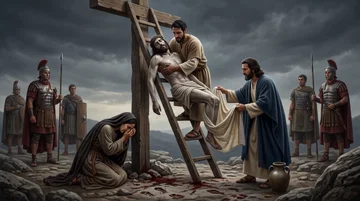
After Jesus died as the mysterious darkness ended, Joseph asked Pilate for the body so it could be buried.ST Aug 1, 1878ST May 13, 1903 Pilate marveled at the unusually early death and called the centurion to inquire if it were really true, since victims of crucifixion customarily did not die in under two or three days.ST Aug 1, 1878ST May 13, 1903 Jesus died that quickly of a broken heart, shown by his piercing cry when his Father's face was hidden and by the blood and water that gushed when his side was pierced, while the two malefactors were not yet dead.ST May 13, 1903 The Jews had asked that the legs be broken and the bodies removed because they hung in a very public place and they did not want the spectacle on that high Sabbath day, but breaking the legs would prevent escape and would not cause death that day nor necessarily at all, so there is no evidence the converted thief died on the same day Christ died.ST May 13, 1903 Giving the body to friends for burial in the evening was the law or custom with all Roman governors unless the criminal was infamous, and this small undesigned detail fits the customs, opinions and institutions of that time and gives evidence for the truth of the Gospel history of the trial, execution and burial.RH Feb 11, 1862 Soldiers were assigned to oversee the burial, the tomb was later found empty, and the disciples proclaimed the foretold resurrection.RH Jul 16, 1861
Mary of Magdala, out of whom seven devils were cast and who had followed and ministered unto him in Galilee and was present during his last visit to Jerusalem, showed devoted faithfulness on that preparation evening before the Sabbath.ST Jul 7, 1898 She followed him to the cross and watched as he hung in silence under its agonies, and she followed him to the sepulcher to see where he was laid.ST Jul 7, 1898 She came early in the morning of the first day of the week to the sepulcher, and not finding her Lord lingered weeping, and the risen Saviour first revealed himself to her, and she brought the glad news to the unbelieving disciples, none following more devotedly or faithfully.ST Jul 7, 1898 Joseph of Arimathea's actions in this account are an example of faith, bold conviction, and fidelity overcoming fear of people and concern for reputation.RH Jul 1, 1902
Sabbath Day Identified
The Sabbath that followed the preparation was the weekly seventh-day Sabbath of the Lord kept according to the commandment, not merely a ceremonial sabbath.RH Feb 7, 1871ST Feb 3, 1881RH Aug 12, 1875 It was not a festival day, a land sabbath, or another ceremonial sabbath that expired by limitation at the cross.RH Mar 19, 1857 It is one of 59 New Testament mentions of the Sabbath of the Lord, matching the 81 Old Testament mentions of the same weekly Sabbath, showing the Sabbath of the Lord exists in the present dispensation as really as in the former dispensation.RH Mar 19, 1857 The day after the crucifixion, when the chief priests came to Pilate to ask for a guard, was that Sabbath.RH Aug 12, 1875
The burial on the preparation was followed by the Sabbath, and the first day of the week came after the Sabbath, which establishes the seventh day as the Sabbath.ST May 11, 1904 Together with the account of the women resting on the Sabbath and returning after it, the time of the burial on the preparation, the day before the Sabbath, marks the Sabbath observed by Christ's followers as the seventh day.ST Oct 26, 1904 The women's preparation of spices followed by their Sabbath rest shows that the Sabbath was the seventh day commanded in the fourth commandment, and their return with the spices on the first day of the week distinguishes that day from the Sabbath.ST Mar 30, 1888 The burial came before the Sabbath on which the women rested, and before the first day of the week when they came to the tomb with spices they had prepared on the evening of the burial.RH Jun 12, 1855 That Sabbath was the same Sabbath described in the Old Testament, on which the women rested according to the commandment in Exodus 20:8-11, and because it came immediately before the first day of the week it was the seventh day.ST Aug 27, 1885
The verse is one of fifteen New Testament allusions to the Sabbath that belong to the time after the crucifixion, and with the witness of the book of Acts written about thirty years after the crucifixion it proves the Sabbath is acknowledged by Inspiration as an existing institution in the gospel dispensation.RH Jan 19, 1860 It is one of the New Testament texts that identifies the seventh day as the Sabbath, showing that Sabbath is the inspired name of the seventh day in the Christian dispensation.RH Jun 5, 1860 The Sabbath during which Jesus lay in the tomb was a real day in the sequence of the week, not a day dropped from the calendar or replaced by the first day, and the seventh day continued to be mentioned in the sacred record afterward.ST Mar 4, 1889
Crucifixion Week Timeline
By itself the verse fixes the crucifixion day by its relation to the Sabbath, not by a weekday name, so the Sabbath must be taken as the fixed point from which the weekday is determined.RH Aug 5, 1852RH Jun 2, 1851RH Oct 4, 1853 If the Sabbath is Saturday, then the day before it, the preparation, is Friday.RH Aug 5, 1852RH Jun 2, 1851RH Oct 4, 1853 To insert another Sabbath between the crucifixion and the Lord's Sabbath would move the crucifixion back to Thursday, two days before the weekly Sabbath, contradicting the claim that it occurred on Friday.RH Aug 5, 1852RH Jun 2, 1851RH Oct 4, 1853 That Thursday reckoning cannot therefore be used to move the Sabbath or the resurrection forward and establish Sunday as the seventh day.RH Aug 5, 1852RH Oct 4, 1853
Christ was crucified on the sixth day before the Sabbath and rose the third day on the first day after the Sabbath, as he had foretold.RH Mar 15, 1860RH Jan 10, 1871RH Oct 21, 1873RH Mar 15, 1860 The weekly Sabbath meant here is proved because the day following the crucifixion scenes is called the first day of the week, and together with Mark 16:1-2 the account establishes that Jesus was crucified before the Sabbath and rose after it.RH Mar 15, 1860RH Aug 5, 1852 The day after the crucifixion, when the priests asked for a guard, was that same Sabbath.RH Mar 15, 1860 The phrases three days and three nights and after three days cover only parts of the first and third days according to Jewish usage.RH Mar 15, 1860
That Sabbath was a high day because the Passover sabbath and the weekly Sabbath fell together on the same day that year, and the preparation was also the preparation of the Passover.RH Mar 15, 1860ST Apr 26, 1905 The crucifixion Friday is identified with the fourteenth of Nisan and was not itself observed with the special sacredness of the first day of unleavened bread, with the fifteenth of Nisan, the first day of unleavened bread, coinciding with the seventh-day Sabbath.RH Apr 15, 1873 In this weekly timing the Passover lamb was killed late on the fourteenth and eaten that night beginning the fifteenth, a yearly Sabbath.ST Dec 23, 1903 Another reckoning places that Friday on the fifteenth day of the month and the following Sabbath on the sixteenth, the first day of the count to Pentecost.ST Mar 11, 1886
Those who held a differing reckoning taught that the burial at even on the preparation was before the Jews' high ceremonial Sabbath, not the weekly commandment Sabbath, with the crucifixion on the fourth day of the week.RH Apr 12, 1860 On that view the evening burial fixes the exact beginning of the three days and three nights in the heart of the earth, counted evening to evening to end at even on the seventh-day Sabbath before the first day began, proving two Sabbaths occurred while Jesus lay in the tomb.RH Apr 12, 1860 The Sabbath following the crucifixion is thus described as a unique day with Jesus lying at rest in the tomb, when the midst of the week had fully come.ST Jan 31, 1911 On this view the commonly received placement of the crucifixion on the sixth day is questioned, the verse itself does not say Christ was buried on Friday, and the Bible nowhere states that Christ was in the grave three days and three nights.RH Oct 4, 1864ST Feb 8, 1905
Sabbath Doctrine Established
The day of Jesus' death is the preparation day, the day before the Sabbath, and the Sabbath followed the crucifixion and remained in observance and was not abolished at the cross.RH Apr 7, 1851 The day of the crucifixion was not set apart for sacred observance, even though it is more momentous than the other days of his history because in his death he showed his love for humanity.RH Feb 13, 1872 The crucifixion and the resurrection have their own memorials, and Jesus was raised the day after the Sabbath without that raising transferring sacredness to another day.RH Feb 13, 1872
His statement that his work was finished belongs to the day before the Sabbath, identified as the preparation day.RH Jun 24, 1852 On that day he shed his blood and completed redemption, which gives that day a stronger connection to commemorating his death than the first day of the week has.RH Jun 24, 1852
Sabbath Preparation Applied
The sixth day is the preparation day before the Sabbath, and it remains so now with no less need than in ancient times because the Sabbath remains of perpetual obligation.RH May 12, 1863ST Apr 19, 1877RH Oct 15, 1861 It is to be set aside for getting ready for the seventh-day Sabbath rather than treated as an ordinary workday.RH May 12, 1863ST Apr 19, 1877RH Oct 15, 1861 On it ordinary chores and business are finished and food is prepared beforehand so that work that could have been done in advance is not left to be done on the holy day.RH May 12, 1863ST Apr 19, 1877RH Oct 15, 1861 The food prepared on the preparation day is for man and domestic animals to eat on the Sabbath day, while other work such as the farmer's work in the field, the miller and machinist's work, and the businessman's business can simply stop at once and wait until the Sabbath is past.RH Oct 15, 1861 In this way the holy time can be entered without confusion and with reverence.RH Oct 15, 1861
Friday is the day to finish ordinary work and make everything ready for the holy Sabbath, including home, meals, and family, so that people can rest from their labor as God did.RH May 16, 1912 Since the Sabbath begins at evening as the sun sets, the day's work and household preparations are completed beforehand for a restful Sabbath.RH May 16, 1912
Sources