John 19:42
There laid they Jesus therefore because of the Jews’ preparation day; for the sepulchre was nigh at hand.
Translations
There laid they Jesus therefore because of the Jews’ preparation day; for the sepulcher was near at hand.
King James Version, KJV Cambridge Paragraph Bible
There laid they Jesus therefore because of the Jews’ preparation day; for the sepulchre was nigh at hand.
There they laid Jesus therefore, because of the Jews' preparation - day, for the sepulcher was nigh at hand.
Revised Version, American Standard Version
There then because of the Jews’ Preparation ( for the tomb was nigh at hand) they laid Jesus.
there, therefore, because of the preparation of the Jews, because the tomb was nigh, they laid Jesus.
There therefore, on account of the preparation of the Jews, because the tomb was near, they laid Jesus.
So, there, by reason of the preparation of the Jews, because, near, was the tomb, laid they Jesus.
Berean Standard Bible, Majority Standard Bible
And because it was the Jewish day of Preparation and the tomb was nearby, they placed Jesus there.
Then, because of the Jews’ Preparation Day ( for the tomb was near at hand), they laid Jesus there.
So they put Jesus there, because it was the Jews' day of getting ready for the Passover, and the place was near.
There then laide they Iesus, because of the Iewes Preparation day, for the sepulchre was neere.
Douay-Rheims (Challoner revision)
There, therefore, because of the parasceve of the Jews, they laid Jesus, because the sepulchre was nigh at hand.
Pictures
Cross-references 20 of 40
- Luke 23:50-53
And, behold, there was a man named Joseph, a counsellor; and he was a good man, and a just:
Gives a parallel account of Jesus being placed in a tomb.
- Matthew 27:59-60
And when Joseph had taken the body, he wrapped it in a clean linen cloth,
Joseph wraps Jesus’ body and lays it in his own tomb.
- Mark 15:42-46
And now when the even was come, because it was the preparation, that is, the day before the sabbath,
Jesus is buried before the Sabbath in a nearby tomb.
- John 19:31
The Jews therefore, because it was the preparation, that the bodies should not remain upon the cross on the sabbath day, ( for that sabbath day was an high day,) besought Pilate that their legs might be broken, and that they might be taken away.
The bodies were to be removed before the approaching high Sabbath.
- Luke 23:56
And they returned, and prepared spices and ointments; and rested the sabbath day according to the commandment.
Records the Sabbath during the time Jesus lay in the tomb.
- John 20:1
The first day of the week cometh Mary Magdalene early, when it was yet dark, unto the sepulchre, and seeth the stone taken away from the sepulchre.
The tomb is found empty on the first day of the week after the Sabbath.
- Mark 16:1-2
And when the sabbath was past, Mary Magdalene, and Mary the mother of James, and Salome, had bought sweet spices, that they might come and anoint him.
The women came to Jesus’ tomb with spices after the Sabbath.
- Luke 23:54
And that day was the preparation, and the sabbath drew on.
Jesus’ burial took place on the preparation day as the Sabbath drew near.
- 1 Corinthians 5:7
Purge out therefore the old leaven, that ye may be a new lump, as ye are unleavened. For even Christ our passover is sacrificed for us:
Christ is identified as the Passover sacrifice.
- Matthew 27:66
So they went, and made the sepulchre sure, sealing the stone, and setting a watch.
The tomb is sealed and guarded after Jesus is buried.
- Luke 24:1
Now upon the first day of the week, very early in the morning, they came unto the sepulchre, bringing the spices which they had prepared, and certain others with them.
The women returned to Jesus’ tomb on the first day after the Sabbath.
- Isaiah 53:9
And he made his grave with the wicked, and with the rich in his death; because he had done no violence, neither was any deceit in his mouth.
Jesus’ burial in a rich man’s tomb fulfills the prophecy.
- Matthew 28:1
In the end of the sabbath, as it began to dawn toward the first day of the week, came Mary Magdalene and the other Mary to see the sepulchre.
The women visit Jesus’ tomb after the Sabbath, on the first day of the week.
- Leviticus 23:5
In the fourteenth day of the first month at even is the LORD’s passover.
The fourteenth-day Passover date fits the burial chronology and its fulfillment in Christ.
- Exodus 20:10
But the seventh day is the sabbath of the LORD thy God: in it thou shalt not do any work, thou, nor thy son, nor thy daughter, thy manservant, nor thy maidservant, nor thy cattle, nor thy stranger that is within thy gates:
The seventh day was the Sabbath observed after Jesus’ burial.
- Mark 15:45-46
And when he knew it of the centurion, he gave the body to Joseph.
Joseph obtains Jesus’ body, wraps it, and lays it in a tomb.
- Matthew 27:45-50
Now from the sixth hour there was darkness over all the land unto the ninth hour.
Places the darkness and Jesus’ death later that day.
- Matthew 12:40
For as Jonas was three days and three nights in the whale’s belly; so shall the Son of man be three days and three nights in the heart of the earth.
Its three-days-and-nights statement is explained by the burial and resurrection chronology.
- Matthew 27:57
When the even was come, there came a rich man of Arimathæa, named Joseph, who also himself was Jesus’ disciple:
Describes Joseph coming to claim Jesus’ body in the evening.
- Matthew 27:62
Now the next day, that followed the day of the preparation, the chief priests and Pharisees came together unto Pilate,
Identifies the day of the crucifixion as preparation day.
Commentary
Each commentary is drawn from primary sources: the writings of Ellen G. White and Adventist pioneers and periodicals. Each commentary is separate. Its own words are not a quotation; follow the references to read the source passages.
Ellen G. White
13 sources
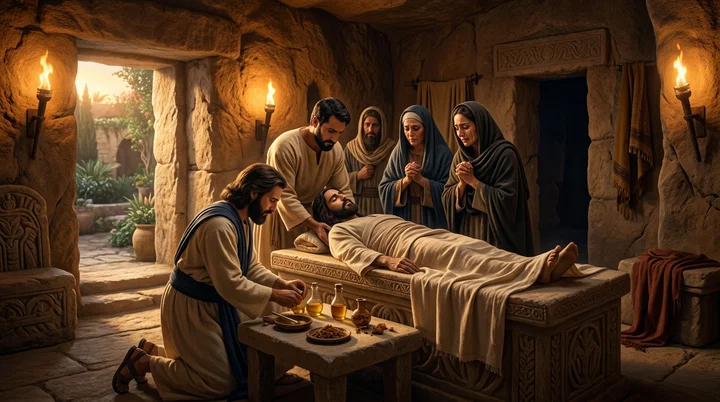
Because the Jews' preparation day was ending, Jesus was laid without delay in a tomb close at hand.ST Aug 1, 18783SP 176.1SG1 64.1 It was Joseph's new sepulchre near Calvary, never used before, where Joseph and Nicodemus wrapped His body in linen with spices and laid it, the stone was rolled to the entrance while the women watched and remained nearby in grief, and angels guarded the resting place.ST Aug 1, 18783SP 176.1SG1 64.1 This secured for Him an honorable burial, contrary to the Roman custom by which common soldiers took down those executed for alleged treason and buried them in a ground reserved for condemned criminals.ST Aug 1, 1878EW 148.25RED 93.15RED 92.2 The prompt burial nearby spared His body from that dishonored place reserved for enemies of Roman rule and fulfilled the prophecy that He would be with the rich in His death, while because no one had been laid there before the evidence of His burial was made clear.ST Aug 1, 18783SP 173.2COS 166.1–2Ms 103, 1897, par. 19 The spices applied to prevent decay were unnecessary because His body was not to see corruption, and the tomb in Joseph's keeping was the place where He lay in state after His execution.Ms 103, 1897, par. 19ST Nov 8, 1883
Burial Time and Place
Because the Jews' preparation day was ending, Jesus was laid in a tomb close at hand, so the burial had to be done promptly and without delay.ST Aug 1, 18783SP 176.1SG1 64.1EW 148.25RED 95.2 The nearness of the sepulchre made that hasty burial possible before the Sabbath.ST Aug 1, 18783SP 176.1SG1 64.15RED 95.24RED 18.3–19.2 The tomb used was Joseph's own new sepulchre near Calvary, which had never held anyone before.ST Aug 1, 18783SP 176.1SG1 64.1EW 148.25RED 95.2 It was previously unused, and no one had ever been laid there.ST Aug 1, 18783SP 176.1SG1 64.15RED 95.24RED 18.3–19.2
Joseph of Arimathea secured the body, and together Joseph and Nicodemus performed the final rites.ST Aug 1, 18783SP 176.1EW 148.25RED 95.24RED 18.3–19.2 They wrapped it in linen, in fine linen with spices, and laid it in the tomb.ST Aug 1, 18783SP 176.1EW 148.25RED 95.24RED 18.3–19.2 The stone was then rolled to the entrance, to close it against the entrance.ST Aug 1, 18783SP 176.1SG1 64.15RED 95.2 The women watched this, staying until they saw the body laid there and the stone in place, and remained nearby in grief.ST Aug 1, 18783SP 176.1SG1 64.15RED 95.2
This took place against the Roman custom for those executed for alleged treason, by which common soldiers took the bodies down and buried them in a burial ground reserved for condemned criminals who had received the death penalty.5RED 92.2 Angels guarded the resting place where Jesus was left at rest, waiting for the command to release him from the tomb.SG1 64.1
Honor and Prophecy Fulfilled
John 19:42 shows that Jesus was given an honorable burial, for Joseph of Arimathea and Nicodemus secured his body for that purpose.ST Aug 1, 1878EW 148.25RED 93.13SP 173.2 Joseph secured the body and had it wrapped in fine linen and laid in his own new tomb close at hand.ST Aug 1, 1878EW 148.2 That honorable burial was secured instead of the dishonored burial otherwise feared for those executed as criminals.ST Aug 1, 18785RED 93.13SP 173.2 The prompt laying of the body in the nearby tomb kept it from the burial ground reserved for executed criminals.ST Aug 1, 18783SP 173.2COS 166.1–2 That ground was the dishonored place appointed for those put to death as enemies of Roman rule.ST Aug 1, 1878COS 166.1–2
His laying in the nearby sepulcher without delay fulfilled the prophetic detail that he would be with the rich in his death.Ms 103, 1897, par. 19 The sepulcher was new and unused by anyone before, and for that reason the evidence of his burial was made clear.Ms 103, 1897, par. 19 The spices applied with the linen wrappings were intended to prevent decay.Ms 103, 1897, par. 19 They were unnecessary, because his body was not to see corruption.Ms 103, 1897, par. 19 The tomb in Joseph's keeping was the place where he lay in state after his execution.ST Nov 8, 1883
Sources
Pioneers and periodicals
49 sources
Jesus was laid in a tomb close at hand because it was the Jews' preparation day, and its nearness explains why that tomb was chosen.ST Jul 8, 1913ST Apr 17, 1879RH Mar 10, 1859 The burial was done the same day He died, in the afternoon before evening brought the Sabbath, and it was performed hurriedly because the preparation day was ending and the Sabbath was drawing on.RH Mar 10, 1859RH Apr 7, 1851ST Feb 16, 1882RH May 5, 1874ST Feb 1, 1899 After His death Joseph of Arimathea and Nicodemus received His body and wrapped it in linen with abundant spices in the Jewish manner, giving Him an honorable burial in a new tomb rather than the burial ground for criminals.ST Aug 1, 1878ST Jul 8, 1913ST May 27, 1897ST Apr 8, 1903ST Feb 1, 1899 He died as the Passover on the fourteenth day of the first month, fulfilling the Passover type exactly as to time, and His burial in the tomb of a wealthy ruler fulfilled Isaiah's prophecy that His grave would be with the rich.RH Oct 30, 1855ST Aug 13, 1874RH Oct 29, 1914RH Oct 29, 1914 The burial was completed before the Sabbath began, He rested in the grave over the Sabbath and was raised on the first day, showing the Sabbath remained in force after the cross and distinguishing the preparation day and Sabbath from the first day that followed.RH Dec 4, 1855ST Jan 28, 1913ST Sep 12, 1900ST Mar 4, 1889
Burial Time and Place
Jesus was laid in a tomb close at hand because it was the Jews' preparation day, and the nearness of the sepulchre explains why that tomb was chosen.ST Jul 8, 1913ST Apr 17, 1879ST Mar 16, 1882ST Aug 13, 1874RH Jan 9, 1872 After He had died, Joseph of Arimathea and Nicodemus received His body from Pilate so they could embalm and bury Him, and He died and was buried that same day.ST Jul 8, 1913RH Mar 10, 1859 The burial therefore connects with the Sabbath and the first day that followed it, belongs to the account of His suffering and burial, and is linked to the fulfillment of the Passover lamb in Christ, allowing the burial to take place before the Sabbath began.ST Apr 17, 1879ST Mar 16, 1882ST Aug 13, 1874RH Jan 9, 1872 The burial was done the same day Jesus died, in the afternoon period called even, after His death at about three o'clock and before evening brought the Sabbath.RH Mar 10, 1859RH Apr 7, 1851 That even means the afternoon preparation period before evening began, not the start of the night.RH Apr 7, 1851
The burial was performed hurriedly because the preparation day was ending and the Sabbath was drawing on.ST Feb 16, 1882RH May 5, 1874ST Feb 1, 1899ST Sep 12, 1900 The preparation day was Friday, the day before the Sabbath, which explains how the first day of the week could be the third day from the start of His suffering.ST Apr 21, 1914ST Jan 28, 1913 Jesus rested in the grave over the Sabbath and was raised on the first day.ST Jan 28, 1913 The verse identifies the day only as the Jews' preparation day and does not by itself say it was Friday.ST Feb 8, 1905
The sepulchre was Joseph's new, previously unused, rock-hewn tomb in a garden near the place of crucifixion at Calvary, a little way outside Jerusalem.ST Aug 1, 1878ST Nov 6, 1901ST May 24, 1905RH Jul 1, 1873ST Apr 8, 1903 The body was wrapped with spices in linen and laid there, closed in with a great stone officially sealed with the government seal, and the entrance watched, with the women watching the stone close the entrance.ST Aug 1, 1878ST Apr 8, 1903 As the day wore to its close and declined, two wealthy men of His own nation, devoted disciples some of whom had not been known before that moment, asked the governor for His body, bought a linen cloth and a hundred pounds of aloes, myrrh and other aromatic substances, wrapped the body in them, and laid it in the rock-hewn tomb belonging to one of them, so that the burial seemed to close the incident when it had only just begun.ST Apr 8, 1903 The reported identification of that tomb is as Joseph of Arimathea's sepulchre.ST Aug 1, 1878ST May 24, 1905RH Jul 1, 1873ST Apr 8, 1903 The verse gives no basis for treating the tomb's location as holy.ST Nov 6, 1901
Mary supposed the use of the nearby tomb might be temporary and thought the gardener could tell her where the body had been placed, since she wanted to find a permanent resting place for Him.ST May 24, 1905 The verse is relevant to whether Jesus was laid face down in the tomb, but it does not prove that He was.RH Jan 1, 1875 If it did prove it, that would support burying people face down.RH Jan 1, 1875
Burial Participants and Manner
After Jesus had died, Joseph of Arimathea and Nicodemus received His body from Pilate and came forward to embalm and bury Him.ST Jul 8, 1913ST May 27, 1897ST Apr 8, 1903RH Jul 1, 1902 Their asking was bold, a final act of kindness showing genuine faith, holy courage and fidelity.ST Jul 1, 1880RH Feb 26, 1901RH Jul 1, 1902 While He was dying no friend dared to show himself, and at the crucifixion His other followers were scattered with blasted hopes and with poverty giving them little influence to turn the tide set against Him.ST Jul 1, 1880RH Feb 26, 1901 It was then, at His death, that the two were filled with holy courage and went forward to perform the last sacred rites of burial.ST Jul 1, 1880RH Feb 26, 1901
They wrapped the body in the Jewish manner in many folds of linen with abundant spices, including myrrh and aloes.ST Aug 1, 1878ST May 27, 1897 One reckoning is a linen cloth bought for the purpose and a hundred pounds of aloes, myrrh and other aromatic substances, with the loved form in snow-white linen and the face hidden under a napkin and shroud.ST Apr 8, 1903RH Oct 4, 1870 Through tears they looked upon the dead Master, drew the iron from the mangled hands and feet, disentangled the crown of thorns, lifted the drooping head, and bathed the bloody forehead.RH Oct 4, 1870 Then they bore the precious burden away and lowered Him into the tomb, while the women watched the stone close the entrance.ST Aug 1, 1878RH Oct 4, 1870
He was given an honorable, decent burial in a new tomb rather than the ignominious burial ground reserved for executed criminals.ST Aug 1, 1878ST Feb 1, 1899 The two who did this were wealthy men of His own nation, one of them the owner of the rock-hewn tomb, who provided the linen, the spices, and the grave.ST Apr 8, 1903RH Jul 1, 1902 He was the tomb's first occupant, laid there after a crucifixion marked by public contempt, and Joseph's willingness to give Him this resting place showed love and faith.RH Jul 1, 1902 Some of the devoted disciples who acted at the declining of the day had not been known before that moment.
Prophecy and Typology
Jesus died as Christ the Passover on the fourteenth day of the first month, on the very day the Passover lamb was slain.RH Oct 30, 1855ST Aug 13, 1874RH Dec 15, 1868 The spring types were fulfilled exactly as to time, with the grand event of the day meeting its antitype on the very day of the type.RH Oct 30, 1855 This fulfilled the Passover type, not a change of the Sabbath. The account of His death and His laying in the nearby sepulchre because it was the Jews' preparation day belongs to that Passover fulfillment in Christ.ST Aug 13, 1874
Mere preliminary and circumstantial burnt offerings did not prevent that exact timing on the day of the type.RH Oct 30, 1855 This establishes the principle that the grand work of the tenth day of the seventh month must likewise have its antitype commence on that day.RH Oct 30, 1855 The antitype may then extend forward a great distance.RH Oct 30, 1855
He was laid in a nearby tomb because the Jewish preparation day was at hand, and burial in the tomb of Joseph of Arimathea, a wealthy ruler, fulfilled Isaiah's prophecy that the Messiah's grave would be with the rich (Isa. 53:9).RH Oct 29, 1914 Though crucified with criminals and intended for an ignominious burial, He was buried with the rich.RH Oct 29, 1914 The prompt action of Joseph and Nicodemus frustrated that plan for disgrace.RH Oct 29, 1914
He was laid in the new rock tomb of Joseph in a garden close at hand to Golgotha, a little way outside the walls of Jerusalem.ST Jan 31, 1911 He lay there peacefully at rest through the Sabbath day following the crucifixion, a Sabbath unlike any other, solitary and alone in time.ST Jan 31, 1911 His lying in that tomb identifies Him as the Shiloh of Jacob and the Messiah of the prophets, proving the midst of the week had fully come.ST Jan 31, 1911
Sabbath Doctrine Proved
Jesus was laid in the tomb close at hand on the preparation day so that His burial could be finished before the Sabbath began, showing that the Sabbath and each day begin at evening.RH Dec 4, 1855 The preparation day was the day before the Sabbath, distinguishing that Sabbath from the first day of the week that came after it and identifying the Sabbath as the seventh day and the first day as the day after it.ST May 11, 1904RH Apr 21, 1874ST Mar 16, 1882 His burial is thus joined to the Sabbath and to the first day that followed it, with the Sabbath as the last day of the week and the next day named the first day.RH Apr 21, 1874ST Mar 16, 1882
Because the tomb was near, He was buried on Friday the preparation day, rested in the grave over the Sabbath, and was raised on the first day, which explains how the first day could be the third day from the beginning of His suffering.ST Jan 28, 1913 The burial took place before the Sabbath drew on, He then lay dead in the tomb during one seventh day, while His followers rested according to the commandment.ST Sep 12, 1900RH Mar 21, 1865 That burial on the preparation day after His death shows the Sabbath remained in force after the crucifixion, for the ceremonial system pointing forward to His death ended when He died, but the Sabbath commandment did not disappear from the week or cease to be recognized.ST Mar 4, 1889
The account of His being buried and resting there on Saturday the Sabbath does not mean He buried a Jewish part of the Sabbath in the tomb or transferred the Sabbath to another day, since Scripture makes no separation between the Sabbath and its day and no distinction between Jewish, Gentile, and Christian Sabbaths.ST Nov 12, 1885 The work of embalming His body could not be done on the Sabbath and was put off until the next convenient day, Sunday, which shows the Sabbath was observed and does not establish Sunday observance.ST Jan 31, 1911
Resurrection and Related Teachings
The verse marks burial after death as part of death for humanity, presenting Him as lying in a tomb close by because the preparation day was at hand.ST Aug 8, 1878ST May 25, 1904 He was truly dead, hanging dead upon a Roman cross and then lying dead within the tomb.ST May 25, 1904 His body lay in Joseph's tomb after being taken down from the cross, where He lay in state after His execution, and His later rising was a resurrection, not recovery from a swoon.ST Nov 8, 1883ST Jun 3, 1908
His death did not end the power in His Name, which to the astonishment of His crucifiers still wielded mighty influence over a large number of His followers and kept winning believers to the truth.ST May 25, 1904 He was laid in a new tomb near the place of crucifixion because the Jews' preparation day was at hand, yet His burial did not have the final power of the grave, for He rose, taking away its dread, and His burial provides the pattern for baptism as burial with Christ and rising to new life.RH Jul 1, 1873 The account of His suffering and burial to which the nearby tomb belongs is a means of overcoming pride and discontent.ST Apr 17, 1879 He died so poor He owned no grave and no sepulcher of His own until Joseph begged His body and gave it room for three days and three nights in his own new tomb, and Joseph won immortal honor not because he was rich and not because he was an honorable counselor but because he came and begged the body of Jesus and lent his tomb, crowning a life of poverty without covetousness and backing the command to take heed and beware of covetousness.RH Nov 4, 1873
At break of day three women groped along the shadowy way to Joseph's tomb and garden lying close at hand, the two Marys and Salome, each bearing a burden of fragrant store, the purest, richest, best spices the East possessed, nards and aloes to imbue the dead sepulchre through and through with vital odors.ST Aug 26, 1880 Christ did not need their gifts because He had risen, yet neither Mary regretted her offering nor did Salome fret over unused aloes, and they did not count as waste what they had brought their Lord.ST Aug 26, 1880 Their way home seemed the path to Heaven, and thenceforth they bore about on the robes they wore the clinging perfume everywhere.ST Aug 26, 1880
Practical Application Today
Joseph and Nicodemus used their means to provide Jesus a burial in an emergency, when the disciples were powerless to give Him the burial they felt He should have, and their generosity pleased Heaven and glorified God.RH Aug 27, 1901 They were men of wealth and influence who devoted their means and service to God in an important crisis and sustained His cause when His followers were scattered with blasted hopes and with poverty giving them little influence to turn the tide set against them, at a time when enemies hoped the crucifixion would prove fatal.RH Feb 26, 1901ST Mar 24, 1887 Their bold asking for the body and preparing linen and spices was a final act of kindness showing genuine faith, bold conviction, holy courage, and fidelity, presented as noble examples for believers to imitate.RH Jul 1, 1902RH Jul 1, 1902
Threatened disaster tests loyalty and develops character, calling men of means today to come forward likewise to wipe out debt and carry forward God's work instead of hoarding or investing in houses and lands and worldly enterprises.RH Feb 26, 1901 The two men showed a little sympathy and courage to the credit of the human race, just as Elijah stood alone before Ahab on Mount Carmel and as Moses stood alone at different times, for while Jesus was dying not a friend dared to show himself, but at His death they were filled with holy courage and went forward to perform the last sacred rites of burial.ST Jul 1, 1880 He who remembers and loves the dead King in the season of His shame and dishonor shall by that King be remembered when He comes again in His glory, and meet Jesus face to face in the change from the awful night at Calvary to the high noon of immortality.RH Oct 4, 1870
Believers cannot now bury the dead Christ but can live for the living Christ, since what is done for His people counts as done to Him because head and body are one and Christ and the church are one.RH Oct 4, 1870 Comforting, caring for, and blessing His people, or burying His poor friends as unto the Lord, is doing those kind deeds to the Lord Himself, and the King notes and records each act of love toward Himself or His own and will remember it when He comes in His kingdom and glory.RH Oct 4, 1870
Sources