Luke 24:5
And as they were afraid, and bowed down their faces to the earth, they said unto them, Why seek ye the living among the dead?
Translations
And as they were afraid, and bowed down their faces to the earth, they said to them, Why seek you the living among the dead?
And as they were afraid, and bowed down their faces to the earth, they said unto them, Why seek ye the living among the dead?
and as they were afraid, and bowed down their faces to the earth, they said unto them, Why seek ye the living among the dead?
And as they were afraid, and bowed down their faces to the earth, they said to them, Why seek ye the living among the dead?
and as they were affrighted, and bowed down their faces to the earth, they said unto them, Why seek ye the living among the dead?
and as they were affrighted and bowed down their faces to the earth, they said unto them, Why seek ye the living among the dead?
and on their having become afraid, and having inclined the face to the earth, they said to them, 'Why do ye seek the living with the dead?
And as they were filled with fear and bowed their faces to the ground, they said to them, Why seek ye the living one among the dead?
And, they becoming afraid, and bending their faces unto the ground, they said unto them—Why seek ye the Living One with the dead?
Berean Standard Bible, Majority Standard Bible
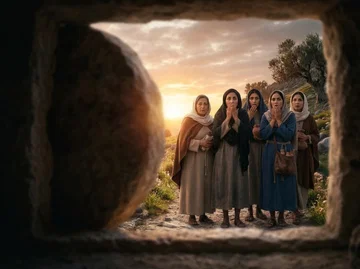
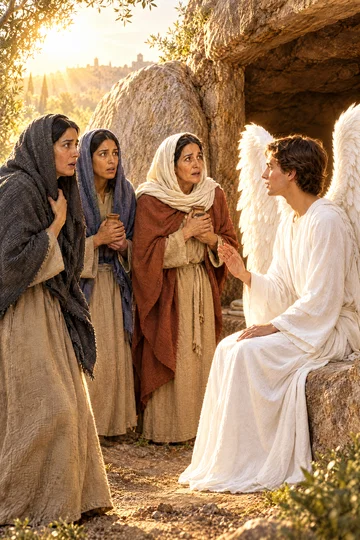
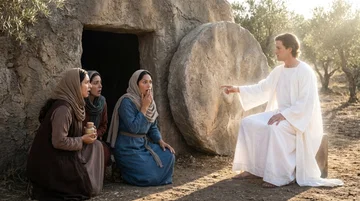
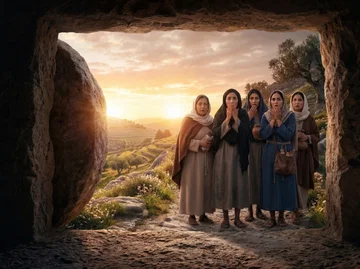
As the women bowed their faces to the ground in terror, the two men asked them, “ Why do you look for the living among the dead?
Becoming terrified, they bowed their faces down to the earth.The men said to them, “ Why do you seek the living among the dead?
And while their faces were bent down to the earth in fear, these said to them, Why are you looking for the living among the dead?
And as they were afraide, and bowed downe their faces to the earth, they sayd to them, Why seeke ye him that liueth, among the dead?
Douay-Rheims (Challoner revision)
And as they were afraid, and bowed down their countenance towards the ground, they said unto them: Why seek you the living with the dead?
Pictures
Cross-references 20 of 68
- Matthew 28:6
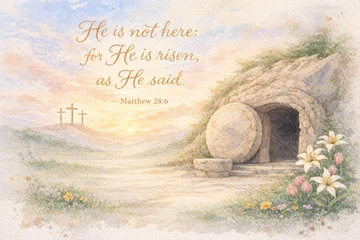
He is not here: for he is risen, as he said. Come, see the place where the Lord lay.
The angel declares that Jesus has risen and is not in the tomb.
- Mark 16:1-6
And when the sabbath was past, Mary Magdalene, and Mary the mother of James, and Salome, had bought sweet spices, that they might come and anoint him.
The women find Jesus’ tomb empty and are told he has risen.
- John 20:1
The first day of the week cometh Mary Magdalene early, when it was yet dark, unto the sepulchre, and seeth the stone taken away from the sepulchre.
Both accounts place the discovery of the empty tomb on the first day.
- Mark 16:14
Afterward he appeared unto the eleven as they sat at meat, and upbraided them with their unbelief and hardness of heart, because they believed not them which had seen him after he was risen.
Jesus appears to the disciples and rebukes their unbelief in the resurrection witnesses.
- Luke 23:56
And they returned, and prepared spices and ointments; and rested the sabbath day according to the commandment.
The women rested on the Sabbath before going to the tomb.
- Matthew 28:1
In the end of the sabbath, as it began to dawn toward the first day of the week, came Mary Magdalene and the other Mary to see the sepulchre.
Both accounts place the women’s visit to the tomb on the first day of the week.
- Luke 9:22
Saying, The Son of man must suffer many things, and be rejected of the elders and chief priests and scribes, and be slain, and be raised the third day.
Jesus foretold his suffering, death, and resurrection on the third day.
- Mark 16:6
And he saith unto them, Be not affrighted: Ye seek Jesus of Nazareth, which was crucified: he is risen; he is not here: behold the place where they laid him.
The angel announces that Jesus has risen and is not in the tomb.
- John 20:12
And seeth two angels in white sitting, the one at the head, and the other at the feet, where the body of Jesus had lain.
Angels at the tomb ask why the women seek the living among the dead.
- John 20:19
Then the same day at evening, being the first day of the week, when the doors were shut where the disciples were assembled for fear of the Jews, came Jesus and stood in the midst, and saith unto them, Peace be unto you.
Jesus appeared to the disciples that evening after his resurrection.
- Mark 16:9-11
Now when Jesus was risen early the first day of the week, he appeared first to Mary Magdalene, out of whom he had cast seven devils.
Mary reports seeing the risen Jesus, but the disciples do not believe her.
- Revelation 1:18
I am he that liveth, and was dead; and, behold, I am alive for evermore, Amen; and have the keys of hell and of death.
Christ declares that he was dead and is alive forever, victorious over death.
- John 11:25
Jesus said unto her, I am the resurrection, and the life: he that believeth in me, though he were dead, yet shall he live:
Christ’s resurrection confirms his declaration that he is the resurrection and the life.
- Luke 24:21
But we trusted that it had been he which should have redeemed Israel: and beside all this, to day is the third day since these things were done.
The disciples note it is the third day since Jesus’ death and remain disappointed that he has not redeemed Israel.
- 1 Corinthians 15:20
But now is Christ risen from the dead, and become the firstfruits of them that slept.
Christ is risen from the dead, the firstfruits of those who have died.
- Acts 2:24
Whom God hath raised up, having loosed the pains of death: because it was not possible that he should be holden of it.
Death could not hold Christ, so he was no longer in the tomb.
- Luke 24:1
Now upon the first day of the week, very early in the morning, they came unto the sepulchre, bringing the spices which they had prepared, and certain others with them.
The women came to the tomb on the first day, beginning the resurrection account.
- Matthew 28:2
And, behold, there was a great earthquake: for the angel of the Lord descended from heaven, and came and rolled back the stone from the door, and sat upon it.
An angel rolls away the stone at the tomb.
- John 20:26
And after eight days again his disciples were within, and Thomas with them: then came Jesus, the doors being shut, and stood in the midst, and said, Peace be unto you.
Jesus appears to the disciples after rising.
- Romans 6:4
Therefore we are buried with him by baptism into death: that like as Christ was raised up from the dead by the glory of the Father, even so we also should walk in newness of life.
Christ’s resurrection is linked with new life and celebrated in baptism.
Commentary
Each commentary is drawn from primary sources: the writings of Ellen G. White and Adventist pioneers and periodicals. Each commentary is separate. Its own words are not a quotation; follow the references to read the source passages.
Ellen G. White
18 sources
On the resurrection morning the women came with spices to anoint a dead body and found the stone rolled away and the body gone, and as they bowed in fear before shining angels they were asked why they sought the living among the dead, meaning Jesus was not dead but risen and the tomb and its spices were no longer the place to seek Him.COS 176.5–177.1Ms 115, 1897, par. 1–2Ms 115, 1897, par. 9–14DA 788.4–789.1SG1 71.2 The angels turned them back to His words in Galilee that He must be delivered, crucified and rise the third day, and remembering those words made the resurrection clear and sent them running with fear and great joy to tell the disciples He would go before them into Galilee.COS 176.5–177.1Ms 115, 1897, par. 1–2Ms 115, 1897, par. 9–14 The empty sepulchre with only the burial shroud left is evidence He does not remain among the dead, for called by His Father He came forth as a mighty Conqueror with power over death and the grave, declaring Himself the resurrection and the life amid trembling earth and adoring angels.ST Aug 15, 1878COS 173.5–174.1ST Nov 8, 1883Ms 203, 1898, par. 9Ms 83, 1910, par. 33–34 He was not left in the grave and does not lie in the sepulchre, but remains a living Saviour with the same power now whom the churches need to recognize.Ms 154, 1907, par. 5–7Ms 83, 1910, par. 33–34 Because He lives and is now making intercession by name before the Father, those whose sins are forgiven through His suffering and death must not live as though He were dead in gloom, but show by peace, happiness and joy that He is alive.Lt 100, 1910, par. 18Ms 83, 1910, par. 33–34Lt 84, 1886, par. 7–8
The Question at the Tomb
On the first day of the week after the crucifixion, early in the morning while it was still dark, the women came to the sepulchre bringing sweet spices to anoint the body of Jesus.SG1 71.2Ms 113, 1897, par. 1 They found the heavy stone rolled away from the door and the body gone, and their hearts sank with fear that enemies had taken it.SG1 71.2ST Nov 8, 1883 That day held everything to fill the disciples' hearts with rejoicing.Ms 113, 1897, par. 1
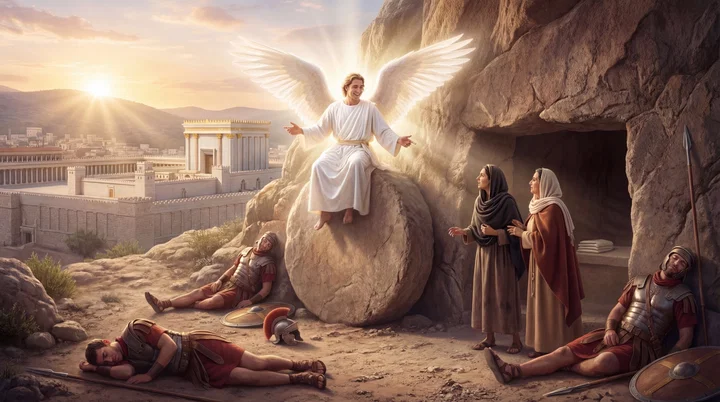
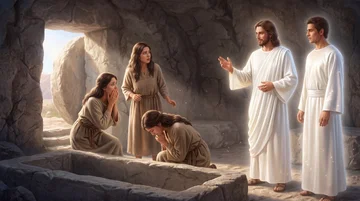
Two angels in white apparel with bright and shining faces stood by them inside the tomb, the light of heavenly glory still shining about them.DA 788.4–789.1SG1 71.2 The women were afraid and bowed their faces to the earth and turned to flee.COS 176.5–177.1DA 788.4–789.1SG1 71.2 A second angel in human form spoke to those who lingered, knowing they were seeking Jesus, and told them He was not there but had risen and pointed them to the place where He had lain.DA 788.4–789.1SG1 71.2
The question, Why seek ye the living among the dead, corrects their search and turns their attention from the dead to His resurrection.COS 176.5–177.13SP 199.1–200.16RED 17.1–18.2 It means Jesus is living and not dead, for He is risen, and He is not to be sought among the dead.Ms 115, 1897, par. 1–2Ms 115, 1897, par. 9–143SP 199.1–200.16RED 17.1–18.2DA 788.4–789.1 The tomb is not the place to seek Him, and the anointing spices are no longer needed.COS 176.5–177.1DA 788.4–789.1 The angels told them to go tell His disciples He would go before them into Galilee, and the women left frightened and astonished to carry what they had seen and heard to the mourning disciples.SG1 71.2
The angels pointed the women back to what Jesus had spoken in Galilee, that He must be delivered into the hands of sinful men and be crucified and suffer death and rise the third day.Ms 115, 1897, par. 1–2Ms 115, 1897, par. 9–146RED 17.1–18.2DA 788.4–789.1 Remembering those words made the resurrection clear, and the women repeated them again and again and gained fresh hope and courage.COS 176.5–177.13SP 199.1–200.16RED 17.1–18.2DA 788.4–789.1 They ran quickly to bring the disciples word with fear and great joy.COS 176.5–177.1DA 788.4–789.1 His words were meant to prepare His followers, but they had forgotten them; remembering His teaching would have preserved their faith and kept them from hopeless discouragement after His death.Ms 115, 1897, par. 9–14
The women reported that the body had been removed, that they had seen angels and the place where He had lain, and that they had met Jesus alive in the garden.Ms 113, 1897, par. 1DA 795.1 The angels had positively affirmed that Christ had risen from the dead.Ms 113a, 1897, par. 1Ms 113, 1897, par. 1 The disciples' difficulty believing shows how weak their faith had become, expecting no resurrection with only a vague understanding of rising from the dead influenced by the Sadducees' teaching and theories.Ms 113a, 1897, par. 1Ms 113, 1897, par. 1 For some it made a day of uncertainty, confusion and perplexity instead of rejoicing.Ms 113, 1897, par. 1
The Living Risen Saviour
The empty sepulchre is evidence that Jesus who had been crucified had risen and does not remain among the dead, for the stone was removed and His body was gone.ST Aug 15, 1878ST Nov 8, 1883 The disciples found the sepulchre empty with the burial shroud lying there but no body, and they afterward saw and spoke with the risen Christ and testified that He had risen.Ms 203, 1898, par. 9 Called by His Father, He came forth from the tomb as a mighty Conqueror, having earned power over death and the grave.COS 173.5–174.1Ms 83, 1910, par. 33–34 Life from heaven entered Him, angels rolled back the stone, and He walked forth declaring Himself the resurrection and the life, while the angelic host bowed in adoration and welcomed Him with songs of praise, and His presence shook the earth with trembling, lightning and thunder.COS 173.5–174.1Ms 83, 1910, par. 33–34
He was not left in the grave and is not lying in the sepulchre, but remains a living Saviour with the same power now, and the churches need to recognize that He lives.Ms 154, 1907, par. 5–7Ms 83, 1910, par. 33–34 His suffering and death make salvation possible, giving forgiveness of sins to those who repent and are converted, come to the Father through faith in Christ, and follow His example.Lt 100, 1910, par. 18 Through belief in the truth His suffering also makes sanctification possible.Lt 100, 1910, par. 18
Because He lives, believers must not act as though He were dead or live a gloomy religious life, but show by their lives that He is alive with peace, happiness and joy.Ms 83, 1910, par. 33–34Lt 84, 1886, par. 7–8 They are to trim their lamps and keep them burning and grasp infinity by living faith for a living issue in this world.Ms 83, 1910, par. 33–34 He is now making intercession for them and presenting their cases by name before the Father.Lt 84, 1886, par. 7–8
Sources
Pioneers and periodicals
89 sources
The women came very early on the first day of the week with spices to anoint Jesus, found the stone rolled away and His body gone, and were perplexed.RH Jan 17, 1856ST Mar 29, 1899 Two men in shining garments stood by them, and being afraid they bowed their faces to the earth, then heard why they sought the living among the dead, for He was not there but risen as He had said in Galilee that He must be crucified and rise the third day.ST Dec 3, 1894ST Apr 3, 1901RH Jan 17, 1856ST Mar 29, 1899 The question means He is living because He has risen and is no longer in the tomb among the dead, the very same Jesus who was crucified having burst the prison-house because death could not hold the Son of God who has life in Himself.ST Apr 11, 1911ST Apr 28, 1909ST Dec 3, 1894RH Dec 5, 1865 The account records only that they came to the sepulchre on the first day and He was not there; it does not say He consecrated that day, made it a Sabbath, or commanded it to be kept holy, and what was said and done that day shows it was not kept as a Sabbath.RH Jan 17, 1856RH Feb 13, 1872ST Jul 2, 1894ST Mar 18, 1889ST Jan 2, 1879 His vacant tomb is the sure foundation of hope that the dead will be raised to immortal life through Him, and He is not to be sought in dead tradition, formalism, and human creeds, but followed as the living Saviour going before His people.ST Jun 26, 1901RH Nov 3, 1904ST Jul 1, 1908
Scene at the Empty Tomb
The women came very early on the first day of the week bringing prepared spices and ointment to anoint and embalm Jesus, found the stone rolled away and the body of the Lord Jesus gone, and were perplexed and fearful.RH Jan 17, 1856ST Mar 29, 1899RH Sep 11, 1860ST Feb 7, 1911ST Feb 7, 1911 Their devotion brought them to the tomb despite friends' advice not to go, and brought them first to see the risen Jesus. Among them were Joanna and the other Galilean women, who were terrified at what they found.RH Sep 11, 1860
Two men in shining garments, heavenly messengers and angels, stood by them at the empty tomb after the stone was rolled away.ST Dec 3, 1894ST Apr 3, 1901RH Jun 6, 1865ST Mar 29, 1899 The women were afraid and bowed down their faces to the earth before them.ST Dec 3, 1894ST Apr 3, 1901RH Jun 6, 1865RH Oct 23, 1856RH Apr 20, 1905 Their fear turned to astonishment as sorrow and perplexity were changed by the message they heard.RH Apr 20, 1905
The angels asked why they sought the living among the dead, meaning the living Christ was not to be sought among the dead and the tomb was not the place to seek Him because He was alive.ST Dec 3, 1894ST Apr 3, 1901RH Jun 6, 1865RH Sep 11, 1860 They announced He is not here but is risen, as He had said, and that He had been crucified but was risen and no longer in the tomb.ST Dec 14, 1882ST Aug 22, 1878ST Mar 29, 1899ST Feb 22, 1899 They directed the women to remember His saying while yet in Galilee that the Son of man must be delivered into the hands of sinful men, be crucified, and rise again the third day, and remembering His words gave them fresh hope and courage.ST Dec 14, 1882ST Aug 22, 1878RH Jan 17, 1856ST Feb 22, 1899
The women were invited to see where He had lain and to tell His disciples that He would meet them in Galilee, and to carry the news to the disciples and Peter who would see Him in Galilee.ST Mar 29, 1899 The announcement is to be made to His disciples, and the women received it as a blessing and carried it to the sorrowing disciples in preparation for the later outpouring at Pentecost.ST Apr 11, 1911ST Nov 11, 1908 They received it with fear and great joy.ST Mar 29, 1899
Those who heard the report did not believe He was risen but counted the women's words as idle tales.RH Jan 17, 1856RH Oct 23, 1856 The disciples were astonished, perplexed, sorrowful, and slow to understand and expect the resurrection.ST Dec 3, 1874 Certain women had been early at the tomb and found not His body but had seen a vision of angels declaring that He was alive, and certain others went to the tomb and found it just as the women had said, but Him they saw not, and this report amazed the disciples on the way to Emmaus.ST Apr 4, 1900 The two disciples journeyed to Emmaus on business on the first day of the week, and the first meeting of Jesus with His disciples came near the close of resurrection day after the two returned from Emmaus.ST Mar 18, 1889RH Feb 25, 1862
The resurrection itself was not witnessed by the women or other followers; a hundred Roman soldiers were its witnesses, though it was a unique and majestic event.ST Feb 7, 1911 The different Gospel details about the resurrection, with one Gospel omitting what another records, do not make the accounts contradictory.ST Mar 5, 1912
He Is Risen Alive
The angels' question means Jesus is living because He has risen and is no longer in the tomb or among the dead, so the tomb is not the place to seek Him.ST Apr 11, 1911ST Apr 28, 1909ST Dec 3, 1894ST Apr 3, 1901RH Jun 6, 1865 The women were afraid and bowed their faces to the earth before the two men in shining garments, and the question pointed to the empty tomb and announced the resurrection to be carried to the disciples.ST Apr 11, 1911ST Dec 3, 1894ST Apr 3, 1901RH Jun 6, 1865 He is alive as He had foretold, and the question itself is the assurance of Christian hope in the resurrection of the dead.ST Apr 3, 1901ST Jun 26, 1901
The empty tomb with the body of the Lord Jesus gone proves the very same Jesus of Nazareth who was delivered to be condemned to death, crucified and buried rose again.RH Nov 21, 1854RH Dec 5, 1865 He died a literal death of the whole man with no soul or spirit surviving apart, and the identical personage who died rose to life again.RH Nov 21, 1854 The grave could not hold Him because He was the Son of God.RH Dec 5, 1865 He is the Righteous One whose righteousness is life, having life in Himself with power to lay down His life and take it again, so everlasting righteousness could not be held by the tomb or by death and life has no fellowship with death.ST Feb 17, 1898
He entered the tomb as a prisoner on behalf of others, but when the appointed time ended death could not hold Him. He burst the prison-house of the grave and rose on the appointed day as conqueror of sin and death, though sinless and guarded in a sealed tomb.RH Apr 20, 1905ST Aug 8, 1878ST Apr 8, 1903 His resurrection broke the power of death so no earthly authority could keep Him in the grave, death was driven back, and He will die no more.RH Jan 9, 1900 The women's sorrow and perplexity was thereby changed to astonishment.RH Apr 20, 1905
His resurrection was on the appointed third day as He had foretold, and the announcement recalls that prediction and reminds the women of His saying that He must die and rise on the third day.ST Apr 3, 1901ST Feb 17, 1898ST Aug 8, 1878ST Feb 22, 1899 The vacant tomb is evidence of a real, bodily, historical resurrection that happened at the grave, with the arrival of the angelic messenger and the removal of the stone revealing that His crucified body was gone.ST Aug 15, 1878ST Nov 8, 1883ST Jan 25, 1905 It is not merely a belief that death is vanquished and there is eternal life, for the grave and the appearances prove a real resurrection, and its credibility stands with the credibility of the Gospel witnesses whose testimony cannot be separated from it.ST Jan 25, 1905RH Jan 1, 1914
In contrast to the verse, the claim that His spirit was restored so He left the tomb bodily but later died naturally and His body returned to dust is false.RH Sep 8, 1853 The weight of teaching holds the empty-tomb account as factual evidence for the resurrection, while those who held otherwise taught that the empty-tomb story is not the primary evidence, which is seen instead in the Christian church's existence and spiritual life.ST Aug 15, 1878ST Nov 8, 1883ST Jan 25, 1905RH Jan 1, 1914RH May 11, 1916 The resurrection occurred in A.D. 31, the same year as His ascension.ST Sep 22, 1909
Resurrection Day and Sabbath
Christ rose from the dead on the first day of the week, the day after the Sabbath, three days from Friday's crucifixion and burial, having rested in the grave on the seventh day and rising on the morning of the first day to begin work.RH Jun 24, 1873ST Sep 23, 1913RH Apr 14, 1874RH Aug 13, 1857ST Dec 19, 1900 The time from Friday's burial to Saturday cannot amount to three days even when partial days are counted as whole days, so the resurrection did not take place on Saturday.RH Jun 24, 1873 The day after His sealing the new covenant with His blood on Friday is reckoned from Luke 24:21 as three days after, and therefore cannot be the Sabbath of the new covenant.ST Sep 23, 1913 The account marks the contrast between His resting on the seventh day after His earthly work was finished and His rising to begin work on the first day.ST Dec 19, 1900
The resurrection first became known on the morning of the first day of the week, when the stone was rolled from the sepulcher and the joyful morning proclaimed a risen Saviour.RH Feb 13, 1872RH Feb 25, 1862RH Oct 4, 1864 On that day He showed Himself to the Marys, to those on the way to Emmaus, to Peter at Jerusalem just before sunset, and then near its close to the eleven with Thomas absent after the two returned from Emmaus.RH Feb 13, 1872ST Oct 28, 1913RH Feb 25, 1862ST Apr 13, 1882 Whether the rising itself took place on the first day or the day before, the fact was first known on the first day, and it could not have been celebrated on a day before it was known, so only the first day could properly be used if the event were to be commemorated by keeping a day.RH Oct 4, 1864
The account records only that they came to the sepulcher on the first day and He was not there, not as a recorded fact that He rose on that day, and it gives no intimation that the day was thenceforth to be regarded as a Sabbath or to be observed in any manner.RH Jan 17, 1856ST Jan 2, 1879ST Aug 6, 1912RH Nov 21, 1871RH Aug 19, 1852 It does not say He consecrated that day, made it a Sabbath, set it apart for sacred purposes, or commanded it to be kept holy, and it shows no observance of the day in honor of the resurrection because those who heard the report did not believe He was risen and counted the women's words as idle tales.RH Jan 17, 1856RH Feb 13, 1872RH Nov 21, 1871 His resurrection appearances to show He was alive and risen, with His teaching and commission and the disciples' authority, do not establish the first day as a holy day.ST Aug 6, 1912RH Nov 21, 1871 No plain, unequivocal scriptural precept commanding that day to be kept holy is provided by the resurrection as a theological argument for its holiness.RH Aug 19, 1852
The resurrection does not prove that day to be the Lord's day, and Scripture gives the title of Lord's day to neither the day of resurrection nor the day of crucifixion, nor sets either day apart for sacred purposes.RH Feb 13, 1872 What was said and done on that first first day shows the character of its Sabbath-keeping and proves it was not kept as a Sabbath.ST Jul 2, 1894 It is described as a day of secular activity, anxiety, unrest, business travel, and unbelief rather than a holy day or day of worship, with two disciples traveling on business to Emmaus and Jesus Himself traveling on foot seven and a half miles and therefore not resting on that day.ST Jul 2, 1894ST Mar 18, 1889RH Dec 16, 1858ST Sep 10, 1896 The resurrection day cannot be called the Lord's day on the ground that the Lord rested on it.RH Dec 16, 1858 Although the women reported on Sunday morning the true report that Jesus was risen and they had seen Him, on Sunday night the disciples were still locked in an upper room utterly disheartened, hopeless, faithless, and filled with doubts and fears until the Emmaus witnesses confirmed the women's word and Jesus Himself appeared to dissipate doubt and sorrow, and the apostles did not yet believe when He appeared later that day so the account does not show they changed the Sabbath.RH Apr 14, 1874ST Mar 8, 1905
The resurrection has its appropriate memorial in baptism, not in keeping Sunday, while the crucifixion has its memorial in the Lord's supper.RH Feb 13, 1872 Commemorating Christ's resurrection by a day of observance would call for observing the day on which He rose, since a memorial should be observed on the day of the event it commemorates.RH Feb 13, 1872RH Mar 26, 1872 Christ's great act for man was not His resurrection but His death, and His exaltation came not at His resurrection but at His ascension forty days later when He led the disciples out to Bethany on the Mount of Olives and ascended on Thursday, the resurrection being necessary to His glorification but not that glorification itself.RH Feb 13, 1872ST Apr 13, 1882 Those three resurrection-day meetings did not make the first day sacred, and it is presumption to say they did, because the ascension manifestation in some respects the most important of all was not in honor of the first day and those later manifestations did not make the first day sacred.RH Feb 13, 1872ST Apr 13, 1882
The resurrection on the first day of the week is given as the reason later alleged for observing Sunday, honoring the day, ceasing from servile work, distinguishing the Lord's day, and keeping the weekly commemoration as distinct from the annual celebration.ST Dec 15, 1881RH Sep 26, 1912ST May 19, 1914RH Apr 20, 1911 The contrast between the day He lay in the tomb and the day of His resurrection is used to explain why Christians supposedly celebrated the resurrection day, but this does not establish divine authority or a command to change the Sabbath and does not establish that Sunday is the Sabbath or that the fourth commandment was changed, which identifies the seventh day as the Sabbath.ST Dec 15, 1881ST Aug 8, 1900 That resurrection on the first day is used to distinguish the Lord's day as solemn and to claim that all the glory of the Jewish Sabbath is transferred to it so the Lord's day must be kept as the ancients were commanded to keep the Sabbath.ST Sep 24, 1894 Sunday-keeping originated when Gentile Christians who as pagans had regarded Sunday as holy to the sun retained some of that reverence upon becoming Christians and used the resurrection as pretext and justification for connecting first-day observance with Christianity as a Christian festival, from patriotism, opportunity, and common expediency, not from any command of Christ or the apostles.ST Sep 24, 1894ST Jul 1, 1886 No writer during the first 300 years understood Christ or the apostles or the early church to have changed the Sabbath by this event.ST Sep 24, 1894
The resurrection is cited by those who hold it as divine warrant for changing the Sabbath from the seventh day to the first day of the week as the Christian Sabbath grounded in the fourth commandment.RH Jun 17, 1873 On that view His resurrection is the great work of redemption directing thoughts to things above, and the first day brings that work to mind as a fitting day for Sabbath observance.RH Jun 17, 1873RH Jun 17, 1873 Luke joins all four evangelists in particularly and formally pointing out the first day of the week as the day Christ rose, in the historian's own language naming the first day of the week while the persons whose words he records, including the angels at the sepulcher, speak of the resurrection only as on the third day from crucifixion and burial.RH Apr 1, 1873 This uniform difference between the historians' language and the recorded speech in histories written twenty to sixty years after the event proves the first day had become an honored and noted day among Christians when they were written.RH Apr 1, 1873
The day of Christ's resurrection on the first day of the week called Sunday, which comes just after the seventh day, is known and never doubted, so the seventh day immediately before it can be found by counting, proving Saturday is the true seventh day from creation and proving time has not been lost so no excuse remains for not keeping God's holy Sabbath. The Gospel account together with Luke 23:56 places the women's Sabbath rest before the events at the tomb and supports the continuity of the Sabbath day, showing the day had not been lost or changed.RH May 7, 1872 The same record that shows the disciples and the women bringing spices going to the sepulcher on the first day and finding it empty with Christ arisen and appeared shows they had kept the previous day as the Sabbath, giving no authority for changing the Sabbath from the seventh to the first day.ST Feb 4, 1903 Looking in the Bible for a change or repeal of any part of God's law to support keeping the first day is like seeking the living among the dead, and no such repeal can be found because the law cannot be made void but is as immutable as the eternal throne.RH Oct 18, 1870
Luke 24 records meetings between Jesus and His disciples on the first day of the week, and those accounts do not establish a first-day Sabbath.
Victory and Hope for Dead
The question at the tomb announces that Jesus is alive and is not to be sought among the dead, and His resurrection is the assurance of the Christian hope in the resurrection of the dead.ST Jun 26, 1901RH Nov 3, 1904 His vacant tomb is a sure foundation for Christian faith and a promise that the dead will be raised.RH Nov 3, 1904 That hope comforts those who mourn.RH Nov 3, 1904
His rising brings immortal life, and His followers, though they die, share His victory and will be raised.ST Jul 1, 1908 His resurrection makes the resurrection of the dead possible.RH Sep 16, 1915 The women had come expecting to anoint His dead body, but He had risen and would die no more.RH Sep 16, 1915
They should not seek the living Christ among the dead, for He had risen from the grave as the conqueror of sin and death.ST Apr 8, 1903 They had sought Him in the tomb because they expected to find Him dead, and were rebuked for looking for the living among the dead because He was not there. His resurrection broke the power of death so that no earthly authority could keep Him in the grave. Death was driven back and could not hold the living One.RH Jan 9, 1900
The rebuke for seeking the living Jesus among the dead in the tomb shows that the living are not to be sought where the dead are.RH Nov 18, 1858 To call from the grave for one who is not there would repeat that same ignorance.RH Nov 18, 1858 So Lazarus himself was in the grave when Christ called him forth, dead and asleep there, rather than an immortal soul called back from heaven.RH Aug 12, 1862RH Nov 18, 1858ST Jul 22, 1875
He is not to be sought at the tomb because He is risen as He said He would be.ST Feb 17, 1898 He is the Righteous One whose righteousness is life, having life in Himself with power to lay down His life and take it again, so the grave could not hold Him.ST Feb 17, 1898 He is a risen Savior, not a dead hope, and the tomb is a place to see that He is no longer there, not a place to worship or remain.ST Feb 17, 1898 He has gone ahead to Galilee, including Galilee of the Gentiles where people in darkness need Him and where He ministers through His agencies.ST Feb 17, 1898
Seeking the Living Saviour
The risen Christ is not to be looked for in dead tradition and formalism, in worn-out methods, or in human creeds and organizations, for a method that once carried divine life becomes an empty shell when that life is gone, and to lean on it for power or success is to look for the living where only the past remains. He is not found in dead doctrines and human traditions, in tombs and mausoleums, in cold resolutions, in lifeless theories of gospel work, or in institutions of stone and brick, but in faithful people who do His work and carry His living message.ST Apr 8, 1903 Nor is He to be sought in the tomb itself or in places where He once was, and contending to possess His tomb mistakes a dead place for the living Saviour.ST Feb 17, 1898 He is alive and goes before His followers, working among people in need who long for freedom from sin, for light and living words, for the Bread of Life and healing, and for the free course of His word, and there He is found.ST Feb 17, 1898ST Apr 7, 1909
The church looks to the empty sepulchre as proof that her Lord is risen and no longer among the dead, and because He goes before His people she follows Him ahead in the light of God's Word rather than defending past creeds, beliefs, failures, or mistakes, a light that can grow clearer over time.ST Apr 2, 1902 To treat the remains of the dead as a source of life, as in worshiping and kissing the bones of saints, is to seek life among the dead.RH Sep 28, 1911 The tomb has no power or life for believers, for the question turns seekers away from where His body had been laid toward the living Christ.ST Mar 18, 1913 The empty tomb is therefore not a place to grieve over dead hopes, since the Master of Life has risen and is to be followed.ST Dec 30, 1903
People may still look for Christ in the place of past disappointments and buried hopes while He has already gone ahead to blessings beyond what they knew, for sorrow and disappointment had obscured the truth of His resurrection from the women even as their continued seeking was pleasing to God.ST Nov 21, 1900 The call is to leave behind the dead past of sin and failure and follow the Master of Life, who covers past sins with His righteousness and gives power over sin and darkness.ST Dec 30, 1903 The question also rebukes fear and looking down in distress when God's Word gives reason for joy, for Jesus is a living Saviour directly accessible through faith in the living Word, needing no other priest to approach Him because He is Himself their priest.ST Apr 3, 1901
His resurrection brings hope to the sorrowful and doubting, for the risen Jesus draws near and makes Himself known and sends His followers to tell others that He lives, turning sorrow and perplexity to astonishment.RH Apr 20, 1905ST Mar 29, 1899ST Nov 27, 1893 Coming with spices to anoint a corpse, asking who would roll away the stone, and standing helpless at the empty tomb showed lack of living faith despite plain declarations of His death and resurrection, looking for a living Lord where only the dead are found; yet He met that weakness not with criticism but by enlightening and employing her to carry the Gospel message, teaching not to criticize the ignorant or weak in faith.ST Apr 10, 1901 The devotion of the women who went early with spices and ointment despite friends' advice not to go brought them first to the tomb to see the risen Jesus, counting nothing waste and carrying joy home to tell the tale.ST Aug 26, 1880 That same myrrh-bearing continues when women go forth by twos and threes at home and abroad through tragic darkness wherever the faintest rim of promise is seen, ministering for Him who rose and holding it joy to retell what the Marys told, every votive gift made worthy because its spices are bruised for Christ.ST Aug 26, 1880
That living message of the very same Jesus who was crucified and laid in the tomb, whom the grave could not hold because He was the Son of God, was to be told to John and Peter and then preached to every nation to dying men, and it stands joined to His promise to come again to take His people home so they will rise and meet Him in the cloud.RH Dec 5, 1865 Disappointment over unfulfilled expectation does not disprove a doctrine, for after His resurrection He met disciples sorely disappointed because they expected Him to be crowned as king and instead saw Him crucified, and proved from prophecy that His suffering fulfilled it; so Millerite disappointment over Christ's soon coming does not disprove His soon coming.RH Dec 8, 1874 The verse sets the living in contrast to the dead.ST Sep 20, 1910 An angel announced He had risen, giving assurance of His resurrection.ST Jul 29, 1913
Further points
The meetings between Jesus and His disciples are recorded in Luke 24.ST Oct 21, 1897 They took place on the first day of the week.ST Oct 21, 1897 Those accounts do not establish a first-day Sabbath.ST Oct 21, 1897
Sources