Luke 24:13
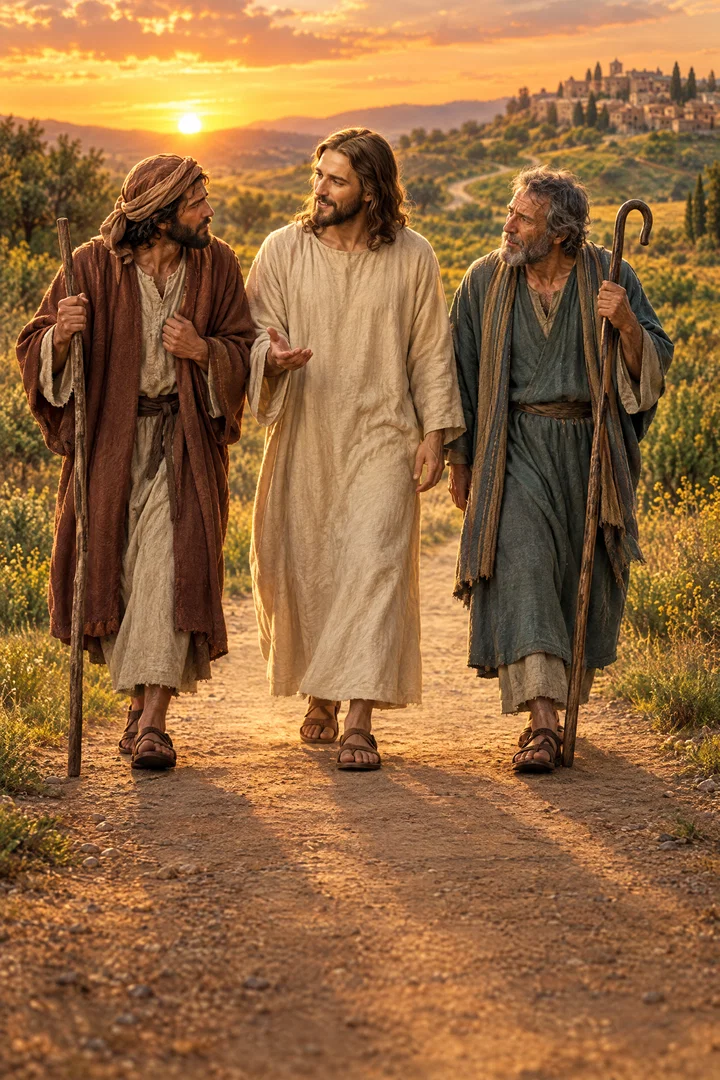
And, behold, two of them went that same day to a village called Emmaus, which was from Jerusalem about threescore furlongs.
Translations
And, behold, two of them went that same day to a village called Emmaus, which was from Jerusalem about three score furlongs.
And, behold, two of them went that same day to a village called Emmaus, which was from Jerusalem about threescore furlongs.
And behold, two of them went that same day to a village called Emmaus, which was from Jerusalem about threescore furlongs.
And behold, two of them went that same day to a village called Emmaus, which was from Jerusalem about sixty furlongs.
Revised Version, American Standard Version
And behold, two of them were going that very day to a village named Emmaus, which was threescore furlongs from Jerusalem.
And, lo, two of them were going on during that day to a village, distant sixty furlongs from Jerusalem, the name of which [is] Emmaus,
And behold, two of them were going on the same day to a village distant sixty stadia from Jerusalem, called Emmaus;
And lo! two from among them, on the selfsame day, were journeying unto a village, distant sixty furlongs from Jerusalem, the name of which, was Emmaus;
Berean Standard Bible, Majority Standard Bible
That same day two of them were going to a village called Emmaus, about seven miles from Jerusalem.
Behold, two of them were going that very day to a village named Emmaus, which was sixty stadia from Jerusalem.
And then, two of them, on that very day, were going to a little town named Emmaus, which was about seven miles from Jerusalem.
And beholde, two of them went that same day to a towne which was from Hierusalem about threescore furlongs, called Emmaus.
Douay-Rheims (Challoner revision)
And behold, two of them went, the same day, to a town which was sixty furlongs from Jerusalem, named Emmaus.
Pictures
Cross-references 20 of 30
- Mark 16:12-13
After that he appeared in another form unto two of them, as they walked, and went into the country.
Jesus appeared to two disciples as they walked in the country, and they told the others.
- Luke 24:26-27
Ought not Christ to have suffered these things, and to enter into his glory?
Christ explains how Scripture foretold his suffering and entry into glory.
- Luke 24:32
And they said one to another, Did not our heart burn within us, while he talked with us by the way, and while he opened to us the scriptures?
Their hearts burned as Jesus opened the Scriptures to them.
- Luke 24:33-36
And they rose up the same hour, and returned to Jerusalem, and found the eleven gathered together, and them that were with them,
The Emmaus disciples return to Jerusalem and report Jesus risen before he appears to the gathered disciples.
- Luke 24:1
Now upon the first day of the week, very early in the morning, they came unto the sepulchre, bringing the spices which they had prepared, and certain others with them.
Places the Emmaus journey on the day the women visited Jesus’ tomb.
- John 20:19
Then the same day at evening, being the first day of the week, when the doors were shut where the disciples were assembled for fear of the Jews, came Jesus and stood in the midst, and saith unto them, Peace be unto you.
Describes Jesus meeting the disciples later that same day.
- Luke 24:29-31
But they constrained him, saying, Abide with us: for it is toward evening, and the day is far spent. And he went in to tarry with them.
The disciples urge Jesus to stay, then recognize him when he breaks bread.
- Luke 24:21
But we trusted that it had been he which should have redeemed Israel: and beside all this, to day is the third day since these things were done.
The disciples recall their hope of Israel’s redemption and note that it is the third day since Jesus’ death.
- Luke 24:30-31
And it came to pass, as he sat at meat with them, he took bread, and blessed it, and brake, and gave to them.
The disciples recognize Jesus when he blesses and breaks bread.
- Matthew 28:1-10
In the end of the sabbath, as it began to dawn toward the first day of the week, came Mary Magdalene and the other Mary to see the sepulchre.
Records the resurrection and appearances on the first day of the week.
- Luke 24:36-43
And as they thus spake, Jesus himself stood in the midst of them, and saith unto them, Peace be unto you.
Jesus appears to the gathered disciples after the Emmaus report and eats before them.
- Luke 24:25-26
Then he said unto them, O fools, and slow of heart to believe all that the prophets have spoken:
Jesus rebukes their unbelief in the prophets’ words about his suffering and glory.
- Luke 23:54-56
And that day was the preparation, and the sabbath drew on.
The women rested on the Sabbath before traveling to Emmaus the next day.
- Luke 24:6-7
He is not here, but is risen: remember how he spake unto you when he was yet in Galilee,
The women recall Jesus’ prediction of his death and resurrection on the third day.
- Mark 16:1-2
And when the sabbath was past, Mary Magdalene, and Mary the mother of James, and Salome, had bought sweet spices, that they might come and anoint him.
Both accounts place events on the day after the Sabbath, the first day of the week.
- Luke 24:22-24
Yea, and certain women also of our company made us astonished, which were early at the sepulchre;
The women reported the empty tomb and angels declaring Jesus alive, while his disciples had not seen him.
- John 20:1
The first day of the week cometh Mary Magdalene early, when it was yet dark, unto the sepulchre, and seeth the stone taken away from the sepulchre.
Both describe the first day of the week at the sepulchre.
- Luke 24:28
And they drew nigh unto the village, whither they went: and he made as though he would have gone further.
Jesus shows willingness to travel onward with the disciples.
- Luke 24:17
And he said unto them, What manner of communications are these that ye have one to another, as ye walk, and are sad?
Jesus asks the disciples why they are sad as they walk.
- Luke 24:34
Saying, The Lord is risen indeed, and hath appeared to Simon.
Reports the risen Jesus appearing to Simon and the Emmaus disciples’ return.
Commentary
Each commentary is drawn from primary sources: the writings of Ellen G. White and Adventist pioneers and periodicals. Each commentary is separate. Its own words are not a quotation; follow the references to read the source passages.
Ellen G. White
50 sources
On the same day Jesus rose, the first day of the week, late in the afternoon toward evening, two earnest believing disciples left Jerusalem to return to their home in the village of Emmaus about eight miles away, elsewhere reckoned as about seven and a half miles.DA 795.1DA 795.2Ms 80, 1886, par. 7–126RED 24.2–25.26RED 31.3–32.1 They walked sadly in the shadow of the cross, perplexed, discouraged and hopeless over his crucifixion and disappointed hope that he would redeem Israel, talking of his death, the empty tomb, and that morning's reports of angels and of Jesus seen alive.DA 795.1DA 795.26RED 24.2–25.23SP 215.1–3COS 181.1–5 Jesus himself joined them on the rough road as an ordinary traveler, but grief and unbelief held their eyes so they did not recognize him.DA 795.2ST Sep 19, 1878ST Nov 14, 1878SG4 119.16RED 31.3–32.1 He purposely kept himself hidden and asked of their sadness so their faith would rest not on seeing him but on the Scriptures, then beginning at Moses and all the prophets opened the things concerning himself that Christ had to suffer and enter his glory, until their hearts burned within them with new hope and joy.ST Sep 19, 1878ST Nov 14, 1878ST Sep 19, 1878RH Mar 31, 1903ST Oct 30, 1884 At their home they urged him to stay, and when he blessed the evening meal they knew him by the wounds in his hands, worshiped him, and he vanished from their sight.ST Oct 6, 1909Lt 11, 1875, par. 1–46RED 31.3–32.1 Their joy then exceeded their former despair, and forgetting hunger and fatigue they retraced the same dark road that night back to Jerusalem to impart the light given on the way and rejoice together in a living Saviour risen from the dead.3SP 214.1–2ST Sep 19, 18783SP 215.1–3ST Sep 26, 1878ST Sep 26, 1878
Time, Place and Travelers
The journey took place on the same day Jesus rose, the first day of the week, late in the afternoon toward evening.DA 795.1DA 795.26RED 24.2–25.2COS 181.1–5Ms 113, 1897, par. 3 Two earnest believing disciples who had no prominent place in Christ's work went from Jerusalem to the village called Emmaus, a little town, returning to their home there.DA 795.16RED 24.2–25.23SP 215.1–33SP 206.1Ms 113, 1897, par. 3 Emmaus was about threescore furlongs, about eight miles, from Jerusalem.DA 795.16RED 24.2–25.23SP 206.1COS 181.1–5ST Oct 6, 1909 Those who reckoned it otherwise put it at about seven and a half miles away.6RED 31.3–32.1
They had come to Jerusalem to keep the Passover and attend the feast, and were now going home to meditate, pray, and seek light and understanding on what had happened.DA 795.16RED 24.2–25.23SP 206.1COS 181.1–5ST Sep 19, 1878 The road led through rugged mountains and rocky slopes, and was rough and uncertain.Ms 80, 1886, par. 7–123SP 215.1–3
Sorrow and Unrecognized Companion
They walked in the evening in the shadow of the cross, sad, perplexed, restless, unhappy, discouraged, disheartened, hopeless and faithless, weeping mournfully with gloomy forebodings for the future.DA 795.13SP 215.1–3COS 181.1–5Ms 113, 1897, par. 3Ms 113a, 1897, par. 2–4 Their hopes were blighted, so that they meant to take up their old employment again and conceal their disappointment as best they could.3SP 215.1–3 They were returning home to meditate and pray and seek light and understanding about what they could not understand.DA 795.1COS 181.1–5
As they went they talked over the trial and the crucifixion and their disappointed hope that Jesus would redeem Israel.DA 795.1DA 795.26RED 24.2–25.2ST Nov 14, 1878RH Mar 31, 1903 They talked of the removal of his body from the tomb and that morning's reports of the women who had seen angels and had met Jesus.DA 795.16RED 24.2–25.2 They had not gone far in discussing these events and struggling to understand his teaching.DA 795.2 Their journey gave them time to talk, meditate, and pray for understanding.6RED 24.2–25.2
They were burdened with grief and puzzled how his shameful death could fit his claims to be the Son of God.3SP 207.1–2 They feared the charge that he saved others but could not save himself might be true, despite the evidence he had given of knowing people's hearts.3SP 207.1–2 Their disappointment showed they had lost sight of the prophecies and promises concerning his suffering, and they had misunderstood those prophecies.RH Mar 31, 19033SP 209.1–210.1
Jesus joined them and walked with them, though they did not recognize him.DA 795.2ST Sep 19, 1878ST Nov 14, 18783SP 207.1–2ST Oct 30, 1884 Grief, disappointment, and unbelief held their eyes so they could not know him.DA 795.2ST Nov 14, 1878RH Mar 31, 1903ST Oct 30, 1884Ms 113a, 1897, par. 9 He appeared with no special marks identifying him as the Son of God, being the same size as before his crucifixion.SG4 119.1 They took him for another traveler returning home from the feast, weary as they were and with their eyes held.Ms 113a, 1897, par. 9 They knew him only when he made himself known to them.SG4 119.16RED 31.3–32.1Ms 113a, 1897, par. 9Ms 113, 1897, par. 18
Christ's Presence and Teaching
His walking beside them in humility shows that after His resurrection and ascension He still identifies with His suffering and perplexed people.ST Sep 19, 18783SP 212.1–26RED 30.1–2ST Oct 6, 1909 He is with them on their hardest paths with the same human sympathies and love He had before death.ST Sep 19, 18783SP 212.1–26RED 30.1–2 He comforts and helps them as educator and divine Teacher, opening the Scriptures concerning Himself and binding their hearts with holy, new, sacred hope and joy.6RED 30.1–2ST Oct 6, 190915MR 23.4 He is just as near to those in distress now, though they may not recognize His presence, to give peace and life to those who accept Him.Ms 80, 1886, par. 25–26
He purposely kept His true character hidden and delayed revealing Himself as risen.ST Sep 19, 1878ST Sep 19, 1878ST Oct 30, 1884 He asked what they discussed and why they were sad, rather than making Himself known at once.ST Oct 30, 1884 He did this because the joy of seeing Him again would have satisfied their souls and left them without hunger for the sacred truths of Scripture He wanted to impress indelibly on their minds.ST Sep 19, 1878 He kept His disguise until He had interpreted the Scriptures and led them to an intelligent faith, so they would receive lessons they would never forget and their joy afterward might be full.ST Sep 19, 1878ST Sep 19, 1878
He wanted their faith to rest not on His personal testimony but on firm root evidence.ST Sep 19, 18783SP 214.1–2 That evidence was that the typical law and the prophets of the Old Testament agreed with the facts of His life, character, mission to earth, death, and resurrection, giving unquestionable evidence of the truth.ST Sep 19, 18783SP 214.1–2 The truths they learned were meant to take firm root in them so they could share them with others.ST Sep 19, 18783SP 214.1–2
Beginning at Moses and in all the prophets He opened to them the things concerning Himself.ST Nov 14, 1878ST Oct 30, 1884SPBC 149.3 He explained why Christ had to suffer and enter His glory, because they had lost sight of and misunderstood the prophecies and promises of His suffering.ST Nov 14, 1878RH Mar 31, 1903ST Oct 30, 18843SP 209.1–210.1 He showed that the prophecies about the Messiah were fulfilled in His life and death in a connected chain extending from the patriarchs to their own time.3SP 209.1–210.1 In opening the Old Testament He revealed in its teachings a meaning its writers themselves had not seen, and opened their understanding so they could comprehend the Scriptures.ST Apr 4, 1906
Though they did not recognize Him, His words sank into their hearts for hours as He walked and talked with them by the way, teaching and comforting them.ST Sep 19, 18786RED 31.3–32.1 His teaching brought truth, comfort, and holy, new, sacred hope and joy to their discouraged hearts.15MR 23.46RED 31.3–32.1 Their hearts burned within them while He talked by the way and opened the Scriptures and as they contemplated His word.SPBC 149.3RP 15.2Lt 57, 1895, par. 33 Contemplating God's word and its teaching about Christ brings spiritual warmth, joy, and nourishment to the soul like this.RP 15.2Lt 57, 1895, par. 33
As evening approached they reached their home and urged Him and longed for Him to stay with them.ST Oct 6, 1909Lt 11, 1875, par. 1–4Ms 113, 1897, par. 18 When He blessed the evening meal they recognized Him by the wounds in His hands and the marks of the nails, and worshiped Him.6RED 31.3–32.1Ms 113, 1897, par. 18 He then vanished from their sight, having made Himself known to them before leaving them as proof He is a risen and living Saviour.ST Sep 19, 1878Ms 78, 1910, par. 30Ms 113, 1897, par. 18
Evidence for the Resurrection
The walk to Emmaus with its exposition from Moses and the prophets belongs with the empty tomb where the shroud and the napkin were left behind, with the testimony of the risen saints, with the testimony of the women, with Peter's testimony of his interview with the risen Lord, and with the revelation in the upper chamber to the eleven, and together they give abundant evidence that makes the resurrection certain.3SP 216.2Ms 203, 1898, par. 9Ms 94, 1897, par. 28–30 The two who went to Emmaus returned to Jerusalem with joyful tidings of the risen Lord and found the disciples assembled in excitement, with hope and faith struggling for ascendancy, having already heard Mary Magdalene and the other women, whom some were too hopeless to believe.3SP 216.2Ms 203, 1898, par. 9 Peter's ardent and assured testimony of his interview carried more weight with the brethren so that their faith began to revive, and when the two from Emmaus entered they were met by many voices exclaiming that the Lord is risen indeed and hath appeared to Simon.3SP 216.2
That combined evidence makes of none effect the priests' lie that his body was stolen.Ms 94, 1897, par. 28–30 His meeting the two disciples on the way and making himself known to them before leaving them proves he is a risen and living Saviour.Ms 94, 1897, par. 28–30Ms 78, 1910, par. 30
After he was revealed to them their joy exceeded their former despair, when their hearts had burned within them while he talked by the way and opened the Scriptures.3SP 215.1–3 They left Jerusalem depressed with blighted hopes, meaning to take up their old employment and conceal their disappointment, but they returned late at night to impart their newly found knowledge and rejoice together in a living Saviour risen from the dead.3SP 215.1–3ST Sep 26, 1878 Their joyful report helped revive the others' faith, showing how news of the resurrection replaced despair.3SP 215.1–3ST Sep 26, 18786RED 34.1–2 Christ's resurrection is the great truth around which all the faith and hope of the church center.3SP 215.1–3ST Sep 26, 1878
He was the same in size as before his crucifixion, with no special marks identifying him as the Son of God, and they knew him only when he made himself known to them.SG4 119.1 As he was known only when he made himself known, so those who come forth in the resurrection will be recognizable to loved ones and will know Christ.SG4 119.1Ms 80, 1886, par. 27 He walks beside sorrowing, despondent and distressed ones now as he walked beside them, though they may not recognize his presence, and when their eyes are opened they see he is beside them to give peace and life to those who accept him and consolation to those who mourn.Ms 80, 1886, par. 25–26Ms 80, 1886, par. 27
Carrying the Light Forward
The light opened on the road was not to end with the two travelers but was entrusted to them to impart to others, who would pass the precious knowledge onward until thousands received it.ST Sep 19, 1878 The truths unfolded to them were to take firm root in their minds so that they could share them with abiding force.3SP 214.1–2ST Sep 19, 1878
After the revelation their joy outweighed their former despair, and forgetting hunger and fatigue they left the prepared meal untouched.3SP 215.1–3 Late at night with no moon they retraced the same road back to Jerusalem to impart their newly found knowledge to the other disciples and rejoice together in a living Saviour risen from the dead.3SP 215.1–3ST Sep 26, 1878ST Sep 26, 1878 They longed to deliver tidings never before given by human lips, that the resurrection centers all the faith and hope of the church.3SP 215.1–3ST Sep 26, 1878 Their return was light-hearted and resolute despite darkness, rough stones, dangerous ledges, stumbling and falling in haste, and losing the path and having to retrace steps to find the track again.3SP 215.1–3 Jesus was their unseen companion all the way, hearing with gladness their expressions of joy and gratitude as they talked together by the way.3SP 215.1–3ST Sep 26, 1878
The right course for any who receive light is the course they pursued, to return and find those whom God had led and is still leading.RCNBP 6.3–7.1 Such are to tell how Jesus was seen and talked with, to go to those chosen of God to bear a living testimony, and to give evidence that will better qualify a people to stand in the great day of God.RCNBP 6.3–7.1 They are to seek counsel of those of deep experience who bear the truth and give the last message of warning, instead of taking a different line and breaking up the unity of the church.RCNBP 6.3–7.1
Their journey stands as a model for others in lonely retreats, as the Waldenses in their mountain seclusion met their Redeemer, received explanations of the truths in God's word, and were strengthened to reject false guides and worship their Creator alone.HSFM 242.4–243.2 That same opening of understanding comes when Daniel, Revelation, and the other prophecies of the Old and New Testaments are studied with prayer by humble, heavenward hearts.Lt 141, 1897, par. 39 The Holy Spirit shines upon the sacred page to give knowledge of what is truth, brings Christ's words to remembrance, guides into all truth, and brings light into the home.Lt 25, 1903, par. 12–14Lt 141, 1897, par. 39
Contemplating God's word and its teaching about Christ and His saving work fills the heart with holy joy and elevating thoughts.14MR 125.2–3CT 342.1–2 It is like the bread of life nourishing the soul, and their burning hearts while the Scriptures were opened show the spiritual warmth such meditation brings.RP 15.2Lt 57, 1895, par. 33CT 342.1–2 Hallowed association with Christ itself brings joy to the traveler.Lt 57, 1895, par. 345T 600.2
Sources
Pioneers and periodicals
116 sources
On the same day Jesus rose, the first day of the week, two of his disciples, one of them Cleopas, walked in the afternoon from Jerusalem toward Emmaus about threescore furlongs, some seven and one-half miles, to spend the night there.ST Apr 4, 1900ST Nov 8, 1905GSAM 69.2–70.1RH Jun 6, 1865 As they went they talked in grief and disappointment over his condemnation, crucifixion and the reports of the empty tomb, and the risen Jesus himself drew near and walked with them as an ordinary traveler unrecognized, reproved them for slowness to believe, expounded from Moses and all the prophets that the Messiah must suffer and rise, and was made known to them in breaking bread at supper before he vanished, whereupon they returned that night to Jerusalem to tell the eleven.ST Oct 14, 1889ST Jun 26, 1901RH Mar 13, 1913ST Mar 13, 1901ST Sep 15, 1887 The verse gives no indication that the day was sacred, blessed, made holy or set apart for worship, but records ordinary travel of seven and one-half miles each way, farther than a Sabbath day's journey, as common labor and unrest rather than rest.ST Nov 8, 1905ST Feb 15, 1910ST Dec 15, 1881RH May 1, 1900RH Oct 23, 1856 Jesus walked with them, blessed them and gave no rebuke or instruction about holy time, and they were mourning and unbelieving rather than assembled to celebrate the resurrection, for the meeting on the road and in the home was to convince them he was risen alive to be witnesses, not to declare the day holy or institute Sunday worship.RH Jan 1851RH Jan 17, 1856RH Dec 16, 1858ST Nov 18, 1886ST May 19, 1909 They had trusted he would redeem Israel by a temporal kingdom freeing them from Rome, and did not understand the prophecies of his death and resurrection until he kept himself hidden and opened the Scriptures first, so their faith would rest on Scripture testimony rather than sight.ST Sep 19, 1878ST Sep 19, 1878ST Feb 10, 1881RH Dec 1, 1874RH Dec 8, 1874
Time Place Distance
Two followers of Jesus were on the road from Jerusalem to Emmaus on the same day he rose, the first day of the week, the day his empty tomb was discovered.ST Apr 4, 1900ST Nov 8, 1905GSAM 69.2–70.1RH Jun 6, 1865ST Feb 15, 1910 Their journey set the scene for him to join them as they discussed the recent events and what they meant for their hopes.ST Apr 4, 1900GSAM 69.2–70.1 The verse records an event of that first day but gives no indication that the day was sacred or was to be made sacred.ST Nov 8, 1905ST Feb 15, 1910 The village lay about sixty furlongs from Jerusalem.ST Apr 4, 1900ST Nov 8, 1905RH Jun 6, 1865ST May 24, 1910 The journey belongs to the same day as the events that followed his resurrection.ST May 24, 1910
The two were disciples, one of them Cleopas, whose account of the condemnation and crucifixion and of the hope that Jesus would redeem Israel is reliable testimony that it was the third day since these events.RH Jun 6, 1865 They left Jerusalem for Emmaus that afternoon intending to spend the night there.ST Jul 19, 1883 Their departure shows no meeting with the disciples in Jerusalem had been arranged for that evening, for the others were still in Jerusalem when the two returned.ST Jul 19, 1883 The two who met Christ on the way are identified as reporting their encounter afterward to the eleven.ST Apr 11, 1900 The account covers the appearance to Cleopas and another disciple as they traveled from Jerusalem to Emmaus on resurrection day and their return to Jerusalem after recognizing him.ST Apr 24, 1901
Emmaus was about threescore or sixty furlongs from Jerusalem, reckoned at about seven and a half miles, also put at about seven to eight miles, about seven miles, and about eight miles.ST Apr 13, 1882ST Oct 5, 1882ST Feb 20, 1879 The walk there required at least two hours and was made late on resurrection afternoon.ST Apr 13, 1882 Going and then hurrying back made about fifteen miles of travel that day.ST Oct 5, 1882 The journey was farther than a Sabbath day's journey and was made as ordinary travel and business on a common working day, not as rest or as a gathering to celebrate the resurrection.ST Feb 20, 1879ST Mar 18, 1889 Their disbelief that he had risen explains why they were not gathered for such a purpose.ST Mar 18, 1889
They went out during the afternoon and traveled late, reaching Emmaus when the day was far spent toward supper and the evening meal.ST Apr 13, 1882ST Dec 11, 1901ST Mar 24, 1909 They had come to Jerusalem for the Passover and were returning toward their homes.ST Jul 29, 1908ST Sep 19, 1878 They were grieving, confused, and troubled by the trial and crucifixion, by the news that his body was gone, and by the reports that the tomb was empty and that women had seen angels and met him.ST Jul 29, 1908ST Sep 19, 1878 They hoped to gain understanding by meditation and prayer.ST Sep 19, 1878 Only after they returned to Jerusalem did Jesus meet with the assembled apostles in the evening.ST Dec 11, 1901
Journey Grief and Recognition
As they walked they talked together about all that had happened in Jerusalem and about their hopes, grieving and confused, sad-hearted, disappointed and discouraged by the condemnation and crucifixion of Jesus and uncertain over the reports of the empty tomb, the angels, and the appearances telling that he was risen.ST Oct 14, 1889ST Nov 14, 1878ST Jun 26, 1901ST Feb 22, 1899ST Apr 7, 1881 They reasoned together as they went, telling even the stranger who joined them of their sorrow and inviting him to hear what troubled them, which prepared them to receive his teaching.ST Jan 30, 1912ST Apr 7, 1881ST Jul 30, 1885 Their sadness and astonishment at the women's report showed they did not yet understand or expect his rising, though their hearts still trusted and were open to courage from his words.ST Nov 14, 1878ST Jun 26, 1901ST Jan 30, 1912
The risen Jesus himself drew near and went with them on the way in the appearance of an ordinary traveler, journeying as a fellow companion though nearer than they realized.ST Jun 26, 1901RH Mar 13, 1913ST Sep 13, 1905RH Nov 26, 1872ST Feb 22, 1899 Their eyes were holden so they did not know him, and unbelief kept them from recognizing him while he walked, talked, and listened beside them.ST Nov 14, 1878RH Nov 21, 1854RH Jan 17, 1856RH Nov 26, 1872 Yet his words from Scripture sank into their hearts and gave courage to them as they groped in spiritual bewilderment toward understanding.ST Jun 26, 1901RH Mar 13, 1913ST Jan 7, 1889
He reproved them as foolish and slow of heart to believe all that the prophets had spoken, teaching that the Messiah had to suffer these things, die, rise, and enter into his glory.ST Nov 14, 1878ST Jan 30, 1912ST Mar 13, 1901 Beginning at Moses and through all the prophets he expounded to them in all the Scriptures the things concerning himself, opening the Scriptures so the entrance of God's words gave light and understanding.ST Jan 30, 1912ST Mar 13, 1901ST Jul 30, 1885 Because they talked together of sacred themes concerning Christ and not of common business, he shared in their talk, warmed their hearts, and made them burn within them as he opened what the Scriptures said about him as risen Redeemer and Conqueror of death.ST Mar 1, 1905ST Jul 30, 1885ST Jan 7, 1889
They did not recognize him until supper in Emmaus, when he took bread and blessed and broke and gave it to them, their eyes were opened and they knew him, and then he vanished from them.ST Jul 29, 1908RH Nov 21, 1854ST Sep 15, 1887ST Feb 22, 1899 Filled with joy that he was alive, they immediately retraced the road that same night to Jerusalem to tell the others, though the path was dark, steep, rough and unsafe, with Christ traveling unseen beside them and protecting them.ST Jul 29, 1908ST Sep 26, 1878ST Feb 22, 1899 They hurried back and told the eleven that they had seen the Lord and that he was risen indeed, but the others at first did not believe them, and their testimony was not received.RH Nov 21, 1854RH Jan 17, 1856RH Jun 5, 1860ST Jul 1, 1880
First Day Not Sacred
Luke 24:13 records two followers on the road from Jerusalem to Emmaus, about sixty furlongs away, on the day Jesus rose, yet gives no indication that the day was sacred, blessed, made holy, rested on, appointed for worship, or set apart as a Sabbath or Lord's day.ST Nov 8, 1905ST Feb 15, 1910ST Dec 15, 1881ST Dec 10, 1902ST Jul 2, 1894 The account belongs to the record of the first first day after the resurrection and shows the character of Sabbath-keeping on that day, proving the day was not kept as a first-day Sabbath and leaving no support for first-day sacredness.RH Nov 1850ST Dec 10, 1902ST Jul 2, 1894 The resurrection on that day calls for a Christian life, not the commemoration of a Christian day, and the verse itself does not establish a change of the Sabbath.ST Nov 8, 1905ST Dec 15, 1881 The journey to Emmaus and the same-day return, a distance described as about fifteen miles, was not undertaken for religious purposes, and with no rebuke or direction to travel differently the travel stands approved and offers no evidence that the first day was sacred or a Sabbath.RH Nov 1850
The journey was ordinary secular travel and business on foot, about seven and one-half miles each way, farther than a Sabbath day's journey, showing the day was treated as a common working day of bustle, labor, anxiety, and unrest rather than rest.RH May 1, 1900RH Oct 23, 1856ST Feb 20, 1879ST Oct 17, 1878 The two walked while the others stayed close at home with doors shut for fear, and they did not believe Christ had risen, so the day was not spent celebrating or honoring the resurrection and was not kept as a Sabbath or in honor of that event.RH May 1, 1900RH Oct 23, 1856ST Mar 18, 1889 They returned late in the evening and told of meeting Jesus, and while they spoke Jesus himself stood among them.RH May 1, 1900 Their disbelief is given as the reason they were not gathered to celebrate the day.ST Mar 18, 1889
Jesus himself accompanied them, walked with them, caused their hearts to burn as he opened the Scriptures, blessed them in the breaking of bread, and gave no rebuke, caution, warning against traveling, or instruction about holy time, which proves his approval of the travel and that he did not regard the day as a Sabbath or rest on it as God rested on the seventh day.RH Jan 1851RH Dec 16, 1858RH Nov 19, 1872RH Aug 1, 1854RH Feb 26, 1901 He joined them as a fellow traveler in the dress of a wayfaring man, talked with them about the resurrection, made as though he would go further, revealed himself and then disappeared, leaving them to walk back with no sense of trespassing on time taken from secular use.RH Nov 19, 1872 His walking that day, including traveling toward Emmaus and remaining active rather than resting, cannot be the ground for calling resurrection day the Lord's day on the claim that the Lord rested on it, nor does it provide an example of first-day worship or evidence that he changed the Sabbath.RH Dec 16, 1858RH Aug 1, 1854RH Feb 26, 1901RH Dec 30, 1862 Those returning brought back no teaching of Sunday sanctity or of the day as a proper time for religious assembly.RH Nov 19, 1872
The disciples were mourning, distressed, sad, reasoning about all that had happened, fearful, unbelieving, and ignorant that he had risen, with eyes holden so they did not know him, not gathered to celebrate the resurrection or honor the day.RH May 1, 1900RH Jan 17, 1856ST Feb 3, 1887RH Feb 27, 1872 Although they had heard the women's report that Jesus had appeared, they did not believe he had risen, recognized him only later at supper near the close of the day, then returned to Jerusalem where their testimony was not believed either, so the meeting gives no warrant for future observance of the first day.RH Jan 17, 1856ST Feb 3, 1887 Their sadness continued into the later part of the day, so the first day was not shown to be more joyful than the Sabbath before it.RH Feb 27, 1872 Christ appeared to them as they went into the country, not while they were assembled for worship, and the Emmaus encounter was not an appointed worship meeting, since Jesus was not recognized during the journey but while they were eating supper, and then he vanished.RH Dec 21, 1869RH Aug 23, 1870RH Sep 10, 1857
The appearance to the two in the evening of the same first day on which he rose early in the morning, followed by their report to the rest who still did not believe until Jesus afterward appeared to the eleven together, rebuked unbelief, showed hands and feet, and ate before them, had the purpose of convincing the disciples that he was really risen and alive again so they could be witnesses to the fact, not to institute a new Sabbath.ST Nov 18, 1886 The whole narrative from morning to evening contains no word about keeping the first day as the Sabbath or for any sacred or religious purpose.ST Nov 18, 1886 His traveling from place to place on earth that day, including the road to Emmaus, was to convince people of unbelief and strengthen faith in him as the promised Messiah, making the day busy for Jesus rather than a day of Sabbath rest.ST May 19, 1909 The journey and appearance are events of that day, not an appointed meeting or command to observe the first day as rest, and being seen on that day gives no sacredness to the first day, for the ascension forty days later on Thursday was in some respects the most important manifestation yet was not in honor of the first day.ST Apr 13, 1882
Those who held the opposite taught that Luke 24:13 proves the first day should be kept as the Sabbath day.RH Oct 4, 1870 In that teaching the verse was brought forward as proof that the apostles usually met together on the first day for religious worship to establish a first-day Sabbath as a substitute for the Sabbath of the Lord, set against continued seventh-day Sabbath observance in apostolic practice.RH Aug 5, 1851 The same teaching supposed the Emmaus travelers were going to an evening meeting and used their journey and the later breaking of bread to argue the disciples met for worship on the first day, though the passage does not establish that purpose.RH May 13, 1858
Those who held the other opposite taught that Jesus' walking and speaking with the disciples to Emmaus on the day he rose does not mean he did not rest that day.RH Aug 1, 1871 In that teaching rest does not mean ceasing from all motion and becoming perfectly inactive and doing nothing, but ceasing from a particular work, as God on the seventh day rested only from creation, so Christ on the first day rested from redemption.RH Aug 1, 1871
The first-day journey occurred three days after Christ sealed the new covenant with his blood and therefore cannot establish Sunday as the Sabbath of that covenant.ST Sep 23, 1913 The disciples distinguished the first day from the Sabbath, which was the day before the first day, the seventh day of the week, on which they had rested according to the commandment before traveling to Emmaus and returning to Jerusalem that first day.RH Jan 1851RH Jun 23, 1853ST Jun 3, 1886
Day Boundaries and Order
The two walked about two hours to reach Emmaus, arriving when the day was far spent late on resurrection afternoon, eating supper there and then setting out back toward Jerusalem near sunset, about six o'clock in early April.ST Apr 13, 1882ST Dec 11, 1901ST Feb 23, 1915 By sunset reckoning the first day of the week, which begins and ends at evening or sunset, expired before they reached Jerusalem, so they arrived after sunset when the first day had ended and the evening beginning the second day had begun.ST Apr 13, 1882ST Feb 23, 1915ST Their departure for Emmaus that afternoon intending to spend the night there shows no meeting with the disciples in Jerusalem had been arranged for that evening, and the whole first day went by uncelebrated and unobserved with no meeting until evening after their return.ST Apr 13, 1882ST Jul 19, 1883ST Dec 11, 1901 The journey, supper, and return before the meeting with the ten therefore place that first meeting with the disciples near sunset or after the first day had ended, possibly on the second day.RH Feb 25, 1862ST Feb 23, 1915ST
One reckoning holds instead that they reached Emmaus near the close of the first day, prepared and ate supper, walked the seven and one-half miles back to Jerusalem on foot, and talked some time with the ten before Jesus entered, so the entering was not earlier than eight or nine o'clock, at least two hours after sundown, yet was still called the evening of the first day.RH May 8, 1879 On that reckoning this proves the first day was reckoned far beyond sundown toward morning and was not called first day only from sunset to sunset.RH May 8, 1879 The return from Emmaus to Jerusalem for that evening meeting has also been proposed as the occasion that began changing the reckoning of time from 6 p.m. to midnight.RH Feb 25, 1862RH Jan 23, 1855
Their statement late that day that it was the third day since the trial, crucifixion, condemnation, betrayal, suffering, and related events shows inclusive counting rather than three complete twenty-four-hour periods.RH Jun 6, 1865RH Feb 7, 1871 It does not require a full seventy-two hours in the tomb but confirms he rose after one intervening day, not two, on the third day since those events.RH Feb 7, 1871RH Apr 20, 1905 That third-day statement is used to count backward so that the Sabbath was the second day since those events and Friday the first, with the events completed at least a day before Friday.RH Apr 12, 1860 On that counting those who so held taught that Jesus was not crucified on Friday and, together with the claim that he was in the tomb three days and three nights, that he rose on the seventh-day Sabbath before the first day began.RH Apr 12, 1860
The Emmaus appearance belongs in the order of resurrection appearances after the appearances to the Marys and to Peter separately and before the appearance to the eleven with Thomas absent, on the day marked by a great earthquake, the angel rolling away the stone, Christ rising, and many saints rising and appearing to many.RH Feb 13, 1872ST Jun 2, 1898ST Aug 3, 1882 It is one of eleven recorded appearances to people after the resurrection and, with the others, one of at least twelve appearances including those to Mary Magdalene apart, to all the Marys, to Peter, John and others fishing in the lake of Tiberias, to the five hundred brethren at once, to James the Lord's brother, to the eleven in Galilee, to all the apostles and disciples at Olivet before the ascension, and to Paul on the road to Damascus.RH Apr 12, 1860ST Jun 2, 1898ST Aug 3, 1882 Jesus preached to the apostles at Emmaus that afternoon and evening, and this meeting is cited among the accounts showing Christ first met his disciples on the day of his resurrection.ST Aug 27, 1885RH Apr 12, 1860ST Jul 2, 1894 Luke's account containing it is one of several distinct Gospel accounts, each including true details the others omit, and differences or omissions do not by themselves make the accounts contradictory.ST Mar 5, 1912
Risen Christ Identical
The walk to Emmaus shows that the identical person who died and was buried is the one who rose, with no change to another person and no surviving spirit apart from the man.RH Nov 21, 1854 Jesus himself drew near and went with the two disciples while they communed together and reasoned on the way.RH Nov 21, 1854 They described him as Jesus of Nazareth, whom the chief priests and rulers delivered to be condemned to death and crucified.RH Nov 21, 1854 At meat with them he took bread and blessed and broke and gave it to them, their eyes were opened and they knew him, and they returned to Jerusalem testifying that the Lord is risen indeed and has appeared to Simon.RH Nov 21, 1854 With his afterward standing among the eleven, showing his hands and his feet and inviting touch because a spirit has not flesh and bones as he has, the walk proves the risen Christ is himself the same bodily Jesus of Nazareth.RH Nov 21, 1854
The account answers for the identity of his person because it records one of his many appearances after resurrection to those who had known him before his death.ST Aug 3, 1882 The fact of his resurrection lies at the very basis of holy faith and is exceedingly well attested beyond dispute, making the foundation secure.ST Aug 3, 1882 To put the matter beyond controversy he appeared many times and to numerous companies, no less than twelve times, and there may have been more appearances not on record.ST Aug 3, 1882 The journey of the two to Emmaus came after his appearance to Simon Peter alone and before his appearance to the ten apostles when the doors were shut.ST Aug 3, 1882 It belongs with his appearances to Mary Magdalene apart, to all the Marys, to all the disciples when Thomas was with them, to Peter, John and others while fishing in the lake of Tiberias, to five hundred brethren at once, to James the Lord's brother, to the eleven disciples in Galilee, to all the apostles and disciples at Olivet before his ascension, and to Paul on the road to Damascus.ST Aug 3, 1882
After the resurrection he appeared and disappeared, vanishing after breaking bread, entering unseen with the travelers, and remaining invisible at times.RH Jan 22, 1857ST Oct 6, 1914 Accompanying the two disciples on their journey to Emmaus and then vanishing from their sight after breaking bread with them, he illustrates the Spirit-born condition compared with the wind's unseen movement.RH Jan 22, 1857 He was a real spiritual being, able to appear visibly and walk with them, then vanish from their sight, and later he returned with them to Jerusalem while remaining invisible to them.ST Oct 6, 1914 He entered with them unseen into the room where the other disciples had shut themselves in for fear, holding himself back from sight so the others would reveal their unbelief when told by those who had seen him at the country village that he was risen, and only after they showed that unbelief did he make himself visible to them. Those who held the other teaching held that his post-resurrection appearances were not usually recognition of his natural, material body, but recognition through opened spiritual perception, as shown by the disciples on the road who did not recognize him.RH Nov 26, 1872
Prophecy Misunderstood and Explained
The two had followed Jesus because of his mighty works and widespread fame, and had trusted he would redeem Israel by taking David's throne, freeing the nation from Roman rule and from rule under the Roman tetrarchs, and establishing his literal kingdom.ST Feb 22, 1899ST Dec 3, 1874RH Jan 21, 1873 They understood Israel only as the natural descendants of Abraham and expected the Messiah to redeem only the Jews, looking for a temporal king in David's line who would deliver Israel and restore the nation.ST Feb 22, 1899RH Jul 24, 1856RH Jan 21, 1873ST Apr 17, 1901 They saw the prophetic signs and works that marked him as Israel's promised Deliverer, yet did not recognize him as Immanuel and their personal Saviour from sin, understanding some truths about him but not that he had to be crucified and rise again.RH Dec 1, 1874RH Dec 8, 1874ST Feb 22, 1899 When he was condemned and crucified their hope was crushed, their faith died with him, and instead of looking forward with joyous hope to the third day they walked to Emmaus mourning, weeping, grieving, and sorely disappointed.ST Feb 10, 1881RH Mar 31, 1903ST Dec 3, 1874RH Jul 24, 1856 Their disappointment did not prove the faith false, because afterward he himself showed them that all this was only fulfillment of prophecy.RH Dec 8, 1874
Their sadness, their astonishment at the women's report that angels said he was alive, and their failure to look for the third day prove they did not understand God's plan of salvation through Christ's death, resurrection, and intercession.ST Feb 10, 1881RH Mar 31, 1903ST Dec 3, 1874 Their eyes were blinded by unbelief, their faith had failed, and they did not discern him when he drew near, because they were not acquainted with the Scriptures concerning himself.ST Feb 10, 1881RH Mar 31, 1903 Had they been familiar with the Scriptures their faith would have been sustained and their hopes unshaken, for prophecy plainly stated the treatment Christ would receive, and their disappointment showed they had lost sight of the prophecies and promises concerning his suffering.ST Feb 10, 1881RH Mar 31, 1903 They needed to believe what Moses and all the prophets had said before they could rightly understand and believe in him and recognize him as the risen Saviour and the world's Redeemer.ST Jan 30, 1912ST Mar 3, 1881ST Apr 17, 1901 His resurrection alone, without understanding Moses and the prophets, could have reinforced their mistaken expectation that he would restore a temporal kingdom to natural Israel.ST Apr 17, 1901 Their lack of understanding is the same as that of people who have not studied the prophetic Word and therefore fail to recognize what it reveals about events, including present events foretold as signs of the soon-coming Saviour.ST
He began their instruction with Moses because they needed Scripture first, answering their doubt by explaining from Moses and all the prophets that the Messiah had to suffer and then enter his glory.ST Jan 30, 1912ST Apr 17, 1901 Understanding those prophecies stirred their hearts and strengthened their faith, and the practical use of prophecy on that journey was to bring them to recognize Jesus.ST Jan 30, 1912ST Mar 3, 1881 The short time left on the walk, after part of the about seven and one-half miles and about two and one-half hours on the road was already gone before he drew near, shows he expounded in all the Scriptures the things concerning himself not by explaining whole contexts but by quoting only the words applying directly to the subject, taking a verse here and another there.ST Sep 16, 1886 In opening their understanding so they could comprehend the Scriptures, he explained the Old Testament and revealed in its teachings a meaning its writers themselves had not seen, opening to them a connected chain of prophecy extending from the patriarchs to their own time and foreshadowing what had happened to the Saviour.ST Apr 4, 1906
Their bitter disappointment and renewed burning certainty parallel those looking for the second advent after the first angel's message, who also burned at news of his speedy coming, suffered a disappointment nearly as bitter when 1844 passed without his return, then had seeming difficulties reconciled from the sacred page and burn again knowing the Deliverer is at hand.RH Jul 24, 1856RH Jan 21, 1873 As the disciples' hope revived after he rose and rehearsed the scriptures that speak of him, explaining passages speaking definitely of his advent, death, and work of redemption until their hearts warmed and burned, so the waiting believers' hope revived when the Third Angel's Message brought new light and explained their disappointment.RH Jul 24, 1856RH Jan 21, 1873 They had failed in not understanding what was written and had need of the promised Comforter, the Spirit of truth, whose coming took away the veil so they could expound with clearness and power that convinced hearers by the thousand, knowing redemption is near even at the doors and the day of glory when all things are made new is soon to dawn.RH Jan 21, 1873 In this way the disciples illustrate how people may accept part of the truth yet misunderstand events until further light comes, and their experience serves as a pattern for how understanding Scripture about the Messiah awakens faith, rejoices hope again, and satisfies seekers looking for a foundation for belief.RH Dec 1, 1874
Companion Teaching and Witness
Jesus kept himself hidden from the two on the road to Emmaus until he had opened the typical law and the prophets agreeing with his life, character, mission, death and resurrection, leading them to an intelligent faith resting not on his personal testimony or on sight but on the unquestionable evidence of Moses and the prophets concerning himself.ST Sep 19, 1878ST Apr 17, 1901 He delayed the full joy of recognition on purpose, for the joy of seeing him risen would have satisfied them and left no hunger for the sacred truths he meant to impress indelibly on their minds.ST Sep 19, 1878 Understanding Scripture was more important than recognizing him by sight, since even the risen Jesus alone could not correct their mistaken ideas about the Messiah unless they believed what Scripture taught.ST Apr 17, 1901 When the object of his labor was gained he revealed himself so their joy might be full, then vanished, and the light given that day was given to impart to others until thousands received it in turn.ST Sep 19, 1878ST Sep 19, 1878
He met them as foolish and slow of heart to believe all the prophets had spoken, that Christ must suffer these things and enter into his glory, and beginning at Moses and all the prophets he expounded the things concerning himself.ST Mar 13, 1901 The entrance of his words gave light and understanding to the simple, and the Holy Spirit opened their understanding to truths long believed but now seen anew, so that their hearts burned within them as he explained the Scriptures.ST Mar 13, 1901RH Aug 11, 1903 Sad-hearted and lonely late on resurrection day, they received a Bible reading on the crucified Messiah as a shower of blessing preparing the early church for the pentecostal baptism of the early rain, and when they constrained him to tarry and sup a copious shower fell that made them elated.ST Nov 11, 1908 By showing the prophecies of his birth, life, mission, death and resurrection fulfilled, he renewed their hope to accept him as Son of God, promised Messiah, Redeemer and Conqueror of death.
He joined them in humility as an ordinary traveler, though fully understanding prophecy and having power over death, showing that he identifies with his suffering and perplexed people and is with them on their hardest paths, sharing the same human sympathies and love after resurrection and ascension.ST Sep 19, 1878ST Oct 6, 1909 Sharing their journey to teach and comfort them, he made the difficult hills easier to climb and the road shorter, turning the walk into a joyful one.ST Oct 6, 1909RH Aug 12, 1862 He continues to come alongside his disciples to make the Scriptures plain by the Spirit and strengthen them when cast down, and his followers still pray for that same companionship and care today.ST Jul 21, 1898 Though unseen at times, he was their companion on the journey and entered with them through the eastern gate into the upper room where the others were gathered.ST Jun 3, 1897
Because they talked together of sacred themes concerning Christ and not of common business such as markets and prices, laying one faith alongside another so that joined hope lifts both higher, he drew near, listened and shared in their talk though they did not know him until the walk was over.ST Mar 1, 1905 As they talked of shattered hopes and grief and carried questions about what recent events meant, he opened the Scriptures about himself and gave anxious inquirers knowledge of God's plan of salvation, warming and refreshing their hearts with comfort.ST Jul 30, 1885ST Apr 4, 1900 Their hearts grew warm with love so that they wanted the stranger who spoke as Jesus did to stay, and invited him to abide, which encourages inviting him to stay in the home.RH Nov 14, 1912 He loved companionship with his friends, loved talking over the events of the day and being with them even without words, was encouraged by their love and welcome, held back at the door to draw out a warmer welcome, and revealed a sympathetic mind responsive to outward impressions and to the needs and feelings of those he met.ST Feb 8, 1883 Speaking with them as a loving friend and accepting their hospitality, he showed communion as friendship, close and confidential exchange, sympathy, shared interests and oneness in spirit, and talking together about Christ, sharing how temptation was overcome and comfort found, still brings his unseen presence, helps others overcome, and makes hearts glad.ST Mar 1, 1905ST Jul 30, 1885RH May 8, 1913
Their walk became the setting in which they met the risen Christ, and after recognizing him and being instructed from Scripture on the road and at home, their grief turned to wonder and joy and they immediately retraced the dark, steep and unsafe road by night, with Christ traveling unseen beside them to protect them, to tell the others he was alive.ST Jul 29, 1908RH Dec 30, 1915 Their changed journey shows how news of the resurrection replaced despair and became the central truth of the church's faith and hope, the message of his victory on which humanity's hopes for this life and eternity depend.ST Jul 29, 1908ST Sep 26, 1878 Their encounter was one of the blessings that put "He is risen" in their mouths, and walking with Jesus still enables people to learn from him and then lead others to the source of life.RH Jul 6, 1911RH Dec 3, 1901 The account of this appearance, not given by Matthew or Mark, provides a lesson in how he walked among people and blessed them.ST Apr 28, 1909 Knowing or repeating that Emmaus was about seven and one-half miles from Jerusalem does not by itself mean a learner understands the verse or its significance.ST Jul 16, 1885
Sources