Luke 24:15
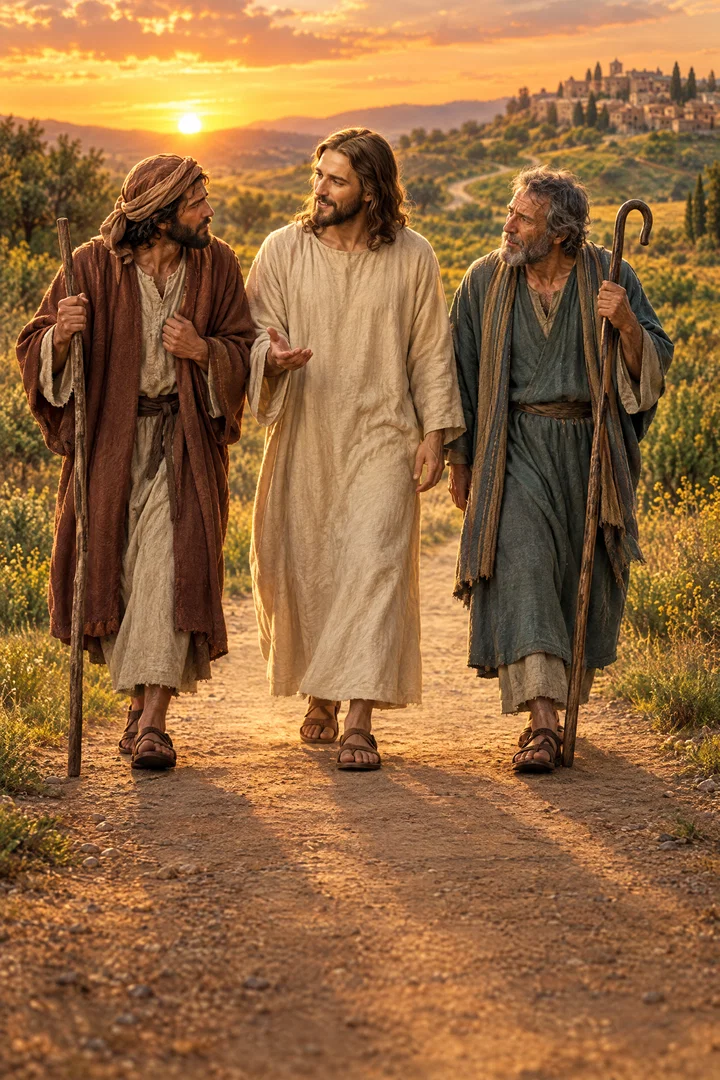
And it came to pass, that, while they communed together and reasoned, Jesus himself drew near, and went with them.
Translations
American King James Version, King James Version
And it came to pass, that, while they communed together and reasoned, Jesus himself drew near, and went with them.
And it came to pass, that while they communed together and reasoned, Jesus himself drew near, and went with them.
And it came to pass, that, while they communed together, and reasoned, Jesus himself drew near, and went with them.
Revised Version, American Standard Version
And it came to pass, while they communed and questioned together, that Jesus himself drew near, and went with them.
And it came to pass in their conversing and reasoning together, that Jesus himself, having come nigh, was going on with them,
And it came to pass as they conversed and reasoned, that Jesus himself drawing nigh, went with them;
And it came to pass, as they were conversing and reasoning together, that, Jesus himself, drawing near, was journeying with them;
Berean Standard Bible, Majority Standard Bible
And as they talked and deliberated, Jesus Himself came up and walked along with them.
While they talked and questioned together, Jesus himself came near, and went with them.
And while they were talking and questioning together, Jesus himself came near and went with them.
And it came to passe, as they communed together, and reasoned, that Iesus himselfe drewe neere, and went with them.
Douay-Rheims (Challoner revision)
And it came to pass, that while they talked and reasoned with themselves, Jesus himself also drawing near, went with them.
Pictures

Cross-references 20 of 37
- Luke 24:36-43
And as they thus spake, Jesus himself stood in the midst of them, and saith unto them, Peace be unto you.
Jesus appears among the gathered disciples and shows that he has a real body.
- Luke 24:32
And they said one to another, Did not our heart burn within us, while he talked with us by the way, and while he opened to us the scriptures?
Their hearts burned as Jesus spoke with them and opened the Scriptures.
- Mark 16:12
After that he appeared in another form unto two of them, as they walked, and went into the country.
Jesus appears to two disciples as they travel.
- Luke 24:25-27
Then he said unto them, O fools, and slow of heart to believe all that the prophets have spoken:
Jesus explains from Scripture why the Messiah had to suffer and enter his glory.
- Luke 24:30-31
And it came to pass, as he sat at meat with them, he took bread, and blessed it, and brake, and gave to them.
The disciples recognize the risen Jesus when he breaks bread with them.
- John 20:19
Then the same day at evening, being the first day of the week, when the doors were shut where the disciples were assembled for fear of the Jews, came Jesus and stood in the midst, and saith unto them, Peace be unto you.
Jesus’ sudden appearance among the disciples is given as another example of his resurrected state.
- Luke 24:29
But they constrained him, saying, Abide with us: for it is toward evening, and the day is far spent. And he went in to tarry with them.
The disciples urge Jesus to stay with them as evening approaches.
- Luke 24:21
But we trusted that it had been he which should have redeemed Israel: and beside all this, to day is the third day since these things were done.
The disciples express their disappointed hope that Jesus would redeem Israel.
- Luke 24:39-43
Behold my hands and my feet, that it is I myself: handle me, and see; for a spirit hath not flesh and bones, as ye see me have.
Jesus shows his flesh and bones and eats, proving his risen body is no phantom.
- John 20:26
And after eight days again his disciples were within, and Thomas with them: then came Jesus, the doors being shut, and stood in the midst, and said, Peace be unto you.
Jesus appears to the disciples again, this time with Thomas present.
- Luke 24:1
Now upon the first day of the week, very early in the morning, they came unto the sepulchre, bringing the spices which they had prepared, and certain others with them.
Both accounts place the events on the first day of the week.
- Luke 24:33-35
And they rose up the same hour, and returned to Jerusalem, and found the eleven gathered together, and them that were with them,
The two disciples return to Jerusalem and tell the gathered group about their encounter with the risen Jesus.
- Matthew 28:9
And as they went to tell his disciples, behold, Jesus met them, saying, All hail. And they came and held him by the feet, and worshipped him.
Lists Jesus’ appearance to the other women.
- Luke 24:25
Then he said unto them, O fools, and slow of heart to believe all that the prophets have spoken:
Jesus rebukes the disciples for being slow to believe the prophets.
- Acts 1:3
To whom also he shewed himself alive after his passion by many infallible proofs, being seen of them forty days, and speaking of the things pertaining to the kingdom of God:
Jesus appeared to his followers during the forty days after his resurrection.
- Mark 16:14
Afterward he appeared unto the eleven as they sat at meat, and upbraided them with their unbelief and hardness of heart, because they believed not them which had seen him after he was risen.
Jesus appeared to the disciples and rebuked their unbelief that day.
- Luke 24:22-24
Yea, and certain women also of our company made us astonished, which were early at the sepulchre;
Reports of the empty tomb and angels explain their astonishment that Jesus was alive.
- 1 Corinthians 15:5
And that he was seen of Cephas, then of the twelve:
Christ appeared to Peter after his resurrection.
- Luke 24:31
And their eyes were opened, and they knew him; and he vanished out of their sight.
Their eyes were opened, and they recognized Jesus.
- John 20:14-16
And when she had thus said, she turned herself back, and saw Jesus standing, and knew not that it was Jesus.
Both show people failing to recognize the risen Jesus at first.
Commentary
Each commentary is drawn from primary sources: the writings of Ellen G. White and Adventist pioneers and periodicals. Each commentary is separate. Its own words are not a quotation; follow the references to read the source passages.
Ellen G. White
51 sources
Late on resurrection afternoon two disappointed believers walked home from Jerusalem to Emmaus, communing sadly together about His trial, death and missing body, when Jesus Himself drew near and went with them as an ordinary fellow traveler unrecognized because their eyes were holden with grief.DA 795.2DA 795.1Ms 80, 1886, par. 7–12Ms 110, 1901, par. 4–12COS 181.1–5 Though He had triumphed over death and possessed all authority, He took the humble place of a companion on the rough road, longing with pitying love to comfort them yet deliberately hiding who He was until He had taught them.DA 795.2ST Nov 14, 1878RH Mar 31, 1903ST Sep 19, 1878 He opened to them in Moses and all the prophets the things concerning Himself, showing the straight chain of prophecy fulfilled exactly in His life, death and resurrection and giving lessons they would never forget.3SP 209.1–210.13SP 216.2Ms 203, 1898, par. 9Ms 94, 1897, par. 28–3015MR 23.4 His walking and talking with them stands as proof of a risen Saviour, joined with His appearing to the eleven to make certain the resurrection and establish Christianity against the falsehood that the body was stolen.Ms 203, 1898, par. 9Ms 94, 1897, par. 28–30Ms 78, 1910, par. 30 He still draws near with the same sympathy to suffering, perplexed and honestly seeking people on their hardest paths to teach, comfort and give peace, yet He does not force His company upon those who remain indifferent and do not invite Him to stay.Ms 45, 1895, par. 25–27ST Sep 19, 18783SP 212.1–26RED 30.1–2Ms 113a, 1897, par. 11
Journey to Emmaus
It was late on resurrection afternoon, on the road from Jerusalem to Emmaus, eight miles away.Ms 110, 1901, par. 4–12COS 181.1–5 The two on that road held no prominent place in Christ's work, yet they were earnest believers who had come up to the city to keep the Passover and were now returning home to meditate and pray.Ms 110, 1901, par. 4–12COS 181.1–5 They set out depressed, meaning to go back to their old work and hide their crushed hopes.3SP 215.1–3
They had expected Jesus to reign on David's throne in Jerusalem and to redeem Israel, and now they were greatly perplexed and disappointed and had lost hope.Ms 110, 1901, par. 4–12 That despair remained despite what they had heard that morning, the news of the removal of His body from the tomb and the report of the women who had seen angels and had met Jesus.Ms 110, 1901, par. 4–12COS 181.1–5 They were returning in hope of light on matters still dark to them.COS 181.1–5
As they walked they communed together and reasoned sadly, even weeping, about His trial and crucifixion and death and resurrection and the reports that His body was gone.Ms 80, 1886, par. 7–12Ms 45, 1895, par. 25–27ST Nov 14, 1878RH Mar 31, 1903 They talked over disappointed hopes caused by the death of the beloved Master, recounting the scenes of the trial and the crucifixion and their unfulfilled hopes.Ms 110, 1901, par. 4–12ST Nov 14, 1878 Their reasoning turned on events and lessons they could not understand, asking how His shameful death could fit His claim to be the Son of God.DA 795.2DA 795.16RED 24.2–25.2
They were so absorbed in grief and disappointment and sorrow and unbelief that their eyes were holden and clouded and did not discern the risen Saviour beside them.DA 795.2Ms 80, 1886, par. 7–12Ms 110, 1901, par. 4–12ST Nov 14, 1878RH Mar 31, 1903 Burdened with grief, they scarcely noticed the stranger who drew near and joined them.6RED 24.2–25.2COS 181.1–5 His appearance bore no special marks revealing Him as the Son of God, and they took Him for a fellow traveler returning from the feast.ST Nov 14, 1878RH Mar 31, 1903
Jesus Drawing Near Unrecognized
Jesus himself drew near and went with the two as they communed together and reasoned on the road, joining their conversation and hearing their talk by the way.DA 795.2DA 795.1Ms 80, 1886, par. 7–123SP 207.1–23SP 215.1–3 He shared their difficult journey over rough ground and rested with them, though absorbed in grief and disappointment they scarcely noticed they were no longer alone.DA 795.23SP 207.1–23SP 212.1–2 They had set out depressed, and their eyes were holden and kept from recognizing him.DA 795.1Ms 80, 1886, par. 7–123SP 215.1–3
Though he had endured the garden and the cross, triumphed over death and possessed all authority, he took the humble role of an ordinary fellow traveler.ST Sep 19, 1878ST Sep 19, 18783SP 212.1–2ST Oct 6, 1909 He came merely as a companion asking what sad communications they had as they walked and why they were sorrowful, their eyes blinded by sorrow and unbelief so they did not discern the risen Saviour beside them.ST Nov 14, 1878RH Mar 31, 19033SP 212.1–2 He thus identified himself with suffering and perplexed people and remained with them on their hardest paths, his sympathy and love unchanged after resurrection and ascension.ST Sep 19, 18783SP 212.1–2ST Oct 6, 1909
He understood their distress and with pitying love saw a sorrow he could comfort and longed to comfort them and reveal himself.DA 795.23SP 207.1–2COS 181.1–5 Yet he did not do so abruptly, but stayed hours with them teaching and comforting them while his words sank deep into their discouraged hearts, first giving lessons they would never forget.DA 795.2ST Nov 14, 1878ST Sep 19, 1878 He saw their perplexity over his death and the reports of the women who had seen angels and had met him, and came near to relieve it.3SP 207.1–2COS 181.1–5
He deliberately kept his identity hidden until he had interpreted the Scriptures and led them to intelligent faith in his life, his character, his mission to earth, and his death and resurrection.ST Sep 19, 1878ST Sep 19, 18783SP 214.1–2 He did this so truth would take firm root not because it rested on his personal testimony, but because the typical law and the prophets of the Old Testament agreeing with the facts of his life and death gave unquestionable evidence.ST Sep 19, 18783SP 214.1–2 He withheld disclosure so they would first attend to the sacred truths he taught and carry that knowledge to others, and when the object of his labor was gained he revealed himself that their joy might be full, and then vanished from their sight.ST Sep 19, 1878ST Sep 19, 1878
He remained their companion beyond the first road, hearing with gladness their joyful and grateful talk together as after revelation their joy exceeded former despair and they hastened back to Jerusalem to share the news of a living Saviour risen from the dead.3SP 215.1–3ST Sep 26, 1878 He traveled with them as an unseen companion on the return from Emmaus to Jerusalem through the dark streets by moonlight.3SP 216.16RED 34.1–2 He entered with them into the upper chamber in Jerusalem where the brethren were gathered.3SP 216.16RED 34.1–2
He draws near to those who honestly seek to understand God's revelation and is ready to help them.Ms 45, 1895, par. 25–27 Yet he does not force his company on anyone, but draws near to those who need him.Ms 45, 1895, par. 25–27Ms 113a, 1897, par. 11 Those who remain indifferent and do not invite him to stay may miss knowing him and suffer loss.Ms 113a, 1897, par. 11
Scriptures Opened and Explained
On the road He opened to them in all the Scriptures the things concerning Himself, beginning at Moses and through all the prophets.Ms 203, 1898, par. 9Ms 94, 1897, par. 28–3015MR 23.4Ms 113, 1897, par. 18 His presence with them in doing this is part of the evidence that He has risen.Ms 203, 1898, par. 9 Together with His revelation in the upper chamber to the eleven as one risen from the dead, this appearance proves the resurrection certain, makes of none effect the priests' falsehood that the body was stolen, and supplies uncontrovertible evidence by which Christianity was established.Ms 94, 1897, par. 28–30 They later recognized Him when He blessed the meal.Ms 113, 1897, par. 18
He opened their minds and understanding so they could comprehend the Scriptures.ST Apr 4, 1906Ms 113a, 1897, par. 9Lt 25, 1903, par. 12–14Lt 141, 1897, par. 39 He explained the Old Testament in a way that revealed meanings its writers had not themselves seen.ST Apr 4, 1906 He spoke with them about the Scriptures while they remained unaware that He was their companion, thinking Him a fellow traveler returning from the feast.Ms 113a, 1897, par. 9 Though weary, they continued listening as He gave them words of life and assurance.Ms 113a, 1897, par. 9
He used their confusion about His trial, death and resurrection to explain that the prophecies about the Messiah had been fulfilled exactly in His life and death.3SP 209.1–210.1 He showed them how prophecy from the patriarchs onward foretold what had happened to their Savior, a straight chain of prophecy reaching from the days of the patriarchs to that time foreshadowing all that had happened to the Saviour.3SP 216.23SP 217.1–3 Careful study and comparison of Scripture would have clarified those prophecies, but mistaken interpretations and traditions had obscured them.3SP 209.1–210.1 When the two told this to the assembled disciples, the company listened in breathless silence, with some given new faith and others remaining unbelieving.3SP 217.1–3
After His resurrection He continued His work as an educator, the same who spoke as never man spoke on earth.15MR 23.4 He drew near to the lonely, disappointed disciples traveling to Emmaus and taught those assembled in the upper chamber.15MR 23.4 To the Emmaus travelers He opened the Scriptures concerning Himself, and His teaching bound their hearts with a holy, new, and sacred hope and joy.15MR 23.4Lt 37, 1887, par. 18–19 After His resurrection He taught the disappointed disciples by opening the Scriptures about Himself, and their hearts filled with holy hope and joy.Lt 37, 1887, par. 18–19
The same divine Teacher still enlightens those who keep their hearts open to heaven.Lt 25, 1903, par. 12–14 The Holy Spirit brings truth to remembrance and guides them into all truth.Lt 25, 1903, par. 12–14
Risen Saviour and Prophecy
His drawing near to the two disciples as they walked and talked on the road to Emmaus, going with them and then explaining from Moses and the prophets what the Scriptures say about Him, is part of the evidence that He has risen.Ms 203, 1898, par. 9 He died on the cross as a sacrifice and was raised from the dead, having proclaimed over the tomb that He is the resurrection and the life, and then He walked on the road where He met two of His disciples and made Himself known to them before leaving them, proving a risen Saviour.Ms 78, 1910, par. 30 His joining the two as they walked to Emmaus was to give abundant evidence that He had risen from the dead, beginning at Moses and opening to them in all the prophets the things concerning Himself.Ms 94, 1897, par. 28–30
Together with His revelation in the upper chamber to the eleven as one risen from the dead, this appearance makes the resurrection certain, makes of none effect the priests' falsehood that the body was stolen, and supplies the uncontrovertible evidence by which Christianity was established.Ms 94, 1897, par. 28–30 The chapter belongs to the teaching that God gave His Son to save sinful people.Lt 100, 1910, par. 18 Through Jesus' suffering and death those who repent, are converted, and come to the Father by faith in Christ can receive salvation and forgiveness, and by believing the truth they can be sanctified.Lt 100, 1910, par. 18
Present Comfort and Holy Conversation
The risen Jesus walking the Emmaus road shows that He identifies Himself with suffering and perplexed people and stays with them on their hardest paths to teach, comfort and help them, though He was the mighty conqueror of death who possessed all authority He took the humble place of an ordinary fellow traveler, sharing the difficult journey over rough ground and resting by the way.ST Sep 19, 18783SP 212.1–26RED 30.1–2ST Oct 6, 1909 His sympathy and love are unchanged by resurrection and ascension, and He is just as near now to those in despondency and grief as He was to the sorrowing disciples, giving consolation, peace and life to all who accept Him.ST Sep 19, 1878Ms 80, 1886, par. 25–26Ms 80, 1886, par. 27 As He met the two on the road and conversed with them and opened the truths of His word, so He met Waldensian believers in their lonely retreats and strengthened them to reject false guides and worship God alone.HSFM 242.4–243.2
He is present with His followers even when unseen, beside them as they talk, hearing their conversation and surrounding them with a holy atmosphere.STB 846.3Lt 57, 1895, par. 34SPBC 149.4 Knowing He is near turns conversation from foolish, common talk to His lessons and holy things, and His presence brings holy joy.RP 15.3STB 846.3SPBC 149.4 Feeding on the bread of life makes hearts burn with spiritual gladness, and contemplating Christ and the Scriptures and His saving work stirs holy joy and spiritual life and calls to renewed conversion.RP 15.3RP 15.2Lt 57, 1895, par. 34Lt 57, 1895, par. 33 Those who commune about Him and seek Christ's righteousness dwell on the great salvation, with the Bible as the storehouse supplying nourishing food for the soul.SPBC 149.3 They meditate on the incarnation of Christ and the great sacrifice made to save from perdition and to bring pardon, peace and everlasting righteousness, their souls glow with these grand themes and holiness and truth and grace and righteousness fill their thoughts, self dies and Christ lives in them, and in contemplating the word their hearts burn within them as did the hearts going to Emmaus when He opened the Scriptures concerning Himself.SPBC 149.314MR 125.2–3
The same joy belongs to the pure in heart now when they talk together about the plan of redemption, the love of Jesus, salvation offered through His infinite love, holiness of heart, the precious saving truth for these last days, and the grace of Christ.5T 600.2 Those who have centered their affections on Christ relish such hallowed association and gather divine strength by it, while those who have no relish for it and prefer sentimental nonsense have wandered far from God and are becoming dead to holy and noble aspirations.5T 600.2 When the travelers received light as Jesus drew near, their joy exceeded their former despair, and they pursued the right course by hastening back through the night to Jerusalem to share the news of a living Saviour risen from the dead.3SP 215.1–3RCNBP 6.3–7.1 True light brings believers back into unity with the church instead of taking a separate line and breaking unity, leading them to return to those whom God has led and is still leading and tell what they have seen, to bear living testimony that better qualifies them to prepare a people to stand in the great day of God, and to seek counsel of those who have borne and are bearing the truth and the last message of warning with deep experience in the things of God.RCNBP 6.3–7.1 His companionship on that journey is the example for all who feel Jesus is not with them, to long for His presence and ask Him to abide with them.Lt 11, 1875, par. 1–4
Sources
Pioneers and periodicals
131 sources
On the afternoon of resurrection day two disciples walked about seven and one-half miles from Jerusalem to Emmaus, talking together about all that had happened to Jesus.ST Dec 10, 1894GSAM 69.2–70.1ST Apr 4, 1900 The risen Jesus himself drew near and went with them in the appearance of a fellow traveler, but their eyes were holden so they did not know him.ST Oct 14, 1889ST Apr 4, 1900RH Oct 21, 1862 They went sad and perplexed with dying faith, still trusting he would redeem Israel by a temporal kingdom and not believing the report that he was alive.ST Oct 14, 1889ST Jun 26, 1901ST Feb 22, 1899ST Dec 3, 1874 He kept his identity hidden until he had rebuked their slowness to believe and expounded from Moses and all the prophets that Christ had to suffer, die, rise again, and enter into his glory.ST Sep 19, 1878ST Sep 19, 1878ST Mar 13, 1901ST Apr 25, 1906 He still draws near when believers commune about sacred truth, comforting sorrowful hearts, opening the Scriptures until hearts burn, and making the disappointed his witnesses.ST Jun 26, 1901RH Mar 13, 1913ST Dec 21, 1882ST Nov 25, 1886ST Nov 11, 1908 That day was ordinary travel and troubled reasoning, not rest or worship, and his joining them to show he was alive instituted no new Sabbath.ST Oct 5, 1882RH May 1, 1900RH Oct 28, 1915ST Dec 11, 1901ST Nov 18, 1886
Journey to Emmaus Setting
The verse belongs to resurrection day, the first day of the week, in the latter part of the afternoon when the day was far spent toward evening.ST Dec 10, 1894GSAM 69.2–70.1ST Apr 4, 1900ST Apr 17, 1901ST Apr 13, 1882 At that hour two disciples were going from Jerusalem to the village called Emmaus, threescore furlongs or about seven and one-half miles away.ST Apr 4, 1900ST Apr 17, 1901ST Oct 17, 1878RH Jan 17, 1856ST Apr 12, 1883 As they went they communed together and questioned one another about all that had happened concerning Jesus, his death and the reports of his resurrection.ST Dec 10, 1894GSAM 69.2–70.1ST Apr 4, 1900RH Oct 21, 1862ST Sep 2, 1886
They walked to Emmaus and afterward returned to Jerusalem that same day, making about fifteen miles in all.RH Nov 1850ST Oct 17, 1878ST Apr 12, 1883 The journey to Emmaus occupied the first part of the day, and by the time they ate there it was late, with arrival back late at night after sunset, near the close of day and even nearly night.ST May 24, 1910ST Nov 11, 1889ST Apr 12, 1883 Because they reached Emmaus late, stayed while they ate, and then walked back, the return and the later meeting with the gathered disciples are reckoned to have occurred after the first day had expired and the second day had begun, the group having first gathered near the close of that day but Jesus meeting them after the second day had begun.ST May 24, 1910ST Mar 24, 1909 One reckoning still calls it the evening of the first day even two hours after sundown.ST May 24, 1910
One traveler was Cleopas, a reliable witness possibly present at the crucifixion.RH Jun 6, 1865 He is identified as a merchant of Emmaus whose withered hand had been restored at Capernaum and who had been in Jerusalem for the Passover and was now returning home.ST Feb 14, 1911 His companion is named as Matthias.ST Feb 14, 1911RH Aug 12, 1862 Together they are described journeying out of the eastern gate toward the mountains of Ephraim as the sun sank, to a small city about eight miles to the northwest, while thousands of Passover visitors camped in tents on the hillsides and valleys.ST Feb 14, 1911
While they talked Jesus himself drew near and went with them in the appearance of a wayfaring stranger.ST Oct 14, 1889ST Feb 22, 1899RH Aug 12, 1862 But their eyes were holden so they did not know him.ST Apr 4, 1900RH Oct 21, 1862RH Jan 17, 1856 Their sight is described as supernaturally restrained and as seeing him in another form, with divine power present in him in humanity while he came to unfold the Scriptures.ST Feb 22, 1899RH Aug 12, 1862
This meeting on the road was the second manifestation that day, after the morning appearance to the women at the sepulchre and before the appearance to Peter as the day closed and the meeting with the ten after sunset.ST Apr 13, 1882 It was not a called worship assembly, but he met the two privately on the road, was invited in because the day was far spent, and made himself known to them at supper.ST Apr 13, 1882 It is variously numbered as the fourth recorded appearance to disciples and the fourth appearance that day, their report preceding Jesus' appearance to the gathered disciples.RH Apr 12, 1860ST Apr 24, 1901 It is also counted as one of the recorded occasions on which he appeared after rising, one of several appearances occupying him on the first day, and as one of many purposeful appearances, numbering no less than twelve, to those who had known him before his death.ST Jun 2, 1898ST Aug 3, 1882 The verse stands at the close of Luke with Luke 23, covering the trials, crucifixion, triumph over death, and parting instruction, and belongs specifically to the triumph over death where the risen Jesus joins his disciples on the way.ST Oct 4, 1910 It belongs to the account of the first day when Jesus made himself known to his disciples.ST Oct 28, 1913
Disciples Sorrow and Unbelief
On the road they rehearsed together his condemnation by the chief priests and rulers, his crucifixion, the arrival of the third day, and the early visit of the women to the sepulchre who found the body gone and reported a vision of angels saying he was alive and that he had risen.ST Oct 14, 1889RH Jun 6, 1865 Their communing concerned his death and burial and the reports of his resurrection, including his works and the reminder that the Son of man must be delivered into the hands of sinful men and be crucified and rise the third day.ST Jan 30, 1912RH Jun 6, 1865 That testimony that today is the third day since these things were done gives witness that he arose from the tomb on the morning of the first day of the week.RH Jun 6, 1865
They traveled sad, grieving, perplexed, lonely and disappointed, with shattered hopes and with faith dying with the Lord.ST Feb 10, 1881ST Nov 14, 1878RH Mar 31, 1903ST Jun 26, 1901 Their hearts were filled with unbelief, sorrow, doubt, fear and anxiety, they had forgotten his own words that he would suffer these things, and they remained uncertain whether he was the true Messiah.ST Oct 14, 1889ST Feb 10, 1881ST Nov 14, 1878RH Mar 31, 1903ST Jan 30, 1912 Their eyes, blinded by sorrow and unbelief, did not discern the risen Saviour walking beside them.ST Feb 10, 1881ST Nov 14, 1878RH Mar 31, 1903 Christ is nearer to people in sorrow than they may suppose, and his words give courage to the trusting heart.ST Jun 26, 1901
They had trusted he was the promised Deliverer who would redeem Israel by establishing a temporal, earthly, literal kingdom and freeing Israel from Roman rule and its tetrarchs and restoring its former position.ST Feb 22, 1899ST Dec 3, 1874RH Jun 2, 1859 They had been convinced by his mighty works, his healing, his authority over demons and nature, and his power to raise the dead, that the Redeemer of Israel had come.ST Feb 22, 1899 Yet they did not yet recognize him as God with them or as their personal Saviour from sin, and they did not understand the purpose of his death, resurrection and intercession in God's plan for the salvation of lost men.ST Feb 22, 1899ST Dec 3, 1874RH Jun 2, 1859 Their confusion came from not understanding Moses and the prophets, for although their trust was rightly placed they mistakenly expected him to redeem only natural Israel, and the bare fact of the resurrection alone would not correct that expectation without scriptural understanding.ST Apr 17, 1901RH Jun 2, 1859 Their mourning shows that otherwise they would have looked forward with joyous hope to the third day when they would see again him whom their souls loved.RH Jun 2, 1859
They had heard he had appeared to the women but did not believe he had risen, and were astonished at their report of angels saying he was alive.ST Feb 3, 1887RH Jun 2, 1859ST Jul 22, 1908 The day was passed in unbelief that he had risen, in doubt and fear and anxiety till its long hours wore away.ST Mar 11, 1889 After Jesus was made known to the two on the road near the end of the day, they returned to Jerusalem and told the others they had seen him, but the rest did not believe them.RH Jun 5, 1860ST Jul 1, 1880 The eleven continued doubting and disputing about the resurrection even at supper, remaining in doubt and perplexity until his late appearance on the first day and his rebuke for slowness to believe.ST Jul 1, 1880ST Jul 22, 1908
His presence met their longing to understand what those events meant for their hopes and for God's plan of salvation.ST Apr 4, 1900ST Apr 4, 1900 He came to unfold the Scriptures and explain the events that had troubled them, walking with them in humanity while divine power was present in him.ST Apr 4, 1900ST Feb 22, 1899 He meets the longing of anxious inquirers by giving them knowledge of God's plan of salvation.ST Apr 4, 1900ST Apr 4, 1900
Jesus Nearness and Teaching
Though he had endured the garden and the cross and triumphed over death as the mighty conqueror of death, he took the humble role of a fellow traveler and companion on the road.ST Sep 19, 1878ST Sep 19, 1878ST Oct 6, 1909 He drew near and walked with the two as they talked over and tried to understand the events surrounding his death, sharing their difficult journey.ST Jul 29, 1908ST Oct 6, 1909ST Oct 6, 1909 He sought out these lonely, discouraged, grieving and perplexed followers whose eyes were clouded so they did not recognize him, and spent hours with them to teach and comfort them.ST Jul 29, 1908ST Sep 19, 1878ST Oct 6, 1909 He understood their sorrow and longed to comfort them, and would first teach them lessons they would not forget, for his sympathy and love remain the same after resurrection and he identifies himself with his suffering and perplexed people on their hardest paths.ST Jul 29, 1908ST Sep 19, 1878ST Oct 6, 1909
He accosted them merely as a fellow traveler, presenting himself as a stranger, and questioned them about their communication and why they were sad.ST Feb 10, 1881ST Nov 14, 1878ST Feb 8, 1883 He asked them to explain what troubled them, though he already knew, because telling him helps them define and understand their burden, and he is interested in what his disciples consider important and walks beside them in ordinary life.ST Nov 14, 1878ST Apr 7, 1881 He longed to reveal himself but did not do so abruptly, and had they been indifferent to him they would have lost the precious opportunity of recognizing the companion who reasoned so ably from the Scriptures about his life, suffering, death and resurrection.ST Feb 10, 1881ST Apr 7, 1881 His approach in this reveals human sympathy and responsiveness to the companionship and feelings of his friends.ST Feb 8, 1883
He deliberately kept his identity hidden and held back an at once convincing manifestation until he had interpreted the Scriptures, so they would first attend to the sacred truths he taught and carry that knowledge to others.ST Sep 19, 1878ST Sep 19, 1878ST Apr 17, 1901 He maintained the disguise until he had led them to an intelligent faith in his life, his character, his mission to earth, and his death and resurrection.ST Sep 19, 1878 He did this so truth would take firm root in their minds, not because it rested on his personal testimony, but because the typical law and the prophets of the Old Testament agreeing with the facts of his life and death gave unquestionable evidence of that truth, for it was more important to understand the Scriptures and believe from Moses and the prophets than to recognize his person, and conviction had to be by faith and not by sight.ST Sep 19, 1878ST Apr 17, 1901 When the object of his labor with them was gained, he revealed himself to them that their joy might be full, and then vanished from their sight, setting the pattern that men are to believe and be sanctified through the truth of the Word proclaimed rather than anything wonderful in the preacher except so far as he intelligibly presents the truth.ST Sep 19, 1878ST Apr 17, 1901
Beginning at Moses and all the prophets he expounded in all the Scriptures the things concerning himself, opening the Scriptures so their hearts burned within them.ST Mar 13, 1901ST Nov 27, 1893ST Jul 30, 1885 He joined their conversation about the events that had shattered their hopes, rebuked them as foolish and slow of heart to believe all the prophets had spoken, and led them to understand that the Messiah's sufferings and death were necessary, that Christ had to suffer these things and then enter into his glory, had to suffer, die, and rise again.ST Mar 13, 1901ST Apr 25, 1906ST Nov 27, 1893 He comforted their hearts by rehearsing the scriptures that speak of him and explaining them to their understanding, speaking definitely of his advent, death, and work of redemption, and his teaching renewed their hope and brought comfort.ST Nov 27, 1893ST Jul 30, 1885RH Jan 21, 1873 He opened their understanding so they could comprehend the Scriptures, explaining the Old Testament in a way that revealed meanings its writers had not themselves seen, proving that the entrance of God's words gives light and understanding to the simple.ST Apr 4, 1906ST Mar 13, 1901ST Apr 25, 1906
He was invited in because the day was far spent and made himself known to them at supper in the breaking of bread, in a private meeting on the road rather than a called worship assembly.ST Apr 13, 1882 He remained close beside them as they hurried back to tell the disciples that Christ was alive, and heard their joyful words on the way.ST Jul 29, 1908ST Sep 26, 1878 He remained their unseen companion all the way back to Jerusalem on that same first day, entering with them into the memorable upper chamber where he had spent the last night before his death, coming by the eastern gate open on festal occasions and through dark and silent houses and narrow streets by the light of the rising moon until cautious hands unbarred the door.ST Jun 3, 1897ST Oct 6, 1914 He returned with them to Jerusalem invisibly and could appear among them and later vanish from sight, entering unseen with them into the shut room and holding back visibility until the others had time to show their unbelief when told he was risen, and then making himself known.ST Oct 6, 1914 When they entered with their joyful tidings after he had made himself known to them, they were met by many voices exclaiming that the Lord is risen indeed and has appeared to Simon.ST Jun 3, 1897
This opening of their understanding, when what they had long believed about his mission became newly clear and their hearts burned as he explained the Scriptures concerning his work, death, and resurrection, is described as receiving the Holy Spirit.RH Jan 21, 1873RH Aug 11, 1903 He is a living Saviour and Teacher who comes near to his followers, helps them when they are cast down, and makes the Scriptures plain through the Spirit of truth when they long to know and obey them, staying with those who truly desire him to nourish them with the bread of life.RH Aug 11, 1903ST Jul 21, 1898 Yet they did not at first perceive it was he speaking, for their eyes were holden and he appeared in another form, because they failed to understand what was written and still needed the Comforter, the Spirit of truth, to take away the veil so they could understand and expound with clearness and power.RH Jan 21, 1873ST Jul 21, 1898
Resurrection Body and Witness
The verse means the identical person who died on the cross lived again, Jesus of Nazareth who had been condemned to death and crucified.RH Nov 21, 1854ST Nov 18, 1886RH Oct 8, 1903 His death was a literal death of the whole man with no soul or spirit escaping, and his resurrection was the return to life of that same I.RH Nov 21, 1854 His presence drawing near and walking with the disciples, his being known in the breaking of bread, his showing his hands and feet and side with flesh and bones, and his eating a piece of broiled fish and honeycomb before them prove he was not another person and not a disembodied spirit, apparition, or spirit of a dead person.RH Nov 21, 1854ST Nov 18, 1886ST Jun 12, 1884RH Jun 13, 1865 The risen Christ thus had a real, recognizable bodily form, and the purpose of appearing to the two on the road and afterward to the eleven that same evening was to convince them that he was really risen and alive again so they might be witnesses to the fact.ST Nov 18, 1886RH Oct 8, 1903
By contrast, those who held it taught that the failure of the two journeying to Emmaus to recognize him means his risen body was not the same veritable material body that was buried.RH Nov 26, 1872RH Nov 26, 1872 In that teaching his body was revivified and left the tomb as proof he was alive and he could at times assume an earthly form to appear in it, but his usual manner was to appear in a real spiritual body seen only when the spiritual eyes of those who beheld him were couched and opened.RH Nov 26, 1872 That non-recognition, like Mary not knowing him, his appearing under a variety of forms, his entering rooms without opening, and his not being seen by the people generally mean his presence was recognized by opened spiritual sight rather than by his having repossessed his natural material body of flesh, blood, and bones.RH Nov 26, 1872 After breaking bread with them the resurrected Jesus vanished from their sight, displaying the freedom of movement associated with being born of the Spirit, able as a spiritual being to appear among them and later vanish and to return with them to Jerusalem invisibly though they did not know he was present.ST Oct 6, 1914RH Jan 22, 1857
The two reckoned that day near the end of the first day of the week, in its latter part, as the third day since his sufferings and betrayal as well as his trial and crucifixion.RH Feb 7, 1871RH Apr 20, 1905 That reckoning illustrates that three days was counted inclusively rather than as exactly seventy-two hours, so that three days and three nights does not require an exact seventy-two hours in the tomb and the crucifixion could not have occurred earlier than Thursday.RH Feb 7, 1871 His drawing near while they talked, though they did not recognize him, served that day as evidence that he had risen on the third day, not to honor the first day of the week.RH Apr 20, 1905 Luke gives a fuller account of the Emmaus way than Matthew or Mark because each evangelist reports some events and omits others, which does not by itself make the accounts contradictory.ST Mar 5, 1912 The appearance story is not presented as the primary evidence for the resurrection, which points instead to the Christian church and the New Testament as evidence of the risen Saviour's life and power.RH May 11, 1916
First Day and Sabbath Question
The walk to Emmaus was ordinary travel and labor on the first day of the week, not rest.ST Oct 5, 1882RH Oct 28, 1915ST Feb 20, 1879RH Feb 7, 1916ST Mar 18, 1889 The two went on foot seven and one-half miles, about threescore furlongs, into the country to Emmaus, evidently for business or going home, and with the return to Jerusalem that night made fifteen miles in all, far longer than a Sabbath day's journey.ST Oct 5, 1882RH Oct 28, 1915ST Feb 20, 1879ST Jul 2, 1894ST Mar 18, 1889 Running to and from the sepulchre went on that day, earth and heaven were astir, and the hours were spent in walking and talking, in troubled reasoning, bustle, anxiety and unrest, not in holiness, rest or worship.RH May 1, 1900RH Oct 23, 1856RH Oct 28, 1915ST Jul 2, 1894ST Mar 11, 1889 The risen Jesus drew near and went with them while they communed and reasoned, traveling with them without rebuke and blessing them, which approves the journey as right and shows travel permitted and the day lacking the rest essential to a Sabbath.ST Oct 5, 1882ST Feb 20, 1879RH May 5, 1851RH Feb 26, 1901
It was not a called worship assembly but a private meeting on the road, while the other disciples remained at home with shut doors for fear of the Jews.ST Apr 13, 1882RH May 1, 1900RH Oct 23, 1856RH Jan 17, 1856RH Dec 21, 1869 Neither the two on the road nor the eleven in Jerusalem believed he had risen, sorrow continued, Thomas was absent, and doubt, fear and anxiety lasted till the long hours wore away, so there was no celebration or honoring of the resurrection, no keeping of the day as a Sabbath, and no gathering to celebrate a new Sabbath.ST Apr 13, 1882RH May 1, 1900RH Jan 17, 1856ST Mar 11, 1889 The meeting came in the latter part of the afternoon when the day was far spent toward evening, seven and one-half miles from Jerusalem, as the second manifestation that day after the morning appearance to the women at the sepulchre and before the appearance to Peter as the day closed and the meeting with the ten after sunset, when the two were invited in and he was made known at supper and they afterward returned late to report, yet the rest did not believe them.ST Apr 13, 1882RH May 1, 1900RH Oct 23, 1856RH Jan 17, 1856ST Dec 11, 1901
The account gives the resurrection day no sacred title and appoints no worship.RH Feb 13, 1872RH Feb 25, 1862ST Jan 2, 1879RH May 5, 1851 Jesus said nothing about the first day, did not name, bless, rest upon, set apart or appoint it to holy use as the Father did the seventh day at creation, gave no teaching that Sunday had become sacred, gave no warning that walking that distance trespassed on holy time, and said nothing about the Sabbath or a change of the Sabbath.RH Feb 13, 1872RH Feb 25, 1862RH May 5, 1851RH Feb 26, 1901 His traveling with them without declaring the day a Sabbath, his going in at their request toward evening and eating with them, and his greeting of peace to them and to the eleven that night gave no command for a new Sabbath and no rebuke for breaking the first day.RH Feb 13, 1872ST Jan 2, 1879RH May 5, 1851RH Feb 26, 1901
The purpose of the appearances that day, with the appearance first to Mary Magdalene and afterward to the eleven that same evening when he showed hands, feet and side and ate broiled fish and honeycomb before them, was only to show he was alive and risen and to make witnesses, not to institute keeping the first day as Sabbath for any sacred or religious purpose.ST Nov 18, 1886ST Oct 21, 1897RH Apr 20, 1905 His acts were something done on the day, not something done to the day, and his silence shows no intent to honor it above other days or institute a Lord's day.ST Nov 18, 1886ST Oct 21, 1897RH Apr 20, 1905 The first day went by uncelebrated, unkept and unobserved, and only after the Emmaus meeting and the eight-mile return did he meet the apostles gathered in their common abode that evening, so the road to Emmaus gives no proof that he set apart the first day by his resurrection.ST Dec 11, 1901ST Nov 18, 1886ST Oct 21, 1897RH Apr 20, 1905
The first day came three days after the new covenant was sealed by his blood on Friday and therefore came too late to be its Sabbath.ST Sep 23, 1913ST Dec 10, 1902RH Dec 30, 1862 Baptism, rather than weekly Sunday observance, represents his burial and resurrection and points forward to the saints' resurrection, and his activity on the resurrection day in drawing near and traveling with the two as they talked and reasoned is used to argue the day was not set apart for rest as a weekly memorial.ST Sep 23, 1913ST Dec 10, 1902RH Dec 30, 1862 Luke 24:1-23 proves the seventh-day Sabbath must still be kept, so a Christian must either keep it or give up all claim to Christianity and to being God's servant, and the light God gives on it in answer to prayer requires obeying God rather than yielding to opposed relatives and friends.ST Sep 23, 1913ST Dec 10, 1902RH Dec 30, 1862
By contrast, those who held it taught that the meeting on the first day is an authoritative example supporting observance of that day, with the resurrection day marking completion of redemption and the reason given in the catechism for keeping Sunday.RH Feb 25, 1862RH Apr 14, 1874RH Aug 1, 1871 On that holding, rest is due on resurrection day as its memorial since the resurrection cannot be changed to another day, and the evening meeting with the eleven in Jerusalem belongs with the Emmaus walk in that support.RH Feb 25, 1862RH Apr 14, 1874RH Aug 1, 1871 On that same holding, his going with them does not prove he did not rest that day, because rest does not mean ceasing from all motion and becoming perfectly inactive, but as God on the seventh day rested only from creation, so Christ on the first day rested from redemption while still walking and working with his disciples.RH Feb 25, 1862RH Apr 14, 1874RH Aug 1, 1871
Advocates use the Emmaus appearance and evening return to argue the apostles usually met together on the first day and that Sunday is a substitute for the seventh-day Sabbath, but that use is without force.ST Dec 11, 1901ST Nov 18, 1886ST Oct 21, 1897RH Aug 5, 1851RH May 13, 1858 It is an effort to confound the Lord's Sabbath with other days and to supply a substitute after claiming the law abolished.RH Aug 5, 1851RH May 13, 1858 The passage reports only a supposition, not a stated fact, that they were going to an evening meeting.RH Aug 5, 1851RH May 13, 1858
Comfort and Present Companionship
Christ draws nearer to people in sorrow than they suppose, joining sad travelers on the road and giving courage to the trusting heart.ST Jun 26, 1901 While the two grieved over having lost him, he walked with them unrecognized, and their grief held an unseen victory as he drew near to win them to himself, though trouble can keep people from recognizing his presence and purpose.ST Nov 25, 1886 Their sorrow over shattered hopes gave way to wonder and joy when they invited him to stay, showing that God remains faithful and brings comfort to his people.RH Dec 30, 1915 His presence revived their hearts and hope even before they recognized him.ST Nov 27, 1893 While they reasoned together in sorrow after crucifixion and burial when hope of redemption seemed lost, he comforted their sorrow-filled hearts by expounding from Moses and all the prophets concerning himself and making himself known, turning sorrow to joy until they confessed the Lord risen, proving himself the same Jesus who had lain three days in the tomb by standing among them with peace, showing flesh and bones and eating before them.RH Jun 13, 1865
He is a willing companion on the life-journey who joins travelers discussing his death, makes the journey pleasant, and inspires hearts through life.RH Aug 12, 1862RH Aug 12, 1862 The ordinary walk from Jerusalem to Emmaus became the setting for meeting the Son of God, remembered as walking by the way with the Master.RH May 4, 1911RH Apr 8, 1909 The two walking with Jesus exemplify walking with God.RH Oct 9, 1900 To walk by his side face to face was privilege and joy indeed, part of the blessedness of being with the Lord.RH Apr 16, 1867 People today serve this living Christ through faith, love, obedience, and service to others.
He comes to enlighten those earnestly discussing and sincerely wanting truth, and when his truth is the subject of conversation his presence brings light to minds.ST Dec 21, 1882 He meets the longing of anxious inquirers trying to understand what events meant for their hopes by giving knowledge of God's plan of salvation.ST Apr 4, 1900 As living Saviour and Teacher he comes near to followers when cast down, makes Scriptures plain through the Spirit of truth to those longing to know and obey, stays with those who truly desire him, and nourishes them with the bread of life.ST Jul 21, 1898 Staying with the confused and spiritually discouraged while explaining Scripture shows how a Bible reading can bring light to the bewildered.RH Mar 13, 1913 Because they were disappointed, discouraged, sad, and needing counsel, and because their conversation about him made hearts ready for truth, he joined them to comfort, encourage, and make them witnesses, and walking with him brings his teaching and prepares followers to lead others to him.RH Dec 3, 1901ST Apr 17, 1901
When believers commune together about sacred themes and lay faith beside faith, Jesus himself draws near, walks with them, and shares in the conversation, later revealing himself in the breaking of bread.ST Mar 1, 1905 Laying faith beside faith strengthens faith, sharing how temptation was overcome gives power to overcome, sharing comfort received gives comfort, and joining hope to hope lifts both higher where righteousness and peace kiss, while failure in such religious converse keeps hearts from being made glad more often by his presence.ST Mar 1, 1905 Talk of mere business such as the sheep market at Jerusalem or the price of olive oil or doves and young pigeons would not have made hearts burn, brought Christ into company, or led to his revealing.ST Mar 1, 1905 Hearts burn as they speak of Jesus and the peace found in him.RH Nov 24, 1859 He draws near and goes with people while speaking together even when unlooked for, near at hand and not distant beyond the stars, present as they bring prayers and troubles.ST Feb 4, 1889 His desire to walk with people and open Scriptures is hindered when the heart is filled with worldly distraction, pride, or self-sufficiency, and is joined to humility before God, yet when Christians share helpful conversation he likewise draws near in sweeter communion.ST Apr 25, 1906RH Jun 12, 1900
His communing as a loving friend and willingness to receive hospitality show communion as friendship and close companionship.RH May 8, 1913 Sad and discouraged by the loss of their Lord, they listened to the unrecognized risen Saviour with wonder and delight and then urged him to stay when they reached home.ST Mar 3, 1881 His words made hearts burn and opened eyes to recognize Christ as risen Redeemer and Conqueror of death.ST Jan 7, 1889 He spoke in a way that stirred love so that they wanted the stranger to stay and invited him to abide.RH Nov 14, 1912
The sad walk after disappointed hope that he would redeem Israel parallels the Advent believers' disappointment when 1844 passed without Christ's return, with hopes reviving as truth emerged from slander and persecution and the Third Angel's Message brought light explaining the disappointment, as the disciples' hopes revived after he rose.RH Jul 24, 1856 They understood some truth but not yet that he had to suffer and rise, and further scriptural light revealed the mistake and restored hope, illustrating how Advent believers could understand part of the truth about Christ's work and judgment yet misunderstand timing, until further light brought clarity and renewed joy.RH Dec 1, 1874 Jesus himself came after death to correct disappointment over expecting a crowned king instead of a crucified one by showing suffering fulfilled prophecy, so disappointment does not prove true doctrine false, neither Christianity a humbug nor the Millerite expectation of his soon coming false.RH Dec 8, 1874 Their sadness in travel did not mean hope misplaced but belonged to events through which prophecy was fulfilled.ST Apr 21, 1881
Their confusion came from not understanding Moses and the prophets, for though trust was rightly placed they mistakenly expected redemption only of natural Israel and restoration of a temporal kingdom, so belief in Moses and the prophets was necessary and the bare fact of resurrection alone would not correct mistaken ideas without scriptural understanding.ST Apr 17, 1901 Had they been familiar with the Scriptures faith would have been sustained and hopes unshaken, for prophecy plainly stated the treatment Christ would receive, yet faith died with the Lord and eyes blinded by unbelief did not discern the risen Saviour walking beside them longing to reveal himself, not abruptly but as a fellow traveler questioning their conversation and sadness, an opportunity they would have lost by indifference to the companion who reasoned so ably from Scripture about life, suffering, death, and resurrection.ST Feb 10, 1881 The example shows those who have not studied the prophetic word may fail to understand events concerning Christ and signs of his coming.ST
His coming in the appearance of a wayfarer without at first revealing himself demonstrates loving attention to searchers for light and truth and shows how humanity can come into close touch with humanity and powerfully witness to truth.ST Feb 22, 1899 His life on earth as blessing to humanity is reason to long for him to come into one's own life and make one a blessing.ST Apr 28, 1909 The road being about seven and one-half miles, a walk of about two and one-half hours with some time already past before he joined them, in the short time remaining he expounded in all Scriptures things concerning himself beginning at Moses and all the prophets, not explaining contexts in many instances but quoting only words directly applying to the subject, skipping about taking a verse here and another there, which gives divine warrant for studying the Bible by grouping together all or many texts bearing on one subject.ST Sep 16, 1886
Meeting the two late on resurrection day on the seven-mile journey home unrecognized was a shower of blessing preceding and preparing for the pentecostal baptism of the early rain, beginning as hearts burned under a Bible reading on the crucified Messiah, becoming copious when they constrained him to tarry and sup, making them so elated that though night they hastened back to Jerusalem to tell joy to the mourning eleven, at once followed by refreshing manifestation of the risen Lord to all together.ST Nov 11, 1908 They knew with glad hearts and great joy in the way and humble home that he was risen, and brought that true report to disheartened, hopeless, doubting, fearful disciples locked in the upper room on Sunday night, confirming the women's morning report, dispelling gloom, sadness, and doubt, and filling hearers with faith and hope before he was manifested to all.ST Mar 8, 1905 His drawing near revealed the living risen Christ, filled them with joy, and prepared them to carry the message that he had risen.RH Jul 6, 1911
Their journey with Jesus while not knowing who he is teaches its lesson. The verse is a pattern for asking him to walk with and strengthen his people now. His drawing near and accompanying travelers provides comparison for one whose questions about Scripture and the Messiah are answered with eager interest and delight.
Sources