Luke 24:31
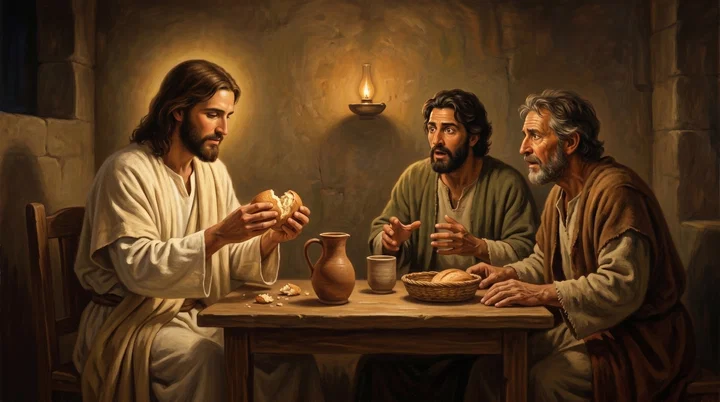
And their eyes were opened, and they knew him; and he vanished out of their sight.
Translations
American King James Version, King James Version, KJV Cambridge Paragraph Bible, Revised Version, American Standard Version
And their eyes were opened, and they knew him; and he vanished out of their sight.
Webster Bible, Douay-Rheims (Challoner revision)
And their eyes were opened, and they knew him: and he vanished out of their sight.
and their eyes were opened, and they recognized him, and he became unseen by them.
And their eyes were opened, and they recognised him. And he disappeared from them.
And, their, eyes were opened, and they knew him; and, he, vanished from them.
Berean Standard Bible, Majority Standard Bible
Then their eyes were opened and they recognized Jesus— and He disappeared from their sight.
Their eyes were opened and they recognized him; then he vanished out of their sight.
And then their eyes were open, and they had knowledge of him, but he went from their view.
Then their eyes were opened, and they knewe him: and he was no more seene of them.
Pictures
Cross-references 20 of 46
- Luke 24:27
And beginning at Moses and all the prophets, he expounded unto them in all the scriptures the things concerning himself.
Jesus expounded from Scripture the things concerning himself.
- John 20:19
Then the same day at evening, being the first day of the week, when the doors were shut where the disciples were assembled for fear of the Jews, came Jesus and stood in the midst, and saith unto them, Peace be unto you.
Christ suddenly appeared among disciples behind closed doors.
- Mark 16:12-13
After that he appeared in another form unto two of them, as they walked, and went into the country.
Jesus appears to two disciples on the road; they report it, but the others do not believe.
- Luke 24:36
And as they thus spake, Jesus himself stood in the midst of them, and saith unto them, Peace be unto you.
Other moments in the same account of the risen Jesus appearing to his disciples.
- John 20:26-29
And after eight days again his disciples were within, and Thomas with them: then came Jesus, the doors being shut, and stood in the midst, and said, Peace be unto you.
Jesus appears again with Thomas present, who recognizes and believes in the risen Lord.
- Luke 24:35
And they told what things were done in the way, and how he was known of them in breaking of bread.
The disciples report recognizing Jesus in the breaking of bread.
- Mark 16:14
Afterward he appeared unto the eleven as they sat at meat, and upbraided them with their unbelief and hardness of heart, because they believed not them which had seen him after he was risen.
Jesus appears to the eleven and rebukes them for disbelieving the Emmaus witnesses.
- Luke 24:16
But their eyes were holden that they should not know him.
Their eyes were held earlier, then opened to recognize the risen Jesus.
- Luke 24:1-3
Now upon the first day of the week, very early in the morning, they came unto the sepulchre, bringing the spices which they had prepared, and certain others with them.
The empty tomb report forms part of the disciples’ conversation before they recognized Jesus.
- Acts 1:3
To whom also he shewed himself alive after his passion by many infallible proofs, being seen of them forty days, and speaking of the things pertaining to the kingdom of God:
Jesus showed himself alive after his suffering, appearing to his disciples for forty days.
- Luke 24:39-43
Behold my hands and my feet, that it is I myself: handle me, and see; for a spirit hath not flesh and bones, as ye see me have.
Jesus shows his wounds and flesh, then eats to prove he is bodily risen.
- Matthew 28:1-10
In the end of the sabbath, as it began to dawn toward the first day of the week, came Mary Magdalene and the other Mary to see the sepulchre.
Also recounts Christ’s resurrection and appearances.
- Mark 16:9
Now when Jesus was risen early the first day of the week, he appeared first to Mary Magdalene, out of whom he had cast seven devils.
Both describe a resurrection-day appearance of the risen Jesus met with disbelief.
- Luke 24:45
Then opened he their understanding, that they might understand the scriptures,
Christ opens the disciples’ understanding in the same encounter.
- Luke 24:13
And, behold, two of them went that same day to a village called Emmaus, which was from Jerusalem about threescore furlongs.
Introduces the two disciples’ journey to Emmaus.
- 1 Corinthians 15:5
And that he was seen of Cephas, then of the twelve:
The risen Jesus appeared to Simon, as he did to the disciples at Emmaus.
- John 20:14-16
And when she had thus said, she turned herself back, and saw Jesus standing, and knew not that it was Jesus.
Mary initially fails to recognize the risen Jesus.
- John 20:20
And when he had so said, he shewed unto them his hands and his side. Then were the disciples glad, when they saw the Lord.
Jesus’ wounds identify him as the risen Lord, and the disciples rejoice when they see him.
- Mark 16:1-8
And when the sabbath was past, Mary Magdalene, and Mary the mother of James, and Salome, had bought sweet spices, that they might come and anoint him.
Recounts Jesus’ resurrection before his appearance to the Emmaus disciples.
- Matthew 28:16-17
Then the eleven disciples went away into Galilee, into a mountain where Jesus had appointed them.
Both describe appearances of the risen Jesus to his disciples.
Commentary
Each commentary is drawn from primary sources: the writings of Ellen G. White and Adventist pioneers and periodicals. Each commentary is separate. Its own words are not a quotation; follow the references to read the source passages.
Ellen G. White
53 sources
On the road to Emmaus the risen Jesus joined two sorrowing disciples as an ordinary traveler, and only at the evening meal when He took the bread, blessed and broke it, were their eyes opened to know Him before He vanished from their sight.ST Sep 19, 18783SP 213.2–3Ms 155, 1904, par. 61–63COS 183.2–184.2Ms 35, 1891, par. 8–10 They had not known Him on the way because unbelief and sorrow clouded their eyes, but as He expounded Moses and all the prophets concerning Himself their faith revived and their hearts were reached before they discerned Him.Ms 11, 1893, par. 2–4RH Mar 31, 1903ST Nov 14, 1878FE 189.1 He kept His true character hidden until after He had opened the Scriptures, so that their faith would rest not merely on seeing Him risen but on the unquestionable evidence of the law and the prophets agreeing with His life, death and resurrection.ST Sep 19, 1878ST Sep 19, 18783SP 214.1–2ST Oct 6, 1909 They knew Him by His familiar voice and manner in breaking bread and by the nail prints in His hands, and the moment they recognized Him their despair turned to certain joy that sent them that same night back to Jerusalem to witness that the Lord is risen.Ms 11, 1893, par. 2–4ST Sep 19, 18783SP 213.2–33SP 215.1–3DA 800.3–4 The same work continues now, for Christ by the Holy Spirit still opens the Scriptures and opens humble, teachable minds to grasp their meaning, walking unseen beside the despondent to give comfort and burning hearts.CE 87.1FE 189.115MR 23.4Lt 11, 1875, par. 1–4ST Dec 10, 1912
Emmaus Road Setting
The verse belongs to the walk to Emmaus, where the risen Jesus humbly joined two disciples as an ordinary fellow traveler to teach and comfort them and to identify with his suffering and perplexed people on their hardest paths.ST Sep 19, 18783SP 212.1–26RED 30.1–2 The mighty conqueror of death chose humble, ordinary company rather than appearing in glory, coming alongside without seeming to be more than a fellow traveler.3SP 212.1–26RED 30.1–2
They did not recognize him by appearance, for he was the same size as before crucifixion with no special outward mark that immediately identified him, seeming only a toiling traveler like themselves.SG4 119.1Ms 35, 1891, par. 8–10 They knew who he was only when he made himself known to them.SG4 119.1
At sunset, when the day was far spent and it was toward evening, they urged him to abide with them and to come in, and he went in with them to their home to tarry with them.Ms 155, 1904, par. 61–63COS 183.2–184.2Ms 35, 1891, par. 8–10 At the simple evening meal he took his accustomed place at the head of the table and acted as head of the family by placing his hands upon the bread and blessing it.COS 183.2–184.2 In breaking bread and asking the blessing they knew him, recognizing him by his manner and by the marks of the crucifixion in his hands, and they glorified God.Ms 155, 1904, par. 61–63Ms 35, 1891, par. 8–10
As they recognized him they rose to worship him, some about to throw themselves upon him, and he suddenly vanished out of their sight.ST Sep 19, 18783SP 213.2–3DA 800.3–46RED 31.3–32.1Ms 80, 1886, par. 17 Until then their eyes had been clouded so they had not discerned him during the walk and conversation, though his teaching had reached their hearts and taken root in them.ST Sep 19, 18783SP 213.2–3ST Oct 6, 1909 They knew him when they heard their Master's familiar voice and saw the wounds and nail marks in his hands in the familiar way he blessed the meal, after their hopes had been revived by the evidence of his Messiahship and by his words from Scripture.ST Sep 19, 18783SP 213.2–3DA 800.3–46RED 31.3–32.1Ms 80, 1886, par. 17
Eyes Closed and Opened
Their eyes were clouded so that they did not recognize him even while he walked and talked with them and taught and comforted them on the road.Ms 11, 1893, par. 2–4ST Sep 19, 1878ST Oct 6, 1909 Unbelief and sorrow had blinded them, with small faith and sadness keeping them from knowing their companion.Ms 11, 1893, par. 2–4RH Mar 31, 1903ST Nov 14, 1878ST Sep 19, 1878 That blindness came from failure to search and understand the Scriptures about Christ suffering and entering into glory, though he opened the prophecies to them as they walked.Ms 11, 1893, par. 2–4RH Mar 31, 1903 Even though his words had deeply affected them, they still did not discern him until the meal.ST Oct 6, 1909ST Oct 6, 1909
Their eyes were opened only after he explained the Scriptures concerning himself, and that exposition revived their faith and brought his promised death and glory back to mind.RH Mar 31, 1903ST Nov 14, 1878ST Sep 26, 1878 His teaching had already taken root in their hearts and reached them before they discerned him, for he opened to them the chain of prophecy from the patriarchs to the events concerning their Saviour.Ms 11, 1893, par. 2–4ST Oct 6, 1909ST Sep 26, 1878 So their recognition when he broke bread with them and then vanished from their sight shows that Christ can open human understanding of Scripture.FE 189.1ST Oct 6, 1909
Recognizing the Risen Jesus
They knew him at the meal by his familiar voice and his own manner of taking, blessing, breaking, and giving the bread, with hands lifted as only he lifted them.Ms 11, 1893, par. 2–4ST Sep 19, 18783SP 213.2–36RED 31.3–32.1Ms 155, 1904, par. 61–63 Having walked with him without knowing him, they had him with them because the day was far spent, and as he asked the blessing and broke the bread they recognized him by that manner and glorified God.DA 800.3–4Ms 155, 1904, par. 61–63ST Oct 30, 1884Ms 80, 1886, par. 17Ms 113a, 1897, par. 16 Their eyes had been clouded on the walk though his teaching had already reached their hearts, and as they rose to worship him and were about to throw themselves upon him he vanished from their sight.ST Sep 19, 18783SP 213.2–36RED 31.3–32.1Ms 155, 1904, par. 61–63Ms 80, 1886, par. 17
In that act they saw the marks of the crucifixion, the wounds and nail prints in his hands, and remembered how he used to bless food, and so knew their companion was their beloved Master and risen Redeemer.Ms 11, 1893, par. 2–4DA 800.3–4Ms 113a, 1897, par. 16Ms 40, 1903, par. 17–18Ms 113a, 1897, par. 12 Their eyes were opened at supper when he sat with them and blessed the meal in the familiar way, and they rose to worship him only to have him vanish from their sight.Ms 11, 1893, par. 2–4DA 800.3–4Ms 113a, 1897, par. 16Ms 113a, 1897, par. 12Ms 113, 1897, par. 18
His words, manner, and wounded hands together made him known, after their hopes had been revived by the evidence of his Messiahship and by his words from Scripture.ST Nov 14, 1878ST Oct 30, 1884Ms 80, 1886, par. 17 Their eyes had been blinded by unbelief and sorrow and they had failed to recognize him earlier, but as he opened the Scriptures their faith revived and then his words, manner, and wounded hands revealed who he was.ST Nov 14, 1878ST Oct 30, 1884Ms 80, 1886, par. 17
Scripture Before Sight
Jesus deliberately held back his true identity and kept his disguise on the road to Emmaus until after he had opened the Scriptures and led the two disciples to an intelligent faith in his life, his character, his mission to earth, and his death and resurrection.ST Sep 19, 1878ST Sep 19, 18783SP 214.1–2ST Oct 6, 19096RED 32.2–3 He would not reveal himself in his true character first, but interpreted the Scriptures to the despairing travelers while his identity remained hidden.ST Sep 19, 1878ST Sep 19, 18783SP 214.1–2 Only when that object was gained did he let their eyes be opened to know him, so that their joy might be full, and then he vanished from their sight.ST Sep 19, 18783SP 214.1–2ST Oct 6, 19096RED 32.2–3
He did this because he knew that if they first saw him risen from the dead they would be so overjoyed that their souls would be satisfied.ST Sep 19, 18783SP 214.1–2 In that satisfaction they would no longer hunger for the sacred truths he wanted to impress indelibly upon their minds and fix firmly there.ST Sep 19, 18783SP 214.1–2 He wanted those truths fixed in them so they would impart them to others, who would spread the precious knowledge until thousands of people received the light given that day.ST Sep 19, 18783SP 214.1–2 Full joy came only when that work was done, at the moment of recognition after the Scriptures had been explained.3SP 214.1–2ST Oct 6, 19096RED 32.2–3
He wanted the truth to take firm root in their minds not because his personal presence and testimony proved it, but because the typical law and the prophets of the Old Testament agreeing with the facts of his life and death gave unquestionable evidence.ST Sep 19, 18783SP 214.1–2ST Oct 6, 19096RED 32.2–3 Their faith was to rest not merely on seeing him, but on that agreement between prophecy and fact.ST Sep 19, 18783SP 214.1–2ST Oct 6, 19096RED 32.2–3 Beginning at Moses and all the prophets he expounded in all the Scriptures the things concerning himself, opening to them in all the prophets what related to him.CE 87.1Ms 11, 1893, par. 2–4Ms 94, 1897, par. 28–30 He laid before them the chain of prophecy from the patriarchs to the events concerning their Saviour, which had foreshadowed what had happened to him.Ms 94, 1897, par. 28–30ST Sep 26, 1878 That exposition showed from Scripture that Christ must suffer and enter into glory, and that the Messiah's death would lead to eternal victory.CE 87.1Ms 11, 1893, par. 2–4Ms 40, 1903, par. 17–18
Joy and Witness Afterward
The instant their eyes were opened to know him, despair gave way to a joy greater than any they had felt before.Ms 11, 1893, par. 2–43SP 215.1–3ST Sep 26, 1878Lt 57, 1895, par. 34 They knew for themselves that their Lord had risen, and that certainty filled them with hope and holy joy.Ms 11, 1893, par. 2–43SP 215.1–3ST Sep 26, 1878Lt 57, 1895, par. 34 The recognition made them forget hunger and fatigue and rise from their prepared meal untouched.Ms 11, 1893, par. 2–43SP 215.1–3 They were unwilling to remain at home and withhold their newly found knowledge, longing instead to impart their joy so that all might rejoice together in a living Saviour risen from the dead.3SP 215.1–3 Though it was late at night, in that same hour they retraced their way to Jerusalem over the rough, uncertain, moonless road, with feelings opposite to those of the outward journey, because they knew where to find the disciples and could now speak with certainty.Ms 11, 1893, par. 2–43SP 215.1–3 Jesus himself was unseen beside them hearing their expressions of joy and gratitude, and with hearts light with new revelation they pressed resolutely on, stumbling over stones and ledges and losing the track in the darkness yet made glad in their talk.Ms 11, 1893, par. 2–43SP 215.1–3
They came with joyful tidings to the assembly gathered in the upper chamber, and their discovery became urgent news to be carried at once to the other disciples.3SP 215.1–3ST Sep 26, 18783SP 216.2 Their report joined the report of Mary Magdalene and the other women, which some in their hopelessness could not believe, and the weightier testimony of Peter about his interview with the risen Lord, borne with ardor and assurance.3SP 215.1–33SP 216.2 Hope and faith were struggling for ascendancy in the excited assembly until many voices met the travelers declaring that the Lord is risen indeed and hath appeared to Simon.3SP 216.2 Such haste was fitting because the fact of Christ's resurrection was to be the great truth around which all the faith and hope of the church would center.3SP 215.1–3ST Sep 26, 1878 The appearance on the Emmaus road stands with the empty sepulcher found early on the first day of the week, the shroud left without the Master, and his revealing himself in the upper chamber as one risen whose body had not seen corruption.Ms 94, 1897, par. 28–30Ms 203, 1898, par. 9Ms 78, 1910, par. 30 Together they give abundant evidence that cannot be controverted, proving he is alive as the risen Saviour whom the disciples saw and talked with, and making of none effect the falsehood of the priests.Ms 94, 1897, par. 28–30Ms 203, 1898, par. 9Ms 78, 1910, par. 30
True enlightenment from receiving light and talking with Jesus does not take a different line from the church, break up its unity, and draw away disciples after oneself.RCNBP 6.3–7.1 It returns instead to those whom God has led and is still leading, to those chosen of God to bear a living testimony and give the last message of warning.RCNBP 6.3–7.1 It seeks counsel of those who have had deep experience in the things of God, giving evidence that the light will better qualify its receivers to prepare a people to stand in the great day of God.RCNBP 6.3–7.1
Christ Still Opens Understanding
The opening of the eyes at Emmaus is Christ opening the Scriptures and opening human understanding and the mind to grasp the meaning of the sacred Word, so that believers can know Him and comprehend what God has spoken.CE 87.1FE 189.1ST Dec 3, 1894 He did this as educator on earth when, beginning at Moses and all the prophets, He expounded in all the Scriptures the things concerning Himself and then made Himself known in the breaking of bread, and He still does this now.CE 87.1FE 189.115MR 23.4 This giving of a clear, well-defined experience with burning hearts is the privilege of all professed Christians, for what He has revealed is for us and our children forever.CE 87.115MR 23.4 The same work is needed now by those with subdued hearts and a single eye to God's glory who drink from the living fountain of the water of life.15MR 23.4
It follows rebuke for unbelief and slowness of heart and His explaining from Moses and all the prophets, and it comes through divine enlightenment by the Holy Spirit.ST Dec 10, 1912Lt 25, 1903, par. 12–14 The Holy Spirit, the same divine Teacher, carries its true significance to the soul in a way not seen or valued before, brings Christ's words to remembrance, and guides into all truth.ST Dec 10, 1912Lt 25, 1903, par. 12–14 This is given when seekers are humble, teachable, subdued, single-eyed to God's glory, and open to heaven, so that truth becomes newly clear.15MR 23.4Lt 25, 1903, par. 12–14ST Dec 3, 1894 As the disciples contemplated the Scriptures thus opened concerning Him, their hearts burned within them.SPBC 149.3RP 15.2Lt 57, 1895, par. 33 His presence and the Scriptures filled them with holy feeling, sacred hope, holy new joy, and refreshment, healing, and heavenly light from the living fountain.SPBC 149.315MR 23.4Lt 37, 1887, par. 18–19Lt 57, 1895, par. 34
Jesus may be near even when not seen, walking beside His followers unseen and beside the despondent and sorrowing to give peace, life, consolation, and comfort.Ms 80, 1886, par. 25–26Lt 57, 1895, par. 34CT 342.1–2Ms 80, 1886, par. 27 Knowing He is near fills the heart with holy joy and makes it burn as the disciples' hearts did while He opened the Scriptures to them.Lt 57, 1895, par. 34CT 342.1–2 Their desire for Him to remain expresses the longing for His presence, and their experience shows the joy found in hallowed fellowship centered on Christ and the plan of redemption.Lt 11, 1875, par. 1–45T 600.2 Believers' encounters with their Redeemer in lonely retreats are like this opening of eyes, as when Waldensian believers had the truths of Scripture opened to strengthen them to reject false guides and worship God alone.HSFM 242.4–243.2 He also walks beside those who grieve, and when the dead are raised their familiar form will remain though wrinkles are gone, loved ones will recognize them, and they will know Christ.Ms 80, 1886, par. 27
Sources
Pioneers and periodicals
113 sources
On the first day of the week, late when day was far spent, the risen Jesus sat at supper at Emmaus and was recognized when he blessed, broke, and gave bread.ST Oct 14, 1889ST Apr 4, 1900ST Dec 10, 1894ST Apr 17, 1901ST May 24, 1910 They knew him by his familiar blessing and breaking, his voice and manner, and the print of the nails in his lifted hands, after walking with him unknowing while their eyes were holden by unbelief, sorrow, and hope of an earthly kingdom.ST Oct 14, 1889RH Mar 31, 1903ST Nov 14, 1878RH Feb 12, 1901ST Feb 22, 1899 He had withheld himself until he had opened Moses and the prophets concerning himself, so that faith would rest on Scripture fulfilled and not on sight alone.ST Sep 19, 1878ST Sep 19, 1878ST Oct 6, 1909ST Dec 10, 1894ST Jun 26, 1901 As they knew him he vanished suddenly out of their sight, for in resurrection he was no longer bound by ordinary bodily limits; those who held otherwise taught that he was hidden from sight and remained unseen beside them on the road.ST Oct 14, 1889ST Apr 4, 1900ST Dec 10, 1894ST Oct 6, 1914RH Jan 22, 1857 The account establishes no sacredness for the first day, giving no command, no transfer of Sabbath rest and blessing, and no worship assembly, but a common journey and meal.RH Jan 13, 1859ST Apr 13, 1882RH Nov 14, 1871RH Feb 11, 1858RH Aug 1, 1854
Time Place and Circumstances
On the first day of the week, the day of the resurrection, the risen Jesus joined two disciples as they walked from Jerusalem to Emmaus, talking and reasoning with them about his death and the resurrection.RH Nov 1850ST Feb 20, 1879ST Oct 17, 1878ST Apr 12, 1883ST Mar 18, 1889 The two are identified as Cleopas and his companion Matthias, and he came to them as a stranger and fellow traveler, in another form.ST Jul 2, 1894ST Apr 24, 1901ST Aug 3, 1882 The distance was about seven to seven and one-half miles, with Emmaus about seven miles from the Mount of Olives.RH Nov 1850RH Oct 23, 1856ST Apr 12, 1883ST Mar 18, 1889 The recognition occurred near the end of the day on that journey, on the first day of the week.RH Oct 23, 1856ST Feb 20, 1879ST Oct 17, 1878
Late on that day, when the day was far spent and near sunset, the two urged him to stay and he entered their home at Emmaus to abide with them.ST Oct 14, 1889ST May 24, 1910ST Apr 13, 1882ST Nov 11, 1889 He was present while they prepared the meal, took his seat at the head of the table, and sat down to supper with them.ST Oct 14, 1889ST Apr 17, 1901ST Apr 13, 1882 He was recognized at the evening supper when he took the bread, blessed it, broke it, and gave it to them.ST Oct 14, 1889ST Apr 17, 1901ST Nov 11, 1889ST Sep 15, 1887 By that breaking of the bread their eyes were opened and they knew him.ST Apr 17, 1901ST Feb 20, 1879ST Oct 17, 1878ST Sep 15, 1887
After recognition they rose up the same hour and hurried back over the same path to Jerusalem that night to tell the others, leaving their meal untasted.ST May 24, 1910ST Apr 13, 1882RH Nov 1850ST Apr 12, 1883 The return was about seven to seven and one-half miles, fifteen miles in all for the day, requiring at least two hours, with some accounts reckoning eight miles and sixty furlongs.ST Apr 13, 1882RH Nov 1850ST Apr 12, 1883ST Dec 11, 1901ST Jul 21, 1909 The walk was over steep places and smooth rocks where they slipped, sometimes running and stumbling.ST Oct 14, 1889 They arrived to tell the others, with the arrival placed after the first day had expired at sunset and in the evening that began the second day, the first day having gone by uncelebrated until evening.ST Apr 13, 1882ST Dec 11, 1901ST Jul 21, 1909
The Emmaus meeting is counted among the appearances of resurrection day, described as the second appearance.RH Nov 1850ST Jul 2, 1894 It is identified as the fourth recorded appearance, and as his fourth appearance that day.RH Apr 12, 1860ST Apr 24, 1901 It was one of five appearances on the day of the resurrection and that night, among many appearances in all, no less than twelve, which together give exceedingly well-attested proof that Christ is risen from the dead.ST Jun 2, 1898ST Aug 6, 1912ST Aug 3, 1882
Recognition Through Breaking Bread
Their eyes were opened and they knew him in the breaking of bread at the evening supper at Emmaus, after he had walked with them as an unseen companion on the journey, and the simple act of hospitality revealed their Master.ST Apr 4, 1900ST Dec 10, 1894ST Apr 17, 1901GSAM 69.2–70.1ST Sep 15, 1887 When he sat at meat he took the bread, blessed it, broke it and gave it to them, and by that breaking their eyes were opened to recognize the risen Jesus, and then he vanished from their sight.ST Apr 4, 1900ST Dec 10, 1894ST Apr 17, 1901GSAM 69.2–70.1RH Nov 21, 1854 The one so recognized in the breaking of bread is the same Jesus who was crucified and buried, alive again and not an apparition or a different person.RH Nov 21, 1854
They knew him by the familiar way he asked the blessing and broke the food, by his familiar voice, and by his words and manner, and by seeing in his lifted and outspread hands the print of the nails and yet open, pierced and wounded hands.ST Nov 14, 1878ST Sep 19, 1878ST Feb 10, 1881ST Jul 29, 1908RH Feb 12, 1901 His human appearance then vanished from their sight, leaving a divine impression on their minds, and their recognition brought fear, joy, astonishment and worship as witnesses that he had risen.ST Sep 19, 1878ST Jul 29, 1908ST Feb 22, 1899 As he opened the Scriptures their faith revived, and his words, manner and wounded hands made him known as their risen Lord.ST Nov 14, 1878ST Feb 10, 1881ST Jul 29, 1908
Until that moment they had not recognized him though he walked and talked with them and taught and comforted them by the way, for their eyes were holden by supernatural blindness and clouded by unbelief, sorrow, disappointment, grief and confusion.ST Oct 14, 1889RH Mar 31, 1903ST Nov 14, 1878ST Sep 19, 1878ST Jul 29, 1908 They had forgotten what he had told them while with them that he must suffer, and had disbelieved the testimony of the women at the sepulchre that he was alive.ST Oct 14, 1889 They expected a political deliverer who would restore Israel and be crowned king, persuaded by his mighty works and by prophecies they saw fulfilled in him, yet without recognizing him as their personal Saviour and without understanding what was written.ST Oct 14, 1889ST Feb 22, 1899
Their recognition came after he expounded from Moses and all the prophets the things concerning himself, showing that Christ ought to suffer these things and enter into his glory and confirming his Messiahship.ST Oct 14, 1889ST Dec 10, 1894ST Jan 30, 1912GSAM 69.2–70.1 His words from Scripture brought courage to their sad hearts, burned within them, broke light upon their minds, revived their faith, filled them with new hope, and brought his promised death and glory back to mind.ST Oct 14, 1889RH Mar 31, 1903ST Jun 26, 1901ST Jan 30, 1912 That opening of the Scriptures prepared them to know him when the bread was broken.RH Mar 31, 1903ST Dec 10, 1894GSAM 69.2–70.1
He deliberately withheld revealing himself in his true character until after he had opened the Scriptures and led them to an intelligent faith in his life, character, mission to earth, death and resurrection.ST Sep 19, 1878ST Sep 19, 1878ST Oct 6, 1909 He knew that if they first saw him risen they would be so overjoyed that their souls would be satisfied and they would no longer hunger for the sacred truths he wanted to impress indelibly on their minds.ST Sep 19, 1878 He wanted truth fixed firmly not merely by his personal presence or miraculous display but by unquestionable evidence from the agreement of the typical law and the prophets of the Old Testament with the facts of his life and death, so that their joy might be full and they would impart it to others until thousands received the light given that day.ST Sep 19, 1878ST Sep 19, 1878ST Oct 6, 1909 Only when that object was gained did he open their eyes to know him, having first taught and comforted them, and then he vanished from their sight.ST Sep 19, 1878ST Oct 6, 1909ST Oct 6, 1909ST Apr 17, 1901
The opening of their eyes was also the opening of their understanding by the Holy Spirit, carrying the true significance of the Word to the soul in a way not seen or valued before.ST Dec 10, 1912RH Aug 11, 1903ST Jul 21, 1898 They came to understand the true meaning of Christ's mission though they had long believed they understood it, with burning hearts as the Scriptures were opened on the way.ST Dec 10, 1912ST Dec 3, 1894RH Aug 11, 1903 As he still comes near in discouraging times, so seekers in the last days who receive the Holy Spirit and long to understand and obey will have their minds opened to know the truth for that time and to grasp anew the meaning of the sacred Word.ST Dec 10, 1912ST Dec 3, 1894RH Aug 11, 1903ST Jul 21, 1898 By another explanation the recognition was a change in their spiritual perception rather than proof that he had resumed his natural body, with his post-resurrection appearances generally made perceptible in this way.RH Nov 26, 1872
Vanishing From Sight
The two recognized him in the breaking of the bread at supper, after he had explained the Scriptures to them from Moses and all the prophets, and once they knew him he vanished out of their sight immediately and suddenly.ST Apr 4, 1900ST Dec 10, 1894ST Apr 17, 1901RH Jan 17, 1856RH Feb 25, 1862 Their eyes had been closed by unbelief, disappointment, sorrow and forgetting what he had told them that he must suffer and enter into his glory, and by disbelieving the testimony of the women that he was alive, until light broke on their minds and then at meat they saw the print of the nails in his lifted hands and knew their risen Lord.ST Oct 14, 1889ST Apr 4, 1900ST Dec 10, 1894ST Apr 17, 1901 As they rose to greet and worship him he disappeared from before them.ST Oct 14, 1889ST Apr 4, 1900ST Dec 10, 1894
After his resurrection he could appear to his disciples and vanish from their sight, so that they could not see him approach or depart.RH Jan 22, 1857RH Mar 13, 1856RH Mar 13, 1856 His sudden disappearance after breaking bread at Emmaus illustrates that he was born of the Spirit and was no longer confined to ordinary bodily limits, with movements that could be imperceptible to human observers.RH Jan 22, 1857RH Mar 13, 1856RH Mar 13, 1856 Though they no longer saw him, he could remain present, and returned with them to Jerusalem without their knowing he was present.ST Oct 6, 1914RH Jan 22, 1857
Those who held the other explanation taught that he did not vanish from sight but that people were prevented from seeing him.ST Sep 13, 1905ST Jun 30, 1898 He probably returned with them to Jerusalem unseen, withholding himself from the others' vision while the Emmaus disciples reported, so their unbelief could be manifested, and remaining close beside them with unseen companionship and protection on the dark road.ST Sep 13, 1905ST Oct 6, 1914 Nothing in the verse forbids that he ate with them, for he had been with them while they prepared the meal, it is not said he vanished immediately, and how long he stayed is unknown, though after he vanished they rose up the same hour and returned to Jerusalem rather than staying supperless.ST Jul 12, 1910
No Sunday Sacredness Established
The record contains no institution of Sunday as the Christian Sabbath, no words declaring the first day to be a Sabbath, no command to keep it through generations as a perpetual sign, and no transfer of the labor six days and rest the seventh to labor the second through seventh days and rest the first.RH Jan 13, 1859 It contains no transfer of the rest and blessing and hallowing of the seventh day of creation to the first day, no sanctifying of the first day to holy use, no rebuke for traveling for lack of discernment of the day the Lord made, and no command henceforth to do no work on the first day and to teach it.RH Jan 13, 1859RH Nov 14, 1871 It contains no statement that the Sabbath was changed to commemorate the resurrection, no purpose or thought to change the Sabbath, and no word about the first day, and a change from the seventh to the first would require testimony just as explicit as a direct divine command with established inspired authority, which is absent.RH Jan 13, 1859RH Nov 14, 1871RH Feb 11, 1858 The first-day meetings with the travelers to Emmaus and with the whole company that night do not establish such a change, give no command to keep Sunday, give no divine example of keeping Sunday, and disprove a first-day Sabbath.RH Feb 11, 1858ST Oct 21, 1897RH Feb 25, 1862 The account says nothing about the Sabbath or a change in the Sabbath day.RH Feb 25, 1862
The day was spent in ordinary travel and activity, not kept as a Sabbath, for the two went on foot seven and one-half miles to Emmaus and seven and one-half miles back to Jerusalem the same day, fifteen miles in all, longer than a Sabbath day's journey.RH Nov 1850ST Apr 12, 1883ST Mar 18, 1889 There was running to and from the sepulchre and an evening meeting besides, and their journey shows they went about ordinary business and regarded that day as an ordinary day rather than treating it as a Sabbath.RH Nov 1850ST Mar 18, 1889 Jesus himself walked with them as a wayfaring man ready to go farther, talking and reasoning about the resurrection, making himself known in the breaking of bread and then vanishing, and leaving them to walk back that same evening with no warning against traveling.ST Apr 12, 1883RH Nov 19, 1872 His accompanying them and his readiness to go farther prove his approval of their journey as right action, showing they were not trespassing on time set apart from secular pursuits and that Sunday had not been made sacred, and he conversed without rebuking them or telling them to act differently in the future.RH Nov 1850RH Nov 19, 1872RH Aug 1, 1854 His peace blessing to those who had walked fifteen miles that day approves travel on the first day, and the appearance gives no sacredness to the day but serves to console the desponding disciples and to testify that he would rise after three days.RH Nov 1850RH May 5, 1851
The meeting was not a called worship assembly or an example of first-day observance but a seven-and-one-half-mile journey and a meal at its close.ST Apr 13, 1882RH Aug 1, 1854RH Sep 10, 1857 The meal happened near sunset at the close of the first day of the week in early April after they had urged him to stay because the day was far spent, and it was a self-revelation at supper to two journeying disciples, not a calling together of the disciples for worship and not a step toward setting the first day apart to holy use.ST Apr 13, 1882 The breaking of bread was a common meal rather than a communion service or regular evening meeting, and the claim that the two were holding an evening meeting is not established by the fact that their eyes were opened and he vanished from their sight.RH Aug 1, 1854ST Jul 18, 1878RH May 13, 1858 Their journey was ordinary travel, not a religious meeting, and he blessed them without reproving them for traveling.RH Aug 1, 1854RH Aug 1, 1854
The same interview is also taught to have been for religious purposes, for worship, as the first of the forty days between resurrection and ascension when he spoke of things pertaining to the kingdom, yet even so it contains no authorization of a change of the Sabbath from the seventh to the first day.RH Nov 14, 1871 Even so understood it contains no word or act lightly esteeming the seventh day and nothing inconsistent with the commandment that the seventh day is the Sabbath of the Lord.RH Nov 14, 1871
The disciples spent much of the day in sadness, disappointment, doubt, fear, anxiety, mourning, and weeping, not believing he had risen, and the whole resurrection day went by uncelebrated, unkept, and unobserved until evening.ST Mar 11, 1889ST Dec 11, 1901RH Feb 27, 1872ST Jul 1, 1880 The travelers passed the day in doubt and fear and anxiety till its long hours wore away, the day was far spent when he met them on the way, and sorrow was not removed until late on the first day when they recognized him.ST Mar 11, 1889ST Dec 11, 1901RH Feb 27, 1872 After recognizing him they hastily returned to Jerusalem to tell the eleven they had seen the Lord risen, but their testimony had no more effect than Mary's before them, for those who heard still did not believe and remained mourning and weeping and incredulous to the very close of that day.ST Jul 1, 1880 Since the disciples were still doubting that evening they were certainly not keeping that day to commemorate an event they did not yet believe, and their return proves the evening gathering was not to honor the resurrection in worship but occurred while still doubting that he had risen.ST Apr 12, 1883ST Mar 16, 1882
On that day he did not rest but resumed the very same work he did before crucifixion as prophet teaching his disciples, instructing the two on the way to Emmaus and meeting with the eleven at the close of the day, and keeping up that doing and teaching going from place to place during the forty days before he was taken up, so there was no cessation from the work of redemption on the first day.RH Nov 14, 1871RH Aug 1, 1871 Neither the women, nor the disciples, nor the angels, nor the risen Lord rested, since the journey to Emmaus with its fifteen-mile return the same day, along with running to and from the sepulchre and the evening meeting, means all were active and traveling, and since rest from labor is essential to the idea of a Sabbath the resurrection day was not kept as the first Sabbath under the new dispensation.RH Dec 16, 1858RH Aug 19, 1851 Rising on that day honors it no more than dying on the sixth day honors the sixth day or ascending on the fifth day honors the fifth day, and his example and blessing prove the first day is not a day of rest and that no change of the Sabbath was taught before or after the resurrection.RH Nov 14, 1871RH May 5, 1851 By contrast, those who held the other explanation taught that rest does not mean ceasing from all motion and becoming perfectly inactive and doing nothing, but ceasing from a particular work as God on the seventh day ceased only from his work of creation, and in that sense he on the first day rested from his work of redemption while still walking with the disciples to Emmaus and teaching them.RH Aug 1, 1871
The meal occurred near sunset at the close of the first day, and immediately afterward the two began the sixty-furlong walk back to Jerusalem requiring at least two hours, so the first day expired before they arrived and he did not meet the assembled disciples until the evening that began the second day.ST Apr 13, 1882ST Jul 21, 1909 They went in with him toward evening for the evening meal, after which they walked seven and one-half miles back to Jerusalem that same evening to tell the apostles he had risen, placing his first meeting with the disciples on the evening following the first day, after the first day had passed.ST Jul 21, 1909STST Sep 8, 1914 They returned to Jerusalem after sunset when the next day had begun, and were there that night with the other disciples when he appeared to them, which helps explain how they could gather in Jerusalem that evening and still be on the first day of the week.STST Sep 8, 1914ST Sep 2, 1886
The passage is also appealed to on the other side as one of his appearances to his disciples on the first day of the week on which he rose, an example used to support the day's significance.RH Feb 25, 1862 It is appealed to as proof that the apostles usually met together on the first day of the week for religious worship and that Sunday is the substitute for the seventh-day Sabbath.RH Aug 5, 1851 It is brought up in connection with the claim that the two who went to Emmaus on the day he rose were holding an evening meeting and broke bread with him, which the fact that their eyes were opened and he vanished does not establish as a regular first-day meeting.RH May 13, 1858
Bodily Resurrection and Prophecy
The one made known when eyes were opened is the same Jesus who was crucified and buried, now alive again, not a departed spirit come back, not an apparition or phantom or a different person, but Christ in real bodily form and personal presence.RH Nov 21, 1854ST Jun 12, 1884RH Oct 8, 1903 His eating before them dispelled fear that he was a phantom, and his blessing of peace reassured them that the one appearing among them was the same Jesus who had died.ST Apr 25, 1906 Though he had at first kept them from recognizing him, they knew him in the familiar act of blessing and breaking bread, and because his resurrection body retained his identity, immortality is shown not to erase personal identity, so that the saints will likewise retain identity and recognize one another in heaven.ST Feb 21, 1878 By another explanation, the opening of their eyes was a change in their spiritual perception rather than proof that he had resumed his natural body, with his post-resurrection appearances generally made perceptible in this way.RH Nov 26, 1872
On the way he had opened his counsel by appealing to Moses and all the prophets, showing that the Old Testament Scriptures remain precious and authoritative for salvation and leave the moral law of ten commands as the unchanged test of moral action.RH Dec 10, 1872 The disciples had accepted Jesus as the Messiah but had not yet understood that he must suffer and rise again, being sorely disappointed because the one they expected to be crowned king had been crucified, and when they received further light they understood where their earlier mistake lay and could rejoice again in hope.RH Dec 1, 1874RH Dec 8, 1874 The specifications concerning Jacob's Shiloh, with his birth, life, mission, suffering, death and resurrection, were shown to be fulfilled in Jesus of Nazareth, the crucified one.ST Feb 14, 1911 He kept his true identity hidden until he had interpreted the Scriptures and led them to an intelligent faith in his life, character, mission to earth, death and resurrection, wanting truth to take firm root not because his personal presence proved it but because the typical law and the prophets agreeing with the facts of his life and death gave unquestionable evidence.ST Sep 19, 1878ST Oct 6, 1909 Only when that object was gained did he open their eyes to know him so their joy might be full, and then he vanished from their sight, for their faith was to rest not merely on seeing him but on that evidence.ST Sep 19, 1878ST Oct 6, 1909 Disappointment in this does not prove the doctrine false and does not prove Christianity a humbug, even as the disappointment over Christ's soon coming does not prove that doctrine false, but corrects mistake, renews hope, and prepares for accepting him as Son of God and long-expected Messiah.RH Dec 1, 1874RH Dec 8, 1874
The appearance was one of several meant to convince the disciples that Jesus was alive again and to make them witnesses of his resurrection.ST Nov 18, 1886 When he blessed the bread they recognized Jesus and saw his pierced hands, then his human appearance vanished from their sight leaving a divine impression on their minds, bringing fear, joy, astonishment and worship, and making them witnesses that he had risen.ST Feb 22, 1899 Having been his unseen companion on the journey, he made himself known to the two, who then went to Jerusalem with joyful news of his resurrection, and this encounter was a shower of blessing that filled them with joy and strengthened the message that he had risen.ST Jun 3, 1897RH Jul 6, 1911 After he entered their home they recognized him as the Saviour who had been crucified and was alive again, and their recognition brought overflowing joy.RH Oct 26, 1911 With glad hearts and great joy they carried that good news to the disheartened, hopeless, fearful disciples locked in the upper room, confirming that the women had told the truth that morning when they said he was risen and they had seen him, and their testimony dispelled gloom, sadness and doubt.ST Mar 8, 1905 That certainty turned hope buried with him into belief that he would indeed reign on the throne of David, centering faith and hope on the resurrection.ST Oct 14, 1889
They later told the other disciples about seeing him, but the others did not believe their report.RH Jun 5, 1860 After recognizing him they hastily returned to Jerusalem to where the eleven were together and told them they had seen the Lord risen, but their testimony had no more effect than Mary's before them, for those who heard still did not believe and refused to believe he was risen, remaining in mourning and weeping and incredulous to the very close of that day.ST Jul 1, 1880 When they told their experience to the rest, the rest did not believe them, proving the disciples did not believe he had risen and were not assembled to celebrate the resurrection.ST Oct 4, 1899 They hurried back to the upper chamber where the disciples gathered and added their testimony to the reports of the women, telling over all the circumstances of their meeting with Jesus, and while they were uttering those words of faith Jesus himself stood among them with the same hands that had been pierced on the cross, even entering through the same unlocked door to appear to all.ST Oct 14, 1889ST Mar 8, 1905
This belongs to Luke's account of the resurrection, which tells particulars the other evangelists do not tell, including the walk to Emmaus, each telling particulars the others did not tell.ST Mar 5, 1912ST Apr 28, 1909 Luke did not witness the events himself but received them from the Lord through Peter and wrote first, and with the other evangelists wrote as the Spirit of God dictated what was true to touch hearts, making no effort to harmonize with the others.ST Mar 5, 1912 The differences in setting are omission of some events and mention of others, where one passes over important items clearly brought out in another, not contradiction.ST Mar 5, 1912 That account is not presented as the primary evidence for the resurrection, which is identified instead with the Christian church's existence and spiritual vitality, though the account of Jesus' life should awaken a longing for him to enter lives and make them a blessing to others.ST Apr 28, 1909RH May 11, 1916
Spiritual Application for Believers
The risen Jesus still humbly walks with his suffering and perplexed people as fellow traveler, friend and companion on the life journey, teaching and comforting the sad, sorrowful, grieving and hopeless who scarcely welcome the stranger who joins and cheers them, nearer to them than they suppose and sharing human sympathy, loving companionship, conversation and silent togetherness in lonely paths and secret places, breaking bread and calling the believer friend to make the road shorter and weariness less.ST Sep 19, 1878ST Jun 26, 1901RH Dec 30, 1915 He is interested in what his disciples count important, invites them to tell what troubles them wherever they are, and opens the Scriptures so that courage comes to the heart and the heart glows within.ST Jun 26, 1901ST Apr 7, 1881 When sad and despairing people welcome him and open their hearts they recognize him, doubts flee, and they find joy, hope and new understanding in his love, filled with wonder and joy, for the God who walked with them is the same today.ST Sep 26, 1878ST Nov 27, 1893RH Dec 30, 1915 Their discovery becomes urgent news carried to others, for his resurrection is the great truth on which faith and hope center.ST Sep 26, 1878
Their interest in having him abide gave him opportunity to make himself known, for their earnest desire for his presence and their urging him to stay brought the privilege of his presence at the shared meal, and afterward they remembered how their hearts burned as he spoke.ST Jul 24, 1879RH Nov 14, 1912 The blessing of personal recognition is given to disappointed, discouraged and sad disciples whose conversation in trouble is of him and who need his counsel because their hearts can be reached by truth, to comfort and encourage them and to make them witnesses; it would have been missed if they had not urged him to stay, for he tests interest in the truth presented.ST Apr 4, 1900ST Apr 17, 1901 Feeling need of Christ and seeking him through his Word assures his presence and help, and leads to deeper knowledge of him, which encourages inviting him to abide in heart and home.RH Nov 14, 1912ST Apr 4, 1900ST Apr 17, 1901
Recognition brings burning hearts, joy and haste to carry the greatest tidings ever given, glad tidings on which the hopes of the human family for time and eternity depend.ST Jul 29, 1908ST Jul 30, 1885 Weariness and hunger leave, the meal is left untasted, and with pilgrim staff in hand they at once set out full of joy back over the same path to tell the disciples in the city the story of the walk and who joined them by the way, repeating over and over that Christ is risen, no longer to be mourned as dead but known as a living Saviour.ST Jul 29, 1908 The road was unsafe with steep places and smooth rocks where they slipped, and they pressed on desiring to go faster than they dared, sometimes running, sometimes stumbling, losing the track and finding it again, without seeing or knowing they had his protection traveling the road with them in unseen companionship close beside them all the way; though night was dark the Sun of Righteousness shone upon them and their hearts leaped for joy as if in a new world.ST Jul 29, 1908 With glad hearts and great joy they carried that good news to the disheartened, hopeless and fearful disciples locked in the upper room, confirming that the women had told the truth that morning, dispelling gloom, sadness and doubt before he himself entered and appeared to all, and from unseen companions on the journey they became bearers of joyful news of his resurrection to Jerusalem.ST Jul 30, 1885ST Mar 8, 1905ST Jun 3, 1897RH May 4, 1911
Their bitter disappointment followed by burning confidence parallels those who heard the first angel's message of his speedy coming, suffered disappointment nearly as bitter as the disciples whose hopes seemed blasted at the loss of the Master they supposed would deliver Israel as a king in the line of David, then saw seeming difficulties reconciled from the sacred page and burn again with confidence, lifting up their heads and rejoicing because redemption is near even at the doors when all things are made new.RH Jan 21, 1873 While their hopes seemed blasted he comforted their hearts by rehearsing the Scriptures that speak of him and explaining to their understanding his advent, death and work of redemption, which warmed their hearts with encouragement from fulfilled prophecy, yet they still did not perceive the speaker because their eyes were holden, he having appeared in another form, and because they failed to understand what was written.RH Jan 21, 1873 They needed the Comforter, the Spirit of truth he had promised, and when it came the veil was taken away so they could expound with a clearness and power that convinced hearers by the thousand; so the opening of their eyes and understanding is a work of the Holy Spirit, by which they came to understand the true meaning of his mission though they had long believed they understood it.RH Jan 21, 1873RH Aug 11, 1903 In the same manner disappointment does not prove doctrine false and does not prove Christianity a humbug, as the disappointment over his soon coming does not prove that doctrine false, and those who receive the Holy Spirit in the last days will have their understanding opened to know the truth for that time.RH Dec 8, 1874RH Aug 11, 1903
Familiar ways of acting, voice and appearance can identify a person, for the disciples recognized him by the familiar way he asked the blessing and broke the bread, and they also saw the nail marks in his hands.RH Feb 12, 1901 Though he had first kept them from recognizing him, his resurrection body retained his identity when he performed the familiar act of blessing and breaking bread, showing that immortality does not erase personal identity and that the saints will likewise retain identity and recognize one another in heaven.ST Feb 21, 1878 His care for his people continues, and by faith they may see the same Christ in heaven today.
Welcoming him and opening the heart drives doubts away and gives joy, hope and love, moving believers to tell others he is risen and to bring comfort to those weighed down with sorrow.ST Nov 27, 1893 Their recognition brought joy and new understanding that was urgently carried to the other disciples, a shower of blessing that filled them with joy and strengthened the message that he had risen, for his resurrection is the great truth on which faith and hope center.ST Sep 26, 1878RH Jul 6, 1911 The account of his life should awaken a longing for him to enter our lives and make us a blessing to others, encouraging inviting him into heart and home.RH Nov 14, 1912ST Apr 28, 1909 He still comes near to people, helps them in discouraging times, and through the Spirit opens Scripture to those who long to understand and obey it, making its truth plain as he did at Emmaus; conversing with him brings awareness of his presence and kindles love, making labor feel like rest and pain sweet.ST Jul 21, 1898ST Jul 21, 1898
Sources