Luke 13:14
And the ruler of the synagogue answered with indignation, because that Jesus had healed on the sabbath day, and said unto the people, There are six days in which men ought to work: in them therefore come and be healed, and not on the sabbath day.
Translations
And the ruler of the synagogue answered with indignation, because that Jesus had healed on the sabbath day, and said to the people, There are six days in which men ought to work: in them therefore come and be healed, and not on the sabbath day.
King James Version, KJV Cambridge Paragraph Bible
And the ruler of the synagogue answered with indignation, because that Jesus had healed on the sabbath day, and said unto the people, There are six days in which men ought to work: in them therefore come and be healed, and not on the sabbath day.
And the ruler of the synagogue answered with indignation, because Jesus had healed on the sabbath, and said to the people, There are six days in which men ought to work: in them therefore come and be healed, and not on the sabbath.
Revised Version, American Standard Version
And the ruler of the synagogue, being moved with indignation because Jesus had healed on the sabbath, answered and said to the multitude, There are six days in which men ought to work: in them therefore come and be healed, and not on the day of the sabbath.
And the chief of the synagogue answering — much displeased that on the sabbath Jesus healed — said to the multitude, 'Six days there are in which it behoveth [us] to be working; in these, then, coming, be healed, and not on the sabbath-day.'
But the ruler of the synagogue, indignant because Jesus healed on the sabbath, answering said to the crowd, There are six days in which [ people] ought to work; in these therefore come and be healed, and not on the sabbath day.
But the synagogue-ruler, answering, being greatly displeased that, on the Sabbath, Jesus had healed, began saying unto the multitude—Six days, there are, in which men ought to get their work done; On them, therefore, come and be healed, and, not on the day of rest.
Berean Standard Bible, Majority Standard Bible
But the synagogue leader was indignant that Jesus had healed on the Sabbath. “ There are six days for work,” he told the crowd. “ So come and be healed on those days and not on the Sabbath.”
The ruler of the synagogue, being indignant because Jesus had healed on the Sabbath, said to the multitude, “ There are six days in which men ought to work. Therefore come on those days and be healed, and not on the Sabbath day!”
And the ruler of the Synagogue was angry because Jesus had made her well on the Sabbath, and he said to the people, There are six days in which men may do work: so come on those days to be made well, and not on the Sabbath.
And the ruler of the Synagogue answered with indignation, because that Iesus healed on the Sabbath day, and said vnto the people, There are sixe dayes in which men ought to worke: in them therefore come and be healed, and not on the Sabbath day.
Douay-Rheims (Challoner revision)
And the ruler of the synagogue ( being angry that Jesus had healed on the sabbath) answering, said to the multitude: Six days there are wherein you ought to work. In them therefore come, and be healed; and not on the sabbath day.
Pictures
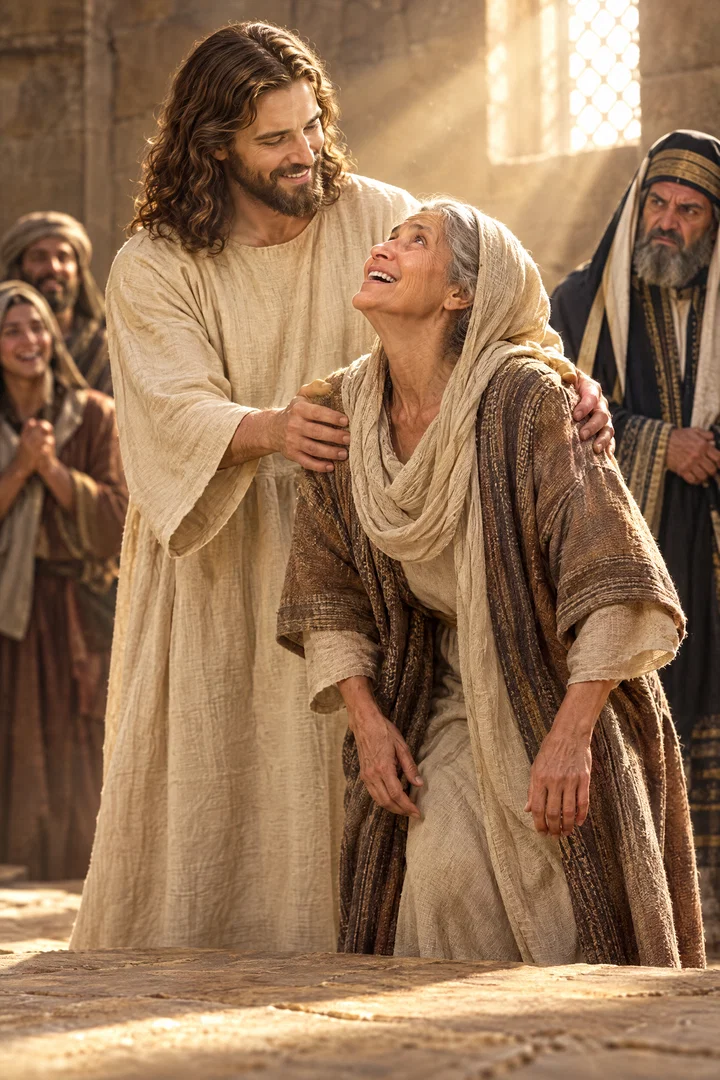
Cross-references 20 of 36
- John 5:9-10
And immediately the man was made whole, and took up his bed, and walked: and on the same day was the sabbath.
A healed man is criticized for carrying his bed on the Sabbath.
- John 9:14-16
And it was the sabbath day when Jesus made the clay, and opened his eyes.
A Sabbath healing prompts Pharisaic dispute over Sabbath observance.
- Matthew 12:12
How much then is a man better than a sheep? Wherefore it is lawful to do well on the sabbath days.
Jesus teaches that doing good and rescuing a person on the Sabbath is lawful.
- Mark 2:27-28
And he said unto them, The sabbath was made for man, and not man for the sabbath:
Jesus says the Sabbath was made for humanity and declares his authority over it.
- Luke 14:1-6
And it came to pass, as he went into the house of one of the chief Pharisees to eat bread on the sabbath day, that they watched him.
Another Sabbath healing dispute defends helping the afflicted as lawful.
- Mark 3:1-5
And he entered again into the synagogue; and there was a man there which had a withered hand.
Jesus heals on the Sabbath and teaches that doing good is lawful.
- Exodus 20:8-10
Remember the sabbath day, to keep it holy.
The ruler invokes the six days for work and the Sabbath prohibition.
- Matthew 12:10
And, behold, there was a man which had his hand withered. And they asked him, saying, Is it lawful to heal on the sabbath days? that they might accuse him.
Both texts describe objections to Jesus healing on the Sabbath.
- John 7:22-23
Moses therefore gave unto you circumcision; ( not because it is of Moses, but of the fathers;) and ye on the sabbath day circumcise a man.
Jesus defends his Sabbath healing by comparing it with circumcision performed on the Sabbath.
- Matthew 12:5
Or have ye not read in the law, how that on the sabbath days the priests in the temple profane the sabbath, and are blameless?
Priests’ necessary temple work is blameless on the Sabbath.
- Luke 6:1-5
And it came to pass on the second sabbath after the first, that he went through the corn fields; and his disciples plucked the ears of corn, and did eat, rubbing them in their hands.
Jesus defends his disciples’ Sabbath actions against restrictive rules.
- Luke 4:16
And he came to Nazareth, where he had been brought up: and, as his custom was, he went into the synagogue on the sabbath day, and stood up for to read.
Jesus customarily worshiped in the synagogue on the Sabbath.
- Luke 23:56
And they returned, and prepared spices and ointments; and rested the sabbath day according to the commandment.
The women rest on the Sabbath according to the commandment.
- Luke 6:7
And the scribes and Pharisees watched him, whether he would heal on the sabbath day; that they might find an accusation against him.
Religious leaders watch Jesus for grounds to accuse him over Sabbath healing.
- Isaiah 58:13
If thou turn away thy foot from the sabbath, from doing thy pleasure on my holy day; and call the sabbath a delight, the holy of the LORD, honourable; and shalt honour him, not doing thine own ways, nor finding thine own pleasure, nor speaking thine own words:
Both address Sabbath observance and turning from personal pleasure.
- John 5:16
And therefore did the Jews persecute Jesus, and sought to slay him, because he had done these things on the sabbath day.
Jesus is criticized and persecuted for healing on the Sabbath.
- Matthew 12:7
But if ye had known what this meaneth, I will have mercy, and not sacrifice, ye would not have condemned the guiltless.
Jesus appeals to mercy rather than sacrifice in defending Sabbath healing.
- Luke 13:10
And he was teaching in one of the synagogues on the sabbath.
It introduces the Sabbath healing episode.
- John 5:18
Therefore the Jews sought the more to kill him, because he not only had broken the sabbath, but said also that God was his Father, making himself equal with God.
Jesus is opposed for healing on the Sabbath and claiming God as his Father.
- Genesis 2:2-3
And on the seventh day God ended his work which he had made; and he rested on the seventh day from all his work which he had made.
Both texts concern the seventh-day Sabbath established after God’s work of creation.
Commentary
Each commentary is drawn from primary sources: the writings of Ellen G. White and Adventist pioneers and periodicals. Each commentary is separate. Its own words are not a quotation; follow the references to read the source passages.
Ellen G. White
6 sources
The ruler of the synagogue answered with indignation because Jesus had healed on the Sabbath.Ms 79a, 1910, par. 1–4ST Apr 23, 1896ST Apr 23, 1896Ms 238, 1902, par. 7 He did not address Christ directly but told the people that there are six days in which men ought to work, and that in them they should come and be healed, and not on the Sabbath day.Ms 79a, 1910, par. 1–4ST Apr 23, 1896ST Apr 23, 1896 Jesus exposed the objection as inconsistent, for people loose their animals on the Sabbath to lead them to water, so this woman, a daughter of Abraham, should also be loosed from her bond on the Sabbath.Ms 79a, 1910, par. 1–4 The episode is thus a lesson in consistency.Ms 79a, 1910, par. 1–4Ms 79, 1910, par. 3–5
His indignation at the suffering woman's deliverance shows that his Sabbath observance was distorted.ST Apr 23, 1896 The healing was not a violation of the Sabbath's purpose or forbidden labor, but was in harmony with the Sabbath and its sanctification.ST Apr 23, 1896ST Apr 23, 18965MR 84.2 As an act of mercy it revealed Christ's character and power, which a heart shaped by truth and righteousness would have recognized instead of treating it as unlawful work.ST Apr 23, 1896 Such a work should have prompted gratitude and praise to God rather than condemnation.ST Apr 23, 1896
The people rejoiced at the deliverance, but some who were moved to believe would not confess their faith for fear of being expelled from the synagogue, loving human approval more than God's.ST Apr 23, 1896 The Sabbath gave an especially good opportunity to reach sick people who worked during the week, and He healed willingly and joyfully, bringing comfort and restoring health.5MR 84.2 His Sabbath practice was to comfort and heal the sick, a work so extensive it could not be counted, with a field of service reaching the world.Ms 238, 1902, par. 7 The passage stands as an example of the work to be carried on after Christ's example.Ms 79, 1910, par. 3–5
Sources
Pioneers and periodicals
45 sources
The verse records the ruler of the synagogue answering with indignation because Jesus had healed on the Sabbath, telling the people there are six working days to come and be healed and not on the Sabbath day.ST Nov 11, 1897ST Mar 19, 1894ST Oct 29, 1896 The setting is Jesus teaching in a synagogue on the Sabbath when He called to Him a woman bowed together eighteen years, laid His hands on her and made her straight so she glorified God, freeing one bound by Satan.ST Nov 14, 1900ST Nov 1, 1905ST Apr 5, 1899 The ruler treated healing the sick as work forbidden on the Sabbath under human tradition and insisted it be sought on the six workdays instead.ST Apr 5, 1883ST Jun 11, 1894 Jesus exposed the objection as hypocritical and inconsistent, since the ruler allowed animals to be loosed and led to water on the Sabbath yet faulted Him for loosing with less labor a daughter of Abraham bound eighteen years.ST Nov 11, 1897ST Jul 16, 1894ST Feb 7, 1911 Relieving the sick is an act of mercy lawful on the Sabbath that honors it and shows it was made for man for his good, and the seventh-day Sabbath Jesus so kept remains binding in the gospel age rather than abolished by correcting its misuse.RH Feb 11, 1862ST Jan 31, 1911ST Apr 5, 1883RH Jun 24, 1858RH Apr 18, 1871
Narrative Context and Wording
Luke 13:14 records the ruler of the synagogue answering with indignation because Jesus had healed on the Sabbath day, telling the people that there are six days in which men ought to work and to come and be healed in them and not on the Sabbath day.ST Nov 11, 1897ST Mar 19, 1894ST Oct 29, 1896ST Jul 16, 1894ST Feb 23, 1882 He treated healing the sick as work forbidden on the Sabbath under that restriction, insisting healing should be sought on the six workdays instead.ST Nov 11, 1897ST Jul 16, 1894ST Feb 23, 1882ST Apr 13, 1904ST Apr 14, 1881 His response contrasts with Jesus' concern for the woman and makes regard for human beings the test of religious character, exposing the selfishness and short-sightedness that exalts things above men.ST Oct 29, 1896ST Apr 13, 1904 Jesus' reply in the surrounding account exposes the inconsistency of this restriction, since people loose their animals on the Sabbath to lead them to water and the afflicted woman, a daughter of Abraham bound eighteen years, should also be released from her suffering that day, so the Sabbath is a fitting time for her healing and her relief by word and touch did not break it.ST Nov 11, 1897ST Jul 16, 1894ST Feb 23, 1882
The setting is Jesus teaching in a synagogue on the Sabbath when he called to him a woman bowed together with a spirit of infirmity for eighteen years, laid his hands on her and immediately made her straight so she glorified God.ST Nov 14, 1900 She had been bound by Satan with physical infirmity and he freed her by declaring her loosed, and being bound and powerless to raise herself her condition illustrates how sin binds people and leaves them without strength to free themselves.ST Nov 1, 1905ST Apr 5, 1899 It is one instance in the ongoing controversy with the Jewish leaders over Jesus doing good and healing on the Sabbath, and one of seven recorded Sabbath miracles in which his choice to heal rather than remain silent challenged the prejudice that such healing broke divine law.ST Nov 14, 1900ST Apr 14, 1881
That indignation was directed against Jesus for healing, against the poor infirm woman for submitting to be healed, and against all the people because they rejoiced for all the glorious things done by Christ.ST Mar 19, 1894 His public rebuke tried to turn the people against Jesus, though the woman had not come to the synagogue for a cure.ST Feb 23, 1882 The verse belongs to the same pattern as another Sabbath healing where Jesus asked whether healing on the Sabbath was lawful, received no answer, healed the afflicted person, and challenged the company by asking whether they would rescue a son or an ox fallen into a pit on the Sabbath.ST Mar 2, 1882 Its context also includes the delay in bringing the sick until sunset marking the end of the Sabbath and the beginning of the next day.RH Feb 28, 1871
The Sabbath in the account had been buried under rabbinical superstition and a heap of human rules and tradition treated as reason to oppose an act of mercy.ST Oct 7, 1897ST Sep 29, 1909 The teachers who claimed custody of the Scriptures had thereby made the Scriptures and law of God void through their tradition, the same way the later apostate church made void the second commandment and the Sabbath commandment through priestly and pagan tradition, grouped with the way tradition made the fifth commandment ineffective in a particular respect.ST Oct 7, 1897ST Sep 29, 1909 The Sabbath day itself is one entire day of the week, a twenty-four-hour hemera embracing both darkness and light, not twelve hours of light only.RH Dec 12, 1871
Ruler's Objection and Spirit
The ruler condemned the healing as work forbidden on the Sabbath and told the sufferers to come for cure on the six working days instead.ST Apr 5, 1883ST Jun 11, 1894ST Apr 19, 1883 His rule expressed restrictive human traditions that classed every act of healing as unlawful, even while those same traditions permitted limited relief of pain.ST Jun 11, 1894ST Apr 19, 1883RH May 5, 1874 Pretended zeal for Sabbath observance was thus misused to oppose a work of mercy.ST Apr 5, 1883ST Nov 16, 1876
The reply exposed the restriction as hypocritical and inconsistent.ST Nov 11, 1897ST Feb 7, 1911ST Mar 30, 1888RH Feb 11, 1862ST Jan 31, 1911 He and those like him would loose an animal on the Sabbath and lead it to water, yet found fault for healing a person with even less labor.ST Nov 11, 1897ST Jul 16, 1894ST Feb 7, 1911ST Mar 30, 1888RH Feb 11, 1862 Since they did so for beasts, the woman as a daughter of Abraham, bound by Satan for eighteen years, ought all the more to be loosed from her infirmity on that day.ST Nov 11, 1897ST Jul 16, 1894ST Feb 7, 1911RH Feb 11, 1862ST Jan 31, 1911
The indignation revealed bigotry, selfishness and short-sightedness that exalts things above men.ST Mar 19, 1894ST Oct 29, 1896ST Apr 13, 1904 Sabbath law and property in sheep and oxen were counted dearer than the life and healing of a suffering bowed woman, and regard for human beings became the test of religious character.ST Oct 29, 1896ST Apr 13, 1904ST Apr 13, 1904 The observance was outwardly strict but inconsistent, driven more by hostility toward Jesus than by genuine regard for the Sabbath.RH Nov 4, 1858ST Nov 16, 1876 It made people serve the Sabbath instead of recognizing that the Sabbath was made for their good.RH Jun 24, 1858ST Apr 13, 1904
That Pharisaical Sabbath was identical in time with the true Sabbath of which Christ is Lord, but opposite in spirit and manner of observance.ST Mar 19, 1894 Loaded down with rigorous and burdensome traditions it had become a yoke of bondage that perverted its design.ST Mar 19, 1894RH May 5, 1874 By those traditions the teachers made void the law of God, in the same way the later apostate church made void the second commandment and the Sabbath commandment through priestly and pagan tradition.ST Sep 29, 1909
Healing Honors the Sabbath
Relieving the sick and leading dependent animals to water are both acts of mercy lawful on the Sabbath, and healing on that day honors it rather than violating or relaxing God's law.RH Feb 11, 1862ST Apr 5, 1883ST Jun 11, 1894ST Apr 19, 1877 Such healing is exactly adapted to the sabbatic institution and upholds its true purpose against burdensome human rules that treated healing as forbidden work.RH Feb 11, 1862ST Jun 11, 1894RH May 5, 1874 The Sabbath is thus shown to be a day of blessing and not a burden, a day of rest, delight and holy joy and not a day of misery for the afflicted.ST Feb 7, 1911ST Jan 31, 1911ST Jun 11, 1894 The ruler's restriction reflects human tradition that distorts the Sabbath's merciful purpose and makes people serve the Sabbath instead of recognizing it was made for their good.RH Feb 11, 1862RH Jun 24, 1858
The Sabbath was made for man and not man for the Sabbath, made in the beginning for all humanity for their good and continued as a blessing to mankind.RH Jun 24, 1858RH Jul 18, 1854ST Apr 13, 1904 A human life matters more than an animal, so if an animal may be loosed and led to water, a daughter of Abraham bound by Satan for eighteen years ought much more to be loosed from her infirmity on that day.ST Feb 7, 1911ST Jan 31, 1911ST Apr 13, 1904 God's purpose for the day is to free the oppressed and relieve burdens, exposing outward religious rules that prevent compassion.ST Jan 31, 1911 It is a sign and channel of divine power to free people from Satan's power, revealing the presence of the One who forgives iniquity and heals disease.ST Jul 8, 1897
The healing was done on purpose to correct the false notion that every act of healing the sick was entirely unlawful on that day, and special care was taken to teach what is lawful on the Sabbath.RH Apr 18, 1871RH May 5, 1874 By going right on with these good deeds Jesus restored the Sabbath to its rightful place, teaching that to do good on the Sabbath day is lawful and right and honoring the Sabbath by exalting its Author.ST Nov 17, 1909ST Feb 2, 1915 He chose the same seventh day kept by the Jewish people for mighty works, proving its sacred, unchangeable and eternal claim.ST Nov 17, 1909 By so acting He kept the Sabbath Himself and taught His disciples true Sabbath keeping, showing that restoring a sufferer bound by sin and bound by Satan on the Sabbath is doing God's work on His own day and is an act of righteousness, widely different from common everyday work for gain such as bringing fish to market, working grain fields and trafficking to get gain.ST Feb 2, 1915
Such mercy was in harmony with the Sabbath's sanctification and should have prompted gratitude and praise to God rather than condemnation.ST Apr 23, 1896ST Apr 23, 1896 A heart shaped by truth and righteousness would have recognized the work's true nature rather than treating it as forbidden labor.ST Apr 23, 1896 His reply exposed the ruler's hypocrisy, His adversaries were put to shame, and the people rejoiced at His glorious deeds.ST Feb 7, 1911ST Jul 8, 1897 Yet some who were moved to believe feared confessing their faith lest they be expelled from the synagogue, loving human approval more than God's.ST Apr 23, 1896
Sabbath Day and Permanence
The Sabbath on which Jesus healed is the seventh day of the week, not the first day.ST Apr 19, 1883ST Apr 11, 1900ST Nov 17, 1909 It is called the Sabbath in the Christian dispensation, and that inspired name proves the seventh day is the Christian Sabbath.ST Apr 19, 1883RH Jun 5, 1860 God has invested injunctions and promises in one day and one day only, namely the seventh-day Sabbath, with no application in any way to the first day of the week.STST Apr 11, 1900 All Sabbath commandments and all instruction about keeping the day pertain to the seventh day alone and cannot be applied to Sunday without wresting the Scriptures.STST Apr 11, 1900 Jesus purposely chose that same seventh day kept by the Jewish people for mighty works, and the healing that drew indignation honors the day and proves its sacred, unchangeable and eternal claim.ST Apr 19, 1883ST Nov 17, 1909
Correcting misuse of the Sabbath did not abolish it.RH Jun 24, 1858 The ruler's demand to come for healing on the six workdays reflected a mistaken view that made people serve the Sabbath instead of recognizing it was made for their good, and Jesus corrected that misuse by teaching its proper use without violating it.RH Jun 24, 1858RH Apr 18, 1871 He took special care to teach what is lawful on the Sabbath, which shows the Sabbath law remains binding in the gospel age.RH Jun 24, 1858RH Apr 18, 1871 It is and remains a sign forever between God and Israel, where Israel means not literal Jews exclusively but all who are of faith in Christ, with no difference between Jew and Gentile, who are children of Abraham and heirs according to promise.RH Apr 18, 1871
Those who held the opposing argument taught that Christ, accused of breaking the Sabbath by healing on it without distinction of days and without enforcing its observance, pleaded justification as Lord of the Sabbath.RH Oct 21, 1851 On that view he had no right to break one of the commandments and never did, but he had a right to abolish the law and did, so he did not break the Sabbath by healing.RH Oct 21, 1851 Otherwise, they reasoned, he did break it and became a transgressor.RH Oct 21, 1851 This requires the Sabbath to have been abolished before he began healing the sick on the Sabbath, and then again at the cross.RH Oct 21, 1851
Satan had bound the woman with disease for many months and years, even eighteen years.ST Dec 16, 1889 Satan himself is able to unbind those he has bound to make it appear that the sick are healed.ST Dec 16, 1889 Such releases are counterfeit healings by superior wisdom and power apart from faith in Christ, not creation.ST Dec 16, 1889 He cannot heal serious organic disease involving wasting and destruction of parts because that requires creation, but where disease is purely functional from mere obstruction he can remove it in a brief time.ST Dec 16, 1889
Moral Test and Application
The ruler's indignant answer directing the people to seek healing on the six workdays instead of the Sabbath sets regard for human beings against regard for things, and that regard is the test of religious character that came to that nation and comes to all nations.ST Oct 29, 1896ST Apr 13, 1904 His reaction exposed a selfishness and short-sightedness that exalts things above men, in contrast to Jesus' concern for the bowed woman He had healed.ST Oct 29, 1896ST Apr 13, 1904 Jewish leaders put their sabbath law above a suffering bowed woman, counting their traditions and rules and their property in sheep and oxen dearer than the lives and healing of fellow creatures.ST Apr 13, 1904ST Apr 13, 1904 Jesus ever lifted the man above the thing, however holy the thing or however holy men counted it, for the Sabbath is God's holy day given in the beginning to be a continuing blessing to mankind, made for man and not man for the Sabbath.ST Apr 13, 1904
Restoring a sufferer bound by sin and bound by Satan on the Sabbath is doing God's work on His own day and is an act of righteousness.ST Feb 2, 1915 Such healing is a work of mercy and direct service to God, not a violation of the Sabbath, for Sabbath rest is from work done for personal profit or pleasure, not from doing good, and works of necessity, worship, mercy and direct service remain in harmony with the commandment to keep the Sabbath holy.ST May 21, 1912ST Feb 2, 1915ST Jun 20, 1911 It is therefore widely different from doing common everyday work for gain on the Sabbath, such as bringing fish to market, working grain fields, and trafficking to get gain, which profanes the Sabbath by setting its Maker aside and being busied with the common cares of life.ST Feb 2, 1915 The same distinction governs ordinary activities like business travel, which continues ordinary work on the sacred day, and getting mail, for the six days appointed for work are distinct from the Sabbath and the Lord's relieving the sick and helping people in trouble does not place ordinary business under mercy.RH Feb 5, 1857ST May 21, 1912 By going right on with these good deeds Jesus restored the Sabbath to its rightful place and taught that to do good on the Sabbath day is lawful and right, and His Sabbath healings were among His most wonderful works honoring the Sabbath by exalting its Author, so that by so acting He kept the Sabbath Himself and taught His disciples true Sabbath keeping, which they also kept.ST Feb 2, 1915
The ancient objection that healing should be sought on the six workdays is the same kind of Sabbath objection made by those who oppose the Sabbath in the present day.RH Apr 28, 1863 The healing of the daughter of Abraham bound by Satan eighteen years was in full accordance with the Sabbath law though against Pharisaic notions, for lawful means agreeable to law, and well-doing and acts of mercy to man were declared lawful on the Sabbath.RH Apr 25, 1854 That declaration exposed the hypocrisy of accusers who would show mercy even to dumb beasts on that day yet condemn mercy to people, so the charge of Sabbath-breaking is false, like the charge of having a devil, for He kept His Father's commandments.RH Apr 25, 1854 Christians must therefore stand with Christ that the healing was lawful rather than with His accusers that it was unlawful.RH Apr 25, 1854 The conflict was between God's ideas of keeping the Sabbath commandment and the Pharisees' ideas, with the ruler indignantly calling Him a Sabbath breaker, and that Sabbath conflict is the cause for which bigoted Jews maligned Christ, misrepresented Him, and secured the aid of Rome to crucify Him.
Sources