Translations
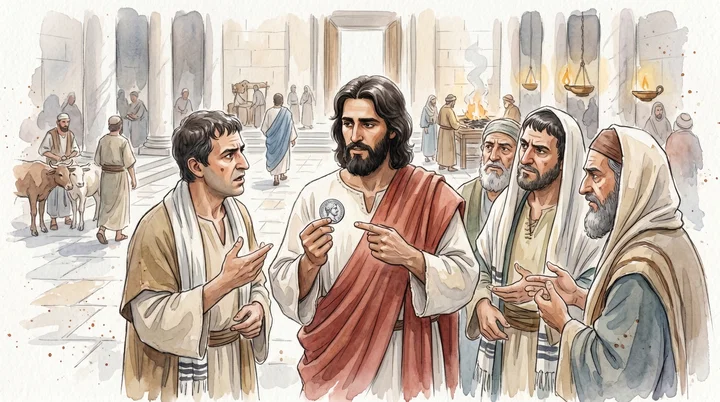
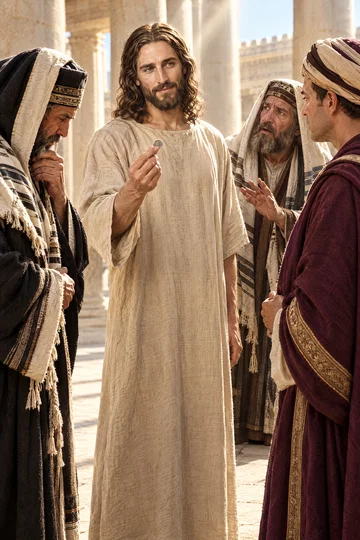
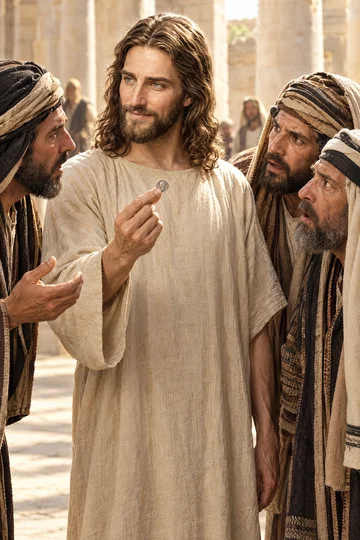
And he says to them, Whose is this image and superscription?
King James Version, KJV Cambridge Paragraph Bible, Revised Version, American Standard Version
And he saith unto them, Whose is this image and superscription?
And he saith to them, Whose is this image, and superscription?
and he saith to them, 'Whose [is] this image and the inscription?'
And he says to them, Whose [ is] this image and superscription?
And he saith unto them—Whose, is this image and the inscription?
Berean Standard Bible, Majority Standard Bible
“ Whose image is this,” He asked, “ and whose inscription?”
He asked them, “ Whose is this image and inscription?”
And he said to them, Whose is this image and name on it?
And he sayde vnto them, Whose is this image and superscription?
Douay-Rheims (Challoner revision)
And Jesus saith to them: Whose image and inscription is this?
Pictures
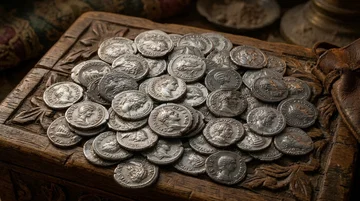
Cross-references
- Luke 20:24-25
Shew me a penny. Whose image and superscription hath it? They answered and said, Cæsar’s.
Jesus asks whose image is on the coin, then teaches to render Caesar’s and God’s due.
- Mark 12:16-17
And they brought it. And he saith unto them, Whose is this image and superscription? And they said unto him, Cæsar’s.
Jesus identifies Caesar’s image on the coin and distinguishes what is owed to Caesar and God.
- Romans 13:7
Render therefore to all their dues: tribute to whom tribute is due; custom to whom custom; fear to whom fear; honour to whom honour.
Commands rendering tribute and other dues to civil authorities.
- Luke 23:2
And they began to accuse him, saying, We found this fellow perverting the nation, and forbidding to give tribute to Cæsar, saying that he himself is Christ a King.
The false charge about tribute contradicts his teaching on tribute to Caesar.
- Matthew 17:24-27
And when they were come to Capernaum, they that received tribute money came to Peter, and said, Doth not your master pay tribute?
Jesus pays the temple tax to avoid giving offense.
- Mark 12:17
And Jesus answering said unto them, Render to Cæsar the things that are Cæsar’s, and to God the things that are God’s. And they marvelled at him.
States the rule of rendering to Caesar and to God.
- Genesis 1:27
So God created man in his own image, in the image of God created he him; male and female created he them.
The coin’s stamp parallels humanity created in God’s image.
- Daniel 3:16-18
Shadrach, Meshach, and Abed-nego, answered and said to the king, O Nebuchadnezzar, we are not careful to answer thee in this matter.
God’s servants refuse a ruler’s demand to worship an image.
Commentary
Each commentary is drawn from primary sources: the writings of Ellen G. White and Adventist pioneers and periodicals. Each commentary is separate. Its own words are not a quotation; follow the references to read the source passages.
Ellen G. White
30 sources
Trapped by flattering enemies asking whether tribute to Rome was lawful so that either answer would accuse Him, Jesus exposed their hypocrisy and called for the coin, then asked whose image and writing it carried to force their admission that it was Caesar's.Ms 10, 1906, par. 8–12ST Jun 29, 18823SP 42.2 The coin bore the Roman ruler's likeness and name, which marked it as belonging to him and to his sphere of civil rule.DA 601.1–602.5ST Apr 25, 1878ST Feb 8, 1899 By pointing to that mark He settled the question without evasion, that what belongs to Caesar is to be given to Caesar and what belongs to God to God, so tribute is to be paid and governing powers honored under God while first allegiance remains to Him.DA 601.1–602.5ST Apr 25, 1878ST Feb 8, 18993SP 129.3–130.1ST Jul 4, 1878 As the coin carried the ruler's stamp, humanity at creation carried God's image and writing, and though sin has marred it its traces remain and God seeks to write His likeness anew upon every soul in righteousness and holiness, which must be stamped in this life as oneness with Christ and perfection of character for heaven.STB 388.1COL 194.3MWISDAP 45.16T 317.3ST That same stamp marks all God entrusts to men as His own and marks heavenly things as the only currency of enduring value, so talents, means, institutions, and even the home's influence on children are to bear God's superscription and be used for Him rather than for self.7T 156.1Lt 90, 1895, par. 31–33Lt 16f, 1892, par. 15–16Ms 11, 1892, par. 5–6Ms 129a, 1901, par. 4–5
Setting and Question
The question about whose image and writing was on the coin was Jesus' call for the tribute money to be shown to Him when the Pharisees joined with the Herodians to lay a trap for Him.Ms 10, 1906, par. 8–12ST Jun 29, 18823SP 42.2 They came with flattering commendation and a pretended desire for instruction, asking whether it was lawful to give tribute to Caesar in order to entangle Him.Ms 10, 1906, par. 8–12ST Jun 29, 1882 They hoped that either answer would let them accuse Him, charging Him before the Romans as an enemy to civil authority if He forbade tribute, and charging Him to the elders as opposed to the law of God if He approved it.Ms 10, 1906, par. 8–12ST Jun 29, 18823SP 42.2
He perceived their wickedness and wicked purposes and was not deceived by their courteous words, but called them hypocrites.Ms 10, 1906, par. 8–12ST Jun 29, 1882 Thrown off guard, they immediately brought Him a penny bearing the image and superscription of the Roman ruler.Ms 10, 1906, par. 8–12ST Jun 29, 1882 He then asked them whose image and superscription it bore in order to make them admit it was Caesar's before commanding them to render to Caesar and to God.Ms 10, 1906, par. 8–12ST Jun 29, 1882ST Feb 8, 1899 His question exposed them, and they marveled and left Him and went their way.Ms 10, 1906, par. 8–12ST Jun 29, 1882
The coin bore Caesar's image, name and inscription, which showed that it belonged to Caesar and to Caesar's sphere of civil authority.DA 601.1–602.5ST Apr 25, 1878ST Feb 8, 18993SP 42.13SP 129.3–130.1 In this He understands the true character of every person, so that whatever the profession no cover of pretentious righteousness can deceive Him, for He records in His book the true motives of all.Ms 10, 1906, par. 8–12 The account belongs to warnings about rejecting the Son of God that apply in every age, whose foreshadowed doom awaits anyone who refuses Christ unless that person repents.DA 600.3
It stands in the second parable of invitation, which is a king's invitation coming from one vested with power to command and involving much.Ms 149, 1898, par. 3 Refusal of this invitation is a deeper insult and brings deeper guilt than refusal of a householder's invitation.Ms 149, 1898, par. 3 Those bidden made light of it on pleas of circumstances and supposed duties, and treated the king's messengers with scorn, despitefully using them and slaying them.Ms 149, 1898, par. 3 This brought the wrath of the king, and their punishment was more than exclusion from his presence and table, for he sent forth his armies and destroyed those murderers and burned up their cities.Ms 149, 1898, par. 3
Duty to Civil Authority
When asked whose likeness and writing were upon the tribute coin, the questioners were made to answer that they were Caesar's, and the image and inscription showed the coin belonged to Caesar and to the sphere of civil authority.DA 601.1–602.5ST Apr 25, 1878ST Feb 8, 18993SP 42.1 That admission grounded the answer that what belongs to Caesar should be given to Caesar and what belongs to God to God, settling the disputed question about tribute without evasion.ST Apr 25, 1878ST Feb 8, 18993SP 42.1 The principle taught is to support and render due to the governing power under which people live, while giving first allegiance to God and provided civil claims do not conflict with a higher duty.DA 601.1–602.5ST Apr 25, 1878ST Feb 8, 1899
The answer taught that tribute should be paid to Caesar, and obedience to the reigning power was shown in paying tribute and teaching disciples to do so.3SP 129.3–130.1ST Jul 4, 18785RED 49.2–50.1 This stood contrary to Jewish tumults and claims that it was against Jewish law to pay tribute to a foreign power.5RED 49.2–50.1 It thereby exposed as false the later priestly accusation that the nation was perverted and giving tribute to Caesar was forbidden.3SP 129.3–130.1ST Jul 4, 18785RED 49.2–50.1
Bearing God's Image
Just as a coin carries the image and writing of the ruling power to which it belongs, humanity at creation carried the image and writing of God.COL 194.3ST Although sin has marred and dimmed that divine marking, its traces remain in every soul.COL 194.3ST Even a soul degraded by sin and lying like a lost coin among dust and rubbish is still precious in God's sight because of that remaining value.COL 194.3 God seeks to recover each person and to write His own image upon him again in righteousness and holiness.COL 194.3ST
God's image and superscription must be stamped upon believers here in this world, where the trial and test take place.STB 388.1MWISDAP 45.1 That stamp is oneness with Christ and the same perfection of character Christ bore on earth.STB 388.1 All who enter heaven must bear it, or they would spoil heaven.STB 388.1 Christ's grace perfects the character of every one who truly accepts Him, preparing with a new heart in perfect harmony those fitted to live in heaven's harmony.STB 388.1MWISDAP 45.1 That unity for which Christ prayed is the sacred pledge of discipleship, making true disciples members of the royal family with one desire for sanctification by the same Spirit, loving as brethren and speaking the same thing though language and manner of expression may differ.STB 388.1
Christ places His own character like a superscription upon people whose minds are brought under His will, and as they behold Him they are changed in character.6T 317.3 When the obedient soul is emptied of self, the Holy Spirit reveals Christ and forms His likeness within.ST Dec 25, 1893 That image and superscription mean inward consecration with the right spirit controlling the heart, in which the divine mingles with the human.Lt 57, 1891, par. 7–9 Without that mingling, even desperate efforts for apparent success interweave things that are an offense to God.Lt 57, 1891, par. 7–9
As the coin bore the ruler's image and inscription, the goods, talents and dollars entrusted to human stewards bear God's image and superscription marking them as His rather than their owners'.Lt 90, 1895, par. 31–33Ms 11, 1892, par. 5–6 The principal is the Lord's and the interest is His, as Master-lent capital of five, two, or one talent.Ms 11, 1892, par. 5–6 Nothing is to be hoarded, for there is a place for every talent to be employed, and not even a small amount or a farthing is to be squandered upon selfish indulgence but every dollar put out to the exchangers is to be used for Him.Lt 90, 1895, par. 31–33Ms 11, 1892, par. 5–6 Stewards will have to answer to God for how they administer what He has entrusted to them.Lt 90, 1895, par. 31–33
God has stamped His own image and superscription upon heavenly things, making them the currency of heaven of infinite value.Lt 16f, 1892, par. 15–16Ms 16, 1890, par. 47–5012MR 333.3 The things of the world perish with the using and are not that golden currency, because God has not stamped them.Lt 16f, 1892, par. 15–16Ms 16, 1890, par. 47–50 All who profess to believe must therefore deal in that heaven-stamped currency by handling what God has stamped, laying up treasure in heaven that will not perish rather than treasure on earth, for where the treasure is the heart will be also.Lt 16f, 1892, par. 15–1612MR 333.3 They must subordinate the world to religion instead of making temporal interests first and exhausting soul, body and spirit to secure temporal advantages, keeping eternity and the coming reckoning in view in business life and renouncing all trust in self-ability and self-wisdom.Lt 16f, 1892, par. 15–16Ms 16, 1890, par. 47–50 This requires transforming grace and a deep and thorough work of the Spirit to make hearts that are as steel soft and sympathetic and true to the service of Christ instead of folding the hands in peace and safety at ease in Zion doing almost nothing.Lt 16f, 1892, par. 15–16
Everything on earth, from the greatest tree to the smallest shell, bears the image and inscription of God, making the unseen God known through what is seen.ED 100.2–3 The same language also marks a false stamp, for selfishness imprints its image and superscription on life and character and some never lose that mark.STMW9 4.3–5.2 A position and conduct characterized by faultfinding, criticism and sowing discord rather than building up the church do not bear God's identifying mark.Lt 48, 1900, par. 9
Image and superscription are impressed upon a child's tender, susceptible mind from the home atmosphere from an early age, even in infancy.Ms 129a, 1901, par. 4–5 Harsh, discordant, fretful and scolding words impress unhappiness and discord, and a child in such a family will cry much.Ms 129a, 1901, par. 4–5 A mother's sunny, smiling countenance impresses cheerful impressions that the infant mind and heart reflect as a polished plate portrays human features.Ms 129a, 1901, par. 4–5 A mother with indwelling Christ impresses the divine likeness upon the expanding mind.Ms 129a, 1901, par. 4–5
What belongs to God must bear God's superscription, so a sanitarium bears it only by preserving its character as a missionary institution in the fullest sense.HPMMW 46.2 Keeping that character requires godliness of life and character in every worker, viewing success in the light of God's word, with true success bearing the heavenly credentials and with rejoicing in the Lord over success joined to self-abasement and dissatisfaction with self for what has been left undone through neglect and unfaithfulness.HPMMW 46.2 Writers bear God's mark by using only what bears it, answering falsehood with truth and avoiding personal hints, insults and opponents' arguments as much as possible.7T 156.1
Sources
Pioneers and periodicals
63 sources
Trapped by flattering enemies over paying tribute to Rome, he called for the tribute coin and forced them to admit its image and inscription marked it as Caesar's, laying the ground for giving to Caesar what is Caesar's and to God what is God's.ST Jun 29, 1882ST Aug 22, 1911ST Jul 3, 1907ST Jan 7, 1889ST Feb 12, 1902 Civil rule has a real but limited claim over outward civil matters such as tribute and taxes, while whole-hearted devotion, worship, conscience and religious allegiance belong to God and come first.ST May 28, 1912ST Jan 23, 1907RH Mar 26, 1914ST May 25, 1904 The state must not intrude on the relation between a person and God by legislating religion or conscience, and the church must not take secular power or rule civil affairs.ST May 28, 1912RH Mar 26, 1914ST Apr 25, 1900RH Mar 26, 1914RH Oct 29, 1914 The Sabbath bears God's image, mark and inscription as Creator's holy day, so it belongs to God and not to Caesar, and no human authority may permit, forbid, change or enforce its keeping.RH Oct 20, 1904ST Jan 30, 1907ST Jan 23, 1907ST Oct 23, 1893ST Mar 19, 1894 People themselves bear their Creator's image, marred by sin yet to be restored in righteousness and holiness, so they belong to God and owe him their highest duty.STST Dec 25, 1893
Setting, Words, and Coin
The question about tribute was a trap laid by Pharisees together with Herodians to catch Jesus over paying tribute to Rome, a politically dangerous issue because Judas of Galilee had led revolt against the land tax by proclaiming tribute unlawful.ST Jun 29, 1882ST Feb 8, 1899ST Feb 12, 1902 They approached with courteous flattery and pretended desire for instruction, but he saw through it, perceived their wickedness, called them hypocrites and exposed the trap.ST Jun 29, 1882RH Mar 10, 1868 He answered without taking a position that would expose him to either party, for either a yes or a no would have condemned him by making him offend Jewish law or Roman authority.ST Jun 29, 1882ST Sep 30, 1886 The setting was constant Jewish tumult against Rome, with many claiming tribute violated Jewish law while Roman authorities watched harshly to suppress sedition, and his enemies hoped to make him declare against paying tribute to a foreign power so they could accuse him.ST Sep 30, 1886ST Mar 23, 1888
He asked them to show him the tribute money, and thrown off guard they immediately brought a penny.ST Jun 29, 1882RH Mar 10, 1868 He asked whose image and inscription it bore to make them admit it was Caesar's, the coin bearing the image and inscription of the Roman ruler and thereby establishing a clear principle about tribute and settling the disputed question without evasion.ST Jun 29, 1882ST Feb 8, 1899 His superior wisdom silenced them so they retired confounded and left him and went their way, confounding one group before the Sadducees challenged him about the resurrection.ST Jan 7, 1889RH Mar 10, 1868 Their questioning was a manufactured theological quibble put not from desire for light or search for truth, and he discerned the motives that prompted them and demolished their quibbles so completely that the web by which they hoped to entangle him was rent. The exchange belongs to his last day of teaching in the temple on Tuesday, when he answered questions and denounced hypocrisy.RH Jan 29, 1914
The word image means a physical image with real form and shape, as on a coin.ST Aug 23, 1877 The coin was a Roman penny carrying Caesar's image and inscription, and such pennies still dug from ruins of once rich and crowded cities give physical testimony to the truth of the Bible.RH Aug 29, 1871 The image and inscription identify whose coin it is and whose authority and lordship its circulation acknowledges, establishing the coin's connection to the ruler whose authority it represents.RH Mar 9, 1869 Where a king's money is current, the inhabitants acknowledge that king as their lord, proving whether it is genuine and current and declaring ownership and rightful use.RH Mar 9, 1869 He used the piece of money as an object lesson to bring teaching before hearing and sight, starting from a familiar thing by asking whose image and inscription were on it.ST Sep 17, 1885ST Mar 12, 1885
In answering, he answered a fool according to his folly lest he be wise in his own conceit, meaning exposing the folly without showing the same evil temper when Scribes and Pharisees questioned him about the lawfulness of giving tribute to Caesar.RH Sep 17, 1861 The chapter containing the verse shows the wedding-garment examination before the wedding, meaning the heavenly court is now in session and the decision of character fixing every man's destiny as holy or filthy, saved or lost, is made before the Lord appears.RH Aug 7, 1900 That decision is made beforehand so the sentence can be carried out in a moment in the twinkling of an eye when he comes to reward every man according to his works at the last trump.RH Aug 7, 1900 It belongs to the indefinite period of patient waiting after the 2300 days ended October 22, 1844, which the sanctuary doctrine explains with the 1844 disappointment.RH Aug 7, 1900
Caesar and God Distinguished
The image and inscription on the tribute coin identify it as Caesar's and belonging to Caesar, and that identification prepares the ruling to render to Caesar what is Caesar's and to God what is God's.ST Aug 22, 1911ST Jul 3, 1907ST Oct 18, 1899ST Mar 19, 1896 The answer that the likeness is Caesar's establishes that civil authorities have a legitimate claim to what belongs to them, distinct from obligations owed to God.ST Aug 22, 1911ST Jun 4, 1894 The question of ownership supplies the rule for distinguishing what is owed to civil government from what is owed to God, to render each what belongs to it.ST Jun 4, 1894
Deciding what is owed begins by asking whose image or mark a thing bears, for what bears someone's identifying mark belongs to that one.ST Oct 31, 1895ST Jun 4, 1894 Civil dues are therefore rendered to the state and religious duties to God.ST Oct 31, 1895 Civil government has its own proper, limited claim over outward civil matters, distinct from what belongs to God.ST May 28, 1912ST Oct 30, 1901RH Feb 3, 1910 Duty to God has prior claim over whole-hearted devotion, worship, conscience, and religious allegiance, while civil matters and relationships among people belong to the state's jurisdiction.ST Jul 1, 1908ST Oct 30, 1901RH Feb 3, 1910 Respect for civil authority does not require obedience when civil demands interfere with duty to God, and people must not let human law dictate their holy observances.ST Jul 1, 1908
The teaching requires separation of church and state.ST May 28, 1912RH Oct 29, 1914 The state has no right to intrude on the personal relation between a person and God, legislate in religion or conscience, or control religious belief.ST May 28, 1912RH Mar 26, 1914RH Feb 3, 1910 Doing so usurps divine authority, and civil authority must reserve worship and conscience for God alone.ST May 28, 1912RH Feb 3, 1910 The church likewise has no divine authority to interfere in civil affairs, take up secular power, or control matters belonging to civil government.RH Mar 26, 1914ST Nov 27, 1901 Jesus did not undertake to regulate civil affairs or engage in political work but came to save sinners, and a question about tribute is a civil matter the church should not make its sphere.ST Apr 25, 1900ST
The Jews' use of coins bearing Caesar's image and inscription showed their recognition of Caesar's civil rule, not a restored theocracy or civil authority exercised in God's name.ST Sep 11, 1893 Things bearing God's stamp in origin and law, including the Lord's Supper, baptism, and the Sabbath, belong to God, not to state authority.ST Jul 3, 1907ST Dec 12, 1895 Civil government therefore has no right to interfere with or enforce them, and when the state interferes with their observance the church has a duty to protest.ST Jul 3, 1907ST Dec 12, 1895 The verse teaches obedience to the reigning power and the duty to respect properly constituted civil authority and to pay tribute and taxes required to support government.ST Jan 23, 1907ST Sep 2, 1889ST Mar 6, 1907 Amid constant Jewish tumult against Rome over whether tribute violated Jewish law, with Roman authorities harshly watching to suppress sedition, Jesus affirmed giving tribute, paid tribute himself, taught his disciples to do so, and his plain teaching to give Caesar all that is due proves false the charge before Pilate that he was perverting the nation and forbidding tribute.ST Jul 4, 1878ST May 25, 1904ST Sep 30, 1886
Sabbath Bears God's Mark
What bears someone's identifying mark belongs to that one, and the tribute coin bore Caesar's image and inscription and therefore belonged to Caesar.RH Oct 20, 1904ST Jan 30, 1907ST Jan 23, 1907 The Sabbath bears God's image, mark, and inscription because he gave it and made it holy, identifies himself by it as Creator, and declares the seventh day to be his Sabbath.RH Oct 20, 1904ST Jan 30, 1907ST Jan 23, 1907ST Jan 11, 1899ST Feb 3, 1909 It therefore belongs to God, not to Caesar or to civil government, and the service rendered in keeping it belongs to God alone.RH Oct 20, 1904ST Jan 30, 1907ST Jan 23, 1907ST Jan 11, 1899ST Feb 3, 1909 Human authorities have no right to permit or forbid that service, nor to enforce religious belief or interfere with matters of worship.ST Jan 11, 1899ST Feb 3, 1909
Civil duties belong to civil government, while duties between the soul and God belong to God.ST Oct 23, 1893ST Mar 19, 1894ST Nov 5, 1894 The Sabbath bears God's image and superscription marking it holy to the Lord, to be kept holy to the Lord and not to man.ST Oct 23, 1893ST Nov 5, 1894 It concerns only the relation between a person and God, having nothing to do with a person's relation to fellow people or with overt acts regulated by civil law.ST Nov 5, 1894 Because holiness concerns inward motives, civil power cannot compel its observance.ST Oct 23, 1893 A state's designation of a day cannot make it God's Sabbath.ST Mar 19, 1894
The Sabbath of the Lord bears the image and superscription of God, proving it genuine and current coin in the kingdom of heaven.ST Oct 29, 1896ST Aug 20, 1912ST May 30, 1895 Sunday bears no such image and superscription and is not current there.ST Oct 29, 1896 Calling Sunday the Sabbath never makes it the Sabbath of the Lord, just as calling black white never makes it white, for a lie stays a lie and a counterfeit bill stays counterfeit.ST Oct 29, 1896ST Aug 20, 1912 Church or state officials may claim power to change the coin and join the counterfeiter to rob and cheat, but it stays counterfeit until in the fulness of time God reveals its hollowness.ST Oct 29, 1896 His Word enables people to discern the counterfeit, whose hollowness will eventually be revealed.ST Oct 29, 1896ST Aug 20, 1912 Good men and women who keep Sunday ignorantly, thinking God taught it, are accepted and blessed in spite of the observance because their hearts are right, just as passing a counterfeit ignorantly does not make the passer worse.ST Oct 29, 1896ST May 30, 1895 But it never makes the coin better or the first day genuine, and failure to recognize the genuine does not make it less genuine.ST Oct 29, 1896ST May 30, 1895
God leaves people free to observe the Sabbath or not, and his servants are not commissioned to condemn or punish them before the final judgment.ST Jun 30, 1909ST Nov 5, 1894 No Christian has right to require an unbeliever to observe it, no unbeliever has right to forbid a Christian to observe it, and no Sabbath law is needed or rightful.ST Nov 5, 1894 The image-and-inscription test asks whose authority a sabbath bears, and the change from seventh day to first must be examined by Scripture, since widespread or long-standing practice does not make error right. The man-made Sabbath bears humanity's image and superscription, while God's Sabbath is divine and cannot be invalidated by an inconsistent day-line.ST Dec 17, 1902 God marked the seventh day as his own at creation and gave it to humanity for its use, so the first day cannot take its place, and the theft is taking the seventh day from God by breaking the fourth commandment and teaching others to do so.ST Nov 25, 1908ST Dec 17, 1902 Civil duties therefore belong to Caesar while religious observance is owed to God.ST Mar 19, 1894 The Sabbath belongs to God, supporting separation of church and state and ruling out using civil power to enforce religious duties.ST Sep 13, 1905
Image in Human Life
The question of whose likeness and writing is on the coin distinguishes what belongs to the state from what belongs to God, for human beings themselves bear God's image and belong to their Creator who gives and sustains their life. Their highest duty is therefore to God, whose moral government reaches the conscience through His word, while the state has no ownership claim over them and no right to control their religious or moral obedience. Humanity originally bore God's image and inscription, and though sin has marred and dimmed them their traces remain in every soul.ST God seeks to recover each person and restore His image in righteousness and holiness, and when the obedient soul is emptied of self the Holy Spirit reveals Christ and forms His likeness within.STST Dec 25, 1893
Money bearing Caesar's likeness and writing can be given to Caesar, while a life devoted to truth bears God's likeness and writing and is proved by giving daily actions and practice to a principle, not merely by words, money, or generous feelings.RH Feb 13, 1900 Tribute paid to Caesar recognizes his authority, while by comparison the tithe recognizes God's claim on every dollar received as a debt owed to Him even though all resources ultimately belong to Him.RH Oct 19, 1916 Every dollar bears Christ's image and inscription and is entrusted to His stewards.RH Oct 19, 1916ST Jul 25, 1911 The image and inscription are also a picture of the heart, for a person's words reveal what is within. The image and inscription of the great King are stamped on small gifts of love as truly as on large ones, so that the cent of a kind word, a smile, and a Good morning bears His image just as fully as the gold coin of the larger gift and costlier sacrifice. Blessings have no fixed absolute value, and a glass of water given in love or a sunny greeting may go farther than checks honored at the bank, so the Christlike life keeps the small coin of love in circulation.
Influence in home, business, friendships, over servants, and from wealth, abilities, and position are talents entrusted for God, more than five if less than ten.RH Sep 19, 1871 Turning them into base coin by stamping them with one's own image and writing one's own inscription and trading on one's own account for self-worship is selfish speculation that, though outwardly prosperous and respectable and not hidden unused, leaves one spiritually bankrupt and in danger of losing one's soul.RH Sep 19, 1871 The question thus becomes whose image and inscription people themselves bear, the Lamb's or the beast's, for the Lamb's are inside the city while the beast and those belonging to it are outside.ST Gold stamped with Caesar's mark pictures wealth hoarded amid greed.ST Nov 17, 1898 The image-and-superscription language also describes ideas that bear the appearance of virtue while being foolish or wrong.RH Apr 13, 1876
Sources