Matthew 26:44
And he left them, and went away again, and prayed the third time, saying the same words.
Translations
American King James Version, King James Version, KJV Cambridge Paragraph Bible, Webster Bible
And he left them, and went away again, and prayed the third time, saying the same words.
Revised Version, American Standard Version
And he left them again, and went away, and prayed a third time, saying again the same words.
And having left them, having gone away again, he prayed a third time, saying the same word;
And leaving them, he went away again and prayed the third time, saying the same thing.
And, leaving them, he, again, departed, and prayed a third time, the same word, saying again.
Berean Standard Bible, Majority Standard Bible
So He left them and went away once more and prayed a third time, saying the same thing.
He left them again, went away, and prayed a third time, saying the same words.
And he went away from them again, and a third time said the same prayer.
So he left them and went away againe, and praied the third time, saying the same woordes.
Douay-Rheims (Challoner revision)
And leaving them, he went again: and he prayed the third time, saying the selfsame word.
Pictures
Cross-references
- Luke 22:41-44
And he was withdrawn from them about a stone’s cast, and kneeled down, and prayed,
Luke recounts Jesus praying in agony and submitting to the Father’s will.
- Mark 14:35-41
And he went forward a little, and fell on the ground, and prayed that, if it were possible, the hour might pass from him.
Jesus prays repeatedly in Gethsemane while the disciples sleep.
- Matthew 26:39
And he went a little further, and fell on his face, and prayed, saying, O my Father, if it be possible, let this cup pass from me: nevertheless not as I will, but as thou wilt.
Jesus first asks for the cup to pass, then submits to the Father’s will.
- Luke 22:42
Saying, Father, if thou be willing, remove this cup from me: nevertheless not my will, but thine, be done.
Jesus asks that the cup pass, yet submits to the Father’s will.
- Luke 22:43
And there appeared an angel unto him from heaven, strengthening him.
An angel from heaven strengthens Jesus during his agony.
- Hebrews 5:7
Who in the days of his flesh, when he had offered up prayers and supplications with strong crying and tears unto him that was able to save him from death, and was heard in that he feared;
Describes Christ praying with strong cries and tears.
- John 18:1
When Jesus had spoken these words, he went forth with his disciples over the brook Cedron, where was a garden, into the which he entered, and his disciples.
Both texts place Jesus with his disciples across the brook before his arrest.
- Matthew 26:38
Then saith he unto them, My soul is exceeding sorrowful, even unto death: tarry ye here, and watch with me.
Jesus shares his deep sorrow and asks the disciples to watch with him.
- Matthew 6:10
Thy kingdom come. Thy will be done in earth, as it is in heaven.
The garden prayer exemplifies the petition for the Father’s will to be done.
- Mark 14:39
And again he went away, and prayed, and spake the same words.
Jesus prays again in Gethsemane, saying the same words.
- Mark 14:37-38
And he cometh, and findeth them sleeping, and saith unto Peter, Simon, sleepest thou? couldest not thou watch one hour?
Jesus urges the disciples to watch and pray while they sleep.
- 2 Corinthians 12:8-9
For this thing I besought the Lord thrice, that it might depart from me.
Paul pleaded three times for relief, but the Lord answered with sufficient grace.
- Matthew 26:40
And he cometh unto the disciples, and findeth them asleep, and saith unto Peter, What, could ye not watch with me one hour?
Jesus rebukes the sleeping disciples during the same vigil.
- Hebrews 4:15
For we have not an high priest which can not be touched with the feeling of our infirmities; but was in all points tempted like as we are, yet without sin.
Christ experienced temptation in human weakness.
- Luke 22:46
And said unto them, Why sleep ye? rise and pray, lest ye enter into temptation.
Jesus urges the sleeping disciples to rise and pray against temptation.
- Mark 14:38
Watch ye and pray, lest ye enter into temptation. The spirit truly is ready, but the flesh is weak.
Jesus warns his disciples to watch and pray against temptation.
- Luke 22:39
And he came out, and went, as he was wont, to the mount of Olives; and his disciples also followed him.
Jesus withdraws to the Mount of Olives to pray.
- Hebrews 2:18
For in that he himself hath suffered being tempted, he is able to succour them that are tempted.
His suffering enables him to help those who are tempted.
- Psalms 22:1
My God, my God, why hast thou forsaken me? why art thou so far from helping me, and from the words of my roaring?
This is the psalm behind the cry from the cross that the passage quotes.
- John 17:9-26
I pray for them: I pray not for the world, but for them which thou hast given me; for they are thine.
Christ fervently prays for his disciples.
Commentary part 1 of 2
Each commentary is drawn from primary sources: the writings of Ellen G. White and Adventist pioneers and periodicals. Each commentary is separate. Its own words are not a quotation; follow the references to read the source passages.
Ellen G. White
77 sources
He left the sleeping disciples and withdrew alone to the place of His former struggle, where He bowed prostrate and prayed a third time repeating the same words of pleading for the cup to pass yet yielding to the Father's will.Ms 42, 1897, par. 4–6ST Jan 15, 1902ST Mar 19, 1912ST Dec 2, 1897Ms 45, 1892, par. 6–9 His agony was superhuman, for the guilt of the whole world was laid upon Him who knew no sin, and He felt the wrath against transgression and the withdrawal of the Father's presence as almost unbearable, sweating as it were great drops of blood.Ms 42, 1897, par. 4–6DA 685.2ST Nov 30, 1882ST Apr 10, 1893COS 118.1–4 That third prayer was the awful moment deciding the destiny of the world, when He could still have refused the cup and left man to perish, but He chose to save man at any cost to Himself and drink the bitter cup of humiliation.DA 690.2–3ST Mar 19, 1912COS 118.1–4ST Mar 19, 1912Ms 184, 1901, par. 6–8 His thrice-repeated prayer was heard, but the cup was not taken away; the Father answered by sending an angel not to remove it but to strengthen Him to drink it, and with the conflict closed He came forth calm with heavenly serenity to meet His betrayer.ST Jun 6, 1878Lt 147, 1903, par. 27ST Jun 3, 1897ST May 30, 1878DA 693.3–694.2 Each time He returned He found the disciples fast asleep when He had urged them to watch and pray, leaving them unprepared for Calvary and without the strength that sympathy and prayer together might have given.ST Jun 6, 1878ST Nov 25, 18899T 102.1–3Ms 45, 1892, par. 6–9EW 136.2
Gethsemane Setting and Approach
The third prayer belongs to the slow walk with His disciples to Gethsemane on Passover night, under a broad and full moon shining from a cloudless sky, while the city of pilgrims' tents was hushed into silence.DA 685.1 As He approached and entered the garden He was utterly sad and silent as they had never seen Him before, His strange sadness deepening with labored steps and swaying form as if about to fall, groaning aloud as under a terrible burden so that twice His companions supported Him or He would have fallen to the earth, while the disciples looked anxiously for His usual place of rest.DA 685.3 It was His usual place for meditation and prayer, but now with a heart fuller of sorrow than ever after earnest conversation and instruction gave way to strange silence, for One who throughout earthly life had walked in the light of God's presence now seemed shut out from that sustaining light.DA 685.2
The place was a dark, wooded garden at the foot of the Mount of Olives, hallowed and consecrated by His prayers and tears, with His blood moistening the sod, and the Mount itself hallowed by His presence while bearing human nature.DA 6856RED 88.13SP 250.3 The agony followed the last solemn and momentous hours after the Passover supper, when without food or drink He spent the time speaking comfort and assurance amid sorrow, doubt and fear, and then all united in a hymn of praise to the Most High, a prelude to Gethsemane, the judgment hall and Calvary.LSEGW 257.4Ms 95, 1897, par. 10–12 He knew the agony was near as He approached Jerusalem, and His tears over the city came not from fear of physical suffering ahead but from grief over its rejection of Him.4RED 122.2–123.2
His resort to solitude for a night of prayer there exemplifies His practice of going to solitary places, even the mountains, to prepare in prayer for some great trial or important work, such as the judgment hall and the cross. He came there hunted from place to place, with priests and rulers on His track misrepresenting His mission, coming unto His own who received Him not, and there wrestled in conflict with the powers of darkness and satanic agencies striving to separate Him from God, a fight of purity against impurity and of the prince of light against the prince of darkness, watched with amazement by angels.ST Nov 25, 1889Ms 95, 1897, par. 10–12Lt 147, 1903, par. 29 The garden recalled the lessons given on the way there, including the vine as the symbol of the union of His church with Him and His Father.3SP 250.16RED 87.1–2
Third Prayer of Submission
After again finding the disciples fast asleep, He left them and withdrew to the place of His former struggle to pray the third time, repeating the same words.ST Dec 2, 1897Ms 45, 1892, par. 6–92T 205.3–206.1SG1 47.1ST Jan 17, 1878 He came back in deep woe and grief hoping for some word of love to strengthen and comfort Him, but they slept with sorrow and gave Him no comfort or prayer in that dreadful hour of betrayal.Ms 45, 1892, par. 6–9SG1 47.1ST Jan 17, 1878 He had urged them to watch with Him and to watch and pray against temptation, yet Satan and evil angels on the ground caused sleep when love for their suffering Master should have kept them awake.Ms 45, 1892, par. 6–9 He bent over them and with pitying tenderness roused Peter, asking if one who had promised prison and death could not watch one hour.Ms 45, 1892, par. 6–9 He staggered back fainting and exhausted, seized with superhuman agony even greater than before.Ms 42, 1897, par. 4–6ST Dec 2, 1897
The repeated prayer asked that the cup of suffering and humiliation appointed for the fallen race might pass from Him and pleaded for deliverance, yet each time yielded in submission that if the cup could not pass except He drink it the Father's will be done.ST Jan 15, 1902ST Mar 19, 1912ST Mar 26, 1894COS 118.1–4ST Dec 2, 1897 His human nature recoiled from the sacrifice and shrank from the last, crowning sacrifice, but He surrendered His will and chose to save humanity at the cost of His own suffering.ST Jan 15, 1902DA 690.2–3 His agony was so great that He sweated as great drops of blood falling to the ground, and the felt withdrawal of His Father's presence filled Him with dread as He bore the guilt of the world.Ms 42, 1897, par. 4–6ST Nov 30, 1882ST Apr 10, 1893 The mysterious cup trembled in His hands as He faced wiping the bloody sweat from His agonized face and letting man go, with the wail, wretchedness, ruin and impending fate of a doomed world before Him.ST Apr 10, 1893COS 118.1–4 Heaven did not leave Him to faint under that burden alone, but sent a messenger to comfort and strengthen Him.ST Nov 30, 1882ST Apr 10, 1893
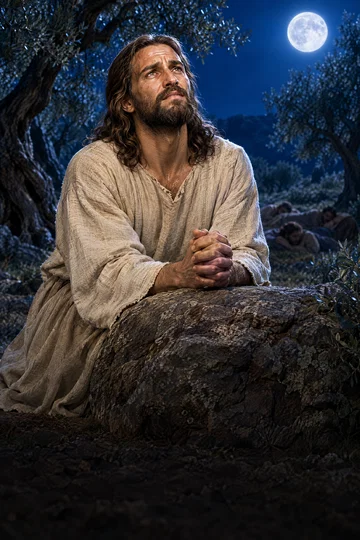
He prayed prostrate and bowed to the earth in profound anguish as the representative bearing the sin and shame of humanity, praying more earnestly as suffering intensified.Ms 42, 1897, par. 4–6Lt 54, 1874, par. 15–16ST Apr 10, 1893ST Dec 2, 1897Ms 184, 1901, par. 6–8 He could have refused the cup, leaving humanity to perish, but submitted to God's will and chose to suffer in order to rescue people from sin.Ms 184, 1901, par. 6–8 In that third prayer He prayed not for His disciples that their faith might not fail, but for His own tempted, agonized soul.DA 690.2–3
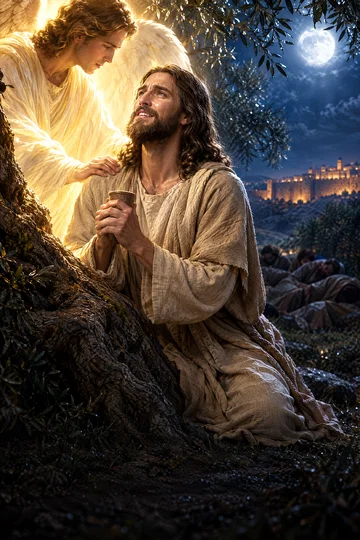
The third prayer closed the conflict and ended His agony, the victory gained and the issue determined.ST Jun 6, 1878ST May 30, 1878DA 693.3–694.2 He asked repeatedly for release, yet for the good of humanity that request was not granted, for if it had been granted mankind would have been left in hopeless despair and eternal ruin; instead the Father answered by sending support from the throne to drink the cup, and though He trod the winepress alone the Father suffered with the Son.ST May 30, 1878 The angel came not to remove the cup but to strengthen Him to drink it, assuring Him His suffering would save a multitude eternally.ST May 30, 1878DA 693.3–694.2 Afterward the language of His prayer rested in full submission, His discouragement gone, and when He stepped forth to meet His betrayer heavenly serenity rested on His pale and blood-stained face and His countenance wore calm dignity and peace with no trace of recent suffering visible.ST Jun 6, 1878ST May 30, 1878DA 693.3–694.2
Nature of His Agony
The agony in which the third prayer was offered was superhuman, the most fearful strain ever brought upon a human being, permitted by God to fall upon His Son because the sins and guilt of the whole world and of fallen humanity were laid upon Him who knew no sin, and He was numbered with transgressors.DA 685.2ST Apr 10, 1893Ms 134, 1905, par. 34SP 481.2–482.2RH Apr 15, 1858 He longed for human companionship in that hour but received no help from the sleeping disciples, and His suffering grew so intense that He prayed more earnestly until sweat fell like drops of blood.Ms 42, 1897, par. 4–6DA 685.2ST Apr 10, 1893 In careful comparison with the disobedience in Eden, the Redeemer here suffered where humanity had chosen disobedience, with the mysterious cup trembling in His hands.ST Apr 10, 1893Ms 134, 1905, par. 3
Sin appeared dreadful to Him and the weight of guilt so great that He was tempted to fear it would shut Him out forever from His Father's love.DA 685.2ST Nov 30, 18823SP 184.1–185.2 Feeling how terrible the wrath of God is against transgression, and feeling the withdrawal of the Father's presence and separation for sin, His soul was exceeding sorrowful even unto death under horror of great darkness, a burden almost unbearable that brought bloody sweat and left Him fainting and near death.DA 685.2ST Nov 30, 1882COS 118.1–4Ms 123, 1909, par. 35–363SP 184.1–185.2 Heaven sent a messenger to comfort Him as He fainted under that burden, for He had lost the sense of the Father's presence and feared that in His human nature He could not endure the test without it.ST Nov 30, 1882COS 118.1–43SP 184.1–185.2Ms 139, 1909, par. 24–25
His anguish was marked by sweat like great drops of blood falling to the ground and moistening Gethsemane, as He lay prostrate, fainting, exhausted and near death, staggering back fainting and exhausted to the place of former struggle to pray the third time with even greater agony and repeating the same submission.Lt 54, 1874, par. 15–16ST Nov 30, 1882ST Apr 10, 1893ST Dec 2, 1897Ms 123, 1909, par. 35–36 Peter had been asleep while Jesus so prayed, and remembering this later deepened his remorse and helped prepare him to pity and strengthen others who were tempted.Ms 42, 1897, par. 4–6Lt 54, 1874, par. 15–16 The mysterious cup trembled in His hands as He apparently hesitated to drink it, facing wiping the bloody sweat from His agonized face while the wail, wretchedness and ruin of a lost world stood before Him.ST Apr 10, 1893Ms 123, 1909, par. 35–36Ms 139, 1907, par. 6
His anguish came not from sins or griefs of His own, but from bearing the griefs and iniquities of others as the representative of the human race, accepting treatment as a transgressor and a sinner so that sinful beings might be treated as innocent, wounded for transgressions, bruised for iniquities, chastised for peace and healed by stripes.Ms 134, 1905, par. 3ST Aug 14, 1879 He joined Himself to humanity in divine sympathy to bridge the gulf opened by sin, continuing the struggle determined to conquer the prince of darkness so that humanity would not remain in hopeless despair.Ms 134, 1905, par. 3ST Aug 14, 1879 He longed for sympathy and companionship from His disciples in His hour of agony, showing that the desire for love and sympathy is part of human nature.Ms 42, 1897, par. 4–6SLP 309.2AA 490.3–491.2RH Dec 28, 1911 That suffering continued through insult, mocking, scourging, staggering fainting under His own cross, and hanging on the cross in shameful humiliation and agony while in the hands of a merciless power, with angels from the heavenly courts watching every movement with intense interest yet God giving them no command to break their ranks to go to the help of the divine Sufferer.Ms 42, 1897, par. 4–6ST Apr 15, 1897
Decisive Crisis of Redemption
The third prayer was the awful moment that decided the destiny of the world, with the fate of humanity trembling in the balance, because it was still not too late to wipe the bloody sweat away, refuse the cup apportioned to guilty man, leave man to perish in iniquity and return to the Father.DA 690.2–3 Before Him passed the history of the race, the helplessness of man, the power of sin, and the wail, wretchedness, ruin, woes and lamentations and impending fate of a doomed world left to itself to perish under transgression of the law.DA 690.2–3ST Apr 10, 1893COS 118.1–4 The mysterious cup trembled in His hands as He faced letting man go, praying more earnestly under horror of great darkness with sweat as great drops of blood, fearing in His human nature He could not endure without the Father's presence which angels longed to relieve but might not.ST Apr 10, 1893COS 118.1–4 He made the final decision to save man at any cost to Himself, to accept His baptism of blood and drink the bitter cup of humiliation and agony, becoming the propitiation of a race that willed to sin and refusing to turn from His mission of leaving heaven's purity, happiness and glory to save the one lost sheep, the one fallen world, so that perishing millions might gain everlasting life.DA 690.2–3COS 118.1–4Ms 184, 1901, par. 6–8 The cup meant humiliation and suffering appointed for the fallen race which He as representative bore in profound anguish bowed to the earth, and though He could have refused it and left humanity to perish He submitted to God's will and chose to suffer to rescue people from sin.Ms 184, 1901, par. 6–8
The choice was the crisis of the sacrifice ordained before the foundation of the world, symbolized in every sacrifice since Adam's transgression and foretold and fulfilled in prophecy and all types and shadows of His suffering and death.ST Mar 19, 1912 His answer would decide whether God's purpose and will that none perish but all have eternal life through faith in the sealed Restorer would stand, whether Satan and his confederacy of evil would triumph or be overcome, whether the prey would remain in the hands of the mighty or the captives be delivered, and whether obedience to the law would be shown possible with all made more than conquerors through Him.ST Mar 19, 1912ST Mar 19, 1912 The third prayer closed the conflict and was the great crisis in the work of redemption when everything was at stake.ST Mar 19, 1912 Unfallen worlds, heavenly angels and Satan with his confederacy of evil and legions of apostasy watched with intense interest as the powers of good and evil waited to see what answer would come, and in the stormy darkness of the crisis hour the heavens opened with light and an angel standing in God's presence from the position Satan fell came to His side.ST Mar 19, 1912ST Jun 3, 1897
The thrice-repeated prayer was heard, but the cup was not taken away, for the angel came not to remove it but to strengthen Him to drink it and assure Him of the Father's love.Lt 147, 1903, par. 27ST Jun 3, 1897DA 693.3–694.2 He was shown that His suffering would save a multitude eternally, defeat Satan and bring the kingdom to the saints of the Most High, so His discouragement left and He came forth calm, at peace and in heavenly serenity with no escape from suffering yet strength to bear it.Lt 147, 1903, par. 27ST Jun 3, 1897DA 693.3–694.2 He asked repeatedly for release, yet for humanity's good the request was not granted, for mankind would have been left in hopeless despair and eternal ruin.9T 102.1–3ST May 30, 1878 Instead the Father answered by sending support and an angel from the throne to sustain Him in drinking the presented cup, and though He trod the winepress alone with no man with Him He was not truly alone because the Father suffered with the Son, and after victory was gained His prayer rested in full submission that if the cup could not pass except He drink it the Father's will be done.9T 102.1–3ST May 30, 1878
Sleeping Disciples Failure
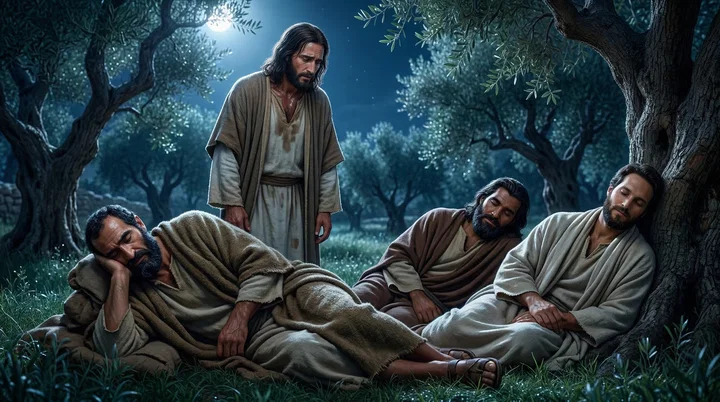
Each time He returned He found them fast asleep, and after the third prayer He looked sorrowfully upon them and aroused them with the announcement that the hour was at hand and the Son of man is betrayed into the hands of sinners, telling them to rise and go because His betrayer with the mob was at hand.ST Jun 6, 18789T 102.1–3EW 136.2SG1 47.1 His agony was then ended, for when He stepped forth to meet His betrayer no trace of His recent suffering was visible.ST Jun 6, 1878 While He prayed three times for the cup to pass yet submitted to the Father's will, they slept and failed to share His watchfulness or support, giving Him no comfort or prayer in that dreadful hour.9T 102.1–3EW 136.2SG1 47.1
After praying in deep woe and grief He came back hoping they would speak some word of love to strengthen and comfort Him in His sorrow, but He found them asleep with sorrow and unable to give the sympathy He hoped for.Ms 45, 1892, par. 6–9Ms 119, 1909, par. 32–34 He had urged them to watch and pray against temptation and needed their sympathy, yet Satan and evil angels were on the ground and caused them to fall asleep when love for their suffering Master should have kept them awake.Ms 45, 1892, par. 6–9 He bent over them and roused Peter with pitying tenderness, asking if he who had promised to go to prison and death with Christ could not watch one hour.Ms 45, 1892, par. 6–9 Hunted from place to place with priests and rulers on His track misrepresenting His mission, come unto His own who received Him not, He wrestled alone in conflict with the powers of darkness while the enemy pressed darkness upon His soul, and though they heard the agony of prayer from His pale and quivering lips they let sleep overcome them and left Him to wrestle alone under the gaze of amazed angels.ST Nov 25, 1889
John was among the three permitted to witness that anguish, but drowsiness and stupor kept them from hearing His voice and recognizing the angel's presence.4T 542.1ST Nov 2, 1882Ms 59, 1897, par. 7 Christ was sending messages to those who would listen for His voice, but the sleeping disciples did not hear Him, having only a dim sense of the angels' presence and losing the power and glory of the scene. By that drowsiness they failed to receive the heavenly evidence that could have strengthened their souls for the terrible scenes before them, leaving them less prepared and less fitted to behold His death on Calvary's cross.4T 542.1ST Aug 31, 1915Ms 59, 1897, par. 7 Time spent praying with Him would have strengthened them, helped them understand the sorrow that pressed upon Him and the anguish of His suffering, and kept Peter from relying on his own weak strength and denying Him.5RED 31.1–2Ms 45, 1892, par. 6–92T 205.3–206.1
Had they watched with Him they would have remembered what He had told them many times before, that the people would turn against Him and put Him to death and that He would rise again, so that rays of hope would have shone amid the gloom and their faith would have been sustained and strengthened when Satan seemed to gain the victory.Ms 45, 1892, par. 6–92T 205.3–206.1 Watching and praying as He asked would have made them ready and able to bear the scorn and mockery that fell on Christ and would not have left Him alone in His bitter trial.Ms 45, 1892, par. 6–9 Instead they clung to hope that He was about to set up an earthly kingdom where all nations would bow and they would be chief rulers, when He was nearing death as slaves died on a cross of shame, and they needed to understand He had come to suffer and die for the sins of the world and to set up a kingdom of love, peace and purity in the hearts of men until they should be fitted for heaven.Ms 45, 1892, par. 6–9
Peter had slept through those fearful hours while Jesus lay prostrated in prayer with sweat like drops of blood, and remembering this later deepened his remorse, broke his pride, and renewed his commitment to Jesus.Lt 54, 1874, par. 15–163T 416.2 That repentance made him humble to pity the tempted, sympathize with the weak and erring, warn the presumptuous, and strengthen his fellow believers.Lt 54, 1874, par. 15–163T 416.2 Their sleep warns that people can be spiritually asleep when they should be awake and faithful.Ms 139, 1909, par. 24–25 The Gethsemane ordeal was a severe test for the disciples as well as for Him, for His coming betrayal and crucifixion would put their faith under trial, and He was preparing and strengthening His true and faithful followers before that final test, though those dear to Him reproached and forsook Him when He most needed their sympathy and comfort, even as the garden recalled the lessons given on the way there, including the vine as the symbol of the union of His church with Him and His Father.Ms 139, 1909, par. 24–25DA 394.2–34RED 102.2–103.13SP 250.16RED 87.1–2
Doctrine and Scriptural Connections
In careful comparison with the disobedience in the Garden of Eden, the third prayer repeating the same submission to the Father's will shows the world's Redeemer suffering superhuman agony with the sins of the whole world rolled upon Him where humanity had chosen disobedience.ST Apr 10, 1893Lt 69, 1897, par. 23–25 The mysterious cup trembled in His hands as He faced wiping the bloody sweat from His agonized face and letting man go, with the wail, wretchedness and ruin of a lost world before Him.ST Apr 10, 1893 In that agony He prayed more earnestly with sweat as great drops of blood falling to the ground, and an angel from heaven appeared strengthening Him.ST Apr 10, 1893
Leaving His sleeping disciples and bowing again in prayer with the same words while the powers of darkness pressed upon Him, He continued the struggle determined to conquer the prince of darkness so that humanity would not remain in hopeless despair.ST Aug 14, 1879 His anguish came not from sins or griefs of His own, but from bearing the griefs and iniquities of others as the representative of the human race, accepting treatment as a transgressor.ST Aug 14, 1879 He joined Himself to humanity in divine sympathy and offered Himself to bridge the gulf opened by sin, and understanding the sacred claims of God's law is necessary for a clear understanding of the atonement.ST Aug 14, 1879 His struggle in prayer in the garden made holy by His agony as He bore the sins of the world is the struggle by which reconciliation with God was obtained.RH Nov 4, 1902 That garden conflict before His arrest was part of the suffering through which He gained victory over death and the tomb.ST Sep 19, 1878
The Lord's Supper calls that great agony to mind, for the bread and wine represent His body given for the world and His sacrifice for each person, bringing the painful history of His betrayal, suffering and agony before the mind.Ms 19, 1897, par. 50–53 When the ordinances are celebrated as commanded, His disciples in thought pass through that garden and witness that struggle.RH Nov 4, 1902 His pouring out His soul in deep agony in prayer there is the pattern for God's people in the time of trouble, who will likewise earnestly cry out and agonize day and night for deliverance.RH May 27, 1862SG4 269.1–21T 353.4 They will so agonize refusing to abandon the Sabbath even when threatened with death.SG4 269.1–2
His betrayal, trial and crucifixion show how a satanic spirit can move hearts opened to doubt into bitterness, wrath and hatred.Lt 14, 1889, par. 2–912MR 14.1–2 His great sacrifice in Gethsemane is compared with His sacrifice on the cross at Calvary, and together they set the measure against which the church's work is shown to fall far short.RH Apr 11, 1912Ms 56, 1901, par. 8 His repeated prayer there, with its spirit of suffering and surrender that is to shape Christian labor, belongs with His saving work at Calvary and with serving others through His restoring power for soul and body.Lt 122, 1901, par. 15
Example for Believers Today
In all that suffering He gives an example of absolute submission to the divine will, surrendering a will capable of asserting itself to the will of God.Ms 134, 1905, par. 3 Though the sinless Son, He consented to lay off His royal robe and kingly crown and clothe His divinity with humanity, to take the body of humanity and live a sinless life in our behalf and make atonement on the cross, and He could have refused this humiliation and death but did not, for to suffer them He came into the world.Ms 134, 1905, par. 3 In travail of soul He did not have His own way but prayed three times with the same words, asking if the cup could pass yet each time yielding, Not My will but Thine be done, under agony that forced drops of blood from His brow from bearing the sins of the whole world and separation from the Father's love.ST Nov 21, 1892 That surrender condemns half-hearted service and following independent judgment and own plans, and requires the same attitude in believers, Not my will but Thine be done, which is true conversion.ST Nov 21, 1892 He was treated as a sinner so that sinful beings might be treated as innocent, wounded for transgressions, bruised for iniquities, chastised for peace, and healed by stripes.Ms 134, 1905, par. 3
His path through Gethsemane, temptation, and Calvary shows the way of self-denial and suffering His followers must be willing to take, with divine help, rather than shrink from hardship or sacrifice in seeking eternal life.STSE 45.13T 371.1 That suffering brings the divine help needed to overcome.STSE 45.1 His earnest, persevering prayer on the night of agony, while the disciples slept, returning a third time and repeating the same words, teaches that prayer may require persistence and self-denial, for He spent the night in prayer even on damp ground.ST Mar 15, 1883 Those who most need divine instruction still fail to receive it when they do not place themselves in communion with heaven, for the sleeping ones had only a dim sense of the angels' presence and lost the power and glory of the scene and the evidence that would have strengthened their souls for the terrible scenes before them, so set times for meditation and prayer and continual communion with God are necessary. His continued seeking of the Father in that struggle teaches believers to wrestle with God in prayer for strength and power to make Him known in words and actions.RH Aug 26, 1909
His soul agony teaches self-sacrifice, patience under affliction, solemn consecration to God, and preparation for holy work.GW92 360.3 Its spirit of suffering and surrender is to shape Christian labor, connected with His saving work at Calvary and with serving others through restoring power for soul and body.Lt 122, 1901, par. 15 In that agony, while bearing the guilt of sinful people, He longed for sympathy from His disciples, showing that the desire for love and sympathy and companionship is part of human nature.SLP 309.2AA 490.3–491.2 Paul likewise yearned for sympathy and companionship during his lonely imprisonment.AA 490.3–491.2 He endured that last terrible trial in order that sinners might not perish but have eternal life, and His agony reveals the love of God in laying down His life for others, which obligates believers to show tenderness and care for one another and to lay down their lives for the brethren in self-denying, harmonious service.SLP 309.2Lt 67, 1903, par. 3–13
His suffering, as the cup of agony trembled in His hands before crucifixion and the weight of sin separating Him from His Father felt almost unbearable and brought bloody sweat, made it possible for humanity to grasp divinity and overcome through the blood of the Lamb and the word of their testimony.Ms 123, 1909, par. 35–36 As He faced betrayal and the cup, considering giving Himself as a criminal for the sins of the whole world and enduring separation from the Father because of sin, He bore the world's sins, showing why believers must hate sin and depend on Christ, whose strength is their only hope.Ms 119, 1906, par. 5–11 Those hours before, in which though heavy with sorrow and distracted with doubt and fear at His foretelling of sufferings and death there were no loud outcries and no abandonment to grief, but He spent the time speaking words of comfort and assurance and then all united in a hymn of praise to the Most High, were a prelude to the agony, the abuse and mockery of the judgment hall, and the awful scenes of Calvary as He entered the bloodstained path after separation from His apostles in a scene more trying than any other.LSEGW 257.4 They give a lesson of courage and fortitude under affliction.LSEGW 257.4
Sources