2 Kings 2:4
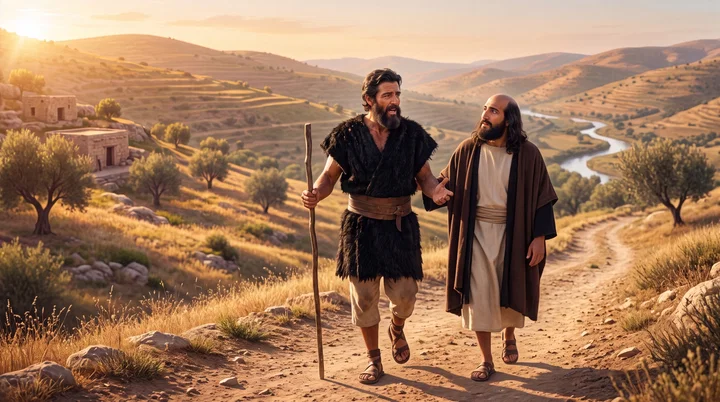
And Elijah said unto him, Elisha, tarry here, I pray thee; for the LORD hath sent me to Jericho. And he said, As the LORD liveth, and as thy soul liveth, I will not leave thee. So they came to Jericho.
Translations
And Elijah said to him, Elisha, tarry here, I pray you; for the LORD has sent me to Jericho. And he said, As the LORD lives, and as your soul lives, I will not leave you. So they came to Jericho.
King James Version, Revised Version
And Elijah said unto him, Elisha, tarry here, I pray thee; for the LORD hath sent me to Jericho. And he said, As the LORD liveth, and as thy soul liveth, I will not leave thee. So they came to Jericho.
And Elijah said unto him, Elisha, tarry here, I pray thee; for the Lord hath sent me to Jericho. And he said, As the Lord liveth, and as thy soul liveth, I will not leave thee. So they came to Jericho.
And Elijah said to him, Elisha, tarry here, I pray thee; for the LORD hath sent me to Jericho. And he said, As the LORD liveth, and as thy soul liveth, I will not leave thee. So they came to Jericho.
And Elijah said unto him, Elisha, tarry here, I pray thee; for Jehovah hath sent me to Jericho. And he said, As Jehovah liveth, and as thy soul liveth, I will not leave thee. So they came to Jericho.
And Elijah saith to him, 'Elisha, abide, I pray thee, here, for Jehovah hath sent me to Jericho;' and he saith, 'Jehovah liveth, and thy soul liveth, if I leave thee;' and they come in to Jericho.
And Elijah said to him, Elisha, abide here, I pray thee; for Jehovah has sent me to Jericho. And he said, As Jehovah liveth, and as thy soul liveth, I will not leave thee! And they came to Jericho.
Then Elijah said to him—Elisha, I pray thee, tarry here, for, Yahweh, hath sent me to Jericho. And he said—By the life of Yahweh and by the life of thine own soul, I will not leave thee. So they came to Jericho.
Berean Standard Bible, Majority Standard Bible
And Elijah said to Elisha, “ Please stay here, for the LORD has sent me on to Jericho.”But Elisha replied, “ As surely as the LORD lives and as you yourself live, I will not leave you.”So they went to Jericho.
Elijah said to him, “ Elisha, please wait here, for the LORD has sent me to Jericho.”He said, “ As the LORD lives, and as your soul lives, I will not leave you.” So they came to Jericho.
Then Elijah said to him, Come no farther, for the Lord has sent me to Jericho. But he said, As the Lord is living and as your soul is living, I will not be parted from you. So they went on to Jericho.
Againe Eliiah saide vnto him, Elisha, tarie here, I pray thee: for the Lord hath sent me to Iericho: But he said, As the Lord liueth, and as thy soule liueth, I will not leaue thee. So they came to Iericho.
Douay-Rheims (Challoner revision)
And Elias said to Eliseus: Stay here because the Lord hath sent me to Jericho. And he said: As the Lord liveth, and as thy soul liveth, I will not leave thee. And when they were come to Jericho,
Pictures
Cross-references
- 2 Kings 2:11
And it came to pass, as they still went on, and talked, that, behold, there appeared a chariot of fire, and horses of fire, and parted them both asunder; and Elijah went up by a whirlwind into heaven.
Elijah is taken up into heaven as Elisha witnesses his departure.
- 1 Kings 19:19-21
So he departed thence, and found Elisha the son of Shaphat, who was plowing with twelve yoke of oxen before him, and he with the twelfth: and Elijah passed by him, and cast his mantle upon him.
Elisha leaves the plow and follows Elijah.
- 2 Kings 2:9
And it came to pass, when they were gone over, that Elijah said unto Elisha, Ask what I shall do for thee, before I be taken away from thee. And Elisha said, I pray thee, let a double portion of thy spirit be upon me.
Elisha’s steadfast following leads him to ask for a double portion of Elijah’s spirit.
- 2 Kings 2:16-17
And they said unto him, Behold now, there be with thy servants fifty strong men; let them go, we pray thee, and seek thy master: lest peradventure the Spirit of the LORD hath taken him up, and cast him upon some mountain, or into some valley. And he said, Ye shall not send.
Records the search for Elijah and that he was not found.
- 1 Kings 19:21
And he returned back from him, and took a yoke of oxen, and slew them, and boiled their flesh with the instruments of the oxen, and gave unto the people, and they did eat. Then he arose, and went after Elijah, and ministered unto him.
Elisha accepted Elijah’s call and became his attendant.
- Luke 9:30-31
And, behold, there talked with him two men, which were Moses and Elias:
Elijah appears in glory after being taken up to heaven.
- 2 Kings 3:11
But Jehoshaphat said, Is there not here a prophet of the LORD, that we may enquire of the LORD by him? And one of the king of Israel’s servants answered and said, Here is Elisha the son of Shaphat, which poured water on the hands of Elijah.
Elisha is described as having poured water on Elijah’s hands.
- Mark 9:4
And there appeared unto them Elias with Moses: and they were talking with Jesus.
Elijah appears with Moses and Jesus at the transfiguration, a type of Christ’s coming.
- 2 Kings 4:30
And the mother of the child said, As the LORD liveth, and as thy soul liveth, I will not leave thee. And he arose, and followed her.
The repeated vow of loyalty contrasts Elisha’s faithfulness with Gehazi’s failure.
- James 5:17-18
Elias was a man subject to like passions as we are, and he prayed earnestly that it might not rain: and it rained not on the earth by the space of three years and six months.
Elijah’s steadfast faith is shown in his bold actions and earnest prayer.
- Ruth 1:16-17
And Ruth said, Intreat me not to leave thee, or to return from following after thee: for whither thou goest, I will go; and where thou lodgest, I will lodge: thy people shall be my people, and thy God my God:
Both Ruth and Elisha refuse to leave when urged to turn back.
- 2 Kings 13:14-19
Now Elisha was fallen sick of his sickness whereof he died. And Joash the king of Israel came down unto him, and wept over his face, and said, O my father, my father, the chariot of Israel, and the horsemen thereof.
both show receiving in measure ventured
- Genesis 5:24
And Enoch walked with God: and he was not; for God took him.
Enoch’s being taken by God parallels Elijah’s translation.
Commentary
Each commentary is drawn from primary sources: the writings of Ellen G. White and Adventist pioneers and periodicals. Each commentary is separate. Its own words are not a quotation; follow the references to read the source passages.
Ellen G. White
27 sources
Elijah was sent by the Lord on to Jericho and told Elisha to remain behind, but Elisha solemnly pledged that he would not leave him, so the two went on to Jericho together.PK 226.2–227.1Lt 12, 1897, par. 24–28Lt 12, 1897, par. 31–33FE 512.2RH Jan 11, 1912 This was part of Elijah's final journey before he was taken to heaven, when he made a last visit to the schools of the prophets to repeat the most important lessons of their education.RH Jan 11, 1912RH Mar 4, 1909Ms 99, 1907, par. 2 Elijah's urging Elisha to stay was a test of his faith, resolve and commitment, giving him opportunity to turn back, while Elisha's refusal to be turned aside came from his desire to learn all he could from Elijah before he was taken away.PK 226.2–227.1Lt 12, 1897, par. 24–28Ms 114, 1901, par. 3–4Lt 12, 1897, par. 31–33PK 225.2–226.1 God was moving Elijah from place to place to keep him from settling at ease, to gain spiritual power and enduring character, and to extend his helpful influence to many, showing that change of place and circumstance can prevent stagnation and build character.RH May 2, 19079MR 11.1–2Lt 59, 1901, par. 18–23 Elijah's close training of Elisha on this journey is a pattern for experienced workers to train younger workers, and Elisha's steadfast loyalty is a pattern of unity and cooperation.6MR 400.2–3YGBCOEP 49.1RH Nov 19, 1903Ms 82, 1899, par. 6–7
Elijah's Final Journey
This verse belongs to Elijah's final journey before he was taken to heaven, when at the Lord's direction he was sent on to Jericho and Elisha went with him.FE 512.2RH Jan 11, 1912RH Mar 4, 1909Ms 29, 1908, par. 4 It was part of his last circuit to visit the schools of the prophets and give the students divine instruction before his ascent to heaven in a chariot of fire.RH Jan 11, 1912RH Mar 4, 1909Ms 29, 1908, par. 4
God was moving Elijah from place to place as He prepared him for translation, and the journey to Jericho illustrates that changing places can be part of God's leading and training.RH May 2, 19079MR 11.1–2Lt 59, 1901, par. 18–23 These changes kept him from settling at ease and from settling into familiar methods and customs.RH May 2, 19079MR 11.1–2 They helped him gain spiritual power, moral greatness and spiritual soundness, and enduring character.RH May 2, 19079MR 11.1–2Lt 59, 1901, par. 18–23 God intended his influence to help many people grow spiritually, and He may still change a person's circumstances and position to prevent spiritual stagnation, unsettle old habits, build character, and make that influence a help to others.RH May 2, 19079MR 11.1–2Lt 59, 1901, par. 18–23
This journey was Elijah's last earthly work, in which he instructed the students and repeated to them the lessons on the most important points of their education.RH Mar 4, 1909Ms 99, 1907, par. 2Ms 29, 1908, par. 4 He taught that simplicity should mark every part of their training so they could receive heaven's mold and shaping and serve in the Lord's work and ways.FE 512.2Ms 99, 1907, par. 2 The verse stands in a dark and troubled time when idolatry and wickedness prevailed under Ahab and Jezebel.Ms 31, 1889, par. 77 Then Elijah served as a preacher of righteousness guided by the Holy Spirit, and God sent His prophets to warn the nation and oppose its wickedness.Ms 31, 1889, par. 77
Jericho held a school of the prophets in Elijah's time, as did Bethel.CE 61.1–3FE 96.4RH Oct 30, 1900 Two schools were added in Elijah's time, at Jericho and Bethel, joining the two from Samuel's day at Ramah and Kirjath-jearim, with others afterward established at Samaria and Gilgal, showing that communities of prophets continued after the schools were established.CE 61.1–3RH Oct 30, 1900 These schools were places where the Spirit of God came upon the students and they prophesied.Ms 118, 1909, par. 23–25 They stand as a precedent for teachers and students joining physical work with instruction.Ms 40, 1903, par. 34–35
Elisha's Tested Loyalty
Elijah was testing Elisha’s faith, resolve and commitment when he urged him to stay at Jericho while he himself went on with the Lord’s errand.PK 226.2–227.1Lt 12, 1897, par. 24–28Lt 12, 1897, par. 31–33PK 225.2–226.1 The invitation to remain behind gave Elisha an opportunity to turn back.Lt 12, 1897, par. 24–28Lt 12, 1897, par. 31–33 It was one of repeated opportunities to turn back given as he accompanied Elijah before Elijah’s translation.Lt 12, 1897, par. 31–33
Elisha answered with a solemn pledge that as the Lord lives he would not leave Elijah.Lt 12, 1897, par. 31–33 He firmly refused to leave his master and remained beside him to the end.PK 226.2–227.1Lt 12, 1897, par. 24–28Ms 191, 1907, par. 17–20 He was determined to see the outcome, so they went together to Jericho.Lt 12, 1897, par. 31–33Ms 191, 1907, par. 17–20Ms 8, 1859, par. 23–24
His loyalty and persistence came from his desire to learn all he could from Elijah before Elijah was taken away.Ms 114, 1901, par. 3–4 He stayed with him to receive further preparation for service and to show readiness to learn.PK 226.2–227.1PK 225.2–226.1Ms 82, 1899, par. 6–7 That persistence showed he would not be turned aside from the work to which he had committed himself.PK 225.2–226.1
He had left a wealthy, beloved home and the plow to follow the prophet.Lt 64, 1897, par. 9–13 He willingly performed humble service, including pouring water on Elijah’s hands.Lt 64, 1897, par. 9–13 His steadfast service and reliance on God through trials showed enduring character and prepared him to serve God.Lt 64, 1897, par. 9–13 Faithfulness in small duties is essential preparation for greater responsibility.Lt 64, 1897, par. 9–13
His persistence represents following with God’s people through trials and pressing on with them.Ms 8, 1859, par. 23–24 Those who do so will witness the heavenly strengthening of the third angel’s message and receive the latter rain.Ms 8, 1859, par. 23–24
Training for Future Service
Elijah's close companionship with Elisha on the way to Jericho was itself training, keeping the younger man beside him in service and travel to prepare him for the work ahead.YGBCOEP 49.1RH Nov 19, 1903Ms 82, 1899, par. 6–7 That preparation is the pattern for experienced ministers now, who are to give younger workers opportunity to learn by working with them and to show them how to teach the truth to others.YGBCOEP 49.1RH Nov 19, 1903Ms 82, 1899, par. 6–7 As Elijah educated the youth of Israel in the schools of the prophets, so young men today are to receive similar training from experienced workers.YGBCOEP 49.1RH Nov 19, 1903Lt 88, 1908, par. 9–10
This journey to Jericho was part of Elijah's final visiting of the schools of the prophets before he was taken to heaven.FE 512.2Ms 99, 1907, par. 2 On those visits he repeated to the students the lessons on the most important points of their education.FE 512.2Ms 99, 1907, par. 2 He taught that simplicity should mark every part of their training, so that they could receive heaven's mold and shaping and thus serve in the Lord's work and ways.FE 512.2Ms 99, 1907, par. 2
Elisha's refusal to leave Elijah on the road to Jericho stands as steadfast commitment and loyalty in service.6MR 400.2–3Ms 82, 1899, par. 6–7 That loyalty is the pattern for unity now, in accord with the call to draw together and cooperate.6MR 400.2–3
Sources
Pioneers and periodicals
32 sources
At Bethel Elijah bids Elisha remain behind while the Lord sends him on to Jericho, but Elisha binds himself by oath not to leave him, so the two go on together toward the Jordan where Elijah is to be taken up.STST May 27, 1913ST Jul 21, 1898 The bidding is a test of constancy and fidelity rather than counsel for Elisha's good, repeated at the next place and a third time to make three trials in all.RH Dec 29, 1868ST Sep 13, 1877 Elisha knows Elijah is to be taken that day, as the sons of the prophets also know, so his refusal to part is steadfast loyalty to his master and trust in the living Lord through the final journey.ST Aug 27, 1885ST Aug 27, 1885RH Dec 6, 1906 That proved faithfulness qualifies him to succeed Elijah, to witness his departure, and then to ask boldly for a double portion of his spirit, which is granted to show that those who venture much through God receive much.ST Sep 17, 1896STRH Nov 9, 1916STRH Dec 29, 1868 The journey is Elijah's last visiting of the schools of the prophets at Bethel and Jericho to give them instruction from God, and his removal by whirlwind without dying points to the living righteous being changed and taken without death when the Lord comes.RH Jan 11, 1912ST Sep 7, 1904ST Mar 5, 1902ST Jul 28, 1898
Final Journey to Jericho
The setting is Bethel, where Elijah bids Elisha to tarry there because the Lord has sent him on to Jericho, and Elisha answers by the life of the Lord and by Elijah's life that he will not leave him, so the two go together to Jericho.STST Jul 21, 1898 This going together is part of the longer journey from Gilgal toward the Jordan where the Lord will take up Elijah by a whirlwind into heaven, and it comes just before Elijah's departure while displaying Elisha's steadfast loyalty to his master.STST Jul 21, 1898 Those who place the bidding at Jericho itself still hold the same substance, that Elijah tells Elisha to remain behind, Elisha refuses to leave him, and they go on together as part of Elijah's final journey to his taking up to heaven.ST May 27, 1913
The going to Jericho at the Lord's direction belongs to the account of Elijah's last days and his translation, and at the same time to the beginning of Elisha's prophetic ministry.ST Aug 27, 1885ST May 13, 1908 Elisha's determination to refuse to stay behind comes from knowing that Elijah is about to be taken away.ST Aug 27, 1885 That journey was Elijah's final visiting of the schools of the prophets, including the school established in his time at Jericho and the school at Bethel, where he gave the students instruction from God before his ascension.RH Jan 11, 1912RH Mar 4, 1909ST Jun 22, 1882 In those final visits he instructed the students on the most important points of their education, repeating earlier lessons and stressing that simplicity should mark every part of their training so they could receive heaven's shaping and serve in the Lord's work.RH Mar 11, 1915 The nearby schools knew that Elijah was to be translated, and this visiting work was completed before his ascent to heaven in a chariot of fire.RH Mar 4, 1909RH Dec 6, 1906
There was a school of the prophets at Jericho in Elijah's time, and two schools at Jericho and Bethel were added in his time to join the two from Samuel's day at Ramah and Kirjath-jearim, with others afterward established at Samaria and Gilgal.ST Jun 22, 1882RH Oct 30, 1900 God's moving Elijah from place to place in this manner prepared him for translation, kept him from settling at ease, and helped him gain spiritual power, while God also intended his influence to help many people grow.RH May 2, 1907 The journey to Jericho thus illustrates that changing places can be part of God's leading and training.RH May 2, 1907 The verse belongs to the account in which the waters of the Jordan were miraculously divided and piled up to make a dry path so Elijah and Elisha could pass through unhindered, and after Elijah was taken up divided again for Elisha to open his way into his prophetic mission.ST Aug 20, 1902
Elisha's Tested Faithfulness
Elijah's bidding to stay behind while he goes on to Jericho is not given because staying is best for Elisha, but to test his constancy, faith and fidelity by inviting him to turn back.STRH Nov 9, 1916STRH Dec 29, 1868ST Sep 13, 1877 The same bidding and refusal are repeated at the next place and a third time, making three trials in all.RH Dec 29, 1868ST Sep 13, 1877 Elisha knows Elijah is to be taken away that day, and the sons of the prophets know it too.ST Aug 27, 1885ST Aug 27, 1885RH Dec 6, 1906 His persistence in refusing to leave is therefore not curiosity, but desire to remain with Elijah through his final journey, with determination coming from knowing what is about to happen.ST Aug 27, 1885ST Aug 27, 1885RH Dec 6, 1906
Elisha's oath-bound refusal to leave, by the life of the Lord and by Elijah's life, proves steadfast loyalty to his master and trust in the living Lord.STRH Nov 9, 1916ST His fidelity under this repeated testing qualifies him to succeed Elijah, to witness his departure, and to receive further favor and the prophetic succession.STRH Nov 9, 1916ST Elijah's reluctance to have even his servant witness the honor God will give him reflects a humble spirit.ST
Elisha's vowed refusal to turn back marks the steadfast Christian who does not need entreaty not to love the world, turn from Christ, harden the heart, or shipwreck the faith.ST Sep 13, 1877 He is unlike Israel who in heart turned back to Egypt, and like Caleb and Joshua who held steadfast.ST Sep 13, 1877 Because Elisha endures the proving, Elijah then bids him ask what shall be done for him before separation.RH Dec 29, 1868ST Sep 13, 1877 Elisha boldly ventures much in faith by asking for more of God's Spirit than Elijah had, even a double portion of his spirit, and his request is granted.ST Sep 17, 1896RH Dec 29, 1868ST Sep 13, 1877
Those who through God venture much receive much, with multiplied grace and wonderful victories given to persons of faith who asked for great things.ST Sep 17, 1896 Steadfastness is thus rewarded with blessing of infinite value in the double portion of Elijah's spirit.RH Dec 29, 1868ST Sep 13, 1877 The verse shows Elisha as the faithful attendant and dependable successor who stays with his master and succeeds to his spirit, in the same office Gehazi later holds under Elisha.RH Dec 23, 1915RH Jul 20, 1916 This is unlike Gehazi, who seeks after Naaman's gain and gains it with leprosy attached.RH Dec 23, 1915
Translation Type and Application
This verse stands on the road to Elijah's departure, when he was really removed from earth and taken up into heaven by a whirlwind in a chariot of fire rather than dying.RH Mar 4, 1909ST Aug 28, 1901ST Apr 20, 1876 Afterward he was not found, and the search that followed confirmed he was gone, though those who searched wondered whether the Spirit of the Lord had carried him to some mountain or valley.ST Aug 28, 1901 His continuing to Jericho at the Lord's direction with Elisha refusing to leave him was part of his final work of visiting the schools of the prophets and giving the students divine instruction before that ascent.RH Mar 4, 1909
He was taken by God to Himself in heaven, the habitation of the Father, showing that heaven is glory.RH Nov 15, 1853ST Apr 20, 1876 His translation without seeing death is different from dying and awaiting the resurrection day.ST Mar 5, 1902ST Jul 28, 1898 Like Enoch's, it points to the living righteous being changed and taken to heaven without experiencing death when the Lord comes to take His people to Himself, an example of the translation of those who are alive and remain and will not all sleep.ST Sep 7, 1904ST Mar 5, 1902ST Apr 20, 1876ST Jul 13, 1904
On that same journey the waters of the Jordan were parted to make a dry path for God's prophets, and after Elijah was taken up they divided again for Elisha to open his way into his prophetic mission.ST Aug 20, 1902 That parting assures God's servants that all things are possible for the One who sent them.ST Aug 20, 1902 The traveling together to Jericho applies to the believer's obedient passage through life toward death, trusting God for daily grace and guidance and for eventual resurrection life. Elijah's close travel and service with Elisha illustrates how ministers are to train younger workers and show them how to teach the truth, and their experiences show the spiritual development produced by the schools of the prophets in preparing devoted young people for service to God.RH Nov 19, 1903ST Jun 7, 1899
Sources