Daniel 8:6
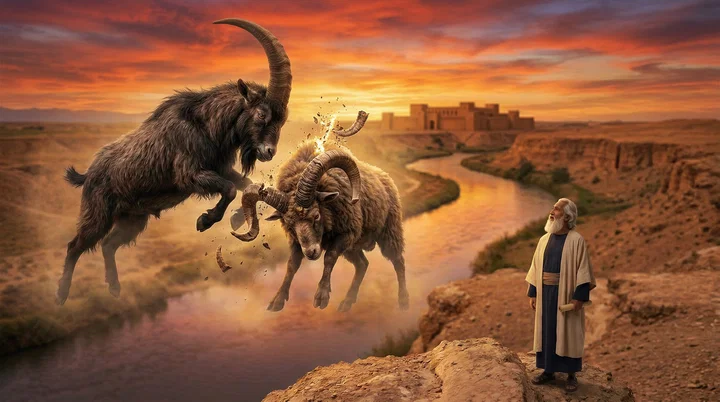
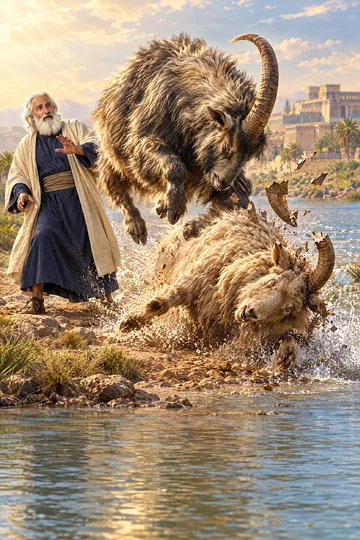
And he came to the ram that had two horns, which I had seen standing before the river, and ran unto him in the fury of his power.
Translations
American King James Version, Webster Bible
And he came to the ram that had two horns, which I had seen standing before the river, and ran to him in the fury of his power.
King James Version, KJV Cambridge Paragraph Bible
And he came to the ram that had two horns, which I had seen standing before the river, and ran unto him in the fury of his power.
Revised Version, American Standard Version
And he came to the ram that had the two horns, which I saw standing before the river, and ran upon him in the fury of his power.
And it cometh unto the ram possessing the two horns, that I had seen standing before the stream, and runneth unto it in the fury of its power.
And he came to the ram that had the two horns, which I had seen standing before the river, and ran upon him in the fury of his power.
So then he came up to the ram having the two horns, which I had seen, standing before the river,—and ran unto him, in the fury of his strength.
Berean Standard Bible, Majority Standard Bible
He came toward the two-horned ram I had seen standing beside the canal and rushed at him with furious power.
He came to the ram that had the two horns, which I saw standing before the river, and ran on him in the fury of his power.
And he came to the two-horned sheep which I saw before the stream, rushing at him in the heat of his power.
And he came vnto the ramme that had the two hornes, whome I had seene standing by the riuer, and ranne vnto him in his fierce rage.
Douay-Rheims (Challoner revision)
And he went up to the ram that had the horns, which I had seen standing before the gate, and he ran towards him in the force of his strength.
Pictures
Cross-references 20 of 22
- Daniel 8:20-21
The ram which thou sawest having two horns are the kings of Media and Persia.
The ram is identified as Media and Persia, and the goat as Grecia.
- Daniel 8:20
The ram which thou sawest having two horns are the kings of Media and Persia.
Identifies the two-horned ram as Media and Persia.
- Daniel 8:14
And he said unto me, Unto two thousand and three hundred days; then shall the sanctuary be cleansed.
The vision’s attack leads to the question answered by the 2,300 days and sanctuary cleansing.
- Daniel 9:20-23
And whiles I was speaking, and praying, and confessing my sin and the sin of my people Israel, and presenting my supplication before the LORD my God for the holy mountain of my God;
Gabriel returns to give Daniel understanding of the earlier vision, including its omitted time element.
- Daniel 8:16
And I heard a man’s voice between the banks of Ulai, which called, and said, Gabriel, make this man to understand the vision.
Gabriel is commanded to help Daniel understand the vision.
- Daniel 8:25
And through his policy also he shall cause craft to prosper in his hand; and he shall magnify himself in his heart, and by peace shall destroy many: he shall also stand up against the Prince of princes; but he shall be broken without hand.
The horn’s opposition to the Prince ends in its being broken without hand.
- Daniel 9:24-27
Seventy weeks are determined upon thy people and upon thy holy city, to finish the transgression, and to make an end of sins, and to make reconciliation for iniquity, and to bring in everlasting righteousness, and to seal up the vision and prophecy, and to anoint the most Holy.
Daniel 9 continues and explains the vision of Daniel 8, including its prophetic chronology.
- Daniel 8:22
Now that being broken, whereas four stood up for it, four kingdoms shall stand up out of the nation, but not in his power.
The four horns represent the four kingdoms that arose after Greece’s great horn was broken.
- Daniel 7
In the first year of Belshazzar king of Babylon Daniel had a dream and visions of his head upon his bed: then he wrote the dream, and told the sum of the matters.
Its prophetic line parallels Daniel 8.
- Daniel 11:3-4
And a mighty king shall stand up, that shall rule with great dominion, and do according to his will.
Describes Alexander’s conquest and the division of his kingdom.
- Daniel 8:2
And I saw in a vision; and it came to pass, when I saw, that I was at Shushan in the palace, which is in the province of Elam; and I saw in a vision, and I was by the river of Ulai.
Identifies the Ulai setting of Daniel’s vision.
- Daniel 9:21
Yea, whiles I was speaking in prayer, even the man Gabriel, whom I had seen in the vision at the beginning, being caused to fly swiftly, touched me about the time of the evening oblation.
Gabriel returns to continue explaining the vision in Daniel 8.
- Daniel 8:11-12
Yea, he magnified himself even to the prince of the host, and by him the daily sacrifice was taken away, and the place of his sanctuary was cast down.
The passage connects the prophecy’s removal of the continual with the sanctuary ministry.
- Daniel 11:2
And now will I shew thee the truth. Behold, there shall stand up yet three kings in Persia; and the fourth shall be far richer than they all: and by his strength through his riches he shall stir up all against the realm of Grecia.
Explains the vision by describing Persia’s campaign against Grecia.
- Daniel 8:1
In the third year of the reign of king Belshazzar a vision appeared unto me, even unto me Daniel, after that which appeared unto me at the first.
dates the vision containing the attack
- Daniel 2:31-45
Thou, O king, sawest, and behold a great image. This great image, whose brightness was excellent, stood before thee; and the form thereof was terrible.
Daniel 8 reviews the kingdoms outlined in Daniel 2.
- Revelation 13:11
And I beheld another beast coming up out of the earth; and he had two horns like a lamb, and he spake as a dragon.
Daniel’s ram helps explain the beast’s two horns.
- Daniel 8:17
So he came near where I stood: and when he came, I was afraid, and fell upon my face: but he said unto me, Understand, O son of man: for at the time of the end shall be the vision.
Gabriel explains the vision that includes the ram.
- Daniel 8:24
And his power shall be mighty, but not by his own power: and he shall destroy wonderfully, and shall prosper, and practise, and shall destroy the mighty and the holy people.
same power putting saints to death
- Daniel 10:1-11
In the third year of Cyrus king of Persia a thing was revealed unto Daniel, whose name was called Belteshazzar; and the thing was true, but the time appointed was long: and he understood the thing, and had understanding of the vision.
An angel explains Daniel’s vision of successive empires and the time of the end.
Commentary
Each commentary is drawn from primary sources: the writings of Ellen G. White and Adventist pioneers and periodicals. Each commentary is separate. Its own words are not a quotation; follow the references to read the source passages.
Ellen G. White
3 sources
This charge against the ram belongs to a vision received in the third year of Belshazzar, in 553 B.C.LS 45.2–3 It was given directly by God.Ms 142, 1901, par. 6 It stands among the wonderful prophecies recorded in Daniel 7-12 that reveal the mysteries of ages to come.PK 547.1 The vision was given especially for the last days.Ms 142, 1901, par. 6 Its full meaning was not understood even by Daniel himself.PK 547.1
Daniel was troubled by the vision's 2,300-day period and mistakenly thought it ended with the seventy years of Israel's captivity.LS 45.2–3 It was among the words ordered to be closed and sealed until the time of the end, with full understanding reserved for the closing period of this world's history.PK 547.1 Gabriel later continued explaining the vision by addressing the time period left unexplained in chapter 8.LS 45.2–3 The events foretold in the vision are being fulfilled and will soon come to pass.Ms 142, 1901, par. 6 Daniel himself will rest and again stand in his lot and place at the end of the days.PK 547.1
Sources
Pioneers and periodicals
109 sources
The ram with two horns is Media and Persia, two nationalities united in one government, with Persia rising last but becoming dominant.RH Feb 15, 1870RH Jul 14, 1863ST Nov 17, 1881ST Jan 22, 1880
The he-goat coming against him is Grecia, and its great notable horn between its eyes is its first king, Alexander the Great.ST Sep 21, 1882RH Feb 15, 1870
His running unto the ram in the fury of his power is Greece's swift, furious and irresistible military charge that overcame, smote and trampled Medo-Persia, fulfilled when Alexander vanquished the Persians at Granicus, routed Darius at Issus, and won complete mastery at Arbela in B.C. 331.ST Aug 14, 1893ST Dec 24, 1894ST Aug 8, 1878ST Nov 17, 1881RH Dec 30, 1915
The charge stands in the succession of Medo-Persia followed by Grecia followed by Rome, the little horn in pagan and papal phases that persecutes the saints and is broken without hand, paralleling the image of Daniel 2 and the beasts of Daniel 7 onward to Christ's everlasting kingdom.ST Aug 14, 1893ST Aug 2, 1877RH Oct 6, 1863RH Feb 17, 1853RH Jun 27, 1878
Given about two hundred years beforehand and fulfilled with minute accuracy, the vision proves the prophetic word dependable, with its days as years reaching through the seventy weeks cut off from the 2300 days unto 1844 and the cleansing of the heavenly sanctuary in the hour of judgment.RH Mar 21, 1854ST Nov 24, 1914ST Feb 7, 1884RH Mar 5, 1867
Ram and Goat Identified
The ram with two horns is Media and Persia, the kings of Media and Persia.RH Feb 15, 1870RH Jul 14, 1863RH Mar 10, 1874RH Apr 30, 1857 Its two horns are the Medes and the Persians, two nationalities united in one government, not a divided beast.ST Jan 22, 1880RH Nov 26, 1857RH Mar 21, 1854ST Sep 29, 1881 The he-goat that comes to the ram is Grecia, the Grecian or Macedonian kingdom, called the goat's people.RH Feb 15, 1870RH Oct 3, 1912ST Nov 17, 1881ST Its great notable horn between its eyes is the first king, Alexander the Great.ST Sep 21, 1882RH Feb 15, 1870RH Oct 3, 1912ST The name fits because two hundred years before Daniel the Macedonians were called Aegeadae, the goats' people, for Caranus with Greeks was told by an oracle to take goats as guides, followed goats fleeing a storm to Edessa, made goats his ensigns, called the place Aege, the goats' town, from aix, aigos, a goat, the burial place of kings, and Alexander named his son Alexander Aegus, Alexander the goat.ST Nov 17, 1881
Running unto him in the fury of his power means a swift, furious, forceful military charge by Greece against Medo-Persia.ST Aug 14, 1893ST Dec 24, 1894ST Aug 8, 1878ST Dec 24, 1894ST Feb 7, 1884 It begins the conflict in which the ram is overcome, smitten, and trampled, with his two horns broken so there is no power in him to stand and none able to deliver him.RH Oct 3, 1912ST Feb 7, 1884ST The fury means sudden conquest by a great military charge, the way the Persian and Grecian empires became great, unlike Rome which afterward became exceeding great gradually by successive conquests.ST Feb 7, 1884 The victory leads to the breaking of the great horn at Alexander's death, the division of Grecia into four kingdoms, and the rise of a little horn stronger than all before it.ST Sep 21, 1882STST Feb 7, 1884
The ram standing before the river recalls the vision's setting by the river.ST Jan 22, 1880RH Nov 26, 1857ST Sep 2, 1913 Its higher horn coming up last means Persia rose last but became dominant and attained higher eminence.ST Jan 22, 1880RH Nov 26, 1857ST Sep 29, 1881 At first Darius the Mede held regal power while Cyrus with Persians served against Babylon, then Cyrus added Media and became absolute monarch.ST Jan 22, 1880 At first the regal power was with Darius king of the Medes while Cyrus with thirty thousand Persians served as commander-in-chief of the combined armies against Babylon, and when Babylon fell Darius the Median took the kingdom though Cyrus had done the work of subjugation, then shortly after Cyrus married the daughter of Darius and received Media in reversion, and after succeeding his father in Persia and Darius died he added Media to his dominions and became absolute monarch of the whole.ST Jan 22, 1880
In symbolic prophecy beasts represent earthly kingdoms or governments.RH May 8, 1916RH Jun 25, 1857 Horns represent kingdoms, nations, rulers, or civil power.RH Mar 21, 1854ST Jan 6, 1887RH May 8, 1916 A horn on the ram and goat denotes civil power, distinct from ecclesiastical power, and days as symbols denote years, not literal days of twenty-four hours each.RH Mar 21, 1854ST Jan 6, 1887RH May 8, 1916 The ram and goat represent governments without the specific portrayal of church and state united in persecution found in the fierce beasts of Daniel 7, and their work is shown in relation to God's people, not as a complete account of everything those governments do.RH Jun 25, 1857
Vision Date and Setting
The vision to which the coming of the goat to the ram belongs was given in the third year of Belshazzar, two years after the vision of chapter 7 and only a short time before the explanation in Daniel 9.RH May 12, 1910RH May 12, 1910ST Feb 20, 1912 It came in the last days of Babylon, in Belshazzar's third and final year and at the beginning of the reign of Darius the Median, only weeks or months before Daniel 9, less than two years before and probably in the same year.RH May 12, 1910ST Mar 11, 1889RH Nov 25, 1902 That third year is reckoned by the weight of testimony as about 538 B.C., the year Babylon fell and the first year of Darius the Median, while those who held the other reckoning placed it about 553 B.C.; the difference in chronology matters little to the interpretation and later reckonings align dates with modern research into Babylonian history.RH May 12, 1910RH May 12, 1910ST Mar 11, 1889 Daniel was then at Shushan the palace in Elam by the river Ulai, and though chapter 6 stands earlier in the book its events follow this vision, which prepared Daniel for the test of faithfulness in worship and service.RH Nov 25, 1902RH Feb 25, 1873ST Feb 20, 1912
Babylon is left out of this vision altogether and the showing begins with Medo-Persia, the ram standing before the river attacked by the goat, because Babylon was then history and not prophecy, having practically passed away while Medo-Persia was just at hand and coming into view.ST Aug 14, 1893RH May 12, 1910 The prophecy was given after the first of the four world monarchies had passed off the stage of action and after Babylon had fallen, dealing with the three kingdoms that were to follow and naming the Medo-Persians and Greeks by name.ST Jun 30, 1914ST Jul 1, 1897 It therefore portrays only the second, third, and fourth universal kingdoms, with the first or Babylonian kingdom not represented, the ram denoting the kingdom named in Daniel 8:20 and the goat denoting the kingdom named in Daniel 8:21.ST Aug 14, 1893ST Jul 1, 1897RH Jun 27, 1878
The coming in fury is the second step of the vision after the ram was first seen standing before the river, and the explanation follows the order in which the symbols were seen, first the ram, then the goat and its notable horn, then the four horns in place of the broken horn, next the little horn, and then the 2300 days.ST Feb 18, 1886ST Feb 20, 1912ST Mar 4, 1886 In that order the goat power comes to the ram and runs against him in the fury of his power, meaning the overthrow of Medo-Persian supremacy by the great conqueror of Grecia, with Rome following as the only universal kingdom since Grecia.RH Jun 27, 1878ST Mar 4, 1886ST Sep 9, 1913 This part of the showing concerns kingdoms as kingdoms, not yet the spiritual aspect affecting the people of God, though the same line of prophecy leads on to the cleansing of the sanctuary and Christ's second coming.ST Aug 14, 1893ST Jul 1, 1897ST Feb 20, 1912
Alexander Conquers Persia
The charge describes Greece under Alexander the Great rushing upon Medo-Persia in fury and taking its place in world dominion in B.C. 331.ST Sep 21, 1882RH Feb 15, 1870RH Apr 30, 1857RH Nov 21, 1854ST Feb 7, 1884 The he-goat is Grecia, the king of Grecia, and the great notable horn between its eyes is the first king, Alexander the Great.RH Feb 15, 1870ST Feb 7, 1884RH Feb 17, 1853 The ram with two horns is the Medo-Persian kingdom, the same as the bear of Daniel 7 and the breast and arms of silver of Daniel 2, while the goat is the same as the leopard of Daniel 7 and the belly and sides of brass of Daniel 2.ST Sep 21, 1882RH Feb 17, 1853 In this exchange the silver surrenders its place to the brass, the slow-footed bear passes from the drama, and the leopard leaps upon him with swiftness as the goat displaces the ram to bear rule over the earth in its stead.ST Sep 21, 1882RH Feb 15, 1870RH Feb 17, 1853 This third universal kingdom was more extensive than any before it and ruled 170 years until 161 B.C.ST May 3, 1877ST Feb 5, 1880 The fury means sudden conquest by a great military charge, the way the Persian and Grecian empires became great, unlike Rome which afterward became exceeding great gradually by successive conquests.ST Feb 7, 1884
The ram standing before the river is the Persian army of Darius standing and guarding the river Granicus, and the goat coming to the ram is Alexander with his forces plunging in, swimming across the stream, and rushing on the enemy with all fire and fury.ST Nov 17, 1881RH Jun 21, 1870 The contests between the Greeks and Persians were exceedingly furious.ST Nov 17, 1881RH Jun 21, 1870 It was fulfilled when Alexander first vanquished the generals of Darius at the Granicus in Phrygia, then attacked and totally routed Darius at the straits of Issus in Cilicia, and afterward on the plains of Arbela in Syria in B.C. 331.ST Nov 17, 1881RH Dec 30, 1915ST Jul 27, 1915ST May 3, 1877RH Jun 21, 1870 By this Alexander became complete master of the whole country and absolute lord of that empire to the utmost extent ever possessed by the Persian kings, marking the conclusion of the Persian Empire.ST Nov 17, 1881RH Jun 21, 1870 The Persian kingdom's fall is thus placed at the battle of Arbela in 331 B.C., with the goat coming from the west as the next power.ST May 3, 1877RH Nov 26, 1857
Alexander was placed in 336 B.C. at age twenty on the throne of the Greeks and Macedonians and started with only 35,000 soldiers to conquer the Persian monarchy.ST Nov 17, 1881ST Jul 27, 1915 He won first at the Granicus River in Asia Minor over 140,000 Persians, then at Issus over 600,000 men of Darius Codoman, with Syria, Damascus, Aradus, Byblus, Sidon and spoils as reward.ST Nov 17, 1881ST Jul 27, 1915 He took Tyre after seven months, held Gaza two months, entered Egypt, crossed the Euphrates and Tigris, and won mastery of the world at Arbela with 100,000 men over 1,000,000.ST Jul 27, 1915 That victory opened Babylon, Shushan and Persepolis, and he then relentlessly pursued Darius in north Media up to the Scythians north of the Oxus and Jaxartes and down into India until his exhausted army refused to go farther, returning through Gedrosia and Karmania to the Persian capitals.ST Jul 27, 1915 On the eve of Arbela Darius sent ten of his chief relations to sue for peace, and Alexander answered that the world will not permit two suns nor two sovereigns.ST Nov 17, 1881
The fury means unparalleled celerity of movement in conquest, with the goat coming from the west over the face of the whole earth without touching the ground.ST Sep 29, 1881RH Dec 3, 1857ST Feb 5, 1880 His feet seemed not to touch the ground, expressing the rapidity, swiftness, fierceness and impetuosity with which Alexander invaded Persia and subdued nations more speedily than others could march their armies through them.RH Dec 3, 1857ST Feb 5, 1880 In less than eight years his army marched upwards of seventeen hundred leagues, more than fifty-one hundred miles, from Macedonia to near the Ganges with turnings from Cilicia to Libya and back to Tyre and windings elsewhere.ST Sep 29, 1881
The symbol fits the Grecian or Macedonian people because two hundred years before Daniel they were called Aegeadae, the goats' people.ST Nov 17, 1881 Caranus, their first king, going with a multitude of Greeks to seek a new habitation in Macedonia, was advised by an oracle to take goats for his guide, and afterward seeing a herd of goats flying from a violent storm he followed them to Edessa and there fixed the seat of his empire.ST Nov 17, 1881 He made the goats his ensigns or standards, and called the place Aege or Aegea, the goats' town, and the people Aegeadae, names derived from aix, aigos, a goat.ST Nov 17, 1881 The city of Aege or Aegea was the usual burying-place of the Macedonian kings, and in reference to this origin Alexander called his son by Roxana Alexander Aegus, Alexander the goat.ST Nov 17, 1881
The ram that stood before the river had pushed westward and northward and southward so that no beasts might stand before him, which is the Persian Empire in its conquests.RH Sep 13, 1915ST Oct 13, 1909RH Apr 14, 1853 The successful wars of Cyrus carried his victorious arms west to Lydia and Babylon, north against the Armenians and Cappadocians, and south over Egypt, with Egypt subdued by Cambyses, and the Persian king wore a ram's head of gold as diadem.RH Sep 13, 1915ST Oct 13, 1909 The he-goat that came to the ram is the Macedonian power, the king or kingdom of Grecia with the notable horn between his eyes, the first king Alexander called great, coming swiftly from west to east and marching on Persepolis.RH Sep 13, 1915ST Oct 13, 1909RH Mar 21, 1912 He came so rapidly as seeming not to touch the earth, proceeded eastward, smote the ram and stamped him under foot, breaking the two horns of Persian strength when he burnt Persepolis and killed Darius in Media, with immense addition made to his own empire by Persia's destruction.RH Sep 13, 1915ST Oct 13, 1909 Two hundred years after the prophecy was declared in the last year of the Babylonian monarchy about 538 B.C. and written down, Alexander ran upon the ram in the fury of his power and trampled it underfoot, winning Granicus and Issus and laying Persia prostrate, transferring world dominion from Asia to Europe.RH Mar 21, 1912
This world conquest was spoken beforehand by Jesus through the spirit of prophecy and is part of the testimony of Jesus.ST Feb 13, 1912 While conquering the world Alexander was cooperating with that testimony, so he could conquer the world easily in a manner little short of miraculous.ST Feb 13, 1912 When he afterward fought against the same testimony by trying to resurrect Babylon from its heaps of ruins he could not build a single city, proving that the testimony of Jesus cannot be broken though earth and hell combine to break it.ST Feb 13, 1912 Turning to Jerusalem, he met the high priest in sacerdotal robes, recognized him from a dream at Dios in Macedon, entered the city and temple, offered sacrifice to the true God, heard the reading of this prophecy that a Greek would overthrow Persia, and granted the Jews liberty of worship.ST Jul 27, 1915RH Mar 21, 1912 When the book of Daniel was shown to him there he saw himself as the Greek foretold to destroy the Persian empire, and for the moment bowed before the living God whose plain word, unlike the dark Greek oracles, had foretold the course of history fulfilling before men.ST Jul 27, 1915RH Mar 21, 1912
After waxing very great the great horn is broken at Alexander's early death, when the youthful Alexander, possessor of every clime, succumbed to the cup amid laughter and mirth while yet in his prime.ST Sep 21, 1882ST Feb 7, 1884ST Sep 29, 1881 God set aside Medo-Persia when He could no longer use it and gave dominion to Grecia, whose unity lasted only during the life of Alexander before breaking into four parts because prophecy required four.ST Sep 29, 1881 The four horns that arise toward the four winds, matching the leopard's four heads and the rough goat's four horns, are the fourfold division among his successors after his death.ST Nov 28, 1895ST Apr 9, 1896ST Sep 29, 1881 Cassander took Macedon and Greece in the west, Lysimachus took Thrace and the parts of Asia on the Hellespont and Bosphorus in the north, Ptolemy took Egypt, Lydia, Arabia, Palestine and Coelo-Syria in the south, and Seleucus took Syria and all the rest in the east.ST Sep 29, 1881 The victory therefore leads to the breaking of the great horn, the division of Grecia into four kingdoms, and the rise of a little horn, Rome, stronger than all before it.ST Feb 7, 1884
The verse leaps over centuries from Xerxes, the richest of the Persian kings, to Alexander, with no kings named between.ST Apr 23, 1912 This gives the pattern for later leaps in prophecy from Persia to Alexander and from Antiochus to Rome.ST Apr 23, 1912 The goat's prominent first horn is Alexander the Great, the first Grecian king to achieve universal conquest, and after him the four horns are the four divisions of the Grecian Empire.ST Nov 28, 1895ST Apr 9, 1896
Empires to Everlasting Kingdom
The furious charge belongs to the succession of Medo-Persia, Grecia, and Rome set forth in Daniel 8, with Babylon omitted because it was then history and not prophecy.ST Aug 14, 1893ST Aug 2, 1877RH Dec 11, 1856 The ram with two horns is Medo-Persia and the he-goat that rushes upon it is Grecia under its first king, overthrowing it by a sudden great military charge, unlike Rome which afterward became exceeding great gradually by successive conquests.ST Aug 14, 1893ST Nov 19, 1885ST Feb 7, 1884 That victory leads to the breaking of the great horn at Alexander's death, the division of Grecia into four kingdoms, and the rise of a little horn, Rome, stronger than all before it.ST Nov 19, 1885RH Dec 11, 1856ST Feb 7, 1884 This little horn represents Rome throughout its pagan and papal forms, not merely the papacy as does the little horn of Daniel 7, and it covers the same ground as Daniel 7's fourth beast and all its horns.RH Oct 6, 1863ST Nov 19, 1885ST Feb 7, 1884 Its field includes putting the saints to death, standing up against the Prince of princes, and meeting its foretold destruction at its appointed time, when the power that waxed exceeding great is broken without human agency.ST Aug 14, 1893ST Aug 2, 1877RH Oct 6, 1863RH Dec 11, 1856
Rome is greater than Persia, which is called great, and than Grecia, which is called very great, for the little horn waxes exceeding great.ST Feb 7, 1884ST Feb 12, 1880 The prophecy of Daniel 8 reaches to the end of this dispensation and is all fulfilled except the very closing specifications, with Babylon, Medo-Persia, Grecia, and Rome having successively arisen and passed away as foreshown.ST Aug 14, 1893ST Aug 2, 1877 The fifth universal empire, which is God's everlasting kingdom, is immediately impending.ST Aug 14, 1893ST Aug 2, 1877 This line of prophecy deals with Jesus Christ by pointing out the time when He would be manifested as Messiah, how long His earthly ministry would last, when His priesthood would begin, and the very year 1844 when He would enter the closing work of that priesthood, the justifying of the heavenly sanctuary or investigative judgment to determine the worthiness or unworthiness of those once in God's service, a comparatively brief work soon to be over, after which Christ will come.ST Aug 14, 1893
A minority teaching identified the power confronting the ram in fury as Rome to be broken without hand, and another minority teaching identified the little horn of Daniel 8 as Mahometanism, distinct from the little horn of Daniel 7 as the Roman Catholic hierarchy, as proved by their respective places of origin and spheres of influence, with the cleansing of the sanctuary referring to affairs on earth at the destruction of Mahometanism.ST Feb 19, 1894RH Apr 15, 1873 The weight of teaching identifies the goat's foe as Grecia and the little horn as Rome in pagan and papal phases.ST Aug 14, 1893RH Oct 6, 1863ST Nov 19, 1885RH Dec 11, 1856ST Feb 7, 1884
The vision parallels the great image of Daniel 2 of gold, silver, brass and iron, the four beasts and little horn of Daniel 7, the kings of the north and south with the reign of Michael in Daniel 10-12, and Revelation, repeating world history with further detail to the violent end of the final apostasy and the eternal kingdom introduced at the second coming of Christ and the resurrection of the dead.RH Feb 17, 1853ST Apr 9, 1912RH Jan 31, 1856 The ram is the same as the bear of Daniel 7 raised up on one side and the breast and arms of silver of the image, and the goat is the same as the leopard of Daniel 7 and the belly and sides of brass of the image, bearing rule over all the earth.RH Feb 17, 1853ST Jul 15, 1913RH Jan 31, 1856 Babylon the first kingdom is not represented, the vision being given when Babylon had practically passed away, and the representation in Daniel 8:3-12 is of the second, third, and fourth universal kingdoms.RH Jun 27, 1878ST Jul 15, 1913ST Apr 9, 1912 The four horns of the goat are the same as the four heads of the leopard, showing the four divisions of the Grecian kingdom, after which Rome succeeds Grecia and becomes dominant in 168 B.C. and remains the one great central power of earth, with France, England, Germany, Italy and others being divisions of the ancient Roman Empire, proved universal because Caesar Augustus decreed taxation of all the world.RH Jun 27, 1878ST Jul 15, 1913 The clash asks how long the sanctuary and host will be trodden under foot and answers unto 2300 days, then shall the sanctuary be cleansed, with the days beginning in 457 B.C. and ending in 1844 in the cleansing of the sanctuary.RH Feb 17, 1853ST Apr 9, 1912 The prophecy gives no prediction of three powers warring before Rome arises, and the conquest under Alexander established Grecia as the third universal kingdom represented by the brass.ST Jul 15, 1913RH Apr 9, 1857
Its prophecy is definite and dependable, given hundreds of years before the Christian era and fulfilled with minute accuracy through the centuries about two hundred years beforehand.ST Nov 24, 1914ST Dec 27, 1905 It traces the course of empires and shows that God in heaven is about to establish His kingdom and set it up at the second advent, giving absolute certainty about the outcome of the world and the future existence of the human race.ST Nov 24, 1914RH Mar 5, 1867RH Apr 23, 1867RH Jan 15, 1867 Its study answers the natural questions of whence humanity came and what its future and the fate of the world will be, proving the nearness of Christ's coming.ST Aug 14, 1893ST Nov 24, 1914
The vision concerns more than Antiochus Epiphanes and his persecution of the Jews and desecration of the temple around 160 B.C., and its prophecy of desolation connects with the event Jesus taught His people to watch for in relation to His coming and God's everlasting kingdom.RH May 1, 1856RH May 15, 1856 To limit its 2300 days to half-days totaling 1150 literal days allegedly fulfilled during his rule, or to make Antiochus the little horn, is a foolish application made to save the Roman church from any share in its fulfillment and followed by opposers of the Advent faith.RH May 1, 1856RH Dec 23, 1852RH Jan 31, 1871 The genuine and authentic prophecy whose fulfillment traced in history is evidence that cannot be overthrown does not refer its little horn to Antiochus, nor is the everlasting kingdom of God on earth set up among the ten horns.ST Dec 27, 1905 Divided Grecia is followed by Rome pagan and papal as the little horn which waxed exceeding great, not by Antiochus Epiphanes, the eighth in order of twenty-six Syrian kings, who was carried to Rome as a hostage, paid tribute to Rome, abandoned Egypt at Rome's command after only temporary conquests there, vented disappointed ambition on the Jews, and died 164 years before Jesus was born.RH Dec 23, 1852ST Feb 12, 1880 Its standing up against the Prince of princes is standing against Jesus Christ.ST Feb 12, 1880
Days Years and Judgment
The vision holds the period of unto 2300 days, then shall the sanctuary be cleansed, and the days are not literal twenty-four-hour days nor solar days but year-days with each day for a year.ST Feb 7, 1884RH Jan 7, 1858ST Jan 6, 1887 That span cannot be literal days, since so short a time would be too short to cover Persia, Greece and Rome whose empires form the field of the vision, so the 2300 days represent 2300 years.RH Jan 7, 1858 This is proved because the seventy weeks are weeks of years reaching to the manifestation of the Messiah at His baptism, and because the seventy weeks are cut off from that longer period.ST Feb 7, 1884RH Jan 7, 1858 The prophecy belongs to a symbolic line parallel to Daniel 2, 7 and 9, in which a horn used as a symbol always means a kingdom or nation or civil power and a day used as a symbol signifies a year.ST Aug 12, 1875ST Jan 6, 1887 Its symbols are correctly applied and its periods correctly expounded with dates that stand rigid criticism, reaching through the present dispensation toward its end, with the sanctuary cleansing beginning in 1844, not at Christ's ascension.ST Aug 12, 1875RH Mar 11, 1875 The error was not in the time but in the event at the close, supposing the earth to be the sanctuary to be cleansed by fire at the premillennial second appearing of Christ, whereas sanctuary means a sacred place which the earth has not been since the fall and the reign of Satan and death, and the true sanctuary is the typical tabernacle of the Jews and the greater and more perfect tabernacle in heaven where Christ now ministers.RH Mar 11, 1875
The vision presents four things, the ram, the he-goat, the little horn, and the period of 2300 days, and the meaning of the ram and the he-goat and the little horn is made plain, leaving only time unexplained, and that unexplained point of time troubles Daniel and is afterward explained.RH Dec 23, 1852RH Mar 21, 1854 The seventy weeks, 490 years, were cut off, determined, from that longer period, so the two periods begin at the same time and the 2300 days extend 1810 years beyond the end of the seventy weeks.RH May 26, 1853SMV 25.1RH Feb 21, 1856 They begin together with the decree to restore Jerusalem in 457 B.C. in the seventh year of Artaxerxes Longimanus recorded in Ezra 7.RH Mar 21, 1854RH May 26, 1853RH Jan 17, 1856 Sixty-nine weeks reach to Messiah, His death at sixty-nine and a half, and the turning to the Gentiles at seventy, fulfilled in A.D. 33-34, leaving 1810 years to reach autumn 1844, October 22, 1844.SMV 25.1RH Feb 21, 1856RH May 20, 1909 The vision's seventy weeks fulfilled in A.D. 33 make the 2300 days years, with the remaining 1810 years leading to 1843-1844, when the sanctuary is cleansed and God's people are justified.SMV 25.1RH May 20, 1909 The termination of that period is the only means of knowing when the cleansing work commences, and the light of God's word shines with clearness upon it, so to deny that the cleansing commences at the termination is as unreasonable as to deny that Christ's ministry began at the termination of the sixty-nine weeks, that His death occurred at sixty-nine and a half, or that the turning to the Gentiles occurred at the expiration of the seventy weeks.RH Feb 21, 1856 To insert twelve years, an eighth part of a century, between the expiration of the period in Daniel 8 and the cleansing would be equally fatal to the truth of that prophecy as adding twelve years to the periods in Daniel 9 would prove either that Jesus was not the true Messiah or that Daniel was not divinely inspired.RH Feb 21, 1856 The prophetic periods in the explanation from Daniel 8:15 through the end of Daniel 12, apart from Daniel's prayer and Gabriel's introductory remarks, including the seventy weeks, are parts of one great prophetic period and form links in a single prophetic chain.RH Jan 17, 1856
Ending in 1844 the period marks not Christ's coming to cleanse the earth by fire nor the ascension, but entry into the most holy of the heavenly sanctuary to begin the cleansing, the investigative judgment of the dead, the final atonement preparatory to coming without sin, proclaimed worldwide as the hour of judgment.ST Aug 14, 1893ST Jun 20, 1916RH May 20, 1909 It belongs to the Daniel 8 and 9 line dealing with Jesus Christ by pointing out the time when He would be manifested as the Messiah, how long His earthly ministry would last, when His priesthood would begin, and the very year 1844 when He would enter the closing work of that priesthood, the justifying of the heavenly sanctuary or investigative judgment to determine the worthiness or unworthiness of those once in God's service, a comparatively brief work soon to be over, after which Christ will come, proving the nearness of Christ's coming.ST Aug 14, 1893RH Feb 17, 1853 The clash belongs to the vision that asks how long the sanctuary and host will be trodden under foot and answers unto 2300 days, then shall the sanctuary be cleansed, with the days beginning in 457 B.C. and ending in 1844 in the cleansing of the sanctuary, giving evidence for the immediate coming of Christ.RH Feb 17, 1853 The chapter advances from Medo-Persia and Grecia to the little horn as Rome in its pagan and papal phases, continuing to the papacy's overthrow in 1798 and the cleansing at the end of the 2300 days in 1844, until earthly empire is broken without hand.ST Aug 14, 1893RH Mar 29, 1864 The period was first proclaimed as ending with the cleansing of the earthly sanctuary and the coming of Christ to set up the kingdom on earth, and its ending marks the beginning of a worldwide movement proclaiming the second coming and the cleansing of the heavenly sanctuary above, which commenced in 1844 as God's last gospel message to every nation and kindred and tongue and people for today.ST Jun 20, 1916RH May 20, 1909 The chapter's prophetic period connected with the seventy weeks of Daniel 9 is thus said to culminate in the cleansing and the beginning of the investigative judgment in 1844.RH Nov 24, 1910
Gabriel was commanded to make Daniel understand the vision, and explained the beasts and horns as symbols, yet explained only ram, goat and little horn, leaving the time, the 2300 days and the sanctuary, unexplained when Daniel fainted and could not bear to hear more.RH Dec 23, 1852RH May 12, 1910ST Jul 28, 1909 Daniel understood this part without difficulty, yet did not understand, so the mission remained unfulfilled and none understood it.RH Aug 23, 1870RH May 12, 1910RH Aug 23, 1870 The vision was given in the third year of Belshazzar in 538, the year Babylon fell and the first year of Darius the Median, only weeks or months before the explanation in Daniel 9, in the last days of Babylon when Medo-Persia was just at hand, so it leaves Babylon out altogether and begins with Medo-Persia, the ram standing before the river attacked by the goat.RH May 12, 1910 After a delay of fifteen years, when the seventy years' captivity were drawing to a close, Daniel was applying the promise of the cleansing at the end of the 2300 days to the repairing of the desolations of the sanctuary in ruins at the end of the captivity, falling into misunderstanding and acting upon it.RH Aug 23, 1870 Gabriel therefore came again to give skill and understanding, to show Daniel the true import of the former vision and set him right, commanding him to understand the matter and consider the vision of chapter 8, and Daniel's prayer in chapter 9 sought understanding of what remained unexplained.RH Aug 23, 1870ST Jul 28, 1909 Gabriel had explained the ram before returning in Daniel 9 to explain the vision's remaining point, the time period, and the seventy weeks in the answer are cut off from the 2300 days, connecting the answer in chapter 9 to the vision in chapter 8 and continuing that unfinished mission, with Daniel 11 further expanding it in plain language.RH Dec 31, 1857RH Aug 23, 1870ST Jul 28, 1909
The 2300 days do not cover the whole vision, so their ending in 1844 does not require the later breaking of the little horn to occur at that time.RH Jun 4, 1857RH Jun 4, 1857 The vision's scope extends beyond the 2300 days ending in 1844 and continues to the destruction of earthly powers, with the little horn, the fourth earthly kingdom and exceeding great horn, not yet broken without hands or without human agency.RH Jun 4, 1857RH Dec 13, 1853 Its symbols have all been fulfilled except that remaining symbolic event, while the prophetic days have long since ended and the sanctuary's cleansing, the investigative judgment and finishing of God's work, is already under way.ST Sep 14, 1882 That breaking and the sanctuary's full vindication are still future and soon to be over.ST Aug 14, 1893ST Sep 14, 1882 The verse belongs to the marvelous prophecy found in the eighth and ninth chapters of Daniel, which unfolds the plan of salvation in its types, shadows, and reality.
Study Certainty and Obedience
The prophecy stands in the main prophetic portion of Daniel, given hundreds of years before the Christian era after the first of the four world monarchies had passed off the stage of action, as Babylon was passing away and Medo-Persia was coming into view.ST Nov 24, 1914ST Jun 30, 1914ST It deals with the three kingdoms that were to follow, naming the Medo-Persians and the Greeks by name in order, followed by Rome, repeating the history of the world's kingdoms with further detail as in Daniel 2 and 7, which foretell four world monarchies with the last divided and remaining divided until the end of time.ST Nov 24, 1914ST Jun 30, 1914ST Its delineations of the great kingdoms have been fulfilled in every specification so far, with minute accuracy through the centuries confirmed by world history, definite and dependable and plain, fortifying the other prophecies, largely fulfilled with further fulfillment still in progress and a climax yet to come, leaving only events closing the world's history unfulfilled.ST Nov 24, 1914ST Jun 30, 1914ST Jun 27, 1878ST Mar 1, 1905ST Jul 4, 1900 Its time period ended in 1844, when the investigative judgment began.ST That accurate literal fulfillment gives absolute certainty about the outcome of the world and the future existence of the human race, firm ground against cunningly devised fables, answering the natural questions of whence humanity came and what its future and the fate of the world will be, showing that making known the coming of the Lord Jesus Christ is not following fables.ST Nov 24, 1914ST Jun 30, 1914
It was given for the latter days and the time of the end, sealed till then, history in advance to be compared with history to learn the nearness of the end.ST Jun 27, 1878RH Dec 9, 1873 In the latter days it is made plain upon tables so that he who reads it may run or make haste, after having been a sealed book which the learned cannot read because it is sealed and the unlearned cannot read because they are not learned, and now it is unsealed with new light dawned upon it and upon the revelation of Jesus Christ to John, light that none can scorn and still hope to gain heaven.RH Dec 9, 1873 While Daniel was considering the vision the he-goat came from the west to the ram standing before the river and ran unto him in the fury of his power.RH Jun 21, 1870 Daniel's considering sets an example for every lover of the truth and all who have regard for things higher than time and sense to turn aside from business or pleasure to consider the important themes to which God's mercy and providence call attention, as Moses turned aside to see the burning bush.RH Jun 21, 1870
Christ called His special angel Gabriel to go to earth with a message of instruction to make Daniel understand the vision, and Gabriel obeyed at once without parleying or quibbling over the plain command, flying swiftly and coming at the beginning of Daniel's supplications to say the commandment came forth and I am come to show thee.ST Apr 2, 1894 This illustrates that angels do His commandments while hearkening to the voice of His word, obeying the moment God speaks.ST Apr 2, 1894 It gives the pattern for doing God's will in earth as it is done in heaven — immediate obedience when God's word speaks on any subject, no matter how much it conflicts with human ideas, with the will fully yielded to Christ.ST Apr 2, 1894
The chapter concerns the worship of God and what that worship means to powers opposed to God's worship and service, concerning the sanctuary and showing the Bible meaning of sanctuary.RH Nov 25, 1902RH Feb 6, 1900 It is not the earth, the land of Canaan, or the church, but includes the earthly sanctuary with its service by which sin was transferred to it and its cleansing, from the tabernacle in the wilderness to the destruction of the temple at Jerusalem, and the sanctuary in heaven with the priestly service of Christ and its cleansing, together with the development of the Roman power.RH Feb 6, 1900 A power would arise and take away the continual service in God's temple; for a time the service would cease, the shekinah glory would depart, and the temple would be desolate.RH Nov 25, 1902 The vision was given in Belshazzar's third and final year and at the beginning of Darius the Median's reign, so its events precede Daniel's experience in chapter 6, though chapter 6 comes earlier in the book, and the vision prepared Daniel for the test of whether he would remain faithful in worship and service to God.RH Nov 25, 1902
The continual means more than the continual burnt-offering, covering the permanent essence of the whole sanctuary service, that which alone makes the worship of sinful beings acceptable to God whether offered with or without ritual service, typical temple, and typical sacrifices. That essential thing is a present Christ, the Lamb slain from the foundation of the world, as the living sacrifice for a fallen world, received through a union of divinity and humanity that makes the believer in Christ a priest, the temple, and the offering, makes the church the body of Christ, and makes each individual a member. To take away the continual is to leave a temple without Christ, a priesthood without Christ, a sacrifice without Christ, and a church without Christ, changing the worship of God into idolatry and substituting paganism for Christianity while keeping Christian names and forms, which the little horn, the Papacy, has done. Its entire force applies to the heavenly sanctuary, because the earthly sanctuary with its priesthood had ended its operations before the power under consideration began its operations.ST Oct 13, 1909 The continual comprehends the entire service of the earthly sanctuary as ordained of God — the morning and evening sacrifices offered every day of the year for the whole congregation, the showbread, the lamps burning continually, the perpetual incense, and the high priest bearing judgment continually before the Lord — and because the earthly sanctuary with all its appointments and services was a type or figure of the heavenly sanctuary, and the heavenly the pattern of the earthly, the term applies with equal force to the sanctuary above, where Christ's priesthood is opposed by earthly priesthoods substituting human mediation.ST Oct 13, 1909 The continual taken as organized paganism was taken away in A.D. 508 by Theodoric's death edict to make room for the abomination set up in 538, reckoning 1290 and 1260 years to 1798.RH Nov 25, 1902ST Oct 13, 1909RH Feb 6, 1900
The vision of the ram and the he-goat is supplemented and explained in greater detail by chapters 10-12, and the prophecy of Daniel 11 covers the same ground, concerns the same powers, and reaches the same end as the vision of Daniel 8.ST Apr 9, 1912 It belongs with Daniel 2, 7, 9, 11-12, Revelation 12-14, the churches, seals and trumpets, as a prophecy about nations viewed as enemies of the gospel, in which periods are measured in days that stand for years, revealing events connected with God's work and presenting the history of the earth's nations and tracing the powers toward Christ's second coming and the everlasting kingdom.ST Aug 9, 1910 It is part of the prophetic delineation of the character of the system identified with Romanism, Daniel's divinely inspired pen picture of the papacy, a prophecy of a mouth speaking great things and blasphemies fulfilled in papal utterances, and helps provide the setting for protest against it.RH Jun 6, 1912RH May 15, 1913 Its specifications are fulfilled, with the coming of the Son of man still future, and its climax is the cleansing of the sanctuary, which is the investigative judgment immediately before Christ's coming.ST Oct 10, 1878ST Aug 9, 1910 The lines of prophecy with present physical, political, social and religious conditions combine to show the last generation reached, tribulation distinct from final plagues, and Christ's coronation as coming King next.ST Apr 9, 1912ST Oct 10, 1878ST Aug 9, 1910
Sources