Daniel 8:7
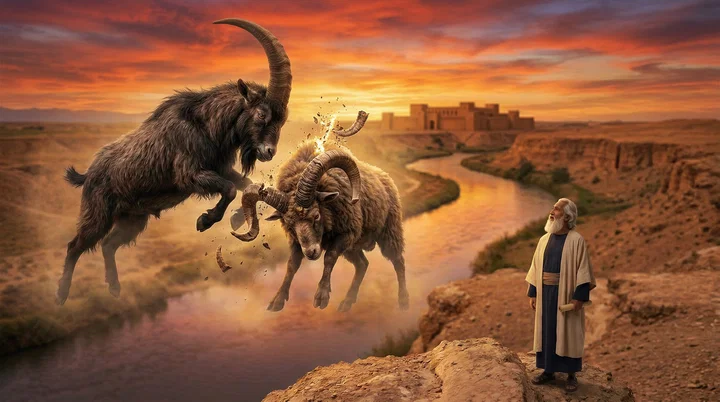
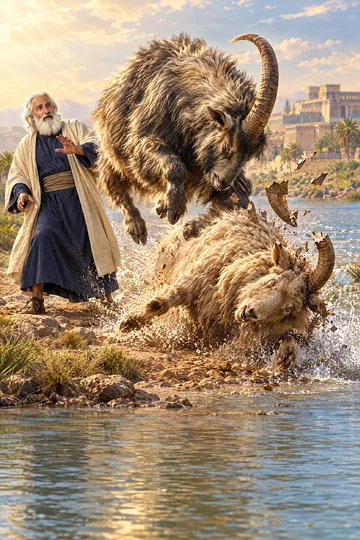
And I saw him come close unto the ram, and he was moved with choler against him, and smote the ram, and brake his two horns: and there was no power in the ram to stand before him, but he cast him down to the ground, and stamped upon him: and there was none that could deliver the ram out of his hand.
Translations
And I saw him come close to the ram, and he was moved with choler against him, and smote the ram, and broke his two horns: and there was no power in the ram to stand before him, but he cast him down to the ground, and stamped on him: and there was none that could deliver the ram out of his hand.
King James Version, KJV Cambridge Paragraph Bible
And I saw him come close unto the ram, and he was moved with choler against him, and smote the ram, and brake his two horns: and there was no power in the ram to stand before him, but he cast him down to the ground, and stamped upon him: and there was none that could deliver the ram out of his hand.
And I saw him come close to the ram, and he was moved with anger against him, and smote the ram, and broke his two horns: and there was no power in the ram to stand before him, but he cast him down to the ground, and stamped upon him: and there was none that could deliver the ram out of his hand.
And I saw him come close unto the ram, and he was moved with choler against him, and smote the ram, and brake his two horns; and there was no power in the ram to stand before him: but he cast him down to the ground, and trampled upon him; and there was none that could deliver the ram out of his hand.
And I saw him come close unto the ram, and he was moved with anger against him, and smote the ram, and brake his two horns; and there was no power in the ram to stand before him; but he cast him down to the ground, and trampled upon him; and there was none that could deliver the ram out of his hand.
And I have seen it coming near the ram, and it becometh embittered at it, and smiteth the ram, and breaketh its two horns, and there hath been no power in the ram to stand before it, and it casteth it to the earth, and trampleth it down, and there hath been no deliverer to the ram out of its power.
And I saw him come close to the ram, and he was enraged with him, and smote the ram, and broke his two horns; and there was no power in the ram to stand before him; and he cast him down to the ground, and trampled upon him; and there was none that could deliver the ram out of his hand.
Yea I saw him coming close upon the ram, and he was enraged at him, and smote the ram, and brake in pieces both his horns, and there was no strength in the ram to stand before him,—but he cast him down to the ground, and trampled him underfoot, and there was none could deliver the ram out of his power.
Berean Standard Bible, Majority Standard Bible
I saw him approach the ram in a rage against him, and he struck the ram and shattered his two horns. The ram was powerless to stand against him, and the goat threw him to the ground and trampled him, and no one could deliver the ram from his power.
I saw him come close to the ram, and he was moved with anger against him, and struck the ram, and broke his two horns. There was no power in the ram to stand before him; but he cast him down to the ground and trampled on him. There was no one who could deliver the ram out of his hand.
And I saw him come right up to the sheep, and he was moved with wrath against him, attacking the sheep so that his two horns were broken; and the sheep had not strength to keep his place before him, but was pushed down on the earth and crushed under his feet: and there was no one to get the sheep out of his power.
And I saw him come vnto the ramme, and being moued against him, he smote the ramme, and brake his two hornes: and there was no power in the ramme to stand against him, but he cast him downe to the grounde, and stamped vpon him, and there was none that coulde deliuer the ramme out of his power.
Douay-Rheims (Challoner revision)
And when he was come near the ram, he was enraged against him, and struck the ram: and broke his two horns, and the ram could not withstand him: and when he had cast him down on the ground, he stamped upon him, and none could deliver the ram out of his hand.
Pictures
Cross-references 20 of 21
- Daniel 8:20-21
The ram which thou sawest having two horns are the kings of Media and Persia.
Identifies the ram as Medo-Persia and the goat as Greece.
- Daniel 8:20
The ram which thou sawest having two horns are the kings of Media and Persia.
Identifies the ram and its two horns as the kings of Media and Persia.
- Daniel 8:25
And through his policy also he shall cause craft to prosper in his hand; and he shall magnify himself in his heart, and by peace shall destroy many: he shall also stand up against the Prince of princes; but he shall be broken without hand.
The power opposing the ram exalts itself against the Prince of princes and is broken without human hands.
- Daniel 8:14
And he said unto me, Unto two thousand and three hundred days; then shall the sanctuary be cleansed.
Gives the 2,300-day period and sanctuary cleansing associated with the same vision.
- Daniel 9:21-23
Yea, whiles I was speaking in prayer, even the man Gabriel, whom I had seen in the vision at the beginning, being caused to fly swiftly, touched me about the time of the evening oblation.
Gabriel returns to complete the explanation of Daniel 8’s vision.
- Daniel 8:16
And I heard a man’s voice between the banks of Ulai, which called, and said, Gabriel, make this man to understand the vision.
Gabriel is commanded to make Daniel understand the vision.
- Daniel 7:5-6
And behold another beast, a second, like to a bear, and it raised up itself on one side, and it had three ribs in the mouth of it between the teeth of it: and they said thus unto it, Arise, devour much flesh.
The bear and leopard parallel the ram and goat in the sequence of empires.
- Daniel 8:22
Now that being broken, whereas four stood up for it, four kingdoms shall stand up out of the nation, but not in his power.
Four kingdoms arose after Alexander’s great horn was broken.
- Daniel 11:2-4
And now will I shew thee the truth. Behold, there shall stand up yet three kings in Persia; and the fourth shall be far richer than they all: and by his strength through his riches he shall stir up all against the realm of Grecia.
Traces Persia’s conflict with Greece and the rise and division of Alexander’s empire.
- Daniel 9:24-27
Seventy weeks are determined upon thy people and upon thy holy city, to finish the transgression, and to make an end of sins, and to make reconciliation for iniquity, and to bring in everlasting righteousness, and to seal up the vision and prophecy, and to anoint the most Holy.
Further explains Daniel 8’s vision and its 2300 days.
- Daniel 8:3
Then I lifted up mine eyes, and saw, and, behold, there stood before the river a ram which had two horns: and the two horns were high; but one was higher than the other, and the higher came up last.
The ram’s two horns represent Medo-Persia, which the goat later smites.
- Daniel 9:21
Yea, whiles I was speaking in prayer, even the man Gabriel, whom I had seen in the vision at the beginning, being caused to fly swiftly, touched me about the time of the evening oblation.
Gabriel returns to explain the vision from chapter 8.
- Daniel 8:2
And I saw in a vision; and it came to pass, when I saw, that I was at Shushan in the palace, which is in the province of Elam; and I saw in a vision, and I was by the river of Ulai.
The vision is set at Shushan by the river Ulai.
- Daniel 8:26
And the vision of the evening and the morning which was told is true: wherefore shut thou up the vision; for it shall be for many days.
Confirms the vision of the time period, left unexplained at that point.
- Daniel 7:24
And the ten horns out of this kingdom are ten kings that shall arise: and another shall rise after them; and he shall be diverse from the first, and he shall subdue three kings.
Both texts explain horns as kingdoms.
- Daniel 11:2
And now will I shew thee the truth. Behold, there shall stand up yet three kings in Persia; and the fourth shall be far richer than they all: and by his strength through his riches he shall stir up all against the realm of Grecia.
Daniel 11 explains the vision of Persia stirring against Greece.
- Daniel 7:7-8
After this I saw in the night visions, and behold a fourth beast, dreadful and terrible, and strong exceedingly; and it had great iron teeth: it devoured and brake in pieces, and stamped the residue with the feet of it: and it was diverse from all the beasts that were before it; and it had ten horns.
Both visions depict a powerful beast and a horn overcoming others.
- Daniel 2:32-33
This image’s head was of fine gold, his breast and his arms of silver, his belly and his thighs of brass,
The ram and goat correspond to the silver and brass parts of the image.
- Daniel 2:39
And after thee shall arise another kingdom inferior to thee, and another third kingdom of brass, which shall bear rule over all the earth.
Both identify Grecia’s rise to dominion after Persia.
- Daniel 8:19
And he said, Behold, I will make thee know what shall be in the last end of the indignation: for at the time appointed the end shall be.
It promises further detail about events before the end.
Commentary
Each commentary is drawn from primary sources: the writings of Ellen G. White and Adventist pioneers and periodicals. Each commentary is separate. Its own words are not a quotation; follow the references to read the source passages.
Ellen G. White
5 sources
Daniel 8:7 belongs to Daniel's prophecies about future events, which reveal the mysteries of the ages to come.PK 547.1 Daniel himself did not fully understand these prophecies, and they were sealed until the time of the end.PK 547.1 The prophecy's subject is Rome, not Antiochus Epiphanes, with the chapter's symbols in this verse applied to Rome's historical role.LS 67.3–69.3
In the vision the symbols including the ram were already explained, while the part left unexplained was the 2300-day period, which Daniel 9 continues to address.LS 45.2–3 The chapter's prophetic periods are reckoned from 457 B.C. as the proper starting year.GC 687.4 The events foretold in the vision are now being fulfilled and will soon come to pass.Ms 142, 1901, par. 6
Sources
Pioneers and periodicals
131 sources
The verse portrays the he-goat coming close to the ram in furious anger, smiting him, breaking his two horns, casting him down and stamping upon him, so that the ram has no power to stand and none can deliver him.RH Nov 21, 1854RH Mar 17, 1853ST The ram is Media and Persia, and the goat is Grecia, so the breaking of the horns is Grecia's conquest and overthrow of Medo-Persia.RH Nov 21, 1854RH Mar 17, 1853ST The two horns are the kings of Media and Persia, the Medes and Persians joined in one government, with the higher horn that came up last for the Persians becoming the leading division.RH Nov 12, 1908RH Sep 13, 1915 This was fulfilled when Alexander the Great swiftly attacked and overthrew Medo-Persia, defeating Darius at Granicus, at Issus, and at Arbela in 331 B.C., and becoming complete master of the Persian country.RH Nov 21, 1854ST Sep 21, 1882ST Nov 17, 1881ST Jul 27, 1915ST Jun 11, 1896 The breaking of both horns with no power to resist means the completeness of the subjection and the transfer of world dominion from Medo-Persia to Grecia as the third universal kingdom.RH Nov 21, 1854RH Feb 15, 1870ST Nov 17, 1881ST Feb 7, 1884ST Feb 10, 1898
Symbols and Plain Meaning
The he-goat comes close to the ram, moved with anger against him, smites him, breaks his two horns, casts him down to the ground and stamps upon him, so that there is no power in the ram to stand before him and none that can deliver the ram out of his hand.RH Nov 21, 1854RH Mar 17, 1853STST Nov 17, 1881ST Aug 8, 1878 The attack leaves the ram decisively defeated, struck down, powerless and without rescue, with both its horns broken.RH Nov 21, 1854RH Mar 17, 1853STST Aug 8, 1878ST Nov 19, 1885 The ram is Media and Persia, the Medo-Persian kingdom, and the goat or rough he-goat is Grecia or Greece, so the verse portrays Grecia's conquest and overthrow of Medo-Persia.RH Mar 17, 1853STST Oct 22, 1874ST Aug 8, 1878ST Nov 19, 1885 The goat defeats the ram in the prophetic sequence of earthly empires, and Grecia succeeds Persia as the world empire.RH Nov 21, 1854RH Mar 17, 1853ST Oct 22, 1874ST Aug 8, 1878ST Nov 19, 1885
The ram's two horns are the kings of Media and Persia, the two powers joined in one Medo-Persian government, representing its two nationalities, the Medes and Persians.RH Nov 12, 1908RH Sep 13, 1915RH Nov 26, 1857RH Mar 21, 1854 Its two horns are high, and the higher that came up last represents the Persians becoming the leading division.RH Nov 12, 1908RH Sep 13, 1915ST Jan 22, 1880RH Nov 26, 1857 At first war was waged by Neriglissar against the Medes, whereupon Darius king of the Medes called Cyrus to his aid as ally with thirty thousand Persians, and during the whole war until the complete subversion of Babylon the regal power was vested solely in Darius while Cyrus was only commander-in-chief of the combined armies.ST Jan 22, 1880 Upon the taking of Babylon Darius the Median was placed on the throne though Cyrus had performed all the work of subjugation, and shortly after Cyrus married the daughter of Darius and received the kingdom of Media in reversion after her father's death, having succeeded his own father in Persia shortly before, and on the death of Darius about two years after the taking of Babylon became absolute monarch of the whole, which is how the higher came up last.ST Jan 22, 1880
In this symbolic prophecy horns represent kingdoms or nations.ST Jan 6, 1887 A horn symbolizes a ruler, whether civil or ecclesiastical.RH Mar 21, 1854RH Jul 2, 1857 Horns more broadly symbolize the civil and religious powers of a nation, and also strength and power and particular features of government.ST Jan 6, 1887RH Mar 21, 1854RH Jul 2, 1857RH May 19, 1851 They do not always signify division, for two horns can belong to one beast in union, and here the two horns represent two powers united in one government rather than divided powers.RH Mar 21, 1854ST Aug 7, 1879RH Jul 2, 1857ST Dec 11, 1879 The horns here represent civil power distinct from ecclesiastical power.RH Mar 21, 1854RH Jul 2, 1857RH May 19, 1851
The goat symbol fits the Macedonian people because two hundred years before Daniel they were called Aegeadae, the goats' people, from aix, aigos, a goat.ST Nov 17, 1881 Caranus their first king went with Greeks to seek a new habitation in Macedonia by taking goats for his guide on an oracle's advice, followed a herd of goats fleeing a violent storm to Edessa where he fixed the seat of his empire, made goats his ensigns, called the place Aege or Aegea, the goats' town, and the people Aegeadae.ST Nov 17, 1881 Aege was the burying-place of the Macedonian kings, and Alexander called his son by Roxana Alexander Aegus, Alexander the goat.ST Nov 17, 1881
The goat's notable great horn between its eyes is the first king, Alexander the Great.ST Feb 20, 1912STRH Jun 27, 1878RH Oct 30, 1856 The four horns that arise afterward are four kingdoms standing up out of the nation but not with his power, namely the four divisions among his successors and his commanders.ST Feb 20, 1912STRH Oct 30, 1856 The victory is followed by the he-goat magnifying himself exceedingly until when he is strong the great horn is broken and four notable horns come up toward the four winds of heaven.ST Feb 20, 1912 The little horn that grows exceedingly great represents Rome throughout its career, pagan and papal, which followed Grecia in the succession of universal empires beginning with Babylon.ST Nov 19, 1885
The breaking of both horns, knocking down and trampling with no power to resist and no deliverer means the completeness of the subjection and the transfer of world dominion from Medo-Persia to Grecia.ST Nov 17, 1881ST Feb 7, 1884ST Oct 10, 1906RH Jan 31, 1856ST Jul 27, 1915 The ram's two broken horns signify the fall of that kingdom, which had become dominated by Persia, and the ram's inability to resist shows Greece's complete victory.ST Nov 17, 1881ST Feb 7, 1884ST Feb 10, 1898ST Oct 10, 1906RH Jan 31, 1856 The action pictures sudden conquest, for the Persian and Grecian empires became great by sudden conquest, unlike Rome which afterward became exceeding great gradually by successive conquests.ST Nov 17, 1881ST Feb 7, 1884ST Feb 10, 1898 The verse's image of no power standing before the attacker underscores the extent of that dominion and succession to the Medo-Persian universal empire.ST Nov 17, 1881ST Feb 7, 1884ST Oct 10, 1906RH Jan 31, 1856ST Jul 27, 1915
A prophetic beast can represent a kingdom through successive changes and revolutions rather than one individual.ST Oct 25, 1883 A prophetic figure can in this way represent a succession rather than one individual, as applied to the man of sin as a succession of rulers of the same character.ST Oct 25, 1883
Historical Fulfillment by Greece
Grecia under Alexander the Great swiftly attacked and overthrew Medo-Persia and succeeded it as the world empire and third universal kingdom in 331 B.C.RH Nov 21, 1854ST Sep 21, 1882RH Feb 15, 1870RH Apr 30, 1857 The he-goat came against the ram in fierce anger, smote him, broke both his horns, cast him down to the ground and stamped upon him, so that there was no power in the ram to stand before him and none could deliver the ram out of his hand.RH Nov 21, 1854RH Feb 15, 1870RH Apr 30, 1857RH Dec 30, 1915 The brass succeeds the silver and the leopard leaps upon the slow-footed bear, for the goat takes the field of the two-horned sheep.ST Sep 21, 1882ST Sep 21, 1882 The lesson is to match each detail of the attack with Alexander's overthrow of the Persian Empire.
The furious attack was fulfilled when Alexander first defeated the generals of Darius at the Granicus in Phrygia, then routed Darius at Issus in Cilicia and afterward at Arbela in Syria in 331 B.C.ST Nov 17, 1881ST Jul 27, 1915ST Jun 11, 1896ST Jun 3, 1897RH Jun 21, 1870 By that final victory Alexander became complete master of the whole Persian country and ended the 207-year Persian rule.ST Nov 17, 1881ST May 3, 1877RH Jun 21, 1870 Darius could not stand against Alexander at Arbela, and Persia lay helpless with no deliverer.ST Jul 27, 1915ST Jun 11, 1896ST Jun 3, 1897RH Nov 26, 1857 After Arbela Alexander ruled their former territories and became monarch of the world.ST Jul 27, 1915ST Jun 11, 1896ST Jun 3, 1897
The breaking of the two horns and the knocking down and trampling with no power to resist mean the completeness of the subjection and the overthrow of the twofold Medo-Persian power of Medes and Persians.ST Nov 17, 1881ST Jul 27, 1915ST Jun 11, 1896RH Jun 21, 1870 Persia was subdued, its country ravaged, its armies cut to pieces and scattered, its cities plundered, and its royal capital Persepolis sacked and burned.ST Nov 17, 1881RH Jun 21, 1870 Alexander broke its twofold strength when he burned Persepolis and Darius was killed in Media, making immense addition to his own empire by its destruction.ST Nov 17, 1881RH Sep 13, 1915 The ram's helplessness and lack of a deliverer describe Persia's defeat and the end of its empire.ST Jul 27, 1915
The conquest showed irresistible swiftness and extent, for the he-goat from the west that thus overcomes the ram is the empire of Grecia and its notable horn is the first king Alexander, who conquered Medo-Persia and reigned gloriously for eight years.STST Jul 27, 1915ST Feb 5, 1880 In eight years his army covered over five thousand miles and made him master of the world.ST Jul 27, 1915 He subdued nations more speedily than others could march armies through them, erecting on the ruins of the Persian monarchy a kingdom more extensive than any before it bearing rule over all the earth, the same third kingdom shown as belly and sides of brass and as the four-headed, four-winged leopard.ST Feb 5, 1880 The goat's swiftness answers to the four wings of the leopard, especially marked in the marvelously short conquests of Alexander over the known Asiatic world, and dominion was given to Grecia by God Himself when Medo-Persia could no longer serve His purpose.
Medo-Persia as the second temporal kingdom after Babylon, where silver replaces gold and the bear replaces the lion, had been made weak by ease and plenty and softened so it fell beneath the sword of Greece, with history echoing the divine presage.ST Sep 21, 1882ST Sep 21, 1882 Its union of two divisions, Medes and Persians, arose when war was waged by Neriglissar against the Medes, whereupon Darius king of the Medes called Cyrus to his aid as ally with thirty thousand Persians.ST Jan 22, 1880 During the whole war until the complete subversion of Babylon the regal power was vested solely in Darius while Cyrus was only commander-in-chief of the combined armies, and upon the taking of Babylon Darius the Median was placed on the throne though Cyrus had performed all the work of subjugation.ST Jan 22, 1880 Shortly after Cyrus married the daughter of Darius and received Media in reversion after her father's death, having succeeded his own father in Persia shortly before, and on the death of Darius about two years after the taking of Babylon became absolute monarch of the whole, which is how the higher horn came up last.ST Jan 22, 1880
The vision was given about 538 B.C. in the last year of the Babylonian monarchy and was fulfilled two hundred years later when Alexander of Macedonia, first king of united Grecia, came swiftly from the west to smite the power of Persia to the earth, winning Granicus and Issus so Persia lay prostrate.RH Mar 21, 1912 When the book of Daniel was shown to Alexander at Jerusalem declaring that one of the Greeks should destroy the empire of the Persians, he recognized himself as the one intended, proving God's plain foretelling of history fulfilled before men and calling even the world conqueror to bow for the moment before the living God.RH Mar 21, 1912 Alexander while yet in his prime as possessor of every clime then succumbed to the cup, and Macedon, Syria, Egypt and Thrace arose in his place as the notable horns.ST Sep 21, 1882 After his death his kingdom was divided among his commanders into four parts, the same as the four heads and four horns toward the four winds, namely Egypt, Syria, Macedonia and Thrace with regions of Asia Minor.RH Oct 30, 1856ST May 3, 1877ST Feb 5, 1880 Grecian rule continued 170 years from 331 B.C. to 161 B.C., and Rome later conquered the Macedonian division of Grecia in 168 B.C., gaining prestige through that victory, which helps explain why the next power in the vision appeared to come from one of the goat's horns.ST May 3, 1877ST Sep 2, 1913
Vision Place in Prophecy
The vision was given in the third year of Belshazzar, dated 538 B.C. in the last days and last year of Babylon and the first year of Darius the Median, two years after the Daniel 7 vision.RH May 12, 1910ST Mar 11, 1889ST Feb 20, 1912 Only weeks or months lay between it and Daniel's prayer in the first year of Darius, and the vision of Daniel 9 followed less than two years later, even in the same year only a few months later, to explain the time brought to view in Daniel 8.ST Dec 24, 1894RH May 12, 1910ST Mar 11, 1889 Later editions adjusted the dates to fit historical research on Babylon, but the interval between Daniel 8 and Daniel 9 is not essential to interpreting the prophecy.ST Dec 24, 1894RH May 12, 1910 In chronological order it came before the den of lions experience and prepared Daniel for that test.RH Nov 25, 1902
The vision begins with Medo-Persia and leaves out Babylon altogether because Babylon was already history, soon to pass away and destined to be overthrown in Daniel's day, while Medo-Persia was just at hand.RH May 12, 1910RH Jun 27, 1878 It therefore portrays only the three remaining universal kingdoms, Medo-Persia, Grecia, and Rome, until earthly empire is broken without hand.ST Aug 14, 1893ST Jun 30, 1914 Given after Babylon had passed off the stage of action, it tells of the three monarchies to follow, with the Medo-Persians and the Greeks mentioned by name.ST Jun 30, 1914RH Jun 27, 1878 The chapter has no symbol for Babylon.RH Oct 8, 1908
The verse belongs to the opening conflict of a prophetic sequence whose field runs through the smiting of the ram to the later power that destroys wonderfully, puts saints to death, stands up against the Prince of princes, and meets its appointed destruction.RH Oct 6, 1863ST Nov 19, 1885ST May 11, 1876 The ram is Medo-Persia and the rough he-goat is Grecia, so the breaking of both horns with no power to resist and no deliverer is Grecia's conquest of Medo-Persia.ST Nov 19, 1885ST May 11, 1876 The notable horn is Alexander the Great and the four horns are the four divisions of his empire, and the little horn that grows exceedingly great and waxes greater than all is Rome throughout its career, covering its pagan and papal eras, with Rome succeeding Grecia.ST Nov 19, 1885ST Dec 24, 1912 That Roman fulfillment is not yet complete but awaits being broken without human agency.RH Dec 11, 1856 The vision as a whole thus connects with Christ's first coming and crucifixion, the turning of the gospel to the Gentiles, Christ's priesthood, and the cleansing of the heavenly sanctuary in the judgment at the end of the 2,300 days in 1844.ST Aug 14, 1893ST Dec 24, 1912
The same powers appear in parallel in Daniel 2 as silver, brass, and iron, in Daniel 7 as the bear, the leopard with four heads and four wings, and the fourth beast with ten horns and little horn, and in Daniel 10-12 as kings of the north and south to Michael's reign, all covering the same ground and closing at the same time.ST Sep 21, 1882RH Feb 17, 1853ST Jun 30, 1914 The goat takes the field of the two-horned sheep, the brass succeeds the silver, and the leopard leaps upon the slow-footed bear.ST Sep 21, 1882ST Sep 21, 1882 The empires of Babylon, Medo-Persia, Grecia, and Rome have successively arisen and passed away, and only the very closing specifications of Daniel 2, 7, and 8 remain unfulfilled, with the fifth universal empire, God's everlasting kingdom, immediately impending.ST Aug 2, 1877ST Jun 30, 1914 All acts ascribed to the he-goat in coming against the ram, smiting him, breaking his two horns, casting him down and stamping upon him belong to the time when the empire is undivided, before the notable horn was broken and the empire was divided.RH Mar 18, 1862
The vision has a twofold aspect, what pertains to the kingdoms themselves as kingdoms and the spiritual aspect affecting God's people, and this verse belongs to the first part concerning the kingdoms themselves as kingdoms.ST Feb 20, 1912 Unlike the fierce beasts of Daniel 7, the ram and goat do not by themselves portray governments in which church and state are united and which persecute.ST Feb 20, 1912
Time Period and Sanctuary
The vision raises the further question how long it would extend, and answers that after 2,300 days the sanctuary would be cleansed.ST Feb 18, 1886 Those days are not literal or solar days of twenty-four hours but symbolic prophetic year-days, each day for a year.ST Feb 7, 1884 They must be symbols just as the beasts and horns are symbols, because not even one power shown lasts only 2,300 literal days.RH Dec 23, 1852 That span could not cover even one of the empires of Persia, Greece and Rome brought into view, so the 2,300 days represent 2,300 years.RH Jan 7, 1858RH Oct 13, 1863 The seventy weeks that mark the Messiah's manifestation at His baptism are part of the 2,300 days, and those weeks were weeks of years and not weeks of days, which proves the year-day reckoning.ST Feb 7, 1884RH Dec 29, 1863
The seventy weeks of Daniel 9 are cut off from the 2,300 days as the first 490 years of the 2,300.RH Jan 7, 1858 Both periods begin together from the decree to restore Jerusalem, given through Ezra in the fall of 457 B.C. in the seventh year of Artaxerxes.RH May 26, 1853ST Oct 28, 1908 Sixty-nine weeks or 483 years run to the Messiah's baptism in the fall of A.D. 27, and the seventy weeks run to A.D. 33 or 34 with the turning to the Gentiles.RH Feb 21, 1856SMV 25.1 Beyond the seventy weeks 1,810 years remain, so the whole 2,300 years end in the fall of 1844, on October 22, 1844, when the sanctuary is cleansed.SMV 25.1RH May 20, 1909ST Oct 28, 1908 The four hundred and ninety years were cut off from the vision's 2,300 days, so both begin at the same time and the 2,300 extend 1,810 years beyond the seventy weeks.RH May 26, 1853 That prophecy contains the time used in the great 1844 movement, though those who used it were mistaken about the event to take place at its end.ST Oct 28, 1908
The cleansing of the sanctuary is the justifying of the heavenly sanctuary, the investigative judgment determining the worthiness or unworthiness of those once in God's service.ST Aug 14, 1893 It is the closing work of Christ's priesthood in the most holy place, including judgment of the dead, pointing also to His second coming.ST Dec 24, 1912RH May 20, 1909 It commenced above at the close of the period as the last gospel message to every nation, kindred, tongue and people.RH May 20, 1909 It is the hour of God's judgment now in progress to separate the just from the unjust and give to each according to his works, proclaimed as the first angel's message in which life stands, to live if accepted and perish if refused.RH Nov 30, 1905 That closing work is the investigative judgment immediately before Christ's coming, comparatively brief and soon over, and then Christ will come.ST Aug 14, 1893
Gabriel was commanded to make Daniel understand the vision and explained the ram, the he-goat, the notable horn and the little horn in plain terms none could fail to understand.RH Mar 21, 1854 He omitted the one point of time, and that omission troubled Daniel and left him astonished with none understanding.RH Mar 21, 1854RH Dec 23, 1852 The beasts and horns belong to the explained part whose meaning was made known, unlike the 2,300 days and the sanctuary which were left unexplained.RH Dec 23, 1852 The angel's explanation makes all clear up to the long prophetic period of the 2,300 years reaching to the cleansing, but that time prophecy is left unexplained.RH May 12, 1910 Gabriel did not explain when the 2,300 days began or whether they were literal or prophetic.RH Mar 17, 1853
The later visit in Daniel 9 supplies skill and understanding of the earlier vision and addresses its unresolved point of time, not the ram and goat symbols already explained.RH Dec 31, 1857 Its explanation comes in the first year of Darius when the angel returns to tell Daniel to understand the matter and consider the vision.RH May 12, 1910 The vision of the ram and he-goat left Daniel sad and perplexed, and Daniel 9 further explains it while Daniel 10-12 develops it with more minute information.ST Apr 9, 1912 This proves the connection between the chapters, with Daniel 11 covering the same ground, dealing with the same powers including the outline of the third monarchy and the little-horn power, and reaching the same end whose triumph of the Prince and host is only implied in the breaking without hand.ST Apr 9, 1912
No part of a century and no period of twelve years may be inserted between the expiration of the 2,300 days and the commencement of the cleansing of the sanctuary.RH Feb 21, 1856 To insert such a gap would destroy the truth of the prophecy.RH Feb 21, 1856 It would be as fatal as inserting twelve years between the sixty-nine weeks and Christ's ministry, between the sixty-nine and a half weeks and Christ's death, or between the seventy weeks and the turning to the Gentiles, which would prove either that Jesus was not the true Messiah or that Daniel was not divinely inspired.RH Feb 21, 1856
The 2,300 days span nearly the entire field of the vision, reaching through the present age to its end rather than ending at Christ's ascension.ST Aug 12, 1875 Only 400 years belonged to the first covenant with its earthly sanctuary and Jewish church, after which the Saviour accomplished His ministry on earth and confirmed the new covenant.RH Oct 2, 1856 After the remaining 1,810 years the sanctuary then to be cleansed is the sanctuary of the new covenant that took the place of the earthly sanctuary when the old covenant ended.RH Oct 2, 1856 The cleansing is not limited to one prophetic day, for the ministry in the holiest requires several prophetic days proportioned to the ministry in the first apartment, which is reasonable and just because of the mighty events connected with that ministration.RH Apr 28, 1853
The continual means far more than the continual burnt-offering; it means the permanent essence of the whole service which alone makes the worship of sinful beings acceptable, whether with or without ritual service and typical temple and sacrifices. That essential thing is a present Christ, the Lamb slain from the foundation of the world, as living sacrifice for a fallen world, requiring union between Christ and the believer so that the believer becomes priest, temple and offering. That union of divinity and humanity is the mystery of godliness, whereby the church becomes the body of Christ and each individual a member. To take away the continual is to have temple, priesthood, sacrifice and church without Christ, changing worship into idolatry and substituting paganism for Christianity under Christian names and forms, which the little horn, the Papacy, has done. The chapter thus teaches what is included under the continual, what results from taking it away, what worship thereby becomes, what is substituted for Christianity, and that a particular power exactly fulfills these specifications.
The continual comprehended the entire daily service of the earthly sanctuary ordained of God, including the morning and evening sacrifices never omitted for the whole congregation, called the continual burnt offering, with the showbread likewise continual, the lamps to burn continually, the incense perpetual, and the high priest bearing the judgment of Israel continually before the Lord.ST Oct 13, 1909 That service in all its appointments was but a figure of the heavenly sanctuary, so the term applies with equal force above.ST Oct 13, 1909 Indeed the entire force of the prophecy applies there because the earthly sanctuary with its priesthood had ended before the power under consideration began its operations.ST Oct 13, 1909
Daniel 8 is the first vision in a prophecy continued and explained in chapters 9-12, containing together four prophetic periods, 2,300, 1,260, 1,290 and 1,335 days.ST Jul 27, 1882 The 2,300 days are the principal and longest period, and the other periods are subdivisions of it.ST Jul 27, 1882 Those who held a different reckoning connected the vision with a total of seven times or 2,520 years divided equally, 1,260 years under paganism and 1,260 under papacy, saying the treading down of God's people was carried out first by paganism then by papacy and that papal rule ending in 1798 marks the end of the treading down.RH Jan 10, 1856 In that reckoning the explanation in chapters 8 and 9 does not answer how long the host will be trodden underfoot or reveal what will befall Daniel's people at the end of the indignation.RH Jan 10, 1856 In that same reckoning the continual in Daniel 8 is organized paganism, taken away in A.D. 508 to make room for setting up the abomination that maketh desolate.ST Sep 21, 1915
Certainty and False Applications
Daniel 8:7 belongs to the main prophetic portion of Daniel in Daniel 6-12, a definite prophecy given hundreds of years before the Christian era and fulfilled with minute accuracy through the centuries.ST Nov 24, 1914RH Mar 8, 1915ST Jun 30, 1914 Greece is named in it and its conquest of the preceding empire is foretold about 200 years before Greece became a world power, and the rise and fall of great nations foretold there is fulfilled in recorded history.ST Feb 13, 1912ST Nov 28, 1895ST Mar 1, 1905 Its divine interpretation can be compared with historical events, it carries a definite interpretation given in the Bible itself so there is no mistake about its meaning, and it has been accurately and literally fulfilled.ST Nov 24, 1914RH Mar 8, 1915ST Jun 30, 1914 Careful study of it removes speculation and gives certain ground to stand on, lays down plain principles for interpreting it in the Bible itself, and shows that making known the power and coming of the Lord Jesus Christ is not following cunningly devised fables.ST Nov 24, 1914ST Jun 30, 1914 Alexander's conquests fulfilled it while conquering the world in harmony with the prophetic word, the prophecy could not be overturned by human power, and his later failure to rebuild Babylon shows that opposing what God had foretold could not make it come to pass.ST Nov 24, 1914ST Feb 13, 1912 Therefore the rest of prophecy can be depended upon with absolute certainty to know the outcome of the world and the future existence of individuals and the human race.ST Nov 24, 1914RH Mar 8, 1915
The symbols are to be understood first by studying other parts of the same prophecy, then related prophecies and the history that fulfills them.RH Sep 2, 1909RH Jan 23, 1913 The vision uses both familiar and new symbols and combines literal and figurative language, and its interpretation follows immediately, providing its explanation.RH Sep 2, 1909ST Jun 30, 1914 The ram denotes Medo-Persia and the he-goat denotes Grecia, identities fixed by the angel's own positive explanation in language that cannot be misunderstood.ST Jun 30, 1914ST Nov 24, 1881RH Jun 28, 1870 This definite Bible-given identification leaves no room for human conjecture about these symbols, for without it men would apply them to anything and everything but the right objects.ST Jun 30, 1914ST Nov 24, 1881RH Jun 28, 1870
The vision of the ram and the he-goat is not fulfilled by Antiochus Epiphanes in 1,150 literal days or about three years, and the claim that he was its central figure and its 2,300 days were half-days fulfilled by him is false.RH May 1, 1856ST Dec 27, 1905RH Jan 31, 1871 Its subject is Rome in pagan and papal phases and in its historical role, not Antiochus Epiphanes.LS 67.3–69.3RH Dec 23, 1852ST Feb 12, 1880 Daniel 8 is genuine and authentic prophecy, and traced in fulfilment it is evidence that cannot be overthrown.RH Mar 8, 1915ST Dec 27, 1905 From the Grecian goat came the Syrian horn, and Antiochus Epiphanes was only the eighth of its twenty-six kings, not another remarkable horn, renamed from Illustrious to Madman for his vile folly.RH Dec 23, 1852ST Feb 12, 1880 After his father Antiochus the Great was defeated by the Romans, paid prodigious tribute, surrendered territory, and gave Epiphanes as a hostage carried to Rome, the Romans maintained ascendency and exacted tribute while the Syrian kings paid it.RH Dec 23, 1852ST Feb 12, 1880 Antiochus enlarged his dominion only by temporary conquests in Egypt which he relinquished when the Romans commanded him to desist for Ptolemy, venting his disappointed rage on the Jews, and as a Syrian king he could not resist the mandates of Rome but abandoned Egypt at Rome's dictation.RH Dec 23, 1852ST Feb 12, 1880 Persia ruling 127 provinces is simply called great and Grecia still more extensive is called very great, so he could not be the power that waxed exceeding great beyond them.RH Dec 23, 1852ST Feb 12, 1880 He died 164 years before Jesus Christ was born, so he could not stand up against the Prince of princes, who is Jesus Christ.LS 67.3–69.3ST Feb 12, 1880 The exceeding great little horn is the Roman power, pagan and papal, and applying the prophecy to Antiochus hides the church of Rome's share in fulfilling it, which opposers of the Advent faith follow.RH Dec 23, 1852ST Feb 12, 1880
Those who held the opposing view taught that the little horn of Daniel 8 is Mahometanism, distinct from the little horn of Daniel 7 which is the Roman Catholic hierarchy, and that the cleansing of the sanctuary is affairs on earth at the destruction of Mahometanism.RH Apr 15, 1873
The fulfilled landmarks of this genuine and authentic prophecy show the world far down the stream of time, with its predicted events fulfilled up to the time described and its remaining closing events still future.ST Jun 27, 1878RH Dec 13, 1853ST Dec 27, 1905 The 2,300 days do not cover every event in Daniel 8: they end in 1844, while the little horn's breaking remains beyond that ending.RH Jun 4, 1857ST Apr 9, 1912RH Dec 13, 1853 The remaining event in Daniel 8 is the breaking of the exceeding great horn without hand, the violent end of the final apostasy.RH Jun 4, 1857ST Apr 9, 1912RH Dec 13, 1853 The verse belongs to the third line of prophecy beginning with Medo-Persia after Babylon passed as a world power, covering Medo-Persia, Grecia, the little-horn power, and the 2,300 days.ST Dec 24, 1912ST Apr 9, 1912 That line is parallel and supplementary to the great image of Daniel 2, the beasts and little horn of Daniel 7, and the kings of the north and south and reign of Michael of Daniel 10-12, covering the same ground and closing at the same time with the reign of Michael, resurrection, and eternity.ST Dec 24, 1912ST Apr 9, 1912 Daniel 10 and 11 explain the vision more fully and extend it in parallel prophecy to the end of earthly rule, when Michael, the great Prince, stands up to reign forever; Michael is another name for Jesus Christ, and his standing up refers to Christ's second coming.ST Dec 24, 1912ST Apr 9, 1912
Daniel saw this vision of the goat coming close to the ram and striking it down while considering, and his act of considering sets an example for every lover of truth to turn aside from business and pleasure to consider the important themes to which God's mercy and providence call attention, as Moses did when he said he would turn aside to see the burning bush.RH Jun 21, 1870 The verse belongs to a divine prophecy whose portrayal includes political developments that are largely fulfilled and still unfolding toward a climax in the ruin of the republic.ST Jul 4, 1911ST Jul 4, 1900 That divine prophetic portrayal applies to the decline and ruin of the republic; the prophecy is partly fulfilled and still being fulfilled, with its climax yet to come.ST Jul 4, 1911ST Jul 4, 1900
Kingdom Hope and Exhortation
The course of empires traced in this prophecy shows that the God of heaven is about to set up His everlasting kingdom at the second advent.RH Apr 23, 1867RH Mar 5, 1867RH Jan 15, 1867RH Jun 18, 1867 It is a plain and thrilling prophecy whose exposition follows the rise and fall of kingdoms to that consummation.RH Jun 18, 1867RH Mar 26, 1867RH Jun 4, 1867 Earthly dominion is transitory and earthly glory fading, while God brings His children through all troubles to its glorious end.RH Apr 23, 1867
The specifications already fulfilled, joined with other prophecies, signs, and present conditions, show that the coming of Christ is near, the last generation reached, and the time of the end begun.ST Aug 2, 1877ST Oct 10, 1878ST Aug 9, 1910RH Jun 18, 1867 Babylon, Medo-Persia, Grecia, and Rome have successively arisen and passed away, with Medo-Persia smitten and overthrown by Grecia, so that only the very closing specifications of Daniel 2, 7, and 8 remain unfulfilled.ST Aug 2, 1877ST Oct 10, 1878 Only a little prophecy remains before He comes in power and glory to destroy the cosmos by a tremendous act of power and give to each according to his works, with no suggestion of world conversion.ST Aug 2, 1877ST Oct 10, 1878ST Aug 9, 1910 The crowning unfulfilled event is the coming of the Son of man, and the fifth universal empire, which is God's everlasting kingdom, is immediately impending.ST Aug 2, 1877ST Oct 10, 1878ST Aug 9, 1910 Together with Daniel 9 it points out distinctly the commencement and termination of the 2,300 days, shows what the sanctuary is and the nature of its cleansing, explains the disappointment of the Advent people in regard to time, and gives the true position of those who are now waiting for their Lord.RH Jun 12, 1856
The contest between the Persian and Grecian armies reveals God's marvelous care for His people during that conflict. The lines of symbolic prophecy illustrating the rise, character, acts, and fall of future kingdoms could not be understood by Daniel himself, and could be of service only after the long period allotted to earthly kingdoms had passed so that history could be compared with their specifications to learn the nearness of the end.ST Apr 15, 1875 Sealed until the time of the end, the vision is opened by the fulfillment of its own specifications, except what stands in immediate connection with the preparatory work for the coming of the Son of man.ST Apr 15, 1875 It relates with great distinctness to the first advent of Christ to suffer for the sins of men and to His second advent in power and great glory, and was given for the benefit of those living near its fulfillment.ST Apr 15, 1875 It lights the path of the people of God in this dark world with ever-increasing light as time fulfills and unfolds it, toward the grand focal point where all the lines of prophecy meet and knowledge is increased.ST Apr 15, 1875
The prophecy views nations in their religious opposition to the gospel, as part of a group of visions covering the same ground, including prophetic periods in which days stand for years, revealing events connected with God's work, and leading to Christ's second coming and the everlasting kingdom.ST Aug 9, 1910 Its conflict and power strongly affect the destinies of Daniel's people.ST Jul 10, 1901 Its later events include the defilement and cleansing of the temple, the cleansing coming three years to the day after a king defiled it, showing God's worship brought low through apostasy followed by severe persecution of His people, which God allowed as chastisement.ST Apr 23, 1912 It reveals the great controversy between good and evil.ST Sep 8, 1909 The persecution of the righteous it describes is distinct from the later time of trouble, which falls on the wicked through the plagues of God's wrath.ST May 7, 1912
The ram's two horns, representing the united Medo-Persian power, illustrate by analogy the two principles of civil equality and religious freedom on which the United States is founded.ST Aug 7, 1879 The beast inheriting the power exercised successively by Babylon, Persia, Greece, and Rome shows a power so great that no opposing power could stand against it.ST Dec 22, 1881 The message here is conveyed through symbols rather than stated directly in words, belonging to symbolic prophecy in which beasts and horns represent kingdoms, powers, or governments of earth, cruel and rapacious, devouring and breaking in pieces.RH May 8, 1916RH Jun 25, 1857ST Nov 28, 1895RH Jun 12, 1855 Unlike the literal prophecy of Daniel 11 where history is presented in literal language, truth here is taught by symbolic representation in which the great universal kingdoms of earth are represented by beasts, and days in that same prophetic connection stand for years.RH May 8, 1916RH Dec 28, 1911RH Dec 12, 1912
This part of Daniel teaches true and false ministry, giving a great lesson for the time in which we are now living.ST Oct 24, 1911 Where Christ commands His special angel Gabriel to make Daniel understand the vision, Gabriel obeys at once with no parleying or delay, being caused to fly swiftly and declaring the commandment came forth, showing how the will of God is done in heaven by immediate hearkening to the voice of His word and providing the pattern for doing God's will on earth as it is done in heaven.ST Apr 2, 1894
Sources