Exodus 12:37
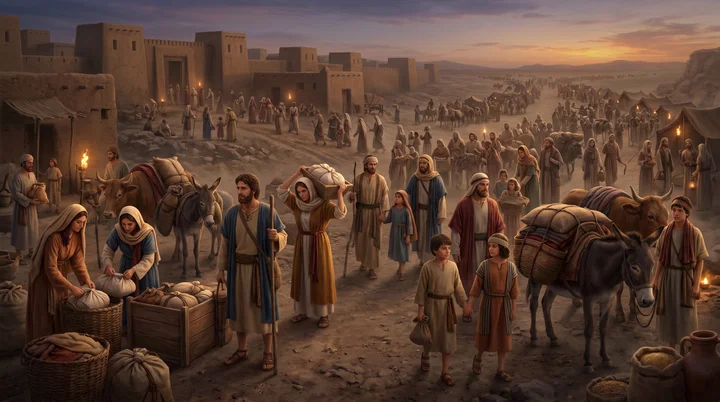
And the children of Israel journeyed from Rameses to Succoth, about six hundred thousand on foot that were men, beside children.
Translations
American King James Version, King James Version, KJV Cambridge Paragraph Bible, Revised Version
And the children of Israel journeyed from Rameses to Succoth, about six hundred thousand on foot that were men, beside children.
Webster Bible, American Standard Version
And the children of Israel journeyed from Rameses to Succoth, about six hundred thousand on foot that were men, besides children.
And the sons of Israel journey from Rameses to Succoth, about six hundred thousand men on foot, apart from infants;
And the children of Israel journeyed from Rameses to Succoth, about six hundred thousand on foot [ that were] men, besides children.
Then did the sons of Israel break up from Rameses, towards Succoth,—about six hundred thousand foot of men grown, besides little ones.
Berean Standard Bible, Majority Standard Bible
The Israelites journeyed from Rameses to Succoth with about 600,000 men on foot, besides women and children.
The children of Israel traveled from Rameses to Succoth, about six hundred thousand on foot who were men, in addition to children.
And the children of Israel made the journey from Rameses to Succoth; there were about six hundred thousand men on foot, as well as children.
Then the children of Israel tooke their iourney from Rameses to Succoth about sixe hundreth thousand men of foote, beside children.
Douay-Rheims (Challoner revision)
And the children of Israel set forward from Ramesse to Socoth, being about six hundred thousand men on foot, beside children.
Pictures
Cross-references 20 of 43
- Exodus 14:21-22
And Moses stretched out his hand over the sea; and the LORD caused the sea to go back by a strong east wind all that night, and made the sea dry land, and the waters were divided.
Israel’s passage through the opened sea continues the journey from Egypt.
- Exodus 12:29-31
And it came to pass, that at midnight the LORD smote all the firstborn in the land of Egypt, from the firstborn of Pharaoh that sat on his throne unto the firstborn of the captive that was in the dungeon; and all the firstborn of cattle.
Egypt’s firstborn are slain, prompting Pharaoh to send Israel away.
- Numbers 33:3
And they departed from Rameses in the first month, on the fifteenth day of the first month; on the morrow after the passover the children of Israel went out with an high hand in the sight of all the Egyptians.
Dates Israel’s departure from Rameses on the fifteenth, the day after Passover.
- Genesis 15:13-14
And he said unto Abram, Know of a surety that thy seed shall be a stranger in a land that is not theirs, and shall serve them; and they shall afflict them four hundred years;
The departure fulfills the prophecy of affliction in Egypt and deliverance with great substance.
- Exodus 19:1
In the third month, when the children of Israel were gone forth out of the land of Egypt, the same day came they into the wilderness of Sinai.
Records Israel’s arrival at Sinai after leaving Egypt.
- Exodus 12:42
It is a night to be much observed unto the LORD for bringing them out from the land of Egypt: this is that night of the LORD to be observed of all the children of Israel in their generations.
The night of Israel’s deliverance from Egypt is to be observed.
- Exodus 12:33
And the Egyptians were urgent upon the people, that they might send them out of the land in haste; for they said, We be all dead men.
The Egyptians hastened Israel’s departure, a rush remembered by the feast.
- Psalms 105:43
And he brought forth his people with joy, and his chosen with gladness:
God brought Israel out of Egypt with joy.
- Exodus 13:6-8
Seven days thou shalt eat unleavened bread, and in the seventh day shall be a feast to the LORD.
The feast recalls Israel’s departure from Egypt.
- Deuteronomy 16:1-3
Observe the month of Abib, and keep the passover unto the LORD thy God: for in the month of Abib the LORD thy God brought thee forth out of Egypt by night.
The Passover commemorates Israel’s departure from Egypt.
- Exodus 13:14
And it shall be when thy son asketh thee in time to come, saying, What is this? that thou shalt say unto him, By strength of hand the LORD brought us out from Egypt, from the house of bondage:
Israel is instructed to remember the deliverance from Egypt.
- Deuteronomy 5:15
And remember that thou wast a servant in the land of Egypt, and that the LORD thy God brought thee out thence through a mighty hand and by a stretched out arm: therefore the LORD thy God commanded thee to keep the sabbath day.
Israel’s deliverance from Egypt is given as the reason for the Sabbath command.
- Exodus 12:13
And the blood shall be to you for a token upon the houses where ye are: and when I see the blood, I will pass over you, and the plague shall not be upon you to destroy you, when I smite the land of Egypt.
gives blood-on-doorpost meaning behind the departure
- Exodus 13:20
And they took their journey from Succoth, and encamped in Etham, in the edge of the wilderness.
Continues the journey from Succoth to the next encampment at Etham.
- Exodus 13:17
And it came to pass, when Pharaoh had let the people go, that God led them not through the way of the land of the Philistines, although that was near; for God said, Lest peradventure the people repent when they see war, and they return to Egypt:
Explains God’s direction of Israel’s route.
- Exodus 12:27
That ye shall say, It is the sacrifice of the LORD’s passover, who passed over the houses of the children of Israel in Egypt, when he smote the Egyptians, and delivered our houses. And the people bowed the head and worshipped.
The Passover commemorates Israel’s deliverance from Egypt.
- Exodus 14:27-28
And Moses stretched forth his hand over the sea, and the sea returned to his strength when the morning appeared; and the Egyptians fled against it; and the LORD overthrew the Egyptians in the midst of the sea.
Egypt’s pursuing army is drowned in the Red Sea.
- Genesis 47:11
And Joseph placed his father and his brethren, and gave them a possession in the land of Egypt, in the best of the land, in the land of Rameses, as Pharaoh had commanded.
Israel departed from the land where Joseph had settled them.
- Psalms 114
When Israel went out of Egypt, the house of Jacob from a people of strange language;
Hallel sung at close not originally required
- Exodus 12:51
And it came to pass the selfsame day, that the LORD did bring the children of Israel out of the land of Egypt by their armies.
It recounts God bringing Israel out of Egypt on that day.
Commentary
Each commentary is drawn from primary sources: the writings of Ellen G. White and Adventist pioneers and periodicals. Each commentary is separate. Its own words are not a quotation; follow the references to read the source passages.
Ellen G. White
14 sources
The children of Israel journeyed from Rameses to Succoth as about six hundred thousand men on foot besides children, together with a mixed multitude and their flocks, herds and possessions.PP 281.2PP 281.4SG3 230.1 Having gathered in Goshen and been organized into companies under appointed leaders, they set out before morning on the morning after Pharaoh let them go free toward the promised land.PP 281.1COS 103.1–4 Their departure fulfilled the four hundred years foretold to Abraham, for God pitied them in slavery, broke the yoke of their bondage, and brought them out with power and mighty signs and wonders while judging the Egyptians by the plagues.PP 281.4SG3 230.1Ms 55, 1901, par. 22–23 He called them out to separate them from the customs of the world and bring them nearer to Himself, to Sinai to hear His law proclaimed with His own voice and to manifest the principles of His kingdom and His character to the world.STB 834.1Lt 74, 1900, par. 29–30 That deliverance, with the opening of the Red Sea and the destruction of their foes, proves His power to save and must be remembered with gratitude and firm trust, for forgetting it led Israel to distrust, murmuring and rebellion, a sin His people on the way to the heavenly Canaan must not repeat.STBk 53.2–54.1STA 53.2–54.1
Departure From Egypt
About six hundred thousand men on foot, besides children, journeyed from Rameses to Succoth.PP 281.2PP 281.4 During the plagues the people had gathered in Goshen and had been organized into companies under appointed leaders, and as a great moving multitude they set out before morning.PP 281.1 They began the journey toward the promised land on the morning after Pharaoh told them they could go free from bondage.COS 103.1–4
They came out as an exceedingly numerous people with their own possessions, with flocks and herds and very much cattle.SG3 230.1 Those livestock and goods had been brought into Egypt by Jacob and his sons and had greatly increased during the sojourn, and they had never been sold to Pharaoh so they did not belong to him.SG3 230.1 God judged the Egyptians by the plagues sent upon them and made them hasten His people out of Egypt with all that they possessed.SG3 230.1 The departure ended the dwelling in Goshen and the country round about it, where they had lived since Joseph settled his father and his brothers in the best part of Egypt.SG3 169.1 That district afforded good, well-watered pastures where they could worship God without disturbance from idolatrous ceremonies, and God brought them out from it with power and mighty signs and wonders.SG3 169.1
The departing company included a mixed multitude with Israel, some of whom trusted in Israel's God while many others joined chiefly to escape the plagues or from excitement and curiosity, and they became a hindrance and a snare to Israel.PP 281.2 Among them were Egyptians who by the signs and wonders shown in Egypt had been led to acknowledge that the God of the Hebrews was the only true God and had been convinced that their own gods were without knowledge and had no power to save or to destroy.SG3 223.1 On the fearful night when the firstborn were slain they entreated to come with their families into the houses of the Israelites, pledged to choose the God of Israel as their God, and decided to leave Egypt and go with the children of Israel to worship Him.SG3 223.1 The Israelites welcomed those believing Egyptians into their houses and into the departing company.SG3 223.1
What Deliverance Reveals
The march from Rameses to Succoth of about six hundred thousand men on foot besides children fulfilled the four hundred years foretold to Abraham, that his seed would be afflicted in a foreign land and afterward come out with great substance.PP 281.4 It was a bringing out with power and mighty signs and wonders, by which God judged the Egyptians with the plagues sent upon them.SG3 230.1SG3 169.1 They came out as an exceedingly numerous people with their own possessions, flocks, herds, and very much cattle, which had been brought into Egypt by Jacob and his sons and had greatly increased and had never been sold to Pharaoh, and by the plagues God made the Egyptians hasten them out with all that they possessed.SG3 230.1 That going out ended the dwelling in Goshen and the country round about it, where they had lived since Joseph settled his father and brothers in the best part of Egypt with good, well-watered pastures where they could worship God without disturbance from idolatrous ceremonies.SG3 169.1
God pitied the Israelites in their slavery, broke the yoke of their bondage, and placed Moses at their head to lead them through the wilderness to the promised land.Ms 55, 1901, par. 22–23 That same pity is not indifferent to the suffering of the colored people in the Southern States of America, who in one sense have been freed from slavery yet remain in the slavery of ignorance, living in sin and degradation, and it calls upon those who name His name to take up the neglected work of lifting them.Ms 55, 1901, par. 22–23 The Lord called His people out of Egypt to bring them to Sinai to hear the proclamation of the law given in Eden.Lt 74, 1900, par. 29–30 God proclaimed the Ten Commandments to them with His own voice in awful grandeur to make known His majesty and authority as Ruler of the world, to impress the sacredness of His law and the importance of obeying it, and the force and power of that delivery reveals its importance as the faith once delivered to the saints by Christ the Redeemer speaking from Sinai.Lt 74, 1900, par. 29–30
God's bringing of Israel out has a continuing purpose for His people today, to separate them from the customs, habits, and practices of the world and to bring them nearer to Himself that He may make known to them His will.STB 834.1 It is that in life and character they manifest the principles of His kingdom and reveal His goodness, mercy, justice, and love, giving the world a representation of His character by which even the world will recognize the superiority of those who love and fear and serve God above every other people.STB 834.1 The people who thus came out had been victims of lifelong slavery and needed instruction and discipline.ED 34.1
Remembering The Exodus
The deliverance from Egyptian bondage, together with opening the Red Sea before Israel and destroying their pursuing foes, proves God's power to save.STBk 53.2–54.1STA 53.2–54.1 It must be remembered with gratitude and firm trust in God, and with firm faith in His leading on the way to the heavenly Canaan.STBk 53.2–54.1STA 53.2–54.1 Forgetting it leads to mourning and lamentation, to distrust of God and desperation, and to the sin of murmuring and rebellion.STBk 53.2–54.1STA 53.2–54.1 That deliverance should have kept Israel trusting God for victory and for entering the promised land, but when discouraged by the false report of the unfaithful spies Israel forgot it along with the opening of the sea and the destruction of their foes.STA 53.2–54.1 That ungrateful, rebellious sin must not be repeated.STBk 53.2–54.1STA 53.2–54.1
The grand march from the land of bondage was rehearsed in solemn silence in the paschal service at Jerusalem.ST Nov 2, 1915 There were recalled the night assembly, the men with girded loins and shoes on feet and staff in hand, the hasty meal of lamb with unleavened bread and bitter herbs, the sprinkled blood, and the death-dealing angel.ST Nov 2, 1915 On the journeys to Jerusalem the experiences of the past were recounted to the Hebrew children and the songs that had cheered the wilderness wandering were sung.ST Nov 2, 1915 With the commandments chanted and bound up with the influences of nature and kindly human association, the deliverance was forever fixed in the memory of many a child and youth, stirring the imagination and impressing the heart.ST Nov 2, 1915
God pitied the Israelites in their slavery in Egypt, broke the yoke of their bondage, and placed Moses at their head to lead them through the wilderness to the promised land.Ms 55, 1901, par. 22–23 That same pity is not indifferent to the suffering of the colored people in the Southern States of America.Ms 55, 1901, par. 22–23 In one sense they have been freed from slavery, yet they remain in the slavery of ignorance, living in sin and degradation.Ms 55, 1901, par. 22–23 It calls upon those who name His name to take up the neglected work of lifting them.Ms 55, 1901, par. 22–23
Sources
Pioneers and periodicals
101 sources
The verse records the hurried departure from Rameses to Succoth on the night after the tenth plague, the death of the firstborn, beginning the march that led directly to the Red Sea, its miraculous crossing, and the destruction of the Egyptian host.ST Jan 25, 1910ST Dec 14, 1915 About six hundred thousand men on foot besides children went out, a whole company of about three million souls with flocks and herds, grown from the small family of about seventy that had entered Egypt.RH Feb 7, 1854ST Jul 17, 1879RH Feb 7, 1854ST Aug 9, 1910 The Passover and the seven-day Feast of Unleavened Bread are the fitting memorials of that deliverance, the blood on the doorposts typifying the blood of Christ by which sin is pardoned and God's people are spared.ST Apr 13, 1904RH Dec 17, 1857RH Apr 7, 1851RH Jan 14, 1862ST Aug 13, 1874 The weekly Sabbath is not a memorial of this hasty flight, but ever remains the memorial of the Creator's rest after making heaven and earth.RH Dec 17, 1857ST May 31, 1905RH Apr 30, 1872 The going out fulfills God's promise to Abraham that after four hundred and thirty years of wandering and affliction his posterity would come forth with great substance, and it is a type of the final deliverance of all believers from sin and death into the heavenly Canaan.RH Jan 2, 1913RH Dec 17, 1861STST Dec 19, 1892
Departure Setting and Route
The verse records the hurried departure from Egypt following the tenth plague, the death of the firstborn, standing in Exodus 11 to 13 within the historical first division of the book in chapters 1-18.ST Jan 25, 1910 Its setting is in close connection with the giving of the ordinance for the Passover and the claiming of the firstborn as the Lord's, together with the last plague and the Passover.ST Jan 25, 1910 It tells of the slaying of the firstborn, set beside the unfinished tomb and the store cities, and it leads directly to the march to the Red Sea, the miraculous crossing, and the destruction of the Egyptian host.ST Dec 14, 1915
The journey from Rameses to Succoth is the beginning of the exodus that gives the book its name, for Exodus means a going out.RH Jan 20, 1916ST Jan 20, 1909 It is the start of the march from bondage toward Canaan under Moses, the beginning of the astonishing movement of a mighty host in deliverance toward the promised land.ST Jan 20, 1909ST May 27, 1908 Israel left with families after bondage ended and journeyed through the wilderness, where God knew and watched over them, Moses leading the people through forty years toward the Jordan toward freedom.ST May 27, 1908ST Nov 4, 1880 The account belongs to chapters 6 to 12, which give the ten plagues upon Egypt and merciful deliverance, and it continues through the song of triumph on the other side of the Red Sea.ST Feb 4, 1913ST Jan 20, 1909
Rameses in Egypt was the starting city and gathering place in Goshen from which the march out of bondage toward Canaan began.ST May 22, 1907 The very first Passover was kept at Rameses on the night they were led out.ST May 22, 1907
Israel left Egypt on the fifteenth day of the first month Abib, the day after the Passover killed on the fourteenth, starting in the night just after midnight when thrust out and urged by the Egyptians.ST Jul 17, 1879ST Jun 12, 1879RH Apr 14, 1874ST Jun 16, 1887 They went forth in haste before dough had time to rise, carrying dough before it was leavened with kneading troughs bound up in clothes upon shoulders, taking what they could carry and marching and driving animals with flocks and herds, taking Joseph's bones with them, about three million in all besides flocks and herds.ST Jul 17, 1879ST Jun 12, 1879RH Apr 7, 1851 This hasty flight with unleavened bread is commemorated by the feast of unleavened bread, while the Passover on the fourteenth commemorates the passing over when Egypt's firstborn were slain.RH Apr 7, 1851RH Apr 14, 1874 That fifteenth day was full of burden-bearing, marching, and driving livestock, wholly unlike the rest of the weekly Sabbath, which points back to creation and the Creator's rest and contains nothing commemorating a midnight flight, so it could not be the foundation of a new order of Sabbaths, since its appointment at the manna five weeks after the flight would be an unaccountable delay.ST Jul 17, 1879RH Apr 14, 1874 Those who held the other teaching held that this very day was the first taking up of a peculiar Sabbath, the sixth day as previously reckoned then made the Sabbath and ever afterward counted the seventh, while the next day the sixteenth became the first day of the week, with God so ordering the year that the fifteenth ever afterward recurred on Saturday.ST Jun 12, 1879ST Jun 12, 1879
The verse belongs to the history of Abraham's descendants in Egypt, where they had first come seeking supplies from Egypt's granaries.ST Nov 14, 1906 Their oppression in the brief narration of Exodus 5 to 12 was not merely physical bondage but involved the right to worship the true Creator of heaven and earth and to keep His commandments, particularly the Sabbath, which became a direct issue and came to a crisis during the latter part of their stay.RH Mar 25, 1909 The power of the oppressor was broken and the people delivered only through the terrible plagues laying waste the land and visiting death on every family and through the direct intervention and miraculous power of God.RH Mar 25, 1909
The departure came before the wilderness sojourn, which began only afterward.RH Oct 21, 1851 Counting from the fifteenth-day departure, the coming to the wilderness of Sin was thirty days later on the fifteenth day of the second month, where the Sabbath was observed before the law was spoken, and the coming to Sinai was sixty days later, three days before the law was given at the mount, so the manna Sabbath test came thirty days before Sinai.RH Oct 21, 1851ST Jun 16, 1887
The exodus and wilderness journeyings are recorded as plain positive historical fact, not allegory or parable, carried out under Moses' direct supervision.ST Jul 28, 1881ST Aug 25, 1881 They are stated with no less certainty and the same direct historical certainty as creation and the fall of man.ST Jul 28, 1881ST Aug 25, 1881 The account of the journey from Rameses to Succoth with the number of men is true history showing that God reveals Himself to man.RH Feb 3, 1910
Number and Growth of Israel
About six hundred thousand men on foot, besides children, journeyed from Rameses to Succoth, and that going out is the event commemorated by the Passover.RH Feb 7, 1854RH Nov 13, 1860RH Jan 7, 1862ST May 12, 1898 The night of the deliverance was to be observed to the Lord, and the Passover was observed only once in the wilderness, in the year after leaving Egypt, and then was omitted until entrance into Canaan.RH Nov 13, 1860RH Jan 7, 1862 The departure was the beginning of the journey from slavery in Egypt toward freedom, with Moses leading the people through the wilderness for forty years toward the Jordan.ST May 27, 1908 The counted group shows the whole company numbered more than 601,000.
The whole company was about three million in all besides flocks and herds, described as six hundred thousand field hands and about three million souls delivered from the house of bondage.ST Jul 17, 1879ST Aug 31, 1888RH Oct 13, 1859 They took what they could carry on their shoulders and marched and drove their animals when they had only enough food for two or three days, and power was signally manifested every day for preservation by feeding manna.ST Jul 17, 1879ST Aug 31, 1888 Scripture numbered males separately from women and children, so the stated number was men with women and children additional, and such counts may include only males of a certain age.
Israel had grown from a small family of about seventy to seventy-five who entered Egypt into a great multitude and free nation, few when the covenant was made with the patriarchs but numerous by the Sinai covenant.RH Feb 7, 1854ST Aug 9, 1910ST Jul 13, 1915 The descendants had grown from Jacob's small family during 215 years in Egypt, after many generations in bondage for the sale of Joseph, and the family brought into bondage for the sale of one brother grew over many generations to 600,000 men besides women and children.RH Aug 23, 1864RH Jun 11, 1901 Their deliverance followed a century of slavery, and with childlike trust they could have reached the promised land in about two weeks, but unbelief kept them from entering.RH Jun 11, 1901 Egypt's loss of about six hundred thousand laborers greatly checked major works and helps explain the near-cessation of monument construction in the following period.RH Apr 23, 1908
More than 600,000 left Egypt in Moses' time, far more than the fewer than 50,000 who returned in Ezra's day, showing how seventy years abroad and a generation born there weakened attachment to the homeland.ST Aug 17, 1904 Those settled and prospering in the lands of dispersion were less inclined to move, while the spiritually minded were more ready to return.ST Aug 17, 1904 The large number did not mean all were faithful or would enter the land, for only Caleb and Joshua of that mighty company entered because they wholly followed the Lord, while the rest disbelieved and died, strewing the wilderness with human wrecks.RH Feb 7, 1854RH Jan 21, 1909 Their experience is a type of entry into the heavenly Canaan, which requires wholehearted obedience and purity, and a warning against departing from faith after prominence through idolatry and Sabbath-breaking, for more than six hundred thousand began the journey with Moses in which they could have shared his success if remaining faithful to the end.RH Feb 7, 1854RH Jan 21, 1909RH Nov 27, 1860RH Feb 4, 1904
Passover Memorial and Meaning
The chapter belongs to the night the destroyer passed through Egypt, when God commissioned an angel to execute judgment while houses marked with blood were spared. The Egyptians were destroyed because they had chosen sin and stood with oppression, and on that dark night every firstborn was smitten, not even the firstlings of the flocks being spared, so that by a mighty arm the chain binding the people to proud Pharaoh's throne would be broken.ST Feb 4, 1889 The plagues connected with this going out showed Jehovah above the gods of Egypt, alone all-powerful and all-wise.ST Nov 1, 1899
The same chapter gives the directions for eating the Passover, under which the lamb was slain and eaten, and those directions governed the meal shared by Jesus with His disciples, who prepared according to them.ST Sep 20, 1910 The first form of the Passover given in Exodus 12 and 13 was the form observed in Egypt and in the wilderness and for some time afterward, but that original form was materially changed after the building of the temple, with injunctions added in later Scriptures that could hardly have been carried out in the wilderness.ST Feb 22, 1899 The original instructions do not enjoin the use of wine found in later observance, nor the closing song called the Hallel.ST Feb 22, 1899
The deliverance was a mighty rush from the land on the fourteenth of the first month, and Exodus 12 plainly declares the Passover to be its memorial with its office described.RH Dec 17, 1857 The Passover was ordained in commemoration of deliverance from bondage, named for the angel passing over Hebrew houses on the night the firstborn in every Egyptian family was slain, beginning with the slaying of the paschal lamb on the fourteenth day of the first month and extending through seven days in which nothing but unleavened bread was to be eaten.RH Jan 14, 1862 It was both a type of Christ and a memorial of deliverance from bondage, perfectly fitted to call that flight and deliverance to mind.ST May 31, 1905ST Apr 23, 1896 The Feast of Unleavened Bread commemorates the same hasty departure, for Israel left before dough had time to rise and baked unleavened cakes from the dough brought out.RH Apr 7, 1851 God gave two fitting memorials of this work instead of the weekly Sabbath: the Passover to preserve remembrance of judgment when Egypt's firstborn were doomed and the destroying angel passed over Israelite dwellings, and the Unleavened Bread to declare how Israel was hurried out, explained when sons ask what the service means as brought up with a mighty hand from Egypt.RH Nov 15, 1853 One memorial is not commemorative of two such unlike events as a day of rest after six days of labor in creation and a rush out of Egypt, nor are two memorials given for the same event, and a weekly rest cannot fitly picture a hasty once-yearly rush.RH Dec 17, 1857RH Nov 15, 1853
The blood on the doorposts typifies the blood of Christ, through which sin is pardoned and God's people are spared from being cut off.ST Apr 13, 1904 The ordinance required the slaying of the paschal lamb on the fourteenth day of the first month, and that slaying met its antitype in the death of the Lamb of God on that day.ST Aug 13, 1874RH Mar 31, 1874 Israel's deliverance also points to the final pardon and blotting out of sin, a corresponding experience belonging to the remnant living at the close of probation.ST Apr 13, 1904
Abib is identified as the first month of the sacred year, though the seventh month of the civil year counted from creation, and the fifteenth of Abib was made memorable by the departure, while the Passover rather than any change of the Sabbath commemorated the deliverance.RH Nov 7, 1871 Those who held the civil reckoning otherwise taught that Abib was established as the beginning of the civil year distinct from the sacred year, so that the Day of Atonement could fall on the tenth day of the seventh month of the civil year while also being the last day of the sacred year when the sanctuary's offerings and work for the year were brought to a close.ST Jun 18, 1912
The Passover was observed only once in the wilderness, in the year after leaving Egypt, and then was omitted until entrance into Canaan.RH Jan 7, 1862
The grand march from bondage, with night assembly of men with girded loins, shoes on feet and staff in hand, hasty meal of lamb with unleavened bread and bitter herbs, sprinkled blood, and death-dealing angel, was rehearsed in solemn silence in the paschal service at Jerusalem.ST Nov 2, 1915 On journeys there the past experiences were recounted to the children and the songs that had cheered the wilderness wandering were sung, and with the commandments chanted and bound up with nature and kindly human association the deliverance was fixed forever in the memory of many a child and youth, stirring imagination and impressing the heart.ST Nov 2, 1915
Sabbath Memorial Controversy Examined
The weekly Sabbath is not a memorial of the deliverance from Egypt.RH Dec 17, 1857ST May 31, 1905RH Apr 30, 1872RH Nov 15, 1853 A weekly rest cannot fitly picture a hasty once-yearly rush from Rameses to Succoth, and one memorial is not commemorative of two such unlike events nor are two memorials given for the same event.RH Dec 17, 1857RH Nov 15, 1853 God gave two other fitting memorials of that work instead: the Passover to preserve remembrance of His judgment when Egypt's firstborn were doomed to die and the destroying angel passed over Israelite dwellings, and the Feast of Unleavened Bread to declare how Israel was hurried out before dough rose, explained when sons ask as brought up with a mighty hand.RH Dec 17, 1857ST May 31, 1905RH Nov 15, 1853 The seventh day always was and always has been the memorial of the Creator's rest after making heaven and earth, established at creation, and Israel's rescue enabled them to observe it but did not create it or make it a merely Jewish institution.RH Dec 17, 1857ST May 31, 1905RH Jan 7, 1862
The day of departure was full of burden-bearing, marching, and driving livestock, wholly unlike the rest of the weekly Sabbath of the Lord, so it could not be the foundation of a new order of Sabbaths.ST Jul 17, 1879 The journey from Rameses to Succoth happened on the fifteenth of Abib, starting in the night just after midnight when Israel was thrust out, when the whole people, about three million in all besides flocks and herds, took what they could carry on shoulders with kneading troughs bound up and marched and drove animals.ST Jul 17, 1879 Resting on the seventh day of each week contains nothing that commemorates a midnight flight on that date, while the deliverance is commemorated by a twofold memorial, the Passover on the fourteenth for the passing over when Egypt's firstborn were slain and the feast of unleavened bread on the fifteenth for the hasty flight, just as the Sabbath points back to creation and the Creator's rest.RH Apr 14, 1874 If the Sabbath were a weekly commemoration of the flight, its appointment at the fall of the manna a little more than a month, five weeks, after the flight would be an unaccountable delay, since God does not delay His work once the reason for it exists.RH Apr 14, 1874
It has been held by some that the fifteenth of Abib, the very day of departure, was the first taking up of a peculiar Sabbath by divine direction.ST Jun 12, 1879ST Jun 12, 1879 On that view the sixth day of the week as previously reckoned was then made the Sabbath and ever afterward counted as the seventh day to be observed by Israel, carrying dough before it was leavened.ST Jun 12, 1879ST Jun 12, 1879 The next day, the sixteenth of Abib, though the seventh day in regular succession from the Creator's rest in the beginning, was thenceforward reckoned the first day of the week.ST Jun 12, 1879ST Jun 12, 1879 God so ordered the year that the fifteenth day of the first month ever afterward recurred upon the Jewish Sabbath, or Saturday, while Sunday or the Christian Sabbath is the seventh day in regular succession from creation.ST Jun 12, 1879
The claim that God changed the Sabbath at the exodus is a disputed argument not supported by the departure in Exodus 12:37-42.ST Jul 24, 1879ST Jul 24, 1879 Opposite theologians placed the supposed change in opposite directions, one that God changed the Sabbath from the seventh day to the sixth and another that it changed from the first day to the seventh.ST Jul 24, 1879 Both claims belong to the error that God took away His Sabbath and replaced it with a ceremonial Sabbath.ST Jul 24, 1879
The Sabbath originated at creation, not at the deliverance.RH Dec 17, 1861RH Jan 7, 1862 Israel was brought out at the end of four hundred and thirty years as the deliverance promised to Abraham, as God's own people so that they might receive His Sabbath and law and acknowledge Him as their God in public covenant relationship, not the beginning of the Sabbath, God's law, or knowledge of God, which already existed.RH Dec 17, 1861RH Jan 7, 1862 That deliverance signified salvation, redemption, and recreation through Christ, and gave Israel opportunity to receive the benefits of the everlasting covenant made with the patriarchs.ST Feb 15, 1905
Israel in Egypt still worshiped God and observed His ordinances, for circumcision was necessary to eat the Passover and they were ready for it.RH Sep 24, 1872 This proves they had not forgotten the Lord's past dealings, so the Sabbath made known at Sinai was an original giving and not the re-making-known of a forgotten ordinance.RH Sep 24, 1872
Exodus 12 provides at most evidence about the calendar for that one year; it does not prove that the week began with the year or that the Sabbath began on a certain day of every month. The Passover holy days were not necessarily always on the weekly Sabbath. The number of years between the Creator's rest-day in Eden in Genesis 1 and the first day of unleavened bread in Egypt, much less the exact number of weeks and days to a day, cannot be established with certainty.ST Jun 12, 1879
The use of the verse to support departure on the fourteenth is incorrect, for Numbers 33:3 says they departed on the fifteenth.RH Oct 31, 1871 The departure date matters because the proposed day-by-day calculation of Israel's journey to the Red Sea depends on it, and correcting the date shifts the supposed triumph there from the seventeenth to the eighteenth day.RH Oct 31, 1871
Promise Fulfilled and Prophecy
The going out from Rameses to Succoth fulfills the promise to Abraham that after four hundred years of wandering and affliction his posterity would come forth from Egypt and make homes in Canaan.RH Jan 2, 1913 Those four hundred years end at this departure in B.C. 1491 and begin at the weaning of Isaac in B.C. 1892, when Ishmael the son of the bondwoman through jealousy began mocking, or afflicting, Isaac the son of the freewoman.RH Jan 2, 1913 The same deliverance is also reckoned at the end of four hundred and thirty years.RH Dec 17, 1861 It is placed 1491 years before Christ, after the descendants had grown from Jacob's small family during 215 years in Egypt, ending a century of slavery under cruel taskmasters who built enduring landmarks at the cost of the lives of God's children.RH Jan 2, 1913ST Jan 28, 1886RH Jun 11, 1901
God brought Israel out at the appointed time by His own power rather than by human wisdom or strength, so that Pharaoh could not hinder them after it had been declared that Abraham's seed would come out after four hundred years of affliction with great substance.RH Mar 20, 1913ST Jan 16, 1896 That arrival of an appointed event at its set time, after preparatory work, is the pattern for the present hour, for the same unstoppable certainty belongs to the prophetic threefold message now going forth.RH Mar 20, 1913ST Jan 16, 1896RH Jun 11, 1901 The plagues that preceded the journey were joyful signs to Israel that freedom was coming, just as God's judgments at the last day will signal to the saints that He is acting for them and bringing their hopes to fulfillment.RH Sep 10, 1901 That exodus is also the earlier fulfillment of the words about God calling His Son out of Egypt, and Egypt may further represent sin from which Christians are called.RH Aug 24, 1916
The plagues of Egypt in Exodus 7-12, coming just prior to the deliverance of Israel, shadow forth the seven last plagues to be poured out just before the final deliverance of the saints.RH Dec 23, 1851 Those seven future plagues that will sweep over the world will be as real and literal as the Egyptian plagues, poured out as God's wrath without mercy, with forgiveness of sin no longer granted once they begin.RH Dec 23, 1851ST Oct 28, 1930 As Israel lived through the plagues on Egypt in that very large company leaving Rameses for Succoth, so God's people will remain on earth through the final plagues, protected by God.ST Jul 18, 1878ST Oct 28, 1930
Types of Final Deliverance
The going out from Rameses to Succoth toward Canaan is the type of the deliverance of God's people from the dark Egypt of earth.ST The homeward journey of about 50,000 captives of Judah together with the longer captives of Israel from Babylon was a second going up out of Egypt to the promised land.ST Dec 19, 1892 Both deliverances typify the final deliverance of all who believe from the bondage of sin and death, when mouths are filled with laughter and tongues with singing because the Lord has done great things.ST Dec 19, 1892
Leaving Egypt without leaven is the type of putting away corruption, for leaven is a sign of corruption.ST Oct 29, 1912 Departing with unleavened bread meant coming clean before God, cutting loose from all the sins of Egypt and of the flesh, retaining none of the old sins in the heart, and worshiping God with sincerity of heart and truth.ST Oct 29, 1912
God brings His people out of bondage in Egypt in a single night, fleeing at darkest midnight with Jesus leading the way and the cloud ever present to guide night and day.ST Jul 4, 1906ST Sep 9, 1913 That deliverance from dwelling in Egypt in service to a cruel king is accomplished through the blood of Jesus into praise and daily following.ST Jul 4, 1906 Yet leaving Egypt is only the beginning, because Egypt remains in the blood and must be gotten out of the people before they are fit for Palestine and for stability and sufficiency in daily life.ST Sep 9, 1913 That getting out comes through defeat, deferred hope, faith, perseverance, gradual conflict with foes, despair over failing food and water, and mystery.ST Sep 9, 1913 The departure itself was a journey accomplished in about forty-eight hours, while getting Egypt's influence out took forty years.ST Sep 29, 1898 Physical freedom did not free them from sin, and their wilderness experience showed that a different, God-given spirit was needed to enter Canaan, illustrating the difference between bodily release and the liberty from sin granted by the Son of God.ST Apr 21, 1909
The departure under Moses exemplifies God leading His people out.RH May 29, 1856 It is linked with the midnight cry, for after Israel was freed from Egypt God gave them His law, and obedience would lead them to the promised inheritance.RH May 29, 1856 It also illustrates a later people coming out of the churches under the midnight cry, then receiving the Third Angel's Message, which contains the Ten Commandments and points to the everlasting inheritance.RH May 29, 1856
The deliverance shows the personal agency of the Son of God in bringing Israel out of bondage.ST Mar 24, 1887 Christ the divine Lord, Jesus the divine I Am, personally led His ancient people toward the earthly Canaan, even as He will erelong lead the saved of every age into the heavenly land.ST Mar 24, 1887ST Mar 30, 1915
That deliverance gave personal acquaintance with the living God.ST Nov 27, 1901 The ten plagues humbled proud Egypt to the dust and annihilated the supposed power of its many gods, giving each Israelite rare opportunity to know the King of kings and Lord of lords.ST Nov 27, 1901 To those who believed, the deliverance of their firstborn was surpassingly impressive, while in the homes of those who rejected God's mercy not one escaped the destroyer's hand.ST Nov 27, 1901 That deliverance, crowned by the opening of the Red Sea for Israel to pass over dry shod and the drowning of the Egyptians, followed by the sweetening of Marah, the bread from heaven, and water from the flinty rock, gave the thrilling personal experience behind the fuller title, I am the Lord thy God, which have brought thee out of the land of Egypt, out of the house of bondage.ST Nov 27, 1901
That deliverance left the people needing instruction in God's salvation and character, so God gave them the sanctuary as a many-part object lesson of the plan of salvation. After generations in bondage the Israelites had become associated with Egyptian worship and had largely lost their knowledge of God and Christ.ST Mar 3, 1898 After bringing them out, God needed to teach them the principles of the atonement before establishing them in the promised land.ST Mar 3, 1898
The miraculous exodus after removal from Palestine to Egypt and centuries of servitude, following the selection of Abraham and his posterity as God's peculiar people, stands with the thunders of Sinai, the revelation of the divine love, and the establishment of Israel in Canaan as a center as some of the most wonderful events on record.RH Apr 20, 1916 The exodus and the fifteen-century history of the children of Israel prove that God lives and reigns and knows how to save His people and punish the wicked.RH Apr 20, 1916 The deliverance from Egypt, joined to the forty years wanderings, the building of the sanctuary, and the entrance into Canaan, illustrates the conflict between good and evil that has gone on for nearly six thousand years and gives Bible history new significance and beauty.RH Apr 13, 1905
Spiritual Lessons for Believers
God led Israel from Rameses to Succoth in order, bringing harmony out of the confusion of distracted Egyptian slavery, for He is not the author of confusion but brings order out of chaos.ST Aug 18, 1881ST Mar 24, 1887 That same order appears in the six days of creation and in the saving of Noah with his family and the beasts and birds while confusion and destruction reigned outside the ark.ST Mar 24, 1887 That orderly leading grounds the whole yearly system of religious service given to bring Israel nearer to God and make them a mighty people and a praise in all the earth, in which departure in the least particular was worthy of blame.ST Mar 24, 1887
Israel stood waiting through the night for departure from Egypt, showing the trust in God needed to obey despite severe test.RH Feb 15, 1912ST Mar 7, 1878RH Oct 6, 1904 Their readiness to act in trust is the faith required of those expecting the Lord's coming, to buy an individual experience that prepares to meet the Lord.RH Oct 6, 1904LDT 173.1–174.1RH Aug 27, 1914 It is the same faith that offered Isaac, built the ark, left Sodom, and entered the lions' den and the fiery furnace.LDT 173.1–174.1 It means believing God's truth and venturing out upon it with strong faith that gives glory to God, daring to be counted fools and madmen, with entire consecration to God and deadness to the world as if to die that day.LDT 173.1–174.1RH Aug 27, 1914
About six hundred thousand men on foot besides children came out, and only two of them entered the promised land because the rest disbelieved God and died, so the wilderness was strewn with human wrecks.RH Jan 21, 1909 This is a warning against departing from the faith after holding a prominent place in the cause of God, with idolatry and Sabbath-breaking as the principal sins causing spiritual wrecks then and the same causing spiritual wrecks in modern Israel.RH Jan 21, 1909 The miracles of the exodus should have taught childlike trust, with which they could have reached the promised land in about two weeks, but unbelief kept them from entering.RH Jun 11, 1901 Those who were under twenty when the journey began, more than six hundred thousand, later entered Canaan.
God in His purposes allowed Israel to remain for a time in a servile condition as serfs of the Egyptians, yet He did not sanction even that modified slavery but demanded instant release, and on refusal brought terrible judgments on the oppressors and drowned the pursuers in the Red Sea.RH Oct 1, 1861 The family brought into bondage for the sale of one brother grew over many generations to six hundred thousand men besides women and children, about three million souls in all, described as six hundred thousand field hands delivered as an army of fugitive slaves.RH Oct 1, 1861RH Aug 23, 1864RH Oct 13, 1859 The size of the nation that suffered that long bondage for selling Joseph measures how much greater punishment is deserved for wholesale trafficking in human flesh and blood of black and white.RH Aug 23, 1864
God's church at the Exodus was the slave nation led by Moses out of Egypt, called out by God's sent messenger with the call of truth to a life of truth and righteousness, and those who yielded to that regular summons constituted His Ekklesia, His faithful remnant in that time of crisis.ST Apr 18, 1911 Rameses recalled slavery and death, while Succoth brought a temporary sense of freedom and security.ST Oct 20, 1914 The journey began amid great enthusiasm, swelled by people who feared being left behind, and a mixed multitude went with them, yet though faces were turned toward Canaan, hopes of ease and temporal advantage left them unprepared for the trials ahead.ST Oct 20, 1914
God delivered about three million souls from the house of bondage when they had only enough food for two or three days, and His power was signally manifested every day for their preservation by feeding them with manna after provisions ran out in the wilderness on the way toward the promised land.ST Aug 31, 1888RH Jun 27, 1912 The wonderful deliverance from Egypt together with the deliverance at the Red Sea demonstrated God's wisdom, love, and power, His ability and right to rule, and Israel's obligation to obey.ST Mar 7, 1906 Israel was the chosen people through whom knowledge of God was to extend throughout the earth as a light to surrounding nations, their course revealing what it means to be a member of God's government and people.ST Jun 13, 1906 The same law given to them, with the Ten Commandments as the constitution of national and individual life explained by ceremonial by-laws, was for every other person of whatever race or nationality.ST Jun 13, 1906
More than six hundred thousand began the journey out of Egypt with Moses, the beginning of the march from slavery toward freedom through the wilderness for forty years toward the Jordan.ST May 27, 1908RH Feb 4, 1904 They could have shared Moses' eventual success if they had remained faithful with him to the end.RH Feb 4, 1904 The exodus under oppression is a comparison for the mass emigration of French Protestants fleeing religious persecution.ST May 17, 1905 As God brought about Israel's departure from Egypt, so being driven out of a church and brought to keep the Sabbath is its parallel.RH Dec 17, 1861 The departure from bondage came amid darkness, plagues, and storm.ST Sep 28, 1904
Sources