Exodus 12:15
Seven days shall ye eat unleavened bread; even the first day ye shall put away leaven out of your houses: for whosoever eateth leavened bread from the first day until the seventh day, that soul shall be cut off from Israel.
Translations
Seven days shall you eat unleavened bread; even the first day you shall put away leaven out of your houses: for whoever eats leavened bread from the first day until the seventh day, that soul shall be cut off from Israel.
King James Version, KJV Cambridge Paragraph Bible, Revised Version, American Standard Version
Seven days shall ye eat unleavened bread; even the first day ye shall put away leaven out of your houses: for whosoever eateth leavened bread from the first day until the seventh day, that soul shall be cut off from Israel.
Seven days shall ye eat unleavened bread; even the first day ye shall put away leaven out of your houses: for whoever eateth leavened bread, from the first day till the seventh day, that soul shall be cut off from Israel.
Seven days ye eat unleavened things; only — in the first day ye cause leaven to cease out of your houses; for any one eating anything fermented from the first day till the seventh day, even that person hath been cut off from Israel.
Seven days shall ye eat unleavened bread: on the very first day ye shall put away leaven out of your houses; for whoever eateth leavened bread from the first day until the seventh day — that soul shall be cut off from Israel.
Seven days, unleavened cakes, shall ye eat, surely, on the first day, shall ye put away leaven, out of your houses,—for whosoever eateth what is leavened, then shall that soul be cut off out of Israel, from the first day, unto the seventh day.
Berean Standard Bible, Majority Standard Bible
For seven days you must eat unleavened bread. On the first day you are to remove the leaven from your houses. Whoever eats anything leavened from the first day through the seventh must be cut off from Israel.
“‘ Seven days you shall eat unleavened bread; even the first day you shall put away yeast out of your houses, for whoever eats leavened bread from the first day until the seventh day, that soul shall be cut off from Israel.
For seven days let your food be unleavened bread; from the first day no leaven is to be seen in your houses: whoever takes bread with leaven in it, from the first till the seventh day, will be cut off from Israel.
Seuen daies shall ye eat vnleauened bread, and in any case ye shall put away leauen the first day out of your houses: for whosoeuer eateth leauened bread from the first daie vntill the seuenth day, that person shalbe cut off from Israel.
Douay-Rheims (Challoner revision)
Seven days shall you eat unleavened bread: in the first day there shall be no leaven in your houses: whosoever shall eat any thing leavened, from the first day until the seventh day, that soul shall perish out of Israel.
Pictures
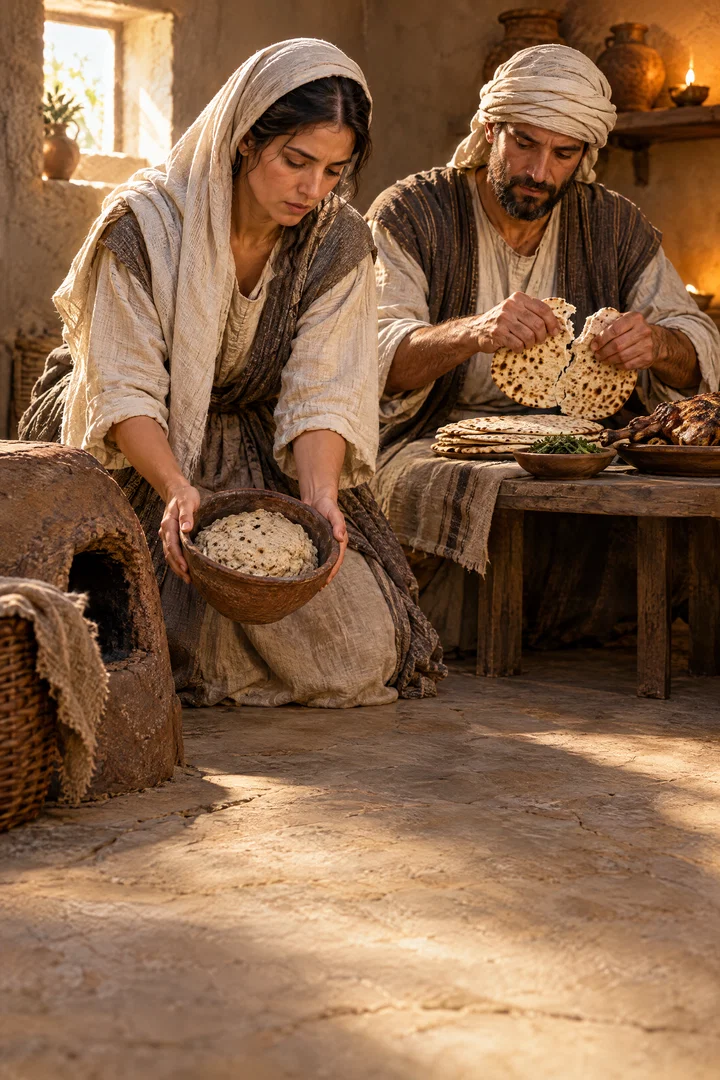
Cross-references 20 of 43
- 1 Corinthians 5:7
Purge out therefore the old leaven, that ye may be a new lump, as ye are unleavened. For even Christ our passover is sacrificed for us:
Christ is identified as the Passover sacrifice, and believers are to purge out leaven.
- Deuteronomy 16:3-4
Thou shalt eat no leavened bread with it; seven days shalt thou eat unleavened bread therewith, even the bread of affliction; for thou camest forth out of the land of Egypt in haste: that thou mayest remember the day when thou camest forth out of the land of Egypt all the days of thy life.
Both require seven days of unleavened bread and forbid leaven during Passover.
- Leviticus 23:6-8
And on the fifteenth day of the same month is the feast of unleavened bread unto the LORD: seven days ye must eat unleavened bread.
Sets out the seven-day Feast of Unleavened Bread and its first and last holy convocations.
- Matthew 26:17-29
Now the first day of the feast of unleavened bread the disciples came to Jesus, saying unto him, Where wilt thou that we prepare for thee to eat the passover?
Jesus celebrates Passover with his disciples and institutes the supper.
- Exodus 13:7
Unleavened bread shall be eaten seven days; and there shall no leavened bread be seen with thee, neither shall there be leaven seen with thee in all thy quarters.
Both require unleavened bread and the removal of leaven during the seven-day feast.
- Exodus 12:19
Seven days shall there be no leaven found in your houses: for whosoever eateth that which is leavened, even that soul shall be cut off from the congregation of Israel, whether he be a stranger, or born in the land.
It repeats the prohibition against leaven in Israelite homes.
- Exodus 12:6
And ye shall keep it up until the fourteenth day of the same month: and the whole assembly of the congregation of Israel shall kill it in the evening.
Dates the Passover lamb’s sacrifice and the beginning of unleavened bread.
- Exodus 12:27
That ye shall say, It is the sacrifice of the LORD’s passover, who passed over the houses of the children of Israel in Egypt, when he smote the Egyptians, and delivered our houses. And the people bowed the head and worshipped.
It recalls deliverance from Egyptian bondage.
- 1 Corinthians 5:8
Therefore let us keep the feast, not with old leaven, neither with the leaven of malice and wickedness; but with the unleavened bread of sincerity and truth.
Leaven represents malice and wickedness, while unleavened bread signifies sincerity and truth.
- Exodus 12:33
And the Egyptians were urgent upon the people, that they might send them out of the land in haste; for they said, We be all dead men.
explains the haste the feast memorializes
- Exodus 11:4-6
And Moses said, Thus saith the LORD, About midnight will I go out into the midst of Egypt:
The final plague of the firstborn occasions the Passover ordinance.
- Deuteronomy 16:3
Thou shalt eat no leavened bread with it; seven days shalt thou eat unleavened bread therewith, even the bread of affliction; for thou camest forth out of the land of Egypt in haste: that thou mayest remember the day when thou camest forth out of the land of Egypt all the days of thy life.
Both require unleavened bread and recall Israel’s hurried exodus from Egypt.
- Exodus 23:15
Thou shalt keep the feast of unleavened bread: (thou shalt eat unleavened bread seven days, as I commanded thee, in the time appointed of the month Abib; for in it thou camest out from Egypt: and none shall appear before me empty:)
Both texts require seven days of unleavened bread at the appointed feast.
- Exodus 12:8
And they shall eat the flesh in that night, roast with fire, and unleavened bread; and with bitter herbs they shall eat it.
The Passover lamb was eaten with unleavened bread.
- Deuteronomy 16:16
Three times in a year shall all thy males appear before the LORD thy God in the place which he shall choose; in the feast of unleavened bread, and in the feast of weeks, and in the feast of tabernacles: and they shall not appear before the LORD empty:
Names the Feast of Unleavened Bread among Israel’s annual feasts.
- Exodus 12:42
It is a night to be much observed unto the LORD for bringing them out from the land of Egypt: this is that night of the LORD to be observed of all the children of Israel in their generations.
The Passover night is observed as a memorial of Israel’s deliverance from Egypt.
- Leviticus 23:5
In the fourteenth day of the first month at even is the LORD’s passover.
Gives the date of the Passover feast instituted in Exodus.
- Colossians 2:16-17
Let no man therefore judge you in meat, or in drink, or in respect of an holyday, or of the new moon, or of the sabbath days:
The feast is a shadow of things to come, fulfilled in Christ.
- Exodus 23:18
Thou shalt not offer the blood of my sacrifice with leavened bread; neither shall the fat of my sacrifice remain until the morning.
Forbids offering sacrificial blood with leavened bread.
- Exodus 13:14
And it shall be when thy son asketh thee in time to come, saying, What is this? that thou shalt say unto him, By strength of hand the LORD brought us out from Egypt, from the house of bondage:
Explains the unleavened-bread observance by recalling the LORD’s deliverance from Egypt.
Commentary
Each commentary is drawn from primary sources: the writings of Ellen G. White and Adventist pioneers and periodicals. Each commentary is separate. Its own words are not a quotation; follow the references to read the source passages.
Ellen G. White
5 sources
The command belongs to the solemn ordinance of the Passover instituted on the night of the last and most severe plague upon Egypt, a night terrible to the Egyptians and glorious to the people of God.1SP 217.2SG3 244.2 Before that night Moses had made known to Pharaoh and to the people of Egypt and to the Israelites the nature and effect of that plague.1SP 217.2SG3 244.2 At that time the king and his idolatrous priests still opposed letting Israel go, though the people desired it.SG3 244.2 This was after the plagues of locusts and of oppressive darkness, in which darkness the Hebrews had pure air and light in their dwellings.SG3 244.2
The Passover in Egypt to which the command belongs included sprinkling blood on the doorway and the destroying angel sweeping over the land.PP 275 Its supper was eaten together with the people gathered around a table, while the slaying of the firstborn brought death and mourning to Egyptian homes.PP 275 In that observance Israel was required to put away leaven out of their houses and to eat unleavened bread throughout the seven-day observance.PP 278.1 Thus no leaven was to be found in their houses during the feast.PP 278.1
The Passover recalled Israel's deliverance from Egypt and was intended to turn their thoughts from worldly concerns to God's works and mercy and faithfulness. In this command leaven is an emblem of sin.PP 278.1COL 95.3–96.2 The direction to remove all leaven from the houses means putting away sin from the heart, just as leaven was put away from the homes.PP 278.1COL 95.3–96.2 Those who receive life and nourishment from Christ must put away the leaven of sin.PP 278.1
Sources
Pioneers and periodicals
106 sources
The verse commands the seven-day Feast of Unleavened Bread from the fifteenth to the twenty-first of Abib, in which leaven is to be put away from the houses from the first day and only unleavened bread eaten, on pain of being cut off from Israel.RH May 10, 1864RH Jan 20, 1916RH Feb 19, 1914 It was ordained as the yearly memorial of deliverance from Egypt, named for the passing over of Hebrew houses when Egypt's firstborn were slain, with the unleavened bread recalling that Israel was hurried out in haste before dough could rise.RH Dec 17, 1857RH Jan 14, 1862RH Jan 7, 1862ST May 12, 1898RH Apr 18, 1854 The putting away of leaven means putting away sin, corruption and all the ways of Egypt, coming clean before God in sincerity.ST Feb 23, 1915ST Oct 29, 1912ST Dec 11, 1901 The lamb slain on the fourteenth met its fulfillment when Christ our Passover was sacrificed, whose blood causes God to pass over transgression and whose sinless life is fitly represented by pure unleavened bread.RH Jan 14, 1862ST Oct 22, 1894ST Aug 13, 1874ST Oct 22, 1894 Its first and last days are annual sabbaths, holy convocations forbidding servile work but allowing food preparation, entirely distinct from the weekly Sabbath which is the memorial of the Creator's rest and cannot also memorialize the hasty flight from Egypt.ST Jul 17, 1879RH Dec 17, 1857ST Apr 12, 1883RH Sep 24, 1872ST May 31, 1905
Egypt and Exodus Setting
Exodus 12:15 is part of God's call to the kingdoms of earth given three and one-half millenniums ago when Egypt ruled the world as the greatest of all kingdoms, acknowledged for might and power and skill and wisdom in statecraft.ST Nov 14, 1906 That Egypt was fertilized by its river's annual overflow which it deified as a god and joined with the sun in producing food, so that it worshiped the sun and titled its kings as representatives of the sun-god upon the throne of men.ST Nov 14, 1906 It was sought out for supplies from its granaries by the few descendants of the nomadic patriarch Abraham after the captive slave Joseph had taught Pharaoh to store grain in plenteous years to become rich in famine.ST Nov 14, 1906 Joseph had instituted an easy rental and tax land-law under which Egypt prospered without oppression as long as his memory was honored and his laws governed.ST Nov 14, 1906
The verse belongs to the ordinance for the Passover given in close connection with the tenth plague, the death of the firstborn, and the hurried departure of Israel from Egypt, when the firstborn were claimed as the Lord's. It stands in Exodus 11-13, the part about the last plague, the Passover, and the going out of Egypt, and in the chapter that tells of the slaying of the first-born.ST Jan 25, 1910ST Dec 14, 1915 It is part of Exodus 6-12, which records the ten plagues upon Egypt and God's merciful deliverance of His children, belonging to the history of Israel's deliverance that leads directly to the passage through the Red Sea.ST Jan 20, 1909ST May 28, 1894 Exodus 12:1-32 is the institution of the Passover in Egypt, including the destroying angel, and the command to remove leaven and eat unleavened bread belongs to that Passover setting.ST Apr 5, 1899
The setting is oppression of Israel in Egypt over the right to worship the true God and keep His commandments, particularly the Sabbath.RH Mar 25, 1909 Pharaoh refused to let Israel go to hold a feast in the wilderness, charged Moses and Aaron with hindering the people from work by making them rest, and laid more work upon them with contempt for God and His law.RH Mar 25, 1909 The oppressor's power was broken and the people delivered only through the plagues and the direct miraculous intervention of God culminating in death in every Egyptian house.RH Mar 25, 1909 The ten plagues humbled that proud nation to dust and utterly destroyed the supposed power of its many gods, while the first-born of those who believed God were spared and in the homes of the rejecters of God's mercy not one escaped the destroyer's hand.ST Nov 27, 1901 That sparing together with the plagues gave each Israelite abundant opportunity to gain personal knowledge of the King of kings and Lord of lords, giving full meaning to the title with which God prefaced His holy law, I am the Lord thy God, which have brought thee out of the land of Egypt, out of the house of bondage.ST Nov 27, 1901
These instructions requiring removal of leaven from houses and eating unleavened bread for seven days belonged to the first Passover, observed before Israel was delivered from Egyptian bondage.ST Oct 7, 1930 The rule for that first Passover was to eat unleavened bread for seven days and remove leaven from houses at the start, with anyone eating leavened bread during those days to be cut off from Israel.ST May 22, 1907 That first Passover was held at Rameses in Egypt on the night the Israelites were led out of bondage.ST May 22, 1907 Rameses named in Exodus 12 was one of the treasure cities in Egypt built by Israelite slave labor for Pharaoh, its builder being Rameses II, the Pharaoh of the oppression, whose reign ran from 1564 to 1497 B.C. and ended six years before Israel left Egypt.ST Aug 9, 1910
The prohibition of leaven in houses during the seven days concerned the future memorial observance as it would be celebrated in later years.RH Apr 7, 1868 Israel had no leaven when they left Egypt because they were forced to leave quickly, not because that departure was itself the later observance of the rule.RH Apr 7, 1868 The Passover began before Israel's exodus from Egypt, and the paschal lamb was eaten on the first night of the feast, with unleavened bread to be eaten throughout the seven days.RH Dec 10, 1867
The word soul means a person or physical self, so that the person who eats leavened bread during the appointed seven days is to be cut off from Israel.ST Nov 2, 1882 The deliverance from Egypt and institution of the rite of unleavened bread and putting away leaven are true history and divine enactment, of divine origin and authority.ST May 8, 1879 They are a verity on which the priesthood, sacrifices, covenants, promises, laws, and whole system of worship rest, which all the other books of the Old Testament recognize as reality and proceed upon, and which the New Testament ratifies in the fullest manner.ST May 8, 1879 The work of redemption revealed in the New Testament is founded on this deliverance and institution, so that without its truth and propriety as God's work the New Testament cannot stand.ST May 8, 1879 Exodus 12 records the exodus under Moses' direct supervision in terms as positive and certain as the history of creation in Genesis 1-3, showing both accounts set forth with equal confidence as fact, and the plagues were literal, Egypt knew it and Philistia did not doubt it.STST Jul 28, 1881
Feast Observance and Timing
The verse establishes the seven-day Feast of Unleavened Bread, also called the Passover, as the first of three annual festivals kept from the fifteenth to the twenty-first of Abib, also called Nisan.RH May 10, 1864RH Jan 20, 1916RH Feb 19, 1914ST Jun 3, 1897 For seven days unleavened bread alone was to be eaten, leaven was to be put away from houses beginning the first day, and whoever ate leavened bread from the first day until the seventh day was to be cut off from Israel.RH May 10, 1864RH Jan 20, 1916ST Jun 3, 1897 On the fourteenth day of the first month all leaven was to be put away, the lamb was to be killed in the evening of the fourteenth, and eating unleavened bread was to begin at the beginning of the fifteenth and continue to the twenty-second.ST Mar 11, 1886ST May 12, 1898 The fifteenth, the first day of the feast, was a sabbath on which no servile work was to be done, though the fourteenth is sometimes called the first day because leaven was put away then and eating began that evening, while the fifteenth is really the first day.ST Mar 11, 1886ST May 12, 1898
The fourteenth was the preparation for the seven days, with the house cleared at an early hour on the eve and with thorough search and cleansing in which all leaven was removed and burned.ST May 20, 1880RH Jan 15, 1914ST Apr 21, 1881 From twelve o'clock on the fourteenth abstinence from leaven was required, and at twelve it was to be solemnly destroyed.RH Jan 15, 1914 Its presence or use would defile the household and make it unfit to eat the Passover.ST May 20, 1880ST Apr 21, 1881 The days were reckoned from evening to evening, beginning at sunset, within a seven-day period.ST Sep 2, 1897 The first and last days were holy days, special Sabbaths regardless of weekday.ST May 12, 1898ST Jun 3, 1897
The directions about unleavened bread and the feast were more than commemoration of the passing over, for they formed part of the observance and of the preparation for eating the lamb and for the festival.RH Jun 24, 1873ST Oct 7, 1930RH Oct 29, 1872 Putting away leaven out of the houses was the work of preparation for eating the lamb.RH Jun 24, 1873ST Oct 7, 1930 The verse belongs to the original instructions for the Passover given in Egypt and for the wilderness journey, as the first form of the Passover before the building of the temple materially changed the form of celebration.ST Feb 22, 1899 Later injunctions about the Passover not found in Exodus 12-13 could hardly have been carried out in the wilderness, the wine of later observances was not enjoined in the Pentateuch, and the Hallel of Psalms 113-118, with the first two psalms sung at the beginning of the meal and the rest at the close, was not required by the original instructions.ST Feb 22, 1899
The Passover was one of three annual feasts kept at the place the Lord chose, Jerusalem, the three together occupying twenty-two days.RH Nov 18, 1862 With the weekly Sabbath and the seventh-year rest this made one hundred twenty-six days, over one-third of the year, occupied in religion besides travel to and from Jerusalem, which increased the need for laborers, and all hired servants were required to observe these Sabbaths and feasts with their masters.RH Nov 18, 1862 Abib was made the first month of the sacred year, though seventh of the civil year reckoned from creation.RH Nov 7, 1871 The verse plainly introduces the Passover as a new institution arising from Abraham's time onward, giving how it should be celebrated, when and by whom, its purpose, and its circumstances and rites, unlike tithing whose origin reaches to the beginning when the fall made its necessity and hope was promised.RH Mar 9, 1905RH Mar 14, 1865 That explicit founding contrasts with Exodus 16, which speaks of the Sabbath as already existing and known, paralleling Genesis 2 as the origin of the Sabbath.RH Mar 14, 1865
Israel left Egypt on the fifteenth of the first month and arrived at Sinai on the first of the third month forty-five days later, so that adding one day to settle, one day for the preliminary covenant, and the third day thereafter when the law was proclaimed makes Sivan 6 exactly fifty days after departure.RH Jan 15, 1914 That day was the very day on which the Feast of Weeks or Pentecost fell, for which reason Pentecost commemorated the giving of the law on Sinai.RH Jan 15, 1914 The seven days represent all time in which people feed upon Christ the Truth.RH Feb 19, 1901 They illustrate Scripture's emphasis on seven as the number of perfection composed of three and four.RH Feb 19, 1901RH Jan 22, 1857
Annual and Weekly Sabbaths
The fifteenth of Abib, the first day of unleavened bread, is an annual sabbath coming once a year, not once a week like the Sabbath of the Lord.ST Jul 17, 1879ST Apr 12, 1883 It holds the same rank as the other annual sabbaths except the tenth day of the seventh month, which is more sacred.ST Jul 17, 1879 It forbids servile work but expressly allows preparation of food, while the weekly Sabbath forbids all work including preparation of food.ST Jul 17, 1879ST Apr 12, 1883 This difference proves the fifteenth of Abib was not made to fall regularly on the day of the weekly Sabbath.ST Jul 17, 1879ST Apr 12, 1883
The feast began the morning after the Passover lamb was slain, on the fifteenth day of the first month, and continued seven days.ST Apr 12, 1883 Its first day was a holy convocation in which no servile work could be done, making it a sabbath or rest.ST Apr 12, 1883 That annual sabbath is entirely distinct from the weekly Sabbath because it comes only once a year on a fixed day of the month and therefore falls on different days of the week from year to year.ST Apr 12, 1883 It establishes an annual commemoration that can come only once a year, not a weekly celebration tied to a day of the week.ST Apr 12, 1883ST Jul 17, 1879
The first and seventh days are two annual Sabbaths instituted here for the first time as holy convocations in which no work is to be done except what every man must eat, with leaven put away and unleavened bread eaten seven days.RH Sep 24, 1872ST Mar 23, 1915 They are introduced indefinitely without the definite article, which marks the first mention of a new institution.RH Sep 24, 1872 They are the first of the seven annual ceremonial sabbaths, distinct from and in contrast to the weekly Sabbath, introduced after the fall because of failure, associated with offerings of blood, and pointing forward to Christ.ST Mar 23, 1915 They required the killing of a lamb and the sprinkling of its blood upon the doorposts to point to Christ the Lamb who takes away sin and passes over the sins of the world, a type met in its antitype when Christ the Passover was sacrificed.ST Mar 23, 1915
The convocation days are appointed for particular days of the month, not the weekly Sabbath, and have no reference to the weekly Sabbath.RH Apr 9, 1861 The feast days connected with the Passover did not necessarily fall on the weekly Sabbath. The Passover year's calendar proves at most a calendar arrangement for that one year, not that the weekly cycle began anew with each month or year. Changes of month or year did not interrupt the sequence of full weeks.
The verse specifies the seven-day feast and requires leaven to be removed on its first day, but it does not say that this feast changed the weekly Sabbath. It gives instructions for the days of unleavened bread in the first month but provides no direct declaration that God changed the Sabbath at the exodus, and it does not state that Abib 15 was made the Sabbath.ST Jun 26, 1879 It does not make Abib 15 into a weekly Sabbath, does not change the Sabbath from the seventh day to the sixth day, and does not change the week to begin on God's seventh day and end on His sixth, refuting the claim that a newly instituted Sabbath replaced the original seventh-day Sabbath.ST Jun 26, 1879ST Jul 17, 1879
Exodus 12-20 read together disproves the claim that the Sabbath is not mentioned until after the law was given from Sinai.RH Mar 1851 That section records departure on the fifteenth day of the first month, keeping of the Sabbath in the wilderness of Sin on the fifteenth day of the second month thirty days before Sinai, and hearing of the Ten Commandments thirty-two days later, showing God and Moses spoke of the Sabbath as already understood.RH Mar 1851 The account stands one month before the fall of the manna and the account of the Sabbath in Exodus 16.ST Apr 24, 1879 The word Sabbath appears in the record before Sinai, not as a first institution there.RH Mar 1851RH Oct 21, 1851
The Passover was to be observed regularly after entering the promised land, and its preparation could require roasting the lamb over fire on the evening after the fourteenth day of the first month.RH Jan 7, 1862 Since that date sometimes fell on the Sabbath, the Passover law would conflict with a continuing ban on lighting fires.RH Jan 7, 1862 This supports the conclusion that the ban in Exodus 35:3 was a temporary wilderness rule, not a lasting restriction for life in the promised land.RH Jan 7, 1862
The Passover was commanded to be kept forever throughout generations as a perpetual covenant, but forever and perpetual there do not mean unceasing duration.RH Jun 10, 1862RH Apr 15, 1873 Forever means only the utmost duration the thing itself allows, decided by its nature.RH Jun 10, 1862 The Passover by nature was limited because it belonged to the Jewish nation as a type and shadow pointing forward to Christ, so its duration was fulfilled and ended when Christ the substance came, and it is grouped with other institutions called perpetual or everlasting to show such wording alone does not prove permanence.RH Jun 10, 1862RH Apr 15, 1873 This does not prove the seventh-day Sabbath must end with it, because the Sabbath is no type, was made at creation before sin and before types were needed, points backward to creation, was made for all mankind, and belongs to a law eternal as God.RH Jun 10, 1862
The feast of unleavened bread is a holy institution forbidding all manner of work and standing as a memorial or sign, given to Israel alone and limited to their generations, with violation punished by exclusion from Israel by death.RH May 10, 1864 Its feast days and sabbaths were ceremonial, distinct from the seventh-day Sabbath of the moral law, belonging to a temporary system of types and shadows ending at the cross.ST Sep 8, 1909 It was a temporary ordinance lasting as long as the Passover existed, the feast and lamb pointing to Christ, so that when the shadow reached the cross its observance ended.ST Apr 23, 1896ST Sep 8, 1909 Its observance ceases through the gospel dispensation after the crucifixion and resurrection of Christ, its appointed substitute is the Lord's Supper, and its complete fulfillment comes in the kingdom of God or new earth.ST Apr 23, 1896RH May 10, 1864
The first day of unleavened bread in Egypt marks the endpoint of the count of weeks and days from the Creator's rest in Eden in Genesis 1.ST Jun 12, 1879 On another reckoning held by some, that first day was the original Sabbath in unbroken weekly succession from Eden and provides an exact midpoint for counting 2,035,369 days or 290,767 weeks from creation to the resurrection, so that resurrection Sunday the sixteenth of Abib was the seventh day from creation and the Bible's first Sabbath corresponds to Sunday.ST Jun 12, 1879 The Passover with its unleavened bread and putting away of leaven belongs to the Jewish feasts whose observance was indifferent for the church at Rome.ST Dec 9, 1897 The day in Romans 14:5 includes such feast days in local application, so there should have been no controversy over observing or not observing them, though the principle applies more broadly.ST Dec 9, 1897
Memorial of the Deliverance
The Passover with its seven days of eating unleavened bread and putting away leaven is the memorial God gave of the deliverance from Egypt, its memorial character plainly declared and its office described in the ordinance itself.RH Dec 17, 1857RH Jan 14, 1862 It was named for the angel of the Lord passing over the houses of the Hebrews on the night the firstborn in every Egyptian family was slain, beginning with the slaying of the paschal lamb on the fourteenth day of the first month and extending through seven days in which nothing but unleavened bread was to be eaten, with any eater of leavened bread cut off from Israel.RH Jan 14, 1862RH Jan 7, 1862 Together the Passover and the Unleavened Feast form two fitting memorials, the Passover preserving remembrance of judgment bringing deliverance when the destroyer passed over Israelite dwellings while Egypt's firstborn were doomed to die, and the Unleavened Feast declaring how the fearful Egyptians hurried Israel away in haste.RH Nov 15, 1853ST Sep 13, 1877 The prescribed answer when sons ask what the service means is that with mighty hand Jehovah brought them up from Egypt's land with mighty hand and stretched-out arm.RH Nov 15, 1853ST Sep 13, 1877
The unleavened bread recalled that Israel was driven out in haste before dough could rise, later baking that dough, and it is called the bread of affliction eaten when they fled.RH Jan 7, 1862ST May 12, 1898RH Apr 18, 1854 The feast began on Abib 15 with preparation on the 14th, and its first and seventh days were special Sabbaths regardless of weekday.ST May 12, 1898 The feast is a yearly memorial kept only once a year at the Passover season on the fifteenth of Abib, an annual commemoration that can come only once a year, not a weekly celebration tied to a weekday.ST Jul 17, 1879RH Oct 21, 1851RH Mar 1851 With the Passover it is the once-a-year memorial of the deliverance on the fifteenth day of Abib, appointed to call to mind God's power in bringing Israel from the house of bondage, commemorating only that deliverance.RH Oct 21, 1851RH Mar 1851
The weekly Sabbath is not and cannot be a memorial of the Exodus, but is and always has been the separate weekly memorial of the Creator's rest after making heaven and earth, instituted before the fall.RH Dec 17, 1857ST May 31, 1905RH Apr 30, 1872 The Passover was perfectly fitted to call the flight and deliverance to mind, and the Unleavened Feast to recall the hasty rush, while the Sabbath keeps its proper office as the memorial of God's rest after creation.RH Dec 17, 1857ST May 31, 1905 That memorial observance of coming out of Egypt is separate from the weekly Sabbath, and the Sabbath is not a memorial of deliverance from Egypt.RH Apr 30, 1872 One event has its own one memorial and one memorial does not commemorate two unlike events, for the eating of unleavened bread commemorates one event only and fits it alone.RH Dec 17, 1857RH Mar 1851 So the Sabbath as rest can refer only to God's rest at creation and cannot be wrested to commemorate also the rush from Egypt on the fourteenth of the first month, and the feast could no more commemorate God's rest at the close of creation than the weekly Sabbath could commemorate the deliverance from Egypt.RH Dec 17, 1857RH Mar 1851
A weekly rest cannot fitly memorialize a once-a-year hasty flight, for a weekly rest cannot keep in memory a day that could come round but once a year.RH Nov 15, 1853ST Sep 13, 1877 As an annual memorial of a hasty flight it has no fitness to be crowded together with a weekly rest, making a rest a memorial of a rush.RH Nov 15, 1853ST Sep 13, 1877 The Passover recalled deliverance to turn thoughts from worldly concerns to God's works, mercy and faithfulness, showing redemption from earthly foes as well as from all sin, the triumph celebrated in the song of Moses and at last in the song of the Lamb.ST Jan 30, 1912 That deliverance typified God's people being freed from the bondage of sin and this world and brought to the heavenly Canaan, and served as a shadow of good to be done for the human race.ST Aug 13, 1885ST Mar 18, 1889 The sparing of the firstborn of those who believed while in the homes of rejecters not one escaped, with the ten plagues humbling proud Egypt to dust and destroying the supposed power of its many gods, gave each Israelite personal knowledge of the King of kings giving full meaning to I am the Lord thy God which brought thee out of Egypt.ST Nov 27, 1901
Foreshadowing of Christ
The feast began with the slaying of the paschal lamb on the fourteenth day of the first month, and that slaying met its antitype in the death of the Lamb of God on that same day.RH Jan 14, 1862ST Aug 13, 1874RH Mar 31, 1874 Christ our Passover was then sacrificed for us, and the great antitype of the feast was reached.RH Jan 14, 1862 The blood put on the doorposts represents Christ's blood, through which God passes over transgressions so that His people are not cut off.ST Apr 13, 1904 The Passover thus points to pardon and the blotting out of sin, for that night taught that safety from judgment came through the blood of the lamb.ST Apr 13, 1904ST Oct 25, 1905 God's remnant at the close of probation will have a decisive experience of this mercy.ST Apr 13, 1904
The seven-day feast beginning with the Passover was a yearly celebration recalling deliverance from Egypt and pointing forward to Christ's sacrifice.RH Feb 2, 1911 The killing of the lamb and the sprinkling of its blood upon the doorposts pointed forward to Christ the Lamb of God who alone takes away sin and passes over the sins of the world.ST Mar 23, 1915 The annual feasts belong to the Levitical service, which was a type of the whole work of Christ.ST Apr 23, 1896 The Passover Sabbath was observed once a year at its season, was introduced after the fall because of man's failure, was associated with offerings of blood, and pointed forward to Christ, a type met in its antitype when Christ the Passover was sacrificed for sin.ST Mar 23, 1915
The command to remove leaven from the houses and eat unleavened bread through the seven days meant no leavened food was present at the Passover supper, so the bread used for the Lord's Supper could only have been unleavened.ST Oct 22, 1894ST Oct 22, 1894ST May 18, 1904 Leaven represents decay, fermentation and putrefaction and would not fitly represent Christ the spotless Passover Lamb.ST Oct 22, 1894ST Oct 22, 1894ST May 12, 1898 Unleavened bread fitly represented His pure sinless life and body.ST May 12, 1898 Those who held the other view taught that the feast setting explains why Jesus used unleavened bread simply because it was the bread then available, not because the absence of leaven represented anything about His body.RH Apr 16, 1867
The directions for preparing and eating the Passover, including eating unleavened bread and putting away leaven, were followed by the disciples when they made ready for Jesus and the last supper.ST Sep 20, 1910 Christ was eaten with unleavened bread as the Passover lamb was commanded to be eaten. Moses instituting the Passover with its seven days of unleavened bread is answered in superior degree by Christ instituting the Lord's Supper, proving Christ a prophet like unto Moses.RH Feb 19, 1861 The Passover was of divine appointment and full of meaning to the children of faith, and it cannot be transfigured by Easter, which comes from Eostre the Saxon goddess of spring, rests solely on human ordinance, and has not one precept of Scripture for its observance, just as heathen Sunday has no divine precept to make it a weekly memorial of the resurrection.ST Dec 9, 1897
Putting away leaven out of the houses was the work of preparation for eating the lamb.RH Jun 24, 1873 The day of the crucifixion was that preparation day.RH Jun 24, 1873 Because the preparation for the yearly Passover Sabbath fell on the same day as the preparation for the weekly Sabbath, that Sabbath was a high day with the weekly and yearly Sabbaths in conjunction.RH Jun 24, 1873 The solemn Passover represented Christ, and its observance calls for personal self-examination today whether sins are washed away if Christ should give His decision in each case tonight or if death should come tonight.ST
Israel's deliverance from bondage precedes God's instructions for a sanctuary meant to teach the plan of salvation. Without understanding the election of Abram, the exodus of Israel, the Angel of Jehovah, the types of the tabernacle, the high priest and the sacrifices, the shepherd-king, the son of Jesse, and the sure mercies of David, the life of Christ presents insuperable difficulties.RH Nov 8, 1906 Jesus cannot be understood apart from the Old Testament, for He is the fulfillment of Moses and the prophets, the Word made flesh as the embodiment of the written Word.RH Nov 8, 1906 The true Christ is distinguished from false Christs by the fulfillment of prophecy.RH Nov 8, 1906
Meaning of Leaven
Leaven is a sign and emblem of sin, corruption, fermentation and decay.ST Feb 23, 1915ST Oct 29, 1912 Leaving it out when Israel left Egypt was a type commanding the putting away of everything indicating corruption in any way and coming clean before God.ST Oct 29, 1912 It means cutting loose from all the sins of Egypt and of the flesh and worshiping God with sincerity of heart, retaining none of the old sins in the heart.ST Oct 29, 1912 The command to eat unleavened bread and to put leaven out of houses means putting away sin from hearts.ST Feb 23, 1915
The removal of leaven from Israelite homes during the Feast of Unleavened Bread signifies that those who receive life from Christ must put away the leaven of sin.ST Dec 11, 1901 In this verse leaven stands for sin, opposite to its use where it stands for the quickening, assimilating power of the grace of God.ST Feb 23, 1915
Through the deliverance from Egypt God demonstrated His wisdom, love, power, and right to rule.ST Mar 7, 1906 That deliverance placed Israel under obligation to obey God, and the people were tested to show whether they would walk in His law.ST Mar 7, 1906 They observed the Passover ordinance, including circumcision as a requirement for eating, showing they had not forgotten God's ordinances in Egypt.RH Sep 24, 1872 The command about unleavened bread belongs to an entire orderly system of religious service instituted to bring them nearer to God and to make them a mighty people and a praise in all the earth, one grand series of forms repeated each passing year.ST Aug 18, 1881 Departure from it in the least particular was worthy of blame, for God is not the author of confusion but the same God of order in creation, in Noah's salvation, and in Israel's deliverance, and He has not changed.ST Aug 18, 1881
Passover Drink and Communion
Leaven here means ferment as a process of decay, so no fermented drink was permitted at the seven-day feast.ST Oct 8, 1894ST Oct 8, 1894 Although drink is treated as optional in the command, a seven-day festival made drink necessary, and its kind was left to circumstances and common sense, but it could never be fermented.ST Oct 8, 1894 The verse therefore means both that the bread had to be unleavened and that the drink had to be unfermented.ST Oct 8, 1894
The law excluding leaven excludes fermented liquors and all fermented substances including wine from religious use during the feast.ST Jun 9, 1914ST May 20, 1880ST Apr 19, 1877 Fermented drink is treated as leaven, and everything fermented must be removed from the home at an early hour on the eve of Passover.ST May 20, 1880ST Jun 18, 1885 No Passover can be celebrated in a house from which everything fermented has not been removed.
The drink at the Passover and therefore at the Lord's Supper was unfermented, called the cup and the fruit of the vine rather than wine.ST Oct 8, 1894 The Passover cup of thanksgiving must be unfermented wine made by boiling down raisins.ST May 20, 1880 Only the unfermented fruit of the vine — fresh grapes, unfermented grape-juice, and raisins — is fit for sacred use, since fermentation is death, rottenness and corruption while blood is life, so only the pure living blood of the grape fitly symbolizes the precious blood shed for remission.ST May 20, 1880ST Feb 7, 1878
Because Christ and the disciples were Jews keeping the feast according to custom, fermented wine could not have been used at the meal instituting the Lord's Supper even had they desired it, proving only unfermented wine was used.ST Jun 9, 1890 Jesus as an observant Jew obeyed the law and drank only unfermented wine at the Paschal Supper, which determines the kind of wine to be used at the Lord's Supper and the kind of wine made at Cana, where the best wine was unfermented.ST Feb 7, 1878 Because the Lord's Supper immediately followed the Passover as its substitute, the fruit of the vine used at its institution was unfermented.ST Feb 7, 1878
Its absence at Passover contrasts with fermented wine and supports the distinction between that drink and the pure unfermented grape juice used by Christ, showing the cup contained unfermented juice.ST Sep 18, 1901ST Jul 13, 1915 Leaven represents fermentation and decay, and its required removal from every household from the first day with cutting off for eating what is leavened shows Passover observance excluded fermented things.ST Sep 18, 1901ST Jul 13, 1915
End-Time and Wider Connections
The going out of Egypt into Canaan shows the deliverance of God's people from the earth, and the plagues visited upon Egypt show the last plagues described in Revelation 16.ST The plagues of Egypt serve as a pattern for the seven last plagues that come before the final deliverance of God's people.RH Dec 23, 1851 The ten plagues fell on Egypt just before God delivered His ancient people, and those plagues foreshadow seven terrible plagues that will sweep over the world just before final deliverance.ST Oct 28, 1930 Those plagues were literal, Egypt knew it and Philistia did not doubt it.ST
Israel's experience during the plagues on Egypt patterns the experience of God's people during the end-time plagues.ST Jul 18, 1878 They will remain on earth through the first six plagues and be protected amid the calamities.ST Jul 18, 1878
The houses of the Israelites marked with the blood of the paschal lamb were spared as the destroying angel passed over to slay the firstborn of the Egyptians.ST May 8, 1879 This means the seal of God is a distinguishing mark or religious characteristic that exempts His servants from the judgments of God falling on the wicked around them.ST May 8, 1879 That seal is given through a preparatory work while war and trouble by the four winds are restrained.ST May 8, 1879 That distinguishing mark is observance of the fourth commandment, the seventh-day Sabbath, which sets its keeper apart as peculiar from both the religious and the unconverted world.ST May 8, 1879
Israel's departure from Egypt was accompanied by darkness, plagues, and storm.ST Sep 28, 1904 It illustrates that major events in sacred history were marked by striking signs in nature.ST Sep 28, 1904
Sources