Exodus 12:13
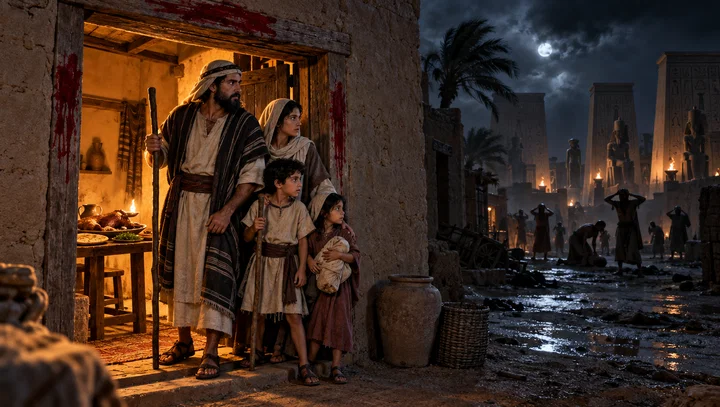
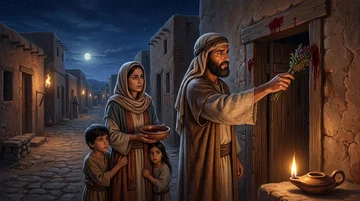
And the blood shall be to you for a token upon the houses where ye are: and when I see the blood, I will pass over you, and the plague shall not be upon you to destroy you, when I smite the land of Egypt.
Translations
And the blood shall be to you for a token on the houses where you are: and when I see the blood, I will pass over you, and the plague shall not be on you to destroy you, when I smite the land of Egypt.
King James Version, Webster Bible
And the blood shall be to you for a token upon the houses where ye are: and when I see the blood, I will pass over you, and the plague shall not be upon you to destroy you, when I smite the land of Egypt.
And the blood shall be to you for a token upon the houses where you are: and when I see the blood, I will pass over you, and the plague shall not be upon you to destroy you, when I smite the land of Egypt.
Revised Version, American Standard Version
And the blood shall be to you for a token upon the houses where ye are: and when I see the blood, I will pass over you, and there shall no plague be upon you to destroy you, when I smite the land of Egypt.
'And the blood hath become a sign for you on the houses where ye [are], and I have seen the blood, and have passed over you, and a plague is not on you for destruction in My smiting in the land of Egypt.
And the blood shall be for you as a sign on the houses in which ye are; and when I see the blood, I will pass over you; and the plague shall not be among you for destruction, when I smite the land of Egypt.
Then shall the blood serve you for a sign, on the houses wherein ye are, then will I behold the blood, and will pass over you,—and there shall be among you no plague to destroy, when I smite the land of Egypt.
The blood on the houses where you are staying will distinguish them; when I see the blood, I will pass over you. No plague will fall on you to destroy you when I strike the land of Egypt.
The blood on the houses where you are staying will be a sign; when I see the blood, I will pass over you. No plague will fall on you to destroy you when I strike the land of Egypt.
The blood shall be to you for a token on the houses where you are. When I see the blood, I will pass over you, and no plague will be on you to destroy you when I strike the land of Egypt.
And the blood will be a sign on the houses where you are: when I see the blood I will go over you, and no evil will come on you for your destruction, when my hand is on the land of Egypt.
And the blood shalbe a token for you vpon the houses where ye are: so when I see the blood, I will passe ouer you, and the plague shall not be vpon you to destruction, when I smite the lande of Egypt.
Douay-Rheims (Challoner revision)
And the blood shall be unto you for a sign in the houses where you shall be: and I shall see the blood, and shall pass over you: and the plague shall not be upon you to destroy you, when I shall strike the land of Egypt.
Pictures
Cross-references 20 of 92
- 1 Corinthians 5:7
Purge out therefore the old leaven, that ye may be a new lump, as ye are unleavened. For even Christ our passover is sacrificed for us:
Christ is the Passover sacrifice whose blood saves from judgment.
- John 1:29
The next day John seeth Jesus coming unto him, and saith, Behold the Lamb of God, which taketh away the sin of the world.
Jesus is the Lamb of God represented by the Passover lamb.
- Exodus 12:7
And they shall take of the blood, and strike it on the two side posts and on the upper door post of the houses, wherein they shall eat it.
The blood was placed on the doorposts and lintel as the sign of protection.
- Exodus 12:29-30
And it came to pass, that at midnight the LORD smote all the firstborn in the land of Egypt, from the firstborn of Pharaoh that sat on his throne unto the firstborn of the captive that was in the dungeon; and all the firstborn of cattle.
The plague strikes Egypt’s firstborn while Israel is spared by the Passover.
- Exodus 12:22-23
And ye shall take a bunch of hyssop, and dip it in the blood that is in the bason, and strike the lintel and the two side posts with the blood that is in the bason; and none of you shall go out at the door of his house until the morning.
Blood applied with hyssop marked the houses, keeping the destroyer from entering.
- 1 John 1:7
But if we walk in the light, as he is in the light, we have fellowship one with another, and the blood of Jesus Christ his Son cleanseth us from all sin.
Passover blood points to Christ’s blood cleansing from all sin.
- Matthew 26:26-28
And as they were eating, Jesus took bread, and blessed it, and brake it, and gave it to the disciples, and said, Take, eat; this is my body.
Jesus connects the Passover meal with the Lord’s Supper and identifies the cup as his blood.
- Ezekiel 9:4-6
And the LORD said unto him, Go through the midst of the city, through the midst of Jerusalem, and set a mark upon the foreheads of the men that sigh and that cry for all the abominations that be done in the midst thereof.
A protective mark distinguishes the faithful who are spared from destruction.
- Hebrews 11:28
Through faith he kept the passover, and the sprinkling of blood, lest he that destroyed the firstborn should touch them.
Faith was shown by keeping the Passover and applying the blood for protection.
- 1 Peter 1:19
But with the precious blood of Christ, as of a lamb without blemish and without spot:
Christ’s precious, spotless blood redeems, fulfilling the Passover lamb’s protective blood.
- Romans 5:9
Much more then, being now justified by his blood, we shall be saved from wrath through him.
Christ’s blood justifies and saves believers from God’s wrath.
- Luke 22:19-20
And he took bread, and gave thanks, and brake it, and gave unto them, saying, This is my body which is given for you: this do in remembrance of me.
Jesus connects the Passover meal with bread and the cup representing his body and blood.
- John 6:53-54
Then Jesus said unto them, Verily, verily, I say unto you, Except ye eat the flesh of the Son of man, and drink his blood, ye have no life in you.
Christ’s blood is linked to life and resurrection, recalling the blood that preserved Israel from destruction.
- John 6:51
I am the living bread which came down from heaven: if any man eat of this bread, he shall live for ever: and the bread that I will give is my flesh, which I will give for the life of the world.
The Passover lamb and Christ’s flesh given for the world point to his life-giving sacrifice.
- Exodus 12:23
For the LORD will pass through to smite the Egyptians; and when he seeth the blood upon the lintel, and on the two side posts, the LORD will pass over the door, and will not suffer the destroyer to come in unto your houses to smite you.
The Lord passes over blood-marked houses and keeps the destroyer from entering.
- Exodus 12:26-27
And it shall come to pass, when your children shall say unto you, What mean ye by this service?
The Passover service recalls Israel’s deliverance from Egypt for their children.
- Deuteronomy 16:1-6
Observe the month of Abib, and keep the passover unto the LORD thy God: for in the month of Abib the LORD thy God brought thee forth out of Egypt by night.
Gives instructions for observing Passover, including sacrificing it at sunset.
- Exodus 12:8
And they shall eat the flesh in that night, roast with fire, and unleavened bread; and with bitter herbs they shall eat it.
The lamb was eaten roasted with bitter herbs during the Passover meal.
- Exodus 12:5-6
Your lamb shall be without blemish, a male of the first year: ye shall take it out from the sheep, or from the goats:
The unblemished yearling lamb is kept and slain for the Passover blood.
- Hebrews 9:22
And almost all things are by the law purged with blood; and without shedding of blood is no remission.
Remission comes through the shedding of blood.
Commentary part 1 of 2
Each commentary is drawn from primary sources: the writings of Ellen G. White and Adventist pioneers and periodicals. Each commentary is separate. Its own words are not a quotation; follow the references to read the source passages.
Ellen G. White
76 sources
On the night of the last and most terrible plague, Israel was to slay a lamb without blemish, strike its blood on the doorposts and lintel, remain inside with the family and eat in haste, and where God saw the blood He passed over that house and its firstborn were spared from the destroying angel at midnight.1SP 199.1–200.1PP 274.1–2SG3 222.2DA 76.1SG3 244.2 Safety depended wholly on that token in exact obedience, for without the blood on the door even Hebrews were not distinguished from Egyptians, and to neglect the striking, to leave the house, or to trust sincerity without heeding all directions left the dwelling unguarded.Ms 24, 1888, par. 41–4412MR 193.3–194.1HSFM 216.4–217.215MR 224.3–225.2Ms 5, 1854, par. 2–3 The slain lamb and its blood foreshadow the sinless Lamb of God, whose atoning blood shed for the sins of the world alone cleanses the believer and shelters from the wrath of a sin-hating God upon the impenitent.Ms 71, 1901, par. 4–51RED 30.13SP 128.14RED 94.25RED 48.1 Sinners are therefore saved only through faith in Christ and His righteousness, not by knowledge, status, or works, yet that faith must be shown by turning from sin to obedience and cooperating with all that God provides.Ms 71, 1901, par. 4–5Lt 52, 1906, par. 11–19Ms 24, 1888, par. 41–4412MR 193.3–194.1PP 278.2–279.1 God Himself pledges that His destroying wrath will not fall on one soul that seeks refuge under that blood, which is the seal of the living God and the sign of the cross seen in His obedient sons and daughters, and which will again mark and protect His people through final judgment and the perilous times just ahead.STA 18.1–19.1Lt 52, 1906, par. 11–19WLF 3.11–13Ms 77, 1902, par. 34–35Lt 126, 1898, par. 3–5
Passover Night in Egypt
Before the judgment God gave directions through Moses for Israel's preservation from the coming stroke upon Egypt.1SP 199.1–200.1PP 274.1–2SG3 222.2 Each household was to slay a lamb without blemish, take its blood and strike it upon the doorposts and upon the upper doorpost as a token without for a sign upon the houses where they were.PP 274.1–2SG3 222.2Ms 59, 1895, par. 40–44 While that token was without they were to remain within, gathered with their families inside their own houses and none going out, eating the lamb roasted whole with bitter herbs and unleavened bread, girded and in haste and prepared to leave.1SP 199.1–200.1SG3 222.2DA 76.1Ms 59, 1895, par. 40–44 The blood was to be the sign God would respect, showing faith in His promised deliverance and distinguishing those inside when He smote the land.1SP 199.1–200.1COS 103.1–4Ms 59, 1895, par. 40–44
At midnight the angel of God passed through the land doing dreadful work, slaying the firstborn of man and the firstborn of beast.SG3 222.2DA 76.1DA 51.2–3 Where God saw the blood upon the house He passed over those inside, the destroying angel did not enter that dwelling, and the plague to destroy was not upon them.PP 274.1–2SG3 222.2COS 103.1–4DA 76.1 Every house had to be marked, for houses without the token lost their firstborn, and the sheltered ate the Passover supper under the token.DA 51.2–3PP 275 The blood sprinkled upon the doorway thus divided the spared from the smitten on that night.PP 274.1–2SG3 246.1PP 275
This was the last plague upon Egypt, more severe and closer and more dreadful than any plague before it.SG3 244.21SP 217.2SG3 246.11SP 219.1 That night was terrible to the Egyptians and glorious to the people of God.SG3 244.21SP 217.2 Moses made known beforehand to Pharaoh, to the people of Egypt, and to the Israelites the nature and effect of that last plague.SG3 244.21SP 217.2 The king and his idolatrous priests opposed to the last the request to let the Hebrews go, while the Egyptian people desired that they be permitted to leave.SG3 244.21SP 217.2
Israel made great preparations, but the Egyptians saw them and ridiculed the token of blood.SG3 246.11SP 219.1 When God smote the land the firstborn were slain from the king upon his throne down to the lowliest servant, and there was wailing throughout all Egypt.SG3 246.11SP 219.1 Then Pharaoh remembered his proud boast that he did not know the Lord and would not let Israel go.SG3 246.11SP 219.1 Humbled, he went in haste with his counselors and rulers to Goshen and bowed before Moses and Aaron, bade them go and serve their God with their flocks and herds as requested, implored them to leave quickly and be gone for fear all would be as dead men, and entreated a blessing from the servant of God thinking it would protect him from further effects of the plague.SG3 246.11SP 219.1
That last night of bondage, when there had appeared no token of deliverance, became the birth of the Hebrew nation, released immediately to go out from Egypt as an independent nation and march out of the land of bondage.ED 42.2DA 76.1ST Nov 2, 1915 The deliverance was instituted as a solemn ordinance to be kept yearly as the Lord's passover, a lasting memorial of preservation.1SP 199.1–200.1DA 76.1LC1 29.2–30.1 Its paschal service solemnly rehearsed the sprinkled blood, the death-dealing angel, the night assembly with girded loins and shoes on feet and staff in hand, and the hasty meal of lamb with unleavened bread and bitter herbs.ED 42.2DA 76.1ST Nov 2, 1915 Parents were to tell children from generation to generation that it was the sacrifice of the Lord's passover who passed over Israel's houses when He smote the Egyptians, calling minds away from world-loving interests and temporal cares and anxieties to review His miracles, mercies and loving-kindness, to increase love and reverence and trust in trial, and to impress the heart and fix the deliverance forever in the memory of child and youth.DA 76.1LC1 29.2–30.1ST Oct 4, 1877ST Nov 2, 1915
Protection Through Obedient Faith
The blood was a token upon the houses where they were, by which God distinguished His people and protected them in judgment, and when He saw it He passed over that dwelling and spared it from the destroying plague.1SP 199.1–200.1PP 274.1–215MR 224.3–225.2Ms 5, 1889, par. 14–16Lt 16e, 1892, par. 38–40 The lamb's blood on lintels and doorposts marked the homes as connected with God and trusting in Him, so the destroying angel coming at midnight did not enter but passed over and spared the firstborn inside.PP 274.1–2Ms 5, 1889, par. 14–16Lt 16e, 1892, par. 38–40 The token belonged with obedience and faith in the promised deliverance, for the sign was to be respected together with gathering the family inside their own houses, and blood alone did not spare those who disregarded the directions.1SP 199.1–200.115MR 224.3–225.2 The Passover so kept was to be a lasting memorial of preservation.1SP 199.1–200.1
Israel was safe only when the blood was on the doorposts, and every other means of safety would fail to keep the angel of death from entering.Ms 24, 1888, par. 41–4412MR 193.3–194.1 Without that sign even Hebrews were not distinguished from Egyptians when the destroyer struck.Ms 5, 1854, par. 2–3 The blood at the houses points to salvation through the blood of Jesus alone, who bears sin and cleanses from it and gives His righteousness, so that sinners are saved by faith in Christ and not by knowledge, status, or human achievement.Ms 24, 1888, par. 41–4412MR 193.3–194.1
The token required exact obedience: to place the blood upon the house, to separate families from the Egyptians, to bring the children into the house, to strike the doorpost with blood, and for none to go out of the house.1SP 199.1–200.1HSFM 216.4–217.2ST Sep 9, 1875Ms 59, 1895, par. 40–44 All found among the Egyptians would be destroyed with them, and without gathering inside and marking the doorway even Hebrew firstborn would not be spared.HSFM 216.4–217.2ST Sep 9, 1875Ms 59, 1895, par. 40–44 To slay the lamb without striking the doorpost, to fail to separate the children, or to go out left them unsecure with no exemption above the Egyptians.RH Sep 19, 1854ST Sep 9, 1875PP 278.2–279.1 Neglect of the blood on the plea that God could distinguish Hebrews from Egyptians would have left that dwelling unguarded.HSFM 216.4–217.2
God tests faith by giving a part to act in connection with His interposition, fulfilling His promises to those who comply with all the conditions and leaving those who depart from His instructions to follow a way of their own choosing to perish with the wicked when judgments visit the earth.HSFM 216.4–217.2Ms 3, 1885, par. 8–9 Deliverance by blood requires evidence of faith by obedience, and honest belief and sincerity without heeding all the Lord's directions would not save the firstborn from the destroyer.HSFM 216.4–217.2PP 278.2–279.1 People must not substitute their own judgment for God's commands or assume He will protect them while they disregard His instructions.Ms 3, 1885, par. 8–9
No one is benefited by this provision of God for salvation unless he performs the work God leaves him to do and by his own acts manifests faith in the provision made.1RED 30.1LC1 29.2–30.1ST Dec 9, 1880ST Oct 4, 1877 The slain lamb points to the future death of the Son of God, and the blood marking the doorposts stands for the blood of Christ, which cleanses the believing sinner from sin and shelters him from the wrath of God coming upon the impenitent and unbelieving world, just as the wrath of God fell upon the Egyptians while Israel was passed over.1RED 30.1LC1 29.2–30.1ST Oct 4, 1877
Blood Foreshadowing Christ
The slain Passover lamb points to the future death of the Son of God, and the blood marking the doorposts stands for the blood of Christ.1RED 30.14RED 94.22SP 36.1LC1 29.2–30.14RED 91.1–2 The blood God commanded upon the doorposts was a sign of safety that protected Israel when the firstborn of their enemies were slain, and it represented the blood of Christ to be shed for the sins of the world.4RED 94.22SP 36.14RED 91.1–2 The lamb to be eaten at the feast pointed forward to Christ's approaching death as the only true propitiation for humanity, while the Jews were about to celebrate with great display even as the very One the lamb represented stood among them presenting Himself as Saviour and they refused His mercy.4RED 94.2LC1 29.2–30.1
The innocent lamb without blemish prefigured the sinless Lamb of God, whose merits alone avert judgment and condemnation from fallen humanity.3SP 128.15RED 48.1ST Jul 4, 1878 Its body eaten at the feast was a symbol of Christ's body given for the life of the world, pointing to eating Christ's flesh and drinking His blood by faith.4RED 94.2ST Mar 15, 1877DA 388.2–389.2 Those who by faith so eat His flesh and drink His blood receive Him who gave Himself for the life of the world and gain a well-founded hope of resurrection to immortal life in the kingdom of God.ST Mar 15, 1877DA 82.3–4DA 388.2–389.2 Yet many made the symbol all-important while its significance went unnoticed, discerning not the Lord's body.DA 388.2–389.2
The blood signifies Christ's atoning blood, teaching that without shedding of blood there is no remission of sins.Ms 71, 1901, par. 4–5SG3 225.11SP 201.1 It cleanses the believing sinner from all sin and alone has power to save the world through His complete sacrifice as the Lamb slain from the foundation of the world, whose crucified and risen blood is the sinner's only hope received by faith in the Redeemer's merits.Ms 71, 1901, par. 4–51RED 30.12SP 36.1ST Dec 9, 1880 As God's wrath fell upon the Egyptians while Israel was passed over, so that blood shelters believers from the wrath of a sin-hating God coming upon the impenitent and unbelieving world.1RED 30.14RED 94.22SP 36.1LC1 29.2–30.1ST Dec 9, 1880 As the lamb's blood shielded Israel, the merits of the sinless Lamb alone avert judgment and condemnation.3SP 128.15RED 48.1ST Jul 4, 1878
The sprinkled blood teaches continual dependence of sinful man upon the merits of that blood for safety from Satan's power and for final redemption.SG3 225.11SP 201.1 The blood means faith in the blood of Christ, and faith in it will bring God's followers safely through the perilous times just ahead as the conflict between Christ and Satan increases in intensity to the end of earth's history.SG3 225.11SP 201.1Ms 77, 1902, par. 34–35 The Passover and its ceremonies cannot be fully explained apart from Christ, for He is the key that unlocks the Old Testament and gives access to its treasures, and all services are valueless if the Saviour represented in them is rejected.3SP 388.1–2SLP 82.1–2ST Jul 17, 1879 There is virtue in the symbolic service only as it directs worshipers to Christ as personal Saviour, for people are saved through Christ only as by faith they make His life their own, and God means the service to lead to prayerful study and meditation on His mission and to show in deliverance from Egypt a promise of deliverance from sin.DA 82.3–4DA 388.2–389.2
Salvation Through Christ Alone
Sinners are saved only through the blood of Jesus Christ, who bears sin and cleanses from it, and salvation depends on faith in Christ and His righteousness, not on knowledge, status, or human achievement.Ms 71, 1901, par. 4–5Ms 24, 1888, par. 41–4412MR 193.3–194.1 Without shedding of blood there is no remission of sins, and the slain lamb points to Christ as the Lamb slain from the foundation of the world, whose crucified and risen blood cleansing from all sin is the sinner's only hope, with salvation gained only through the merits of the Redeemer received by faith.Ms 71, 1901, par. 4–5 Every other means of safety would fail, for Israel was protected from death in Egypt only by the blood placed on the doorposts, and when God saw it the plague passed over them.Ms 24, 1888, par. 41–4412MR 193.3–194.1
Redemption from the penalty of transgression is by Christ only, and man is saved by faith not by works, yet faith must be shown by works.PP 278.2–279.1 Deliverance by blood requires evidence of faith by obedience, so all who hope to be saved by the merits of the blood of Christ have something to do in securing salvation, turning from sin to obedience, cooperating with saving agencies, appreciating and using the helps God has provided, and believing and obeying all divine requirements.PP 278.2–279.1 God gave His Son to die as a propitiation for sin and manifested the light of truth, the way of life, facilities, ordinances, and privileges to be used.PP 278.2–279.1
The blood is the token of blood-bought rights Christ purchased for the redeemed, with all hopes of eternal life centered in Him as the Lamb of God who alone takes away sins and spiritual uncomeliness.Ms 71, 1901, par. 4–5Lt 52, 1906, par. 11–19 It testifies that the sinner has accepted Christ as personal Saviour, and there is no guarantee of safety in this life or the future life unless the angel of God's ministration sees the blood of the covenant on the threshold.Ms 71, 1901, par. 4–5Ms 74, 1900, par. 20 Christ pleads this blood with divine eloquence for His church on earth before the Father, claiming exemption for His people from the deluge of divine wrath.Lt 52, 1906, par. 11–19
The blood is Christ's precious life given with infinite love, now seen by faith as the Lamb that was slain risen and at the right hand of God making intercession before the Father for the church on earth.STA 18.1–19.1STOM 14.1–15.1STBk 18.1–19.1 Though innocent, He was pronounced guilty as the Father let His wrath fall upon Him, and His complete sacrifice enables God to pass over the repentant sinner.STBk 18.1–19.1Ms 72, 1897, par. 8 God Himself pledges that His wrath will not fall to destroy one soul that seeks refuge in Him when He sees the blood.STA 18.1–19.1Ms 19, 1890, par. 34Lt 52, 1906, par. 11–19STOM 14.1–15.1STBk 18.1–19.1
To every humble, contrite, believing soul the rainbow of promise round about the throne, with the cloud of confessed sins behind it, is assurance that his life is one with Christ and Christ is one with God.STA 18.1–19.1Lt 52, 1906, par. 11–19STOM 14.1–15.1STBk 18.1–19.1 With the cloud of their sins behind it they see about the throne the rainbow reflecting its glory and giving evidence to unbelievers.Lt 52, 1906, par. 11–19 This calls for earnest prayer in Christ's name for the heavenly unction to prepare the way of the Lord, and for cultivating Christ's infinite love by loving one another as He has loved.STOM 14.1–15.1
Those who by faith receive Christ and spiritually eat His flesh and drink His blood have a well-founded hope of resurrection to immortal life in the kingdom of God and will finally be raised from the dead.ST Mar 15, 18772SP 278.1–279.1 The blood on the doorposts was a sign of safety that protected them when the firstborn in Egypt were slain, while the lamb whose flesh was eaten represented the Lamb of God and the blood represented Christ's blood shed for the sins of the world.ST Mar 15, 18772SP 278.1–279.1
The token is the seal of the living God placed in the foreheads of His people, a mark angels but not human eyes can read which the destroying angel must see.Lt 126, 1898, par. 3–5 It is the sign of the cross of Calvary seen in God's adopted sons and daughters, meaning the sin of transgression of the law of God is taken away.Lt 126, 1898, par. 3–5 Those who have it have on the wedding garment and are obedient and faithful to all God's commands.Lt 126, 1898, par. 3–5
Memorial Fulfilled in Christ
The Passover looked both backward and forward, backward commemorating the deliverance of Israel from Egypt and forward as typical pointing to Christ the Lamb of God slain for the redemption of fallen man.SG3 225.1 The blood sprinkled upon the doorposts prefigured the atoning blood of Christ and taught continual dependence of sinful man upon the merits of that blood for safety from Satan's power and for final redemption.SG3 225.1 It was both commemorative and typical, and the type reached the antitype when Christ the Lamb without blemish died upon the cross.SG3 225.1
The paschal service was given to call God's people away from worldly cares and world-loving interests and temporal cares and anxieties, to remind them of His wonderful work in delivering them from Egypt.LC1 29.2–30.1ST Oct 4, 1877DA 82.3–4 It turned minds to review His miracles, mercies and loving-kindness, increasing love and reverence for Him and leading them to look to Him and trust Him in trial and not turn to other gods.LC1 29.2–30.1ST Oct 4, 1877 In that deliverance from Egypt was shown a promise of deliverance from sin.DA 82.3–4 As the blood of the slain lamb sheltered the homes of Israel, so the blood of Christ saves souls, but there is virtue in the symbolic service only as it directs worshipers to Christ as personal Saviour, and only as by faith they make His life their own does God mean it to lead them to prayerful study and meditation on His mission.DA 82.3–4
The Passover was instituted by Christ Himself before His incarnation, and He was the foundation of the whole Jewish economy.Ms 104, 1897, par. 8–919MR 163.2–3 Its rites as seen at Jerusalem when He was twelve years old were bound up with His own life and with the work He would accomplish for the children of Abraham, Isaac and Jacob, the appointed heirs of the covenant promises.IRCUP 10.1 The type reached the antitype when Christ the Lamb of God without blemish died upon the cross.SG3 225.1 Jesus is the antitypical Lamb the feast kept for centuries prophesied, slain by wicked hands while the people were still observing the Passover and presenting their morning and evening sacrifices in the temple and while His body lay in Joseph's tomb over the Sabbath.ST Aug 8, 1878 His death in the midst of the feast fulfilled prophecy and gave the feast its full meaning, proving the crucified one is the world's Redeemer, a truth convicting all who searched the prophecies about the feast, whether they sought to understand it, to disprove Jesus, or to find hope in Him.ST Aug 8, 1878
At His trial type met antitype, for Christ in humanity, His divinity clothed with humanity, the foundation of the Jewish system, stood in the midst of the priests while they kept the outward Passover ceremony.Ms 104, 1897, par. 8–919MR 163.2–3 They were exact about not entering the judgment hall lest they be defiled so they might eat the Passover, yet in blindness under satanic deception they rejected and condemned the true Passover Himself even as they sought His death.ST Jan 24, 1900Ms 104, 1897, par. 8–919MR 163.2–3 That joining links the blood in Egypt to death on a cross on a hill.PP 273 Christ identified Himself as the Passover's great antitype and fulfillment when He connected the Lord's Supper with the Passover.3SP 128.1ST Jul 4, 1878
Christ ate the Passover supper with His disciples just before His crucifixion and the same night instituted the ordinance of the Lord's Supper to be observed in commemoration of His death, leaving an ordinance to commemorate the events of His crucifixion.SG3 225.1
Future Judgment and Sealing
The marking of the side posts and upper door posts before the slaying of the firstborn foreshadows the marking or sealing of the saints before the seven last plagues.WLF 3.11–13 Israel was safe in that perilous night because God was their protector, and the true Israel will be safely protected when Christ rules the nations with a rod of iron and dashes them in pieces like a potter's vessel, because He has promised to give His angels charge over them to keep them in all their ways.WLF 3.11–13 Those who keep the word of Christ's patience in the time of waiting and trial will be kept from the hour of temptation or trial that shall come upon all the world to try them that dwell on the earth.WLF 3.11–13 The destroying angel is again to pass through the land to slay utterly old and young, men, women and little children who lack the mark.HSFM 216.4–217.2ST Sep 9, 1875Ms 5, 1854, par. 2–35MR 205.4–206.2 Without that sign Israelites were not distinguished from Egyptians, and without that obedience Israel had no exemption above the Egyptians, for all found among the Egyptians would be destroyed with them.HSFM 216.4–217.2ST Sep 9, 1875Ms 5, 1854, par. 2–3
The judgment will reveal the character formed in family life and shown in relations with neighbors and the world.Ms 116, 1894, par. 14 The blood on the doors was a signature of blood declaring the Israelites were God's property, a mark placed over the Hebrew dwellings to preserve the people from general ruin.Ms 39, 1899, par. 15–16 In the same way every child of God in this age bears the signature God has appointed by placing himself in harmony with God's holy law.Ms 39, 1899, par. 15–16RH Feb 6, 1900 That mark placed upon every one of God's people to preserve them from ruin is God's Sabbaths as the sign that He sanctifies them.HSFM 216.4–217.2Ms 3, 1885, par. 8–9Ms 39, 1899, par. 15–16
In the day of final destruction God will pass over those who keep the Sabbath of the fourth commandment, so the destruction falling on the world will not fall on them, just as He passed over the blood-marked houses when He smote Egypt.Ms 7, 1886, par. 13–1410MR 94.1 The blood was a sign by which God distinguished and protected His people from destruction, and the Sabbath is likewise a sign between God and His people.Ms 7, 1886, par. 13–14RH Feb 6, 1900 Parents who allow children to receive education with the world and make the Sabbath a common day prevent the seal of God from being placed upon them so they will be destroyed with the world with blood resting upon the parents.HSFM 216.4–217.2Ms 3, 1885, par. 8–9 Faithfully teaching God's commandments, bringing children into subjection to parental authority, committing them to God by faith and prayer, and not substituting human judgment for God's commands brings God's working with parental effort so that parents and children may be hidden in the secret of the Lord's pavilion when the overflowing scourge passes through the land.HSFM 216.4–217.2ST Sep 9, 1875Ms 5, 1854, par. 2–3Ms 3, 1885, par. 8–95MR 205.4–206.2
Guarding Family and Home
Before the slaying of the firstborn, God commanded His people to gather their children into their own houses and to abide within that protection under the blood marked on the lintel and side posts, so that when the destroying angel went through Egypt he would recognize the marked dwellings as the homes of His followers and pass over them and not destroy them.MH 403.3Lt 47, 1905, par. 1–8Ms 77, 1902, par. 34–35 The blood on the doorposts was the token assuring protection, a witness that they were God's denominated people, and houses thus marked were not visited with the plague of death.ST Nov 24, 1914MH 403.3Lt 47, 1905, par. 1–8 Given at the birth of Israel as a nation, this command was an object-lesson to impress all hearts with the importance of guarding the associations of children, with all civil, religious and social arrangements made to preserve them from harmful companionship and to make them familiar from their earliest years with the precepts and principles of the law of God.MH 403.3Ms 28, 1895, par. 10–11 The same duty continues today, for mothers and fathers are not to leave this work to God or angels but must protect their children from influences that turn them from God and heaven.Lt 12, 1886, par. 2–3Ms 28, 1895, par. 10–11
Parents must bring their children out from the influence of the world and educate them in right lines.ST Sep 9, 1875Lt 47, 1905, par. 1–8 This means separating them from the world and wicked company, choosing their society, teaching obedience to parents as preparation for obedience to God's commandments, praying with and for them to Christ who receives little children, and training them in the nurture and admonition of the Lord.ST Sep 9, 1875MH 403.3 Without such obedience Israel had no exemption above the Egyptians, and the same protection will be needed again when the destroying angel goes forth to slay utterly old and young, men, women and little children who lack the mark.ST Sep 9, 18755MR 205.4–206.2
Parents who love and fear God should keep their children under the bond of the covenant, within the protection of those sacred influences made possible through Christ's redeeming blood.ST Nov 24, 1914MH 403.3 Christians in days of deception are to apply this lesson by gathering their families under the Lamb's protection, for the judgment will reveal the character formed in family life and shown in relations with neighbors and the world.Ms 116, 1894, par. 14Ms 77, 1902, par. 34–35 Faith in the blood of Christ will bring them safely through the perilous times just ahead as the conflict between Christ and Satan increases in intensity until the end of this earth's history.Ms 116, 1894, par. 14Ms 77, 1902, par. 34–35
The blood on the houses was a sign that the household accepted the promised Redeemer and trusted in God, for the lamb's blood prefigured Christ's blood whose saving power shields from destruction.2MR 147.2–148.1Ms 26, 1885, par. 28–34Lt 16e, 1892, par. 38–40 The Israelites' obedience showed their faith, and that obedient faith of the parents covered the parents and their children, as the destroyer passed over every marked house.2MR 147.2–148.1Ms 26, 1885, par. 28–34 So the seal or mark of believing parents will cover children who are properly taught and brought up, illustrating that a believing parent's faith extends to the children.Ms 26, 1885, par. 28–345MR 205.4–206.2 The blood for a token upon the houses is the blood of Jesus Christ as a safeguard, to be marked on the doorposts of every family, meaning faith in the Father's only-begotten Son through whom believers receive everlasting life.Ms 7, 1908, par. 7Ms 3, 1884, par. 8Lt 16e, 1892, par. 38–40 This calls for model homes where parents and children live lives of consecration and obedience under that blood, by which children are separated from the world, and such homes produce a perfect model church; the Christian work is likened to placing this mark of blood on the home and gathering the children there.Ms 7, 1908, par. 7Lt 16e, 1892, par. 38–40
Sources