Genesis 47:9
And Jacob said unto Pharaoh, The days of the years of my pilgrimage are an hundred and thirty years: few and evil have the days of the years of my life been, and have not attained unto the days of the years of the life of my fathers in the days of their pilgrimage.
Translations
And Jacob said to Pharaoh, The days of the years of my pilgrimage are an hundred and thirty years: few and evil have the days of the years of my life been, and have not attained to the days of the years of the life of my fathers in the days of their pilgrimage.
King James Version, KJV Cambridge Paragraph Bible
And Jacob said unto Pharaoh, The days of the years of my pilgrimage are an hundred and thirty years: few and evil have the days of the years of my life been, and have not attained unto the days of the years of the life of my fathers in the days of their pilgrimage.
And Jacob said to Pharaoh, The days of the years of my pilgrimage are a hundred and thirty years: few and evil have been the days of the years of my life, nor have they attained to the days of the years of the life of my fathers in the days of their pilgrimage.
And Jacob said unto Pharaoh, The days of the years of my pilgrimage are an hundred and thirty years: few and evil have been the days of the years of my life, and they have not attained unto the days of the years of the life of my fathers in the days of their pilgrimage.
And Jacob said unto Pharaoh, The days of the years of my pilgrimage are a hundred and thirty years: few and evil have been the days of the years of my life, and they have not attained unto the days of the years of the life of my fathers in the days of their pilgrimage.
And Jacob saith unto Pharaoh, 'The days of the years of my sojournings [are] an hundred and thirty years; few and evil have been the days of the years of my life, and they have not reached the days of the years of the life of my fathers, in the days of their sojournings.'
And Jacob said to Pharaoh, The days of the years of my sojourning are a hundred and thirty years. Few and evil have been the days of the years of my life, and they do not attain to the days of the years of the life of my fathers, in the days of their sojourning.
And Jacob said unto Pharaoh, The days of the years of my sojournings, have been a hundred and thirty years,—Few and evil, have been the days of the years of my life, neither have they attained unto the days of the years of the lives of my fathers, in the days of their sojournings.
Berean Standard Bible, Majority Standard Bible
“ My travels have lasted 130 years,” Jacob replied. “ My years have been few and hard, and they have not matched the years of the travels of my fathers.”
Jacob said to Pharaoh, “ The years of my pilgrimage are one hundred thirty years. The days of the years of my life have been few and evil. They have not attained to the days of the years of the life of my fathers in the days of their pilgrimage.”
And Jacob said, The years of my wanderings have been a hundred and thirty; small in number and full of sorrow have been the years of my life, and less than the years of the wanderings of my fathers.
And Iaakob sayd vnto Pharaoh, The whole time of my pilgrimage is an hundreth and thirty yeeres: fewe and euill haue the dayes of my life bene, and I haue not attayned vnto the yeeres of the life of my fathers, in the dayes of their pilgrimages.
Douay-Rheims (Challoner revision)
He answered: The days of my pilgrimage are a hundred and thirty years, few, and evil, and they are not come up to the days of the pilgrimage of my fathers.
Pictures
Cross-references 20 of 22
- Hebrews 11:9
By faith he sojourned in the land of promise, as in a strange country, dwelling in tabernacles with Isaac and Jacob, the heirs with him of the same promise:
Both describe the patriarchs’ life in Canaan as a sojourn.
- Genesis 25:26
And after that came his brother out, and his hand took hold on Esau’s heel; and his name was called Jacob: and Isaac was threescore years old when she bare them.
Jacob was born when Isaac was sixty and was 130 when he spoke to Pharaoh.
- Genesis 47:28
And Jacob lived in the land of Egypt seventeen years: so the whole age of Jacob was an hundred forty and seven years.
Records Jacob’s total lifespan and his seventeen years in Egypt.
- Hebrews 11:13
These all died in faith, not having received the promises, but having seen them afar off, and were persuaded of them, and embraced them, and confessed that they were strangers and pilgrims on the earth.
Jacob describes his life as a pilgrimage, like those who confessed they were strangers on earth.
- Genesis 15:13-14
And he said unto Abram, Know of a surety that thy seed shall be a stranger in a land that is not theirs, and shall serve them; and they shall afflict them four hundred years;
Foretells the descendants’ sojourn and affliction in a foreign land.
- Exodus 12:40
Now the sojourning of the children of Israel, who dwelt in Egypt, was four hundred and thirty years.
Jacob's 130 years helps make up the 430-year sojourn in Egypt.
- Genesis 12:4
So Abram departed, as the LORD had spoken unto him; and Lot went with him: and Abram was seventy and five years old when he departed out of Haran.
Marks Abraham’s departure, beginning the chronology leading to Jacob’s 130 years.
- Genesis 25:7
And these are the days of the years of Abraham’s life which he lived, an hundred threescore and fifteen years.
Abraham’s lifespan is compared with Jacob’s.
- Genesis 35:28-29
And the days of Isaac were an hundred and fourscore years.
Jacob contrasts his lifespan with his fathers’ longer lives; Isaac died old and full of days.
- Psalms 90:10
The days of our years are threescore years and ten; and if by reason of strength they be fourscore years, yet is their strength labour and sorrow; for it is soon cut off, and we fly away.
seventy years as allotted life, further strength as borrowed
- 1 Chronicles 29:15
For we are strangers before thee, and sojourners, as were all our fathers: our days on the earth are as a shadow, and there is none abiding.
Jacob and David describe human life as a pilgrimage of strangers and sojourners.
- Genesis 49:33
And when Jacob had made an end of commanding his sons, he gathered up his feet into the bed, and yielded up the ghost, and was gathered unto his people.
Dates Jacob's death seventeen years after his entry into Egypt.
- 1 Peter 2:11
Dearly beloved, I beseech you as strangers and pilgrims, abstain from fleshly lusts, which war against the soul;
Both describe life as a pilgrimage among strangers.
- Genesis 23:4
I am a stranger and a sojourner with you: give me a possession of a buryingplace with you, that I may bury my dead out of my sight.
Both describe the patriarchs’ lives as a pilgrimage among others.
- Exodus 1:8-14
Now there arose up a new king over Egypt, which knew not Joseph.
Jacob’s welcome in Egypt is followed by affliction and harsh bondage.
- 1 Peter 1:17
And if ye call on the Father, who without respect of persons judgeth according to every man’s work, pass the time of your sojourning here in fear:
Both describe life on earth as a sojourn.
- Joshua 24:4
And I gave unto Isaac Jacob and Esau: and I gave unto Esau mount Seir, to possess it; but Jacob and his children went down into Egypt.
Recalls God giving Canaan to Jacob and his descendants.
- Leviticus 25:23
The land shall not be sold for ever: for the land is mine; for ye are strangers and sojourners with me.
God calls Israel strangers and sojourners with him.
- Luke 20:37
Now that the dead are raised, even Moses shewed at the bush, when he calleth the Lord the God of Abraham, and the God of Isaac, and the God of Jacob.
Connects God’s relation to Jacob with the raising of the dead.
- Genesis 49:29
And he charged them, and said unto them, I am to be gathered unto my people: bury me with my fathers in the cave that is in the field of Ephron the Hittite,
shows Jacob died still without possession
Commentary
Each commentary is drawn from primary sources: the writings of Ellen G. White and Adventist pioneers and periodicals. Each commentary is separate. Its own words are not a quotation; follow the references to read the source passages.
Ellen G. White
5 sources
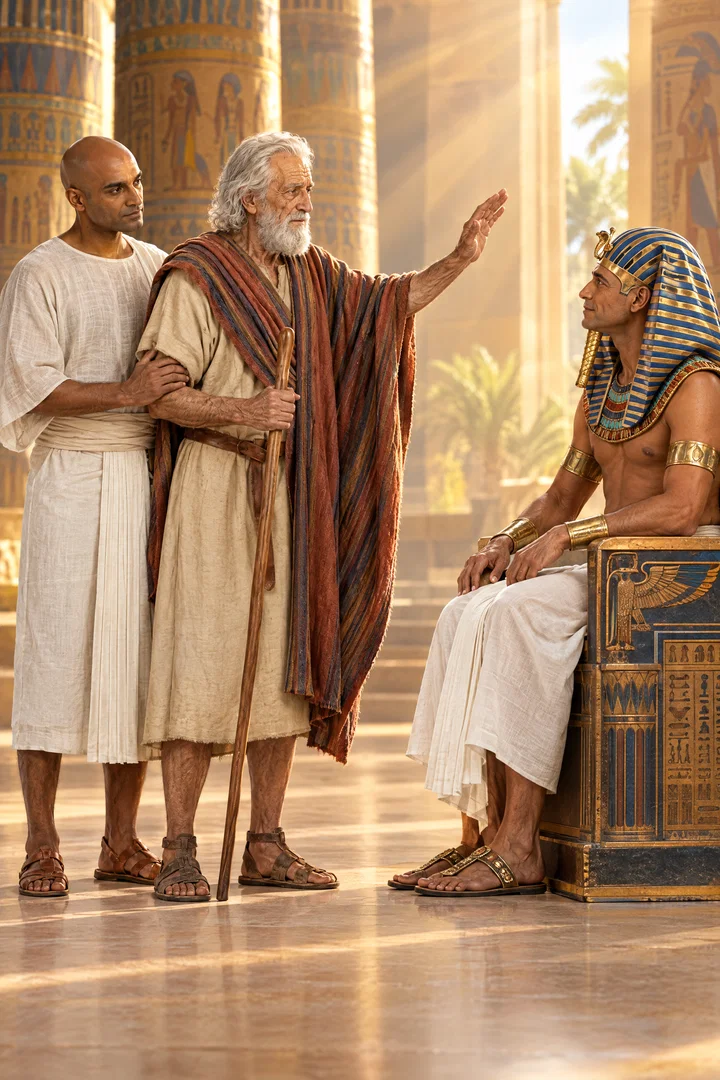
At one hundred and thirty years old Jacob stands before Pharaoh and blesses him, and Pharaoh bows to receive the blessing.ST Feb 5, 1880 He is unawed by royal pomp and magnificence because amid nature he has communed with a mightier monarch, so he blesses Pharaoh in conscious superiority.ST Feb 5, 1880 After painful struggle and crippling, his weakness has become part of his victory of faith, making him a man who can bless a king though Pharaoh is heir to a royal line.
He calls the one hundred and thirty years of his life a pilgrimage.1SP 153.2–154.1ST Feb 5, 1880SG3 169.2PP 233.1–3 By calling his days few and evil and not attaining to his fathers, he means his life has been marked by trouble and perplexity, not smooth or peaceful, and has been shorter than the lives of his fathers and forefathers.1SP 153.2–154.1ST Feb 5, 1880SG3 170.1SG3 169.2PP 233.1–3 The trouble includes the jealousy of his wives bringing a long train of evils and the sinful course and grief caused by some of his children making his life very bitter.1SP 153.2–154.1ST Feb 5, 1880SG3 170.1SG3 169.2
His last years are more peaceful after his sons turn from their evil ways and reform.1SP 153.2–154.1ST Feb 5, 1880SG3 170.1SG3 169.2 The joyful reunion with Joseph restored to him brings such relief that he says he can now die, yet he lives seventeen more peaceful years in Goshen surrounded by every comfort, passing gently and calmly toward the grave.ST Feb 5, 1880PP 233.1–3
Sources
Pioneers and periodicals
21 sources
Earthly life is a pilgrimage of temporary travelers in a land that is not their home, because Jacob with Abraham, Isaac, Joseph and his brethren owned none of Canaan but lived in it only as sojourners.ST Dec 1, 1898ST Jun 7, 1905ST Dec 1, 1898 His one hundred and thirty years were few and evil in being short and troubled compared with his fathers, since Abraham lived one hundred and seventy-five years and Isaac one hundred and eighty while Jacob lived to one hundred and forty-seven, with his final seventeen years in Egypt as years of peace.ST Dec 1, 1898ST Feb 13, 1912ST Aug 9, 1910 In his personal meeting with Pharaoh, distinct from the meeting of Joseph's brethren with Pharaoh in the settlement in Goshen for preserving the ancestors of the Seed, he blessed Pharaoh unawed by royal pomp because he had communed with a mightier monarch, proving the shepherd patriarch superior to the Egyptian king since true greatness is goodness, not kingship.ST Feb 5, 1880RH Mar 12, 1861ST Dec 1, 1898ST Dec 1, 1898 He was one hundred and thirty years old when he went down into Egypt, and twenty-five years from the promise to Abraham to Isaac's birth plus sixty years to Jacob's birth plus one hundred and thirty years to Egypt makes two hundred and fifteen years, which with two hundred and fifteen years more in Egypt makes four hundred and thirty years to the giving of the law, proving the four hundred and thirty years was the whole sojourning from Abraham's entrance into the promised land to the Exodus and not in Egypt alone.ST Aug 9, 1910ST Apr 20, 1888ST Jun 4, 1885RH Dec 3, 1867 His life up to that point had been marked by trials and misfortunes that strengthened his character, yet after arriving in Egypt it became tranquil and peaceful with Joseph restored and every comfort surrounding him, showing that mortal life counted in years is brief, vulnerable and full of trouble from birth, and that God can lead people by a difficult or indirect path and still guide them to where He intends them to be.ST Feb 5, 1880ST Feb 13, 1912RH Jan 19, 1860RH Sep 8, 1863ST Aug 9, 1899
Words and Royal Meeting
Earthly life is called a pilgrimage, meaning a journey of temporary travelers in a land that is not their home.ST Dec 1, 1898ST Jun 7, 1905 Jacob's one hundred and thirty years are so named because he, with Abraham, Isaac, Joseph and his brethren, owned none of Canaan as possession and lived in it only as sojourners.ST Dec 1, 1898ST Jun 7, 1905ST Dec 1, 1898 That sojourning raises the distinction between what is inherited by the first birth and what is inherited by the second.ST Dec 1, 1898
Few and evil means his days were short and troubled compared with his fathers.ST Dec 1, 1898ST Feb 13, 1912ST Jun 7, 1905 Abraham lived one hundred and seventy-five years and Isaac one hundred and eighty years, while Jacob lived to one hundred and forty-seven.ST Feb 13, 1912 He was one hundred and thirty years old when he and his family entered Egypt, so his years were shorter than the lifespans of his fathers and difficult.ST Dec 1, 1898ST Aug 9, 1910ST Jun 7, 1905 His final seventeen years, spent in Egypt, were years of peace.ST Feb 13, 1912
The verse belongs to the account of Israel's journey to Egypt and reception by Joseph and Pharaoh, within the story of God's care in preserving the ancestors of the Seed. More particularly it belongs to Israel's personal meeting with Pharaoh, distinct from the meeting of Joseph's brethren with Pharaoh, in the settlement in Goshen.ST Dec 1, 1898 In that meeting Jacob blessed Pharaoh.ST Feb 5, 1880RH Mar 12, 1861ST Dec 1, 1898 He stood at one hundred and thirty years before Pharaoh unawed by royal pomp and magnificence because amid nature he had communed with a mightier monarch, and in conscious superiority he blessed him.ST Feb 5, 1880 That blessing proves the shepherd patriarch superior to the Egyptian king, since the less is blessed of the better, and true greatness is goodness, not kingship.ST Feb 5, 1880ST Dec 1, 1898
Chronology and Egyptian Settlement
Jacob was one hundred and thirty years old when he went down into Egypt, and that age gives the interval from his birth to the beginning of Israel's sojourn there.ST Aug 9, 1910ST Apr 20, 1888ST Jun 4, 1885RH Dec 3, 1867 Twenty-five years from the promise to Abraham to the birth of Isaac, plus sixty years from the birth of Isaac to the birth of Jacob, plus one hundred and thirty years to the going down into Egypt, makes two hundred and fifteen years from the promise to Egypt.ST Aug 9, 1910ST Apr 20, 1888RH Dec 3, 1867 With two hundred and fifteen years more continued in Egypt, the whole makes four hundred and thirty years to the giving of the law after the departure from Egypt.ST Aug 9, 1910ST Apr 20, 1888RH Dec 3, 1867 The four hundred and thirty years was therefore not dwelt in Egypt alone, but was the whole sojourning from Abraham's entrance into the promised land to the Exodus.RH Dec 3, 1867
The entry belonged to 1706 B.C., two hundred and fifteen years after Abram left his father's house, when Israel was not yet in bondage.RH May 14, 1901 Pharaoh welcomed them and commanded that they dwell in the best of the land, and Joseph gave them a possession in Goshen and nourished his father and his brethren and all his household with bread as a little child is nourished through the years of famine.RH May 14, 1901 Israel was not compelled to give money or to sell stock, land, or themselves as the Egyptians were, who were bought by Pharaoh and made to give the fifth part.RH May 14, 1901 Israel dwelt in Egypt with possessions and grew and multiplied exceedingly.RH May 14, 1901 Jacob lived seventeen years in Egypt and died in 1689 B.C., and Joseph died fifty-four years later in 1635 B.C., seventy-one years after Jacob came, with no signs of slavery yet.RH May 14, 1901
Israel's beginning in Egypt was favor and not bondage, for through the seven years of famine Joseph nourished his father and brethren while Pharaoh gave them a possession in the best of the land and welcomed them.RH May 14, 1901 The Egyptians themselves were left in slavery to Pharaoh.RH May 14, 1901 This favored beginning stands in sharp contrast to the later time when a new king afflicted Israel with hard bondage and made their lives bitter.RH May 14, 1901
Troubled Pilgrimage Applied
Up to his meeting with Pharaoh his life had been troubled and marked by trials and misfortunes, with the jealousy of his wives bringing a long train of evils and the sinful course of some of his children making his life very bitter.ST Feb 5, 1880RH Sep 8, 1863 His reward was not earthly, and his suffering strengthened his character.RH Sep 8, 1863 His years were few and painful compared with the years of his fathers.RH Sep 8, 1863
After arriving in Egypt his life became tranquil and peaceful and gave him time for calm reflection.ST Feb 5, 1880ST Feb 13, 1912ST Oct 11, 1883 His sons had turned from evil ways, Joseph was restored to him, and every comfort surrounded him, so he passed gently and calmly toward the grave.ST Feb 5, 1880 The final seventeen years of his life, spent in Egypt, were years of peace.ST Feb 13, 1912
Mortal life counted in years is brief and vulnerable, few and evil, full of trouble and peril from birth.ST Aug 9, 1899 It is fleeting as a flower springing in the morning and cut down by night and as a shadow, and man is a worm before God yet brought to judgment. Death is lying down in dreamless sleep and life is vanity, and the dead wake no more till the heavens break. Faithful people may look forward to endless life beyond this mortal existence, with safety till wrath is past found hidden where hope anchors fast in the Redeemer's grave.ST Aug 9, 1899
Life is short and hard, full of vanity and quickly gone like a tale that is told, like chaff which the wind drives away, like grass and like a flower of the field that flourishes for a moment and then when the wind passes is gone so its place knows it no more. Because life is this brief and vain, the heart should not envy sinners in their popularity but stay in the fear of the Lord all day long.
The verse gives words for an aging believer to compare his life with Jacob's pilgrimage marked by hardship and to describe life as brief and troubled.RH Mar 12, 1861 After giving himself to God a person reviewing life may recognize how little good he has done and how much weakness and failure remain.ST Aug 13, 1894 At seventy years or on a birthday one may confess past errors while trusting God's mercy and fellow believers' forgiveness, and rejoice in God as Saviour.RH Feb 18, 1902 There is a sense of how little has been accomplished even though God has been near all those years to bless and by His Spirit has sought to wean the heart from this world to place affection on Him.RH Dec 30, 1873 Any further strength granted belongs to God to be used as His instrument in holding aloft the banner of Christ.RH Feb 18, 1902 This calls for a new life of daily nearness to God, full salvation and victory over self, and faithfulness in advancing His cause and winning souls in order to be saved.RH Dec 30, 1873
The phrase the days of the years of life means the full span of a person's lifetime. A ruling passion to do good gives strength and tenacity of life, so unselfish people can carry through many years an amount of suffering that would have prematurely crushed a less unselfish life, and their diseased condition does not subtract a single unit from the days of the years of their life. As part of Joseph's history, the verse shows that God can lead people by a difficult or indirect path and still guide them to where He intends them to be.RH Jan 19, 1860
Sources