Translations
Six days shall you labor, and do all your work:
King James Version, KJV Cambridge Paragraph Bible, Revised Version
Six days shalt thou labour, and do all thy work:
Six days shalt thou labor, and do all thy work:
Six days shalt thou labor, and do all thy work;
six days thou dost labour, and hast done all thy work,
Six days shalt thou labour, and do all thy work;
Six days, shalt thou labour, and do all thy work;
Berean Standard Bible, Majority Standard Bible
Six days you shall labor and do all your work,
You shall labor six days, and do all your work,
On six days do all your work:
Sixe dayes shalt thou labour, and doe all thy worke,
Douay-Rheims (Challoner revision)
Six days shalt thou labour, and shalt do all thy works.
Pictures

Cross-references 20 of 151
- Genesis 2:2-3
And on the seventh day God ended his work which he had made; and he rested on the seventh day from all his work which he had made.
God rested on the seventh day and blessed and sanctified it.
- Mark 2:27
And he said unto them, The sabbath was made for man, and not man for the sabbath:
The Sabbath was made for humanity.
- Isaiah 58:13
If thou turn away thy foot from the sabbath, from doing thy pleasure on my holy day; and call the sabbath a delight, the holy of the LORD, honourable; and shalt honour him, not doing thine own ways, nor finding thine own pleasure, nor speaking thine own words:
The Sabbath is the Lord’s holy day, set apart from ordinary pursuits and honored as a delight.
- Luke 23:56
And they returned, and prepared spices and ointments; and rested the sabbath day according to the commandment.
The women rested on the Sabbath according to the commandment.
- Exodus 16:22-30
And it came to pass, that on the sixth day they gathered twice as much bread, two omers for one man: and all the rulers of the congregation came and told Moses.
The manna account describes six days of gathering and the Sabbath rest.
- Exodus 31:15-17
Six days may work be done; but in the seventh is the sabbath of rest, holy to the LORD: whosoever doeth any work in the sabbath day, he shall surely be put to death.
Connects six days of work with the Sabbath sign, grounded in creation and God’s rest.
- Ezekiel 20:12
Moreover also I gave them my sabbaths, to be a sign between me and them, that they might know that I am the LORD that sanctify them.
The true Sabbath is presented as a token of allegiance to divine authority.
- Ezekiel 20:20
And hallow my sabbaths; and they shall be a sign between me and you, that ye may know that I am the LORD your God.
The Sabbath is a sign by which people know the Lord as their God.
- Exodus 31:13
Speak thou also unto the children of Israel, saying, Verily my sabbaths ye shall keep: for it is a sign between me and you throughout your generations; that ye may know that I am the LORD that doth sanctify you.
The Sabbath is a sign between God and his people that he sanctifies them.
- Colossians 2:16-17
Let no man therefore judge you in meat, or in drink, or in respect of an holyday, or of the new moon, or of the sabbath days:
Festival sabbaths are described as shadows, distinguished from the weekly Sabbath commandment.
- Mark 2:28
Therefore the Son of man is Lord also of the sabbath.
Jesus declares himself Lord of the Sabbath.
- Genesis 1
In the beginning God created the heaven and the earth.
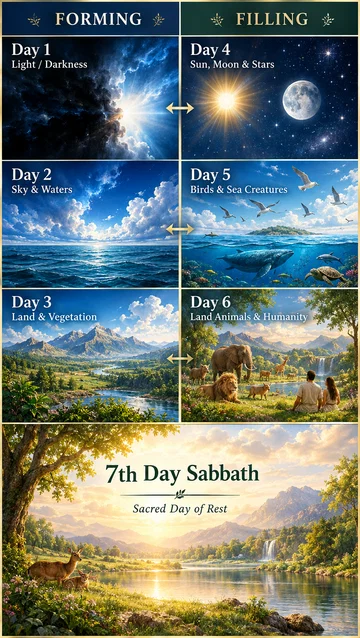
God’s six days of creation and seventh-day rest establish the weekly pattern.
- Deuteronomy 5:12-15
Keep the sabbath day to sanctify it, as the LORD thy God hath commanded thee.
The parallel Decalogue record gives the same commandment in different wording and adds a reason for Sabbath observance.
- Matthew 5:17-19
Think not that I am come to destroy the law, or the prophets: I am not come to destroy, but to fulfil.
Christ affirms that the law and its commandments remain in force.
- Matthew 12:12
How much then is a man better than a sheep? Wherefore it is lawful to do well on the sabbath days.
Jesus teaches that doing good and showing mercy are lawful on the Sabbath.
- Deuteronomy 5:22
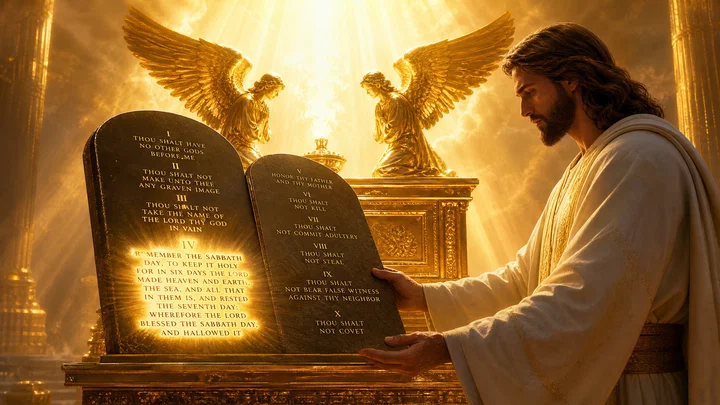
These words the LORD spake unto all your assembly in the mount out of the midst of the fire, of the cloud, and of the thick darkness, with a great voice: and he added no more. And he wrote them in two tables of stone, and delivered them unto me.
God spoke the commandments, including the Sabbath law, and wrote them on stone.
- Exodus 16:4-5
Then said the LORD unto Moses, Behold, I will rain bread from heaven for you; and the people shall go out and gather a certain rate every day, that I may prove them, whether they will walk in my law, or no.
Manna tested Israel’s obedience and established the six-day work and Sabbath-rest pattern.
- Deuteronomy 4:13
And he declared unto you his covenant, which he commanded you to perform, even ten commandments; and he wrote them upon two tables of stone.
Identifies the Ten Commandments as God’s covenant.
- Isaiah 56:2
Blessed is the man that doeth this, and the son of man that layeth hold on it; that keepeth the sabbath from polluting it, and keepeth his hand from doing any evil.
Blesses the person who keeps the Sabbath from profanation and avoids evil.
- Luke 4:16
And he came to Nazareth, where he had been brought up: and, as his custom was, he went into the synagogue on the sabbath day, and stood up for to read.
Jesus customarily observed the commanded Sabbath.
Commentary part 1 of 15
Each commentary is drawn from primary sources: the writings of Ellen G. White and Adventist pioneers and periodicals. Each commentary is separate. Its own words are not a quotation; follow the references to read the source passages.
Ellen G. White
311 sources
Six days are given for all ordinary secular labor, business and livelihood, while the seventh day alone is the Lord's holy Sabbath for rest and worship.GC 434.2–3ST Sep 16, 1913SG3 266.1 This follows God's own pattern of making all things in six days and then resting, blessing and hallowing the seventh as His memorial of creation.GC 434.2–3CE 190.1–2GC88 434.2 The command stands at the very center of the ten-precept moral law spoken at Sinai and engraved on stone, immutable and binding on every age.GC 434.2–3ST Sep 16, 19134SP 273.3–274.1 No other day can be substituted for the seventh, so keeping the first day as holy breaks the law while it remains an ordinary working day.GC 434.2–3SG4 14.1–2EW 216.2Ms 6, 1878, par. 7–10Lt 94, 1910, par. 1–4 Keeping the true Sabbath is God's test of loyalty that brings blessing and life, while trampling it removes protection and brings loss and judgment.Lt 109, 1899, par. 5–8Ms 3, 1879, par. 12Ms 68, 1910, par. 4–5HSFM 215.2GC88 605.1–2
Six Days for Work
Six days are set apart for all ordinary secular labor, work, business, employments and livelihood for profit or pleasure, while the seventh day is the Lord's holy, blessed and sanctified Sabbath for rest, worship, prayer and spiritual growth.GC 434.2–3ST Sep 16, 1913SG3 266.1SG4 14.1–24SP 273.3–274.1 The six days are for labor and completing all work before the Sabbath, distinguished from the seventh day God made sacred for rest, and the specified days matter so that neither the sixth day nor the first day can be substituted for the seventh-day Sabbath.SG3 266.1SG4 14.1–2EW 216.2 This direction to labor and do all work in six days stands in the very bosom of the Ten Commandments as first proclaimed, part of the fourth commandment and of the law with its ten precepts binding upon men of every age and in every country, grounded in God making heaven and earth and all things in six days and resting on and blessing and hallowing the seventh.GC 434.2–3ST Sep 16, 19134SP 273.3–274.1 The commandment remains unchanged and unabolished, preserved in the heavenly sanctuary, and to disregard the Creator's rest-day and observe the first day instead is to transgress this precept because Scripture gives no evidence the Sabbath was changed and the blessing that first hallowed the seventh day was never removed.GC 434.2–34SP 273.3–274.1EW 216.2
All secular work and secular duties must be promptly fulfilled and finished within the six days with care not to infringe even one hour of holy time, and work that can be done before the Sabbath should be completed then with anything left undone when holy time begins waiting until the Sabbath is past.1T 531.2HSFM 217.3–218.21SP 259.1 No business of man is important enough to transgress, and God's appointed time is not for people to treat as a matter of convenience or to withhold for their own interests even occasionally.1T 531.24T 249.3 Taking Sabbath time for unfinished work or for personal use violates the fourth commandment, and supposed time gained or pecuniary advantage sought by doing so instead brings loss and may bring God's punishment.1T 531.21SP 259.1SG3 292.1–293.1 Transgressing in a small matter to save time or gain hardens conscience and leads to greater labor while falsely claiming to keep the Sabbath, dishonors God's name, causes His precepts to be lightly esteemed, prevents Him blessing as He desires, and brings His curse with ten or twentyfold loss, for it is robbing God.1T 531.2 This applies even in busy plowing and harvest seasons, and labor on the Sabbath is permitted only to save the life of men or animals, while violating the letter for gain or to save property makes one a Sabbath-breaker guilty of transgressing all the commandments.1T 531.2SG3 292.1–293.1 These six days are for carrying on ordinary affairs and the usual business of life, while God claims a separate day for rest, worship, and spiritual growth.4T 249.2
The six working days include the first day of the week, which remains an ordinary common working day with no sanctity and no scriptural command to keep it holy.Ms 6, 1878, par. 7–10Lt 94, 1910, par. 1–4 Doing regular press and business work then while shutting down all business on the seventh day obeys the fourth commandment just as it reads, and permitting labor on Sunday does not teach Sunday-keeping and does not contradict the Bible.Ms 6, 1878, par. 7–10Lt 94, 1910, par. 1–4 That open-versus-closed contrast preaches a continual sermon that arouses conscience, answers inquiry about Sunday work and Sabbath rest, and turns minds to the truth.Ms 6, 1878, par. 7–10 The division of the week rests on creation, because in six days the Lord made heaven and earth, the sea and everything in them and rested, blessed, hallowed and sanctified the seventh day, setting it apart and giving it to man to observe as His memorial of creation.Ms 6, 1878, par. 7–10Lt 94, 1910, par. 1–42T 582.3Ms 140, 1906, par. 26Lt 138, 1910, par. 9 The six days of work with the seventh-day Sabbath go back to the beginning of the world when the morning stars sang together, were proclaimed from Sinai in awful grandeur, and point to God as Creator, Monarch, true and living God, Teacher, Redeemer and Saviour, to be remembered and kept by all the world as a sacred rest day.Lt 138, 1910, par. 921MR 88.1
The verse fixes God's distinction between the sacred and the common, reserving six days for common labor and all ordinary work and the seventh for holy use, so obedience means setting the day apart for God's service.RH Jun 29, 1911STB 181.1 Using the Sabbath for one's own work disregards its holiness and shows contempt for the Lawgiver and His word, and replacing the day God made holy and consecrated with a common working day or a humanly chosen day dishonors God, disregards His law, and makes void the law.Ms 38, 1904, par. 87–88RH Jun 29, 1911ST Jul 24, 1884GC 577.2RH Nov 20, 1913 A common business enterprise such as a workshop, factory, or corn field belongs to that common labor, while an institution established to advance God's cause is sacred and must not be treated as common.STB 181.1 Those who work in God's publishing houses bear a sacred charge as workers together with God, giving ability, service, and unwearying vigilance with vigorous purpose, lofty aspiration, and zeal to make the publishing house a light in the world, a faithful witness for God, and a memorial of the Sabbath of the fourth commandment.STB 181.1
Labor in the six days is to be done diligently all day as religious duty in dependence on God, with morning prayer for strength to work and evening prayer for strength to earn means for His cause, which God answers by giving strength to labor hard all day.LS 245.2–246.1 This includes hard physical labor for unbelievers to earn a living and means to spread truth, with its fatigue, pain, hunger, cold and heat as a sacrifice of ease, pleasure and comfort for Christ and for the good of others.LS 245.2–246.1 Obedience to this commandment is a needed experience for perfecting Christian character, yielding the will to God so efforts to save soul, body, and spirit become more effective, and useful daily labor can carry lessons of divine truth continually reminding people of their Creator and Redeemer rather than absorbing attention and making them forget God.CH 165.1Ms 126, 1907, par. 40 Those who teach the commandments must practice and exemplify it in every line of work, working in touch with God with fine, keen, clear perceptions of equity in judgment, with eye single to God's glory, watching, praying, and working as followers of Christ.RCOC 40.1–2Lt 22, 1894, par. 10–115MR 3.2 It forbids double dealing, deception, injustice, oppression and suffering brought upon souls, receiving large wages and selfish ambition to be keen and sharp for financial interest, and making God's cause an excuse for wrong, requiring instead hearts as tender, pure, true, and compassionate as Christ's, with pure heart and clean hands adopting Christ's maxims, loving God supremely and neighbors as themselves and not letting business crowd out love.RCOC 40.1–2Lt 22, 1894, par. 10–11
The six days are given for temporal needs and livelihood while the Sabbath limits toil for health and life, because man needs a day of rest from toil and care and his health and life are endangered without relaxation from the labor and anxiety of the six days.1T 532.1Ms 106, 1893, par. 1–2Ms 106, 1893, par. 3–4 The reserved day is to be used to specially honor God, to glorify Him and respect His authority, for rest, peace, worship, holy communion, and contemplating God as Creator, with appreciation of His works in nature as a way to know His love and care.1T 532.1Ms 192, 1897, par. 11Ms 106, 1893, par. 3–4 Work and money-making must not be allowed to take so much from the week that needed rest and sleep are stolen and then made up by sleeping through the Sabbath and missing worship and spiritual exercise.GW92 208.4 Leaving business on the seventh day to repair to worship, out of harmony with the world that does business on that day and even more business on the last day of the week than on the other six, bears testimony to city and world that the seventh day is the Sabbath of the Lord instituted in Eden, and taking even a little of that reserved time for self robs God.1T 532.1Ms 6, 1878, par. 11–12
As nine-tenths of increase is given to man while the tenth is sacred, so six days are man's portion for his own work and secular business while the seventh is reserved wholly to God, sanctified and blessed as His holy day.Lt 10, 1881, par. 73T 395.2–396.1 Using it for personal convenience or self-interest instead of giving the Creator His own robs God of the service that belongs to Him, is dishonest and unjust toward God, shows contempt for His righteous law, and will surely bring the violator into judgment.Lt 10, 1881, par. 7 No work should be left to take even one hour of holy Sabbath time, so everything that can possibly be done should be done in those six days, and placing a high estimate on the Sabbath and meeting its obligations brings great blessings.CH 523.4 All work connected with traveling belongs to those days, requiring securing tickets, making all necessary arrangements, and planning a journey so as not to travel or reach a destination on the Sabbath, since traveling on boats or cars when it can be avoided, talking about business, and engaging in common worldly conversation break the command.6T 359.5–360.1 Travel on the Sabbath is allowed only when necessary to reach churches needing help to give them God's message, and when compelled to travel worldly company that draws the mind to worldly things must be avoided, the mind kept stayed upon God in communion with Him, truth spoken when there is opportunity, and suffering relieved, which strict observance proves loyalty, brings the blessing promised to the obedient, and sets a right example before children and youth.6T 359.5–360.1 Carrying work from the six days into the seventh violates the Sabbath commandment and takes time from its holy hours.Ms 1, 1856, par. 31T 150.1–2
Law Given at Sinai
Exodus 20:9 stands in the very bosom of the Decalogue as part of the fourth commandment, which assigns six days for labor and doing all ordinary work while setting apart the seventh day as God's holy Sabbath rest for households, servants, cattle and strangers.GC 434.2–3ST Sep 16, 19134SP 273.3–274.1EW 216.2ST Nov 12, 1894 That ten-precept moral law was first proclaimed at Sinai and engraved on stone, and it remains unchanged, unabolished and binding upon men of every age and in every country, with all mankind under obligation to obey every injunction in it.ST Sep 16, 19134SP 273.3–274.1EW 216.2ST Nov 12, 1894ST Jul 29, 1897 It is grounded in God making heaven and earth and all things in six days and resting on and blessing and hallowing the seventh, and the blessing that first hallowed the seventh day was never removed, so Scripture gives no evidence that the command was abolished or the Sabbath changed to the first day.GC 434.2–34SP 273.3–274.1EW 216.2 To disregard the Creator's rest-day and observe the first day instead is therefore to transgress this precept, and recognizing it as part of God's continuing law preserved in the heavenly sanctuary leads to keeping the seventh-day Sabbath.GC 434.2–34SP 273.3–274.1
The law was spoken by God's own voice above warring elements amid thunder, lightning, trumpet, cloud, fire and earthquake, and written by His finger on tables of stone and preserved in the ark, demonstrating its sacredness and God's majesty as Ruler.Ms 77, 1899, par. 11–12SG3 298.1–299.2ST Apr 8, 1875 Its requirements are clear and cover the whole duty of humanity, with the first four commandments including this command about six days of work outlining duty to the Maker.9T 211.4Ms 2, 1904, par. 6–19 God's laws given through Moses at Sinai were to guard against injustice and guide dealings with one another, and their instruction remains needed with Christ as the Teacher who gave it.Lt 160, 1906, par. 3–9 The Decalogue proclaimed from Sinai must be studied by everyone professing to keep God's commandments, for its principles will decide the destiny of every soul and stand to witness against the world in the day of judgment.Ms 77, 1899, par. 11–12
That law already existed before it was declared at Sinai, first given in Eden and to Adam after his fall, preserved in the ark by Noah and observed by Abraham.SG3 298.1–299.2Ms 160, 1899, par. 1–2RH Jun 4, 1901 During Israel's years of bondage in Egypt it was lost sight of, as minds were blinded and degraded by witnessing idolatry and held confused ideas of God's requirements.SG3 298.1–299.2RH Jun 4, 1901 After God delivered His people through the divided Red Sea He proved them to see if they would trust Him, but they murmured and wished to return to Egypt, so to leave them without excuse He Himself came down upon Sinai enshrouded in glory and surrounded by angels.SG3 298.1–299.2 In sublime and awful manner He made known His law of ten commandments with an audible voice in the hearing of all the people without trusting its teaching to anyone, not even angels, and wrote it with His own holy finger upon tables of stone so short memory, tradition and practices of men could not mingle with His holy precepts or confuse His requirements.SG3 298.1–299.2ST Apr 8, 1875ST Jan 22, 1880 He then came still closer and guarded the ten precepts by requiring Moses to write judgments and laws with minute directions about what He required them to perform, to draw erring man prone to transgress to obedience of the moral law.SG3 298.1–299.2 Israel received it not for themselves only but as custodian, to pass it down to later generations and make it known to every nation.ST Jan 22, 1880
The verse belongs with the first four commandments on the first table defining supreme love and duty to God, distinct from the last six defining love and duty to fellow men.ST Mar 7, 1878STB 841.44T 632.1–2CT 329.21T 289.1 The first four allow no separation of the heart's affections from God, requiring loving Him with all heart, soul and mind with nothing allowed to divide or share supreme delight in Him.STB 841.4CT 329.21T 289.1Lt 171, 1904, par. 3Lt 16, 1885, par. 8 Fully obeying them means sacrificing every idol and putting away whatever divides the affections and takes away supreme love to God, drawing God's chosen people to Christ and separating them from the elements of the world, since there is no concord between Christ and Belial and loving God and keeping His commandments is far from loving the world's pleasures and friendship.1T 289.1 Neither part can be kept while the other is broken, for love to God comprehends love for fellow men formed in His image, and obeying the fourth commandment is always doing right and for a person's best good as the first and greatest duty.Lt 171, 1904, par. 33SP 52.2 Using God's time and money for needless display of dress violates duty to others, because gifts should be used to serve others and bring them to truth.4T 632.1–2
The law reveals God's will, wisdom, holiness and character and is the transcript of His character, the golden link uniting finite man to the Infinite God and linking earth to heaven.Ms 117, 1908, par. 17–18ST Mar 7, 1878ST Oct 1, 1894SG2 274.2 The fourth commandment defines who the living God is by pointing back to creation and Eden, bears the signet or seal of the Creator, occupies a central position among the regulations defining duty to God and to fellow men, and makes the Sabbath a sign between God and His people for as long as He has a people on earth.ST Mar 7, 1878ST Oct 1, 1894ST May 6, 1880 Spoken by the voice of God and engraved on stone for the benefit of all mankind to endure through all time, it is distinct from the specific social and religious rules given through Moses for Israel which embraced its principles.ST Mar 7, 1878 Its claims are holy and binding and its authority stands above earthly rulers as the standard of human action and of righteousness, by whose righteous principles at the judgment people receive a sentence of life or death.Ms 117, 1908, par. 17–189T 93.4–94.3 No man has authority to flout this precept more than any of the other nine, and ministerial substitution of a papal institution, general neglect by world and churches, and general transgression do not excuse trampling its sanctity or lessen the sin, for God holds every man responsible for its observance, and rejecting the law to avoid its claims casts away the Sabbath as well.ST Mar 7, 1878GC88 586.2ST Aug 27, 1885
The ten are joined as one whole like links of a chain resting on love to God and love to man in one symmetrical body, spoken in awful grandeur from Sinai by Christ the Sovereign of the world to make known the principles that should govern mankind and require implicit obedience.ST Mar 7, 18783SP 52.2 They can never be repealed while heaven and earth remain, are the origin of all enlightened law and government and the foundation of God's government in heaven and on earth, perpetual and unchangeable as God's character so that not even the smallest claim can be abolished.ST Mar 7, 1878ST Jul 18, 1878 God requires obedience not to nine-tenths of the law but to every one of the ten, where one broken link makes the chain of no value, so he that offends in one point is guilty of all and violation of one makes a person a commandment breaker.ST Mar 7, 1878Lt 35, 1877, par. 22–26Lt 41, 1898, par. 35–38 Keeping the day observed by the world instead of God's Sabbath is disobedience, and having obeyed most other requirements does not excuse breaking this one, for obedience to all including this commandment's order for six days of work bound with Sabbath rest is absolutely essential to eternal life without hesitation or excuse-making.ST Dec 15, 1887Lt 35, 1877, par. 22–26 Salvation depends on keeping all ten with perfect, continuous, unswerving, whole-hearted obedience, ceasing to transgress, obeying to please Him who died to save sinners from the penalty of transgression, and not presuming on mercy while venturing near perdition.Lt 35, 1877, par. 22–26Lt 41, 1898, par. 35–38
The ten were solemnly pledged in covenant at Sinai, with the people entering covenant and pledging to obey Him, and Moses was instructed to repeat them to Israel's new generation before his death so they would understand the need to obey God's commandments and laws.SG4 52.2Lt 198, 1908, par. 5–11 They were followed by judgments and minute directions about duty to one another and the stranger to guard them, and had Israel been obedient and loved to keep God's commandments the multitude of added ceremonies and ordinances to keep God in remembrance would not have been required.SG3 298.1–299.25T 666.3–667.1 The law contained in the sacred chest in the ark governed Israel's prosperity and adversity according to obedience or transgression, and as the hedge planted round about God's vineyard it distinguished the Israel of God from all other nations upon the face of the earth.SG4 106.11SP 403.2Ms 166, 1898, par. 1–3
Christ proclaimed the law at Sinai as the earlier teaching of the Son of God, and He did not come to destroy the law or the prophets nor did the law end with His death, for His death magnified and honored it and upholds obedience to its precepts.SG1 109.22SP 254.1–255.1 God could not change or abolish His holy, just and good law to save fallen man, and the fact that Jesus pitied man's hopeless degradation and gave His life to bear God's wrath due to man and save him from the curse merited by transgression shows its immutability.SG2 274.2 By humbling Himself Jesus exalted man to be a stepping-stone to elevate him, that man may lay hold of the virtue of His blood, keep God's law, and be brought back to eat of the fruit of the tree of life which Adam and Eve forfeited.SG2 274.2 He kept the commandments in human nature by perfect obedience, proving man can keep them and through His merits be a final overcomer, and those who accept Him as Saviour and share the divine nature are enabled to follow His example, so the law remains binding in the Christian age.ST May 14, 1902ST Jul 18, 1878 The binding Sabbath law instituted in Eden is old treasure of truth and direct testimony of Christ to be brought forth together with the new treasure of the personal teachings of Jesus as an inseparable whole, since accepting only the Old Testament while rejecting Christ or accepting Christ while rejecting the Sinai law and Sabbath is not unto salvation.2SP 254.1–255.1ST May 17, 1877
The lessons God taught Israel while they abode at Mount Sinai were not to lose their influence till the close of time, and the sacred precepts He Himself came down to speak with a voice that made the mountain tremble to its base must never lose their sacredness.Lt 374, 1908, par. 3–4 They are to be learned by youth amid the scenes of nature and the everlasting hills, with old and young as constant students of nature and students and teachers studying how to tax physical and mental powers equally, drawing lessons of highest and holiest character from the object lessons around them.Lt 374, 1908, par. 3–4 The law proclaimed at Sinai, including its commandments, will be revealed in majesty at Christ's return, when every person will recognize its authority and the guilt of having transgressed it.Ms 39, 1898, par. 17–20 The commandments plainly declare what people must and must not do, and children are to learn to respect and obey them.CT 111.2 Their principles spoken from Sinai are to be held firmly, while differences of opinion about diet should not become a barrier between brethren or cause disunion.Lt 331, 1904, par. 11
Creation Pattern and Memorial
Six days are given for labor and doing all work, while the seventh day is set apart as holy rest, and this division follows the pattern by which heaven and earth, the sea and all things in them were made in six literal days, after which God rested, was refreshed, and blessed and hallowed the seventh day.GC 434.2–3CE 190.1–2GC88 434.2Lt 258, 1907, par. 22–25Ms 82, 1893, par. 15 The six working days include the first day of the week, so doing regular business then while shutting down all business on the seventh obeys the commandment just as it reads, and that open-versus-closed contrast preaches a continual sermon that arouses conscience and turns minds to the truth.Ms 6, 1878, par. 7–10 The command was not new at Sinai but recalled a day already known, framing the weekly observance of the seventh-day Sabbath as a memorial of creation and a sign of allegiance to the Creator and of sanctification for His obedient children.Lt 258, 1907, par. 22–25Ms 82, 1893, par. 157T 106.4 To disregard the Creator's rest day and observe the first day instead is transgression, for no evidence abolishes the command or changes the Sabbath, and the blessing that first hallowed the seventh day was never removed.GC 434.2–3
The weekly cycle of seven literal days goes back to Eden and commemorates creation and God's rest, with the blessed and sanctified seventh day set apart for worship as God's memorial of creation so that people would remember their Creator.SG3 91.1–2SG3 53.1Lt 17, 1904, par. 2Lt 26, 1893, par. 10–12 The command to count time by sevens gives special honor to the seventh day, which was set apart in Eden to be observed as holy through all time.SG3 53.1Lt 17, 1904, par. 2 To treat the creation days as vast indefinite ages obscures the command, weakens its claim, and makes the requirement to observe a week of literal days senseless.SG3 91.1–21SP 87.1CE 190.3
The six-day pattern was reinforced in the wilderness when manna fell daily, with a double portion preserved on the preparation day and none on the seventh, repeatedly reminding Israel of the appointed rest day.PP 408.4–409.3PK 180.2 At the exodus the taskmasters had tried to make the people work on the Sabbath by increasing their weekly labor, but God delivered them so they could observe all His commands without hindrance.PK 180.2 The sixth day is the time to prepare food for the Sabbath, so cooking beforehand and taking simpler, smaller meals prevents sluggishness and preserves devotional attention, while caring for the sick and suffering, including preparing warm food and drink for their comfort, does not violate the commandment.1SP 225.2SG3 254.1SG3 253.2 Even urgent work on the Lord's house must give way to the Sabbath, for sacredness and urgency do not make it a working day, since it remains God's memorial of creation.Ms 77, 1900, par. 7–8 Gathering sticks and kindling fires belong to the six days and are open transgression when done on the Sabbath, and in the wilderness kindling fires on the seventh day was strictly prohibited because fire was not needed for warmth there, though where severe climate made fires a necessity the prohibition did not apply in the same way.PP 408.4–409.3
Cain and his descendants disregarded the appointed six days for labor by choosing their own times for labor and rest instead of honoring the day God had set apart, while the obedient respected and revered His Sabbath.SG3 53.21SP 60.1PP 80.3
The Sabbath as creation memorial identifies the living Creator, points to Him as rightful Ruler and object of worship, binds people to Him like a golden chain, and preserves knowledge of the only true God.4SP 281.24SP 503.1–25MR 82.1 Keeping the true Sabbath would have preserved the world from idolatry and prevented infidelity and atheism, while dishonoring it brings instability, refusal of God's sign, misrepresentation of His character, and exaltation of a spurious sabbath.LSEGW 96.15MR 82.1 The Sabbath was known and kept before Sinai, was made for all humanity rather than Israel alone, shares the law's imperishable obligation, remains a sign of the Creator's power, and will be honored in the new earth.RH Aug 18, 1910 Knowingly keeping a counterfeit Sabbath in place of the true Sabbath after the issue is made clear exchanges God's commandments for human religious authority.4SP 281.2
The Sabbath is a creation institution hallowed by the Creator's rest and blessing, and the commandment expresses the enduring authority of God's law.GC 453.1–2 Its observance has continued from Eden through the patriarchs and across generations, despite periods when knowledge of the law was lost and times of persecution.GC 453.1–2
Seventh Day Permanence
Only the seventh day is holy, and the sixth day, the first day, or any common working day cannot be substituted for it.GC 434.2–3SG4 14.1–2EW 216.21SP 279.3–280.1Lt 105, 1903, par. 8–10 Six days are appointed for labor and doing all ordinary work before the seventh-day Sabbath, which alone is set apart, blessed and hallowed as God's rest.SG4 14.1–2EW 216.21SP 279.3–280.1Lt 258, 1907, par. 22–25Ms 93, 1908, par. 11–15 Keeping the first day instead does not fulfill the command to work six days and rest on the specific seventh day God sanctified.GC 434.2–31SP 279.3–280.1Lt 105, 1903, par. 8–10DA 839.3–4Lt 94, 1910, par. 6–10 To disregard the Creator's rest-day and observe the first day of the week instead is to transgress this precept and dishonor the Creator, because Scripture gives no evidence that the command was abolished or the Sabbath changed and the blessing that first hallowed the seventh day was never removed.GC 434.2–3EW 216.2Lt 94, 1910, par. 6–10Ms 93, 1908, par. 11–15SG1 164.1 Placing the first day where the seventh should be and reverencing a false rest day brings condemnation.Lt 105, 1903, par. 8–10DA 839.3–4Lt 94, 1910, par. 6–10
The Sabbath is God's sign, seal, signet and perpetual covenant memorial of His authority and creative and sanctifying power.DA 839.3–4ST Feb 13, 1896ST Mar 18, 1897Ms 167, 1904, par. 7–8 The fourth commandment is the only commandment that points to God as Creator of heaven and earth, the sea and all in them, stating definitely who God is and distinguishing Him from idols of wood and stone that did not make the heavens and the earth.Lt 7, 1900, par. 8–11Lt 94, 1910, par. 6–10ST Mar 18, 1897 It declares to the whole universe, to worlds unfallen and to the fallen world, that God created the world in six days and rested on the seventh, and its evidence leaves no standing room for skepticism, since the work of creation and the science of life can never be explained by science.Lt 7, 1900, par. 8–11 It is placed in the forehead as understanding, marking those He recognizes as His own and distinguishing keepers of the commandments from the world and worshipers of God from worshipers of the beast.Lt 7, 1900, par. 8–11DA 839.3–4 Instituted in Eden as a memorial of God's creative work, it calls people to contemplate His goodness, mercy and love, and Satan's work is to obliterate it through intellectual skepticism and skeptical ideas causing it to be overlooked and ignored.Lt 7, 1900, par. 8–11ST Feb 13, 1896
The permission for work on six days and the requirement of the seventh day as the Sabbath still read the same as when delivered to Moses at Sinai, proving God has not changed the Sabbath from the seventh to the first day, for He never changes.EW 26.1–2RH Jul 21, 1851SG1 164.1 The Sabbath was not nailed to the cross, for then the other nine would also be void and all could be broken.EW 26.1–2RH Jul 21, 1851 Its claim remains fully binding and is not abrogated, lessened or removed by being ignored, slighted and forgotten, by worldly love of gain, by business needs, convenience or inclination, or by claims of sanctification or mercy, and keeping some other day in seven does not fulfill its explicit requirement.EW 26.1–2RH Jul 21, 18514T 147.2ST Feb 14, 19114T 247.4 Working on that day from worldly gain desecrates it, and every transgression will bring its punishment, for the time of probation is given for preparing for eternity and must not be squandered in worldly pursuits, pleasure and sin.ST Feb 14, 1911 The four commandments on the first table of stone, kept in the ark in the Most Holy Place of the temple in heaven beside the golden pot of manna and Aaron's rod that budded, shine brighter than the other six, and the fourth shines above them all with a halo of glory because the Sabbath was set apart to be kept in honor of God's holy name, and the holy Sabbath is and will be the separating wall between the true Israel of God and unbelievers and the great question to unite the hearts of God's waiting saints.EW 26.1–2RH Jul 21, 1851
Christ and His followers respected and carefully observed the Sabbath requirement, and violating it would have given their enemies grounds to condemn them and exposed them to severe punishment.ST May 1, 1884SLP 213.1 Jesus left the fourth commandment standing as God gave it, freed the Sabbath from human traditions and useless rites and restored it to its lasting foundation with His divine sanction.4RED 51.2Ms 43b, 1891, par. 12 His healing on the Sabbath showed that acts of mercy honor the day, while human restrictions dishonor it.4RED 51.2 Those Christians who kept the true Sabbath regarded it as part of God's enduring law and observed it as the holy day of the Lord.4SP 68.1GC88 53.1
Sunday is a human institution set in the place of the divine rest-day, without scriptural authority as a replacement.4SP 183.24SP 234.2–235.3ST Nov 12, 1894RH Apr 23, 19014SP 395.1 Changing the seventh day consecrated by God to the first day alters His moral and unchanging command and sets human authority above God.4SP 183.24SP 234.2–235.34SP 395.1 Replacing the seventh day with the first sets aside God's memorial and sign between Him and His commandment-keeping people and exalts a rival sabbath.ST Feb 22, 1910 The change to the first day was made by the Pope and advanced by ambitious bishops, councils, Constantine and Rome, and Christ's resurrection on that day gives no authority for celebrating it as the Sabbath or as the Christian Sabbath.EW 26.1–2RH Jul 21, 1851ST Nov 12, 1894 Sunday enforced by law is identified as the mark of the beast, in contrast to the seventh-day Sabbath as the sign of God's authority and creative power.DA 839.3–4
The instruction is too plain to be misunderstood, reserving the seventh day alone as holy while the six days are for common labor.Lt 105, 1903, par. 8–10Lt 94, 1910, par. 6–10Ms 37, 1894, par. 19–20 It opens with Remember because men in press of business forget it, and it was not new at Sinai but recalled a day already known, framing the weekly observance of the seventh-day Sabbath as a memorial of creation and a sign of allegiance to the Creator.Lt 258, 1907, par. 22–25 Earnest study of the commandments after the 1844 disappointment showed wherein work had been done contrary to them and convicted that the seventh day is the Sabbath, leading to its observance as holy unto Him.Lt 94, 1910, par. 6–10 It is learned from the Bible alone without dependence on fathers, and keeping this seventh-day Sabbath is obeying the Word of God and worshiping God, a decision requiring moral courage, firmness, decision, perseverance and much prayer on the unpopular side to obey God's word rather than man's word.Ms 37, 1894, par. 19–20
Apostasy and Final Conflict
The fourth commandment alone defines the living God who made heaven and earth and all things in them, and its foundation was laid when the foundations of the earth were laid, so that keeping the true Sabbath would have preserved the world from infidelity, atheism and idolatry.LS 236.2–3EW 180.1–3GC88 53.2–3 It stands in the very center of the ten precepts with a halo of light encircling it, is the foundation of God's government in heaven and on earth, is unalterable, and was founded at creation to keep the living God ever before minds as source of being and object of reverence and worship.LS 236.2–3EW 180.1–31T 75.4–76.1GC88 53.2–3 Because it points to God as Creator and distinguishes Him from all false gods, Satan directs his efforts especially against it to turn men from allegiance and obedience, working through half-converted pagans, ambitious prelates, world-loving churchmen, and his vicegerent the proud pontiff claiming to be Christ's representative to gather the Christian world under his banner.SG1 111.1GC88 53.2–3 The man of sin exalted himself above God and above all that is called God or worshiped, and thought to change times and laws by trampling and breaking down this commandment and changing the Sabbath from the seventh to the first day of the week.LS 236.2–31T 75.4–76.1GC88 53.2–3 He used Christ's rising on the first day as pretext, covered God's plain will with error and tradition taught as God's commandments and zealously defended, erected a rival memorial to sever God from His people, and pressed the instituted Sabbath lower through vast councils convened from all the world while exalting Sunday until the pagan festival was honored as divine institution and the Bible Sabbath was pronounced a relic of Judaism with its observers declared accursed.EW 180.1–3SG1 111.1GC88 53.2–3 This deception is suffered until the second appearing of Jesus, yet through all this time of error God is not left without a witness.EW 180.1–3SG1 111.1
Sunday as a public festival came through Emperor Constantine's decree in the early fourth century honoring the venerable day of the sun to unite paganism and Christianity, urged by ambitious bishops seeking power and nominal conversions.GC 53.1–2GC 52.1–2GC88 573.2–574.2 His first edict required townspeople to rest but allowed country people to continue agricultural pursuits, and was virtually a heathen statute made after his nominal acceptance of Christianity.4SP 391.1–2GC88 573.2–574.2 The change was not attempted openly at first but with subtlety, making Sunday a festival in honor of Christ's resurrection with religious services held upon it, yet it was regarded as a day of recreation while the Sabbath was still sacredly observed.GC 52.1–2 Before Christ's advent Satan had led the Jews to load the Sabbath with rigorous exactions making it a burden, and taking advantage of that false light he cast contempt upon it as a Jewish institution, leading Christians who generally kept Sunday as a joyous festival to show hatred of Judaism by making the Sabbath a fast, a day of sadness and gloom.GC 52.1–2 Afterward Sunday was exalted by church councils until the pagan festival was honored as divine institution and the Bible Sabbath pronounced a relic of Judaism, while Eusebius's admission that all things whatsoever it was duty to do on the Sabbath were transferred to the Lord's day points to human authors of the change, and the groundless claim that Christ transferred all Sabbath duty to Sunday has not a single testimony of Scripture to support it.GC 53.1–2GC88 573.2–574.2 Sunday was a day devoted to vile heathen sun worship, a foundling of heathenism cherished and nourished by the church of Rome and clothed by her in garments of sanctity, and in Scotland its hours were even extended by an edict treating Saturday from noon until Monday morning as holy and prohibiting worldly business throughout that period.Ms 91, 1894, par. 19GC 577.1
The fourth commandment requires the Bible Sabbath as the true Sabbath and rejects Sunday as a false sabbath of Rome's creating, a papal institution to be trampled underfoot in place of Jehovah's sanctified rest day.5T 137.1GC88 448.3–419MR 243.1–4 Accepting Sunday while rejecting the Bible Sabbath virtually admits Rome's claim to supremacy and abandons the principle that the Bible, and the Bible only, is authority.GC88 448.3–4 Enforcing a religious duty by secular power forms an image to the beast, so enforcement of Sunday-keeping by Protestant churches, especially in the United States uniting Protestantism with the papacy, is enforcement of the worship of the papacy, of the beast and his image.GC88 448.3–4 In the future a decree will go forth commanding all to disregard the Sabbath of the fourth commandment and honor the first day or lose their lives, and a universal decree will condemn God's obedient servants to death for hallowing His day.RH May 27, 1862PK 512.1 The faithful will not yield but will earnestly cry and agonize day and night for deliverance as Jesus agonized in the garden, and God will in a wonderful manner preserve them through the time of trouble.RH May 27, 1862 The Sabbath commandment identifies the great Lawgiver as Creator of heaven and earth, and by many it is made void and treated as a thing of naught while the spurious sabbath, child of the papacy, is exalted and the laws of the man of sin are elevated in place of God's laws to receive universal homage, making the Sabbath the great point at issue and the center of controversy where honoring it means obeying God rather than yielding to religious and civil pressure.ST Feb 22, 1910GC88 448.3–419MR 243.1–4
When Jesus finished mediation in the holy place in 1844 at the end of the 2300 days, He shut that door and entered the Most Holy Place by the ark, and the time came for the commandments to shine out with all their importance and for God's people to be tried on the Sabbath truth.EW 34.1–2ExVEGW 24.2–25.1 Then Jesus rose up and shut the door of the holy place and opened the door into the most holy and passed within the second veil, where He now stands by the ark and where the faith of Israel now reaches.EW 34.1–2 Since that opening, the commandments contained in the ark have been shining out to God's people and they are being tested on the Sabbath question, which cannot be separated from the testimony of Jesus Christ relating to the shut door.EW 34.1–2ExVEGW 24.2–25.1 The earthly sanctuary was a figure or pattern of the heavenly, and the law deposited in the earthly ark was an exact transcript of the law in the heavenly ark, so light shining from the open door shows the fourth commandment including six days of labor is enshrined in heaven and what God established there no man can overthrow.4SP 275.1GC 435.1 Those who studied after the disappointment of 1844 read and reread the commandments with Revelation 14, saw wherein they had worked and walked contrary to God's law, thanked God for the disappointment, learned the meaning of keeping the commandments of God, were convicted that the seventh day is the Sabbath of the Lord, and began to observe it as holy unto Him.Lt 105, 1903, par. 6–7 Embracing the fourth precept with its provision for six days of work is loyalty to God and the onward course to the golden gates, the tree of life, and the eternal city, with blessing on those who do His commandments giving right to the tree of life and entrance through the gates into the city.LS 124.3–125.1
In the first centuries all Christians kept the true Sabbath jealous for God's honor, and faithful witnesses held it fast as unadulterated truth through ages of darkness and apostasy while others compromised little by little.GC 52.1–2GC88 65.1 They maintained it under long-continued persecution and fiercest opposition, hated and persecuted, gashed by the spear and scorched by the fagot, even at peril of life, denying Rome's supremacy, rejecting image worship as idolatry, declaring Rome apostate Babylon, resisting her corruptions, and standing unflinchingly for God's Word and His honor.GC88 65.1 Bodies of Christians in Central Africa and among the Armenians of Asia remained almost wholly free from papal corruption, regarded the Bible as the only rule of faith, adhered to many of its truths while surrounded by heathenism, and obeyed the fourth commandment by keeping the seventh-day Sabbath.GC 577.3–578.2GC88 577.3–578.2GC88 63.1 Their abstention from labor on Sunday followed church custom, not the commandment, and when Roman rule forced them to set aside the true Sabbath they returned to obedience after regaining independence.GC 577.3–578.2GC88 577.3–578.24SP 395.2–396.1 Hatred toward that Sabbath was a leading cause of separation between the true church and Rome, for the papal power trampled God's law in the dust while exalting traditions and customs of men and compelling churches under its rule to honor Sunday as holy day.GC88 64.2GC 65.1 Papal leaders demanded not only that Sunday be hallowed but that the Sabbath be profaned by labor, denouncing in strongest language those who dared honor it and bewildering even many true people into resting on both days, so that only by fleeing from Rome's power could anyone obey God's law in peace.GC88 64.2GC 65.1
Guilt is measured by light given, so those who died before light came upon the law and the claims of the fourth commandment were not guilty of violating the Sabbath, and the special test upon it did not come until after the temple of God was opened in heaven and the ark containing the law was seen.2T 693.2–3 This present test was not a test to generations far back, for those who lived in the past were accountable only for light permitted to shine upon them, not for light they did not have, and special truths are adapted to each generation with the Sabbath truth unfolded during the last generations that shall live upon earth.2T 692.1–693.1 Christians who in past generations kept Sunday supposing it was the Bible Sabbath, and true Christians now in every church who honestly believe Sunday is of divine appointment, are accepted for sincerity of purpose and integrity, and before light and opportunity come God accepts sincere efforts in ignorance.GC88 449.1Lt 35, 1877, par. 19–21 While that ignorance and integrity remains God accepts sincerity, but when light falls upon the pathway God requires harmony with His law and observance of the Sabbath of His appointing.ST Nov 14, 1895Ms 91, 1894, par. 19 When Sunday observance is enforced by law and the world is enlightened concerning the obligation of the true Sabbath, whoever then transgresses God's command to obey a precept with no higher authority than Rome honors popery above God, pays homage to Rome and to the power enforcing Rome's institution, and worships the beast and his image.GC88 449.1 The mark of the beast is received only when the issue is plainly set before the people and they are brought to choose between the commandments of God and the commandments of men, and then continue in transgression, for no one feels the wine of God's wrath poured out without mixture until truth has been brought in contact with mind and conscience and rejected, yet everyone will have sufficient light to make an intelligent decision before the decree urging that none may buy or sell without the mark and that refusers shall be put to death.GC88 449.14SP 422.2 After full light and the working of the Spirit with no change of views, continued refusal to yield the will shows no harmony of spirit.Lt 35, 1877, par. 19–21
Just prior to the great day of God a message warns the people to come back to allegiance to the law, to repair the breach made by the spurious sabbath and plead for the Sabbath by precept and example, and the third angel proclaiming the commandments of God and the faith of Jesus represents the people who receive this message and keep the commandments and the law as the apple of the eye.LS 236.2–31T 75.4–76.1 Amid well-nigh universal contempt for God's law, all loyal to Him have a sacred and solemn work to magnify the law and make it honorable, and by rendering obedience they uphold God's honor in the earth.ST Oct 8, 1896 Six days are given for labor as part of the commandment designating the Creator who made the world and all in it in six days and rested on the seventh, and the commandment is to be respected and obeyed with Sabbath truth made especially plain because keeping it honors God's law and magnifies His name.Ms 169, 1903, par. 18–19 Its seventh-day observance identifies God's people as loyal to the Creator and as people God recognizes as His own, pointing to His creative power and faithfulness, meaning submission to His will, treasuring His law in the heart, and obeying His commands in daily life.ST Nov 22, 1899 Obedience to the fourth commandment is part of the remnant's work of restoring the principles of God's law as a memorial of creation, holding fast to truth in every line as the only hope when Satan seeks control of heart and mind, accepting the seventh-day Sabbath in full conversion, and proclaiming it plainly in cities and new fields, in Washington with power, and by sanitariums and memorials calling people back to allegiance.Ms 73, 1908, par. 10PK 677.2–678.2RH Nov 5, 1908
Understanding the claims of the fourth commandment and then choosing the false instead of the true Sabbath pays homage to the Catholic Church and to the papacy by which alone Sunday is commanded.GC88 448.3–4 During the old law Saturday was the sanctified day, but the Catholic Church claims to have substituted Sunday for Saturday by its own authority as instructed by Jesus Christ and directed by the Spirit, so Protestant observance of Sunday recognizes that power to ordain feasts and command them under sin, and the very act of changing Sabbath into Sunday is the sign or mark of the Romish Church, the mark of the beast.GC88 448.1–2 Knowingly observing a false sabbath in place of the true one is homage to the power commanding it, showing allegiance to human authority rather than the Creator.GC88 448.3–4 Obeying God's Sabbath law giving six days for labor means resting on the Sabbath and refusing to hallow Sunday, not resting on both days contrary to the command to work during the six days.4SP 69.2GC88 64.2ST Jun 25, 1885 Its pattern of six days' work followed by the Sabbath will be a great point at issue in the last-day conflict because it identifies the Lawgiver as Creator of heaven and earth.1MR 297.1–3
Sources