Exodus 25:28
And thou shalt make the staves of shittim wood, and overlay them with gold, that the table may be borne with them.
Translations
And you shall make the staves of shittim wood, and overlay them with gold, that the table may be borne with them.
King James Version, KJV Cambridge Paragraph Bible
And thou shalt make the staves of shittim wood, and overlay them with gold, that the table may be borne with them.
And thou shalt make the staffs of shittim wood, and overlay them with gold, that the table may be borne with them.
Revised Version, American Standard Version
And thou shalt make the staves of acacia wood, and overlay them with gold, that the table may be borne with them.
and thou hast made the staves of shittim wood, and hast overlaid them with gold, and the table hath been borne with them;
And thou shalt make the staves of acacia-wood, and overlay them with gold; and the table shall be carried upon them.
and thou shalt make the staves of acacia wood, and shalt overlay them with gold,—and the table shall be lifted there, with;
Berean Standard Bible, Majority Standard Bible
Make the poles of acacia wood and overlay them with gold, so that the table may be carried with them.
You shall make the poles of acacia wood, and overlay them with gold, that the table may be carried with them.
Make rods of the same wood, plated with gold, for lifting the table.
And thou shalt make the barres of Shittim wood, and shalt ouerlay them with golde, that the Table may be borne with them.
Douay-Rheims (Challoner revision)
The bars also themselves thou shalt make of setim wood, and shalt overlay them with gold to bear up the table.
Pictures
Cross-references 20 of 21
- Hebrews 9:2
For there was a tabernacle made; the first, where in was the candlestick, and the table, and the shewbread; which is called the sanctuary.
Names the table and showbread among the first tabernacle’s furnishings.
- Hebrews 8:5
Who serve unto the example and shadow of heavenly things, as Moses was admonished of God when he was about to make the tabernacle: for, See, saith he, that thou make all things according to the pattern shewed to thee in the mount.
The earthly sanctuary service is an example and shadow of heavenly things.
- Exodus 25:8-9
And let them make me a sanctuary; that I may dwell among them.
God commands a sanctuary for his dwelling, built according to the pattern he showed.
- Exodus 25:40
And look that thou make them after their pattern, which was shewed thee in the mount.
Moses is commanded to make the sanctuary according to the pattern shown on the mount.
- Acts 7:44
Our fathers had the tabernacle of witness in the wilderness, as he had appointed, speaking unto Moses, that he should make it according to the fashion that he had seen.
The wilderness tabernacle was made according to the pattern shown Moses.
- Exodus 37:15
And he made the staves of shittim wood, and overlaid them with gold, to bear the table.
The table’s wooden poles are overlaid with gold to carry it.
- Exodus 40:22-23
And he put the table in the tent of the congregation, upon the side of the tabernacle northward, without the vail.
The table is placed in the sanctuary and the bread set in order upon it.
- Hebrews 9:24
For Christ is not entered into the holy places made with hands, which are the figures of the true; but into heaven itself, now to appear in the presence of God for us:
Earthly holy places are figures of the true heavenly sanctuary.
- Numbers 4:7-8
And upon the table of shewbread they shall spread a cloth of blue, and put thereon the dishes, and the spoons, and the bowls, and covers to cover withal: and the continual bread shall be thereon:
The table and its poles are prepared for carrying.
- Exodus 25:10-22
And they shall make an ark of shittim wood: two cubits and a half shall be the length thereof, and a cubit and a half the breadth thereof, and a cubit and a half the height thereof.
The ark holds the testimony and is the place where God meets with Israel.
- Exodus 25:9
According to all that I shew thee, after the pattern of the tabernacle, and the pattern of all the instruments thereof, even so shall ye make it.
Both describe sanctuary furniture made according to a heavenly pattern.
- Hebrews 8:2
A minister of the sanctuary, and of the true tabernacle, which the Lord pitched, and not man.
earthly as figure of true tabernacle
- Exodus 36:1
Then wrought Bezaleel and Aholiab, and every wise hearted man, in whom the LORD put wisdom and understanding to know how to work all manner of work for the service of the sanctuary, according to all that the LORD had commanded.
God gave the wisdom and skill for the tabernacle work.
- Leviticus 24:6-7
And thou shalt set them in two rows, six on a row, upon the pure table before the LORD.
Describes the loaves’ arrangement and frankincense.
- Hebrews 9:9
Which was a figure for the time then present, in which were offered both gifts and sacrifices, that could not make him that did the service perfect, as pertaining to the conscience;
The earthly sanctuary and its furnishings served as a pattern and type.
- 1 Samuel 21:6
So the priest gave him hallowed bread: for there was no bread there but the shewbread, that was taken from before the LORD, to put hot bread in the day when it was taken away.
David receives the hallowed showbread.
- Exodus 30:1
And thou shalt make an altar to burn incense upon: of shittim wood shalt thou make it.
altar stood with table glittering gold
- Exodus 40:4
And thou shalt bring in the table, and set in order the things that are to be set in order upon it; and thou shalt bring in the candlestick, and light the lamps thereof.
The table is placed in the tabernacle when it is set up.
- Leviticus 24:9
And it shall be Aaron’s and his sons’; and they shall eat it in the holy place: for it is most holy unto him of the offerings of the LORD made by fire by a perpetual statute.
Says the priests ate the removed bread.
- Numbers 4:15
And when Aaron and his sons have made an end of covering the sanctuary, and all the vessels of the sanctuary, as the camp is to set forward; after that, the sons of Kohath shall come to bear it: but they shall not touch any holy thing, lest they die. These things are the burden of the sons of Kohath in the tabernacle of the congregation.
gives express directions for carrying the ark
Commentary
Each commentary is drawn from primary sources: the writings of Ellen G. White and Adventist pioneers and periodicals. Each commentary is separate. Its own words are not a quotation; follow the references to read the source passages.
Ellen G. White
9 sources
This direction was one of the specifications for building the tabernacle given to Moses on the mount by Christ for Israel's service, received within the forty days when Moses was given God's laws and details for worship.Ms 97, 1899, par. 3–4Ms 170, 1904, par. 4–6 It directs that the staves be made of shittim, that is acacia, wood and overlaid or covered with gold, so that the table may be carried with them.LSEGW 100.1–3EW 213.2–214.1EW 25.6 The table is the table of showbread or shewbread in the holy place, the first apartment of the sanctuary, standing on the north side.LSEGW 100.1–3PP 348.1RH Nov 8, 1915EW 213.2–214.1
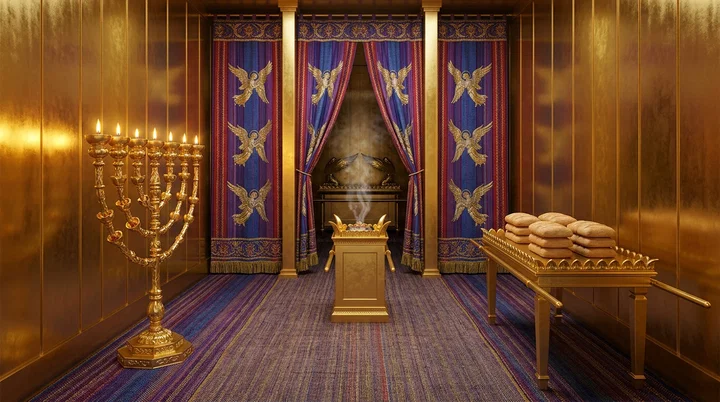
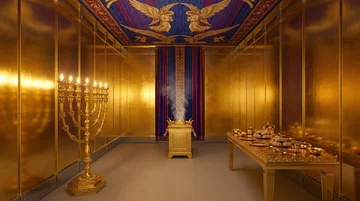
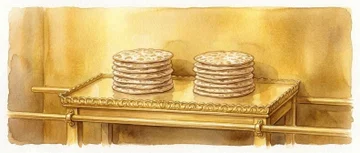
The table was overlaid with pure gold and had gold-plated walls.PP 348.1ST Mar 4, 1903 Each Sabbath the priests placed twelve cakes on it in two piles and sprinkled them with frankincense, and the loaves removed from the table were holy and were eaten by the priests.PP 348.1 The table glittered with the other furnishings in the light of the candlestick, contributing to the sanctuary's magnificence.ST Mar 4, 1903
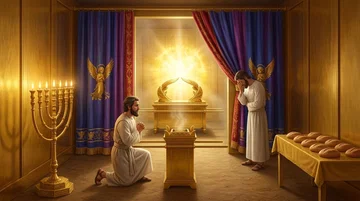
A real table corresponding to the one described in Exodus 25:23-30 stands in the first apartment, the holy place, of the heavenly sanctuary or temple, seen there with its showbread together with the candlestick with seven lamps and the altar of incense and censer.LSEGW 100.1–3SG1 158.1EW 25.6 All the furniture of that apartment looks like purest gold and reflects the image of the one who enters there.SG1 158.1EW 213.2–214.1 Paul repeated this verse chapter after chapter with Exodus 24, Exodus 26, and Exodus 27 to his fellow workers while working quickly and skillfully with his hands at tentmaking, preaching the gospel by voice and by intelligent labor for his own benefit and theirs.Ms 97, 1899, par. 3–4
The verse teaches that supreme honor is to be given to God and that the skill, genius, and wisdom put into the tabernacle work were given by God to be used for His glory, giving an example of diligence and thoroughness in business as serving the Lord.Ms 97, 1899, par. 3–4
Sources
Pioneers and periodicals
59 sources
God commanded that the carrying poles for the table be made of acacia wood, called incorruptible wood, and covered with gold so the table could be lifted and borne by them.RH Jan 6, 1853STST Dec 5, 1895 The table itself was overlaid with pure gold and stood in the holy place on the north side opposite the candlestick, holding the bread of the presence continually before the Lord.RH Aug 4, 1863RH Jan 6, 1853STRH Mar 1, 1870RH Aug 3, 1916 This direction was part of the detailed pattern given to Moses on Sinai for a portable sanctuary where God would dwell among His people, belonging to the ceremonial system that regulated the tabernacle, priesthood and typical service.ST Jan 29, 1908ST Jan 24, 1911ST May 20, 1875RH Oct 20, 1863RH Feb 11, 1858 Made to be taken down and set up as Israel journeyed toward the promised land, the staves show the sanctuary was adapted for travel and for bearing its furniture from place to place.ST Nov 14, 1892RH Dec 31, 1901ST Oct 25, 1905 As part of that earthly object lesson of Christ and His priestly work in the heavenly sanctuary, the table represented the Word of God, and its twelve loaves represented heaven's sustaining care for the twelve tribes with fresh blessing on the Sabbath.STRH Jul 27, 1916ST Nov 23, 1904RH Feb 10, 1910
Command and Setting
Exodus 25:28 belongs to God's call to Moses to build Him a sanctuary as a center of worship where His manifest presence would abide.ST Jan 29, 1908ST Jun 4, 1885 It is part of the detailed, God-given pattern for the tabernacle, giving the materials desired and describing the sanctuary and its furniture, together with the consecration of the priests.ST Jan 29, 1908 It belongs to the detailed instructions Moses received for constructing the tabernacle and its furniture, given on Mount Sinai after Moses was shown the sanctuary's pattern.RH Feb 11, 1858 The sanctuary was God's dwelling place among His people.ST Jun 4, 1885
The instructions were given to Moses on Mount Sinai during forty days and nights.RH Oct 20, 1863ST May 20, 1880RH Dec 31, 1861 They belong to the first instructions respecting the sanctuary in Exodus 25, coming after Exodus 24, and Moses was enjoined to make the sanctuary and all its vessels according to the pattern shown.RH Oct 20, 1863RH Feb 11, 1858 They gave the pattern of the ark to place the law written on stone in, and the mercy-seat to place over that law, and the sanctuary to deposit the ark in, and ordained the priesthood to minister in the sanctuary before the ark, all ordained before God committed His own written law into Moses's hands and again enjoined the Sabbath.RH Dec 31, 1861 They stand within the Exodus 24-34 record of the personal descent of God upon Mount Sinai with His angels, joined to the records in Exodus 19 and Exodus 20 and continuing through Exodus 24-34.RH Dec 24, 1861
The directions God told Israel to build in Exodus 25 to 31, completely described in Exodus 25-30, covered every part from offered gold, silver, brass, acacia wood, fine linen and goat's hair to framework, coverings, divisions, furniture and vessels.ST Jan 27, 1909ST Mar 11, 1886ST Nov 14, 1892 Their center was the holy of holies holding the ark of the covenant containing God's holy law written on tables of stone.ST Jan 27, 1909 The direction was carried out exactly as God directed, as recorded in Exodus 35 to 40 with the ark and all its furniture and equipment, and when completed blessing and glory came down upon the congregation and the building.ST Jan 27, 1909 The work shows God placed His Spirit upon Bezalel and Oholiab and other devoted men and women so the building would be properly erected and the work properly done, proving God is just as willing to bless workers in material things who are consecrated to Him as workers in spiritual things.ST Jan 27, 1909
The tabernacle is called the tabernacle of witness because its principal article is the ark containing the tables of the law, the ten commandments called the ark of the testimony.RH Sep 23, 1902 Since the commandments are God's testimonies and testimony is witness, and love is the fulfilling of the law and God is love, the law is God's life.RH Sep 23, 1902 From above that ark of the testimony, between the cherubim, God meets and communes and specially manifests His glory as the God who dwells between the cherubim, and the ark was the central point of Israel's true worship because God manifested His presence from between the cherubim on the mercy-seat and because the tables of stone containing the ten commandments, God's moral law, were laid underneath the mercy-seat within the ark.RH Sep 23, 1902ST Jul 2, 1896 The verse is part of the ceremonial law, not the moral law.ST May 20, 1875 It was given through angels in the hand of Moses as mediator, who wrote it out in a book of parchment during several weeks in the mount, beginning with Exodus 25 and extending through Leviticus to regulate the typical service, the sacrifices, the altar, the tabernacle, the priesthood and its furniture, standing to the ceremonial system as the decalogue stands to the moral system, following immediately after the ten commandments spoken by God Himself were given and solemnly ratified.ST May 20, 1875
The instructions for building the tabernacle and the manner of setting it up were given after the second tables of stone until the close of Exodus.RH Mar 21, 1865 They come after the giving of the law and before the taking of the ark by the Philistines and its return to Israel.RH Sep 22, 1904 They were peculiar to the Hebrews and only for the time in the wilderness, not perpetual or part of the original Sabbath institution.RH Mar 21, 1865
Wood Gold and Carrying
The command is that the carrying staves for the table be made of shittim wood, that is acacia wood, and overlaid with gold, so that the table may be borne with them.RH Jan 6, 1853STST Aug 19, 1913 The table whose bearing is so provided for is part of the furniture of the sanctuary built by Moses at God's command according to the pattern shown him on the mountain, and it held the showbread continually before the Lord.RH Jan 6, 1853STRH Jan 9, 1855 In that setting the table stood on the north side of the holy place, presented as an earthly object lesson of Christ and of God's dwelling among His people, and representing the Word of God, God's bread of life set out fresh each Sabbath.STST Aug 19, 1913 Shittim wood is acacia, whose character is incorruptible, the Greek word asepton meaning incorruptible, so that the command reads as incorruptible wood overlaid with gold.ST Dec 5, 1895
The table itself was made of shittim wood overlaid throughout with pure gold.RH Aug 4, 1863RH Mar 1, 1870ST Nov 19, 1912 It had a gold crown around its top and glittered as part of the furnishings of the first apartment or holy place together with the golden candlestick and the altar of incense.RH Aug 4, 1863ST Nov 19, 1912 It was about three and a half feet long, two and a half feet high, and two feet wide, with showbread always kept upon it before the Lord and the bread set in order upon it, placed when erected without the veil on the north side of the holy place.RH Aug 4, 1863RH Mar 1, 1870ST Nov 19, 1912
The staves of shittim wood overlaid with gold for bearing the table show the tabernacle was adapted to the circumstances of Israel while journeying to the promised land.ST Nov 14, 1892RH Dec 31, 1901 It was made from willing offerings of gold and shittim wood and other materials in the minute description of Exodus 25-31, to be easily taken down when the camp was to move forward and set up again where the pillar of cloud indicated the camp was next to halt.ST Nov 14, 1892RH Dec 31, 1901 The instruction to make carrying poles of acacia wood and overlay them with gold therefore serves the practical purpose of bearing the table, belonging to a larger revelation whose theme is Christ, so that the tabernacle's construction points to Christ.ST Nov 14, 1892RH Dec 31, 1901
Table Place and Bread
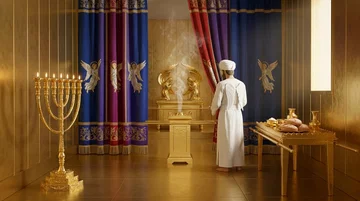
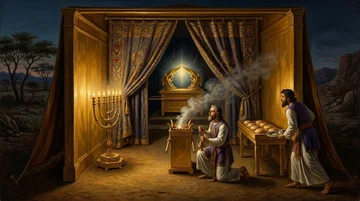
The table made to be borne with its staves is the table of showbread, or presence bread, standing in the first apartment or holy place together with the golden candlestick and the altar of incense.RH Aug 4, 1863RH Dec 24, 1908RH Jun 21, 1864RH May 11, 1869RH Aug 3, 1916 It is separate from the second apartment containing the ark with the ten commandments, with the mercy-seat and the cherubim over it.RH Aug 4, 1863RH May 11, 1869 The sanctuary and its furniture were patterned after the sanctuary in heaven where Christ ministers, so that articles found in the sanctuary built by Israel have corresponding articles in the sanctuary pitched by God.ST Nov 11, 1897 When erected, the table was placed without the veil on the north side of the holy place, to the right of the entrance just inside the entrance veil.RH Nov 8, 1915STRH Mar 1, 1870ST Mar 11, 1886ST Jun 20, 1911 It stood opposite the seven-branched candlestick on the south side, with the golden altar of incense before the inner veil and the ark containing the tables of stone beyond in the most holy place.ST Jun 20, 1911 That arrangement stood within a small gold-overlaid building divided by veils and set in a linen-hung court entered from the east, with the brazen altar of burnt offerings and the laver outside.ST Jun 20, 1911
The table held the showbread continually before the Lord, set in order upon it, ever before His face.RH Jan 6, 1853RH Mar 1, 1870RH Aug 3, 1916 It is called the table of showbread because it was ever before the face of the Lord, which indicates the abiding presence in some sense of the divine Being in the first apartment.RH Aug 3, 1916 The bread consisted of twelve loaves or cakes, with frankincense sprinkled on them.ST Apr 1, 1913 They were renewed fresh every Sabbath, and the removed cakes were eaten by the priests.RH Jul 27, 1916ST Apr 1, 1913 One teaching describes the table as standing opposite the seven-branched candlestick and holding two loaves freshly placed every Sabbath as a token of God's providing mercy toward His twelve chosen tribes.RH Feb 10, 1910
The table was a furnishing of the windowless sacred apartments kept in light day and night by the candlestick beaten from one solid piece of gold with seven lamps.ST Mar 21, 1911 Overlaid so that it glittered like burnished gold, it stood with gold-plated walls reflecting the lamplight around it.ST Mar 21, 1911ST Mar 4, 1903 Richly embroidered blue and purple and scarlet curtains with shining cherubim and the altar of incense surrounded it, presenting a scene of magnificence and glory.ST Mar 21, 1911
Symbol and Teaching
The sanctuary and its services were given as an earthly object lesson of God's plan of salvation and of His government, and the direction for the table's carrying poles belongs to that explicit instruction for building the sanctuary and preparing its services. The tabernacle with its furnishings was an earthly object lesson of Christ and of God's dwelling among His people. The instructions for building the sanctuary were made according to a pattern shown by God and served as an object lesson of Christ's priestly work in the heavenly sanctuary, belonging to the larger account of the sanctuary's construction, the consecration of the priests, and the erection and anointing of the tabernacle.ST Nov 23, 1904 The account of building the tabernacle belongs to a larger revelation whose theme is Christ, so that the construction of the tabernacle, including the practical provision of acacia-wood poles overlaid with gold for bearing the table, points to Christ.RH Dec 31, 1901
The table stood on the north side of the holy place and represented the Word of God.STST Aug 19, 1913ST Dec 29, 1909 It was the table of showbread, whose bread was set out fresh each Sabbath and represented God's bread of life, His Word. The table of showbread stood in the holy place to the right of the entrance and held twelve loaves representing heaven's sustaining care for Israel's twelve tribes.RH Jul 27, 1916 The loaves were replaced each Sabbath, showing that fresh blessings were available on God's holy day to sustain the people through the following week.RH Jul 27, 1916 Those who describe it as holding two loaves freshly placed every Sabbath present it as a token of God's providing mercy toward His twelve chosen tribes.RH Feb 10, 1910
The table stood in the first apartment, or holy place, of the wilderness sanctuary together with the candlestick and the altar of incense, and it was called the table of showbread because it was ever before the face of the Lord.RH Aug 3, 1916 Its being ever before His face indicates the abiding presence in some sense of the divine Being in the first apartment.RH Aug 3, 1916 As part of the earthly sanctuary standing in the first apartment, the table with its shittim-wood poles overlaid with gold for carrying belonged to a pattern that taught God's way in the sanctuary and pointed to the heavenly sanctuary.ST Jun 19, 1907 Earthly things could not fully represent heavenly things.ST Jun 19, 1907
Pattern Heaven and Covenant
The sanctuary with its two holy places was made according to the pattern shown to Moses and served as a pattern of the heavenly temple where Jesus now ministers, a sanctuary pitched by God rather than man.ST May 16, 1878ST Dec 3, 1874RH Nov 3, 1874ST Jun 14, 1883RH Feb 21, 1856 That ancient tabernacle was built for ministration involving sacrifices and offerings, and its sacrificial services passed away when Christ died.ST Jan 24, 1911 The wilderness tabernacle was the sanctuary of the first covenant and served as the type or pattern of the heavenly sanctuary of the new covenant.ST Dec 3, 1874RH Nov 3, 1874ST Jun 14, 1883
Articles found in the sanctuary built by Israel have corresponding articles in the sanctuary in heaven where Christ ministers.ST Nov 11, 1897 The table of showbread was an article of furniture in the first apartment of the earthly sanctuary, together with the candlestick and the altar of incense, made with staves of shittim wood overlaid with gold for carrying it, and the sanctuary and its instruments of furniture were patterned after the sanctuary in heaven.ST Nov 11, 1897
The sanctuary where the plan of redemption is carried forward was a building or tabernacle located in the midst of the camp of Israel as a dwelling place for God.RH Oct 15, 1901 There were the law, the priesthood, the sacrifices, and the symbols of pardon and forgiveness, where the penitent came confessing sins and sending them through the blood of the victim and the ministration of the priest into the sanctuary, where atonement was made and sins in figure put away.RH Oct 15, 1901 That worldly sanctuary was first pitched in the wilderness after the deliverance from Egypt and afterward succeeded by Solomon's temple, with explicit directions given to Moses in the mount for its dimensions, material and furnishings by which God dwelt among men.ST Jun 26, 1907 As part of that typical system it served unto the shadow of heavenly things and pointed to the coming Messiah and His power to forgive sin, transform character and deliver from burdens, answering every purpose for which it was constructed until it passed away entirely and forever when the veil was rent at the death of Christ.ST Jun 26, 1907
The full minute description beginning in Exodus 25 of the tabernacle erected by Moses with a holy and a most holy place and various vessels of service and their uses identifies it as the sanctuary of the first covenant during the time from Sinai to Christ.RH Jul 19, 1870ST Dec 8, 1881ST Aug 30, 1877 That distinct and plainly defined object clears the field of doubt and sets the right track of inquiry by showing what positively for a time constituted the sanctuary.ST Dec 8, 1881 The tabernacle built by Moses in the wilderness of Sinai was later embodied in the temples of Solomon, Zerubbabel, and Herod, and the direction that the table's carrying poles be made of acacia wood and covered with gold so the table can be carried belongs to that detailed description of the worldly sanctuary connected with the first covenant.ST May 17, 1877ST Aug 5, 1889ST Aug 30, 1877
The carrying poles for the table of showbread belong to the objects in the earthly sanctuary, and the table is named as an example of a sanctuary object for which the earth offers no corresponding antitype, supporting that the earth is not the sanctuary.RH Feb 18, 1858 The table of showbread with its gold-covered wooden carrying poles is treated as a sanctuary furnishing whose proposed earthly antitype would need to correspond to it.ST May 27, 1880 God's instruction in Exodus 25:1-40 to make objects and figures for the sanctuary, including cherubim woven into its curtains for use in worship rather than for worship themselves, shows that making useful or beautiful things to glorify God is permitted, while the commandment forbids making an image in order to worship it.ST Jun 3, 1908
History and Fulfillment
The table for the presence bread stood in the holy place of the temple and was counted among the most important and most sacred vessels.ST May 14, 1902 After the destruction of Jerusalem it was carried to Rome as spoil.ST May 14, 1902 It was sculptured on the Arch of Titus with two cups upon it and two trumpets in front of it and a sign-board such as Roman standard-bearers carried, beside the book of the law and the seven-branched golden candlestick, while many other precious spoils of the temple were left unsculptured.ST May 14, 1902
The verse belongs among the instructions giving the particulars for building the sanctuary and its furnishings, concerning the portable dwelling God commanded Israel to build.ST Oct 25, 1905ST Jul 8, 1930 The table for the presence bread stood in the holy place, and the verse specifies how it was made portable and borne by its staves.ST Oct 25, 1905ST Jul 8, 1930 The same chapter gives the description of the ark, which was the central point of Israel's true worship because God manifested His presence from between the cherubim on the mercy-seat and because the tables of stone containing the ten commandments, God's moral law, were laid underneath the mercy-seat within the ark.ST Jul 2, 1896 It gives express direction for moving the ark, that it was to be carried by means of the staves and by the sons of Kohath of the Levites, leaving no excuse for moving it in any other way.ST Jul 2, 1896
Sources