Exodus 5:14
And the officers of the children of Israel, which Pharaoh’s taskmasters had set over them, were beaten, and demanded, Wherefore have ye not fulfilled your task in making brick both yesterday and to day, as heretofore?
Translations
And the officers of the children of Israel, which Pharaoh’s taskmasters had set over them, were beaten, and demanded, Why have you not fulfilled your task in making brick both yesterday and to day, as heretofore?
King James Version, KJV Cambridge Paragraph Bible
And the officers of the children of Israel, which Pharaoh’s taskmasters had set over them, were beaten, and demanded, Wherefore have ye not fulfilled your task in making brick both yesterday and to day, as heretofore?
And the officers of the children of Israel, which Pharaoh's task-masters had set over them, were beaten, and demanded, Why have ye not fulfilled your task in making brick, both yesterday and to-day, as heretofore?
And the officers of the children of Israel, which Pharaoh’s taskmasters had set over them, were beaten, and demanded, Wherefore have ye not fulfilled your task both yesterday and today, in making brick as heretofore?
And the officers of the children of Israel, whom Pharaoh’s taskmasters had set over them, were beaten, and demanded, Wherefore have ye not fulfilled your task both yesterday and to-day, in making brick as heretofore?
And the authorities of the sons of Israel, whom the exactors of Pharaoh have placed over them, are beaten, saying, 'Wherefore have ye not completed your portion in making brick as heretofore, both yesterday and to-day?'
And the officers of the children of Israel, whom Pharaoh's taskmasters had set over them, were beaten, [ and] it was said, Why have ye not fulfilled your task in making brick, both yesterday and to-day, as heretofore?
Then were beaten the overseers of the sons of Israel, whom the taskmasters of Pharaoh had set over them saying: Wherefore have ye not completed your task for making bricks, as heretofore, so also, yesterday and, to-day?
Berean Standard Bible, Majority Standard Bible
Then the Israelite foremen, whom Pharaoh’s taskmasters had set over the people, were beaten and asked, “ Why have you not fulfilled your quota of bricks yesterday or today, as you did before?”
The officers of the children of Israel, whom Pharaoh’s taskmasters had set over them, were beaten, and were asked, “ Why haven’t you fulfilled your quota both yesterday and today, in making brick as before?”
And the responsible men of the children of Israel, whom Pharaoh's overseers had put over them, were given blows, and they said to them, Why have you not done your regular work, in making bricks as before?
And the officers of the children of Israel, which Pharaohs taskemasters had set ouer them, were beaten, and demanded, Wherefore haue ye not fulfilled your taske in making bricke yesterday and to daye, as in times past?
Douay-Rheims (Challoner revision)
And they that were over the works of the children of Israel were scourged by Pharao’s taskmasters, saying: Why have you not made up the task of bricks both yesterday and today as before?
Pictures
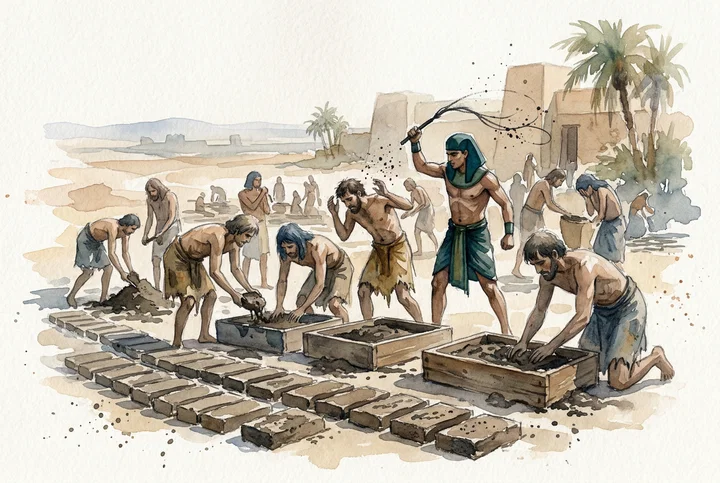
Cross-references
- Exodus 5:7-8
Ye shall no more give the people straw to make brick, as heretofore: let them go and gather straw for themselves.
Straw is withheld while the brick quota remains unchanged, making failure certain.
- Exodus 1:13-14
And the Egyptians made the children of Israel to serve with rigour:
Describes the harsh forced labor imposed on Israel in Egypt.
- Exodus 3:7
And the LORD said, I have surely seen the affliction of my people which are in Egypt, and have heard their cry by reason of their taskmasters; for I know their sorrows;
God sees Israel’s affliction under Egyptian oppression and hears their cry.
- Exodus 5:19-21
And the officers of the children of Israel did see that they were in evil case, after it was said, Ye shall not minish ought from your bricks of your daily task.
The officers face the consequences and reproach Moses and Aaron.
- Exodus 5:1-4
And afterward Moses and Aaron went in, and told Pharaoh, Thus saith the LORD God of Israel, Let my people go, that they may hold a feast unto me in the wilderness.
Pharaoh refuses Israel’s release and responds with harsher labor.
- Exodus 5:5
And Pharaoh said, Behold, the people of the land now are many, and ye make them rest from their burdens.
Pharaoh objects that Moses is making the people rest from their burdens.
- Deuteronomy 4:20
But the LORD hath taken you, and brought you forth out of the iron furnace, even out of Egypt, to be unto him a people of inheritance, as ye are this day.
Calls Egypt an iron furnace from which God brought Israel.
- Exodus 5:8
And the tale of the bricks, which they did make heretofore, ye shall lay upon them; ye shall not diminish ought thereof: for they be idle; therefore they cry, saying, Let us go and sacrifice to our God.
Pharaoh’s refusal to recognize the Lord accompanies forced labor.
- Exodus 1:11
Therefore they did set over them taskmasters to afflict them with their burdens. And they built for Pharaoh treasure cities, Pithom and Raamses.
Pithom was a store city built by Israelite labor.
- Exodus 5:18
Go therefore now, and work; for there shall no straw be given you, yet shall ye deliver the tale of bricks.
The order to make bricks without straw echoes the lack of resources.
- Exodus 5:9
Let there more work be laid upon the men, that they may labour therein; and let them not regard vain words.
Pharaoh increases Israel’s work and dismisses their words as empty.
- Acts 7:34
I have seen, I have seen the affliction of my people which is in Egypt, and I have heard their groaning, and am come down to deliver them. And now come, I will send thee into Egypt.
Recalls God seeing Israel’s affliction in Egypt.
- Exodus 5:22-23
And Moses returned unto the LORD, and said, Lord, wherefore hast thou so evil entreated this people? why is it that thou hast sent me?
Moses complains deliverance delayed while evil increased
Commentary
Each commentary is drawn from primary sources: the writings of Ellen G. White and Adventist pioneers and periodicals. Each commentary is separate. Its own words are not a quotation; follow the references to read the source passages.
Ellen G. White
15 sources
The Egyptian taskmasters set over Israel held Hebrew officers under them responsible for overseeing the work and compelling the people to perform their usual amount of labor.SG3 198.11SP 177.1–180.1 Pharaoh greatly increased that labor by requiring the people to find their own straw while keeping the brick quota unchanged, so that scattered to gather stubble they could not fulfill it, and the officers were beaten and demanded to answer why the task had not been done yesterday and today as heretofore.SG3 198.11SP 177.1–180.1ST Mar 4, 1880 Thinking their oppression came from the taskmasters rather than the king, the officers carried their grievance to Pharaoh, but he hardened his heart against their distress and mocked them, while their beating exposed that Israel expected deliverance without trial of faith and was unwilling to patiently endure affliction until God should work it.1SP 177.1–180.1SG3 199.1 The verse thus stands as the great example of the cruelty and injustice of demanding work while withholding what is needed to do it.Lt 92, 1902, par. 14–15Lt 23, 1905, par. 5Lt 119, 1902, par. 18–2418MR 67.2–3 To send missionaries and workers out, to press for books and enlarged work, or to demand results through shortsighted ambition without providing adequate facilities, means, help, and money repeats that same impossible burden.Lt 92, 1902, par. 14–1518MR 67.2–3Lt 2, 1899, par. 14–15Ms 3, 1897, par. 22Lt 262, 1899, par. 2–5
Beating of Hebrew Officers
The taskmasters set over Israel were Egyptians, while the officers under them were Hebrews who had oversight of the work, directed the people, and were responsible for compelling them to perform their usual amount of labor.SG3 198.11SP 177.1–180.1 Pharaoh greatly increased the labor by the unjust requirement that the people find their own straw while the brick quota stayed unchanged.SG3 198.11SP 177.1–180.1ST Mar 4, 1880PP 258.3–4 The people were therefore scattered abroad throughout Egypt gathering scattered straw and stubble from the fields, and they could not perform their usual amount.SG3 198.11SP 177.1–180.1ST Mar 4, 1880 Though the Egyptian taskmasters still hastened them to fulfill their daily tasks as when straw was given, the full amount was not accomplished.SG3 198.11SP 177.1–180.1SG3 199.1
The Hebrew officers were then called to account and cruelly beaten and demanded to answer why the brick task had not been fulfilled yesterday and today as heretofore, being held responsible between the taskmasters who hastened the work and the suffering people.SG3 198.11SP 177.1–180.1ST Mar 4, 1880SG3 199.1PP 258.3–4 This beating for failure to meet the imposed quota after the means to do it were withheld shows slavery made more cruel by a more unfeeling heart.SG3 198.1ST Mar 4, 1880Lt 140, 1898, par. 8 The officers thought their oppression came from the taskmasters and not from the king himself, so they took their grievances about cruel treatment to Pharaoh, but his heart was hardened against their distress and he derided and mocked their complaints with hatred against them.SG3 199.1 Their suffering exposed that Israel expected deliverance from bondage without any particular trial of faith or suffering on their part, having but little faith and being unwilling to patiently suffer and perseveringly endure affliction until God should work for them a glorious deliverance, and so they were not prepared to be delivered.1SP 177.1–180.1
Working Without Needed Means
The verse shows the cruelty and injustice of demanding work while withholding what is needed to do it, for the officers were beaten because the people could not meet the brick quota after straw was withheld.Lt 92, 1902, par. 14–1518MR 67.2–3 To send missionaries to foreign fields without adequate facilities and means imposes the same impossible burden.Lt 92, 1902, par. 14–15 To send workers out to labor while providing neither the facilities nor the help they need repeats the hardship of holding workers responsible for demands they cannot meet.Ms 3, 1897, par. 22 Shortsighted ambition that demands results without giving workers needed support or regard for one another repeats that same injustice.18MR 67.2–3
Being held responsible for work made harder by the decisions of others is the burden illustrated when the same amount of work was still demanded and the officers were beaten when the quota was not met.21MR 359.6–360.1 The brickmaking setting is an image of hardship caused by severe demands joined with lack of resources.Lt 23, 1905, par. 5 The phrase about making bricks without straw describes workers making desperate efforts to meet demands despite lacking the resources they need.Lt 119, 1902, par. 18–24
The work in Australia could not be enlarged without the means and facilities needed to begin and continue it, for workers cannot make bricks without straw.Lt 2, 1899, par. 14–15 The work at Cooranbong lacked the basic facilities and funds needed to carry it on, so workers could not produce the needed publications and outreach materials, like being pressed to meet a brick quota after straw was withheld.Lt 140, 1898, par. 16 Demanding the production of books without providing the money needed to pay the workers who make them repeats the situation of punishing the officers when the people could not meet the quota after being denied straw.Lt 262, 1899, par. 2–5
Sources
Pioneers and periodicals
35 sources
The verse records Israelite foremen placed over the laborers under Egyptian taskmasters being beaten and called to account for failing to deliver the same daily number of bricks as before after the supply of straw was cut off and they were forced to gather stubble for themselves.ST Mar 4, 1880RH Mar 25, 1909ST Jan 20, 1909 It stands at the beginning of the deliverance after Moses and Aaron first demanded leave to go worship in the wilderness, when Moses was recalling the people to Sabbath rest and Pharaoh answered by making the work heavier and unceasing so they could not keep it.ST Aug 1, 1911RH Mar 25, 1909ST Feb 4, 1913ST Apr 28, 1909 God therefore wrought deliverance with a mighty hand to bring them out of the house of bondage to a place where they could keep the Sabbath and freely obey his law, which Deuteronomy recalls in commanding rest for servants.ST Aug 1, 1911ST Oct 11, 1883RH Feb 3, 1852 Those who held the contrary taught that the quarrel was only over brickmaking with no dispute about a rest day, showing Israel was not keeping the seventh day in Egypt.ST Oct 21, 1889 Unlike Pharaoh the hard master who demanded the full task without furnishing the means, God as Father and Christ as Master supply strength and all that is needed for obedience, so his service is perfect freedom and his commandments are not grievous.ST Sep 22, 1881ST Jan 30, 1912RH Mar 26, 1861
Bondage in Brick Yards
Exodus 5:14 belongs to the opening history of Exodus, chapters 1 to 18, and to the record of God's call to earthly kingdoms about three and one-half millenniums ago when Egypt was the greatest kingdom acknowledged for might and power and skill and statecraft.ST Nov 14, 1906RH Jan 20, 1916 It comes after the family that closed Genesis comfortable and prosperous in Egypt had grown greater and mightier than the Egyptians.RH Jan 20, 1916 It shows the severer oppression that followed the first appearance of Moses and Aaron before Pharaoh and the beginning of the demand to go into the wilderness to worship.ST Feb 4, 1913 It stands at the beginning of the deliverance in contrast to the song of triumph beyond the Red Sea when Egypt's host was overthrown, revealing God's mighty creative power in saving a nation as never done before.ST Jan 30, 1912
The oppression was a long and terrible bitter servitude described as the iron furnace following brief prosperity.RH Dec 17, 1861 The horror of great darkness and the smoking furnace seen by Abraham in vision foreshadowed this servitude, which the family of Abraham had to go down into Egypt to endure.RH Dec 17, 1861 Pharaoh's taskmasters had set Israelite officers over the workers and held them responsible for the daily brick quota.ST Mar 4, 1880RH Mar 25, 1909ST Jan 20, 1909 When Pharaoh stopped supplying straw but kept the required amount unchanged, the people had to gather stubble from the field for themselves.ST Mar 4, 1880RH Jun 25, 1901ST Mar 18, 1880RH Sep 23, 1862 They failed to meet the task in making brick both yesterday and today as heretofore.ST Mar 4, 1880RH Jun 25, 1901RH Sep 23, 1862
The officers were beaten and questioned wherefore they had not fulfilled the task, placed between the taskmasters and the suffering people under cruel, burdensome, impossible exaction every day.ST Mar 4, 1880RH Mar 25, 1909ST Jan 20, 1909RH Jun 25, 1901ST Mar 18, 1880 The chapter portrays cruel tasks imposed with no allowance, and the workers labored every day.RH Mar 25, 1909ST Jan 20, 1909 The demand for the full quota while withholding straw was cruel exaction of impossible labor.ST Mar 18, 1880RH Sep 23, 1862
The brickmaking account is historically consistent with the store-city of Pithom and its great brick storehouses for preserving grain in war or famine.RH Apr 23, 1908ST Aug 12, 1913ST Nov 20, 1884 Its brick chambers built with mortar include bricks containing chopped straw mixed with Nile mud and bricks lacking straw.RH Apr 23, 1908RH Nov 27, 1866ST Aug 12, 1913ST Oct 21, 1930 Egyptian monuments with pictures and accounts of slaves with Hebrew features making brick in the same way illustrate the habits, customs, land and people described.ST Nov 20, 1884 They contain no record of the miracles because kings do not report their disasters.ST Nov 20, 1884 The discovery of those storehouses, including bricks made with straw and bricks made without it, confirms the historical setting of the account of Hebrew slaves making bricks for Pharaoh's storehouses without straw while still held to their required output.RH Apr 23, 1908ST Aug 12, 1913ST Oct 21, 1930
Sabbath Denied and Restored
Moses was teaching the people to observe the Sabbath, and with Aaron sought to bring them back to Sabbath observance and rest for worship of Jehovah.ST Aug 1, 1911ST Apr 28, 1909ST Oct 21, 1889ST Mar 7, 1906RH May 27, 1852 Pharaoh charged Moses and Aaron with making the people rest from labor and resisted that instruction.ST Aug 1, 1911RH Mar 25, 1909ST Apr 28, 1909 To stop Sabbath-keeping he made the labor more burdensome by withholding straw, requiring stubble-gathering from the field, and fixing an unvarying daily quota with no allowance for keeping a day.ST Aug 1, 1911ST Apr 28, 1909ST Mar 7, 1906RH May 27, 1852 As servants in Egypt working every day Israel could not keep the Sabbath, and under that added hardship Israel murmured and complained bitterly.ST Aug 1, 1911ST Apr 28, 1909ST Oct 21, 1889ST Mar 7, 1906RH May 27, 1852
Under forced labor and cruel oppression Israel was in great measure prevented from practically observing God's law and could not have kept the Sabbath even if desired, though the other nine commandments might have been kept.ST Aug 1, 1911ST Oct 11, 1883RH Feb 3, 1852RH May 16, 1854 The quota had previously been achievable in six days, leaving the seventh day for holy rest.RH Jun 20, 1912 God wrought deliverance with a mighty hand to bring them where they could keep the Sabbath and enjoy the privilege of obeying and serving him in a land flowing with milk and honey.ST Aug 1, 1911ST Oct 11, 1883RH May 16, 1854 He spoke his law to the whole multitude and gave it in lasting form to help them enjoy liberty.ST Oct 11, 1883 Deuteronomy 5:14,15 recalls this denial of rest when commanding Israel to let servants rest with them on the Sabbath and not treat servants as Israel was treated in Egypt.ST Aug 1, 1911RH May 16, 1854
Israel's inability to keep the Sabbath under bondage explains why God enforced its observance after delivering them, and is the reason Deuteronomy gives for now requiring it, not the design of its institution.RH May 16, 1854RH May 27, 1852 It does not show that the Sabbath itself began after the Exodus.RH May 27, 1852
By a contrary reading, the trouble between Pharaoh and the officers and Hebrew slaves was over brick-making work and other irritations with no hint or statement of conflict over a sacred rest-day.ST Oct 21, 1889 The lack of any dispute about refusing to work on Saturday shows Israel was not keeping a seventh-day Sabbath in Egypt.ST Oct 21, 1889 Egypt kept Sunday as its sacred day for sun worship, so Israel kept the same first-day sabbath as Egypt.ST Oct 21, 1889
Egypt was not liberty but the house of bondage.ST Oct 11, 1883 Hundreds of years of cruel slavery had unfitted Israel to comprehend God's great salvation and the character he required. Though redeemed with a mighty hand they needed a great multiple object-lesson by various forms and rites teaching the whole plan of salvation, leading God to have them bring free-will offerings and make him a sanctuary that he might dwell among them. The persecution by idolatrous Egyptians of Hebrews who worshiped the true God proves that he that was born after the flesh persecutes him that was born after the Spirit and that the wicked persecute the righteous.RH Jun 8, 1916
Warnings and Gospel Comfort
Pharaoh was a hard, close-fisted master in a hurry for brick who laid onerous burdens on the makers and gave them no time to read or pray, beating the officers when the task was not fulfilled.RH May 17, 1860 The same ugly sin is committed by modern oppressors who make rapacious demands for more work with cutting reproaches, and by the upholders of American slavery who act like those taskmasters in cruel exaction.RH May 17, 1860RH Sep 23, 1862 The North shares the guilt and cannot excuse itself by saying England forced slavery upon it, since forgetting the brother in bonds and voting for ambitious men who embrace slavery makes the people responsible and leaves them to grapple with its consequences.RH Sep 23, 1862 Escape from coming national punishment is only by repentance toward God and withdrawing national support from slavery, by being humbled and praying for a little respite until God's servants are sealed for the kingdom.RH Sep 23, 1862 The oppressed should be pitied and speedily delivered from their burdens, while the oppressor is warned that such doctrine will only be a millstone to sink him in an ocean deep as eternity.RH May 17, 1860RH Sep 23, 1862
A hard master makes a bad servant by stirring up evil passions and sinking him lower than he thought possible, until discouragement of mind afflicts the body so that strength fails, arm trembles and knees grow weak while bearing burdens to earn something for family.RH May 17, 1860 By contrast a kind, good master wins a good servant bound by loving loyalty.RH May 17, 1860 The phrase about making brick without straw became the title of a story about the Negro exodus.ST Jun 3, 1880 The command to make bricks without straw did not order making bricks with no material at all, but required gathering the straw instead of having it brought while still fulfilling the same task, adding to the labor.RH Jan 25, 1906
Even Pharaoh in cruelty and oppression never commanded slaves to labor with no means whatever, because that would command the impossible as the condition of life and welfare.RH Jan 25, 1906 Since not even Pharaoh did this, God who commanded men to labor must have granted all men the right to the necessary means and opportunity to labor.RH Jan 25, 1906 The oppression also shows Egypt's ingratitude and guilt, for Joseph had been Egypt's saviour and deliverer, yet Egypt quickly forgot him, enslaved his descendants in the brick-kilns, set them to make brick without material, beat them when they failed, and murdered their infants lest its own iniquity be found out. It was a cruelty no man would have borne from an enemy, yet God bore with it, leaving men without excuse.
Working for Pharaoh under the lash with sighing and crying over the full task demanded yesterday and today as heretofore without straw stands opposite to working for God as Father.ST Sep 22, 1881 God guarantees strength, supplies all materials, fellowships with workers while they work, forgives blunders, and quickly accepts the work in love, so His service is perfect freedom to be done cheerfully for the sheer joy of doing it even apart from reward.ST Sep 22, 1881 Prospective ministers must not try to do their task without the needed means.ST Jan 30, 1912 Christ is not a hard master or cruel slave-holder keeping His children on short allowance and near famine.RH Mar 26, 1861 He does not supply spiritual wants sparingly nor require service beyond the possibility of obedience by grace in this life, for His commandments are not grievous and His yoke is not too heavy, and to represent Him as requiring brick without straw is the opposite of His teaching.RH Mar 26, 1861
Moses in Egypt acted wisely in opposing Pharaoh's scheme against Israel, an example of wise resistance to an evil plan standing alongside Noah at the flood, Abraham in Canaan, David with Saul, John the Baptist, Paul before the Roman tribunal, and Elijah opposing Jezebel.RH Dec 4, 1913
Sources