Genesis 27:25
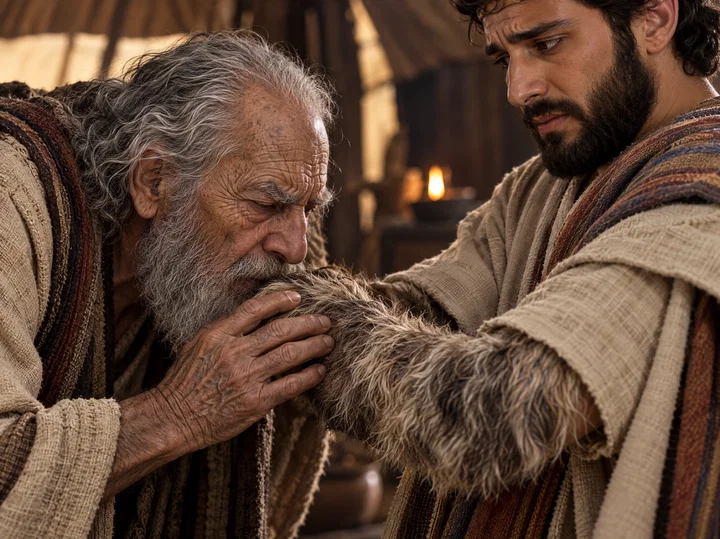
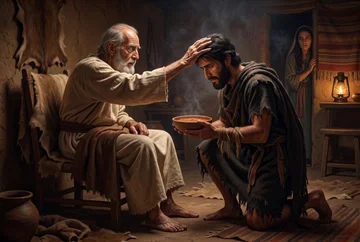
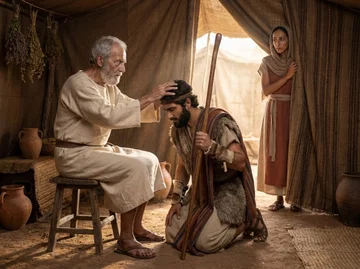
And he said, Bring it near to me, and I will eat of my son’s venison, that my soul may bless thee. And he brought it near to him, and he did eat: and he brought him wine, and he drank.
Translations
And he said, Bring it near to me, and I will eat of my son’s venison, that my soul may bless you. And he brought it near to him, and he did eat: and he brought him wine and he drank.
King James Version, KJV Cambridge Paragraph Bible, Revised Version, American Standard Version
And he said, Bring it near to me, and I will eat of my son’s venison, that my soul may bless thee. And he brought it near to him, and he did eat: and he brought him wine, and he drank.
And he said, bring it near to me, and I will eat of my son's venison, that my soul may bless thee. And he brought it near to him, and he ate: and he brought him wine, and he drank.
And he saith, 'Bring nigh to me, and I do eat of my son's provision, so that my soul doth bless thee;' and he bringeth nigh to him, and he eateth; and he bringeth to him wine, and he drinketh.
And he said, Bring [ it] near to me, that I may eat of my son's venison, in order that my soul may bless thee. And he brought [ it] near to him, and he ate; and he brought him wine, and he drank.
So he said, Bring it near to me., that I may eat of the game of my son, To the end my soul may bless thee. And he brought it near to him, and he did eat, and he brought in to him wine, and he drank.
Berean Standard Bible, Majority Standard Bible
“Serve me,” said Isaac, “ and let me eat some of my son’s game, so that I may bless you.”Jacob brought it to him, and he ate; then he brought him wine, and he drank.
He said, “ Bring it near to me, and I will eat of my son’s venison, that my soul may bless you.”He brought it near to him, and he ate. He brought him wine, and he drank.
And he said, Put it before me and I will take of my son's meat, so that I may give you a blessing. And he put it before him and he took it; and he gave him wine, and he had a drink.
Then said he, Bring it me hither, and I will eate of my sonnes venison, that my soule may blesse thee. And he brought it to him, and he ate: also he brought him wine, and he dranke.
Douay-Rheims (Challoner revision)
Then he said: Bring me the meats of thy hunting, my son, that my soul may bless thee. And when they were brought, and he had eaten, he offered him wine also, which after he had drunk,
Pictures
Cross-references
- Genesis 25:29-34
And Jacob sod pottage: and Esau came from the field, and he was faint:
Jacob obtained Esau’s birthright for food before Esau sought the blessing.
- Genesis 25:23
And the LORD said unto her, Two nations are in thy womb, and two manner of people shall be separated from thy bowels; and the one people shall be stronger than the other people; and the elder shall serve the younger.
God foretold that the elder would serve the younger, framing the brothers’ dispute over the blessing.
- Genesis 27:3-4
Now therefore take, I pray thee, thy weapons, thy quiver and thy bow, and go out to the field, and take me some venison;
Isaac asks Esau to prepare venison before blessing him.
- Hebrews 12:16-17
Lest there be any fornicator, or profane person, as Esau, who for one morsel of meat sold his birthright.
Esau’s sale of his birthright is followed by his rejected plea for the blessing.
- Genesis 27:41-45
And Esau hated Jacob because of the blessing wherewith his father blessed him: and Esau said in his heart, The days of mourning for my father are at hand; then will I slay my brother Jacob.
Esau’s death threat over the blessing drives Jacob to flee.
- Genesis 28:12-15
And he dreamed, and behold a ladder set up on the earth, and the top of it reached to heaven: and behold the angels of God ascending and descending on it.
Jacob’s flight after deceiving Isaac leads to God’s vision and promises of blessing and protection.
- Genesis 27:35-36
And he said, Thy brother came with subtilty, and hath taken away thy blessing.
Jacob obtained Isaac’s blessing through subtilty, supplanting Esau.
- Hebrews 11:20
By faith Isaac blessed Jacob and Esau concerning things to come.
Isaac’s blessing of Jacob and Esau was an act of faith.
- Genesis 25:28
And Isaac loved Esau, because he did eat of his venison: but Rebekah loved Jacob.
Explains Isaac’s love for Esau in the chapter’s setting.
- Genesis 28:1-2
And Isaac called Jacob, and blessed him, and charged him, and said unto him, Thou shalt not take a wife of the daughters of Canaan.
After the deception, Jacob is sent to relatives to find a wife.
- Romans 9:13
As it is written, Jacob have I loved, but Esau have I hated.
Quotes the declaration about Jacob and Esau in their Genesis account.
- Genesis 29:25
And it came to pass, that in the morning, behold, it was Leah: and he said to Laban, What is this thou hast done unto me? did not I serve with thee for Rachel? wherefore then hast thou beguiled me?
Jacob, who deceived Isaac, is himself deceived by Laban.
- Genesis 32:26-29
And he said, Let me go, for the day breaketh. And he said, I will not let thee go, except thou bless me.
Jacob wrestles for a blessing after taking his brother’s blessing.
- Genesis 48:14-20
And Israel stretched out his right hand, and laid it upon Ephraim’s head, who was the younger, and his left hand upon Manasseh’s head, guiding his hands wittingly; for Manasseh was the firstborn.
Jacob’s crossed hands show God’s purpose prevailing over human expectations in blessing.
Commentary
Each commentary is drawn from primary sources: the writings of Ellen G. White and Adventist pioneers and periodicals. Each commentary is separate. Its own words are not a quotation; follow the references to read the source passages.
Ellen G. White
19 sources
Isaac was old and nearly blind and favored Esau, and he asked for prepared meat to eat before giving his dying blessing, and Jacob came with food and wine which Isaac ate and drank as the feast before the blessing intended for Esau, obtaining it by posing as his brother.1SP 107.1ST Apr 17, 1879SG3 115.1SG3 114.1 God did not prompt this fraud to secure the promise already given to the younger son, but Jacob acted from lack of faith and tried by his own deceptive effort to bring about what God was fully able to accomplish in His own time and way.SG3 115.1Ms 139, 1899, par. 17–21PP 197.2–198.1 That deception brought sorrow and lasting retribution, forcing Jacob to flee for his life into twenty years of exile where he was himself wronged and defrauded, with the evil cropping out again in his sons.ED 147.1–24SP 432.3ST Jan 29, 1880 His wrong made him a supplanter and deceiver until he truly repented before his night of wrestling and prayer, when his sin was forgiven and his name changed to commemorate victory, without which repentance God would not have heard his plea for deliverance from Esau.SG3 133.2PP 197.2–198.1PP 201.3–202.2 Concealed, unconfessed sin leaves a person unable to plead confidently for deliverance in trouble, so past fraud must be repented and put away and blotted out before God will save in the final struggle.GC 619.2–620.14SP 437.2PP 201.3–202.2
The Meal and Deception
Isaac was old and nearly blind and favored his firstborn, and he asked the son he believed to be Esau to bring him prepared meat so that he could eat and then give him his blessing before he died.ST Apr 17, 1879SG3 114.1 He planned this blessing for Esau even though Esau had already sold his birthright, and even though he knew God's purpose was for Jacob to receive the promise.ST Apr 17, 1879SG3 114.1 The meal in the verse is that feast before the blessing Isaac intended for Esau, with Jacob bringing food and wine and Isaac eating and drinking.1SP 107.1ST Apr 17, 1879SG3 115.1 Jacob came as his son under deception to obtain that blessing, carrying out the fraud by bringing what his father ate and drank.SG3 115.1PP 195.1
God did not prompt Jacob and Rebekah to deceive Isaac, and the blessing and the foretold place of the younger son were not to be secured by fraud.SG3 115.1Ms 139, 1899, par. 17–21 Jacob showed lack of faith and did not trust God's promises, but sought by his own efforts to bring about by deception what God was fully able to accomplish in His own time and way without fraud.SG3 115.1PP 197.2–198.1ST Jan 29, 1880 God was fully able to provide for Jacob by His own methods without fraud, and He has not changed and will not connive at selfishness to carry out His plans nor work with any devising or planning after this example.Ms 139, 1899, par. 17–21 Rebekah and Jacob should have trusted God to fulfill His purposes in His own way and time rather than forcing His purpose through fraud.ST Apr 17, 1879SG3 115.1
The act means deceptive reasoning used to grasp advantage and turn a man from his rights, joined with partiality and hypocrisy.Lt 7, 1896, par. 1–4 It was covetousness, selfishness, ambitious pride, rivalry, conniving at evil, and underhand dealing to gain the advantage of a brother in order to obtain the blessing.Ms 139, 1899, par. 17–21 God in no case justifies or excuses such dealing, and angels veil their faces at it.Lt 7, 1896, par. 1–4 Such principles must be cleansed from mind and heart, for this unholy work hurts and finally ruins every soul who engages in it.Ms 139, 1899, par. 17–21
A father's blessing or firstborn privilege could not by itself ensure God's favor.1SP 107.1SG3 115.1 God alone gives prosperity or adversity according to a person's conduct, so Jacob would have been blessed if he loved and feared God even without those privileges, while a corrupt, God-defying course brings rejection.1SP 107.1SG3 115.1 The blessing's outcome was not dependent on Jacob's deception, for prosperity depended on loving and reverencing God.1SP 107.1SG3 115.1
Consequences, Repentance, Warning
The fraud to gain what was already his by God's promise brought sorrow and lasting consequences, for Esau's hatred and threats forced Jacob to flee for his life as a fugitive from his native land.ED 147.1–24SP 432.3ST Jan 29, 1880ST Feb 13, 1901 That flight led into twenty years of exile in which he was himself wronged and defrauded until forced to find safety in flight.ED 147.1–2 There was a second harvest when the evils of his own character cropped out in his sons.ED 147.1–2 The deception directly caused fear, self-reproach, and an accusing conscience when Jacob later faced the danger of meeting Esau, for he recognized his own sin had caused it.GC 616.2–3GC88 616.1–2 When he left Padan-aram in obedience to God's direction and retraced the road home, the memory of that sin was ever before him and made his journey sad and full of misgivings day and night, even as he also remembered God's favor toward him and God's promises of help and guidance.PP 195.1
The account shows the retributions of human life, where every deed reacts upon the doer.ED 147.1–2 Yet it does not end without hope, for this wrong did not cause God to forsake Jacob.ED 147.1–2ST Feb 13, 1901 God will not contend forever nor be always wroth but will heal, lead, and restore comforts and peace to him that is far off and to him that is near.ED 147.1–2 Obtaining the blessing by fraud was sin that made Jacob a supplanter and deceiver, and the name Jacob remained a reminder of that sin until it was forgiven and changed to commemorate victory.SG3 133.2PP 197.2–198.1PP 201.3–202.2 Jacob truly repented of that wrong before his night of wrestling and prayer, pointing back to that repentance when he pleaded for deliverance, and without that prior repentance God would not have heard his prayer and mercifully saved his life from Esau.SG3 133.2GC 619.2–620.14SP 437.2PP 201.3–202.2
Concealed, unconfessed sin leaves a person unable to plead confidently for deliverance in a time of trouble.GC 619.2–620.14SP 437.2 Only those whose sins have gone beforehand to judgment and have been blotted out can plead with confidence for deliverance.GC 619.2–620.1 If unconfessed sins remained, fear and anguish would overwhelm faith and cut off prayer, so past fraud must be repented and put away before God will deliver in the final struggle.GC 619.2–620.1PP 201.3–202.2 The same deception is practiced by men standing in high places of trust who handle men as machinery, bind their freedom, and rule as lords over God's heritage, wronging others by deceptive practices.Lt 7, 1896, par. 1–417MR 196.2–197.1 God has not changed and will not connive at selfishness to carry out His plans nor work with any devising or planning after this example, and such principles of covetousness, selfishness, ambitious pride, rivalry, conniving at evil and underhand dealing must be cleansed from mind and heart, for this unholy work hurts and finally ruins every soul who engages in it.Lt 7, 1896, par. 1–4Ms 139, 1899, par. 17–21
Sources
Pioneers and periodicals
54 sources
Isaac ate the meal and drank the wine brought to him in disguise before giving the covenant blessing, thinking he was blessing Esau the hunter son he favored.ST Apr 17, 1879ST Jul 31, 1901ST Sep 22, 1898ST The act was deliberate impersonation and falsehood by Jacob at his mother's urging to take the blessing meant for his brother.ST Feb 24, 1887ST Jan 3, 1911ST Mar 30, 1888ST Jan 14, 1913ST Feb 28, 1906 God had already decreed before birth that the elder would serve the younger and meant both birthright and blessing for Jacob, which He would have brought about in His own time and way if trusted.ST Jul 31, 1901ST Feb 26, 1894ST Oct 1, 1902 Rebekah and Jacob instead tried to secure the promise by human scheming, supposing their ingenuity must complete what God had spoken.ST Apr 17, 1879ST Jul 31, 1901RH Nov 16, 1916 Though the deception gained its immediate end, it brought long sorrow — flight, exile, separation, and retribution in kind — showing that wrongdoing is forgiven upon repentance yet still bears painful consequences in this life.ST Jul 31, 1901STST Jan 3, 1911ST Jan 9, 1912ST Jun 9, 1881
Meal Before the Blessing
The meal in the verse comes before the blessing, with Isaac eating the food Jacob brought to him and drinking the wine Jacob served him before he pronounced the blessing.ST Jul 31, 1901ST Sep 22, 1898ST Jan 9, 1912ST Jan 6, 1909 He ate believing the son before him was Esau, and he intended the blessing for Esau, who was out in the fields hunting at the time.ST Jul 31, 1901ST Sep 22, 1898ST Jan 9, 1912ST Jan 14, 1913 The bringing of the prepared venison and wine so that Isaac would eat and bless him was the carrying out of the deception, the seeking and obtaining of the blessing through impersonation and a lie.ST Jan 9, 1912ST Jan 6, 1909ST Jan 14, 1913 The wine itself had been prepared by Rebekah as part of that meal.ST Sep 22, 1898
Isaac was old and nearly blind, with dim sight that could not discern his own son.ST Apr 17, 1879RH Nov 4, 1858 He favored Esau, not for superior merit, but because Esau was a skillful and cunning hunter whose savory dishes and venison appealed to his aged father's appetite.ST Apr 17, 1879ST Feb 24, 1887ST Esau knew this weakness and, though he had foolishly sold his birthright, hoped that by ministering to that appetite he could still secure the coveted blessing as the highly favored firstborn.ST He did not tell his father that he had sold his birthright to Jacob, while Isaac planned to bless his favored firstborn despite knowing God's purpose was for Jacob to receive the promise.ST Apr 17, 1879ST Feb 24, 1887 Isaac had asked Esau to prepare venison so he could bless him before he died, and was arranging the feast before giving the blessing he meant for Esau.ST Apr 17, 1879ST Feb 24, 1887ST Oct 1, 1902
While Esau was out hunting the venison Isaac had requested, Rebekah overheard the father's call to Esau.ST Jul 31, 1901STST Oct 1, 1902 She feared the promise would be frustrated and urged Jacob into the deception, supposing she must do something by human ingenuity.ST Jul 31, 1901ST Oct 1, 1902 While Esau was in the fields she told Jacob to kill two kids, prepared the dinner herself with wine, put the skins on Jacob's neck and hands to imitate his brother's hairy skin, and sent him to deceive his father by personating Esau.ST Jul 31, 1901ST Oct 1, 1902RH Jul 4, 1865 Her artifice and Jacob's bringing of the prepared food and wine to Isaac, who ate and drank before giving the blessing, were the means by which the blessing was secured through deceit and double-dealing.STST Oct 1, 1902RH Jul 4, 1865
The blessing Isaac was preparing to give was the household's solemn ancestral consecration of the heir of the sacred covenant.ST Mar 31, 1881 Jacob had already purchased the claim to it, and God approved and sanctified his consecration, though the deceitful means were wrong and unnecessary because an honest representation of his claim would have sufficed.ST Mar 31, 1881 Isaac's words at that meal were prophetic, distinguishing the spiritual blessing of Jacob given in God's name from a carnal blessing given to Esau in his own name.ST Sep 22, 1898 The blessing belonged with the firstborn's birthright, which Esau had already sold to Jacob.
Fraud to Gain Blessing
The meal and wine belong to an act of trickery, fraud, duplicity, guile, dissimulation and deception by Jacob and his mother to steal from Esau the paternal blessing and inheritance through impersonation and a lie.ST Feb 28, 1906RH Mar 30, 1869RH Oct 4, 1864RH Apr 26, 1870ST Oct 6, 1914 By that fraud Jacob obtained his father's blessing that was designed for Esau, so that Esau the firstborn was given a second place and Jacob was forced to flee from home because of his brother's hatred.ST Jan 3, 1911ST Apr 1, 1897ST Apr 6, 1888 It was a blessing Esau later sought to inherit after deliberately selling his birthright, but he could not undo the deliberate trade.ST Mar 30, 1888 Deceitful, unbrotherly conduct brings sorrow back upon the wrongdoer, and though Jacob repented and was forgiven he suffered in this life because God abhors deception.RH Mar 30, 1869RH Apr 26, 1870 Laban later deceived him, and his sons deceived him about Joseph, causing him to mourn for years, yet he was still granted mercy and life to come.RH Mar 30, 1869 He was later made to see more clearly how heinous that sin was and how its effects would reach his posterity through generations, as they became increasingly deceitful, covetous and wicked, and his sin could not be put away without his prior repentance.RH Oct 4, 1864
The course fits the name Jacob, meaning supplanter, revealing an overreaching, mercenary and covetous character.ST Apr 1, 1897ST Apr 6, 1888 That character was joined to taking advantage of Esau's appetite in Genesis 25 to purchase the birthright, and then to obtaining the blessing by fraud.ST Apr 1, 1897 At that time he was unconverted and willing to use worldly means and a lie to obtain what he valued, though he later repented and yielded himself to God.ST Oct 6, 1914 He secured the blessing by a dishonorable course of deceit, and his actions led Esau to hate him and plan to kill him, so Jacob fled to Laban.ST Apr 6, 1888 The few days he expected to stay away stretched to more than twenty years.ST Apr 6, 1888
The household was divided by favoritism and material ambition contributing to division, with Isaac favoring Esau while Rebekah favored her handsome son who stayed by her side.ST Feb 24, 1887ST Jan 14, 1913ST Isaac favored Esau, not for superior merit, but because Esau was a cunning hunter whose savory dishes appealed to his aged father's appetite, and Esau knew this weakness and, though he had foolishly sold his birthright, hoped by ministering to his father's appetite to secure the coveted blessing as the highly favored firstborn.ST Isaac asked Esau to prepare venison so he could bless him before he died, while Rebekah remembered God's promise that the elder would serve the younger, and Esau did not tell Isaac that he had sold his birthright to Jacob.ST Feb 24, 1887ST Rebekah overheard the father's call to Esau and schemed so her favored son would get the blessing instead, persuading Jacob to deceive Isaac and receive it.ST Feb 24, 1887ST She humored and petted her best-loved son and suggested and urged the selfish and fraudulent act upon him, arranging for him to deceive Isaac in order to secure the coveted blessing for her favorite son.ST Jan 14, 1913ST Feb 11, 1913RH Oct 3, 1907 The blessing was obtained, but through deceit and double-dealing, with a sad and mournful ending, leaving Rebekah separated from her darling son never to see him again on earth.ST
That deceit made him a lonely wanderer in a strange and barren land, lying down weary and homesick under strange skies with his staff by his side and a cold rock for a pillow instead of his accustomed soft pillow, with aching heart full of thoughts of home and mother, yet still under the eye of a pitying God who sent angels to him that night in a dream to relieve, comfort and encourage him.ST Feb 11, 1913 Her scheme interfered with God's providential shaping of events, but human plans could not make God's purposes fail.RH Oct 3, 1907
Jacob valued God's promise and blessing above all else and was driven by ambition to receive its spiritual blessings, longing to know and do God's will.ST May 17, 1910RH Dec 30, 1915ST Oct 4, 1905 The birthright he valued included a double share of property, rulership in the family, and the priesthood, and in this case also included the line through which Christ would come and, in a measure, the salvation of the human race.ST May 17, 1910 Esau represents a worldly man who traded these lasting privileges for temporary gratification, while Jacob represents a man who longed to know and do God's will.ST May 17, 1910 The blessing was of great worth to Jacob and his posterity though lightly esteemed by Esau, including both spiritual blessings and manifold temporal blessings, including a home in the kingdom of God.RH Dec 30, 1915 It involved the choice of obedience to God, denying sinful worldly pleasures, and wrestling with God until sinful scheming and supplanting were forgiven in answer to humble confession and seeking for pardon, after which his name was changed to Israel upon conversion.ST May 17, 1910RH Dec 30, 1915 His method was wrong and God could not approve his action, though He recognized Jacob's desire and repentance.ST Oct 4, 1905
Those who so hold teach beside this that he coveted the family birthright and blessing for temporal rather than spiritual ends, seeking place and advantage, and his wrongdoing led to exile, loneliness and sorrow.ST Oct 4, 1905
Promise Versus Human Scheming
God had promised the blessing to Jacob and had decreed it upon Abraham and Isaac, declaring before the twins were born that the elder should serve the younger, and He meant both the birthright and the blessing for Jacob.ST Jul 31, 1901ST Feb 26, 1894ST Oct 1, 1902RH Jul 8, 1915ST Feb 26, 1894 Isaac was arranging to pronounce that blessing upon Esau while Esau was in the fields hunting the venison he had requested, yet the meal of meat and wine Jacob brought in disguise became the occasion on which the promised blessing was in fact obtained by Jacob.ST Jul 31, 1901ST Feb 26, 1894ST Oct 1, 1902 God designed to bestow both birthright and blessing upon Jacob in His own way and time, and if trusted and waited for He would have performed His promise at the proper time when Jacob was ready to receive it.ST Feb 24, 1887ST Jul 31, 1884ST Jul 31, 1901ST Feb 26, 1894ST Oct 1, 1902 His blessings were to be quietly waited for until ready to receive them, without human wisdom forcing the outcome.ST Feb 24, 1887ST Jul 31, 1901
Rebekah urged Jacob into the deception from fear that the Lord needed human ingenuity to fulfill His promise, supposing she must do something lest the promise be frustrated.ST Jul 31, 1901RH Nov 16, 1916ST Oct 1, 1902 Both mother and son lacked faith that God could fulfill His promises unless they took a hand in it, believing it necessary to use their own wisdom and to supplement His promise with human works.ST Feb 24, 1887ST Jul 31, 1901STST Feb 26, 1894ST Feb 26, 1894 They should have trusted God's power to carry out His purposes quietly in His own way and time rather than using deception, for Jacob could have received the blessing by trusting God.ST Apr 17, 1879ST Feb 24, 1887ST Jul 31, 1884RH Nov 16, 1916ST Feb 17, 1914 Isaac himself, though old and nearly blind, planned to bless his favored firstborn despite knowing God's purpose was for Jacob to receive the promise.ST Apr 17, 1879 That unbelief brought sorrow and lasting consequences, lasting remorse, bitter hardship, flight from home, and Rebekah's separation from her son's companionship, never to see him again.ST Apr 17, 1879ST Jul 31, 1901RH Nov 16, 1916
Jacob had already purchased the claim to the blessing with the birthright, and God approved and sanctified his consecration as heir of the sacred covenant, so an honest representation of his claim would have sufficed and the deceitful means were wrong and unnecessary.ST Mar 31, 1881 He obtained the blessing not because of his deception but in spite of it, while the scheme as deception succeeded but as an attempt to supplement the Lord's promise with human works was disastrous to the whole family.ST Feb 26, 1894ST Oct 1, 1902ST Feb 26, 1894 Rebekah's effort to secure the coveted blessing for her favorite son by arranging the impersonation interfered with God's providential shaping of events, but human plans could not make God's purposes fail.RH Oct 3, 1907 God designed this bestowal because Jacob had the superior character, being greatly superior to Esau in morality, integrity, and faith in God, yet still purposed to bestow it in His own way and not through unregenerate wisdom.ST Feb 26, 1894ST Feb 26, 1894
The eating and blessing belongs to the record of human interference in God's plans for the Promised Seed and the channel through which that Seed should come, the same lack of faith first shown in Abraham and found at the basis of all union of church and state.ST That human scheming resulted in lifelong separation of mother and son and great hardship to Jacob.ST The unrighteous course of bringing food and wine to obtain Esau's blessing was driven by coveting Esau's birthright and blessing. That covetousness is idolatry and breaks the first and second commandments, proving the law against it was already in force before Moses.
Birthright and Covenant Blessing
The birthright embraced a double share of the property, rulership in the family, and the priesthood.ST May 17, 1910 In this household it embraced still more, even the line through which Christ would come and, in a measure, the salvation of the human race.ST May 17, 1910 Esau stands as the worldly man who traded these lasting privileges for temporary gratification, while Jacob stands as the man who longed to know and do God's will and set high value on the birthright.ST May 17, 1910 After his conversion his name was changed to Israel.ST May 17, 1910
The blessing went with the birthright, which Esau had already deliberately sold to Jacob for a mess of pottage to gratify appetite.ST Mar 30, 1888ST Feb 23, 1915ST Feb 26, 1894ST Oct 4, 1905 Isaac ate the meal Jacob brought and drank the wine before pronouncing the blessing he believed was for Esau, and Jacob by that deception obtained what Isaac designed for Esau but God meant for Jacob.ST Mar 30, 1888ST Feb 23, 1915ST Mar 31, 1881ST Feb 26, 1894 Jacob had already purchased the claim, and God approved and sanctified his consecration as heir of the sacred covenant, though the deceitful means were wrong and unnecessary because an honest representation would have sufficed.ST Mar 31, 1881ST Feb 26, 1894 He obtained the blessing not because of his deception but in spite of it, and God designed to bestow both birthright and blessing upon him because of superior character, but to bestow them in His own way.ST Feb 26, 1894 Esau afterward sought to inherit the blessing with tears, yet he could not undo the deliberate trade and was rejected, and his anger over the deception led him to seek Jacob's life.ST Mar 30, 1888ST Feb 23, 1915ST Oct 4, 1905
The blessing was of great worth to Jacob and his posterity though lightly esteemed by Esau, comprising both manifold temporal blessings and spiritual blessings with a home in the kingdom of God.RH Dec 30, 1915 It involved the choice of obedience to God, the denial of sinful worldly pleasures, and wrestling with God until sinful scheming and supplanting were forgiven in answer to humble confession and seeking for pardon.RH Dec 30, 1915 It was sought from ambition to receive its spiritual blessings, and that ambition made conspiracy, fraud, and deceit the means.RH Dec 30, 1915
That wrong did not cause God to forsake Jacob, yet then he was unconverted and willing to use worldly means to obtain what he valued, and he later repented and yielded himself to God.ST Feb 13, 1901ST Oct 6, 1914 His stealing of his brother's blessing through fraud was a great and shameful error, which he would have obtained in a more honorable manner had he waited for God's own time instead of taking his case into his own hands.RH Apr 8, 1875 To develop thorough repentance and perfect trust in him and to remit his error, he was subjected to a number of perplexing trials, the greatest of which, wrestling with the angel, places him among the heroes of faith.RH Apr 8, 1875
Consequences and Retribution
The meal and wine taken before the blessing succeeded as deception but proved disastrous as an attempt to force God's purpose, bringing sorrow and lasting consequences upon the whole household.ST Jul 31, 1901STST Jan 3, 1911ST Jan 9, 1912 Esau's rage was aroused to threaten Jacob's life, and Jacob was forced to flee from home and from his brother's hatred to Padan-aram and to Laban as a lonely wanderer.ST Jul 31, 1901ST Jan 3, 1911ST Jan 9, 1912ST Feb 26, 1894 An exile expected to last only a few days stretched beyond twenty years into long years of bitter hardship, loneliness, remorse, and loss of self-confidence.ST Jul 31, 1901STST Feb 26, 1894 Rebekah, who had urged the deception, was separated lifelong from her darling son, never to see him again on earth.ST Jul 31, 1901STSTST Feb 26, 1894
Deceitful, unbrotherly conduct brings sorrow back upon the wrongdoer, and God's providence brings retribution in time.ST Jan 9, 1912RH Apr 26, 1870ST Mar 31, 1881 Though Jacob repented and was forgiven, he suffered in this life because God abhors deception, and repentance did not remove all consequences.ST Jun 9, 1881RH Mar 30, 1869RH Apr 26, 1870ST Mar 31, 1881ST Mar 30, 1888 Laban later deceived him, and his own sons deceived him about Joseph, causing him years of mourning.ST Jun 9, 1881RH Mar 30, 1869 No sin is so secret that God cannot see it, and the way of the transgressor is hard.ST Jun 9, 1881RH Mar 30, 1869RH Apr 26, 1870 His crude, uninstructed faith still enabled God to work toward his moral reformation, and would ultimately be found to his praise and honor at Christ's appearing.ST Mar 30, 1888
That sin in taking the blessing through venison and wine brought long-continued affliction and captivity upon Jacob as God's chastisement.ST Jul 21, 1881 The chastisement worked deep and thorough repentance in him.ST Jul 21, 1881 When he went down into Egypt those afflictions were closed forever and the rod was withdrawn.ST Jul 21, 1881 His sojourn there was the time appointed for ripening him for the kingdom of God, and his life ended in heavenly brightness.ST Jul 21, 1881
More than twenty years passed before even a formal reconciliation of the brothers, and Esau's animosity affected his descendants for hundreds of years.ST Oct 1, 1902 They refused Israel passage from Egypt to Canaan on any conditions.ST Oct 1, 1902 They were afterward subdued by warfare in the days of David and in the days of Amaziah, and Israel never wielded any moral influence upon them.ST Oct 1, 1902
Jacob was later made to see more clearly how heinous that sin was and how its effects would reach his posterity through generations in increasing deceit, covetousness, and wickedness.ST Nov 20, 1879RH Oct 4, 1864RH Oct 4, 1864 His sin could not be put away without prior repentance, and he later recognized it as the cause of his long exile and a stain on his conscience.ST Nov 20, 1879RH Oct 4, 1864 Even after deep repentance the sin was continually held up before his mind when he wrestled for deliverance, showing the thoroughness of his repentance.RH Oct 4, 1864 First views of sin are imperfect, but as holiness increases the iniquity, hatefulness, and exceeding sinfulness of sin appear more clearly, so the Christian continues to bewail it as it presents itself, as David mourned often for his sin in the matter of Uriah.RH Oct 4, 1864
His experience warns that God's people must confess concealed wrongs before the coming time of trouble, for he had to repent of his fraud before God heard his prayer and preserved him.RH Nov 14, 1912 No concealed, unforgiven wrong must be left to undermine faith or confidence in pleading for deliverance.RH Nov 14, 1912
Siding with his mother in the deceit through sympathy on the wrong side had an influence with no end.RH Jan 7, 1873 It obliged Jacob to flee for his life to a stranger's land and in after years nearly proved his ruin and the ruin of his family and of his substance.RH Jan 7, 1873 Such influence lives on destroying precious souls for whom Christ died until the Judgment makes manifest souls eternally lost by it, and even if those who commit such errors are saved through the pardoning love of God there is loss to them where there might have been eternal gain.RH Jan 7, 1873
The verse means the fruit of favoritism in the home is bitter and unpleasant to the taste.ST The deceit made Jacob, Rebekah's best-loved son, a lonely, homesick wanderer in a strange and barren land, lying down weary under strange skies with his staff by his side and a cold rock for a pillow instead of his accustomed soft pillow, with aching heart full of thoughts of home and mother.STST Feb 11, 1913 Yet he was still under the eye of a pitying God who sent angels to him that night in a dream to relieve, comfort, and encourage him.ST Feb 11, 1913
Types and Practical Lessons
The bringing of venison and wine to eat before the blessing, done to receive what was intended for the firstborn, shows coming to the Heavenly Father clothed in the righteousness of Christ in order to receive a blessing.ST Dec 13, 1883 Christ is the elder Brother and firstborn among many brethren, and it is in His righteousness that the blessing is sought.ST Dec 13, 1883 Jacob in this deceitful taking of Esau's blessing represents those who seek the Lord's blessing through fraud, expediency, or worldly advantage.ST Nov 18, 1897ST Sep 1, 1909 They treat the blessing as a matter of temporal place and position rather than spiritual good, sacrifice principle and join with the world and state, and their effort ends in disappointment.ST Nov 18, 1897ST Sep 1, 1909
The bringing of food and wine while carrying out deception to obtain a father's blessing shows that an outward act of service can be used for selfish ends.RH Sep 27, 1870 The obtaining of a father's inheritance through guile and dissimulation in this act was sin.RH Aug 17, 1869 It gives no permission to others to act deceitfully and must not be imitated.RH Aug 17, 1869
Sources