John 19:13
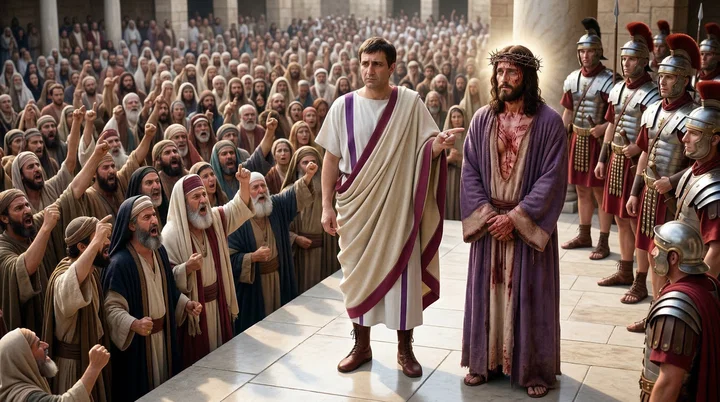
When Pilate therefore heard that saying, he brought Jesus forth, and sat down in the judgment seat in a place that is called the Pavement, but in the Hebrew, Gabbatha.
Translations
American King James Version, King James Version, KJV Cambridge Paragraph Bible
When Pilate therefore heard that saying, he brought Jesus forth, and sat down in the judgment seat in a place that is called the Pavement, but in the Hebrew, Gabbatha.
When Pilate therefore heard that saying, he brought Jesus forth, and sat down on the judgment-seat, in a place that is called the Pavement, but in the Hebrew, Gabbatha.
Revised Version, American Standard Version
When Pilate therefore heard these words, he brought Jesus out, and sat down on the judgment-seat at a place called The Pavement, but in Hebrew, Gabbatha.
Pilate, therefore, having heard this word, brought Jesus without — and he sat down upon the tribunal — to a place called, 'Pavement,' and in Hebrew, Gabbatha;
Pilate therefore, having heard these words, led Jesus out and sat down upon [ the] judgment-seat, at a place called Pavement, but in Hebrew Gabbatha;
Pilate, therefore, when he heard these words, led Jesus outside, and sat down upon a raised seat, in a place called Pavement, but, in Hebrew, Gabbatha.
Berean Standard Bible, Majority Standard Bible
When Pilate heard these words, he brought Jesus out and sat on the judgment seat at a place called the Stone Pavement, which in Hebrew is Gabbatha.
When Pilate therefore heard these words, he brought Jesus out and sat down on the judgment seat at a place called “ The Pavement”, but in Hebrew, “ Gabbatha.”
So when these words came to Pilate's ear, he took Jesus out, seating himself in the judge's seat in a place named in Hebrew, Gabbatha, or the Stone Floor.
When Pilate heard this woorde, hee brought Iesus foorth, and sate downe in the iudgement seate in a place called the Pauement, and in Hebrewe, Gabbatha.
Douay-Rheims (Challoner revision)
Now when Pilate had heard these words, he brought Jesus forth, and sat down in the judgment seat, in the place that is called Lithostrotos, and in Hebrew Gabbatha.
Pictures
Cross-references
- Matthew 27:24-25
When Pilate saw that he could prevail nothing, but that rather a tumult was made, he took water, and washed his hands before the multitude, saying, I am innocent of the blood of this just person: see ye to it.
Pilate washes his hands as the crowd accepts responsibility for Jesus’ blood.
- Luke 23:4
Then said Pilate to the chief priests and to the people, I find no fault in this man.
Pilate declares that he finds no fault in Jesus.
- John 18:28-40
Then led they Jesus from Caiaphas unto the hall of judgment: and it was early; and they themselves went not into the judgment hall, lest they should be defiled; but that they might eat the passover.
Cited as the preceding account of Jesus before Pilate.
- Mark 15:1-20
And straightway in the morning the chief priests held a consultation with the elders and scribes and the whole council, and bound Jesus, and carried him away, and delivered him to Pilate.
Parallel account of Jesus’ trial before Pilate and his delivery to be crucified.
- Matthew 27:2
And when they had bound him, they led him away, and delivered him to Pontius Pilate the governor.
Listed as a parallel account of the trial.
- Luke 23:14
Said unto them, Ye have brought this man unto me, as one that perverteth the people: and, behold, I, having examined him before you, have found no fault in this man touching those things whereof ye accuse him:
Pilate declares Jesus innocent despite the accusations against him.
- Luke 23:20-24
Pilate therefore, willing to release Jesus, spake again to them.
Pilate declares Jesus innocent, but the demand for His death prevails.
- Acts 3:13-14
The God of Abraham, and of Isaac, and of Jacob, the God of our fathers, hath glorified his Son Jesus; whom ye delivered up, and denied him in the presence of Pilate, when he was determined to let him go.
Peter accuses the people of rejecting Jesus and handing Him over.
- John 18:31
Then said Pilate unto them, Take ye him, and judge him according to your law. The Jews therefore said unto him, It is not lawful for us to put any man to death:
The Jewish leaders condemn Jesus for blasphemy but cannot carry out the death penalty.
- Luke 23:11
And Herod with his men of war set him at nought, and mocked him, and arrayed him in a gorgeous robe, and sent him again to Pilate.
Herod’s soldiers mock Jesus during his trial.
- John 19:7
The Jews answered him, We have a law, and by our law he ought to die, because he made himself the Son of God.
The Jewish leaders condemn Jesus for blasphemy but cannot carry out the death penalty.
Commentary
Each commentary is drawn from primary sources: the writings of Ellen G. White and Adventist pioneers and periodicals. Each commentary is separate. Its own words are not a quotation; follow the references to read the source passages.
Ellen G. White
10 sources
John 19:13 belongs to the proceedings in Pilate's judgment hall on the day Jesus was led from there to Calvary to be crucified.DA 722.5 It belongs to the trial in which Jesus was brought before Pilate and condemned for alleged treason against the Roman government, and that judgment marks the beginning of His humiliation which culminated in the demand for His crucifixion.4RED 102.2–103.15RED 92.2 Those condemned for that offense of treason were taken down by soldiers after execution and buried in a burial ground reserved for criminals who had received the death penalty.5RED 92.2
The verse shows Pilate bringing Jesus forth before the people and sitting down on the judgment seat in the place called the Pavement, Gabbatha, after hearing the saying that releasing Jesus would make him no friend of Caesar.Ms 51, 1897, par. 33–34 He took his place as judge having just asserted that he had power to release Jesus or to condemn Him.3SP 147.1 The Jewish leaders were pressuring Pilate with appeals to Caesar's honor to intimidate him into condemning Jesus, using the same tactic they later tried against Festus in Paul's case.ST May 22, 1884
Although Pilate had sought to release Jesus and had declared Him innocent and without fault, finding no fault in Him, he nevertheless handed Him over to be crucified despite that conviction.Ms 51, 1897, par. 33–34Ms 74, 1911, par. 17Lt 12, 1911, par. 8–11 He yielded and sacrificed the innocent life of Jesus, the Son of God, to protect his own position.EW 152.3Ms 74, 1911, par. 17 He acted for worldly honor and from fear of losing his power, authority, position, and even his life, and his wavering indecision let the mob overrule his convictions.EW 152.3SG1 56.13SP 147.1
Pilate remained responsible and guilty for condemning Christ and delivering an innocent man to die even though he tried to place the blame on His accusers.Ms 51, 1897, par. 33–34SG1 56.1 Had he followed his conviction he would not have condemned Him, and his course in sacrificing an innocent life brought his own ruin.SG1 56.13SP 147.1 After Christ rose, Pilate became convinced that his guilt was not merely for an innocent man's blood but for the blood of the Son of God.EW 152.3
Sources
Pioneers and periodicals
18 sources
When Pilate heard the threat to accuse him of disloyalty to Caesar for releasing one who claimed kingship, he brought Jesus forth and sat down in the judgment seat at Gabbatha to proceed toward sentence on the Roman charge of treason.ST Mar 15, 1877 He was troubled by the claim that Jesus was the Son of God and knew Him to be innocent, a doer of healing works and speaker of love, hope and courage, the very embodiment of truth in whom he could find no evil.ST Jul 11, 1878RH Jun 15, 1911 Yet though he declared Him innocent, he let self-interest and fear for his office and Caesar's favor prevail, and from weakness appealed to the people, offered to scourge an innocent man, and at last yielded to the mob and handed Him over to His enemies to be crucified.ST Mar 28, 1911ST Mar 13, 1901 In this the religious leaders joined with Roman authority to secure His death by misrepresentation and threats, compelling the civil power that alone could impose death to enter the domain of conscience and punish for claimed sin and Sabbath-breaking.ST May 19, 1914ST Dec 18, 1893ST Feb 10, 1898 So Christ, the Passover Lamb and antitype of the Passover lamb, was sacrificed on the fourteenth day of the first month, on the day before the Sabbath, brought forth as a man of sorrows to die for each person that they might be wholly His.RH Oct 30, 1855ST Aug 13, 1874RH Apr 8, 1902
Pilate's Judgment at Gabbatha
When the leaders threatened to accuse him of disloyalty to Caesar for allowing a claimant to kingship to live, Pilate brought Jesus forth and sat down in the judgment seat.ST Mar 15, 1877 That sitting marks the turn where, fearing the political consequences, he moved toward sentencing Jesus on the Roman charge of treason rather than on the Jewish charge of blasphemy.ST Mar 15, 1877
The sitting belongs to the moment when Pilate faced whether Jesus would live or die. He was troubled when he heard that Jesus had claimed to be the Son of God, and he repeatedly declared that he found no evil in Him.ST Jul 11, 1878RH Jun 15, 1911 His works were healing and His words brought love, hope, and courage, and Pilate knew Him to be innocent, the very embodiment of truth, yet gave approval for the sake of earthly honor and Caesar's favor.ST Jul 11, 1878
Though he had declared Jesus innocent, Pilate from weakness let self-interest prevail and from fear for his office and for Caesar's favor sentenced Him to die.ST Mar 28, 1911 He acted inconsistently by continually appealing to the people for consent to do his plain duty, by presenting the beaten Jesus to the crowd, and by offering to cruelly scourge an innocent man only to appease their unreasoning wrath.ST Mar 13, 1901 At last he yielded to the mob and handed Him over to His enemies and persecutors to be crucified.RH Jun 15, 1911ST Mar 13, 1901 The rulers showed the same inconsistency in crying for Barabbas, who was convicted of practically the same crime they charged against Jesus, while Jesus Himself was declared innocent.ST Mar 13, 1901 After that declaration of innocence Jesus received unmerited torture and mockery by the soldiers and the compromise scourging, and in that cruel manner His life was sacrificed so that our lives might be saved.ST Mar 13, 1901
Passover Fulfillment and Timing
Christ is the Passover and the Lamb of God, the antitype of the Passover lamb.RH Oct 30, 1855ST Aug 13, 1874RH Dec 15, 1868 As the Passover lamb was slain on the fourteenth day of the first month, so the Lamb of God died on that same day.RH Oct 30, 1855ST Aug 13, 1874RH Dec 15, 1868 In this the New Testament record shows that Christ was sacrificed on the fourteenth day of the first month.RH Oct 30, 1855ST Aug 13, 1874RH Dec 15, 1868 He thus fulfilled the Passover type on its appointed day and at its appointed time.RH Oct 30, 1855ST Aug 13, 1874RH Dec 15, 1868
The portion from this judgment scene through the end of the chapter gives a detailed account of the events surrounding the crucifixion.ST Apr 21, 1914 It places the crucifixion on the day before the Sabbath.ST Apr 21, 1914 That day is the one commonly called Friday.ST Apr 21, 1914
Church Power and Personal Faith
John 19:13 shows the religious leaders joining with Roman authority to secure Jesus' death, using civil power against him because he rejected their traditions made into civil law. Their misrepresentation and threats secured Rome's power to put Christ to death for keeping God's commandments, especially the Sabbath, according to God's principles rather than the Pharisees' rules. Jesus was brought before Pilate, whose Roman authority included the power to impose the death penalty, and he was crucified by the authority of the Roman government.ST Feb 10, 1898 The episode illustrates how a church allied with the state can use its power against God and condemn even the Son of God.
John 19:13 shows Jesus brought before Pilate's judgment seat as the religious leaders' demand for his death was heard and granted.ST Feb 12, 1894ST Oct 2, 1893 His death was made possible when the leaders appealed to civil authority to carry out their demand.ST Oct 2, 1893 Pilate sat to judge him and delivered him to be crucified under pressure, their misrepresentation and threats overcoming his judgment.ST Feb 12, 1894ST Oct 2, 1893 Just so religious bigotry later used threats to advance its aims.ST Feb 12, 1894
John 19:12-15 shows the Jewish leaders pressuring Pilate with appeals to Caesar's honor, seeking to intimidate him into condemning Jesus.ST May 22, 1884 As they tried to intimidate Festus in Paul's case, so they tried to intimidate Pilate.ST May 22, 1884
John 19:13 places Jesus before Pilate as the authorities secured his death sentence on religious charges and legislation, including the charge that he claimed to be the Son of God and disputes over Sabbath observance.ST May 19, 1914ST Oct 9, 1907ST Oct 16, 1893 The Jews defined sin and condemned the Lord's Christ, and by threats compelled the Roman governor to execute him.ST Dec 18, 1893ST Oct 9, 1907ST Oct 16, 1893 The episode illustrates civil government being compelled to punish at the demand of those claiming authority to define sin, thereby usurping God's place.ST Dec 18, 1893ST Oct 9, 1907ST Oct 16, 1893 In entering the domain of conscience to define sin and to punish sin, civil government usurps the place of God and becomes rebel to his authority.ST Oct 9, 1907ST Oct 16, 1893 That course always results disastrously to the government itself and in persecution of its most conscientious and devoted citizens.ST Oct 9, 1907
John 19:13 shows Jesus as a man brought forth under an Eastern sky amid a rabble's cry to go to his death, and that going forth to die was for each person personally.RH Apr 8, 1902 It means he was made wholly theirs, and in return they are to be wholly his.RH Apr 8, 1902 They are to ask for grace and strength divine to do his will in thought and word and deed and to be led to him even though the soul bleeds.RH Apr 8, 1902
John 19:13 shows Jesus as a man of sorrows suffering bitter depths of human woe here below. He shared every human burden and care in pitying love through days of toil and nights of prayer, bearing the heavy cross, wearing the piercing crown of thorns, and enduring the nails and the spear and the gore. With such a record remaining, no grief or pain gives cause to murmur or complain, to ask a life of ease, or to live one hour to please self. Since Jesus suffered, pain is sweet because it brings the sufferer lower at his feet to meet him in closer sympathy.
Sources