Luke 23:4
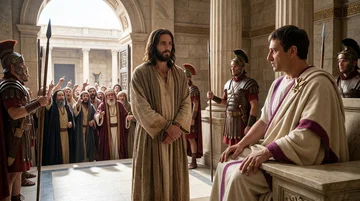
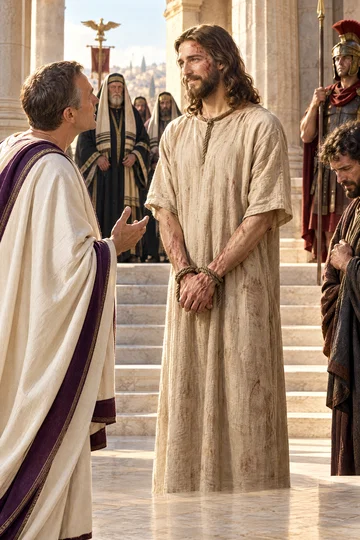
Then said Pilate to the chief priests and to the people, I find no fault in this man.
Translations
American King James Version, King James Version, KJV Cambridge Paragraph Bible
Then said Pilate to the chief priests and to the people, I find no fault in this man.
Then said Pilate to the chief priests, and to the people, I find no fault in this man.
Revised Version, American Standard Version
And Pilate said unto the chief priests and the multitudes, I find no fault in this man.
And Pilate said unto the chief priests, and the multitude, 'I find no fault in this man;'
And Pilate said to the chief priests and the crowds, I find no guilt in this man.
And, Pilate, said unto the High-priests and the multitudes, Nothing, find I, worthy of blame, in this man.
Berean Standard Bible, Majority Standard Bible
Then Pilate said to the chief priests and the crowds, “ I find no basis for a charge against this man.”
Pilate said to the chief priests and the multitudes, “ I find no basis for a charge against this man.”
And Pilate said to the chief priests and the people, In my opinion this man has done no wrong.
Then sayd Pilate to the hie Priests, and to the people, I finde no fault in this man.
Douay-Rheims (Challoner revision)
And Pilate said to the chief priests and to the multitudes: I find no cause in this man.
Pictures

Cross-references 20 of 34
- John 18:38
Pilate saith unto him, What is truth? And when he had said this, he went out again unto the Jews, and saith unto them, I find in him no fault at all.
Pilate declares that he finds no fault in Jesus.
- Matthew 27:11-23
And Jesus stood before the governor: and the governor asked him, saying, Art thou the King of the Jews? And Jesus said unto him, Thou sayest.
Pilate questions Jesus, recognizes no evil in him, and faces the crowd’s demand for his death.
- Luke 23:14-15
Said unto them, Ye have brought this man unto me, as one that perverteth the people: and, behold, I, having examined him before you, have found no fault in this man touching those things whereof ye accuse him:
Pilate and Herod find no grounds for the charges against Jesus.
- John 19:4
Pilate therefore went forth again, and saith unto them, Behold, I bring him forth to you, that ye may know that I find no fault in him.
Pilate again declares that he finds no fault in Jesus.
- Matthew 27:24
When Pilate saw that he could prevail nothing, but that rather a tumult was made, he took water, and washed his hands before the multitude, saying, I am innocent of the blood of this just person: see ye to it.
Pilate declares Jesus innocent while washing his hands and yielding him to the crowd.
- Mark 15:4-5
And Pilate asked him again, saying, Answerest thou nothing? behold how many things they witness against thee.
Pilate marvels at Jesus’ silence before the accusations.
- Luke 23:22
And he said unto them the third time, Why, what evil hath he done? I have found no cause of death in him: I will therefore chastise him, and let him go.
Pilate again declares Jesus has done nothing deserving death.
- 1 Peter 2:22
Who did no sin, neither was guile found in his mouth:
Both affirm that Jesus was without sin.
- John 19:6
When the chief priests therefore and officers saw him, they cried out, saying, Crucify him, crucify him. Pilate saith unto them, Take ye him, and crucify him: for I find no fault in him.
Pilate declares Jesus innocent and finds no fault in him.
- Matthew 27:2
And when they had bound him, they led him away, and delivered him to Pontius Pilate the governor.
Both describe Jesus being brought before Pilate.
- Matthew 27:4
Saying, I have sinned in that I have betrayed the innocent blood. And they said, What is that to us? see thou to that.
Judas confesses that he betrayed Jesus, whom Pilate finds innocent.
- Luke 23:14
Said unto them, Ye have brought this man unto me, as one that perverteth the people: and, behold, I, having examined him before you, have found no fault in this man touching those things whereof ye accuse him:
Pilate again declares Jesus innocent during his trial.
- Mark 15:14
Then Pilate said unto them, Why, what evil hath he done? And they cried out the more exceedingly, Crucify him.
Pilate finds no fault in Jesus, while the crowd demands his crucifixion.
- Luke 23:41
And we indeed justly; for we receive the due reward of our deeds: but this man hath done nothing amiss.
The thief likewise says Jesus has done nothing wrong.
- John 19:12
And from thenceforth Pilate sought to release him: but the Jews cried out, saying, If thou let this man go, thou art not Cæsar’s friend: whosoever maketh himself a king speaketh against Cæsar.
Priests pressure Pilate not to release Jesus, whom he found innocent.
- Luke 23:16
I will therefore chastise him, and release him.
Pilate proposes chastising and releasing Jesus despite finding Him innocent.
- John 18:33-35
Then Pilate entered into the judgment hall again, and called Jesus, and said unto him, Art thou the King of the Jews?
Pilate questions Jesus about being king.
- Matthew 27:22
Pilate saith unto them, What shall I do then with Jesus which is called Christ? They all say unto him, Let him be crucified.
Poses the question of what to do with Jesus.
- John 18:19-28
The high priest then asked Jesus of his disciples, and of his doctrine.
The account continues Jesus’ trial before Pilate.
- Luke 23:47
Now when the centurion saw what was done, he glorified God, saying, Certainly this was a righteous man.
The officer calls Jesus a righteous man.
Commentary
Each commentary is drawn from primary sources: the writings of Ellen G. White and Adventist pioneers and periodicals. Each commentary is separate. Its own words are not a quotation; follow the references to read the source passages.
Ellen G. White
25 sources
After examining the accusations Pilate found no evidence to support the charges and no valid basis for condemnation, being convinced Jesus was innocent and had been handed over out of envy.Ms 112, 1897, par. 1–6Ms 107, 1893, par. 2ST Jan 24, 1900 He publicly proclaimed to the chief priests and the people that he found no fault in Him, a declaration even by a heathen Roman magistrate that stands as proof the charges were false.ST Jul 4, 1878SLP 108.2–3Ms 39, 1891, par. 6–7 The verdict testifies to His blameless, sinless humanity, against whom His enemies had no just cause because He had spent His life doing good.3SP 133.15RED 53.1ST Oct 31, 1900Ms 75, 1910, par. 19–21Ms 39, 1891, par. 6–7 Although he three times declared Him without fault, Pilate compromised with wrong and handed Him over to be scourged and crucified to please the Jews.Ms 79, 1912, par. 23–25ST Jul 12, 1899COS 147.1–4 His innocent suffering, witnessed by the heavenly universe, was His bearing the penalty in behalf of the human race so that the law might be honored and all who believe might be saved.ST Jul 12, 1899Lt 132, 1910, par. 4–921MR 36.2–5Ms 29, 1899, par. 6
Pilate's Examination and Verdict
After examining the accusations of blasphemy and sedition, Pilate found no evidence to support the charges and no valid basis for condemnation.Ms 112, 1897, par. 1–6Ms 107, 1893, par. 2ST Jul 4, 1878 The witnesses contradicted one another so that their testimony was worthless.Ms 107, 1893, par. 2 His appearance bore no sign of guilt, and Pilate refused to condemn Him without a charge that could be brought and proved.DA 723.1–724.1ST Jul 4, 1878 He was convinced Jesus was not guilty, but that the priests had handed Him over out of envy and were plotting to destroy an innocent man.Ms 112, 1897, par. 1–6ST Jan 24, 1900ST Jul 4, 1878 Jesus' calm silence under false charges and abuse strengthened that conviction.ST Jan 24, 1900
Pilate publicly proclaimed to the chief priests and the people that he found no fault in Jesus.ST Jul 4, 1878SLP 108.2–3Ms 39, 1891, par. 6–7 That public declaration by even a non-Jewish Roman magistrate stands as evidence that the charges were false.ST Jul 4, 1878 The declaration frustrated, enraged and disappointed the leaders, who feared their effort to secure execution would fail and faced His possible release.Ms 107, 1893, par. 25RED 53.1 They did not stop but accused Him of stirring up the people through His teaching.ST Jan 24, 1900 They lost reason and self-control, cursed Him, loudly censured Pilate, and threatened him with Roman vengeance if he refused to condemn one they claimed had set Himself against Caesar.5RED 53.1
Pilate sent Jesus to Herod because Galilee was under Herod's jurisdiction, also hoping to avoid responsibility and to repair their quarrel.ST Jan 24, 1900 Herod also found nothing worthy of death.COS 147.1–4 Yet Pilate and Herod were made friends by the act of crucifying Him.Ms 39, 1891, par. 6–7 Although he had three times declared Jesus without fault, Pilate compromised with wrong and handed Him over to be scourged and crucified.Ms 79, 1912, par. 23–25ST Jul 12, 189912MR 405.1–406.1 He did this to please the Jews and to make their enmity effective.Ms 29, 1899, par. 6Ms 39, 1891, par. 6–7
His offer to chastise and release Jesus contradicted his own finding, for punishment of an innocent man was wrong.COS 147.1–4 His weakness allowed the accusers to press their advantage until Jesus was condemned.COS 147.1–4 The trial became a mockery of justice exposing oppression and rejection of truth, even though the sentence was pronounced that He should be crucified while found not at fault.Ms 79, 1912, par. 23–2512MR 405.1–406.1
Testimony to Christ's Innocence
Pilate, a non-Jewish Roman magistrate, publicly declared Jesus innocent, and that declaration stands forever as inspired proof to the world of the treachery, baseness and falsehood of the charges against Him.3SP 133.15RED 53.1 Even a heathen magistrate pronounced Him innocent, exposing accusations brought through entrapment and hired witnesses as deceitful and worthless.3SP 133.15RED 53.112MR 405.1–406.1 That finding enraged and disappointed the priests and elders who had labored to secure His death and now faced His possible release, so that they lost reason and self-control, cursed Him, acted like demons, loudly censured Pilate, and threatened him with Roman vengeance if he refused to condemn one they claimed had set Himself against Caesar.5RED 53.1 Pilate repeated the finding three times but still surrendered Christ to the mob instead of protecting Him, making the trial a mockery of justice and exposing the rulers' oppression and rejection of truth.ST Jul 12, 189912MR 405.1–406.1
The finding that Jesus was without fault is echoed in Judas's confession that he had betrayed innocent blood and that Jesus was innocent of crime.3SP 123.2–124.2 That testimony exposed that the priests had bribed Judas to deliver Jesus to them, but the high priest dismissed Judas and urged the people not to release Jesus.3SP 123.2–124.2 The verse testifies to Christ's blameless, perfect humanity as Lord of life and glory, who had spent His life doing good for the people.ST Oct 31, 1900Ms 39, 1891, par. 6–7 His sinless character and teachings gave His enemies no just cause for accusation, yet He was crucified to satisfy Jewish malice and to make their enmity effective.Ms 75, 1910, par. 19–21Ms 39, 1891, par. 6–7 Their hostility was driven by His reproof and purity, because the principles He presented did not coincide with their ideas and ambitious aims, for He condemned all guile, all underhanded scheming for supremacy, and every unholy practice.Ms 75, 1910, par. 19–21Ms 39, 1891, par. 6–7
The condemned thief had heard in the hall the judgment that Jesus was a just man, and seeing His Godlike conduct and pitying forgiveness, acknowledged Him as the Son of God.5RED 76.2–3 The trial in the judgment hall was a mock trial in which the accusers found nothing by which He could be proved guilty, yet although Pilate three times declared Him without fault he ordered Him scourged and delivered Him up to suffer the most cruel death that could be devised.ST Jul 12, 1899 The scenes of betrayal, trial, scourging and crucifixion were witnessed by the heavenly universe, God the Father, Satan and his angels.ST Jul 12, 1899 Christ's innocent suffering was His bearing the penalty in behalf of the human race in order that the heavenly universe might see the conditions of the covenant of redemption, so that all doubts would be forever settled, every mouth among unfallen worlds, the heavenly universe, Satanic agencies and the fallen race would be stopped, the throne of justice would be eternally secured, honor would be restored to God's government, the law would be exalted and honored as unchangeable and could not in any way be changed to meet man in his sinful condition, and the human race would be saved if they would return to allegiance.ST Jul 12, 1899
Christ foresaw beforehand this humiliation as part of taking the guilt of every sinner, seeing Himself in the hands of men moved by demons, betrayed by a professed disciple, denied by Peter, rejected, condemned though innocent, mocked and scourged while enduring the contradiction of sinners against Himself.21MR 36.2–5 He took it as part of bearing the guilt of every sinner and gave His life for the world so that all who believe in Him would not perish.21MR 36.2–5Ms 29, 1899, par. 6 He remained sinless and faithful to His Father through suffering and death, thereby proving false Satan's claim that God's law could not be kept and exposing the falsehood of Satan's charges against God.Lt 132, 1910, par. 4–9 Although declared faultless, He was with cruel injustice handed over to the crowd to please the Jews and crucified.Lt 132, 1910, par. 4–921MR 36.2–5Ms 29, 1899, par. 6
Example and Contrast for Believers
Luke 23:4 is Pilate's public declaration that he found no fault in Jesus and knew Him to be an innocent man.SLP 108.2–38RED 64.3–65.1 Yet he went on to do Him injustice and failed to protect an innocent man from it.SLP 108.2–38RED 64.3–65.1 In this he stands opposite to Gallio, who would not be made the dupe of the Jews and refused to do injustice to Paul when he knew Paul was innocent.SLP 108.2–38RED 64.3–65.1
The verse shows Jesus utterly helpless under the Jewish priests and rulers forcing even the Roman governor to work their will, opposed even on the cross.RH Nov 11, 1915 Yet in that helplessness He trusted the word of God and withstood the power of the whole world.RH Nov 11, 1915 His stand is an example of saving faith as confiding trust by which, through the grace of Christ, the soul becomes a conquering power.RH Nov 11, 1915 Pilate declared Him innocent after He had been judged, even as the people demanded His crucifixion.ST Nov 25, 1889 His innocence did not protect Him from persecution because His tormentors were controlled by evil, and His suffering is an example for those who may also face persecution.ST Nov 25, 1889
The verse belongs to the great trial of His betrayal and death, when He was betrayed and condemned in the judgment hall, humiliated, hissed at and reviled by the multitude that had hailed Him as king, while the cruel jeering crowd cried for Him to be crucified.4RED 102.2–103.1 He knew beforehand this ordeal of betrayal, agony in Gethsemane, and crucifixion, with its fear and disappointment and grief and horror and ruin of fondest hopes.4RED 102.2–103.1 He brought on an earlier testing while still present to comfort and strengthen His chosen, so the faithful would not be overwhelmed with surprise at the insult to their Master and would be prepared for His betrayal and death.4RED 102.2–103.1 In that preparation they were taught not to hang faith on the inconstant favor of the world and the opinions of others, not to sink beneath fear, and not to be carried away by faint-hearted apostasy in the hour of His trouble.4RED 102.2–103.1
Sources
Pioneers and periodicals
34 sources
Pilate the Roman governor examined Jesus and announced openly to the chief priests and the people that he found no crime or guilt in him.ST Jul 4, 1878ST Mar 13, 1901RH Feb 8, 1915 The charges were sedition, opposing Caesar and claiming kingship, yet he saw no political threat or attempt to overthrow civil government, being convinced the priests acted from envy against an innocent man whose calm silence and open account of a non-worldly kingdom confirmed his innocence.ST Jan 24, 1900ST Nov 12, 1894ST Mar 13, 1901 He and Herod repeatedly refused to condemn him, but the rulers pressed harder with false testimony and stirred the crowd to choose Barabbas and demand crucifixion, forcing condemnation through fear and malice.ST Mar 28, 1906ST Mar 28, 1906ST Feb 25, 1886 Though declared innocent he was scourged and put to death as the just for the unjust, the blameless sacrifice suffering for the sins of the guilty to bring them to God and save human lives.ST Jul 12, 1899ST Oct 31, 1900ST Jun 15, 1904RH Apr 22, 1862 The Spirit prompted Pilate's true verdict, yet from fear of the Jews and love of position he lacked courage to act on conviction and yielded to the mob, warning that vacillation and self-preservation deny Christ and forfeit life.ST Mar 27, 1901ST Oct 27, 1898ST Nov 19, 1894ST Aug 20, 1896
Pilate Finds No Fault
Pilate, the Roman governor of Judea and pagan judge, examined Jesus and publicly declared to the chief priests and to the people that he found no fault, crime, or guilt in him and that he was innocent of the accusations brought against him.ST Jul 4, 1878ST Mar 13, 1901RH Feb 8, 1915ST Jan 17, 1911 Even though Jesus was accused of claiming to be King of the Jews, Pilate's judgment stands as testimony to his innocence.RH Feb 8, 1915 That verdict from a non-Jewish Roman magistrate is evidence that the charges were false and that there was no basis to condemn him and no crime warranting condemnation.ST Jul 4, 1878ST Jan 17, 1911
The charges were that he was stirring up the nation, opposing Caesar, treason, claiming to be King of the Jews, and stirring the people through his teaching, but the accusations did not change the verdict and only made the accusers press more urgently.ST Nov 12, 1894ST Mar 13, 1901 Pilate saw no sedition and no attempt to change the character of the civil government, showing that Christ's kingdom is not a worldly political kingdom.ST Jul 4, 1878ST Mar 19, 1896 He was convinced from the first that the priests had handed Jesus over out of envy and were plotting to destroy an innocent man, and Jesus' calm silence under false charges and abuse and his making no attempt to vindicate himself to Pilate's marvel strengthened that conviction.ST Jan 24, 1900ST Jul 4, 1878ST Dec 1, 1898 Roman law allowed no condemnation without cause, so Pilate demanded the nature of the offense, was willing from the outset despite his cruel nature to release him from his enemies, and was therefore duty-bound to release and protect him.ST Mar 13, 1901ST Dec 1, 1898 After hearing charge after charge, Pilate took him inside the palace and questioned him privately, where Jesus openly told who he was and his mission to earth, then Pilate brought him out before the crowd and declared him innocent.ST Dec 1, 1898 Because Galilee was under Herod's jurisdiction, Pilate then sent him to Herod, also hoping to avoid responsibility and to repair their quarrel, and instead from fear of unrest and unpopularity evaded his responsibility.ST Jan 24, 1900ST Mar 13, 1901
Pilate examined Jesus and repeatedly declared him innocent, finding no fault or guilt in the charges and nothing worthy of death, and again declared him innocent though the accusations were repeated and increased, and he repeatedly tried to secure his release and called him a just person.ST Mar 28, 1906ST Mar 28, 1906RH Jun 15, 1911 Herod also returned him without condemning him.ST Mar 28, 1906 His judgment contrasts with the high priest's decision that Jesus should die whether innocent or guilty.ST Feb 25, 1886 Since his adversaries could find no just cause to condemn him openly, they pressed harder and used fear, force, perjury, malice, and false testimony to bring about his condemnation to death.RH Dec 8, 1859ST Jun 21, 1899 The rulers stirred the people to choose Barabbas instead and to demand that Jesus be crucified, even when Pilate asked what evil he had done, yet Pilate ultimately allowed him to be crucified under pressure from the mob.ST Mar 28, 1906RH Jun 15, 1911
A sentence from Pilate was necessary before the Jews could proceed to execution, because the power of life and death was vested in the Roman governor.RH Feb 11, 1862 This incidental detail about Pilate's authority fits the customs and political order of that time, and that exact consistency in a subordinate point evidences the minute accuracy and truth of the Gospel history of Christ's trial and execution.RH Feb 11, 1862 The verse belongs to the last scene of Jesus' life when he stood before Pilate before his crucifixion, which also included his appearance before Herod and the cruelty and mockery he endured.RH Jun 10, 1862
Sinless One Suffers to Save
Though officially declared innocent by the Roman judge and yet put to death, he suffered unjustly as the just one for the unjust to bring people to God.ST Jun 15, 1904RH Apr 22, 1862 He suffered not for any wrongdoing of his own but for the sins of the guilty, so that they might be reconciled to God, and his trial thus attested that he was without blemish like a sacrifice.RH Apr 22, 1862 He had spent his life doing good for the very people to whose rage he was given over, a testimony to his blameless perfect humanity.ST Oct 31, 1900 His life was so filled with the life of God that no fault could be found in him, and he was crucified as the just One with the inscription Jesus of Nazareth the King of the Jews placed over him at Pilate's command.ST May 10, 1905 Though declared innocent, he was tortured and mocked by Herod's and Pilate's soldiers, scourged as a compromise, and finally handed over to be crucified, his life sacrificed so that human lives might be saved.ST Mar 13, 1901
The trial in the judgment hall was a mock trial in which his accusers found nothing by which guilt could be proved, and though three times declared without fault he was ordered to be scourged and delivered up to suffer the most cruel death that could be devised.ST Jul 12, 1899 The scenes of betrayal, trial, and crucifixion were witnessed by the heavenly universe, by God the Father, and by Satan and his angels.ST Jul 12, 1899 His innocent suffering was his bearing the penalty in behalf of the human race in order that the heavenly universe might see the conditions of the covenant of redemption.ST Jul 12, 1899 By it all doubts would be forever settled, every mouth among unfallen worlds, the heavenly universe, Satanic agencies and the fallen race would be stopped, the throne of justice would be eternally secured, the human race would be saved if returning to allegiance, honor would be restored to God's government, and the law would be exalted by making known a government that could not in any way be changed to meet man in his sinful condition.ST Jul 12, 1899
His faultless perfection draws sinners to him and reveals their own sinfulness, and because he died for them their salvation rests on what he has done and not on the conduct of those who profess to follow him.ST Jan 20, 1904 His conduct before the governor demonstrated the spirit of the gospel and convinced the governor that his prisoner was innocent, yet he used no force despite having an invincible army at his command.ST Dec 20, 1905 He rested in the grave on the seventh day, the same seventh day on which the Father rested and on which the women rested, one day before the first day of the week, the resurrection day.RH Sep 4, 1856 So the Saviour kept the same Sabbath as the Father, and the seventh day and the first day cannot be conjoined.RH Sep 4, 1856
Compromise Warns Faithful Witness
The Spirit of God prompted the true verdict of innocence, but courage to act on conviction was lacking, and the vacillating course grieved the Spirit away.ST Mar 27, 1901 Prejudice turned away from the truth, so that from fear of the Jews and fear of unrest and unpopularity there was listening to the crowd, remaining undecided, and yielding to the mob to have Jesus scourged and sent to the cross as a criminal.ST Mar 27, 1901ST Oct 27, 1898ST Aug 20, 1896
God presented the gospel in perfection to Rome through meeting Christ, and after conversation no evidence of crime was found.ST Oct 27, 1898 The declaration of innocence, together with a dignified bearing unlike known criminals, trust in a higher power, Herod also finding nothing worthy of punishment, silence without retaliation when Barabbas was chosen, and unresentful endurance under scourging, beating, bruising, bleeding and insult, convinced that before him stood One more than man and urged doing right whatever the consequences.ST Oct 27, 1898 Repeated efforts to release the innocent man were met by fresh malignity from priests and people who yielded neither to law nor justice nor to pity, while fear of the Jews kept indecision until there was refusal to identify with the suffering Innocent One.ST Oct 27, 1898
The declaration of innocence stood alone as the only word spoken in his favor while priests and rulers, filled by Satan and his angels with bitter hatred to make his death as humiliating as possible, stirred the multitude against the Son of God. Even though innocence was known, he was given over to the abuse of men under the control of Satan.
Witness to innocence was borne three times and declared openly before the chief priests and the people, an act of moral courage in speaking publicly for an accused man.ST Nov 19, 1894 That courage was what Emperor Sigismund lacked toward John Huss, failing to declare him innocent publicly or to make public effort to rescue him despite written protest from ten noblemen of Bohemia and the principal nobles of Moravia. When yielding began, influence was lost and Jesus was delivered up to save self, warning that selfish concerns about position, business, or friends can lead to denying him or taking a vacillating course.ST Nov 19, 1894 Surrendering him to preserve life ends in loss because he alone can give life, yet he remains faithful.ST Nov 19, 1894
Condemnation came while innocent even after judgment, as the people demanded crucifixion and priests and rulers forced even the Roman governor to work their will.RH Nov 11, 1915ST Nov 25, 1889 Innocence did not protect from persecution because the tormentors were controlled by evil.ST Nov 25, 1889 Utterly helpless yet trusting the word of God and withstanding the power of the whole world, that stand exemplifies saving faith as confiding trust by which, through the grace of Christ, the soul becomes a conquering power.RH Nov 11, 1915 It is an example for those who may also face persecution, as the same finding of no fault was applied when the vali examined and released persecuted believers.ST Nov 25, 1889RH Jun 18, 1908
Sources