Translations
American King James Version, Webster Bible
Pilate therefore, willing to release Jesus, spoke again to them.
King James Version, KJV Cambridge Paragraph Bible
Pilate therefore, willing to release Jesus, spake again to them.
Revised Version, American Standard Version
And Pilate spake unto them again, desiring to release Jesus;
Pilate again then — wishing to release Jesus — called to them,
Pilate therefore, desirous to release Jesus, again addressed [ them].
Again, however, Pilate, called out unto them, wishing to release Jesus.
Berean Standard Bible, Majority Standard Bible
Wanting to release Jesus, Pilate addressed them again,
Then Pilate spoke to them again, wanting to release Jesus,
And Pilate again said to them that it was his desire to let Jesus go free.
Then Pilate spake againe to them, willing to let Iesus loose.
Douay-Rheims (Challoner revision)
And Pilate again spoke to them, desiring to release Jesus.
Pictures
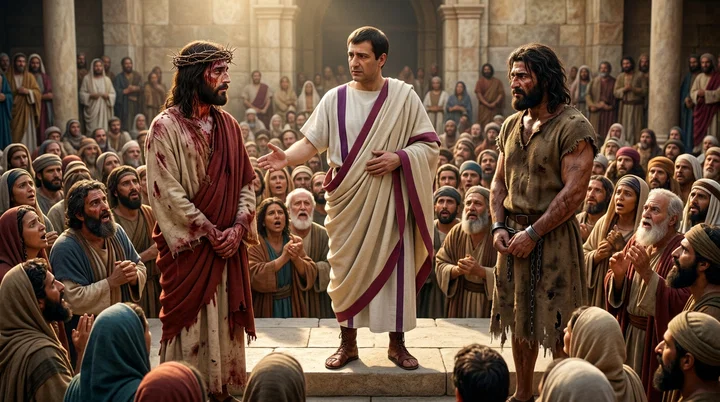
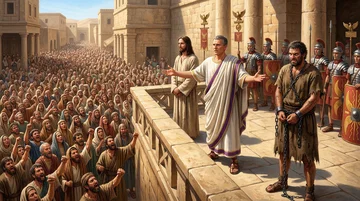
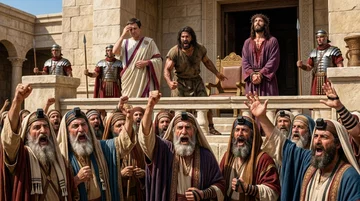
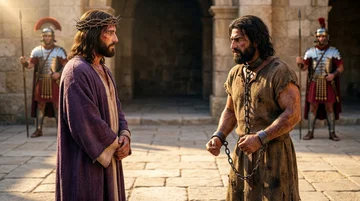
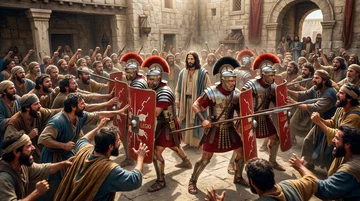
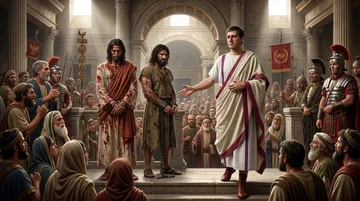
Cross-references 20 of 29
- Matthew 27:22
Pilate saith unto them, What shall I do then with Jesus which is called Christ? They all say unto him, Let him be crucified.
Records Pilate’s question and the demand to crucify Jesus.
- Mark 15:1-20
And straightway in the morning the chief priests held a consultation with the elders and scribes and the whole council, and bound Jesus, and carried him away, and delivered him to Pilate.
Parallel account of Pilate's appeals and the crowd's demand
- John 19:12
And from thenceforth Pilate sought to release him: but the Jews cried out, saying, If thou let this man go, thou art not Cæsar’s friend: whosoever maketh himself a king speaketh against Cæsar.
Pilate sought to release Jesus but faced pressure from the Jewish leaders.
- Matthew 27:24
When Pilate saw that he could prevail nothing, but that rather a tumult was made, he took water, and washed his hands before the multitude, saying, I am innocent of the blood of this just person: see ye to it.
Pilate yielded to the crowd instead of releasing Jesus and claimed innocence of his blood.
- Matthew 27:17
Therefore when they were gathered together, Pilate said unto them, Whom will ye that I release unto you? Barabbas, or Jesus which is called Christ?
Pilate offers the crowd a choice between Jesus and Barabbas.
- John 18:28-40
Then led they Jesus from Caiaphas unto the hall of judgment: and it was early; and they themselves went not into the judgment hall, lest they should be defiled; but that they might eat the passover.
Cited as a parallel account of Jesus’ hearing before Pilate.
- John 19:1-5
Then Pilate therefore took Jesus, and scourged him.
Pilate displayed Jesus after scourging him, appealing to the crowd to release him.
- Acts 3:14
But ye denied the Holy One and the Just, and desired a murderer to be granted unto you;
The people chose Barabbas, a murderer, instead of Jesus, whom Pilate sought to release.
- Matthew 27:21
The governor answered and said unto them, Whether of the twain will ye that I release unto you? They said, Barabbas.
Pilate asks whom the crowd wants released, and they choose Barabbas.
- Luke 23:24-25
And Pilate gave sentence that it should be as they required.
Pilate yields to the crowd’s demand, releasing Barabbas and delivering Jesus to their will.
- Luke 23:16
I will therefore chastise him, and release him.
Pilate had already proposed chastising Jesus and releasing him.
- Matthew 27:2
And when they had bound him, they led him away, and delivered him to Pontius Pilate the governor.
A parallel account of Jesus before Pilate.
- Luke 23:4
Then said Pilate to the chief priests and to the people, I find no fault in this man.
Pilate declares Jesus innocent before seeking his release.
- Matthew 27:19
When he was set down on the judgment seat, his wife sent unto him, saying, Have thou nothing to do with that just man: for I have suffered many things this day in a dream because of him.
Pilate’s wife warned him in a dream that Jesus was just.
- Luke 23:12
And the same day Pilate and Herod were made friends together: for before they were at enmity between themselves.
Pilate and Herod became friends during Jesus’ trial.
- Mark 15:13-14
And they cried out again, Crucify him.
The crowd demands Jesus’ crucifixion as Pilate seeks to release him.
- John 18:39-40
But ye have a custom, that I should release unto you one at the passover: will ye therefore that I release unto you the King of the Jews?
Parallel account of the crowd choosing Barabbas over Jesus.
- Mark 15:9
But Pilate answered them, saying, Will ye that I release unto you the King of the Jews?
Pilate asks whether to release Jesus.
- Luke 23:14
Said unto them, Ye have brought this man unto me, as one that perverteth the people: and, behold, I, having examined him before you, have found no fault in this man touching those things whereof ye accuse him:
same declaration of no fault
- John 18:31
Then said Pilate unto them, Take ye him, and judge him according to your law. The Jews therefore said unto him, It is not lawful for us to put any man to death:
Jews could not execute penalty
Commentary
Each commentary is drawn from primary sources: the writings of Ellen G. White and Adventist pioneers and periodicals. Each commentary is separate. Its own words are not a quotation; follow the references to read the source passages.
Ellen G. White
19 sources
Pilate was still determined to set Jesus free and spoke out again to the crowd to gain His release, because he was convinced He was innocent and found no fault in Him.DA 723.1–724.1DA 735.1–5ST May 17, 1899Lt 12, 1911, par. 8–11 To move them to pity he had Jesus scourged and set Him bloodied before them, and he seized on the custom of freeing a prisoner to set the innocent Christ side by side with Barabbas so the contrast would lead them to choose Jesus.5RED 63.1DA 735.1–5ST Jul 11, 1878 Instead the people, pressed on by the priests and rulers and stirred by Satan working to destroy the champion of truth, demanded Barabbas and cried for Jesus to be crucified and for His blood to be upon them.DA 735.1–516MR 259.3–260.119MR 277.1–278.1RH Nov 11, 1915 So the holy Son of God, the Life and Light of the world, pale and blood-stained yet still noble, stood against Barabbas, a hardened robber, murderer and pretender who claimed by theft and violence what was not his own.5RED 63.116MR 259.3–260.119MR 277.1–278.1 That choice was watched with intense interest by the heavenly universe, and it is still being made now, for every person shows whom they choose and to choose Barabbas is to say crucify Christ.16MR 259.3–260.119MR 277.1–278.1Lt 12, 1911, par. 8–11ST Apr 15, 1897
Pilate's Repeated Appeal
Pilate remained willing to release Jesus and spoke again to the crowd to secure His release.DA 723.1–724.1DA 735.1–5RH Nov 11, 1915Lt 31, 1898, par. 13 He addressed the people a second time because he wanted to set Jesus free, even as they pressed for His death.DA 735.1–5RH Nov 11, 1915Lt 31, 1898, par. 13Ms 55, 1886, par. 28–30 He was unwilling to condemn Him without a charge that could be proved.DA 723.1–724.1
He was convinced Jesus was innocent, impressed by His goodness and dignity.DA 723.1–724.1ST May 17, 1899Lt 12, 1911, par. 8–11 He declared to the maddened throng that he found no fault in Christ.ST May 17, 1899Lt 12, 1911, par. 8–11Ms 112, 1897, par. 33–34 He knew Jesus had been brought to the judgment hall for envy.Ms 112, 1897, par. 33–34 He knew His power, even while bound and under accusation, was the power of no common man but of God.Ms 112, 1897, par. 33–34
His soul was in terrible conflict because he dared not give Jesus up to a maddened power, yet he sought another way to save Him instead of acting firmly on his judgment.ST Jul 11, 1878Ms 112, 1897, par. 33–34 He tried to appease the accusers rather than stand decidedly upon what he knew to be right.ST Jul 11, 1878 He washed his hands and claimed to be innocent of His blood, and tried to put the responsibility on the Jews by telling them to take Him and crucify Him.ST May 17, 1899 Yet he himself delivered Christ into their hands to be crucified.ST May 17, 1899Lt 12, 1911, par. 8–11
To gain the release he vainly hoped to excite pity so the people would decide the punishment already inflicted was sufficient.5RED 63.1DA 735.1–5ST Jul 11, 1878 To that end he proposed and carried out having Jesus scourged, hoping that punishment would satisfy the crowd.5RED 63.1DA 735.1–5ST Jul 11, 1878 He had Jesus scourged in the presence of the multitude and then displayed Him side by side with Barabbas, pale, exhausted and stained with blood.5RED 63.1 He seized on a pagan invention without one particle of justice in it, the custom that at the great national festival one prisoner condemned to death should be set at liberty, to bring about by subterfuge what he desired.Ms 112, 1897, par. 33–34 He presented the true and innocent Christ side by side with the notable Barabbas, flattering himself that the contrast between innocence and guilt would be so convincing that the people would choose Jesus of Nazareth and consent to His release.5RED 63.1Ms 112, 1897, par. 33–34
The Crowd's Fateful Choice
Pilate spoke again because he wanted to release Jesus, yet when given the choice between Jesus and Barabbas the people demanded Barabbas and pressed for Jesus' death.16MR 259.3–260.119MR 277.1–278.1Lt 31, 1898, par. 13 They answered, release Barabbas, and to the question what should be done with Jesus they cried, crucify Him, crucify Him.19MR 277.1–278.1ST May 17, 1899 They chose Barabbas the robber and murderer rather than the Son of God, crying crucify Him and calling for His blood to be upon them and upon their children.ST May 17, 1899Lt 12, 1911, par. 8–11 This rejection of Jesus for speaking truths they did not want to hear is repeated when people persecute His saints, showing how those who reject grace can be led by the same hostile spirit across generations.Lt 31, 1898, par. 13
The demand was driven by the Jewish priests and rulers pressuring the Roman governor to do their will despite his wish to release Jesus.DA 735.1–5RH Nov 11, 1915 Herod, stirred up by the chief priests and acting in union with Pilate, joined in killing the just and holy Son of God while a murderer was released in His place.Ms 55, 1886, par. 28–30 Behind the trial Satan with his band worked with fierce determination to destroy the champion of God and of truth and by one desperate act to cut off all communication between heaven and earth, confederating with the priests and rulers to kill Christ.ST Apr 15, 1897 Satan stood at the head of those who reviled and crucified Jesus, leading the cruel mob in its abuse, while the people's cry was raised by men inspired by Satan and shows what humanity will do when not under the control of the Spirit of God.19MR 277.1–278.1Lt 12, 1911, par. 8–11
Barabbas stood in the place of Satan personified, so that choosing Barabbas before Christ the Son of God exalted Satan.16MR 259.3–260.1 The choice set Jesus, the One who made the world and all things in it, the innocent holy Prince of heaven, the Son of God, against Barabbas, a base thief and murderer.16MR 259.3–260.119MR 277.1–278.1ST May 17, 1899 Jesus was placed side by side with Barabbas pale, exhausted and stained with blood, stripped and revealing long cruel stripes flowing with blood, with a crown of thorns on His head, yet His noble character still visible through suffering in marked contrast to Barabbas as a debased and hardened robber chief.5RED 63.1 He was the just and holy Son of God, the Life and Light of the world, put against a notorious pretender to be Christ who claimed whatever he could obtain by theft and robbery and murder was his own, who had done great wickedness and did wonderful things through satanic agencies, claiming religious power and a right to establish a different order of things and to set the world right.Ms 112, 1897, par. 33–34Ms 55, 1886, par. 28–30
Wider Meaning and Application
The choice Pilate set before the maddened throng was watched from the heavenly courts with intense interest as a sight for the whole heavenly universe.ST Apr 15, 1897 While Satan stood at the head of the revilers leading the cruel mob in abuse, angels witnessed men putting Christ to open shame.Lt 12, 1911, par. 8–11 Behind the trial Satan with his band worked with fierce determination to destroy the champion of God and of truth and by one desperate act to cut off all communication between heaven and earth.ST Apr 15, 1897
The same voices that cried out against Jesus and demanded His crucifixion could readily be turned afterward to praise Herod.3SP 343.27RED 76.3 Jesus had prepared His disciples beforehand for the rejection and humiliation He would face, yet the full details of cruelty were not told them because they could not have comprehended them.19MR 277.1–278.14RED 102.2–103.1 When the events came — Jesus mocked and scourged, Barabbas chosen instead of Him, Jesus condemned to die and delivered into the hands of wicked men while His nation clamored for His blood — they brought the disciples deep grief and tested their faith and hope.Ms 3, 1898, par. 20–21ST Jul 7, 1898 That test reached also to their courage as they faced His approaching the cross.ST Jul 7, 1898
His pure life and holy teaching convicted His accusers of sin, and their demand for His death shows the hostility that leads people to resist God's word.STE 59.3 The crowd that demanded Barabbas and called for Jesus to be crucified shows how people who reject God's grace can be led by the same hostile spirit across generations. That rejection of Jesus for speaking truths they did not want to hear is repeated when people persecute His saints.Lt 31, 1898, par. 13
That same choice between Barabbas and Christ the Son of God, the One who made the world and all things in it, is being made now in the world.16MR 259.3–260.1 Every person individually demonstrates whom they choose, so that to choose Barabbas before Christ is to exalt Satan and to say crucify Christ.16MR 259.3–260.1 The cry, Release unto us Barabbas, and to the question what to do with Jesus, Crucify Him, crucify Him, was raised by men inspired by Satan and shows what humanity will do when not under the control of the Spirit of God.19MR 277.1–278.1 This scene is a representation of what those will do who stand under the black banner of the powers of darkness and of the spirit to be met in the great crisis, test and trial before us, so greater faith is needed now and prayer for the Lord to increase faith in order to stand.19MR 277.1–278.1
Sources
Pioneers and periodicals
32 sources
Pilate wanted to release Jesus and spoke to the crowd again to secure his release.ST Nov 19, 1894ST Mar 13, 1901ST Mar 27, 1901 His renewed appeal came after he had repeatedly declared Jesus innocent, yet the crowd had set the innocent Jesus beside Barabbas and chosen the robber and murderer in his place.ST Mar 13, 1901ST Mar 28, 1911ST Oct 27, 1898 He was convinced Jesus was innocent and more than man, having marveled at His silence under abuse and been troubled all the more by His claim to be the Son of God and by the message from his wife.ST Oct 27, 1898RH Jun 15, 1911 He vacillated and compromised with Jesus' enemies until he was powerless before them, yielding from fear of the Jews and fear for his office and trying to shift responsibility and appease anger with scourging instead of freeing an innocent man.ST Mar 27, 1901ST Mar 28, 1911ST May 10, 1905 The united people rejected his plea and demanded Barabbas's release and Jesus' crucifixion, stirred by the chief priests and rulers until their widespread cry and public opinion overpowered Pilate, so that both Jews and Gentiles shared responsibility for His death, with the Jews most responsible.ST Nov 19, 1894ST Mar 13, 1901ST Mar 28, 1911ST Oct 27, 1898ST May 31, 1899
Pilate Sought Jesus' Release
Pilate wanted to release Jesus and spoke to the crowd again to secure His release.ST Nov 19, 1894ST Mar 13, 1901ST Mar 27, 1901ST Mar 28, 1911ST May 31, 1899 Even after the crowd had demanded Barabbas instead, he again urged them to let Jesus go, confirming that he wished to free the One he had found innocent, but they rejected his pleas and demanded crucifixion.ST Nov 19, 1894ST Mar 13, 1901ST Mar 27, 1901ST May 10, 1905ST May 31, 1899 His desire to free Jesus did not overcome his vacillating response, and he ultimately yielded to them despite having declared Him innocent.ST Mar 27, 1901ST Mar 28, 1911ST May 10, 1905
The renewed appeal came after Pilate had declared Jesus innocent and after the crowd had chosen Barabbas.ST May 17, 1899ST Mar 13, 1901ST Mar 28, 1911ST Oct 27, 1898 He put Jesus on a level with Barabbas, who had been convicted of the very crime charged against Jesus, and left Jesus' fate to the choice of His avowed enemies.ST May 17, 1899ST Oct 27, 1898 The chief priests stirred the people to demand Barabbas's release, showing their inconsistency, while Pilate spoke again to turn the crowd from killing the One in whom he found no fault.ST May 17, 1899ST Mar 28, 1911 He had acquitted Jesus as innocent, yet sentenced Him to die because he feared for his office.ST May 17, 1899ST Mar 28, 1911ST Oct 27, 1898
In his efforts he asked what should be done with Jesus called Christ, changing the form of his question in hopes of getting the people to choose differently, but they replied that Jesus should be crucified.ST May 17, 1899ST Nov 9, 1882ST Oct 27, 1898 He proposed having Jesus chastised and then released, hoping punishment would satisfy the crowd and excite their pity so they would decide punishment was sufficient.ST Jul 11, 1878ST Oct 7, 1886ST Mar 13, 1901ST Mar 13, 1901 To move them he caused Jesus to be scourged in the presence of the multitude and then placed Him side by side with Barabbas.ST Jul 11, 1878ST Oct 7, 1886ST Mar 13, 1901 Jesus stood pale and suffering with a crown of thorns, stripped to the waist revealing long cruel stripes flowing with blood, His face stained with blood and marked with exhaustion and pain, yet His noble character stood in marked contrast with Barabbas the robber chief whose every feature proclaimed a debased and hardened desperado.ST Oct 27, 1898ST Oct 7, 1886 Pilate tried to put the responsibility on the Jews by saying take Him and crucify Him, and washed his hands claiming to be innocent of His blood, yet he himself delivered Christ to be crucified when they chose Barabbas the robber and murderer rather than the Son of God and cried crucify Him and let His blood be on them and their children.ST May 17, 1899ST Oct 27, 1898ST Mar 13, 1901
He acted as the Roman governor of Judea, whose sentence was necessary before Jesus could be executed, because the power of life and death was vested in the Roman governor.ST Mar 28, 1911RH Feb 11, 1862RH Jul 16, 1861 His scourging Jesus before giving Him up to be crucified followed very usual Roman practice before execution, and the minute accuracy of these political and customary details agrees with outside history.RH Feb 11, 1862 Barabbas had been arrested in a Galilean uprising connected with Pilate's violent suppression of a protest at Jerusalem.ST Feb 16, 1882 Pilate regarded Jesus' teaching as harmless and wished Rome to leave Him free to speak, but the Passover crowd's demand and lack of support left him unable to suppress the disorder.RH Jul 16, 1861ST Feb 16, 1882
Pilate was convinced Jesus was innocent and more than man.ST Oct 27, 1898RH Jun 15, 1911 He had marveled at the silence of Jesus under abuse and had over and over pronounced Him innocent and just.ST Oct 27, 1898RH Jun 15, 1911 When he heard Jesus had claimed to be the Son of God he was all the more troubled, for he knew Jesus was different from any man he had ever met.ST Oct 27, 1898RH Jun 15, 1911 He was confronted with the scourged, beaten, bruised, bleeding, unresentful and unresisting Man who made no retaliation, while priests and scribes would yield neither to law nor justice in the declarations of both Pilate and Herod nor to pity.ST Oct 27, 1898RH Jun 15, 1911 God was thus presenting the gospel in glorious perfection to great Rome represented by Pilate, appealing to him to do right whatever the consequences, and made one more effort to reach him through the dream given to his loved wife Claudia Procula before he refused to identify himself with the suffering Innocent One.ST Oct 27, 1898RH Jun 15, 1911
He vacillated and compromised with Jesus' enemies until he was powerless before them.ST Mar 27, 1901ST May 10, 1905ST Mar 13, 1901ST Aug 20, 1896ST Mar 13, 1901 Prejudice led him to heed the mob and send Jesus, whom he had declared innocent, to the cross as a criminal, and fear of the Jews and fear that his office would be endangered prevailed when the terrible howling of the mob crying crucify Him overcame him.ST Mar 28, 1911ST Oct 27, 1898ST Aug 20, 1896RH Jun 15, 1911 He tried to shift responsibility to Herod and to the Jewish leaders, to appease anger with scourging, and to evade the duty of releasing an innocent man, instead appealing repeatedly for the people to consent to what he knew was his duty.ST May 17, 1899ST Mar 13, 1901ST Mar 13, 1901 His sorrow continued in wrongdoing without a heart truly broken by sin.ST Mar 13, 1901ST Mar 13, 1901 Political pressure even brought Pilate and Herod together, yet their unity did not produce justice.ST Oct 27, 1898ST Mar 13, 1901
Crowd Chose Rejection's Consequences
The united people rejected the renewed plea to release Jesus, crying away with Him and demanding that Barabbas be released instead and that Jesus be crucified.ST Nov 19, 1894ST Mar 13, 1901RH Jul 15, 1875 Pilate spoke again because he wanted to release Jesus whom he had found innocent and declared to be without fault, and his repeated appeal after the demand for Barabbas confirms his willingness to free Him.ST Nov 19, 1894ST Mar 13, 1901ST Mar 28, 1911 The crowd chose a robber chief, robber and murderer instead of the innocent Lamb of God and Son of God, so that the innocent was condemned to die between criminals.ST Mar 28, 1911RH Jul 15, 1875 The people's voice thus prevailed against the voice of God when they rejected the effort to release Him and insisted that He be crucified.ST May 31, 1899ST Jun 28, 1905
Both Jews and Gentiles were responsible for His death, with the Jews the most responsible, since Pilate sentenced Jesus to die though he had acquitted Him as innocent because he feared his office would be endangered.ST Mar 28, 1911 The chief priests and ambitious rulers stirred the people to demand Barabbas's release, and their cry against Jesus became so widespread that it overpowered the effort to free Him.ST Mar 26, 1912 Priests and scribes would yield neither to law nor justice in the declarations of both Pilate and Herod nor to pity at the sight of the scourged, beaten, bruised, bleeding, unresentful and unresisting Man.ST Oct 27, 1898 As the representative of earthly power Pilate yielded to the crowd and took the life of the one who was Himself the Voice of God.ST May 31, 1899ST Jun 28, 1905 He had put Jesus on a level with Barabbas, who had been convicted of the very crime charged against Jesus, and left His fate to the choice of His avowed enemies, showing the inconsistency of those who stirred the people.
To excite pity Pilate caused Jesus to be scourged in the presence of the multitude in the vain hope they would decide that punishment was sufficient, and then placed Him side by side with Barabbas.ST Oct 7, 1886 Jesus stood pale and suffering with a crown of thorns on His head and stripped to the waist, revealing long cruel stripes from which blood flowed freely, His face stained with blood and marked with exhaustion and pain, yet His noble character could not be hidden.ST Oct 7, 1886 That noble character stood in marked contrast with Barabbas the robber chief, whose every feature proclaimed him a debased and hardened desperado.ST Oct 7, 1886
Behind the trial Satan with his band worked with fierce determination to destroy the champion of God and of truth and by one desperate act to cut off all communication between heaven and earth, confederating with the priests and rulers to kill Christ.ST Apr 15, 1897 The people with hearts filled with frenzy cried with one voice for crucifixion, making their choice between Barabbas the robber and murderer and Christ the Son of God, and that frenzied choice with one voice was watched from the heavenly courts by angels with intense interest as a sight for the universe.ST Apr 15, 1897 The scene belongs to Israel's rejection of its rightful humble King in demanding His crucifixion and choosing Caesar as king instead, presenting Him as a humble figure standing before Roman authority.RH Jun 29, 1916RH Dec 28, 1911 It belongs to the final scenes as He stood before Pilate and Herod and endured mockery and cruelty before the crucifixion, whose meditation reveals the madness and folly of sin.RH Jun 10, 1862 The surrounding conflict reflects the hope that He would establish an earthly kingdom and the pressure to choose Barabbas instead rather than accept His mission of salvation, while His rebukes of the Pharisees and association with publicans and people of low rank made Him unwelcome to those who claimed they would have received Him.ST Oct 4, 1910RH Jun 6, 1871
Jesus' unjust condemnation and crucifixion set the pattern of suffering His followers may face, for He walked that path and rose from the grave.RH Dec 24, 1867 The disciples would see Him delivered into the hands of wicked men while His nation clamored for His blood, and these events would bring them grief and test their faith, hope and courage.ST Jul 7, 1898
That condemnation brings wrath in the last day, when those who condemned Him will cry for rocks and mountains to fall on them to hide them from Him, but their cries will be in vain because it will be impossible to flee the wrath of the soon-coming Lord.RH Jul 15, 1875 The same cry of away with Jesus is repeated louder today by people who by their actions say away with the commandments of God and choose the sweet traditions from the man of sin, and to gain a home in the earth made new they must keep both the commandments of God and the faith of Jesus.RH Jul 15, 1875 The demand for Barabbas and the call for Jesus to be crucified show how people who reject God's grace can be led by the same hostile spirit across generations. Prejudice led to heeding the mob and sending Jesus, whom Pilate had declared innocent, to the cross as a criminal, and public opinion and public sentiment helped bring about His crucifixion.ST Aug 20, 1896ST Jun 17, 1903ST May 10, 1910 The crowd's cry stands as a sharp comparison to those who accept ordinary Sunday activity but condemn a Sabbathkeeper for working, exposing the course of religious intolerance that abandons bending conscience by harsh treatment only to punish and cast out the dissenter with public condemnation.ST Dec 18, 1893ST Jun 17, 1903
Sources