Translations
American King James Version, King James Version, KJV Cambridge Paragraph Bible, Webster Bible, Douay-Rheims (Challoner revision)
And he called one of the servants, and asked what these things meant.
Revised Version, American Standard Version
And he called to him one of the servants, and inquired what these things might be.
and having called near one of the young men, he was inquiring what these things might be,
And having called one of the servants, he inquired what these things might be.
and, calling near one of the youths, he inquired what these things, could be.
Berean Standard Bible, Majority Standard Bible
So he called one of the servants and asked what was going on.
He called one of the servants to him and asked what was going on.
And he sent for one of the servants, questioning him about what it might be.
And called one of his seruaunts, and asked what those things meant.
Pictures
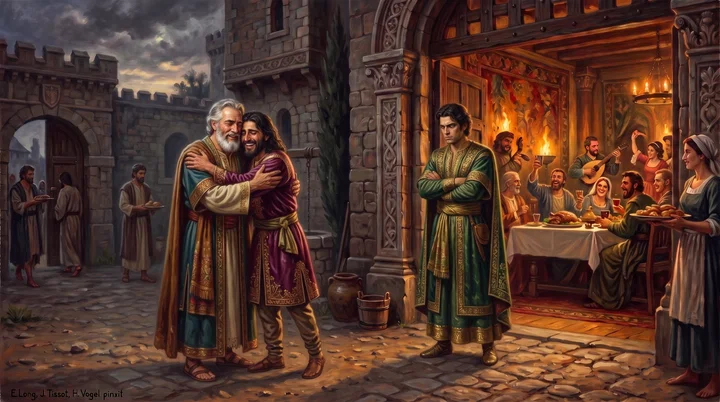
Cross-references
- Luke 15:20
And he arose, and came to his father. But when he was yet a great way off, his father saw him, and had compassion, and ran, and fell on his neck, and kissed him.
The father sees his returning son and runs to welcome him with compassion.
- Luke 15:4-7
What man of you, having an hundred sheep, if he lose one of them, doth not leave the ninety and nine in the wilderness, and go after that which is lost, until he find it?
The shepherd seeks the lost sheep, finds it, and rejoices over its recovery.
- Luke 15:8-10
Either what woman having ten pieces of silver, if she lose one piece, doth not light a candle, and sweep the house, and seek diligently till she find it?
The lost coin is found, and its recovery brings rejoicing over a repentant sinner.
- Luke 15:13
And not many days after the younger son gathered all together, and took his journey into a far country, and there wasted his substance with riotous living.
The younger son wastes his inheritance in riotous living and departs for a far country.
- Luke 15:17
And when he came to himself, he said, How many hired servants of my father’s have bread enough and to spare, and I perish with hunger!
The prodigal comes to himself, remembers his father’s abundance, and turns toward repentance.
- Luke 15:32
It was meet that we should make merry, and be glad: for this thy brother was dead, and is alive again; and was lost, and is found.
The father says it is right to celebrate the lost son’s return.
- Luke 15:18-19
I will arise and go to my father, and will say unto him, Father, I have sinned against heaven, and before thee,
The prodigal confesses his sin and resolves to return to his father as a servant.
- Luke 15:1-2
Then drew near unto him all the publicans and sinners for to hear him.
The gathering and complaint provide the setting for the parable of the lost son.
- Luke 15:22
But the father said to his servants, Bring forth the best robe, and put it on him; and put a ring on his hand, and shoes on his feet:
The father welcomes his returning son with a robe and a ring.
- Luke 15:16
And he would fain have filled his belly with the husks that the swine did eat: and no man gave unto him.
The prodigal son longs to eat the husks while in a far-off land.
- Luke 15:4
What man of you, having an hundred sheep, if he lose one of them, doth not leave the ninety and nine in the wilderness, and go after that which is lost, until he find it?
A lost sheep is sought until it returns.
- Matthew 20:1-16
For the kingdom of heaven is like unto a man that is an householder, which went out early in the morning to hire labourers into his vineyard.
Both parables challenge claims to greater reward for longer service.
- Luke 15:6
And when he cometh home, he calleth together his friends and neighbours, saying unto them, Rejoice with me; for I have found my sheep which was lost.
Rejoicing over the lost sheep contrasts with the brother’s jealousy.
Commentary
Each commentary is drawn from primary sources: the writings of Ellen G. White and Adventist pioneers and periodicals. Each commentary is separate. Its own words are not a quotation; follow the references to read the source passages.
Ellen G. White
76 sources
The verse pictures the elder son coming in from the field, hearing music and dancing at the house, and asking a servant what it means, only to learn that his younger brother has come home safely and his father is celebrating with a feast.ST Jan 29, 1894COL 207.2–33T 103.1–4 The father's welcome shows God receiving the repentant sinner without reproach or accusation, as a son and not as a servant, with compassion, honor, and great joy in heaven.RH Jan 19, 1911COL 203.2–205.1GW 157.3 The elder son's questioning exposes selfishness, pride, envy, and resentment at that joyful welcome, standing apart from his father's joy with suspicion instead of kindness.ST Jan 29, 1894COL 207.2–33T 103.1–4 His self-righteous contrast of his own service with his brother's course proves his own need of repentance, for service does not earn salvation.COL 210.1Lt 71, 1895, par. 26Ms 87, 1899, par. 16 The parable therefore calls all to share the father's compassion rather than the elder brother's coldness, seeking the lost and welcoming the repentant with tenderness and free forgiveness.3T 103.5–104.1Lt 45, 1894, par. 21–2418MR 113.5Ms 132, 1902, par. 9Ms 81, 1893, par. 61–63
Story and Context
The elder son is coming in from the field toward the house when he hears music and dancing, calls one of the servants to him, and asks what these things mean, and he learns that his younger brother who was thought dead has come back safe and sound and that his father has made a feast to celebrate the return.ST Jan 29, 1894COL 207.2–33T 103.1–4Lt 52, 1899, par. 3 His asking with suspicion rather than kindness opens the way to jealousy and anger at the honor given to his repentant brother instead of sharing his father's joy over the lost son's return.COL 207.2–33T 103.1–4
Before that moment the younger son had asked for his portion of the estate so he could separate his interest from his father and manage his share to suit his own inclination, bracing his selfish rebellious spirit with the thought that part of his father's property belonged to him when rightfully he could claim nothing and should have had nothing.COL 198.4–199.13T 100.3–101.2 The father complied, and the son selfishly withdrew so he would not be troubled with counsel, reproofs, advice, restraint, or mutual obligation, going far away so he might even forget he had a father, despising restraint and determined to take pleasure in any way he chose.COL 198.4–199.13T 100.3–101.2 After receiving treasure of which he was undeserving he spent all in sinful indulgence and extravagant pleasure, and when famine visited the land he felt pinching want, regretted his course, became destitute of the means he had squandered, and came down to the low business of feeding swine.COL 198.4–199.13T 100.3–101.2 Such a wayward course is bound up with indulgence and with parental failure to restrain and train children.11MR 40.3–41.2
The prodigal also pictures those who claim to keep the commandments while transgressing the law, unthankful and unholy, flattering themselves that they are Christians while employing their entrusted talents to counterwork God, with no light in them so that their light is darkness and their influence is not unto sanctification or holiness.Ms 75, 1898, par. 13–14 He likewise pictures one who through selfish indulgence becomes a ruined temple of his own making, once standing in pride with ambitious hopes and winning the richest prizes by excelling in seeking victory, then filled with self-sufficiency by praise and flattery and sunk lower and lower by the habit of wine-drinking until courage, God-given manhood, mind, and judgment are lost and he drifts under Satan's guidance and control with no power to leave the snare, and to this discouraged, sick, tempted, and fallen one Christ speaks words of tender sympathy that he needs and can understand.Ms 22, 1898, par. 19
The verse belongs to one of the parables told in response to criticism of association with sinners, teaching mercy and forgiveness through the father's joyful welcome of his returning son who was thought dead but is alive, whom the father sees afar off, runs to meet, and rejoices to receive.Ms 102, 1894, par. 12–14Ms 24, 1891, par. 8819MR 259.1–3 It uses facts of life and familiar experience from daily surroundings to illustrate immortal truth, showing an open spirit to the influences of nature and delight in gathering spiritual teaching from ordinary life, so that the daily task is brightened and uplifted by constant reminders of the spiritual and unseen that hold something to interest every mind and appeal to every heart and awaken sympathy.3MR 333.2–319MR 259.1–3Lt 223, 1905, par. 8–10GW 408.2 In that setting the father-and-son picture is connected with God's dealings with Israel, representing loving care for Israel, and recalling servants sent to receive the vineyard's fruit who were despised.ST Feb 27, 1896Ms 56, 1902, par. 5
Father's Forgiving Welcome
The father in the story is God in His tender, loving and pitying care for those who have turned away from Him and are lost.COL 198.111MR 367.1 He does not leave them in misery but is kind and tender toward those exposed to the tempter's influence.COL 198.1 His heart yearns for the wanderer far from home, and every longing to return is the pleading of His Spirit drawing the sinner back to the Father's love. The parable itself still falls short of expressing the full measure of that love.
The music and feasting about which the servant is asked show God receiving the repentant sinner without reproach or accusation.RH Jan 19, 1911COL 203.2–205.1GW 157.3 He welcomes him as a son and not as a servant, restoring him with honor, compassion, warmth, courtesy, love, and a place at the Father's table, with great joy in heaven over his return.RH Jan 19, 1911COL 203.2–205.1TCBMP 128.1Ms 19, 1890, par. 21 He clothes the returning one with righteousness, forgives him, and does not hold the forgiven sin against him.RH Jan 19, 191111MR 370.2–371.1 He rejoices that the erring one has returned and recognized his need, pitying, loving and forgiving him.TCBMP 128.1
This welcome rests on infinite love shown in the gift of the beloved Son for the fallen race, which has made a channel for the outflow of that love so that all who believe may be restored again to favor.Lt 85, 1886, par. 17–18 That infinite love in Jesus as the sacrifice gives a solid foundation for faith, and believing on Him leads to obedience to all of God's commandments and to life in Jesus Christ.Lt 85, 1886, par. 17–18 It pictures God's boundless love in assuming humanity in the person of His Son and making propitiation for the sins of the whole world.ST May 8, 1901 It shows the amazing sacrifice made for the lost and the labor and energy Heaven expends to reclaim them and bring them back to the Father's house.ST Oct 31, 1916
God works with loving concern to bring back those who have known the Father's love but have been led away, and when they repent He receives them.11MR 370.1 Any sinner who comes in repentance can expect to be received and forgiven with love, and one who turns with full decision of soul is accepted.Lt 76, 1898, par. 18–20Lt 33, 1896, par. 12 Though long separated and serving sin and the flesh and the devil for poor wages, he is still met even now when he comes, ready to be accepted and pardoned of all transgressions and cleansed from sin as he lays hold on Christ.2T 295.1 Christ's message of mercy to such an erring one is Come, for all things are now ready that he may have life, and he must turn and live and not neglect this work or flatter himself with false hopes lest he perish in his sins and die.2T 295.1
The welcome is freely given, but to enjoy a son's privileges one must meet the conditions of sonship.Lt 164, 1900, par. 21–23ST May 8, 1901 This means meeting God on His own ground with cordial assent and willing obedience, renouncing the favor and friendship of the world and making Christ all and in all, receiving Him as Saviour and obeying His word and living under the Father's authority.Ms 183, 1901, par. 12ST May 8, 1901 The return means unreserved surrender and the gift of the whole life, not giving money alone where no effort is required, but consenting to accept a son's obligations.Ms 98, 1901, par. 17–2010MR 110.3–5 The son's place in the family is restored, yet claiming its privileges requires remaining under the father's care, submitting to control, obeying direction, denying self, taking up the cross, and making personal effort and self-denial.Ms 98, 1901, par. 17–2010MR 110.3–5 Like the found sheep remaining under the shepherd's care in the fold and repaying his love by remaining instead of renewing its wanderings, the returned wanderer must remain, for refusing submission is continuing in disobedience and stepping to the devil's side is falling into the devil's hands.10MR 110.3–5
Elder Brother's Resentment
Coming in from the field he hears music and dancing at the house, calls a servant and asks what these things mean, and learns that his younger brother has come home safe and his father has made a feast to celebrate.ST Jan 29, 1894COL 207.2–33T 103.1–4 His question exposes selfishness, pride, envy, jealousy, anger and resentment at his father's joyful welcome, for instead of sharing the father's joy he stands apart from it and meets the news with complaint.ST Jan 29, 1894COL 207.2–33T 103.1–4Lt 80, 1898, par. 9–13Ms 40, 1899, par. 10–12 He feels insulted by the honor given to the repentant one, asks with suspicion and distrust rather than kindness and tenderness, and stands by stubborn and complaining while his brother is still struggling to return.Lt 80, 1898, par. 9–13Ms 40, 1899, par. 10–12TCBMP 128.2 That complaining answer was natural but not right, and the returning sinner already suffers in feeling and is often desponding and discouraged.3T 103.5–104.1TCBMP 128.2
As brother often deals with brother, he watches to criticize and accuse of every fault, magnifies faults, tries to make the erring feel where they have erred, and keeps reminding them of their mistakes.3T 103.5–104.1Lt 80, 1898, par. 9–13COL 210.1 His spirit toward the struggling one is indifference, contempt, coldness, suspicion, dislike, careless disregard and retaliation, refusing to forgive as the father forgives and refusing to help bring the wanderer back.Lt 80, 1898, par. 9–13GW 140.2RH Apr 10, 190019MR 202.3Lt 71, 1895, par. 25 Such a fault-finding and complaining spirit spoils his service even when he bears hardships and burdens.Ms 29, 1911, par. 69 It stands opposite the true Shepherd, who goes after the lost sheep, calls the distressed to return, heals backsliding, loves freely, and rejoices with all heaven when the lost is found.3T 103.5–104.1Lt 71, 1895, par. 25
He feels his own course righteous, supposes he has been faithful in home duties and needs no repentance, contrasts his conduct with the prodigal's, and cannot sympathize with the father's joy in receiving the wanderer.COL 210.1Lt 71, 1895, par. 26 He counts long service and hardship as earning a greater reward and resents goodness shown to others, for service does not earn salvation.COL 210.1Ms 87, 1899, par. 16 By this selfish unwillingness to receive his repenting brother and rejoice at his return he proves his own need of repentance.Lt 71, 1895, par. 26 By accusing his brethren he places himself where he cannot receive God's favor.COL 210.1
His response belongs to the portrayal of unrepenting Israel, which refused to recognize publicans and sinners as brothers who should be sought, forgiven, and led to everlasting life.ST Jan 29, 1894 He represents people who need salvation themselves yet look on a struggling soul with contempt, established believers and handlers of sacred things who resent attention and labor given to wandering people and new converts and fail to help them.RH Apr 10, 1900Lt 71, 1895, par. 26Lt 57, 1898, par. 4–5 Those who should rejoice when wandering people are brought back instead become envious and jealous that attention and labor are given to them.Lt 8, 1898, par. 20–21 Some called Seventh-day Adventists will act in the same suspicious, distrustful, unkind, retaliatory way, meeting others unfavorably and making the work hard for those who need help most, and those who have felt that distrust must not return it or practice it in labor for others.19MR 202.3Lt 92, 1895, par. 1–4
He means church members who murmur because ministers go to save the lost instead of laboring constantly for the church, who want to be constantly fed with sermons and nursed while others perish, and who speak as if the church were robbed of labor it should have had.21MR 32.4–33.2Ms 49, 1898, par. 24–25Ms 49, 1898, par. 26–28 This lacks the Spirit of Christ who left the ninety-nine to seek the lost, and it is gossiping, doubting, questioning, evil surmising, jealous fault-finding selfishness that sorely displeases the Lord.21MR 32.4–33.2Ms 49, 1898, par. 24–25Ms 49, 1898, par. 26–28 It hinders ministers, keeps souls from being added, and marks those who neglected souls in peril, left them to wander and perish, drove them into snares, and will not rejoice when Christ brings them back.Lt 23, 1894, par. 6–7Ms 49, 1898, par. 26–28 They act jealous and complaining of the Father's favors to the poor prodigal, whom He values as one for whom Christ died.21MR 32.4–33.2Lt 23, 1894, par. 6–7
Seeking and Restoring Wanderers
The parable calls for earnest cooperation with God in seeking the lost sheep and winning back the prodigal.18MR 113.5Ms 132, 1902, par. 9 That cooperation requires having the Spirit of Christ in councils and going into the wilderness of darkness and confusion to search for straying sheep, since they can never find their way back without help.Ms 81, 1893, par. 61–63 Luke 15:11-32 gives the true pattern for this work in the tender, loving, pitying care of the Father who receives repenting, returning children with the joy of an earthly father receiving a long-lost son.18MR 113.5Ms 132, 1902, par. 9
Those who welcome the repentant must reflect the father's compassion and not the elder brother's jealousy, resentment, cold response, complaint, or unforgiving spirit.3T 103.5–104.1Lt 45, 1894, par. 21–24TCBMP 128.2RH Nov 25, 1902Lt 71, 1895, par. 27 The erring need tenderness, pity, help, sympathy, and above all free forgiveness rather than reproach, severe judgment, cold rejection, or constant reminding of mistakes, and the parable should soften the heart toward those fallen under temptation.3T 103.5–104.1TCBMP 128.2RH Nov 25, 1902Lt 71, 1895, par. 27Lt 16a, 1887, par. 4 This is because the returning sinner already suffers in feeling and is often desponding and discouraged, while brother often deals with brother by trying to make him feel his error and magnify his faults.3T 103.5–104.1TCBMP 128.2 A harsh, unchristlike character wounds and drives away instead of welcoming, and keeps people from entering God's kingdom.Lt 71, 1895, par. 27Lt 16a, 1887, par. 4
The lesson rebukes the church's failure to seek the lost and bring them into the fold, a failure that hindered efforts to reach George Lay.Ms 16, 1868, par. 2–3 Many are still far from the Father's house and perishing with hunger, and they are to be treated with compassion and brought to saving knowledge of the truth.9T 50.2 For youth the story teaches that forsaking God, the source of true pleasure, for a pleasure-loving life of sinful indulgence ends in misery and spiritual poverty, while return to the Father in penitence brings forgiveness, welcome, and restoration.MYP 408.1 Those who have left the Father's house and service are encouraged to return without delay with a humble heart, turning to God and following an enlightened conscience, as Edson's return showed renewed submission like the prodigal's.STB 147.5 Seekers coming to the Sanitarium may likewise turn toward God when truth is lived out before them as a saving power, and people who have themselves been rescued from sin can help bring other prodigals back to the Father.MH 179.1–2Lt 200, 1902, par. 8–10
The Father's house means the Father's service, leaving the service of Satan and of sin to belong to Christ as His property bought by His blood.Lt 59, 1886, par. 1–53MR 64.5–65.3 A thorough backslider who has given up the Sabbath for work through discouragement and temptation must therefore turn square about at once and return to the Father.Lt 59, 1886, par. 1–53MR 64.5–65.3 Mistakes by brethren and severity toward simple errors of youthful indiscretion are no reason to grieve the heart of Christ who died to redeem him.3MR 64.5–65.3 The return requires an immediate, solemn decision before God and angels to be a Christian from that day, even at loss of position, trade, and livelihood.Lt 59, 1886, par. 1–53MR 64.5–65.3 God then evidences pardon and love with purified thoughts, changed purposes, happiness, and thankfulness.Lt 59, 1886, par. 1–53MR 64.5–65.3
The returning sinner may tell God of failures and trust His welcome and help for a fresh effort.MYP 97.1 Even the poorest person who comes in repentance is met with warmth, courtesy, love, and great joy in heaven.Ms 19, 1890, par. 215T 604.1STBk 14.1 The call to return is thus a message of love and hope that encourages the wanderer to come back rather than blaming and condemning him, for one in danger through temptation calls forth tender sympathy and earnest effort to save.Lt 178, 1902, par. 28–305T 604.1
Sources
Pioneers and periodicals
122 sources
The elder son comes in from the field to find his home filled with music and dancing, and stops outside to ask a servant what is happening.ST Jan 29, 1894ST Jan 29, 1894ST Sep 6, 1899 He is told his younger brother has come home safe and sound after being lost as if dead, and their father has killed the fatted calf and made a feast to celebrate his return.ST Jan 29, 1894ST Jan 29, 1894ST Sep 6, 1899 The question belongs to the parable of the prodigal son, one of three parables of the lost that vindicate receiving publicans and sinners with joy against the complaint of scribes and Pharisees.ST Nov 22, 1899RH Sep 3, 1872ST Nov 21, 1900ST Mar 28, 1906ST Oct 24, 1900 The younger son pictures Gentile sinners, publicans and the lost, while the questioning elder son pictures the Jews, scribes and Pharisees and all respectable religious people who cannot understand God's rejoicing over a wanderer.ST Jan 29, 1894STST Nov 22, 1899RH Jul 6, 1868ST Aug 6, 1894 The feast he hears expresses the Father's heart-love toward the repentant, meeting the returning sinner while yet afar off with embrace, full pardon without reproach, restoration to sonship, and joy shared through the household and heaven.RH Jan 19, 1911RH May 9, 1871ST Jul 7, 1909ST Nov 7, 1900ST Aug 11, 1914
Verse Scene Described
The elder son was coming in from the field toward the house when he heard music and dancing, and he called one of the servants to him and asked what these things meant.ST Jan 29, 1894ST Jan 29, 1894ST Sep 6, 1899ST Dec 18, 1901 His question was an inquiry from outside about why there was music and celebration at the house.ST Dec 18, 1901ST Apr 25, 1878ST Apr 30, 1894RH Sep 15, 1910 In asking, he was approaching from the field and learning for the first time what was happening inside.ST Mar 25, 1880ST Sep 6, 1899ST Dec 18, 1901ST Apr 25, 1878ST Aug 6, 1894
The servant answered that his younger brother had come home safe and sound, and that their father had prepared a feast and killed the fatted calf to celebrate his return.ST Jan 29, 1894ST Jan 29, 1894ST Sep 6, 1899ST Aug 11, 1914ST Aug 6, 1894 The brother who had been thought dead had returned, and the father had received him again as from the dead.ST Mar 25, 1880ST Aug 11, 1914ST May 19, 1898 The sounds heard were those of the royal feast ordered to honor a deeply mourned and long-lost son.ST Mar 25, 1880ST Aug 11, 1914
The question places the elder son outside the family celebration at the moment he discovers his brother's return.ST Apr 30, 1894RH Sep 15, 1910ST Feb 10, 1904ST Sep 28, 1904 It sets up his discovery that his father is welcoming home his younger brother and introduces his response to it.ST May 19, 1898ST Apr 30, 1894RH Sep 15, 1910 That response stands in contrast to the return itself and to the father's welcome and celebration of restoration to life.ST May 19, 1898ST Feb 10, 1904ST Sep 28, 1904
Parable Literary Context
Luke 15:26 belongs to the parable of the prodigal son in Luke 15:11-32, one of three parables of the lost sheep, the lost coin, and the lost son given to show God's love and concern for lost and wandering people.ST Nov 22, 1899RH Sep 3, 1872ST Nov 21, 1900 The three form a progression from one lost sheep among a hundred, to one coin among ten, to one son among two, with the return of the lost son requiring a change of will and a choice to come back.ST Oct 10, 1900RH Mar 28, 1865 Finding what was lost is made a cause for joy, and the angels rejoice over one sinner who repents. The chapter's setting may be compared with Zaccheus to show how a rich man can be saved because the Son of man came to seek and to save that which was lost.ST Nov 21, 1900
The parables were spoken when Jesus was welcoming publicans and sinners while scribes and Pharisees complained.ST Nov 22, 1899 They correct the false view that God has no pity for the erring and fallen.ST Nov 22, 1899 In the parable of the prodigal son Christ justified receiving sinners and contrasted two classes, with the elder brother asking what the rejoicing meant and refusing to enter showing Pharisees who would search hard for lost sheep and lost money and rejoice when found, yet were offended when lost men came to Christ to be saved and would not join heaven's joy over their salvation.ST Mar 28, 1906 The account shows that Christ receives sinners as He did in the past, and the parable was addressed to publicans and Pharisees.ST Oct 24, 1900
The discourse beginning in Luke 15 continues through Luke 16, so the verse belongs to a series of parables presented in the same discourse as the parable in Luke 16.RH Apr 8, 1858 It is the third parable spoken at the same gathering as the lesson about the steward.ST Oct 24, 1900
The account is a parable rather than literal history, real history, or literal narration.RH Sep 3, 1872RH May 28, 1861ST Aug 19, 1880 That it is a parable is known from the nature of the text and context rather than from a positive declaration that it is one, and from its setting among the three parables in Luke 15 and from the way it begins with "A certain man had two sons" like the adjoining accounts introduced in the same way.RH Sep 3, 1872RH Mar 28, 1865ST Aug 19, 1880 Christ used this familiar event of life to teach immortal truth, turning an ordinary human experience into a reminder of spiritual realities, and the story of the prodigal son illustrates the love of God for sinners and their obligation to love Him in return as an especially effective way to teach truth through a striking example.ST Nov 30, 1915ST Jun 1, 1882
Brothers Represented Meaning
In this parable the younger wandering son stands for the Gentile world and for Gentile sinners, publicans, and the lost, while the elder son who calls a servant and asks what the music and rejoicing mean stands for the Jews, the scribes and Pharisees, who claimed to be Abraham's seed and the favored class.STST Nov 22, 1899RH Jul 6, 1868ST Mar 28, 1906 His questioning and then his anger at the welcome illustrate Jewish indignation that Gentiles should be welcomed into God's favor and made fellow heirs of the kingdom of heaven.RH Jul 6, 1868ST Mar 28, 1906 His asking what the rejoicing meant and refusing to enter shows those who would search hard for lost sheep and lost money and rejoice when found, yet were offended when lost men came to Christ to be saved and would not join heaven's joy over their salvation.ST Mar 28, 1906 Together the two brothers stand for sinners and backsliders, Jews and Gentiles.ST
The great object served by the inquiry is to show God's great love to the undeserving, whether Jew or Gentile, backslider or sinner, because God is no respecter of persons.ST The same inquiry teaches that God is willing to receive the penitent sinner who has turned away from Him, so that wherever mercy is needed and repentance is present, mercy may be given.RH Jul 6, 1868 The elder brother's response belongs to the portrayal of unrepenting Israel, which refused to recognize publicans and sinners as brothers who should be sought, forgiven, and led to everlasting life.ST Jan 29, 1894
The elder brother also pictures anyone now who takes the same carping, critical place, so that every person is either the prodigal returning to the Father's house or the carping elder brother, and the one in the elder brother's place is in as hard and lost a condition as the prodigal without knowing it.ST Aug 6, 1894 His questioning incomprehension is the incomprehension of respectable religious people when God rejoices over a wanderer come home, the celebration being utterly incomprehensible to him.ST Jun 13, 1916 Divine love finds its largest field and most earnest longing toward the one gone astray, working most earnestly for the unlovely, the forsaken and the hopeless, as a devoted mother's time and thought and prayer entwine most strongly around a wandering boy.ST Jun 13, 1916
The wandering prodigal remains a member of the family and a son and heir while away in the far country, though persistence in his disloyal course will finally disinherit him.ST Sep 28, 1904ST Mar 8, 1899ST Nov 14, 1900 This time away is minority and probation and bondage to sin, giving opportunity to acknowledge God as Father and become sons indeed, yet while away he is as a slave who must return to the father or die.ST Mar 8, 1899ST Nov 14, 1900 The family bond can be restored only as far as he is willing to return, since he cannot be forced into harmony, while the faithful brother continues to watch and pray for his return until the returning brother acknowledges the father and brotherhood he had disowned.ST Sep 28, 1904 A lesser-held teaching applies the prodigal children coming home to Protestants returning to the mother Catholic Church, which remains exactly the same without changing to meet them and prays every day for their soon joint return together, with their uniting among themselves making that joint return easier like pulling chairs fastened together rather than pulling each one separately.
Father Welcoming Sinners
The music and dancing the elder son hears are the father's royal feast ordered to honor a deeply mourned and long-lost son now come home, and they express the father's great heart-love and God's mercy and compassion toward repentant sinners.RH May 9, 1871ST Aug 11, 1914RH Jun 14, 1870 Those who have wandered from God can return because God loves them and is willing to pardon, forgive and bless them when they turn from sin with the whole heart and humbly seek His help.RH May 9, 1871RH Jun 14, 1870ST Oct 22, 1896 The return brings a welcome of open arms, pardon, reconciliation and joy throughout the household, showing the welcome God gives a sinner who comes back to Him.ST Jul 7, 1909ST Dec 10, 1894ST Oct 22, 1896 They must resolutely break free from Satan's hold, and His mercy is ready to help as soon as they earnestly begin to return, meeting them before they reach home, removing shame, and bringing repentance and the peace that comes from experiencing His love.RH Jun 14, 1870ST Dec 10, 1894ST Oct 22, 1896
The father's heart-love goes out to meet the returning son while he is yet a great way from home, puts arms around him and gives a kiss of welcome and forgiveness even before any confession of wrong.ST Aug 11, 1914 God who reads the heart answers its first aspiration and the desire to return more abundantly than could have been asked, without waiting for a reformed life to prove sincerity.RH Jun 4, 1901ST Feb 18, 1886 He welcomes and forgives those who return with joy rather than requiring them to complete penances or a long series of apologies, for there is no penance or purgatory.ST Nov 7, 1900ST Feb 18, 1886 A guilty, needy sinner can come to the Father with nothing to offer but himself and be welcomed, restored to the Father's favor without first confessing to a priest or receiving priestly absolution.ST May 4, 1876ST Apr 10, 1893
Servant status is refused for the penitent, and instead the father orders the best robe to be put on him and makes open, gladsome honor of his restoration.ST Aug 11, 1914 When a sinner sincerely turns to God for mercy, God welcomes him as a son rather than leaving him to seek acceptance as a servant, continually yearning for those who have wandered and tenderly inviting them to return.RH Aug 17, 1911ST Feb 24, 1887 The son who returns is welcomed with rejoicing, given the best robe and received at a feast, and returning to God is open to everyone who has wandered away.ST Mar 17, 1898 The lost son made poor by sin is welcomed home, given a robe and celebrated as one who was lost and is found, dead and alive again, and his restoration is pictured as new birth and rescue from sin and the grave. The sin-defiled child in rags is embraced, pardoned and reconciled by the Father, clothed by His love in a dress of spotless righteousness which is Christ's righteousness, fed from a spread feast of love upon the children's bread which is the bread of life, and put in the children's place by fullness of grace to bear Christ's name, wear His robe, share the Father's love, gaze upon His face and shine in His likeness with everlasting joy shared by the angels.RH Aug 17, 1911ST Sep 9, 1875
The father receives the repentant son without reproach, treats him as his son and celebrates his return, showing that God forgives the sinner who returns to Him and does not hold the forgiven sin against him.RH Jan 19, 1911 When the son turns homeward, needy, suffering and homesick, the father welcomes and forgives him without dwelling on his wrongdoing, clothing and honoring him, and the repentant sinner is not taunted for his past but his sins are forgiven and forgotten.ST Feb 18, 1913RH Dec 23, 1915 As a father forgives a stoutly rebellious son who feels sorry, repents and humbly asks forgiveness because he cannot help it when he sees how sorry the son is, with the matter settled forever and nothing more said about it, so God forgives the sorry sinner who humbly asks Him fully and finally, so that great sins once forgiven need not be continually lamented.ST May 27, 1897 Such magnanimous, generous, trusting forgiveness reinstates the repentant in divine confidence, affection and esteem, buries his sin in the depths of the sea, blots it out of the book of remembrance and remembers it no more against him forever.ST Feb 18, 1886ST Feb 18, 1886 Forgiveness is not merely remission of penalty and does not always include remission of penalty, since penalty may redeem from sin's power, but it always includes reinstatement; and if a wrongdoer abandons wrongdoing, makes what reparation he can, desires cleansing, acknowledges sin without concealment, palliation or defense, and bears its just consequences unshrinkingly, he is brought back by that fact.ST Feb 18, 1886ST Feb 18, 1886
The questioning of what the celebration means is the questioning of a soul tormented by sin, astonished at mercy past believing and grace so full and free, and the things meant are a Father's love still abiding with boundless store for one who has wandered far, grieved the Holy Spirit, squandered his substance and trod the darkest paths.ST Dec 10, 1896 God lets people go their own way alone till they are homesick and distressed, thirsting and hungering in the wilderness and fainting in far-off lands feeding on husks, yet He waits to bless at their feeblest faintest knock, and when they humbly come back with empty hands and swelling heart the celebration is that welcome with robe and ring for the last and least while angels sing over them.ST Jan 2, 1907 The Father is yearning over the returning sin-stained soul, and that return floods the courts of God with joy.ST Dec 10, 1896 That yearning illustrates the depth of love and concern for the lost, the anguish of Christ burdened for souls, the amazing sacrifice made for the lost and the labor and energy Heaven expends to reclaim them and bring them back to the Father's house.ST Oct 31, 1916RH Jan 16, 1908 Finding what was lost is a cause for joy, and the angels rejoice when even one sinner repents, which repentance is the Spirit of God's work in a person with that person's willing cooperation, honorable and welcomed by God and not a cause for shame.RH Aug 3, 1869
The welcome pictures God's boundless love in assuming humanity and making propitiation for the sins of the whole world, freely given, but to enjoy the privileges of a son requires complying with the conditions of sonship, meeting God on His ground with cordial assent and willing obedience, renouncing the favor and friendship of the world and making Christ all and in all.ST May 8, 1901 The son is far from his father's house and must make the journey back to return, illustrating that pardon and mercy await the sinner, but return from sin involves repentance and reformation.ST Oct 27, 1898 The father's joy and reception picture God taking the repentant sinner into His family and training him to obey.ST Apr 1, 1886
Repentance Leading Home
Fallen human nature is blind and depraved, and discontent can lead away from good into ruin at great cost, for departure from home is leaving the right way.RH Jul 15, 1862ST Aug 26, 1875 Sin misuses what the Father has given, wastes it in unrestrained pleasure, and brings misery, slavery, suffering, famine, want, and starvation feeding on husks while the soul starves away from the bread in the Father's house.RH Jul 15, 1862RH Jan 19, 1911ST Aug 26, 1875ST Nov 14, 1900RH Feb 28, 1871 God gives a season to return, yet delay can make return too late, so the wise and decisive course is to arise and turn back to the Father in repentance and reform rather than remain proud and impenitent or rely on personal effort away from him.RH Jul 15, 1862 There the hungry soul finds sustenance, welcome, willingness to receive and help, bounty like that given to the servants, and power to live rightly.RH Jan 19, 1911RH Jul 21, 1910 Restoration is to the privileges of a son, and the penitent is welcomed with a father's love.RH Jul 15, 1862ST Aug 26, 1875
True repentance recognizes sin and lost condition, feels need, accepts personal guilt rather than blaming circumstances or other people, and revolts against wrongdoing because it is wrongdoing and not merely from regret for consequences or because sin costs much and pays little.RH Feb 16, 1869ST Dec 15, 1887ST Feb 18, 1886 It confesses without excuse, concealment, palliation, or defense, humbles self to take the lowest place, casts aside rags of own righteousness to stand in nakedness of soul pleading grace, and asks forgiveness rather than offering works or offering to do something for the Father.RH Feb 16, 1869RH Apr 14, 1863ST Dec 24, 1902ST Feb 18, 1886 Such confession gives hope of reform and prepares the sinner to receive welcome, favor, and saving grace.RH Apr 14, 1863ST Dec 15, 1887 The penitent confesses unworthiness to be called son and even to lift eyes to heaven, praying in Jesus' name for His blood to cover transgressions and His spotless righteousness to clothe, for lips touched with sin-consuming fire, for new thought, purpose and desire, for daily grace and guidance in the narrow way, with all power belonging to God and to His praise through endless eternity.ST Dec 24, 1902 Forgiveness then reinstates in confidence and affection, buries sin in the depths of the sea, blots it out of remembrance, and remembers it no more forever, and those who pray for forgiveness must give that same forgiveness to a wrongdoer who has abandoned sin and acknowledged it, borne its penalty unshrinkingly, and done all conscience and duty call for to repair the evil, though unlike God who reads the heart they must wait for deeds to prove repentance real.ST Feb 18, 1886 The returning sinner who recognizes wandering and seeks restoration receives pardon and welcome back to his people, willing to make restitution and walk in life.RH Jul 27, 1869ST Feb 18, 1886
Repentance is the Spirit of God's work in a person with willing cooperation, honorable and welcomed by God and not shameful, over which angels rejoice when even one sinner repents.RH Aug 3, 1869 The Father does not give up in despair but keeps care over the wanderer, with His Spirit ever pleading and drawing to return, and when the sinner begins turning toward the Father God is already answering by giving the desire to return and answering it more abundantly than could be asked even before confession.ST May 1, 1901RH Jun 4, 1901 That drawing comes through the Father's goodness, through memory of home that brings the sinner to himself, and sometimes through affliction, hardship, and want that stop his course, awaken him to his senses, and bear good fruit when met rightly.ST Nov 14, 1878RH Mar 19, 1914 Hunger among the swine can thus awaken an idle, wasteful person to change course and return to industry and responsible living.ST Nov 14, 1878 Return also brings new awareness of the heart's hidden sins, even in one who had felt self-complacent while far from God.ST Aug 5, 1875
Leaving the father's house in folly pictures a Christian backsliding, so that backsliding re-acts the prodigal's former folly and leaves the Father's house a second time.ST Oct 4, 1877 Time in a foreign country shows that one who turns from God cannot find lasting satisfaction in worldly life.RH Jul 18, 1912 Yet return is possible with confidence not only that there is bread enough in the Father's house but that the returning one will be welcomed to a place as near the great Father's heart as that occupied by more fortunate sons and daughters.RH Mar 13, 1879 The Father welcomes with pity the one who gives up sin and returns with all the heart hoping in mercy though deserving nothing, even if it is the thousandth time.ST Aug 5, 1875ST Oct 31, 1895 Such return brings prayer, confession of sins, asking pardon of God and the prayers of God's people, and joyful celebration where God's children praise Him, sinners are moved to weeping aloud, and many weep for joy as husbands, children, brothers and sisters start to follow Jesus.RH Jan 16, 1866
The younger son selfishly takes his portion and goes far away to live for pleasure without restraint, spurning home to roam the unknown world.ST Mar 25, 1880 He wastes all he was given in sinful indulgence, spoils the fields given him to labor, turns from the fruits of the vineyard to feed on husks with the swine, leaves the pure springs of mercy for the rioter's wine, and changes the white robes of favor for tattered soiled garments.ST Mar 25, 1880ST Mar 25, 1880 Falling into famine he sinks from ease and luxury to the low business of feeding swine, is used ill by the world with no friend like those left behind, and comes to friendlessness, destitution, humiliation, and pinching want while perishing with hunger.ST Mar 25, 1880 There in weariness, wounds, burden, crimson-stained hands, and a heart bringing only sin and pain, he remembers his father's kindness and love and the bounties even hired servants enjoy, recognizes the love slighted and the law broken, and realizes the depth of sin only by realizing what might have been at home with the Father.ST Mar 25, 1880ST Feb 26, 1902 He resolves to return as a wretched, emaciated beggar with humble confession, saddened, ashamed and defiled, asking for a servant's bread as unworthy of the name of child and waiting in the dust for greeting even with the rod if it hastens meeting of penitent heart with God.ST Mar 25, 1880ST Mar 25, 1880 He comes back shamed and sorrowing yet hopeful to find forsaken love, rest and fond forgiveness, dragging faltering worn and bleeding feet, leaving sins and pressing onward close-clasping the cross, to be received with a grasp that cleanses stained hands, ways that heal bleeding feet, a pardoning face of wonderful mercy, tearful eyes healed of blindness, and joy with thankful prayer to God for blessings grace has won.ST Mar 25, 1880
Elder Brother Warning Spirit
The question asked on hearing music and dancing opens the elder son's selfishness, pride, envy and resentment at the father's joyful welcome of a brother come home safe, and his later jealousy and faultfinding complete the picture.ST Jan 29, 1894RH Jan 20, 1916 He watches his brother, criticizes his actions and uses his faults to justify an unforgiving spirit, showing how self-righteousness makes men cold and critical toward others.RH Jan 20, 1916 The inquiry itself belongs to that same spirit, for it stands at the moment he learns of the feast for the lost son received again and reacts not with joy but with inward complaint.ST Jan 29, 1894
His response lays bare a hard and ungracious spirit that looks on a struggling soul with contempt and complains instead of helping bring the wanderer back to God.ST Dec 18, 1901RH Apr 10, 1900 Where the erring suffer in feeling and are desponding and discouraged, they need above all sympathy and help and free forgiveness, yet the elder brother's course is to make them feel where they have erred and to keep reminding them of their error.ST Mar 25, 1880 That cold rejection stands against the manner in which the heavenly Father receives the erring and repenting, for though He is the one sinned against He meets the prodigal in compassion and pity and forgiveness with great joy.ST Mar 25, 1880RH Nov 25, 1902RH Nov 26, 1901 The joy is right because the son believed dead to all filial affection has become sensible of his great sin and neglect, has come back appreciating love and acknowledging claims, has suffered and felt his need and has come as to the only one who can supply it.ST Mar 25, 1880 The contrast is therefore between God's loving efforts to bring back those separated from Him and a self-righteous, critical spirit, between Christ's welcome and continuing love to the backslider and an attitude that withholds it, even from those who themselves need salvation.ST Dec 18, 1901RH Apr 10, 1900RH Nov 25, 1902RH Nov 26, 1901
He could not understand the father's loving welcome, and his question reflects that failure to comprehend the father's love.RH Jan 12, 1911 It was foolish to grumble instead of rejoicing that his brother had given up wrongdoing and returned to his father.ST Jun 24, 1897 He is made miserable by his own heart, and his father's kindness does nothing to relieve that misery.ST Jul 1, 1880
He remains outside the family's harmony by choosing not to return and not sharing the father's joy over the lost restored, complaining against his father's kindness rather than entering into it.RH Dec 13, 1906ST Feb 10, 1904 The father loves him also and invites him to share that joy when the lost are restored, showing mercy toward the elder son as well as the younger.RH Dec 13, 1906RH Jul 3, 1900 The bond can be restored only as far as he is willing to return, for he cannot be forced into harmony, while the faithful brother continues to watch and pray for his return.ST Feb 10, 1904ST Sep 28, 1904
Call To Seek
Luke 15 belongs to the call for sinners to arise and return to the Father in repentance, taking the prodigal's confession as their own language of return.ST Apr 25, 1878RH Oct 13, 1904 The parable presents salvation as good news for a lost world, offered to every kind of sinner from Pharisee to prodigal, and shows that Christ receives sinners now as then.ST Feb 26, 1902 Faith brings the sinner and the Father together in loving embrace, the cleansing touch removes the distance, and no sin is so defiling that the Saviour cannot heal it when called upon in simple faith.
The same story calls for bringing prodigals back to the Father through the loving help of those who have themselves been saved and converted.ST Mar 23, 1904ST Sep 8, 1914ST Jun 3, 1908 The return home is the pattern for welcoming and caring for even one lost person, for rejoicing when an erring one returns to loyalty and obedience, and for meeting the prodigal sister as well as the brother because her life is equally precious and is to be met with mercy and help.ST May 3, 1899ST Jul 2, 1885RH Jul 28, 1904 No soul leaving Satan's service for Christ's is to be turned away, but all giving evidence of true conversion are to be encouraged to enter the Lord's service and work for others, since he who was sought and brought back knows how to seek the lost and point sinners to the Lamb of God.ST Sep 8, 1914 That seeking is to be done through humanity with earnest effort, prayer, kindness, interest and love rather than censure, braving hardship to follow the unreconciled.ST Mar 23, 1904ST Jun 3, 1908ST May 3, 1899
Earthly fathers should continue to guard and guide the wayward child, for rebellion does not cancel the duty of care, and even when reconciliation is not sought interest and compassion must not cease.RH Jul 25, 1871RH Feb 18, 1902 Parents of prodigals who were faithful with God and the family altar should take courage and persevere, because the silent influence of a pious home remains with the child far from home and from God like the song of the sea kept in a shell, the son remembering home because it had not been repulsive and the father had not been stern and forbidding.RH Nov 17, 1868 A mother's and parent's prayers for the wayward child who may repent and return to Jesus are not in vain though the answer is delayed, and the return brings joy.ST Jun 6, 1878 The erring one who may yet return must be dealt with by patient waiting rather than forcing the mind, since the mind moves involuntarily and slowly on moral subjects, the understanding must be convinced before conscience is reached, and time must be given for arguments to work, while a noble forgiving heart is kept to welcome the wanderer whose heart may already be struggling free.RH Nov 20, 1860
Bodily coming home is not itself being found, for a boy is lost before leaving and remains lost after returning when innocence and a teachable spirit are gone and he is left without firm parental control to roam, smoke, loaf and come and go as he pleases; being truly found means being brought by correct control onto virtue's road.RH Aug 29, 1865 True awakening moves the wanderer to return to God, to be led by the gentle Shepherd back into the fold, to be fed with heavenly food with every need sustained, to be lifted from mire onto the Rock to full joy, and this awakening belongs to the Sabbath of the Lord.RH Sep 1, 1874 That return is true Sabbath reform, the free submission of will and repentant soul to God's precepts, laying hold of the everlasting covenant and its righteousness, accepting the hallowed seventh day as its sign, refusing conscience to any earthly power, and rejoicing in obedience as love to the Infinite Love that won the heart back from the far country. The joy of the returned prodigal rests on secret importunate prayer in the shut closet for self and for companion, child, brother, sister or enemy until prevailing like Jacob, and if that closet is forsaken in self-sufficiency he goes mourning and is overcome for a time if not forever.
Wandering is shaped by home influence, calling for tears for the homeless misguided boy as well as his mother, for if cards are made congenial at home he will seek congenial card company abroad, if wine is served daintily to guests the rumseller can scarcely be condemned, and if the impure are clasped across the threshold the smirch will rest on innocent daughters, so the shelter must be kept free while the erring are still won by Christlike touch elsewhere and not in a Pharisaic aloofness.RH Dec 10, 1901 The story pictures ruin by liquor, gambling and the saloon, with grieving loved ones watching and praying at home and fathers longing and searching, until reunion sobers witnesses, breaks the fascination of wine and cards, ends drinking and turns men toward home and aged parents far away.ST Mar 13, 1901ST Mar 13, 1901 Even across the sea the influence of home can protect, when one who left to enjoy foreign pleasure and drank into madness and guilt hears distant music, distinguishes the home song, stands motionless to learn its meaning, sees mother and dear ones and their counsel and farewell, is smitten with remorse, has reason restored and wine's power broken, and turns repentant with a vow never to taste again in thankfulness for escape.RH Aug 24, 1916
Together with the sermon on the mount and the parables of the lost sheep, lost coin, good Samaritan, and Pharisee and publican, the chapter teaches love to God, common brotherhood as children of God the Father, and the rights of all however poor or despised, fulfilling good news to the poor and liberty to the bruised against chattel slavery and property in man in every form.RH Oct 8, 1861 The parable warned the Jewish nation that blessings claimed without righteous fruit producing deeds would be taken and given to others, while also representing Christ's loving care for Israel.ST Feb 27, 1896RH Jun 1, 1916 Its dignity as a beautiful picture of God's relation to humanity is lost when turned into slang or ridicule, and its pattern echoes when a woman wandered into sin, returned home and found joy in Christ.RH Jan 14, 1915ST Sep 10, 1894
The wider story is used without explaining the servant's question itself, as a picture of fallen humanity leaving the right way, suffering through sin, then penitently returning to the Father and restoration to sonship, with hunger satisfied, pardon settled, affliction rightly met, drifting boys warned, cleansing given, and wanderers brought to the Father's house by song.ST Aug 26, 1875ST May 21, 1896ST The father's love for the needy homesick wayward son is infinite, welcoming and forgiving without dwelling on wrongdoing, clothing and honoring him, and calling for patient self-forgetting generosity toward wrongdoers.ST Feb 18, 1913 Mother-love and father-love for the wayward reflect God's everlasting love for sinners, and the parent left with an aching void by a son or daughter who turns from counsel and returns no more shows how God yearns for rebels, since no insult or ruin destroys true parental love and a chamber of memory remains, a love most nearly godlike which eternity will not remove.ST Oct 4, 1899ST Aug 22, 1911
Sources