Luke 15:27
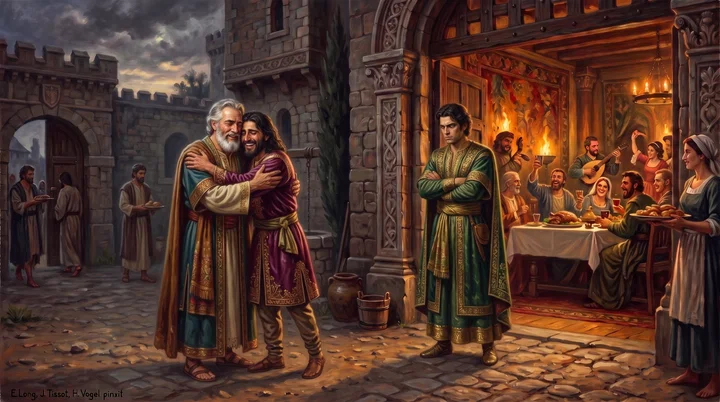
And he said unto him, Thy brother is come; and thy father hath killed the fatted calf, because he hath received him safe and sound.
Translations
And he said to him, Your brother is come; and your father has killed the fatted calf, because he has received him safe and sound.
King James Version, KJV Cambridge Paragraph Bible, Revised Version, American Standard Version
And he said unto him, Thy brother is come; and thy father hath killed the fatted calf, because he hath received him safe and sound.
And he said to him, Thy brother is come; and thy father hath killed the fatted calf, because he hath received him in health.
and he said to him — Thy brother is arrived, and thy father did kill the fatted calf, because in health he did receive him back.
And he said to him, Thy brother is come, and thy father has killed the fatted calf because he has received him safe and well.
And, he, said unto him,—Thy brother, hath come, and thy father hath sacrificed the fatted calf, because, safe and sound, hath he received him back.
Berean Standard Bible, Majority Standard Bible
‘ Your brother has returned,’ he said, ‘ and your father has killed the fattened calf, because he has him back safe and sound.’
He said to him, ‘ Your brother has come, and your father has killed the fattened calf, because he has received him back safe and healthy.’
And he said to him, Your brother has come; and your father has had the young ox put to death because he has come back safely.
And hee sayde vnto him, Thy brother is come, and thy father hath killed the fatte calfe, because he hath receiued him safe and sound.
Douay-Rheims (Challoner revision)
And he said to him: Thy brother is come, and thy father hath killed the fatted calf, because he hath received him safe.
Pictures
Cross-references 20 of 27
- Luke 15:7
I say unto you, that likewise joy shall be in heaven over one sinner that repenteth, more than over ninety and nine just persons, which need no repentance.
Heaven rejoices over a sinner who repents, as the father rejoices at his son’s return.
- Luke 15:20
And he arose, and came to his father. But when he was yet a great way off, his father saw him, and had compassion, and ran, and fell on his neck, and kissed him.
The father sees, runs to, and welcomes his returning son.
- Luke 15:10
Likewise, I say unto you, there is joy in the presence of the angels of God over one sinner that repenteth.
Angels rejoice over a repentant sinner.
- Luke 15:32
It was meet that we should make merry, and be glad: for this thy brother was dead, and is alive again; and was lost, and is found.
The father says rejoicing is fitting because his lost son has returned.
- Luke 15:18-19
I will arise and go to my father, and will say unto him, Father, I have sinned against heaven, and before thee,
The son resolves to return to his father and confess his sin.
- Luke 15:22
But the father said to his servants, Bring forth the best robe, and put it on him; and put a ring on his hand, and shoes on his feet:
The father restores and honors his returning son with a robe and feast.
- Luke 15:17
And when he came to himself, he said, How many hired servants of my father’s have bread enough and to spare, and I perish with hunger!
The prodigal comes to himself and remembers his father’s abundant provision.
- Psalms 103:13
Like as a father pitieth his children, so the LORD pitieth them that fear him.
The father’s welcome reflects a father’s compassion.
- Luke 15:16
And he would fain have filled his belly with the husks that the swine did eat: and no man gave unto him.
Both describe the prodigal reduced to feeding on husks among swine.
- Matthew 18:12-14
How think ye? if a man have an hundred sheep, and one of them be gone astray, doth he not leave the ninety and nine, and goeth into the mountains, and seeketh that which is gone astray?
The Father seeks the straying and rejoices when the lost are recovered.
- Luke 15:4
What man of you, having an hundred sheep, if he lose one of them, doth not leave the ninety and nine in the wilderness, and go after that which is lost, until he find it?
Both portray seeking and rejoicing over the lost.
- Luke 15:2
And the Pharisees and scribes murmured, saying, This man receiveth sinners, and eateth with them.
The elder brother echoes the Pharisees’ complaint that Jesus welcomes sinners.
- 2 Corinthians 5:20
Now then we are ambassadors for Christ, as though God did beseech you by us: we pray you in Christ’s stead, be ye reconciled to God.
God’s appeal to be reconciled is illustrated by the father welcoming his son home.
- Isaiah 55:7
Let the wicked forsake his way, and the unrighteous man his thoughts: and let him return unto the LORD, and he will have mercy upon him; and to our God, for he will abundantly pardon.
Both depict welcome and mercy for one who returns.
- Luke 15:21
And the son said unto him, Father, I have sinned against heaven, and in thy sight, and am no more worthy to be called thy son.
The son's confession precedes the father's welcome and feast.
- Luke 15:31
And he said unto him, Son, thou art ever with me, and all that I have is thine.
The father assures the elder son that he remains with him.
- Luke 15:19
And am no more worthy to be called thy son: make me as one of thy hired servants.
The son confesses he is unworthy to be called his father's son.
- Ezekiel 33:11
Say unto them, As I live, saith the Lord GOD, I have no pleasure in the death of the wicked; but that the wicked turn from his way and live: turn ye, turn ye from your evil ways; for why will ye die, O house of Israel?
God calls the wicked to turn and live rather than die.
- John 6:37
All that the Father giveth me shall come to me; and him that cometh to me I will in no wise cast out.
Christ promises to welcome and not cast out those who come to him.
- Luke 15:11
And he said, A certain man had two sons:
The passage cites the parable of the two sons as an example of a parable introduced directly.
Commentary
Each commentary is drawn from primary sources: the writings of Ellen G. White and Adventist pioneers and periodicals. Each commentary is separate. Its own words are not a quotation; follow the references to read the source passages.
Ellen G. White
96 sources
A servant in the field explains to the elder son why there is feasting and music, that his lost brother has come home alive and well and their father has killed the fatted calf to celebrate his safe return.COL 207.2–33T 103.1–4Ms 24, 1891, par. 88 The welcome shows the Father's pitying love toward those who strayed, who does not abandon them in misery but waits with yearning to receive the repentant without reproach or condemnation.COL 198.1ST Jan 29, 18943T 103.5–104.118MR 113.5Lt 80, 1898, par. 9–13 He takes the wanderer back as a son into his heart and home, forgiving and forgetting the past, covering him with righteousness and giving him a place at his table.COL 203.2–205.1MYP 408.1RH Jan 19, 1911 The elder son, who shared no concern for the lost, treats this mercy as an insult, becoming angry, jealous and unwilling to go in, which pictures the self-righteous who think faithful service entitles them to reward and cannot rejoice when sinners are saved.ST Jan 29, 1894COL 207.2–33T 103.1–4Lt 71, 1895, par. 26Ms 87, 1899, par. 16 The celebration therefore calls every backslider to return at once in humility, confession and willing obedience, for God even now stands ready to pardon, restore and fill with joy all who come to Him.2T 295.1Lt 59, 1886, par. 1–5MYP 97.1Lt 27, 1890, par. 13MR 64.5–65.3
Parable Context and Story
Luke 15:27 belongs to the parable of the prodigal son, which portrays the Lord's dealings with those who have known the Father's love but have turned away and been led captive by the tempter.COL 198.4–199.1Ms 102, 1894, par. 12–14COL 198.2–3 It was spoken in response to the complaints of the scribes and Pharisees that Jesus associated with sinners, and with the lost sheep and the lost coin it teaches mercy and forgiveness toward the lost.Ms 102, 1894, par. 12–14 The younger son's departure and wasteful life set the background for the return and welcome celebrated in this verse.COL 198.4–199.1
Christ taught this truth through a familiar event of daily life to illustrate immortal truth, gathering spiritual teaching from everyday surroundings so that daily work is brightened by reminders of the unseen.3MR 333.2–3ED 102.3–4Lt 223, 1905, par. 8–10ST Nov 30, 1915 The return to the father's home is a most pathetic and touching illustration, presented by coming directly to the point to touch the heart and awaken sympathy while leaving hearers free to accept or reject.19MR 259.1–3 Reading every heart, He drew things new and old from His treasure to illustrate and enforce His teaching, without forcing belief or proving by long, farfetched, complicated reasoning.19MR 259.1–3 The father's welcome of the lost son safe and sound, seeing him afar off, running to meet him, and rejoicing that he who had been thought dead is alive again, shows this way of making the unseen memorable through ordinary experience.19MR 259.1–3Lt 223, 1905, par. 8–10
The younger son selfishly asked for his share of the estate though he could rightfully claim nothing and should have had nothing.3T 100.3–101.2 He separated his interest from his father to manage his share as he pleased and to escape counsel, reproof, advice, restraint and mutual obligation, withdrawing far away to forget his father and to have pleasure in any way he chose.TCBMP 123.13T 100.3–101.2 He spent the undeserved treasure in sinful indulgence until it was all gone, and was then brought by famine into pinching want and destitution down to feeding swine and perishing with hunger far from his father's house.3T 100.3–101.29T 50.2Ms 45, 1901, par. 8 His course pictures one ruined through selfish indulgence and one who once loved and served God but turned away, becoming a ruined temple of his own making under Satan's guidance.Lt 52, 1899, par. 1Ms 22, 1898, par. 19 Once standing in pride, full of ambitious hopes and winning the richest prizes by excelling in seeking victory, he was filled with self-sufficiency by praise and flattery, his habitual wine drinking became fixed, and he sank lower and lower until he lost courage and drifted with no power to leave the snare, losing his God-given manhood as Satan controlled mind and judgment.Ms 22, 1898, par. 19 In that far, perishing condition he is an object of compassion.9T 50.2Ms 45, 1901, par. 8
In the verse a servant tells the elder son in the field what the celebration means, for he heard the general demonstrations of joy but did not know his brother had returned.COL 207.2–33T 103.1–4 The message is that thy brother is come and the father has killed the fatted calf because he has received him safe and sound, welcomed safely home again as from the dead whom they had thought dead, now alive again.COL 207.2–33T 103.1–4Ms 24, 1891, par. 8811MR 40.3–41.2Lt 52, 1899, par. 3 The father made the return an occasion of special rejoicing and feasting, illustrating the joyful welcome given to one who comes back after going astray and the father's continuing love and readiness to receive his son.3T 103.1–411MR 40.3–41.2Lt 52, 1899, par. 3 The honor and respect shown beyond anything the faithful son had received stirs the elder brother to anger so he will not go in to see or receive him, feeling the unfaithful brother had left the father, thrown shared duties upon him, and wasted in wicked profligacy the means given him until reduced to want while he at home faithfully performed a son's duties.COL 207.2–33T 103.1–4 The father entreats him to receive his brother with gladness because he was lost and is found, was dead in sin and iniquity but is alive again and has come to his moral senses and abhors his course of sin, assuring him he was ever with him and all he had was his, but it is right to show this demonstration of joy, for the fact that the lost is found and the dead is alive again overbears all other considerations.3T 103.1–4
Those acting as the prodigal are Jesus' own sons and daughters whom He yearns to bless, professed commandment-keepers who flatter themselves they are Christians yet break the law, are unthankful and unholy, and use entrusted talents to counterwork God.Ms 75, 1898, par. 13–14 There is no light in them, their light is darkness, and their influence is not unto sanctification or holiness, and He longs to do them the good He delights to do but cannot because of the perversity of their characters.Ms 75, 1898, par. 13–14
Father's Compassionate Welcome
The welcome shows that God does not abandon in misery those who have strayed from Him and are exposed to the tempter's influence, but meets them with kindness and tender pity and pitying love.COL 198.118MR 113.511MR 367.1 His love remains strong for those who separate from Him, and when they repent and return He receives them with joy as an earthly father receives a long-lost son returning in penitence.18MR 113.5Lt 80, 1898, par. 9–1311MR 370.1 That welcome is a picture of forgiveness and restoration, giving the true representation of the tender, loving, pitying care exercised by the Father.18MR 113.5Lt 80, 1898, par. 9–13
The Father waits with yearning love to receive the returning prodigal, and when the lost one comes home He does not hurl accusations of wrath but prepares a feast to welcome the return.GW 157.3ST Jan 22, 1894 He takes the first step to seek the wanderer, drawing him back even while far away by His Spirit, so that the longing to return is the Spirit's work.ST Jan 22, 1894 Heaven expends amazing sacrifice and labor and energy to reclaim the lost in bringing them back to the Father's house.ST Oct 31, 1916 God Himself goes after the lost, calls the distressed soul to return, heals backsliding and loves freely, and heaven rejoices when the lost are restored.ST Jan 22, 1894Lt 71, 1895, par. 25
Though He is the one sinned against, the Father meets the erring and repenting with compassion, pity, forgiveness and great joy.3T 103.5–104.1TCBMP 128.1 The joy is because the son, believed dead to all filial affection, has become sensible of his great sin and neglect, has come back appreciating his love and acknowledging his claims, has suffered and felt his need, and comes in humility, penitence, sorrow and contrition to the only one who can supply that need.3T 103.5–104.1TCBMP 128.1Lt 76, 1898, par. 18–20 The returning sinner is not reproached or reminded of past unworthiness, nor taunted or condemned for former sins, but is welcomed safely home with celebration and with patient care rather than cold rejection.ST Jan 29, 1894COL 203.2–205.1Ms 113, 1902, par. 30 Penitence is required, and sorrow and contrition meet forgiveness and covering with Christ's righteousness.ST Jan 29, 1894Lt 76, 1898, par. 18–20
He receives the sinner as a son back into the family and heart, with restoration after a sinful, wasteful life through humility and repentance.COL 203.2–205.1MYP 408.1 He forgives and blots out the past so that past sins are forgiven and forgotten, covers the returning one with His robe of righteousness, reconciles and protects as a child and gives a place at His table.COL 203.2–205.1RH Jan 19, 191111MR 370.2–371.1Lt 76, 1898, par. 18–20 He gives favors to the poor prodigal because He appreciates and values every soul for whom Christ died, receiving any class of sinners who return to Him.11MR 370.2–371.1Lt 23, 1894, par. 6–7
The joyful reception reveals the Father's infinite love for the fallen race in giving Jesus as a sacrifice, opening a channel to restore all who believe in Jesus Christ to His favor, giving them life in Christ and leading them to obey all of God's commandments.GW 157.3Lt 85, 1886, par. 17–18 That love is shown at Calvary, where Christ was given as the propitiation for the sins of the whole world, and through His mercy and dying love sinners are restored to God's favor and assured of acceptance, peace and love.Ms 45, 1901, par. 8Lt 15a, 1890, par. 9–11Ms 82, 1894, par. 22–24 Their return, whether of backsliders coming with confession and contrition after wandering from God or of first-time seekers turning to Him, is met by the tender compassion and pity of Jesus who died to save them, by the convicting and helping power of the Holy Spirit resting upon them, and by the faithful fulfillment of Christ's assurances, so that none who truly come and seek Him seek in vain.Ms 21, 1889, par. 96–97Ms 82, 1894, par. 22–24 Making that love known is the way of winning souls.GW 157.3
The safe return welcomed with feasting is a cause for celebration reflecting the joy in heaven when one is brought back to God.COL 197.2STOM 11.2STBk 14.1STA 14.1 Heaven rejoices when a sinner returns, with greater joy over one sinner who repents than over ninety-nine who need no repentance, and the endangered sinner calls forth tender sympathy and earnest labor.Ms 19, 1890, par. 215T 604.1 Heaven is thus marked by warmth, courtesy and love.Ms 19, 1890, par. 21
Elder Brother's Resentful Complaint
The servant in the field tells the elder son, who hears the general demonstrations of joy but does not know his brother has returned, what the celebration means — that his brother has come and his father has killed the fatted calf because he has received him safe and sound, as from the dead whom they thought dead now alive again, making the return an occasion of special rejoicing.ST Jan 29, 1894COL 207.2–33T 103.1–4 Because the elder brother had not shared his father's concern for the lost son, the celebration awakens jealousy rather than joy in him.ST Jan 29, 1894COL 207.2–3 He treats his brother's restoration and the honor shown, even beyond anything he himself ever received, as an insult and injustice to himself, reasoning that the unfaithful brother left and threw shared duties upon him and wasted in wicked profligacy the means given him until reduced to want while he at home faithfully performed a son's duties.ST Jan 29, 1894COL 207.2–33T 103.1–4 He becomes angry and will not go in to see or receive him.ST Jan 29, 18943T 103.1–4 The father patiently entreats him and defends the welcome, seeking to awaken tenderness, urging him to receive his brother with gladness because he was lost and is found, was dead in sin and iniquity but is alive again and has come to moral senses abhorring his course of sin, and assuring him he was ever with him and all he had was his, yet it is right to show this demonstration of joy, for the fact that the lost is found and the dead is alive again overbears all other considerations.ST Jan 29, 18943T 103.1–4
His spirit is selfish, proud, envious, jealous, stubborn, contemptuous and fault-finding, watching his brother for faults and criticizing him.ST Jan 29, 1894GW 140.211MR 370.2–371.1COL 210.1 Instead of kind and tender treatment he shows suspicion, distrust, unkindness and retaliation toward one struggling against temptation, and his refusal to forgive stands in contrast to the Lord's forgiveness in receiving any class of sinners who return and covering them with His robe of righteousness.GW 140.211MR 370.2–371.119MR 202.3 He does not understand God's gracious way of dealing with people, so even burden-bearing service and enduring hardship is spoiled by a spirit unlike Christ's.COL 210.1Ms 29, 1911, par. 69 His complaint was natural but not right, picturing the way brother often treats brother by working to make the erring feel where they erred and keeping error before them, when those who erred already suffer in feeling and are desponding and discouraged and need pity, help, sympathy, and above everything else free forgiveness, while the father's greatest joy at his son's returning is the right response.TCBMP 128.2
He represents unrepenting Israel and the Pharisees refusing to regard publicans and sinners as fellow people to be forgiven and sought for.ST Jan 29, 1894 The welcome with feast and kindness given every repentant soul without reproach or reminding of past unworthiness, with penitence required, illustrates the joy and kindness of the Heavenly Father that Israel had resisted.ST Jan 29, 1894ST Feb 27, 1896 It describes God's dealings with Israel in loving, fatherly mercy, willing to suffer for their sins and bear their guilt though they resisted His grace and neglected His invitations, a mercy Jesus grieved over in Jerusalem while knowing the judgment that awaited it.ST Feb 27, 1896Ms 56, 1902, par. 5
He represents many handling sacred things who feel their own course righteous, suppose they have been faithful in home duties, think they need no repentance and expect to be commended and honored.Lt 71, 1895, par. 26 He contrasts his own course with the prodigal's and cannot sympathize with the father's joy in receiving back the wandering one, and in selfishness is unwilling to receive his repenting brother and rejoice at his return, which proves he himself is in need of repentance, a lesson given for those claiming to love God that they may properly represent Him in service.Lt 71, 1895, par. 26 People who have served longer or endured more may resent another's welcome when they believe their work entitles them to greater reward, and the father's joyful reception of the son safely home therefore contrasts with a view of service as earning salvation.Ms 87, 1899, par. 16
That same elder-brother spirit appears when members of churches resent labor bestowed to save the lost instead of feeding themselves, envy the care given to new believers, and murmur as though robbed of ministerial labor.21MR 296.5–621MR 32.4–33.2Ms 49, 1898, par. 24–25Lt 57, 1898, par. 4–5 The very ones who neglected souls in peril, left them to wander and perish, and drove them into Satan's snares reenact his jealousy and complaint over the fatted calf when they refuse to rejoice with Christ in bringing back the lost and wandering sheep and complain of the Father's favors to the restored sinner, whom He appreciates and values as one for whom Christ died.Lt 23, 1894, par. 6–7 Those who have had labor bestowed should have knowledge of God and of Jesus Christ, and if Christ is formed within as the hope of glory they will seek to save the lost and use strength and talents to carry the burden for perishing souls, hunting for souls and bringing truth close to hearts rather than expecting to be constantly fed with sermons while failing to do righteousness at home and in church.Ms 49, 1898, par. 24–25 A living church is not a gossiping church planting doubt, questioning, evil surmising and jealousy, but an earnest, working church whose members are chosen vessels carrying salvation, light-bearers reflecting truth by precept and example, stretching out hands all day in burden for souls and sincere prayer.Ms 49, 1898, par. 24–25 Such murmuring lacks Christ's Spirit, displeases God who hears words and sees attitude, hinders the saving of souls and God's work, and can keep erring people from the kingdom, as was acted out in the Ashfield church where instead of rejoicing that wandering people were brought back some resented that more labor could not be devoted to them; the warning against the complaining attitude toward a returning sinner has eternal importance.21MR 296.5–6Lt 71, 1895, par. 2721MR 32.4–33.2Lt 57, 1898, par. 4–5
Conditions of Restored Sonship
The welcome home brings the wanderer back into the father's care and restores his place as a son, celebrated because he returned safe and sound.Ms 98, 1901, par. 17–20Ms 183, 1901, par. 1210MR 110.3–5 Enjoying the privileges of sonship requires living according to the father's conditions and submitting to the father's authority.Lt 164, 1900, par. 21–23Ms 183, 1901, par. 12 Claiming a son's privileges means accepting a son's obligations.Ms 98, 1901, par. 17–2010MR 110.3–5 Like the found sheep, the restored wanderer is to remain in the fold under the shepherd's care rather than wander again.Ms 98, 1901, par. 17–2010MR 110.3–5
Enjoyment of sonship calls for complying with its conditions on God's ground, not man's own, with cordial assent and willing obedience to His terms.ST May 8, 1901 This means receiving Christ as Saviour and King to reign in the soul, renouncing the favor and friendship of the world, and making Him all and in all.ST May 8, 1901 It means walking in accordance with His Word, acknowledging His authority, consulting His will, making His law the rule of life and making His life the pattern.ST May 8, 1901 It means denying self and being ready to part with all and make any sacrifice for His sake, with friendship with Him measured by His dominion.ST May 8, 1901 This is made possible because God in boundless love assumed humanity in the person of His Son, who made propitiation for the sins of the whole world, and who is not far off but will freely cooperate with and gladly receive all who come.ST May 8, 1901 God accepts those who turn to Him with full commitment, and souls who decide to return to God and receive truth can be wisely cared for and saved, for truth brought into their lives has saving power.Lt 200, 1902, par. 8–10Lt 33, 1896, par. 12
Seeking and Restoring Wanderers
Luke 15 teaches the church to seek the lost and bring them into the fold, hunting for souls and bringing truth close to hearts rather than expecting to be constantly fed with sermons.Ms 16, 1868, par. 2–3Ms 49, 1898, par. 24–25Ms 81, 1893, par. 61–63 It calls for earnest cooperation with God in seeking the lost sheep and in winning back the prodigal, for the father's joy over receiving his son safe and sound shows the tender, loving, pitying care with which God receives those who repent and return.Ms 16, 1868, par. 2–318MR 113.5Ms 132, 1902, par. 9 Those who have been sought and brought back can then understand how to seek others and bring them to the Father.Ms 132, 1902, par. 9MH 179.1–2 A living church is not a gossiping church planting doubt, questioning, evil surmising and jealousy, but an earnest working church of chosen vessels carrying salvation and light-bearers reflecting truth by precept and example, stretching out hands all day long in burden for souls and sincere prayer and doing righteousness at home and in church.Ms 49, 1898, par. 24–25Ms 81, 1893, par. 61–63 That duty was pressed home in labor for George Lay, that the church must seek the lost and bring them in.Ms 16, 1868, par. 2–3Ms 49, 1898, par. 24–25
Those who have fallen under temptation and gone astray must not be abandoned, harshly condemned or severely judged.Lt 16, 1887, par. 7–14Lt 16a, 1887, par. 416MR 339.3 They need the loving Father's welcome, not the elder brother's cold rejection, contempt, indifference, suspicion, distrust and retaliation.Ms 40, 1899, par. 10–12RH Apr 10, 1900RH Nov 25, 1902 They are to be labored for tenderly with loving, unselfish care and patient welcome that seeks to lead them to repentance and to the sin-pardoning Saviour.Ms 40, 1899, par. 10–12RH Nov 25, 1902Lt 16, 1887, par. 7–14 The father's embrace and celebration over receiving his son safe and sound, with clothing and ring and the killed fatted calf, shows God's tenderness toward the returning sinner and warns against withholding compassion from one struggling to come back.Ms 40, 1899, par. 10–12RH Apr 10, 1900RH Nov 25, 1902 Making the Father's love known is the way of winning souls.RH Nov 25, 1902Lt 16, 1887, par. 7–14
The safe return is a source of the greatest joy, expressed in feasting, because the son believed dead to all filial affection has become sensible of great sin and neglect and has come back appreciating the father's love and acknowledging his claims, having suffered and felt need and come as to the only one who can supply it.3T 103.5–104.1Lt 45, 1894, par. 21–24TCBMP 128.2 Such a repentant one restored safe and sound must be welcomed and forgiven with pity, help, sympathy, gladness and love, and above everything else free forgiveness, rejoicing when the lost are restored and partaking in God's seeking love and heaven's rejoicing.3T 103.5–104.1Lt 45, 1894, par. 21–24Lt 71, 1895, par. 25Lt 45, 1894, par. 25–27 Brother must not pursue brother by making the erring feel where they erred, keeping error before them, magnifying every fault, or meeting them with censure, suspicion and reproach.3T 103.5–104.1TCBMP 128.2Lt 45, 1894, par. 25–27 The elder brother's complaint at the honor shown was natural but not right, and his cold, jealous, resentful spirit of suspicion, distrust, retaliation, indifference and careless disregard for those ready to die stands condemned as the opposite of the father's mercy.3T 103.5–104.1TCBMP 128.219MR 202.3Lt 71, 1895, par. 25Lt 45, 1894, par. 25–27 Those who have learned by experience what distrust feels like must not return it nor practice it in labor for others, but exercise patience and forbearance, refuse retaliation, treat the brother with kindness and brotherly love, and keep Christ's prayer before the mind and answer it in daily attitude and practice.Lt 45, 1894, par. 21–2419MR 202.3Lt 45, 1894, par. 25–27
Invitation to Return Home
The verse invites every thorough backslider who has wandered from God and truth out of the Father's house and blessing into Satan's and sin's service to return like the prodigal by an immediate square-about decision to be a Christian from that day.Lt 59, 1886, par. 1–5Lt 27, 1890, par. 13MR 64.5–65.3 That leaving includes giving up the Sabbath and Christian service for worldly employment, even when it began through discouragement, Satan's temptation, and brethren dealing too severely with youthful indiscretion and lacking tenderness and love.Lt 59, 1886, par. 1–53MR 64.5–65.3 Returning means leaving sin and no longer withholding and robbing God of time, talent and influence that belong to Christ who loved and bought him with His blood, even at cost of position, livelihood and trade, while mistakes and severity from brethren give no excuse for staying away and grieving Christ whose tender compassionate love shines from Calvary.Lt 59, 1886, par. 1–53MR 64.5–65.3 The degraded sinner moved toward full conversion should humble himself, follow enlightened conscience, and come to Jesus who alone can save and help, for turning back brings the Father's welcome and blessing.Lt 27, 1890, par. 1Lt 27, 1890, par. 18–19Lt 28, 1874, par. 6–7
The return is made by backsliders coming to the Father's house to seek the Lord with confession and contrition of soul and penitence, and the same picture holds for first-time seekers turning to Him.Ms 21, 1889, par. 96–97Lt 178, 1902, par. 28–30 The Lord waits with open arms for those who come after sin to bring failures and ask strength to begin again.MYP 97.1 A message of love helps the wanderer grasp hope of redemption through Christ, met by the tender compassion and pity of Jesus who died to save, by the convicting and helping power of the Holy Spirit, and by faithful fulfillment of Christ's assurances so none truly coming seek in vain.Ms 21, 1889, par. 96–97Lt 178, 1902, par. 28–30
God as Father is ready even now to accept the erring one long separated and staying away so long and to pardon all transgressions if he will but come, meeting him with evidenced pardon and love.2T 295.1Lt 59, 1886, par. 1–53MR 64.5–65.3 When he turns square about he is put in a new channel with purified thoughts and changed purposes and solemn responsibility, and is received back safe to his Father's house filled with happiness and thankfulness.Lt 59, 1886, par. 1–53MR 64.5–65.3 Christ presents to such a one the message of mercy, Come for all things are now ready, and the Majesty of Heaven invites him to come that he may have life and be cleansed from sin by laying hold on Christ.2T 295.1
The returning sinner must search his heart over what road he is traveling and where it will end, and rejoice that life was not cut off while without certain hope of eternal life.2T 295.1 He must no longer neglect the work lest he perish in sins, not flatter his soul with false hopes, and consent to accept the one humble way to get hold again.2T 295.1 Serving sin and the flesh and the devil brings only poor wages and no profit, and the call to the prodigal is Turn ye, turn ye, for why will ye die.2T 295.1
The safe homecoming received with joy and the killed fatted calf and celebration encourages without delay all who left the Father's house to return to God.2T 295.1STB 147.5STB 620.1–2STB 119.1 It is an example of returning humbly to parents and to God rather than delaying, showing the wayward can come back.Lt 18f, 1890, par. 2 Sanitarium workers are to encourage the sinful and prodigal to come back to the welcome awaiting them.RH Mar 16, 1905 That return is pictured in Edson's return to his father's house gaining rich experience toward submission to God's will, in the urging of Daniel as a prodigal neglecting God's invitation to return and take the Lord's side, and in the warning that children's rebellious ways may follow parental indulgence and neglect of discipline.STB 147.5STB 620.1–2Lt 18f, 1890, par. 2Lt 178, 1902, par. 28–30RH Mar 16, 1905
Sources
Pioneers and periodicals
121 sources
The servant is answering the older son out in the field, who hears music and dancing and wants to know what is happening, by telling him his brother has come home and their father has prepared a feast with the fatted calf because he has him back alive and well.ST Mar 25, 1880ST Mar 25, 1880ST Sep 6, 1899ST Aug 6, 1894 It belongs to the story of the prodigal son, the last of the three parables of the lost sheep, the lost coin, and the lost son in Luke 15, given to answer those who complained that Jesus received sinners, to show heaven's joy when what was lost is found.RH Jul 15, 1862ST May 4, 1904 The father's feast is God's joyful welcome to the penitent, receiving even the first step toward Him with kindness and tender pity, without reproach or reminding of past unworthiness, forgiving freely and fully and restoring the wanderer to sonship and honor rather than servitude.ST Jan 29, 1894RH Jul 15, 1862RH May 9, 1871ST Aug 29, 1895ST Aug 11, 1914 The older son's anger at that mercy exposes a selfish, envious, unforgiving spirit, representing those who resent God's favor to publicans, sinners, and Gentiles as fellow heirs, and it tests all who would meet a returning sinner with contempt or harsh judgment instead of sympathy and open forgiveness.ST Jan 29, 1894ST Mar 25, 1880ST Jan 29, 1894RH Jul 3, 1900ST Mar 28, 1906 Any backslider who longs to come home may still return and be welcomed, for that longing itself is the Spirit's call, and return means coming to oneself, confessing sin without excuse, and arising to go to the Father, who seeks the wanderer while yet far off.ST Apr 25, 1878RH Aug 12, 1915RH Jul 21, 1910RH Apr 14, 1863
Wording and Setting
The servant gives this answer to the elder son, who was out in the field and, hearing music and dancing, asked what was happening and what it meant.ST Mar 25, 1880ST Sep 6, 1899ST Aug 6, 1894 He is told that his brother has come home and that his father has killed the fatted calf and made a feast to mark the return with special rejoicing and special tokens of respect.ST Mar 25, 1880ST Sep 6, 1899ST Aug 6, 1894ST Mar 28, 1906 The elder brother had not known of the return, and the report explains the general demonstrations of joy he heard.ST Mar 25, 1880
The report is that thy brother is come and thy father hath killed the fatted calf because he hath received him safe and sound.ST Mar 25, 1880ST Sep 6, 1899ST Aug 6, 1894 Safe and sound means alive and well, unharmed, received back as from the dead after degradation and want.ST Mar 25, 1880ST Sep 10, 1894RH Aug 29, 1865 The father celebrates the younger son's safe return, welcomes him home in a loving embrace, and parallels the joy of a family receiving back one rescued from a life of sin with thanksgiving.ST Sep 10, 1894 Bodily return alone does not make one found, for a boy can be eating and sleeping at home yet still be lost in innocence and teachable spirit unless turned from dark wandering to virtue.RH Aug 29, 1865
The verse belongs to the story of the lost son, the last of the three parables of the lost sheep, the lost coin, and the prodigal son in Luke 15.ST May 4, 1904ST May 4, 1904 Those parables were spoken in reply to the criticism of the Pharisees and scribes that Jesus received sinners and ate with them, and together they picture what is lost being found and the joy in heaven and on earth at a sinner's return.RH Jul 15, 1862ST May 4, 1904ST Nov 21, 1900 The father's feast brings out God's pitying love for those straying from Him, that though they have turned away He does not leave them in misery but is full of kindness and tender pity toward all exposed to the temptations of the artful foe.ST May 4, 1904 The account is a parable, not a record of actual historical events, an event from ordinary life used to teach spiritual truth and brighten daily experience with reminders of the unseen.ST Nov 30, 1915ST Jun 18, 1885RH May 28, 1861ST Aug 19, 1880
The younger returned son represents publicans and sinners, the Gentile world, lost people who come to Christ for salvation, and all penitent returning sinners, while the elder son represents the Pharisees and the Jewish people.STRH Jul 6, 1868ST Oct 17, 1900ST Mar 28, 1906 The elder brother's anger and refusal to join the celebration reproves resentment that Gentiles, publicans, and sinners are welcomed into God's favor as fellow heirs, and the parable teaches that sinners are their brothers and should be treated as such.RH Jul 6, 1868ST Oct 17, 1900ST Mar 28, 1906RH Dec 27, 1855 God's great love is shown to the undeserving, whether Jew or Gentile, sinner or backslider, because God is no respecter of persons.ST Before this verse the son in selfish rebellion took treasure he did not deserve, left the Father's house for a far country to forget his father and live without restraint for pleasure of his own choosing, wasted all he was given in sinful indulgence, was left destitute in famine and pinching want, and sank to feeding swine and feeding on husks.ST Mar 25, 1880ST Mar 25, 1880RH Feb 15, 1912RH Feb 28, 1871RH Nov 30, 1905 He settled for the husks of a far country and forgot the bread in his father's house, despising home for worldly pleasures whose best cannot give lasting happiness and peace, picturing the unconverted, lost sinner and the backslider who finds no true satisfaction away from the father.RH Feb 15, 1912RH Feb 28, 1871RH Jul 18, 1912RH Nov 30, 1905
Father's Joyful Welcome
The father gets his son back alive and well, unharmed after degradation and want, and marks the safe homecoming by killing the fatted calf and making a feast.RH Jul 15, 1862RH May 9, 1871ST Jan 18, 1905ST Dec 18, 1901 The household rejoices because one believed dead to filial affection is recovered, and the joy, kindness and tender pity of that reception picture God's mercy and love in receiving penitent sinners affectionately, with the blessings of the Father's house open to all who return.ST Jan 29, 1894RH Jul 15, 1862RH May 9, 1871ST Dec 18, 1901 The welcome shows His willingness to pardon all who truly repent, even at the first step toward Him.RH May 9, 1871RH Jun 14, 1870
No reproach, taunting, distrust or reminding of past unworthiness mars the welcome.ST Jan 29, 1894ST Dec 18, 1901ST Aug 29, 1895 The erring past is put away, forgiven freely, fully and once for all, buried, blotted out of remembrance and remembered no more, so the sin is settled forever.ST Mar 25, 1880RH Jan 19, 1911ST Dec 18, 1901RH Jul 21, 1863 Though He is the one sinned against, He meets the prodigal in compassion, pity and forgiveness with great joy because the son has become sensible of his great sin and neglect, feels his need, appreciates His love, acknowledges His claims and comes to Him as the only one who can supply that need.ST Mar 25, 1880 In the same way brother must not pursue brother by making him feel where he has erred and reminding him of his error, for those who have erred suffer in feeling and are desponding and discouraged and need above everything else sympathy, help and free forgiveness.ST Mar 25, 1880ST Jan 29, 1894
The repentant is not left as a mere dependent without inheritance, nor put in a field servant's or hired servant's place without sonship, but is received as a son and restored to his place in the family and to the privileges, honor, friendship, confidence, affection and esteem of sonship and heirship.ST Aug 29, 1895ST Aug 11, 1914ST Aug 26, 1875 The kiss of welcome and forgiveness comes even before confession is finished, then confession asking only a servant's place is answered with the best robe, the ring, royal garments and a royal feast in gladsome honor of a deeply mourned and long-lost son.ST Aug 11, 1914ST Dec 10, 1894ST Dec 15, 1909RH Apr 20, 1916 So the pardoned sinner is embraced, reconciled, clothed in righteousness in place of a wasted life, and given the best rather than scraps and a bountiful sharing of the Father's store with former wrongdoing not brought to mind.ST Dec 10, 1894ST Dec 15, 1909ST Sep 9, 1875
The celebration was given to sweep away the false view that God has no feeling for the erring and fallen but regards them as fit subjects of divine wrath, entirely without mercy and to be shunned by good people.ST Nov 22, 1899 In its place it shows His true beneficent character, His interest, love, pity and compassion for lost and wandering, poor, helpless and perishing souls defiled with sin.ST Nov 22, 1899ST Nov 22, 1899RH Jun 14, 1870 He watches for the wanderer, seeks him first while still a great way off, hurries to meet him, keeps His care over him and His Spirit pleading with him to return, hastening the return and assuring him He will never leave nor forsake him because He is not willing that any should perish.RH Jun 14, 1870ST May 1, 1901ST Aug 6, 1894
That heart-love does not change when the son disgraces the family or wastes the inheritance, and does not give up in despair when its object fails.RH Apr 20, 1916RH Jan 12, 1911ST May 1, 1901 His unchanged love and pity are expressed in welcoming, clothing and feasting the returning son, in deep longing and loving concern and anguish for one in danger or far away.RH Apr 20, 1916RH Jan 12, 1911RH Jan 16, 1908 He attends to each individual person as if there were no others, so that no one is lost in the mass of mankind, and His joyful unselfish welcome knows no limit, even great prodigality not making that love something to regret.ST May 10, 1905RH Mar 25, 1909
Ruin and Repentance
To go on in sin is starvation of soul, while to return to the Father's house is to be satisfied with the bread of life where there is enough and to spare.ST Nov 14, 1900ST Nov 22, 1883RH Feb 28, 1871 For a time the wanderer settles for the husks of a far country and forgets the bread at home, learning that even the best pleasures of this world cannot give lasting happiness and peace.RH Feb 28, 1871RH Jul 18, 1912 Hunger, hardship and suffering clear his vision, and the idle and wasteful person feels want, comes to his senses, and returns to renewed enjoyment of the family's good things through industry and right living.ST Dec 24, 1902ST Nov 14, 1878 Wasting gracious gifts leaves him feeding on husks and wearing only rags of his own righteousness, naked in soul and unworthy to be called son or to lift his eyes to heaven.ST Dec 24, 1902
Return begins when he comes to himself, recognizes his wrong, and remembers the Father's kindness and the plenty even hired servants enjoy.RH Jul 21, 1910ST Feb 24, 1887 It is completed not by resolve alone but by arising and going to the father, where provision and welcome are found and the place in the household is restored.RH Jul 21, 1910RH Apr 14, 1863 The return is marked by confessing I have sinned without blaming people or circumstances, accepting a lowly place, and turning from sin, and that humble confession rather than an offer of service gives hope of reform because repentance must come before good works.RH Apr 14, 1863ST Dec 15, 1887 The father in eager mercy meets the repentant one while still far off and embraces him before he can ask for a servant's place, meeting the sincere plea for mercy with restoration to the family.ST Feb 24, 1887 Unlike the lost sheep or the lost coin, which are sought and carried home, the willing son's return requires a change of will and choice, casting aside self-righteousness to plead to be covered and clothed, given new thought and purpose and daily grace, and guided in the narrow way.ST Dec 24, 1902
The last scene of that history is restoration to the privileges of a son, following departure from home, abandonment to an unholy world, ensuing suffering, deep penitence, and return to profess allegiance to God.ST Aug 26, 1875 That return restores full fellowship in the Father's household and brotherly love and loyalty, replacing disloyalty, hatred and indifference with loyalty, love and concern.RH Sep 15, 1910ST Feb 10, 1904ST Sep 28, 1904 The family bond remains even while a brother stays away, but he must choose to come home and live in harmony, for continued refusal and estrangement end in loss of inheritance and disinheritance.RH Sep 15, 1910ST Feb 10, 1904ST Sep 28, 1904 The faithful brother keeps hoping and praying for that return.RH Sep 15, 1910ST Feb 10, 1904 The restored one then stops wandering and becomes a seeker instead of a wanderer, an advocate who follows the footprints of still-lost brothers and sisters to rescue the disheartened and bewildered who cannot find their way back by their own power, braving desert heat and every terror lest they perish in eternal ruin.ST Feb 10, 1904RH Sep 15, 1910
Any backslider who longs to return may come back and be welcomed, and that longing is itself an echo of the Spirit's call.RH Aug 12, 1915ST Apr 30, 1894 No soul leaving Satan's service for Christ's is to be turned away, even after turning back many times, where even a little love for truth still burns.ST Apr 30, 1894 God lets men go their own way alone until they are homesick and distressed, thirsting by the rock and hungering in the wilderness and fainting in far lands, then at their feeblest faintest knock with empty hands and swelling heart He waits to bless and receives them tenderly as His own with robe and ring and feast while angels sing over even the last and least.RH Aug 12, 1915ST Jan 2, 1907 One who has departed and squandered his living among the wicked can return and be received again safe and sound, trusting in Christ's victory and strength to overcome sin.ST Apr 25, 1878ST Sep 13, 1910 The departure itself from the father's house pictures a Christian's backsliding as a return to former folly.ST Oct 4, 1877
Elder Brother Tested
The servant's report that the lost brother has come home safe and the fatted calf has been killed draws out the elder brother's anger, and that anger lays bare selfishness, pride, envy and jealousy.ST Jan 29, 1894RH Jan 20, 1916 His self-righteousness makes him cold-hearted, critical and unforgiving, watching his brother, criticizing every action and magnifying every wrong as a way to justify himself.ST Jan 29, 1894RH Jan 20, 1916 He treats his brother's restoration as an insult and accuses his father of injustice for celebrating it, unable to understand unchanged love and pity toward the returned son.ST Jan 29, 1894RH Jan 12, 1911 The father does not cast him off but patiently explains and defends the welcome, seeking to awaken tenderness in him, for the erring need the loving Father's welcome and not cold rejection.ST Jan 29, 1894RH Nov 25, 1902
The elder brother stands for unrepenting Israel and the Pharisees, who resented that publicans, sinners and Gentiles should be welcomed into God's favor as fellow people and fellow heirs who should be forgiven and sought.ST Jan 29, 1894ST Mar 28, 1906 His refusal to join the celebration reproves those who objected when Jesus received sinners and when God favored wanderers who humbly and penitently returned.ST Mar 28, 1906RH Dec 27, 1855 The same figure warns that the blessings and promises claimed by the Jewish nation could be taken from it and given to others whose faith produces righteous deeds.RH Jun 1, 1916 The father's welcome of the returned son thus exposes the mercy Israel had resisted, even as Jesus grieved over Jerusalem knowing the judgment awaiting it.ST Feb 27, 1896
That mercy to the prodigal becomes the test of the elder brother.RH Jul 3, 1900 The complaint against the feast may feel natural, but it is not right, and it gives the lesson that brother must not pursue brother by making him feel where he has erred and continually reminding him of his error.ST Mar 25, 1880 Those who have erred already suffer in feeling and are desponding and discouraged, and they need sympathy and help, and above everything else free forgiveness, with loving, unselfish care that seeks to lead them to repentance rather than harsh condemnation, contempt or indifference.ST Mar 25, 1880RH Apr 10, 1900RH Nov 25, 1902 The way must be left open with patience and a forgiving heart rather than blocked with obstacles, for even one gone astray may still be struggling to escape Satan's influence and may yet return.RH Nov 20, 1860 Where even a little love for truth still burns, kindness, interest and love can rekindle the flame and rescue those fallen under temptation, in trial, or even given up the truth, rather than censure letting them go to ruin.ST Oct 28, 1875
God's love is as much shown in dealing with the elder son as with the younger, for the elder is ever with Him and all He has is his, and His heart yearns with kindness and joy over both the wayward and the faithful in thoughts of peace, mercy and love.RH Jul 3, 1900ST Apr 17, 1907 Those who no longer count themselves prodigals must see themselves as the prodigal's brother, tempted to complain and find fault because mercy is extended to others besides themselves.RH Jul 3, 1900 Such complaining is opposite to Christ the true Elder Brother, who possesses all things the Father has yet rejoices, and opposite to the angels in heaven who rejoice over one sinner who repents more than over ninety and nine who need no repentance.RH Jul 3, 1900
Doctrine and Prophecy
God restores a returning sinner at once to former honor, friendship, confidence, affection and esteem in His house upon return, directly and without any stop to confess to a priest or receive priestly absolution.ST May 4, 1876RH Jun 30, 1874 The welcome of the father who receives the wanderer safe and sound and kills the fatted calf is immediate reinstatement in the family place.ST May 4, 1876RH Jun 30, 1874
The story does not teach probation after death or another chance for one who dies unrepentant, for the son had many opportunities during life and came to himself then.ST Jun 21, 1883ST Jul 22, 1908 The father's welcome is not sentimental indulgence that makes the prodigal interesting whether penitent or not and excuses rejecting responsibility.ST Jun 21, 1883ST Jul 22, 1908
Even the ungodly in the bondage of sin, wanderers from God kept under the law as under a severe master and shut up to be led to the promise, are still His children and heirs in minority, since the human race has not been cast off and the first man created was called the son of God.ST Mar 8, 1899ST Nov 14, 1900 God regards all sinners as wandering prodigal sons, bond-servants yet sons and heirs of Himself and of all His possession even while enslaved to the world of sin, and it is not yet manifest who constitute the seed until the harvest.ST Mar 8, 1899ST Nov 14, 1900 There must be a coming back to the Father so great that it is a new birth from slavery to sonship in Christ through adoption, and unless sinners come back like the prodigal they will die as slaves, this probationary life being given to give them a chance to acknowledge God as Father and become sons indeed.ST Mar 8, 1899ST Nov 14, 1900 Enjoyment of the privileges of sonship requires complying with the conditions on God's ground with cordial assent and willing obedience to His terms, receiving Christ as Saviour and King to reign in the soul, renouncing the favor and friendship of the world, making Him all and in all, walking according to His Word, acknowledging His authority, consulting His will, making His law the rule of life and His life the pattern, denying self and being ready to part with all and make any sacrifice for His sake, friendship with Him being measured by His dominion.ST May 8, 1901 This is made possible because in boundless love God assumed humanity in the person of His Son who made propitiation for the sins of the whole world, who is not far off but will freely cooperate with and gladly receive all who come.ST May 8, 1901
Divine forgiveness answers the first aspiration of the heart without waiting for demonstration, without distrust, without penance or further probation, receiving the prodigal as the father receives the returning son safe and sound with joy and celebration.ST May 27, 1897ST Feb 18, 1886ST Feb 18, 1886 God forgives like a father forgives his child, moved by genuine sorrow to forgive freely, fully and once for all, so that sin is settled forever, buried in the depths of the sea, blotted out of remembrance and remembered no more, and does not need to be continually lamented or asked for again.ST May 27, 1897ST Feb 18, 1886ST Feb 18, 1886 Forgiveness is not limited to canceling penalty and does not always remit penalty, which may serve redemption to free the wrongdoer from sin.ST Feb 18, 1886ST Feb 18, 1886 True repentance is the revolt of conscience against wrongdoing because it is wrongdoing, not regret for consequences nor reformation because sin costs much and pays little, proved not by cheap words alone but by deeds, by abandoning sin, acknowledging it without concealment, palliation or defense, bearing its penalty unshrinking, and doing all that conscience and duty require to repair the evil.ST Feb 18, 1886 The same reception God gives must be given by individuals, teachers, churches and society to one who has so turned, while recognizing that humans unlike God cannot read the heart and must often wait for evidence of reality.ST Feb 18, 1886 The father's kindness and forbearance in receiving the lost son safe and sound and killing the fatted calf yet did nothing to take away misery apart from repentance, for both the prodigal until his repentance and the elder brother made themselves supremely miserable in spite of it, proving wretchedness comes from the hard impenitent heart itself and showing how the wicked are miserable both in God's presence and away from it.ST Jul 1, 1880
The parable upholds brotherhood and love toward the despised and the equal dignity and rights of all people in the father's joyful welcome of the returned son.RH Oct 8, 1861 It presents the good news of the lost world that Christ comes to save, not destroy, and that sinners may turn to Him for help and salvation, humanity having left the Father's house through sin and become subject to sin and death yet provided a way to return and receive His name again.RH Jun 12, 1900RH Oct 8, 1861 Salvation from sin is offered to every kind of sinner, from Pharisee to prodigal, the prodigal representing one kind for whom it is available.RH Jun 12, 1900ST Feb 26, 1902ST Jan 15, 1902ST Nov 13, 1901
Those who so read it make the prodigal children Protestants whose coming home is union with the mother church of Rome, prayed for daily and soon to happen together, while the home remains the same and never changes to meet them, and uniting among themselves makes their joint return easier.
The joyful celebration is obedience to the divine precept as free submission of heart-love to the Love that won wanderers in a far country back to the Father's house safe and sound, laying hold of the everlasting covenant and its righteousness and accepting its sign, the blessed and hallowed seventh day, while refusing to submit conscience to any earthly prince or potentate. Arising to return to the Lord and to the Sabbath is coming home to the Father's house where there is bread enough and to spare, being received with care by His people and enjoying their society once more, as the gentle Shepherd leads the wanderer back into the fold to feed on heavenly manna and sets wandering feet out of mire upon the Rock of Ages to full joy.RH Sep 1, 1874
Call to Return
The servant's report of a brother come home safe and sound and a fatted calf killed is a call to every ruined sinner to return powerless and guilty without self-righteous claims, whether trapped in drink and impurity and gambling or in opium and utter ruin.ST Apr 10, 1907ST Nov 25, 1930 The same welcome reaches a farmer who had rejected Christianity and is led by the story to seek admission to the church, with his family then coming to Christ through him, and it reaches a girl rescued from a life of sin and restored to family with thanksgiving.ST Jul 7, 1909ST Sep 10, 1894 It comforts a dying sinner who fears he cannot be forgiven, leading him to repent and pray and commit his spirit to his Creator, and it pictures a sailor who turned back to his Father's house before he died.RH May 9, 1912ST Nov 25, 1930 A long wanderer separated from God by yielding to temptation finds through the gospel that he can return and have his burden lifted as he looks to Calvary, rejoicing in Jesus as Saviour with forgiveness and peace.RH Oct 13, 1904
Fathers and mothers are to reflect the heavenly Father by receiving a repentant returning child with forgiveness and care, not abandoning parental responsibility and interest even when the child stays wayward, and never with sternness, forbidding harshness, or speech that makes children feel unwanted.RH Nov 17, 1868RH Jul 25, 1871RH Feb 18, 1902 A pious home that is not repulsive leaves a lingering memory of faithfulness and family altars that draws the far-off son back safe and sound, and that silent influence gives parents of prodigals courage to persevere in family religion.RH Nov 17, 1868 A mother's long-standing forgiveness and welcome reflects that same joyful reception, and prayers for a wayward child are not in vain but may be answered after long delay when the child repents and returns to Jesus, even after a mother's death.ST Oct 4, 1899ST Jun 6, 1878 Corrupt home influences work the other way, when card-playing company and wine entice sons away, while humble importunate closet prayer for companion and child and brother and sister and enemy brings inexpressible joy and peace at being received safe and sound, a joy that overflows in urging others to come and share it.
The church is likewise to rejoice when one who has wandered returns, just as the father rejoiced because his son had come back safely.RH Jun 29, 1869 Backsliders are to be received into confidence and labored with in the same gladness as the father's feast, and the call to lend a hand and welcome the prodigal applies equally to a prodigal sister whose life is as precious as a brother's.RH Jul 28, 1904RH Nov 3, 1904 Youth at the crisis of heart versus head need wholesome Christian training to govern their passage into adulthood, and the Bible fulfills its purpose when it brings the wayward child back to the Heavenly Father, picturing humanity's return.RH Jun 25, 1914RH Jun 2, 1903 Bible and song and personal sympathy and sanitarium work are means to guide the lost home, making the practical force of God's love for sinners and their obligation to love Him clear, and when kindness rekindles the flame powerful work may be expected.ST Jun 1, 1882
The Father does not give up in despair when sons grow tired of living with Him and wander to spend time and means lavishly in sinful pleasure, but His care stays over them and His Spirit keeps pleading with them to return with the assurance that He will never leave nor forsake them and the invitation to come for rest, because He is not willing that any should perish but that all should come to repentance.ST May 1, 1901 He takes the first step to seek people even while they rebel, and the restoration of the lost brings joy in heaven.ST Jun 25, 1912 No soul leaving Satan's service for Christ's service is to be turned away, but every encouragement to enter the Lord's service is to be given while the Spirit strives, and those themselves sought and brought back to the fold understand soul-saving and, giving themselves without reserve to God, point sinners to the Lamb so that many other prodigals are brought to the Father.ST Sep 8, 1914 That love is faintly seen when a devoted mother gives most time and thought and prayer and care to her wandering boy above her other children, and when a sorrowing father searches from state to state for a son ruined by liquor and gambling and driven from home, until reunion rebukes drink and saloon and card table and turns witnesses sober toward home and loved ones watching and praying and old folks waiting far away.ST Jun 13, 1916ST Mar 13, 1901 Loss of a son or daughter who turns from loving counsel and returns no more leaves an aching void no time can fully heal, yet no insults or hard speeches or falls into ruin destroy true parental love, which keeps a chamber of the heart dedicated to memory, and so God's heart ever yearns for the rebellious who go out from His presence and turn a deaf ear, a love eternity will not remove and a cost of sin deeper even than scars.ST Aug 22, 1911
Afflictions can stop a wayward course and interrupt a sinner's course to lead to repentance, as with the prodigal, whose father then welcomed him home safely with celebration.RH Mar 19, 1914RH Nov 10, 1863 The Lord receives with pity a backslider who returns after years of travel away from God, meeting him on his return even when light comes slowly because the distance was great, leaving the returner amazed at how far he had been, for wandering from God is spending years feeding on husks and returning is gladly coming back to the Father's house.ST Aug 5, 1875RH Jul 23, 1914 Yet many who leave the path of duty will never return, even though the story gives an example of a wayward child returning.RH Oct 22, 1914 Bodily coming back by itself does not mean a lost boy is found, for he may eat and sleep at home yet still be lost in innocence and teachable spirit, and only right control that turns him from dark wandering to virtue truly restores him; nor does conversion make falling away impossible.RH Aug 29, 1865
Sources