Luke 22:20
Likewise also the cup after supper, saying, This cup is the new testament in my blood, which is shed for you.
Translations
American King James Version, King James Version, KJV Cambridge Paragraph Bible, Webster Bible
Likewise also the cup after supper, saying, This cup is the new testament in my blood, which is shed for you.
Revised Version, American Standard Version
And the cup in like manner after supper, saying, This cup is the new covenant in my blood, even that which is poured out for you.
In like manner, also, the cup after the supping, saying, 'This cup [is] the new covenant in my blood, that for you is being poured forth.
In like manner also the cup, after having supped, saying, This cup [ is] the new covenant in my blood, which is poured out for you.
And—the cup, in like manner, after the taking of supper, saying—This cup, is the new covenant in my blood, which, in your behalf, is to be poured out.]]
Berean Standard Bible, Majority Standard Bible
In the same way, after supper He took the cup, saying, “ This cup is the new covenant in My blood, which is poured out for you.
Likewise, he took the cup after supper, saying, “ This cup is the new covenant in my blood, which is poured out for you.
And in the same way, after the meal, he took the cup, saying, This cup is the new testament, made with my blood which is given for you.
Likewise also after supper he tooke the cup, saying, This cup is that newe Testament in my blood, which is shed for you.
Douay-Rheims (Challoner revision)
In like manner the chalice also, after he had supped, saying: This is the chalice, the new testament in my blood, which shall be shed for you.
Pictures
Cross-references 20 of 51
- 1 Corinthians 11:23-26
For I have received of the Lord that which also I delivered unto you, That the Lord Jesus the same night in which he was betrayed took bread:
Describes communion in Christ’s body and blood.
- Matthew 26:27-28
And he took the cup, and gave thanks, and gave it to them, saying, Drink ye all of it;
Jesus identifies the cup as his covenant blood, shed for forgiveness of sins.
- Mark 14:23-24
And he took the cup, and when he had given thanks, he gave it to them: and they all drank of it.
Jesus identifies the cup with his covenant blood, shed for many.
- Hebrews 9:15-18
And for this cause he is the mediator of the new testament, that by means of death, for the redemption of the transgressions that were under the first testament, they which are called might receive the promise of eternal inheritance.
Christ’s death establishes the new covenant, and a testament takes effect through death.
- Exodus 12:13
And the blood shall be to you for a token upon the houses where ye are: and when I see the blood, I will pass over you, and the plague shall not be upon you to destroy you, when I smite the land of Egypt.
Passover blood marked the homes spared, foreshadowing deliverance through Christ’s blood.
- Hebrews 8:7-13
For if that first covenant had been faultless, then should no place have been sought for the second.
Describes the new covenant that Luke 22:20 names, contrasted with the first.
- 1 Corinthians 11:25
After the same manner also he took the cup, when he had supped, saying, This cup is the new testament in my blood: this do ye, as oft as ye drink it, in remembrance of me.
Repeats Jesus’ words about the cup and the new covenant in his blood.
- Galatians 4:24-26
Which things are an allegory: for these are the two covenants; the one from the mount Sinai, which gendereth to bondage, which is Agar.
Contrasts the covenant of bondage with the new covenant in Christ’s blood.
- 1 Corinthians 5:7
Purge out therefore the old leaven, that ye may be a new lump, as ye are unleavened. For even Christ our passover is sacrificed for us:
Christ is the Passover sacrifice, fulfilling the lamb’s symbolism.
- 1 Corinthians 10:16
The cup of blessing which we bless, is it not the communion of the blood of Christ? The bread which we break, is it not the communion of the body of Christ?
The cup signifies communion in Christ’s blood.
- 1 Corinthians 11:27-29
Wherefore whosoever shall eat this bread, and drink this cup of the Lord, unworthily, shall be guilty of the body and blood of the Lord.
Warns against partaking unworthily and calls for self-examination and discernment.
- Matthew 26:29
But I say unto you, I will not drink henceforth of this fruit of the vine, until that day when I drink it new with you in my Father’s kingdom.
Jesus identifies the cup’s contents as the fruit of the vine and promises to drink anew in his Father’s kingdom.
- Daniel 9:27
And he shall confirm the covenant with many for one week: and in the midst of the week he shall cause the sacrifice and the oblation to cease, and for the overspreading of abominations he shall make it desolate, even until the consummation, and that determined shall be poured upon the desolate.
Christ confirms the covenant and ends sacrifice through his death.
- Galatians 3:15
Brethren, I speak after the manner of men; Though it be but a man’s covenant, yet if it be confirmed, no man disannulleth, or addeth thereto.
A confirmed covenant cannot be annulled or amended.
- Hebrews 8:6
But now hath he obtained a more excellent ministry, by how much also he is the mediator of a better covenant, which was established upon better promises.
Christ mediates the better covenant in his heavenly ministry.
- Hebrews 13:20
Now the God of peace, that brought again from the dead our Lord Jesus, that great shepherd of the sheep, through the blood of the everlasting covenant,
Both identify Christ’s blood with the covenant.
- Isaiah 53:5-12
But he was wounded for our transgressions, he was bruised for our iniquities: the chastisement of our peace was upon him; and with his stripes we are healed.
The servant bears sin and suffers, giving the covenant its validity.
- Hebrews 10:10
By the which will we are sanctified through the offering of the body of Jesus Christ once for all.
Christ’s once-for-all offering fulfills and ends the repeated sacrifices.
- 1 Corinthians 11:20-22
When ye come together therefore into one place, this is not to eat the Lord’s supper.
Paul condemns treating the Lord’s Supper as an ordinary meal.
- John 13:1-17
Now before the feast of the passover, when Jesus knew that his hour was come that he should depart out of this world unto the Father, having loved his own which were in the world, he loved them unto the end.
Jesus washes the disciples’ feet and gives them an example to follow.
Commentary
Each commentary is drawn from primary sources: the writings of Ellen G. White and Adventist pioneers and periodicals. Each commentary is separate. Its own words are not a quotation; follow the references to read the source passages.
Ellen G. White
31 sources
In the upper chamber at the Passover meal on the night before His crucifixion, Jesus took the cup after supper as the new covenant in His blood shed for His disciples and for you.5RED 4.2–5.13SP 83.2–84.11SP 202.2–203.2Ms 19, 1897, par. 30–33ST May 23, 1878 The juice of the vine stands for His blood spilled on the cross to save, as the broken bread stands for His broken body, and the cup must hold pure unfermented juice with unleavened bread to truly represent them.1SP 202.2–203.2COS 109.4–7SG3 227.1Ms 14, 1850, par. 4–6Ms 35, 1897, par. 21 That night type met antitype, for the Passover lamb slain in Egypt prefigured the sinless Lamb of God, and when its pointing forward to His death ceased at Calvary He instituted the Lord's Supper during the meal as the memorial to replace it.5RED 4.2–5.13SP 83.2–84.1ST May 23, 18781SP 201.15RED 48.1 It is to be kept often in all lands through all ages until He comes again, as a memorial of His betrayal, humiliation, crucifixion and death for the sins of the world, with foot-washing first to prepare the heart in humility.1SP 202.2–203.2DA 652.1–2SG3 227.1SG3 227.2SCEV 37.1–2 His atoning blood seals the new covenant for remission of sins, full and sufficient for every soul, and those who drink in faith show they receive Him as Saviour and continually depend on its cleansing power for pardon and redemption, for faith in His blood and righteousness alone is the title to heaven's blessings.1SP 202.2–203.2COS 109.4–7Lt 45, 1896, par. 1–2Lt 108, 1899, par. 269MR 319.1
Setting and Cup Meaning
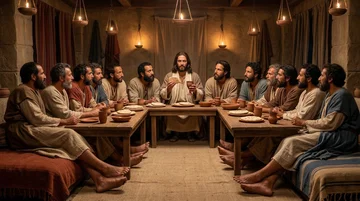
The words were spoken in the upper chamber at the Passover meal on the night before the crucifixion, in the few quiet hours between Jesus and Gethsemane as He prepared to suffer.3SP 83.2–84.1Ms 19, 1897, par. 30–33ST May 23, 1878SG3 225.11SP 201.1 That meal was virtually the last Passover ever to be celebrated.3SP 83.2–84.1ST May 23, 1878 Those hours He spent for His disciples' benefit.3SP 83.2–84.1ST May 23, 1878
He spoke with heaviness and touching sadness and with troubled spirit, clearly foreseeing His near suffering and full baptism of suffering.3SP 83.2–84.1ST May 23, 1878 He was grieved by the ingratitude and cruelty of those He came to save and by the terrible fate awaiting them.ST May 23, 1878
The cup taken after supper is the new covenant, the new testament, in His blood, shed for His disciples and for you.5RED 4.2–5.13SP 83.2–84.11SP 202.2–203.2Ms 19, 1897, par. 30–33Ms 35, 1897, par. 3–4 His blood shed in sacrifice on the cross establishes that covenant and provides remission of sins, and His offering is full, free, abundant, perfect and sufficient, giving comfort and assurance to every soul in need of a Redeemer.Lt 45, 1896, par. 1–2 The bread and wine belong together as the memorial service He left for His disciples.Ms 35, 1897, par. 3–4
The wine, the juice of the vine poured out, stands for His spilled blood shed on the cross to save.1SP 202.2–203.2COS 109.4–7Ms 14, 1850, par. 4–612MR 247.1–2Ms 22, 1898, par. 36–40 With it the broken bread stands for His broken body.Ms 14, 1850, par. 4–612MR 247.1–2Ms 35, 1897, par. 21 By drinking the cup believers show they believe His blood was shed for them.COS 109.4–7
The cup must contain pure, unfermented grape juice, and the bread must be unleavened, because these alone correctly represent His blood and body.SG3 227.1Ms 35, 1897, par. 21Ms 22, 1898, par. 36–40 Fermented wine would spoil the symbol of His blood.Ms 22, 1898, par. 36–40 This bread and wine He left to the church as a final legacy before His death.Ms 22, 1898, par. 36–40
Passover Fulfilled and Replaced
In keeping the Jewish law He observed its divinely appointed ordinances at the Passover meal, and by connecting the Lord's Supper with the Passover He identified Himself with the paschal lamb as its great antitype.5RED 48.1ST Jul 4, 1878 This was virtually the last Passover ever to be celebrated, where type was to meet antitype in the slaying of the Lamb of God for the sins of the world.5RED 4.2–5.13SP 83.2–84.1ST May 23, 1878
The innocent lamb slain in Egypt, whose blood sprinkled on the doorposts caused the destroying angel to pass over the homes of Israel, prefigured the sinless, unblemished Lamb of God.1SP 201.15RED 48.1ST Jul 4, 1878 The deliverance of the children of Israel commemorated by the feast typified the great salvation He brought.5RED 48.1ST Jul 4, 1878 His merits and atoning blood alone avert the judgment and condemnation of fallen man.1SP 201.15RED 48.1ST Jul 4, 1878
The Passover pointed forward to Christ's sacrifice, and its significance ceased when He died at Calvary.SG3 225.11SP 201.1PP 539.3 That death fulfilled the type when the sinless Lamb of God presented Himself as the sin-offering, ending the sacrifices offered for four thousand years.SG3 225.11SP 201.1Ms 43, 1897, par. 24 At that last Passover before He suffered, Jesus instituted the Lord's Supper during the meal as the memorial to replace the festival that had pointed forward to His death.5RED 4.2–5.13SP 83.2–84.1DA 652.1–2ST May 23, 1878SG3 225.1 It takes the place of the Passover as the memorial of deliverance from the bondage of sin.DA 652.1–2SG3 225.1PP 539.3
Memorial Observance and Promise
The Supper is a memorial of His betrayal and crucifixion for the sins of the world, of His humiliation, death, and sacrifice for the sins of the world and for final deliverance, of which Israel's deliverance from Egypt and from the bondage of sin was a type.1SP 202.2–203.2SG3 227.1SG3 225.1SG3 227.21SP 201.1 It was instituted during the Passover meal to replace the festival that had pointed forward to His death, and it commemorates His death as the sin-offering.DA 652.1–2SG3 225.11SP 201.1 It was appointed to be observed often to keep His sacrifice and its solemn scenes of betrayal and crucifixion fresh in memory.1SP 202.2–203.2SG3 227.1SG3 227.2 It is to be observed in all lands and every country and through all ages until He comes again, as a duty Christ gave His people to practice more frequently, following His example as closely as possible with care and wisdom.DA 652.1–2SCEV 37.1–2Ms 43, 1897, par. 246MR 22.2
The foot-washing ordinance was appointed to come first with the Supper, after the example of broken bread and cup, because pride, conflict, and desire for supremacy prevent fellowship with Christ and readiness to receive the communion of His body and blood.Ms 14, 1850, par. 4–6DA 650.2–3Ms 43, 1897, par. 246MR 22.2 Together with the Supper it is to recall Christ's act and teach that true service requires humble, unselfish ministry.Ms 43, 1897, par. 246MR 22.2 Following His example of taking the disciples away from others and giving the cup to His disciples alone, the communion is to be kept private among believers apart from unbelievers and the wicked, to keep reproach from God's cause.Ms 14, 1850, par. 4–612MR 247.1–2 Shepherds must carefully follow this order and seclusion.Ms 14, 1850, par. 4–6 Participation is not to be restricted, but each person publicly bears witness to accepting Christ as a personal Saviour who gave His life to rescue them from death and for the remission of sins.Ms 35, 1897, par. 8
Judas also partook of the bread and wine before leaving to carry out his betrayal.Ms 35, 1897, par. 3–4 Though Jesus knew he would betray Him, He allowed him the emblems to hold out opportunity to receive Him, repent, and be cleansed from sin.Ms 35, 1897, par. 3–4Ms 14, 1850, par. 4–6Ms 106, 1903, par. 54–55 His example teaches that those believed to be in error or sin should not be abandoned.Ms 106, 1903, par. 54–55 Yet one who eats and drinks unworthily does so to his own condemnation, and even in closed observance God will quickly make him manifest and purge him from among Israel.Ms 14, 1850, par. 4–6 By drinking the cup believers show they believe His blood was shed for them to save, repent of their sins, and receive Him as Saviour.1SP 202.2–203.2COS 109.4–7SG3 227.2Ms 35, 1897, par. 8 Salvation depends continually on applying that cleansing blood to the heart, depending on its merits for pardon, remission, cleansing from sin, safety from Satan, and final redemption.1SP 202.2–203.2SG3 227.1SG3 227.21SP 201.1Ms 35, 1897, par. 8
The new covenant is sealed by His atoning blood shed on the cross for the remission of sins.Lt 45, 1896, par. 1–2Lt 108, 1899, par. 26 His offering is full, free, abundant, perfect, and sufficient, giving comfort and assurance to every soul in need of a Redeemer.Lt 45, 1896, par. 1–2Lt 108, 1899, par. 26 Those who drink from the cup in faith receive its peace-making and soul-cleansing power, which restores the sin-stricken soul as the Holy Spirit applies the truth about Jesus to the understanding.Lt 108, 1899, par. 26 His blood is the pledge and seal of His promise, and faith in His efficacious blood and His righteousness alone is the only hope and stronghold and the title to heaven's blessings.9MR 319.1 The Lord's Supper is the scriptural ordinance using simple bread and wine that remain bread and wine and are not changed into His actual body and blood.GC 59.24SP 63.1GC88 59.2 The claim that priests by ritual words convert them into Christ's actual body and blood is a senseless, blasphemous, idolatrous heresy replacing the ordinance with an idolatrous sacrifice, in which men pretend to create their Creator and insult Heaven, enforced at one time on pain of death, with those who refused to avow it given to the flames.GC 59.24SP 63.1GC88 59.2
Sources
Pioneers and periodicals
110 sources
The cup taken after the Passover supper is the new covenant in Christ's blood shed for his followers, for the word rendered testament means covenant.ST Nov 22, 1883ST Oct 22, 1894ST Mar 1, 1883ST Feb 6, 1879ST Oct 22, 1894 At that last Passover He instituted the Lord's Supper as a gospel ordinance to replace the Passover, with bread and wine alone as memorial emblems of His broken body and shed blood until He comes.ST May 23, 1878ST Jun 21, 1905ST Nov 18, 1880RH Jan 8, 1867ST Mar 3, 1909 Drinking the cup entered believers into the new covenant, which was pledged that night, sealed by His death on the cross and confirmed to the world through His ministry as Mediator.ST Feb 22, 1883ST Jan 23, 1879RH Jul 7, 1874RH May 26, 1853RH Jan 1851 It is to be kept solemnly in remembrance with repentance and faith for pardon and cleansing from sin, not carelessly or as a common meal.ST Nov 22, 1883ST Oct 22, 1894ST Jun 21, 1905RH Jan 8, 1867ST Aug 13, 1896 The cup holds the pure unfermented fruit of the vine, fitting emblem of His spotless blood, and He will drink it anew with His people in the kingdom at its final consummation.ST Mar 25, 1880ST Apr 5, 1883ST Mar 6, 1879ST Oct 5, 1882ST Jul 13, 1915
Wording and Immediate Setting
The word rendered testament means covenant, for both translate the same Greek word diatheke, so the cup in his blood is the new covenant.ST Mar 1, 1883ST Feb 6, 1879ST Oct 22, 1894 The cup was taken after the Passover supper and after the bread at the close of the meal, distinct from the earlier Passover cup in Luke 22:17.ST Nov 22, 1883ST Nov 22, 1883ST Nov 22, 1883 The bread was already part of the meal, and taking and giving it marked the meal's close, so the cup followed after supper even though the disciples had still been eating when the bread was given.ST Jun 21, 1905ST Nov 22, 1883 The bread and wine alone are its emblems, commemorating death until he comes, and the ordinance is to be observed in remembrance with regard for its solemn meaning and not in a self-serving or careless manner.ST Jun 21, 1905ST Jan 1, 1885
The setting is the last Passover with the disciples in the large upper room, with the table spread with bread and the sop, on the night of betrayal before suffering, in the few quiet hours between him and Gethsemane before apprehension in the garden.ST May 23, 1878ST Sep 27, 1910ST It was Thursday evening, the evening when the crucifixion day began, the night before he was crucified, with his death to follow on the sixth day; one reckoning places the evening probably Wednesday evening and certainly no later than Thursday evening.ST Jul 12, 1905RH Nov 14, 1865ST May 11, 1915 He spoke with troubled spirit and touching sadness, clearly foreseeing his near and full suffering, grieved by the ingratitude and cruelty of those he came to save and the terrible fate awaiting them, knowing this was virtually the last Passover ever to be celebrated when type would meet antitype in the Lamb of God slain for the sins of the world.ST May 23, 1878 The fact of celebration on a particular day makes no day a Sabbath and prescribes no recurring day or time, establishes no first-day requirement, and did not make the day sacred.ST Jul 12, 1905RH Nov 14, 1865ST May 11, 1915
Luke's account is not necessarily in strict chronological order, for verses 19-20 are a parenthetical account of the Lord's Supper within the Passover account and verse 21 resumes the Passover narrative, so mention of the betrayer there does not show presence at the institution.ST Nov 22, 1883ST Nov 22, 1883 The dispute about greatness recorded after the supper happened before the meal and prompted the lesson in humility.ST Jul 30, 1885 The foot washing took place before the Lord's Supper was instituted, during or near the beginning of the meal, between Luke 22:18 and 19, after the dispute about greatness, and after washing he sat down again at the meal.ST Jul 12, 1905ST Jul 30, 1885ST Jul 30, 1885ST Apr 29, 1897
The weight of the passages holds that Judas ate of the Passover supper but received the sop and left into the night before the memorial was instituted afterward, so he had no part in the memorial of Christ's death.ST Nov 22, 1883ST Nov 22, 1883STRH May 27, 1873 The words about betrayal, One of you shall betray Me, were spoken at the Passover table where each asked, Master, is it I, including John leaning on Jesus, and after Judas stepped out Jesus and the remaining disciples including Peter, Thomas, and John sang together a sad solemn hymn on the still night air, the last hymn with the Man of Sorrows.ST Those who held the other teaching held that Judas was present through the Passover, the dispute, the foot washing and the Lord's Supper and partook, that Jesus shared the meal and gave the bread and cup even to Judas knowing his deceit and to disciples arguing about greatness, that participation was not limited to people standing clear of all sin or to the sinless, and that a casual reading of Matthew, Mark and Luke places him as present and partaking.ST Jul 12, 1905RH Jul 29, 1873RH Dec 28, 1911RH Jan 8, 1914 The decisive question is the relative time of eating the Passover and instituting the memorial, whether the memorial was instituted some time after Judas received the portion and went out immediately.RH Jul 29, 1873 Wine was used in the later observances of the Passover, though not required by the original instructions for the feast.ST Feb 22, 1899
Institution of Lord's Supper
At this last Passover Jesus by a special act toward His disciples instituted the Lord's Supper as a gospel ordinance for Christians in the gospel age.ST May 23, 1878RH Jan 8, 1867ST Oct 7, 1930 It was given to replace the Passover which had served its time, and not Easter which is a heathen institution, and together with the ordinance of humility it is what Christians should celebrate instead.ST Mar 3, 1909ST Oct 7, 1930 Type met antitype when the Passover lamb met the Lamb of God slain for the sins of the world, for Christ the true Passover was about to offer Himself as a sin offering and bring the system of types and ceremonies to an end.ST May 23, 1878ST Oct 7, 1930 The service thus established was to be observed by His followers in every land and age as a manifestation of faith in Christ belonging to the period of His priestly work, ceasing when that work closes.ST Oct 7, 1930 To celebrate it acceptably requires living in obedience to God and being at peace with the brethren.ST Mar 3, 1909
The bread and the cup alone are its emblems, commemorating His broken body and shed blood and proclaiming His death until He comes.ST Jun 21, 1905ST Nov 18, 1880ST Jan 1, 1885ST Jan 3, 1884 The cup taken at the close of the Passover supper represents the new covenant in His blood shed for His disciples and followers, a solemn and fitting reminder of the Redeemer's death as part of the work of redemption.ST Jun 21, 1905ST Nov 18, 1880ST Jan 1, 1885 It is a memorial of His death rather than a type, and rather than an ordinary meal or feast to satisfy hunger, and it must be observed with regard for its solemn meaning and not in a self-serving or careless manner.ST Jun 21, 1905ST Jan 1, 1885RH Jan 8, 1867 Christ Himself ate the bread and drank the cup to set the example, and in commanding His disciples to eat and drink in remembrance of Him He enjoined an outward duty of literal emblems commemorating His literal death, not a form that may be discarded for an exclusively inward worship.ST May 27, 1880ST Jan 3, 1884 The command is, This do in remembrance of me, that God's children may hold Christ in lasting remembrance by reflecting upon His sufferings and death as the sacrifice for fallen man who bore the iniquity of all from Gethsemane and betrayal and condemnation to six dreadful hours on the cross at Calvary.RH Jan 8, 1867
It is an ordinance expressly commanded and plainly defined and enforced in Scripture, shown by the agreement among the Gospel accounts and Paul's account as testimony that the event was factual.ST May 27, 1880ST May 13, 1903RH Jan 28, 1862 The cup after supper with bread and wine was expressly enjoined by an express act and law for its institution, so a Christian ordinance requires proof that the Lord has consecrated it.ST Jul 17, 1901RH Jul 29, 1873 In contrast, the proposed ceremony of baptism for the dead is not prescribed or defined in Scripture.ST May 13, 1903ST Jul 17, 1901 Sunday likewise has no such proof for name, dedication, and observance and is only of heathen origin.RH Jul 29, 1873
It arose from Christ's farewell meeting with His disciples in the upper chamber and upper room, a feast consecrating His memory and giving a legacy of His love, rather than being introduced by a separate formal proclamation.RH Mar 29, 1864RH Sep 4, 1855ST Jul 21, 1898 It is a solemn and appropriate memorial ordinance of Gethsemane, the last supper, and Calvary where He suffered for sins that people might live, and the emblems set before believers fill the mind with those scenes and turn the heart toward submission to God.RH Dec 13, 1870RH Mar 29, 1864 They are good for the soul to meditate upon often.RH Dec 13, 1870 Before His death it was first observed as an expression of faith in the Saviour yet to die, pointing to His death and commemorating the crucifixion and His blood shed for His people in the new testament; after His death it is observed in memory of the Saviour who has already died.ST Dec 11, 1879
It is one of His ordinances given to the church, part of the scriptural marks by which the true church can be recognized.ST Mar 6, 1884ST Oct 17, 1900 The holy communion instituted here is a permanent rite, yet the Scriptural warrant for keeping it is no stronger than the warrant for keeping foot washing as a permanent rite.ST Oct 17, 1900 Without ecclesiastical tradition there is no full Scriptural answer that keeps communion while setting aside foot washing, and churches that pervert or ignore these ordinances do not heed His voice.ST Mar 6, 1884ST Oct 17, 1900
Cup and New Covenant
The cup taken after supper is the new covenant in blood poured out for the disciples, and its wine stands for that blood given for followers for salvation, cleansing from sin and pardon and remission of sins on which they continually depend.ST Mar 25, 1880ST Nov 22, 1883ST Oct 22, 1894ST Nov 18, 1880ST Nov 22, 1883 It was given after the bread as the sign of the covenant established through that pouring out, a solemn and fitting reminder of the Redeemer's death in the work of redemption.ST Oct 22, 1894ST Nov 22, 1883ST Nov 18, 1880 When those who shared it drank from it they entered into that covenant as members of it, and the apostles in receiving it stood for the believers of the house of Israel and for God's people.ST Apr 15, 1880ST Feb 22, 1883
On the night he was betrayed he pledged through the cup to die for his disciples, and by accepting it they pledged to receive salvation through his blood and to fulfill the covenant's conditions.ST Feb 22, 1883ST Jan 23, 1879 His death gives validity to the new covenant, and the cup is the token of that mutual pledge between him and the eleven.ST Feb 22, 1883ST Jan 23, 1879 The cup shared by him with his Jewish apostles was the first solemn act ratifying and establishing that covenant with the Hebrew people.ST Feb 22, 1883ST Jan 30, 1879 That confirmation belonged to the period of his ministry to them, with the crucifixion coming in the midst of that work.ST Jan 30, 1879
His blood was shed after the blood of the old covenant, and for that reason this covenant is called new.ST Jan 16, 1893 Shed on the cross, it confirmed and ratified the everlasting covenant promised to Abraham with blessing for the whole human family, the same covenant as the gospel.ST Jan 16, 1893 That Abrahamic covenant, not the covenant made at Sinai, is the one that can grant an inheritance, and his death sealed it and made it forever sure so that it was complete at his death.ST Jan 16, 1893ST Oct 25, 1899 As the old covenant was dedicated with blood, so the new was dedicated with his blood, answering to Moses ratifying God's covenant with Israel through blood.RH Jul 7, 1874RH Feb 19, 1861
Through his death he became the covenant's Testator, bequeathing his inheritance to believers as the promised seed of Abraham who kept the covenant requiring perfect obedience and then died for human transgressions.RH May 26, 1853RH Jan 1851 After being raised and ascending he serves as Mediator of that better covenant, exercising a more excellent ministry in heaven itself and appearing in the presence of God for his people.RH Jul 7, 1874RH May 26, 1853 There as priest he ministers grace and remission of sins until the gospel has completed its mission.RH Jul 7, 1874ST Jan 21, 1903
Covenant History and Fulfillment
The new covenant begins at the death of Christ and continues forward to the consummation, after the first or old covenant which extends from the time of Moses to the death of Christ.ST May 11, 1876RH Mar 10, 1874ST Nov 20, 1879ST Aug 8, 1878ST Oct 22, 1874 The cup is the new covenant in his blood.ST May 11, 1876RH Mar 10, 1874ST Nov 20, 1879ST Jan 18, 1883ST Oct 22, 1874 It was brought in as soon as man sinned and was ratified at the cross.ST Aug 8, 1878ST Jan 18, 1883ST Oct 22, 1874
It was sealed by his blood at his crucifixion in the spring of A.D. 31, in the middle of the seventieth week of Daniel's seventy weeks.ST Mar 18, 1889 Its terms were preached for three and one-half years by the Lord himself and by those he sent out, it was then sealed by his offering of himself which abrogated sacrifice and offering, and during the latter half of the seventieth week it was further confirmed to the Jews by those immediately commissioned by Christ as Mediator of the covenant, more properly by the Lord himself working through his apostles.ST Mar 18, 1889 This sharing of the cup after supper by Jesus and his Jewish apostles was the first solemn act of ratifying that covenant, and its confirmation belonged to the period of his ministry to the Hebrew people, with his crucifixion occurring midway through the seventieth week.ST Jan 30, 1879
In contrast to the first covenant given in the majesty of the law at Sinai, the new covenant is given in the blood of Christ at Calvary.ST Mar 29, 1883 Calvary centers not on the condemning law but on the Lamb of God as sin-offering, though the law was present there striking the Son with divine justice.ST Mar 29, 1883 Through his death comes life, through his blood comes pardon for transgression of the law, through his stripes comes healing, and from him comes grace, so mercy and truth meet in his sacrifice.ST Mar 29, 1883 The blood covenant is able to save law-breakers by forgiving their sin and then putting the law in their hearts so obedience becomes their nature, which is conversion.ST Mar 29, 1883 It is a system of salvation in which God is shown just in justifying the sinner and the law is shown established by justification by faith.ST Mar 29, 1883
Under the new covenant God's law is written in the hearts of Christ's people, as it was in Christ's heart.ST Jul 8, 1880RH May 5, 1874 Jesus established the New Testament through his blood, given in death for his people.RH His perfect obedience and sacrificial death provide the basis for pardon, while the New Testament also brings the renewing of the Holy Spirit and writes God's law in the hearts of believers; it does not abolish God's law.RH Those saved by him are to obey that law, including the fourth commandment.RH May 5, 1874
He had not tasted the fruit of the vine again since the night he gave them this covenant cup.ST Apr 5, 1883ST Mar 6, 1879 He will drink it anew with his immortal saints in the kingdom at the marriage supper.ST Apr 5, 1883ST Mar 6, 1879 That supper points to the consummation and final fulfillment of the new covenant, when Christ gathers his people to himself and they receive their eternal inheritance and he brings them into his presence.ST Apr 5, 1883ST Mar 6, 1879 The cup with the broken bread reminds those who partake around the table of their common Lord of his sufferings and humiliation, while also pointing forward to the time when he will again unite with them in drinking the fruit of the vine in a kingdom with no more perils and no more parting, so that joining together in the ordinance is a strong pledge of mutual confidence and sympathy even when believers are separating. Doing it in symbols now, with songs and prayers and tender brotherly love and meditation and sincere humiliation of heart, carries hope of having part in its reality at the great marriage of the Lamb for those who remain steadfast unto the end.RH Dec 26, 1912
Because his death sealed the covenant when he confirmed it with his own blood on the cross, it could not afterward be altered by adding a new Sabbath.ST Sep 6, 1910 His teaching about the law remained in force, and his disciples were to teach all that he had commanded.ST Sep 6, 1910
Scripture Connections and Doctrines
Jesus linked the Supper to the Passover and presented himself as the great antitype of the paschal lamb.ST Jul 4, 1878ST Sep 30, 1886 As the blood of the lamb slain in Egypt, sprinkled on the doorposts, caused the destroying angel to pass over the homes of Israel, so his merits alone as the sinless Lamb of God avert the judgment and condemnation of fallen man and bring salvation.ST Jul 4, 1878ST Sep 30, 1886 The deliverance of Israel from Egypt commemorated by the feast typified the great salvation he brought in obedience to the divinely appointed ordinances.ST Jul 4, 1878
Together with baptism, the Supper commemorates Christ's death and resurrection, while the Sabbath by contrast commemorates creation.RH Aug 18, 1868 The bread and cup were appointed as the memorial of his death, to be observed in remembrance of him until he comes, and the cup is part of that commanded observance rather than a command to keep a particular day.RH Aug 18, 1868ST Oct 14, 1889 It keeps the fact of his death and resurrection in memory but does not appoint a religious celebration tied to the time of his arrest, trial, crucifixion, or resurrection.ST Nov 25, 1880 It commemorates the Lord's death, not his resurrection, and breaking bread gives no requirement to keep Sunday.ST Jan 13, 1881ST May 27, 1875 The Supper was instituted on the evening when the crucifixion day began, with Jesus and the apostles present, the night before the crucifixion, so breaking bread on Thursday evening or on the first day does not establish that day as a Sabbath.ST Jan 13, 1881ST May 27, 1875
The institution took place in the evening before the crucifixion, probably Wednesday evening and certainly no later than Thursday evening, on a weekday night and not on Sunday.RH Nov 14, 1865RH May 5, 1851ST May 27, 1875 It therefore gives no command and no precedent requiring the Supper to be celebrated on Sunday or on any particular weekday, and it says nothing about changing the Sabbath.RH Nov 14, 1865ST May 27, 1875ST Jul 21, 1909 The New Testament does not restrict communion to a particular day of the week, and it may rightly be celebrated on Saturday, Sunday, or any other weekday with blessing.RH May 5, 1851ST May 27, 1875 Celebrating it on Sunday is equally permissible, and the evening after the Sabbath is presented as a fitting time, but making Sunday communion a church duty or a Sabbath has no scriptural basis.RH May 5, 1851ST May 27, 1875 His death followed on the sixth day and completed the greatest act in the plan of salvation, but these events did not make that day sacred, and if the Supper had to be observed on one weekday the sixth day would fit because the crucifixion took place then.ST May 11, 1915RH May 5, 1851 The institution on the night of betrayal, identified as Thursday night, does not make the day on which bread is later broken a Sabbath.ST May 11, 1915ST Jan 25, 1910
The cup's wine represents Christ's blood to be shed for human sin and keeps the cost of salvation before the minds of those who partake.ST Jan 27, 1914RH Dec 24, 1914 This cup is an expression for communion in his blood, not teaching that the cup itself becomes the new covenant, and its meaning is conveyed by the spiritual reality it represents, like calling Jesus the true vine.RH Jul 11, 1912 The bread and wine are emblems showing his death until he comes, and they also point to the continual feast of receiving Christ's word and Spirit.ST Dec 12, 1911 Communion with Christ is real and precious when God abides in a person through the Holy Spirit, and feeding on Christ means receiving his spirit and life, for the flesh by itself profits nothing.RH Jul 11, 1912ST Dec 12, 1911 The cup is the new covenant in his blood, identified further as the fruit of the vine, meaning grape juice rather than fermented wine, since alcohol is produced by fermentation or distillation and not simply the fruit of the vine.ST Feb 6, 1879ST Dec 12, 1911 Those who held transubstantiation taught the opposite, that by the words of consecration an inward change takes place so that what appears to be bread and wine is no longer bread and wine but the true body and blood of Christ truly, really and substantially present with his soul and divinity, the outward species remaining while the inward substance is changed.ST Mar 4, 1897
The rite involves material bread and wine, and treating it as purely spiritual and dispensing with them is inconsistent with its enacted form.ST Jul 17, 1879 Avoiding alcoholic wine also protects people recovering from drunkenness, for whom even tasting alcohol may lead to danger.ST Feb 6, 1879 The verse is an example of Jesus teaching and encouraging his disciples from the Old Testament as he approached the cross, showing his reliance on its words and the authenticity of those Scriptures.ST Feb 15, 1883
Observance and Christian Life
The single cup and the divided bread express unity, for the drink poured for each comes from a common receptacle just as the bread is shared from one loaf, and this sharing in remembrance binds believers together until he comes.ST Jun 14, 1910RH Oct 22, 1901 No particular shape or size of cup is required by the institution after supper.ST Jun 14, 1910 In a large church pouring from one receptacle into smaller glasses preserves that shared meaning while being more hygienic and practical.ST Jun 14, 1910
The cup contains pure unfermented grape juice, the fruit of the vine freshly pressed, not intoxicating fermented wine.ST Mar 25, 1880ST Oct 5, 1882ST Jul 13, 1915ST Feb 7, 1878 The account never uses the word wine but speaks only of the cup and the fruit of the vine, meaning wine freshly pressed from grapes, since alcohol comes by fermentation or distillation and is not simply fruit of the vine.ST Jul 13, 1915ST Feb 6, 1879 Only such pure juice could fitly represent spotless blood shed for salvation and cleansing from sin, on which followers continually depend, for fermentation speaks of corruption and decay and rottenness.ST Mar 25, 1880ST Jul 13, 1915ST Feb 7, 1878 At Passover all ferment was searched out and destroyed and the bread was unleavened, and in Jewish sacred feasts no fermented drink is ever used, fresh grapes and unfermented juice and raisins serving as the symbol of benediction.ST Jul 13, 1915ST Feb 7, 1878 The wine therefore represents spotless blood, the sacrifice for sin and blood of the everlasting covenant, and the Bible authorizes only unfermented wine for the sacrament and gives no foundation for fermented wine.ST Oct 22, 1894ST Feb 23, 1915
Condemning alcoholic wine as a beverage while serving alcoholic wine with solemnity in the sacred ordinance is inconsistent.ST Jan 26, 1882 Churches must therefore abandon fermented wine and lead in practical temperance and prohibitory measures, not seeking legal exception for sacramental liquor.ST Feb 23, 1915 Avoiding it also protects those recovering from drunkenness, for whom even tasting may bring danger.ST Feb 6, 1879
The ordinance must be observed in remembrance with regard for its solemn meaning, not in a self-serving or careless manner and not with worldly pomp.ST Jun 21, 1905RH Jan 8, 1867 It is not a feast to satisfy hunger but a solemn rite in which the partaker reflects upon the sufferings and death of the Lord from betrayal to six dreadful hours on the cross, loving to go over in mind the incidents of his passion with reverent fear and thankful heart.RH Jan 8, 1867ST May 13, 1889 Those who partake properly declare themselves unworthy and in perishing need of pardon, justification, divine aid to do God's will, strength to keep God's law, and final salvation, humbly repenting of transgressions of the moral law and exercising faith in the Saviour for remission and salvation.ST Aug 13, 1896 There is no merit in the act toward justification, and it is eaten worthily when his body is discerned and he is received by faith into the heart, as bread and wine nourish physical life so his body and blood received by faith give spiritual life.ST Aug 13, 1896ST Oct 22, 1894 Partaking is an act of faith done with meditation and sincere humiliation of heart, with songs and prayers and tender brotherly love.RH Dec 26, 1912
The cup after supper belongs to his true followers, the true children of God, not to worldlings nor to those living in sin and disgracing his name, for it was given only to his chosen disciples on a special occasion in a private room apart from the crowd, not as a promiscuous public meal.RH May 27, 1873 Yet participation was not limited to people standing clear of all sin, since the bread and cup were given even to Judas though his deceit was known and to disciples arguing about greatness.RH Dec 28, 1911 Breaking the bread as the bread of life and drinking the cup as the wine of sorrow gives his word as strength to meet the morrow and his peace as oil upon the waves of strife.ST Feb 27, 1907 Together with the bread the wine points to Calvary and reminds those who partake of his death until he comes again, sustaining hope of life through Christ and a home in heaven.RH Dec 28, 1911 Joining together around the table in remembrance of their common Lord's sufferings and humiliation, with hope of again drinking the fruit of the vine together in a kingdom with no more perils and no more parting, is a strong pledge of mutual confidence and sympathy even when believers are separating. Breaking bread and drinking wine in remembrance is a precious privilege for those who love him, inviting renewed devotion to supply the believer's need, and through this observance he reveals himself to his followers in a special way.ST Dec 30, 1889
The ordinance is to be celebrated often so followers remember his betrayal and crucifixion and their continual dependence on his blood for cleansing and pardon, and churches and members should carefully observe this memorial and not habitually neglect and disregard it month after month, quarter after quarter, and year after year.ST Mar 25, 1880RH Dec 13, 1870 Elders have authority to attend to it, and monthly meetings serve as good occasions for it.RH Dec 13, 1870 It is a service to be conducted by workers and shared by believers when churches gather, including isolated believers seldom able to be present at quarterly occasions, with a service at the close of a camp meeting being a fitting occasion and a bright spot in their experience.RH Dec 23, 1915ST Nov 12, 1885RH Dec 11, 1866 It may be celebrated in a private house on Sabbath morning for a believer too feeble to meet with the church, whose sojourn in this mortal state is very brief, and may be timed so those present can immediately after attend the Sabbath service.ST May 9, 1878
Its institution in the evening does not require that it be observed only in the evening, for no time restriction is given, and it commemorates his death to continue until he comes again. It consists of bread and the fruit of the vine and is to be kept continuously as often as believers eat and drink, but it sets no time or frequency, so time and frequency are not subjects of faith or matters of religious duty. It gives a plain command and plain description of what it consists in and the action to be done, yet says nothing about stated periods, so frequency is no part of the law of the institution and there is no obligation respecting it, and any stated period rests solely on human and uninspired testimony and has no authority.RH May 20, 1873
These ordinances with foot washing are part of the scriptural marks by which the true church can be recognized, and churches that pervert or ignore them do not heed his voice.ST Mar 6, 1884 Together with the ordinance of humility the Supper replaces the Passover which has served its time, not Easter which is a heathen institution, and to celebrate it acceptably requires living in obedience to God and being at peace with the brethren.ST Mar 3, 1909 The partaking follows washing one another's feet after his example and brings the divine blessing to obedient participants.RH May 13, 1862 Doing it in symbols now carries hope of having part in its reality at the great marriage of the Lamb for those who remain steadfast unto the end.RH Dec 26, 1912
It is a divinely appointed memorial also of his incarnation and humiliation, for his cup extended from lowly birth to death on the cross, accepted as the price of redeeming the lost world and making redemption possible.ST Apr 20, 1915 The supper instituted in the upper room consecrates his memory and gives his disciples a legacy of his love.RH Sep 4, 1855
Sources