Luke 22:21
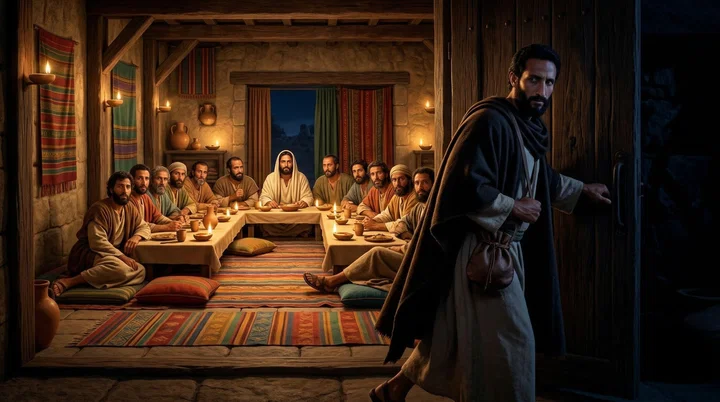
But, behold, the hand of him that betrayeth me is with me on the table.
Translations
But, behold, the hand of him that betrays me is with me on the table.
But, behold, the hand of him that betrayeth me is with me on the table.
KJV Cambridge Paragraph Bible, Webster Bible, Revised Version, American Standard Version
But behold, the hand of him that betrayeth me is with me on the table.
'But, lo, the hand of him delivering me up [is] with me on the table,
Moreover, behold, the hand of him that delivers me up [ is] with me on the table;
Nevertheless, lo! the hand of him who is delivering me up, is with me upon the table.
Berean Standard Bible, Majority Standard Bible
Look! The hand of My betrayer is with Mine on the table.
But behold, the hand of him who betrays me is with me on the table.
But the hand of him who is false to me is with me at the table.
Yet beholde, the hand of him that betrayeth me, is with me at the table.
Douay-Rheims (Challoner revision)
But yet behold, the hand of him that betrayeth me is with me on the table.
Pictures
Cross-references
- John 13:21-30
When Jesus had thus said, he was troubled in spirit, and testified, and said, Verily, verily, I say unto you, that one of you shall betray me.
Jesus identifies Judas as the betrayer during the supper, and Judas leaves after receiving the sop.
- Matthew 26:21-25
And as they did eat, he said, Verily I say unto you, that one of you shall betray me.
Jesus announces that one at the table will betray him and identifies Judas.
- Mark 14:18-21
And as they sat and did eat, Jesus said, Verily I say unto you, One of you which eateth with me shall betray me.
Jesus announces that his betrayer is among those eating with him.
- John 13:18-19
I speak not of you all: I know whom I have chosen: but that the scripture may be fulfilled, He that eateth bread with me hath lifted up his heel against me.
Jesus identifies the betrayer at the table and foretells the event as Scripture’s fulfillment.
- Psalms 41:9
Yea, mine own familiar friend, in whom I trusted, which did eat of my bread, hath lifted up his heel against me.
A trusted table companion’s betrayal fulfills the prophecy.
- Matthew 26:23
And he answered and said, He that dippeth his hand with me in the dish, the same shall betray me.
Identifies the betrayer as the one dipping with Jesus in the dish.
- Mark 14:22-25
And as they did eat, Jesus took bread, and blessed, and brake it, and gave to them, and said, Take, eat: this is my body.
A parallel account of Jesus instituting the Lord’s Supper and speaking of its future.
- John 13:5
After that he poureth water into a bason, and began to wash the disciples’ feet, and to wipe them with the towel wherewith he was girded.
Jesus washed Judas’s feet before announcing his betrayal.
- Matthew 26:26-29
And as they were eating, Jesus took bread, and blessed it, and brake it, and gave it to the disciples, and said, Take, eat; this is my body.
A parallel account of the Lord’s Supper.
- Matthew 26:25
Then Judas, which betrayed him, answered and said, Master, is it I? He said unto him, Thou hast said.
Jesus identifies Judas as his betrayer.
- John 13:21-26
When Jesus had thus said, he was troubled in spirit, and testified, and said, Verily, verily, I say unto you, that one of you shall betray me.
John describes Jesus identifying the betrayer with a dipped piece of bread.
- Matthew 26:24
The Son of man goeth as it is written of him: but woe unto that man by whom the Son of man is betrayed! it had been good for that man if he had not been born.
Jesus goes as written, yet pronounces woe on the betrayer.
- John 13:27
And after the sop Satan entered into him. Then said Jesus unto him, That thou doest, do quickly.
Jesus tells Judas to act quickly after Satan enters him.
- 1 Corinthians 11:23-26
For I have received of the Lord that which also I delivered unto you, That the Lord Jesus the same night in which he was betrayed took bread:
Recalls Jesus’ institution of the memorial meal.
- Matthew 26:28
For this is my blood of the new testament, which is shed for many for the remission of sins.
The cup follows the bread at the supper without separation.
Commentary
Each commentary is drawn from primary sources: the writings of Ellen G. White and Adventist pioneers and periodicals. Each commentary is separate. Its own words are not a quotation; follow the references to read the source passages.
Ellen G. White
8 sources
The betrayal belongs to the last Passover supper, with the betrayer's hand on the table with Jesus as they ate.Lt 195, 1903, par. 3–7Ms 19, 1897, par. 30–33DA 652.1–2 It came as Jesus was about to offer Himself as a sin-offering and to institute the Lord's Supper as the memorial of His sacrifice.DA 652.1–2 The setting is the table shared with the twelve at that final meal.Lt 195, 1903, par. 3–7Ms 19, 1897, par. 30–33DA 652.1–2
Jesus knew from the beginning that Judas would betray Him, yet He announced it openly while the betrayer was present.Ms 106, 1903, par. 54–55 He declared that His death would occur as determined and as written of the Son of man, as part of the events leading to His suffering.Lt 195, 1903, par. 3–7Ms 19, 1897, par. 30–333SP 85.1–2 At the same time He pronounced woe upon the betrayer, for whom it would have been good not to have been born.Lt 195, 1903, par. 3–7Ms 19, 1897, par. 30–333SP 85.1–2
The betrayer was Judas, one of the close and favored twelve who had heard Jesus teach, received His love, and been brought into close communion with Him.5RED 6.13SP 85.1–2 Yet he was already committed to betrayal and sat at the table brooding over dark purposes even as he shared the meal.Ms 35, 1897, par. 3–4Ms 106, 1903, par. 54–55 He shared the table with Jesus and the other disciples while that purpose was fixed.Ms 35, 1897, par. 3–4Ms 106, 1903, par. 54–55
Judas dipped his hand with Jesus in the dish and ate with Him in silence.3SP 85.1–2 He partook of the bread and wine that symbolized Christ's broken body and spilled blood, and Jesus even washed his feet and let him unite with Him in that sacrament.Ms 35, 1897, par. 3–4Ms 106, 1903, par. 54–55 Jesus thus identified the betrayer as the one sharing food with Him at the table.DA 654.1–2
The announcement shocked the other disciples, who could not imagine that one of the twelve would do this.5RED 6.1 It brought amazement and consternation and painful self-distrust.3SP 85.1–2 They questioned among themselves who would do it, searched their own hearts, and each asked whether it was himself.Lt 195, 1903, par. 3–7DA 654.1–23SP 85.1–2 This occurred in the same setting where they disputed who among them should be considered greatest.Ms 19, 1897, par. 30–33
Judas remained silent while the others examined themselves.DA 654.1–23SP 85.1–2 Only after all eyes turned to him did he ask whether it was himself.3SP 85.1–2 He was told in reply that he himself had said so, which exposed his crime.3SP 85.1–2 He was then urged to do quickly what he was going to do, and hastily rose to leave.3SP 85.1–2
In this the Scripture about a companion who ate with Jesus turning against Him was being fulfilled when Judas left the sacramental table to carry out the betrayal.Ms 35, 1897, par. 3–4 This meal was his last time with the twelve.Ms 35, 1897, par. 3–4 He could still have repented at that solemn service, and the words spoken at the foot washing went to his heart with conviction, but pride would not yield and he hardened his heart in opposition and braced himself against it.Ms 35, 1897, par. 3–4Ms 106, 1903, par. 54–55 By choosing to proceed and leaving Jesus and the disciples he passed beyond the boundary of God's mercy and love.Ms 35, 1897, par. 3–4
By keeping Judas at the table Jesus as a long-suffering Saviour held out every inducement for the sinner to receive Him, repent, and be cleansed from the defilement of sin.Ms 106, 1903, par. 54–55 His dealing is an example that one supposed to be in error and sin is not to be divorced, carelessly separated, left a prey to temptation, or driven onto Satan's battleground.Ms 106, 1903, par. 54–55 The scene also warns against trusting appearances or self-confidence, as Peter confidently promised loyalty but fell, so strength rests in trusting Christ.Lt 195, 1903, par. 3–7
Sources
Pioneers and periodicals
15 sources
On the night of his betrayal, in the room where the Passover was eaten, Jesus told the disciples at the meal that the one who would betray him was sharing the table with him, a saying whose full setting is seen only with the accounts in Matthew and Mark beside it.ST Oct 29, 1894ST May 12, 1898
The table is that of the paschal supper, for the word opening the saying turns back to the Passover after the brief account of the Lord's Supper, and Judas was pointed out by the dipped bread and went out at once during the Passover meal before the memorial was instituted and without part in it.ST Nov 22, 1883ST Nov 22, 1883RH Jul 14, 1863ST Nov 22, 1883
Others understand the saying to place the betrayer with Jesus at the table when the memorial itself was instituted.RH Jul 29, 1873
Though he knew the deceitful and unfaithful purpose of Judas, he still ate the Passover with him at the same table and gave him a final merciful call to repentance, which only alarmed him and hardened him to carry out his plan, thus fulfilling Psalm 41:9.ST Nov 22, 1883RH Jan 8, 1914
The warning moved the disciples to ask which of them would do it, yet they soon disputed about who was greatest, exposing rivalry and the need for conversion, humility, self-examination, and watching and prayer rather than self-trust.RH Jul 6, 1868
Setting and Sequence at Table
The hand of the betrayer was with Jesus on the table, announced on the evening of the betrayal in the room where the Passover was celebrated as part of his conversation with the disciples that night, during the meal by one sharing the table with him.ST Oct 29, 1894ST May 12, 1898 The saying belongs to the conversation at the table about the betrayer, whose full record is found only by putting the accounts in Matthew, Mark, and Luke together. The word rendered but can mark a return to an earlier subject after a digression, so the verse resumes the Passover narrative after the brief insertion of the Lord's Supper in verses 19-20, and its mention of the betrayer at the table does not place Judas at the institution of the Lord's Supper.ST Nov 22, 1883 The table is the table of the paschal supper, not the table of the Lord's Supper, for Luke gives a connected account of the two suppers and then adds the fact about the betrayer, so the verse alone does not place Judas at the Lord's Supper.RH Jul 14, 1863
Judas was identified as the betrayer while still eating the Passover meal by the giving of a dipped piece of bread or sop, and he went out immediately during the Passover meal before the Lord's Supper was instituted, having no further lot with the eleven and not partaking at the Lord's table, since Luke's account is not in chronological order.ST Nov 22, 1883RH Jul 14, 1863ST Nov 22, 1883 On a casual reading the passage in verses 14-23 shows Judas present when the memorial was instituted and partaking with the others, with the betrayer's hand on the table placing him with Christ at the table, so the decisive question is the relative time when the Passover was eaten and when the memorial of the death was instituted, to be settled by careful examination of the united testimony of the four evangelists.RH Jul 29, 1873 The verse places the betrayer at the table with Jesus during the meal at which the Lord's Supper was instituted and is included in the account of the institution.
The betrayer was still at the table with Jesus during the last supper even after the announcement that one of the disciples would betray him, and after receiving the sop he went out and did not join the others in their solemn hymn.ST The announcement of the betrayer came at the Passover supper after the washing of the disciples' feet and after the breaking of the bread, with the blessing of the cup following the breaking of the bread immediately and not separated from it by other events, and with the disciples' questioning, the departure of Judas, and the warning to Peter coming afterward in that order.ST Feb 4, 1903
Teaching, Prophecy and Application
The warning that one of the Twelve would betray him at the last Passover led the disciples to ask which one would do it, yet they then fell into a dispute over who among them was greatest.RH Jul 6, 1868 Their rivalry showed they had not yet learned the lesson of conversion and humility, and it showed the need to examine personal weakness and to watch and pray rather than to trust in self.RH Jul 6, 1868 He knew the deceitful and unfaithful thoughts and purposes of the betrayer, yet he ate the Passover with him at the same table, so sharing a meal with a sinner is not wrong.RH Jan 8, 1914 He dealt with the betrayer with mercy, giving him a final opportunity to repent and a convincing sign of divine knowledge of his purposes, but the betrayer was only startled and alarmed, did not repent, became more determined in his plan, and went out to carry it through.
The betrayer was identified while they were still eating the Passover meal by the giving of a dipped piece of bread or sop, and he then left, so he was not present when the Lord's Supper was instituted.ST Nov 22, 1883 That betrayal by one eating at the table fulfilled the prophecy in Psalm 41:9.ST Nov 22, 1883 The betrayer sharing the table serves as a type of a greater betrayal by an apostate church, which corrupts the Lord's Supper by treating its bread and wine as inherently able to put away sin and by making the mass a sacrifice for sin.RH Mar 7, 1912
The verse shows that Judas was not present when the supper was instituted, and this answers an objection sometimes urged against close communion.RH Jul 29, 1873 Those who held the other view taught that the mention in verses 21-23 does not settle his presence or absence, but raises instead whether he was driven away or was allowed to examine himself and eat.RH Nov 4, 1873 The verse belongs to the account of the institution during the meal at which the memorial was instituted, yet it is not used to establish a required time for later observances of the ordinances. The chapter shows the breaking of bread celebrated on Thursday evening, so breaking bread does not belong to Sunday and does not make the first day sacred or required for breaking bread.ST Jan 13, 1881
Sources