John 19:4
Pilate therefore went forth again, and saith unto them, Behold, I bring him forth to you, that ye may know that I find no fault in him.
Translations
Pilate therefore went forth again, and says to them, Behold, I bring him forth to you, that you may know that I find no fault in him.
King James Version, KJV Cambridge Paragraph Bible
Pilate therefore went forth again, and saith unto them, Behold, I bring him forth to you, that ye may know that I find no fault in him.
Pilate therefore went forth again, and saith to them, Behold, I bring him forth to you, that ye may know that I find no fault in him.
Revised Version, American Standard Version
And Pilate went out again, and saith unto them, Behold, I bring him out to you, that ye may know that I find no crime in him.
Pilate, therefore, again went forth without, and saith to them, 'Lo, I do bring him to you without, that ye may know that in him I find no fault;'
And Pilate went out again and says to them, Lo, I bring him out to you, that ye may know that I find in him no fault whatever.
And Pilate went forth again outside, and saith unto them—See! I lead him unto you outside, that ye may take knowledge, that, no single fault, do I find in him.
Berean Standard Bible, Majority Standard Bible
Once again Pilate came out and said to the Jews, “ Look, I am bringing Him out to you to let you know that I find no basis for a charge against Him.”
Then Pilate went out again, and said to them, “ Behold, I bring him out to you, that you may know that I find no basis for a charge against him.”
And Pilate went out again and said to them, See, I let him come out to you to make it clear to you that I see no wrong in him.
Then Pilate went foorth againe, and said vnto them, Behold, I bring him forth to you, that ye may knowe, that I finde no fault in him at all.
Douay-Rheims (Challoner revision)
Pilate therefore went forth again, and saith to them: Behold, I bring him forth unto you, that you may know that I find no cause in him.
Pictures
Cross-references 20 of 27
- John 18:38
Pilate saith unto him, What is truth? And when he had said this, he went out again unto the Jews, and saith unto them, I find in him no fault at all.
Pilate declares that he finds no fault in Jesus.
- Luke 23:4
Then said Pilate to the chief priests and to the people, I find no fault in this man.
Pilate finds no fault in Jesus.
- John 18:40
Then cried they all again, saying, Not this man, but Barabbas. Now Barabbas was a robber.
The crowd chose guilty Barabbas over innocent Jesus.
- Matthew 27:4
Saying, I have sinned in that I have betrayed the innocent blood. And they said, What is that to us? see thou to that.
Judas confesses that he betrayed innocent blood, affirming Jesus’ innocence.
- Matthew 27:11-31
And Jesus stood before the governor: and the governor asked him, saying, Art thou the King of the Jews? And Jesus said unto him, Thou sayest.
Both recount Jesus before Pilate and the events leading to his crucifixion.
- John 19:15-18
But they cried out, Away with him, away with him, crucify him. Pilate saith unto them, Shall I crucify your King? The chief priests answered, We have no king but Cæsar.
The crowd chooses Caesar over Christ, leading to Jesus’ condemnation and crucifixion.
- Mark 15:1-20
And straightway in the morning the chief priests held a consultation with the elders and scribes and the whole council, and bound Jesus, and carried him away, and delivered him to Pilate.
Pilate questions Jesus, finds no evil in him, yet delivers him to be crucified.
- Luke 23:14-15
Said unto them, Ye have brought this man unto me, as one that perverteth the people: and, behold, I, having examined him before you, have found no fault in this man touching those things whereof ye accuse him:
Pilate and Herod both find no charge worthy of death.
- Luke 23:22
And he said unto them the third time, Why, what evil hath he done? I have found no cause of death in him: I will therefore chastise him, and let him go.
Pilate declares that Jesus has done nothing deserving death.
- Matthew 27:2
And when they had bound him, they led him away, and delivered him to Pontius Pilate the governor.
Jesus is brought before Pilate during his trial.
- Luke 23:41
And we indeed justly; for we receive the due reward of our deeds: but this man hath done nothing amiss.
Both affirm that Jesus had done nothing wrong.
- John 19:19
And Pilate wrote a title, and put it on the cross. And the writing was, JESUS OF NAZARETH THE KING OF THE JEWS.
Pilate declares Jesus faultless, then inscribes him as King of the Jews.
- John 19:12
And from thenceforth Pilate sought to release him: but the Jews cried out, saying, If thou let this man go, thou art not Cæsar’s friend: whosoever maketh himself a king speaketh against Cæsar.
The threat about Caesar overcomes Pilate’s resolve to release Jesus.
- Acts 3:13
The God of Abraham, and of Isaac, and of Jacob, the God of our fathers, hath glorified his Son Jesus; whom ye delivered up, and denied him in the presence of Pilate, when he was determined to let him go.
The people denied Jesus even though Pilate was determined to release him.
- Matthew 27:24
When Pilate saw that he could prevail nothing, but that rather a tumult was made, he took water, and washed his hands before the multitude, saying, I am innocent of the blood of this just person: see ye to it.
Pilate recognizes Jesus’ innocence but yields to the crowd.
- Matthew 27:22-23
Pilate saith unto them, What shall I do then with Jesus which is called Christ? They all say unto him, Let him be crucified.
The crowd demands that Jesus be crucified.
- John 19:16
Then delivered he him therefore unto them to be crucified. And they took Jesus, and led him away.
The faultless Christ is delivered to be crucified.
- 1 Peter 2:22
Who did no sin, neither was guile found in his mouth:
Pilate's verdict confirms sinless life
- Matthew 26:59-60
Now the chief priests, and elders, and all the council, sought false witness against Jesus, to put him to death;
Pilate’s verdict confirms that the testimony against Jesus was false.
- Matthew 27:26
Then released he Barabbas unto them: and when he had scourged Jesus, he delivered him to be crucified.
Jesus is scourged and handed over for crucifixion despite being innocent.
Commentary
Each commentary is drawn from primary sources: the writings of Ellen G. White and Adventist pioneers and periodicals. Each commentary is separate. Its own words are not a quotation; follow the references to read the source passages.
Ellen G. White
34 sources
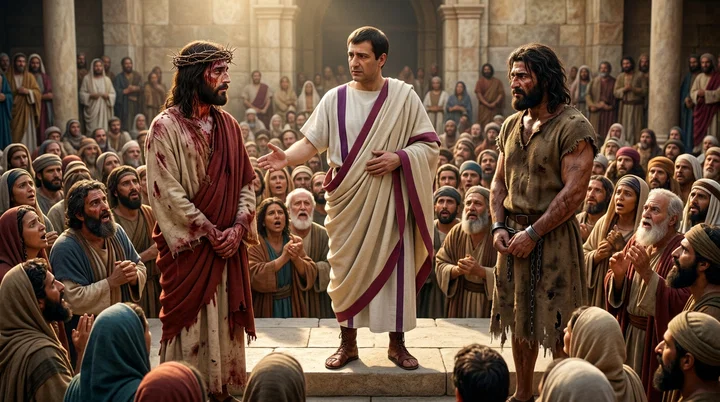
Pilate brought Jesus forth from the judgment hall after the scourging, wearing the crown of thorns and mocking purple robe, and publicly declared that he found no fault in him.DA 723.1–724.1Ms 51, 1897, par. 31–323SP 143.1–2 He set the wounded and patient sufferer before the people in hope that the sight would awaken pity and lead them to spare his life.3SP 144.15RED 63.2–64.1ST Jul 11, 1878 Though priests, rulers and people were convicted by the contrast with Barabbas, they rejected the innocent one and demanded his crucifixion and the release of the robber and murderer.3SP 144.15RED 63.2–64.1DA 735.1–55RED 63.13SP 143.1–2 The thrice-repeated verdict proves that no sin was found in Christ, for he was pure, holy, undefiled and blameless, with even Satan able to find nothing to accuse him of.Lt 100, 1910, par. 12–15Ms 111, 1897, par. 16–18Ms 72, 1898, par. 11Ms 101, 1897, par. 27–29Ms 128, 1897, par. 1–4 Yet though innocent, he submitted to public shame and the cruelest death as man's substitute and surety, while Pilate, who condemned one he declared faultless to save his office, brought lasting guilt and infamy upon himself.Lt 100, 1910, par. 12–15Ms 111, 1897, par. 42–45Ms 72, 1898, par. 11Ms 73, 1911, par. 15–16DA 731.6–732.3
Pilate's Declaration of Innocence
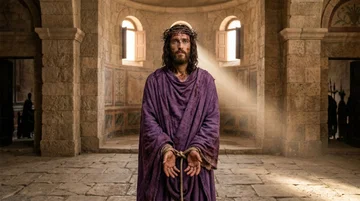
Pilate brought Jesus forth in the Roman judgment hall after the scourging, wearing a crown of thorns and a purple, cast-off robe put on Him in mockery, and publicly declared that he found no fault in Him, having seen no sign of guilt and having no substantiated charge or grounds to condemn Him.DA 723.1–724.1Ms 51, 1897, par. 31–323SP 143.1–2Lt 106a, 1896, par. 27 He presented Jesus wounded and humiliated in this state in hope that the sight of His suffering would satisfy the people and lead them to spare Him.3SP 144.1Ms 51, 1897, par. 31–323SP 143.1–2 His purpose was that the sight of suffering, patience, forbearance, gentleness and dignity would move the crowd to pity and persuade them that He had suffered enough.5RED 63.2–64.1ST Jul 11, 1878DA 735.1–55RED 63.1
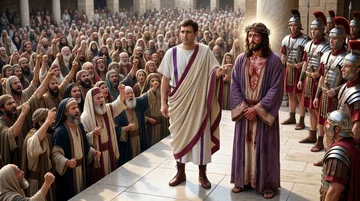
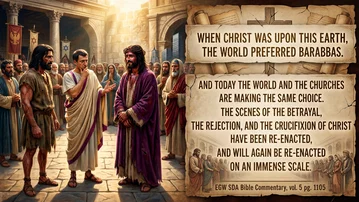
In that presentation Jesus' bleeding, exhausted yet patient dignity stood in contrast beside Barabbas, the robber with hardened criminal character.DA 735.1–55RED 63.13SP 143.1–2 The contrast moved some onlookers to pity, and even priests and rulers were convicted by what they saw.DA 735.1–5 Yet despite the declaration of innocence, the priests, rulers and people, stirred by hatred, rejected Jesus and demanded His crucifixion.3SP 144.15RED 63.2–64.1ST Jul 11, 1878DA 735.1–5 They called for the release of Barabbas, a robber and murderer, while the same crowd that once hailed Jesus as king now reviled Him, deeds witnessed by angels in heaven.Ms 51, 1897, par. 31–32ST Nov 2, 1882
Pilate repeated the finding of innocence three times after the priests failed to find anything in Him worthy of condemnation, affirming he had no grounds to condemn Him.Ms 111, 1897, par. 16–18Ms 51, 1897, par. 31–32 Yet he lacked courage to defend Him, and to appease the accusers and save his office he violated justice and principle, had Him scourged, and surrendered Him to the mob.Ms 72, 1898, par. 11Ms 128, 1897, par. 1–4ST Jul 12, 1899DA 731.6–732.3 That wavering and indecision emboldened the crowd and began the chain of choices that left him burdened with guilt.DA 731.6–732.3 By condemning One he had declared faultless, Pilate burdened himself with a guilty conscience and lasting infamy.Ms 72, 1898, par. 11DA 731.6–732.3 He became an example followed by other unjust judges, and for condemning the Son of the infinite God despite that verdict he will have to answer to God in the judgment.Ms 72, 1898, par. 11Ms 73, 1911, par. 15–16
It was appointed that the trial and death unfold publicly, scene by scene and point after point at Passover, with publicity given to the whole transaction.Ms 111, 1897, par. 42–4512MR 413.4–414.2 By God's design those who delivered Jesus to death would hear Pilate's oft-repeated testimony to His innocence.RH Jun 12, 190012MR 388.3–412MR 413.4–414.2
Meaning of Spotless Suffering
Pilate's words prove that not one sin was ever proven against Christ, for he was pure, holy, undefiled, spotless and blameless, without fault and no criminal.Lt 100, 1910, par. 12–15Ms 21, 1897, par. 27–29Ms 140, 1898, par. 3ST Oct 31, 1900ST Jul 16, 1896 His spotless life was without blame, and his blameless life of service, compassion, teaching, healing and devotion to God joined in harmony stands as a perfect example.Ms 101, 1897, par. 27–29ST Oct 31, 1900 Yet even while declared spotless and blameless he was delivered to be crucified.ST Jul 16, 1896
Even Satan could find nothing in him to turn into an accusation.Ms 140, 1898, par. 3 He was persecuted because he taught truth from heaven, having come as the light of the world to save his people, living the law and revealing God's character, yet they would not receive the heavenly truth he brought and rejected him.Ms 101, 1897, par. 27–29Ms 140, 1898, par. 3Ms 79, 1886, par. 10 The verdict exposes the accusations as false and the witnesses as hired by corrupt priests, with truth itself coming to Christ's help against his accusers.Ms 101, 1897, par. 4–5RH Jun 12, 190012MR 388.3–4 It lays bare how base and corrupt the priesthood had become in seeking his condemnation, so that a heathen, irreligious judge spoke for him as plainly as no friend dared.12MR 388.3–412MR 413.4–414.2RH Jun 12, 1900
Though innocent he bore the shame of being treated as unjust, publicly humiliated and put to open shame before scornful, maddened accusers demanding his death, standing as man's substitute and surety.Lt 100, 1910, par. 12–15Ms 111, 1897, par. 42–45Lt 12, 1911, par. 8–11 He submitted to death by crucifixion, the most shameful of all deaths, with nails and spikes driven through his hands and his feet and his side pierced through with a spear, while Satan was raging against God.Lt 100, 1910, par. 12–15Ms 73, 1911, par. 15–16Ms 74, 1911, par. 17 The events of his trial and death were appointed to unfold publicly, scene by scene, witnessed even by angels in heaven.Ms 111, 1897, par. 42–45Lt 12, 1911, par. 8–11
A blameless life alone was not the whole work of redemption.Ms 101, 1897, par. 27–29 He also had to shed his blood and die publicly on the cross as the sacrifice for sin so that his death would be witnessed beyond doubt, and his precious blood bought children for God.Ms 101, 1897, par. 27–29Ms 73, 1911, par. 15–16 The innocent one is the Son of the infinite, living God, God disguised by and clothed with humanity, come from the heavenly courts and the foundation of the whole Jewish economy to whom the Jewish sacrifices pointed.Ms 73, 1911, par. 15–16Ms 74, 1911, par. 1712MR 413.4–414.2 In being brought before the people wearing a crown of thorns and a cast-off robe placed on him in mockery, he exchanged his royal crown and robe of majesty for signs of suffering as he bore the consequences of human sin.Lt 106a, 1896, par. 27
By choosing a robber and a heathen king in place of the Prince of Life and crying that they have no king but Caesar, his rejecters withdrew from the divine theocracy and chose a heathen ruler.12MR 413.4–414.2 The public declaration was heard by the condemned, repentant thief and formed part of the evidence that led him to recognize Jesus as the innocent Christ.DA 749.1–2DA 749.3–750.1 Because he suffered innocently for the truth, Jesus can understand and stand beside those who suffer for faith.Ms 137, 1897, par. 6–8
Telling how Jesus was in the world, was derided, declared faultless by Pilate, and hung on the cruel cross is part of the word of testimony to bear to those in the world, while impurity and sin are to be overcome by the blood of the Lamb.Ms 74, 1911, par. 17
Sources
Pioneers and periodicals
31 sources
Pilate went out again to the Jews at his tribunal and brought Jesus forth after He had been scourged and mocked by the soldiers with a crown of thorns and a purple robe.ST May 13, 1897ST Oct 7, 1886ST Dec 1, 1898 His settled judgment after examining Him face to face was that He was without fault or crime, with no truth in the charge of making Himself a king against Rome.RH Feb 8, 1915ST Oct 7, 1886ST He had Him scourged and presented Him bleeding, exhausted and wearing the mock robe and crown, in the vain hope that the sight would excite pity and be accepted as sufficient punishment so the people would consent to His release.ST Jul 14, 1881RH Dec 9, 1858 He publicly declared that he found no fault in Him, pointing to Him to stir sympathy, and that declaration stands as the testimony of a heathen judge to Christ's spotless innocence.RH Jun 12, 1900ST Oct 7, 1886RH Feb 8, 1915RH Apr 2, 1908RH Aug 26, 1875 Instead of moving them to pity, the declaration was met with mad fury and renewed cries to crucify Him, and though Pilate knew Him innocent he yielded for fear of the people and of losing standing with Caesar and delivered Him to be crucified.ST Jul 11, 1878ST Jul 14, 1881RH Dec 9, 1858ST Oct 7, 1886
The Trial Scene
Pilate went out again to the Jews, to the priests, rulers and people, and brought Jesus forth to them at the tribunal at the Pavement after he had been scourged and mocked by the soldiers with a crown of thorns on his head, a purple garment, hailing as King of the Jews and striking with their hands.ST May 13, 1897ST Oct 7, 1886ST Dec 1, 1898 The scenes of that trial and crucifixion were cruel mockery and suffering at Calvary.ST Feb 16, 1882 Under Roman law allowing no condemnation without cause, he demanded to know the nature of the offense, understood from the first that the priests and elders had delivered Jesus from envy, and though heartlessly cruel was willing from the outset to release him from the power of the Jews.ST Dec 1, 1898 As charge after charge was brought he marveled that Jesus made no attempt to vindicate himself, took him inside the palace to question him privately about the charges, where Jesus candidly stated who he was and his mission to earth, and then brought him out to render the verdict of innocence before the people.ST Dec 1, 1898
His settled judgment after face-to-face examination was that Jesus was without fault and without crime, even though Jesus said he was King of the Jews, the same title written over the cross.RH Feb 8, 1915ST There was no truth in the charge of sedition against Rome in making himself a king, the charges had not been substantiated, and he repeatedly declared him free from crime and worthy of no death, having determined to release him.RH Feb 8, 1915ST Oct 7, 1886ST He had Jesus scourged and presented him in the vain hope that the sight would excite pity and be accepted as sufficient punishment so the people would consent to his release.ST Jul 14, 1881RH Dec 9, 1858ST Oct 7, 1886ST Oct 7, 1886 He was brought forth pale and suffering, stripped to the waist to reveal long cruel bleeding stripes, blood-stained and exhausted, wearing the mock purple robe and crown of thorns with blood dripping, yet in offering to scourge an innocent man to appease the crowd Pilate was already compromising justice and inconsistently appealing to the people for consent to do his plain duty.ST Oct 7, 1886ST Oct 7, 1886RH Aug 26, 1875ST Mar 13, 1901
Jesus was placed side by side with Barabbas and stood calmly amid the roar, his face marked by purity, nobility and suffering with hidden divinity shining through, an appearance that awakened conscience and broke pride.ST Oct 7, 1886RH Apr 2, 1908RH Aug 26, 1875 This stood in marked contrast to Barabbas the robber chief, whose every feature proclaimed a debased and hardened desperado reflecting evil.ST Oct 7, 1886RH Apr 2, 1908 Yet after being declared innocent Jesus received unmerited torture and mockery by the soldiers and the compromise scourging before being handed over to his persecutors to be crucified.ST Mar 13, 1901
Innocence Declared and Rejected
Pilate went out again and set Jesus before priests, rulers and people, pointing to him and speaking in solemn entreaty that they might know he found no fault in him.ST Oct 7, 1886RH Apr 2, 1908RH Aug 26, 1875 His appeal held up the sufferer's appearance as a striking witness to innocence, meant to stir sympathy and pity.ST Oct 7, 1886RH Apr 2, 1908RH Aug 26, 1875 Even in the mock purple robe and crown of thorns, with hidden divinity shining through, that sight awakened Pilate's conscience and broke his pride.RH Apr 2, 1908RH Aug 26, 1875
The declaration stands as the verdict of a Roman and heathen judge after face-to-face examination, testifying that Christ was without fault though he said he was King of the Jews.RH Jun 12, 1900RH Feb 8, 1915 It is joined with the witness of Pilate's wife that he is a just man, and no friend dared speak up for him as plainly as Pilate did.RH Jun 12, 1900RH Feb 8, 1915 It was God's design that those who delivered Jesus to death should hear Pilate testify to his innocence.RH Jun 12, 1900 That testimony exposed the accusations as false and showed the witnesses had been hired by corrupt priests.RH Jun 12, 1900
He whom Pilate declared faultless is spotless and blameless even while the Son is being rejected and given over to the people.ST Oct 31, 1900ST Jul 16, 1896ST Feb 5, 1902 His perfection draws people to him and reveals their own sinfulness.ST Jan 20, 1904 His blameless life was a perfect example, with service, compassion, teaching, healing and devotion to God joined in harmony.ST Oct 31, 1900
Instead of moving them to pity Jesus in his suffering and forbearance, the declaration was met with mad fury stirred up by the priests.ST Jul 11, 1878ST Nov 2, 1882ST Oct 7, 1886 Priests and people answered the appeal for pity with demands for crucifixion and rejection.ST Jul 11, 1878ST Nov 2, 1882ST Jul 14, 1881 The mob cried crucify him, crucify him like the roaring of wild beasts.ST Oct 7, 1886
Although he recognized Jesus' innocence, Pilate was weak and failed to protect him and give him release.ST Jul 14, 1881RH Dec 9, 1858 He had hoped the sight of the beaten, scourged and mocked prisoner would move the crowd to consent to release, but their renewed cries for crucifixion overcame his resolve.ST Jul 14, 1881RH Dec 9, 1858 Constrained by demand and threat that letting Jesus go would prove disloyalty to Caesar, he feared for his standing with Caesar because of his bad career and danger of accusation, deposition and death.ST Jul 14, 1881RH Dec 9, 1858 For worldly interest and fear of popular pressure he silenced his conscience, in despair told them to take him and crucify him, had him scourged, delivered him up and ordered the execution.ST Jul 14, 1881RH Dec 9, 1858ST Oct 7, 1886 Finding no fault in Jesus did not keep him from yielding and allowing him to be condemned.RH Sep 28, 1911
Prophecy Doctrine and Application
Christ the Passover sacrifice and Lamb of God was put to death on the day the paschal lamb was slain, the fourteenth day of the first month, fulfilling the Passover-lamb type exactly as to time on its appointed day.RH Oct 30, 1855ST Aug 13, 1874RH Dec 15, 1868 His sacrifice stands with the resurrection on the day of firstfruits and the outpouring of the Holy Spirit on Pentecost to show that the spring types met their antitypes on the very days of the types.RH Dec 15, 1868 Preliminary and circumstantial offerings did not prevent the grand event of the day from meeting its antitype at the time pointed out in the type.RH Dec 15, 1868
Brought forth in Zion before the people and declared to have no fault in him, Jesus stood in crownless, poor, disrobed, bleeding abasement.RH Jun 24, 1902 In that weakness he is more awful and sublime, and in that meekness more than kingly, as the Son of God.RH Jun 24, 1902 Against Pilate high in place and Rome compelling the world by arms in pride, he is greater, and he will reign while the world divides glory and honor and crowns and unmakes its monarchs.RH Jun 24, 1902 Here in humiliation and there in glory interceding, he is the King.RH Jun 24, 1902
He was brought forth in humiliation wearing a purple robe and a crown of thorns pressed upon his anguished brow so that blood dripped slowly as the price he pays as the perpetual Sacrifice, with heaven in mourning over him.RH Jul 24, 1856ST Nov 17, 1898 He will not come again in that low condition.RH Jul 24, 1856 He returns as Conqueror led to certain victory, no longer in the robe and thorns of suffering but wearing a brighter crown on his brow than ever shone on a monarch.RH Jul 24, 1856
Pilate's settled judgment was that Jesus was innocent, with no truth in the charge of sedition against Rome in making himself a king, and he had determined to release him and repeatedly declared him free from crime and worthy of no death.ST He delivered Jesus to be crucified only because the leaders of the Jews declared he ought to die by their law and constrained him by demand and pressure, threatening that to let him go would prove disloyalty to Caesar, which Pilate feared because of his bad career and danger of accusation to Caesar, deposition and death.ST The Roman execution therefore leaves the guilt for killing the Holy and Righteous One, the Prince of Life, on the Jewish leaders who delivered him up, denied him before Pilate, and asked for a murderer instead.ST The rulers showed inconsistency in crying for the release of Barabbas, whose crime was practically the same as what they charged against Jesus, while Barabbas was convicted at his trial and Jesus was declared innocent.ST Mar 13, 1901
Pilate could have saved himself the sin and disgrace of authorizing Jesus' death if he had acted with the same independence before handing him over that he later showed in refusing to change the inscription.ST May 17, 1899 Finding no fault in Jesus did not keep Pilate from yielding to the crowd and allowing him to be condemned, which warns that fear of popular pressure can lead people to abandon truth they recognize.RH Sep 28, 1911 Jesus is the incarnate Truth, and the scene confronts each person with a choice about whether to accept him as leader, even as Pilate failed to uphold his own conviction and allowed Jesus to be condemned. Pilate's public declaration of the Saviour's innocence is contrasted with Emperor Sigismund's failure to show even Pilate's moral courage by publicly trying to rescue Huss.
Pilate's declaration that he found no fault in Christ is compared with the description of the people ready for Christ's return as without fault, meaning they are to have Christ's character fully formed in them.ST Jul 3, 1893 Because Christ revealed God's character and God's law expresses that character, being without fault means living in harmony with God's law.ST Jul 3, 1893 Those prepared for translation must therefore correct their disregard of the Sabbath, so that their lives are in harmony with God and Christ.ST Jul 3, 1893
His perfection draws people to him and reveals their own sinfulness, and his death for them is the ground of their salvation, not the conduct of those who profess to follow him.ST Jan 20, 1904 After being declared innocent, Jesus received unmerited torture and mockery and the compromise scourging, and after all was handed over to his persecutors to be crucified, his life sacrificed in that cruel manner at Calvary that our lives might be saved.ST Feb 16, 1882ST Mar 13, 1901 Men must see and know him as morality itself and the hope of heavenly life instead of pawning him for earthly coin.ST Nov 17, 1898 Reading the account of his sufferings can help subdue pride and cast out discontent when read by a fretful or gloomy Christian.ST Apr 17, 1879
Sources