Luke 23:9
Then he questioned with him in many words; but he answered him nothing.
Translations
American King James Version, King James Version, KJV Cambridge Paragraph Bible, Webster Bible
Then he questioned with him in many words; but he answered him nothing.
Revised Version, American Standard Version
And he questioned him in many words; but he answered him nothing.
and was questioning him in many words, and he answered him nothing.
and he questioned him in many words, but he answered him nothing.
And he went on to question him in a good many words; but, he, answered him, nothing.
Berean Standard Bible, Majority Standard Bible
Herod questioned Jesus at great length, but He gave no answer.
He questioned him with many words, but he gave no answers.
And he put a great number of questions to him, but he said nothing.
Then questioned hee with him of many things: but he answered him nothing.
Douay-Rheims (Challoner revision)
And he questioned him in many words. But he answered him nothing.
Pictures
Cross-references
- Isaiah 53:7
He was oppressed, and he was afflicted, yet he opened not his mouth: he is brought as a lamb to the slaughter, and as a sheep before her shearers is dumb, so he openeth not his mouth.
Jesus’ silence before Herod reflects the suffering servant’s silence under oppression.
- Mark 15:3-5
And the chief priests accused him of many things: but he answered nothing.
Jesus remains silent despite repeated charges and questioning before Pilate.
- Matthew 27:12-14
And when he was accused of the chief priests and elders, he answered nothing.
Jesus gives no answer to accusations before Pilate.
- John 18:28-40
Then led they Jesus from Caiaphas unto the hall of judgment: and it was early; and they themselves went not into the judgment hall, lest they should be defiled; but that they might eat the passover.
Both recount Jesus’ trial before Pilate.
- Luke 23:4
Then said Pilate to the chief priests and to the people, I find no fault in this man.
Pilate declares Jesus without fault.
- John 19:9
And went again into the judgment hall, and saith unto Jesus, Whence art thou? But Jesus gave him no answer.
Jesus gives Pilate no answer during his questioning.
- Matthew 27:19
When he was set down on the judgment seat, his wife sent unto him, saying, Have thou nothing to do with that just man: for I have suffered many things this day in a dream because of him.
Pilate warned after Jesus returned
- Matthew 26:63
But Jesus held his peace. And the high priest answered and said unto him, I adjure thee by the living God, that thou tell us whether thou be the Christ, the Son of God.
Jesus remains silent under questioning.
- John 18:38
Pilate saith unto him, What is truth? And when he had said this, he went out again unto the Jews, and saith unto them, I find in him no fault at all.
Pilate asks about truth but does not pursue an answer.
- Luke 23:15
No, nor yet Herod: for I sent you to him; and, lo, nothing worthy of death is done unto him.
Herod also found Jesus worthy of no punishment.
- Acts 4:27
For of a truth against thy holy child Jesus, whom thou hast anointed, both Herod, and Pontius Pilate, with the Gentiles, and the people of Israel, were gathered together,
Names Herod among those joined against Jesus.
- Matthew 27:42
He saved others; himself he cannot save. If he be the King of Israel, let him now come down from the cross, and we will believe him.
The silent prisoner is mocked on the cross and later glorified.
- Matthew 27:2
And when they had bound him, they led him away, and delivered him to Pontius Pilate the governor.
Cited as a parallel account of Jesus’ trial.
- Mark 6:17-29
For Herod himself had sent forth and laid hold upon John, and bound him in prison for Herodias’ sake, his brother Philip’s wife: for he had married her.
Herod Antipas imprisoned and executed John the Baptist.
- Matthew 27:24
When Pilate saw that he could prevail nothing, but that rather a tumult was made, he took water, and washed his hands before the multitude, saying, I am innocent of the blood of this just person: see ye to it.
Pilate called Jesus innocent and just
- Mark 6:16
But when Herod heard thereof, he said, It is John, whom I beheaded: he is risen from the dead.
Herod feared Jesus was John risen from the dead.
- Luke 23:24
And Pilate gave sentence that it should be as they required.
Pilate gives sentence against Jesus after his unjust trial.
Commentary
Each commentary is drawn from primary sources: the writings of Ellen G. White and Adventist pioneers and periodicals. Each commentary is separate. Its own words are not a quotation; follow the references to read the source passages.
Ellen G. White
33 sources
Herod was eager to see the prisoner because he hoped to watch Him perform a wonder, so he interrogated Him at length with urgings, threats and boasts of his own authority.Ms 112, 1897, par. 7–8Ms 129, 1897, par. 4–53SP 136.1–23SP 137.2 Jesus answered him nothing at all, maintaining calm, dignified composure as though He neither saw nor heard.Ms 129, 1897, par. 4–5COS 143.1–33SP 135.2 He would not work a wonder to satisfy idle curiosity nor use divine power to spare Himself, since that power was given for the salvation of others.COS 143.1–33SP 135.2SG1 55.1–25RED 56.13SP 136.1–2 He had no word for Herod because Herod had rejected the light given through John and would only trample further truth, though His ear remained open to every sin-sick soul who would seek help.Ms 112, 1897, par. 7–8DA 730.1–5ST Jul 11, 18785RED 56.2–57.1 That very silence spoke conviction to Herod's heart, filling him with fear that Jesus was more than an ordinary man and leaving him unwilling to condemn Him, so he sent Him back to Pilate.Ms 112, 1897, par. 7–85RED 59.2ST Jun 3, 18893SP 139.2
Herod Questions Jesus
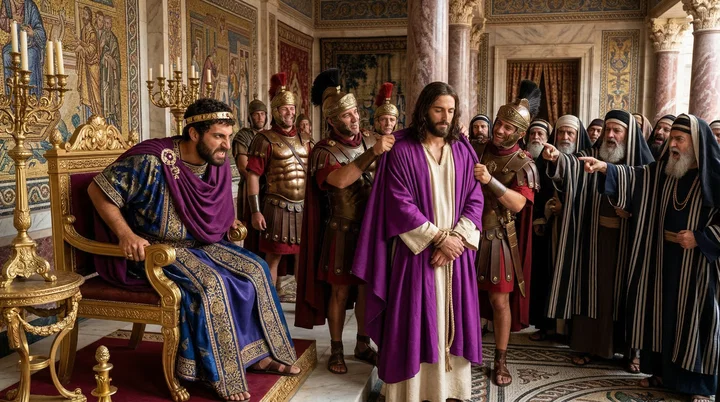
Herod, whose hands were stained with John's blood, was exceeding glad to see Jesus because he had long desired to see Him and hoped to see some miracle done by Him.Ms 112, 1897, par. 7–8 He silenced the accusing mob around Jesus and had Him unbound so that he could interrogate Him.ST Jun 3, 18895RED 55.2 He looked on Him with curiosity mingled with pity, seeing a pale, sad face marked with deep wisdom and purity yet showing extreme weariness and suffering.ST Jun 3, 18895RED 55.2 From his acquaintance with the Jews he knew that malice and envy had led them to condemn an innocent man.ST Jun 3, 18895RED 55.2
He questioned Him at length with many words, with repeated urgings, threats, and boasts of his own exalted position and authority.Ms 129, 1897, par. 4–53SP 136.1–23SP 137.2Ms 129, 1897, par. 1–3COS 144.2–3 He reminded Him how a prophet like Him had been treated at his hands and punished in John's case, hoping to force a miracle from Him.Ms 129, 1897, par. 4–53SP 136.1–2 He believed Jesus might answer if offered hope of release, and his hardened heart could not bear continued silence.Ms 129, 1897, par. 1–3COS 144.2–3Ms 129, 1897, par. 6–7 He demanded that Jesus prove His claims and widespread fame for saving the sick by His power.Ms 129, 1897, par. 4–53SP 136.1–2 He had the decrepit and maimed brought in and ordered Him to work miracles for others and now for His own good, to secure His release, and to show a sign of the power rumor accredited to Him.Ms 129, 1897, par. 4–5
This questioning belongs to Jesus' passage from one tribunal to another amid mockery and violence.ST Nov 30, 1882 It came while He faced hostility from religious leaders and Roman authority pressing the governor to do their will.RH Nov 11, 1915 It followed a whole night without food or drink since the Passover supper with His disciples, conflict in Gethsemane, betrayal by Judas, the flight of all His disciples, and hearings before Annas, then Caiaphas, then Pilate.Ms 95, 1897, par. 10–12 His form was already lacerated by the cruel scourge and twice tortured by it when He stood unresisting before Herod as before Pilate.Ms 95, 1897, par. 10–12DA 780.3
When Jesus would not answer, Herod mocked His claim to be king by having Him dressed in a thorn crown and tattered purple robe and seated on a mock throne.3SP 138.1–2 There He was treated with derision, insults, and blows without retaliation.3SP 138.1–2 Herod found nothing in Him to condemn and would not pronounce sentence against Him, yet heaped insult upon insult and mockery upon mockery before sending Him back to Pilate.Ms 95, 1897, par. 10–12
Why Jesus Stayed Silent
To many words of questioning, with false accusations and demands for a sign, He answered nothing at all, neither by word nor by look, as one who heard and saw not.Ms 129, 1897, par. 4–5COS 143.1–33SP 135.2SG1 55.1–2ST Nov 2, 1882 Through repeated urgings He preserved His silence and Godlike majesty, giving no sign that He heard a word, holding calm, dignified composure and unparalleled serenity.Ms 129, 1897, par. 4–53SP 135.2SG1 55.1–2ST Nov 2, 18825RED 59.2 He spoke only what was essential and tended to glorify God, showing conscious innocence and steadiness under hostility, without retaliation or attempt to save Himself by answering every charge.SG1 55.1–2EW 142.1–2
He would not perform a miracle to satisfy wicked, idle curiosity or to prove His power at Herod's command, but stood before him as though He neither saw nor heard.COS 143.1–33SP 135.2ST Nov 2, 18822RED 90.1–2ST Nov 2, 1882 That miraculous power was for the salvation of others, not for His own defense.SG1 55.1–2EW 142.1–2 He would not use divine power to spare Himself the suffering and humiliation He had accepted as a man, nor to escape pain and humiliation or to secure His own release.ST Nov 2, 18825RED 56.13SP 136.1–2ST Jul 11, 1878DA 728.2–729.3
He came to heal the brokenhearted, not to gratify the idle curiosity of princes, rulers, scribes, priests, or peasants.Ms 112, 1897, par. 7–8 Hard-hearted, depraved hearers could no more understand His pure, elevated words than brute creation could, and precious gems of truth were not to be cast before swine to be trampled underfoot, for He knew they would reject or misuse even true and uplifting words like pearls trampled underfoot.Ms 112, 1897, par. 7–8ST Jan 24, 1900 If any word could have healed the bruises of sin-sick souls He would have spoken it.Ms 112, 1897, par. 7–8
The ear ever open to human woe had no room for Herod's words, the eyes that ever rested in pitying, forgiving love on the penitent sinner had no look to bestow on Herod, and the lips that had uttered impressive truth and pled in tender entreaty and were ever ready to speak pardon to the hardest sinner were closed to him.Ms 112, 1897, par. 7–8Ms 129, 1897, par. 4–5 He welcomed the earnest pleas of even the worst sinners who sought help, yet gave no answer or attention to the commands of the proud, cruel ruler.ST Jul 11, 18785RED 56.2–57.1 He had no message for Herod because Herod had rejected the light received through John the Baptist, felt no need he would acknowledge for a Saviour, and would reject, misuse, and trample truth underfoot.DA 730.1–5ST Jul 11, 18785RED 56.2–57.1DA 728.2–729.3
His silence was not inability, for He could have exposed Herod's guilt and coming doom.ST Jul 11, 18785RED 56.2–57.1 His calm, dignified silence itself was a severe rebuke to the haughty ruler, so that a spoken rebuke would have been a mercy by comparison, and His hardened heart could not bear to remain unmoved before it.DA 730.1–5Ms 129, 1897, par. 1–3COS 144.2–3
Silence Convicts and Witnesses
His very silence and bearing before Herod were eloquent, speaking conviction to Herod's heart such as no words could have done.Ms 112, 1897, par. 7–85RED 59.2ST Jun 3, 18893SP 139.2 That calm submission and silence perplexed him and unsettled him, moving him with sudden fear that Jesus might not be a common man but a god come down to earth, and making him wonder whether He was more than an ordinary man.5RED 59.2ST Jun 3, 18893SP 139.2 His pure, pale face and kingly appearance, His calm submission, patience, and noble bearing amazed the crowd and contrasted with those judging Him, making Him seem kingly rather than criminal.5RED 59.23SP 139.2SG1 53.1 The kingly look in the sufferer's face shamed even mockers who came to bow in derision into turning back, and His demeanor troubled even Herod and Pilate.5RED 59.23SP 139.2SG1 53.1
Herod felt mocked and became excited, treating the silence as an affront to his authority and an insult to his power.Ms 129, 1897, par. 4–5DA 730.1–5Ms 129, 1897, par. 6–7 His hardened heart could not bear that silence, so he tried to intimidate Jesus, questioning and threatening Him while remaining unmoved himself by any rebuke except that silence.Ms 129, 1897, par. 4–5DA 730.1–5COS 144.2–3 Hardened though he was and finding nothing in Jesus to condemn, Herod grew ill at ease and dared not ratify the condemnation of the Jews.5RED 59.2ST Jun 3, 1889Ms 95, 1897, par. 10–12 Troubled and unwilling to condemn Him, he sent Jesus back to Pilate.5RED 59.2ST Jun 3, 18893SP 139.2
The silent, scourged, unresisting prisoner who stood at the bar of Herod and Pilate and was refused is the same Jesus who was nailed to the cross, mocked by priests and rulers, laid in Joseph's new tomb, and came forth glorified in resurrection.Lt 31, 1898, par. 36DA 780.3 His form was already lacerated by the cruel scourge as He stood unresisting before Herod, just as before Pilate.DA 780.3 In the final judgment Herod will see again the scene of Jesus brought before him and mocked, and will recall his own part in Christ's suffering.4SP 481.2–482.2 The trial in which Jesus was thus condemned and humiliated before His crucifixion prepares His faithful disciples for the betrayal, condemnation, and hostility they will face, so that the crowd's rejection of Him will not take them by surprise.4RED 102.2–103.1
Sources
Pioneers and periodicals
35 sources
Pilate sent Jesus as a Galilean to Herod who questioned him at length, yet he answered nothing but remained calm and silent under mockery and abuse.RH Jul 16, 1861ST Aug 21, 1907ST Jan 17, 1911ST Jan 17, 1911ST Oct 31, 1916 He was silent because Herod acted from idle wicked curiosity demanding a miracle for display, and he would not use divine power to gratify curiosity or spare himself suffering.ST Nov 2, 1882ST Nov 2, 1882ST Oct 23, 1884 He also knew Herod had rejected light and would reject or misuse true words, so answering would waste words and increase guilt, making silence both judicial and merciful.ST Jan 24, 1900ST Jul 11, 1878ST Feb 6, 1907 His lamb-like silence fulfilled Isaiah 53 that the afflicted servant would not open his mouth.ST Oct 12, 1904RH Jul 15, 1875 His silence is the example his followers must follow in not resisting evil and in refusing to answer scoffers who demand proof to gratify curiosity.RH Jun 27, 1871RH Jul 15, 1875
Trial Before Herod
Because he was a Galilean, Jesus was sent by Pilate to Herod, the ruler of Galilee who had executed John the Baptist, and was brought before him with his accusers, and Herod then sent him back to Pilate, leaving his fate in Pilate's hands.RH Jul 16, 1861ST Aug 21, 1907ST Jan 17, 1911ST Sep 20, 1905 He was tried by Pilate and Herod and the high priest and was executed by the Romans.ST Mar 15, 1877 Luke alone records the episode before Herod, a detail not given by the other evangelists.ST Apr 28, 1909ST Sep 20, 1905 The history of the trial and execution and burial is told with minute accuracy about the customs, opinions, political events and other circumstances of that time.RH Feb 11, 1862 Bringing Jesus to Pontius Pilate as governor of Judea with power of life and death, the derision shown to criminals, scourging before crucifixion, the accusation written on the cross in three languages, the bearing of the cross, and the giving of the body to friends for burial agree with the manners and institutions of that period, and this circumstantial consistency, given naturally and without forced design, shows the account is true and serves as evidence for Christianity.RH Feb 11, 1862
Herod questioned him at length in many words, and Jesus answered him nothing.ST Nov 30, 1882ST Aug 21, 1907ST Jan 13, 1898 He remained calm, passive and silent by word and look even when challenged, commanded, threatened with power, pressed to prove his power by a miracle, insulted, mocked and abused by Herod, his attendants, the rulers and the crowd.ST Jan 17, 1911ST Oct 31, 1916RH Aug 25, 1859 He submitted with unparalleled serenity and composed willingness to endure, at times weary and praying for strength and for his enemies, through passage from tribunal to tribunal to mockery, violence, cruelty and sarcasm leading to crucifixion, giving his life for humanity.ST Nov 30, 1882ST Oct 31, 1916RH Aug 25, 1859 His silence continued amid unjust treatment and derision and was followed by Herod's mockery.ST Jan 17, 1911ST Jan 13, 1898
Herod had him unbound and questioned him, looking with curiosity mingled with pity on his pale, sad face marked with deep wisdom and purity yet showing extreme weariness and suffering, knowing from acquaintance with the Jews that malice and envy had caused them to condemn an innocent man.ST Jun 3, 1889 Jesus submitted passively to all indignity heaped on him with unparalleled serenity and answered nothing, and his very silence with dignity, without retaliation, spoke conviction to Herod's heart such as no words could have done.ST Jun 3, 1889ST Oct 27, 1898 It perplexed him, moved him with sudden fear that Jesus might not be a common man but a god come down to earth, and left him ill at ease, so that hardened as he was he dared not ratify the condemnation of the Jews and sent Jesus back to Pilate.ST Jun 3, 1889 Herod found nothing in him worthy of punishment, agreeing with Pilate that he was innocent.ST Oct 27, 1898
Pilate had sent him to Herod to escape responsibility, and might have stopped the false accusation until his defense was heard.ST Oct 27, 1898ST Oct 12, 1876 Over and over Pilate pronounced him innocent and just and was troubled all the more on hearing he claimed to be the Son of God, knowing he was different from any man he had met.RH Jun 15, 1911 The episode belongs to unjust proceedings against him amid hostility of religious leaders and Roman authority pressing the governor, as priests and rulers pressed the Roman governor to do their will.RH Nov 11, 1915ST Oct 12, 1876 But the terrible, demon-like howling of the mob crying for crucifixion prevailed, and Pilate permitted him to be led away and crucified.RH Jun 15, 1911 Herod is shown as a weak and wicked ruler who would have put Jesus to death but feared losing influence with Caesar.RH Jul 16, 1861
Reasons For Silence
He was silent because Herod was actuated by mere idle curiosity, and the Lord does not lend His wisdom or power to gratify idle curiosity.ST Oct 23, 1884 He would not perform mighty works merely to display His power or to gratify a ruler. He did not perform a miracle to satisfy curiosity even though refusal left Him exposed to cruel insults, for His works served God's purpose rather than human demands for signs. While Herod repeatedly questioned and urged Him to prove His power, He stood calmly and gave no answer by word or look, refusing to perform a miracle to satisfy wicked curiosity or to use divine power to spare Himself suffering and humiliation.ST Nov 2, 1882ST Nov 2, 1882 His silence was not inability.ST Nov 2, 1882ST Jul 11, 1878 As He did not comply with Satan's challenge to prove Himself by a sign, so He did not comply with Herod's challenge, for miracles are not to be demanded as proof of faith nor performed for human display.ST Feb 17, 1904
He knew Herod and the others were wicked and would reject or misuse even true and uplifting words, like pearls trampled underfoot, and so His silence was a refusal to offer such words to them.ST Jan 24, 1900 He could have exposed Herod's guilt and coming doom, but Herod had rejected the light he had received through John the prophet and had no need he would acknowledge for a Saviour.ST Jul 11, 1878 Though He welcomed the earnest pleas of sinners, He gave no answer or attention to the commands of the proud, cruel ruler.ST Jul 11, 1878 Herod was not ready to hear words of grace, so that answering would have wasted His words and increased Herod's guilt, and the silence was both judicial and merciful.ST Jul 11, 1878ST Feb 6, 1907
He could have answered to conciliate Herod, but He did not.ST Nov 14, 1900 His silence showed that He was free from fear of death, of people, and of torture.ST Nov 14, 1900 It exposed the mockery of human justice and the emptiness of human power.ST Nov 14, 1900
Prophecy, Example, Warning
His meek silence when questioned at length with no answer fulfilled Isaiah's prophecy that the afflicted servant would not open his mouth.ST Oct 12, 1904 Though his rights extended over the whole universe and it was in his power to maintain them, he did not stand up for his rights but was silent like a lamb led to slaughter and like a sheep dumb before shearers.RH Jul 15, 1875 His silent, unresentful, unresisting endurance under every indignity and insult, trusting in a power higher than Pilate knew, was part of God's presentation of the gospel in its perfection before Rome in the person of Pilate.ST Oct 27, 1898 That endurance convinced Pilate that Jesus was more than man and appealed to him to do right whatever the consequences as God's final effort to save him.ST Oct 27, 1898
His answering nothing amid cruel mocking in Herod's court was one step of the sacrifice giving his life for a lost and sinful race. That step belongs with his temptation in the wilderness, prayers during long cold nights in the mountains, teaching and healing, agony of Gethsemane, trials before Annas and Caiaphas, scourging and crowning with thorns, unjust condemnation, journey from the Praetorium to the cross, and crucifixion and death in the great all-comprehending divine sacrifice for fallen man. His visit to Herod's hall was part of going among people of every station.ST Jul 9, 1894 His bearing before Herod, before Pilate and on the cross is named as courage and faithful endurance.RH Mar 9, 1905
His silence is the example his followers are required to follow, bearing the cross after him and not resisting evil when misused, because the disciple is not above his master.RH Jul 15, 1875 He would not perform or respond to demands made to gratify curiosity or put him to the test.RH Jun 27, 1871 His silence therefore teaches that believers need not answer scoffers who demand proof in an improper manner, and that refraining from speaking can sometimes be the wiser course.RH Jun 27, 1871
His silence was both judicial and merciful, for he was not ready to be heard with words of grace and answering would have wasted his words and increased guilt, and it warns that neglect or levity can make people deaf to Christ.ST Feb 6, 1907 Herod stands as a sinner who is sorry yet continues without a heart truly broken by sin.RH Sep 22, 1863 The scene, here described as Pilate questioning Jesus without receiving an answer, illustrates how prejudice can turn a person away from truth, so that though Pilate had declared him innocent he listened to the crowd and sent him to the cross instead of seeking the truth he had asked about.ST Aug 20, 1896
Satan stirred up pagan Rome under Herod and Pilate to do his will and destroy Jesus, the hope of the race.ST Jun 27, 1911 Pagan Rome was the fourth head of the Satan-controlled beast system of government, succeeding Grecia in B.C. 161 so far as God's people are concerned, and though pagan Rome itself did not know the Man Child was to be born, Satan knew and watched and waited, using Herod and Pilate against Christ, but the attempt failed.ST Jun 27, 1911 The powers were wicked in condemning Christ — Herod using unjust authority against the Son of God, with the dishonesty and intrigue of Caiaphas seeking innocent blood on grounds of expediency and the fear of Pilate signing the death warrant to save his office — yet he and the apostles did not call the church to hold indignation meetings, denounce and trample rulers, send protests to legislative halls, make correct political views essential to fellowship, or reform Rome.RH Dec 3, 1857 That political way seeks the triumph of Christianity by law and union of church and state, by which the church proves herself a harlot.RH Dec 3, 1857
Sources