Matthew 27:26
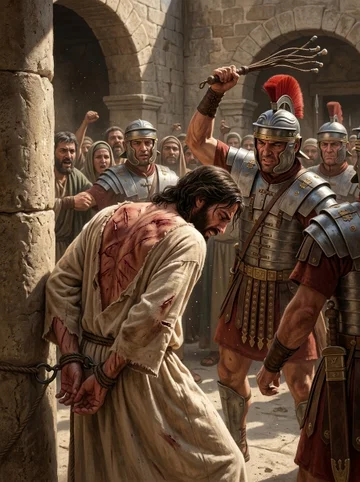
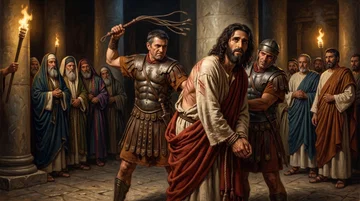
Then released he Barabbas unto them: and when he had scourged Jesus, he delivered him to be crucified.
Translations
Then released he Barabbas to them: and when he had scourged Jesus, he delivered him to be crucified.
King James Version, KJV Cambridge Paragraph Bible
Then released he Barabbas unto them: and when he had scourged Jesus, he delivered him to be crucified.
Then he released Barabbas to them: and when he had scourged Jesus, he delivered him to be crucified.
Then released he unto them Barabbas: but Jesus he scourged and delivered to be crucified.
Then released he unto them Barabbas; but Jesus he scourged and delivered to be crucified.
Then did he release to them Barabbas, and having scourged Jesus, he delivered [him] up that he may be crucified;
Then he released to them Barabbas; but Jesus, having scourged [ him], he delivered up that he might be crucified.
Then released he unto them Barabbas, but, scourging, Jesus, delivered him up, that he might be crucified.
Berean Standard Bible, Majority Standard Bible
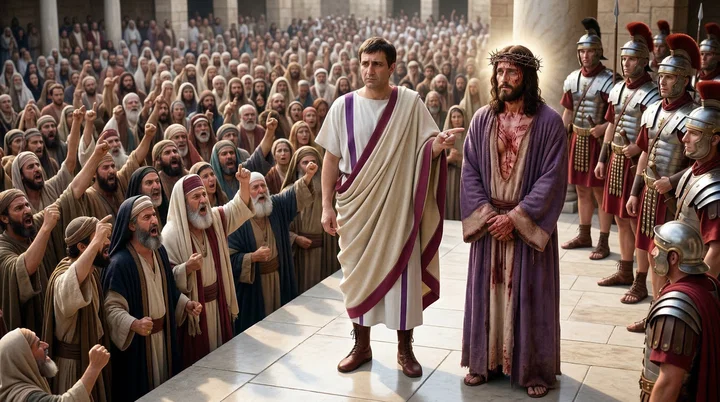
So Pilate released Barabbas to them. But he had Jesus flogged, and handed Him over to be crucified.
Then he released Barabbas to them, but Jesus he flogged and delivered to be crucified.
Then he let Barabbas go free: but after having Jesus whipped, he gave him up to be put to death on the cross.
Thus let he Barabbas loose vnto them, and scourged Iesus, and deliuered him to be crucified.
Douay-Rheims (Challoner revision)
Then he released to them Barabbas, and having scourged Jesus, delivered him unto them to be crucified.
Pictures
Cross-references 20 of 63
- John 19:1
Then Pilate therefore took Jesus, and scourged him.
Both recount Jesus’ scourging before he is delivered for crucifixion.
- Mark 15:15
And so Pilate, willing to content the people, released Barabbas unto them, and delivered Jesus, when he had scourged him, to be crucified.
Records Barabbas’s release and Jesus’s scourging before crucifixion.
- Luke 23:18-25
And they cried out all at once, saying, Away with this man, and release unto us Barabbas:
The crowd chooses Barabbas, and Pilate releases him and delivers Jesus to be crucified.
- John 19:17
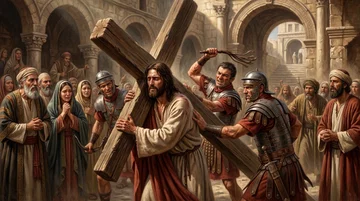
And he bearing his cross went forth into a place called the place of a skull, which is called in the Hebrew Golgotha:
Jesus bears his cross on the way to his execution.
- John 18:39-40
But ye have a custom, that I should release unto you one at the passover: will ye therefore that I release unto you the King of the Jews?
The crowd chooses Barabbas instead of Jesus at Passover.
- Isaiah 53:5
But he was wounded for our transgressions, he was bruised for our iniquities: the chastisement of our peace was upon him; and with his stripes we are healed.
Foretells the wounds and bruises fulfilled in Jesus’ scourging.
- Matthew 27:19
When he was set down on the judgment seat, his wife sent unto him, saying, Have thou nothing to do with that just man: for I have suffered many things this day in a dream because of him.
Pilate’s wife warns him not to condemn Jesus, whom she calls just.
- Luke 23:32-33
And there were also two other, malefactors, led with him to be put to death.
Jesus is crucified between two criminals.
- John 19:16
Then delivered he him therefore unto them to be crucified. And they took Jesus, and led him away.
Pilate delivers Jesus to be crucified.
- Matthew 27:22
Pilate saith unto them, What shall I do then with Jesus which is called Christ? They all say unto him, Let him be crucified.
The crowd demands that Jesus be crucified.
- Matthew 27:35
And they crucified him, and parted his garments, casting lots: that it might be fulfilled which was spoken by the prophet, They parted my garments among them, and upon my vesture did they cast lots.
Records Jesus being crucified.
- Acts 3:14-15
But ye denied the Holy One and the Just, and desired a murderer to be granted unto you;
Contrasts Barabbas the murderer released with Jesus, the Prince of life, rejected and killed.
- Matthew 27:2
And when they had bound him, they led him away, and delivered him to Pontius Pilate the governor.
Jesus was handed over to Pilate before being delivered for crucifixion.
- Matthew 28:6
He is not here: for he is risen, as he said. Come, see the place where the Lord lay.
Christ rises from the grave as victor after his suffering and death.
- Matthew 26:57-59
And they that had laid hold on Jesus led him away to Caiaphas the high priest, where the scribes and the elders were assembled.
Jesus’ trial before the high priest leads to his condemnation and crucifixion.
- Matthew 27:15-18
Now at that feast the governor was wont to release unto the people a prisoner, whom they would.
Pilate offers Barabbas or Jesus under the Passover pardon custom, knowing envy prompted the accusation.
- John 19:6-10
When the chief priests therefore and officers saw him, they cried out, saying, Crucify him, crucify him. Pilate saith unto them, Take ye him, and crucify him: for I find no fault in him.
Pilate finds no fault in Jesus yet claims power to crucify or release him.
- Luke 23:16
I will therefore chastise him, and release him.
Pilate proposes to chastise Jesus and release him.
- Isaiah 50:6
I gave my back to the smiters, and my cheeks to them that plucked off the hair: I hid not my face from shame and spitting.
It predicts the Messiah’s suffering, fulfilled when Jesus was scourged.
- Acts 2:23
Him, being delivered by the determinate counsel and foreknowledge of God, ye have taken, and by wicked hands have crucified and slain:
Jesus was put to death by human agents within God’s purpose.
Commentary
Each commentary is drawn from primary sources: the writings of Ellen G. White and Adventist pioneers and periodicals. Each commentary is separate. Its own words are not a quotation; follow the references to read the source passages.
Ellen G. White
54 sources
Pilate released the notorious robber and murderer Barabbas and had the innocent Jesus scourged and handed over to be crucified, though he himself had repeatedly declared Him without fault and with no crime proved against Him.Ms 40, 1897, par. 7–10RH Jan 23, 19003SP 142.2–3 In setting Christ side by side with Barabbas under the festival custom of freeing one condemned prisoner, he vainly hoped the contrast and the sight of bloody punishment would move the rulers and crowd to pity and secure Jesus' release, but they pressed for death and chose Barabbas instead.3SP 143.1–25RED 63.1DA 735.1–5Ms 112, 1897, par. 33–34 That choice was a rejection of Christ for Satan personified, with the priests, rulers and mob yoking themselves to Satan who led them in reviling and abuse, while calling Christ's blood upon themselves and their children.16MR 259.3–260.112MR 411.3–4Lt 132, 1910, par. 4–9Ms 106, 1897, par. 5 Jesus endured the lacerating scourging and the mocking, crowning and crucifixion that followed without murmur or resentment, with quiet patience and dignity, as the just suffering for the unjust under the burden of the world's sins to redeem mankind to God.DA 735.1–5EW 40.3SG1 39.1Ms 56, 1894, par. 3–4 By that cruel death He exposed Satan's character and vindicated God before the universe, proving Satan's charges false, and the same choice between Barabbas and Christ still stands before everyone in deciding whether to accept Christ and His truth or reject Him.16MR 259.3–260.1ST Mar 12, 1885Lt 132, 1910, par. 4–9Lt 31, 1898, par. 33–35
Setting and Sequence
Matthew 27:26 belongs to the judgment-hall scene where Jesus stands bound before Pilate while the Jewish leaders seek to have their sentence confirmed and carried out, at the Passover whose significance those leaders had lost by rejecting Jesus, the true Passover lamb.DA 723.1–724.1 Pilate tried to save Jesus by using the pagan and unjust custom of freeing one prisoner condemned to death at the great national festival.Ms 112, 1897, par. 33–34 Knowing the priests had brought Jesus for envy, and knowing that even bound and under accusation Jesus had power not of a common man but of God, Pilate in terrible conflict of soul set the true and innocent Christ side by side with the notable Barabbas, flattering himself that the contrast between innocence and guilt would be so convincing that the people would choose Jesus of Nazareth.Ms 112, 1897, par. 33–34
Barabbas was a notorious robber and murderer and hardened criminal, the opposite of Christ.Ms 112, 1897, par. 33–34 He was a pretended Christ who had done great wickedness and wonderful things through satanic agencies, who under satanic delusion claimed by theft and robbery and murder that whatever he could obtain was his own, and who claimed religious power and the right to establish a different order of things and to set the world right.Ms 112, 1897, par. 33–34 Heaven beheld Jesus seized at midnight in Gethsemane as a murderer and hurried from tribunal to tribunal with mockery and violence.ST Nov 30, 1882 He was dragged to and fro from palace to judgment hall and arraigned twice before the priests, twice before the Sanhedrin, twice before Pilate and once before Herod, enduring the sneers of persecutors at His lowly birth and denial with cursing and swearing by one of His best-loved disciples, revealing the frenzied work of Satan and his power over the hearts of men.ST Nov 30, 1882 This trial and suffering in the judgment hall and on the way to the cross followed a night He had spent in prayer to His Father.MH 509.1
The scourging and delivery to be crucified stand on the road to Calvary, where the crowd saw the body of Judas.DA 722.5 That sight quieted some of the mockery, and pale faces showed that many thought retribution was already coming upon those guilty of Jesus' blood.DA 722.5 After Barabbas was released and Jesus was scourged, Jesus was led away to be crucified.ST Jul 18, 1878 The cross prepared for Barabbas was laid on Jesus' bruised and bleeding shoulders, while two thieves also carried crosses to be put to death at the same time, Barabbas's companions being taken to die with Jesus.COS 155.1ST Jul 18, 1878 The scourging and blows left Him so weak that from blood loss, exhaustion and pain He soon collapsed and fainted three times under the cross, which was then carried by one of His followers to the place of execution.ST Jul 18, 1878SG1 57.2
Pilate's Unjust Sentence
Pilate repeatedly declared Jesus innocent and without fault, with no crime proved against Him, yet he released Barabbas and had Jesus scourged and handed Him over to be crucified.Ms 40, 1897, par. 7–10RH Jan 23, 19003SP 142.2–3 In doing so he surrendered judgment to an enraged crowd and a maddened throng that demanded Jesus' death and called for the release of Barabbas.3SP 142.2–3Lt 132, 1910, par. 4–9 His authority made him responsible for the condemnation and cruel scourging.Ms 40, 1897, par. 7–10RH Jan 23, 1900
He recognized Jesus as a just man but, unable to save Him, sacrificed an innocent life rather than risk his position, revealing failure to act on conscience and duty.5RED 66.3 That act exposed an unjust determination to get Christ out of the way though no fault could be found in Christ or His teachings, driven by hatred of His reproof and sinless character.Ms 75, 1910, par. 19–21 He delivered an innocent Jesus to be crucified for selfish interest and love of honor from the great men of earth.SG1 56.1EW 142.3SG1 70.2 Tempted by Satan and his angels on to his own ruin, he consented through fear of losing his power, authority, worldly honor and even his life, and through fear of being denounced as a believer on an impostor if he did not take part in condemning Him.SG1 56.1EW 142.3SG1 70.2
His public claim of innocence, washing his hands and attempting to place responsibility on the accusers, did not remove his guilt.Ms 40, 1897, par. 7–10RH Jan 23, 1900SG1 56.1EW 142.3 By using his authority to condemn Jesus he made himself responsible and guilty of the blood of Christ for knowingly condemning an innocent man.Ms 40, 1897, par. 7–10RH Jan 23, 1900SG1 56.1 Had he followed his convictions he would have had nothing to do with condemning Jesus.SG1 56.1EW 142.3 He had Jesus scourged and displayed beside Barabbas, proposing to chastise and then release Him though He had done no provable wrong.3SP 143.1–25RED 63.15RED 62.3 It was a vain, weak hope that the sight of punishment, bloodied wounds and exhaustion would satisfy the crowd and rulers' fury, move them to pity, and secure His release.3SP 143.1–25RED 63.1DA 735.1–53SP 142.2–3ST Jul 11, 1878 The Jewish leaders recognized the weakness and pressed for death, and the crowd still demanded crucifixion.DA 735.1–5ST Jul 11, 1878
He delivered Jesus to die for worldly honor and fear, and afterward trembled at the strong testimony that Jesus had risen and had brought up many others with Him.SG1 70.2 His peace left him forever as he became fully convinced the blood he was guilty of was not merely that of a common innocent man but of the Son of God.SG1 70.2 He lived miserably to its close with despair and anguish crushing every hopeful feeling, refusing comfort, and dying a most miserable death.SG1 70.2 Jesus was delivered to be crucified after the Jewish leaders had been permitted to exercise power over Him, and the later charge that they had been willing to receive His blood treats them as guilty of His death.EW 162.2–163.1
Suffering and Demeanor
Matthew 27:26 means He was scourged before He was handed over to be crucified, beaten with rods until His form was lacerated with stripes.SG1 50.1Ms 75, 1910, par. 19–21DA 780.3Ms 39, 1898, par. 21–22 Angels were present at that scourging and could scarcely endure the sight of His suffering.Ms 39, 1898, par. 21–22 The same prisoner who stood before Pilate and Herod in that condition later came forth from the tomb glorified.DA 780.3
The abuse that followed the scourging came from the soldiers, including Herod's soldiers, who dressed Him in a purple robe and plaited a crown of thorns for His sacred brow.SG1 50.1EW 138.3Ms 3, 1898, par. 20–21 They bowed before Him in mockery as King of the Jews, then struck Him with the reed placed in His hand so that the thorns pierced His temples and brow.SG1 50.1EW 138.3Ms 3, 1898, par. 20–21Ms 75, 1910, par. 19–21 He was scourged as the worst of criminals and afterward hung with nails driven through His hands and feet.Ms 3, 1898, par. 20–21Ms 75, 1910, par. 19–21
He endured the scourging, blows and mockery without a murmur and without resisting.ST Jul 11, 1878DA 780.3 There was in Him no cowardly weakness and no resentment toward His persecutors, but quiet patience, gentleness and dignity.DA 735.1–5 Though He had taken human nature He remained sustained by godlike fortitude and did not depart from His Father's will.ST Jul 11, 1878 Satan hoped He would resent such treatment and would not maintain His humility and meekness, but He maintained them under it.SG1 39.1
Despite wounds, exhaustion and cruel humiliation inflicted to satisfy fury, His bloodied and wounded appearance still revealed noble character, patience, gentleness and dignity.3SP 143.1–25RED 63.1ST Jul 11, 1878 That patient, dignified bearing impressed some onlookers and revealed His character even amid suffering.DA 735.1–5 It stood in sharp contrast to Barabbas's hardened criminal appearance when He was displayed beside Barabbas.3SP 143.1–25RED 63.1DA 735.1–5ST Jul 11, 1878
The scourging as laceration with stripes was part of every cruelty that an apostate angel could instigate through evil men.ST Dec 4, 1893 It was joined to buffeting with temptations and to crowning with thorns and mocking and deriding Him as a false king, ending at last in crucifixion on the cross.ST Dec 4, 1893 He was mocked, struck, spat upon and hung like a criminal between two malefactors, enduring humiliation and suffering without seeking applause or fearing the world's threats.8MR 241.2–242.3
His suffering took place as Satan stirred the Jewish priests, rulers and crowd against Him.ST Mar 26, 1894ST Mar 12, 1885 Satan was at the head of those who reviled and crucified Him and led the cruel mob in its abuse, while angels witnessed these cruel deeds.Lt 132, 1910, par. 4–9 The chief priests and elders ridiculed His claim to be the Son of God, and their religious frenzy spread through the vast mob until people from every level joined in mocking, insulting and blasphemy.5RED 68.1ST Jul 11, 1878 That mockery included ridicule of His birth, humble life and deity, and their abuse revealed how the deceiver's dominion can make people violent and murderous.ST Mar 26, 1894ST Jul 11, 1878
His own nation took the most active part in contempt against Him, with truth scorned as a deceiver and hunted as a malefactor.ST Dec 4, 1893 His friends and even His brethren denied and forsook Him.ST Dec 4, 1893 His disciples followed in fear and despair, with their hopes of His reigning as a temporal king overturned.SG1 57.2 His death left the sick and suffering without the healing help they had hoped to receive from Him, and only after He was gone did many grasp how much His presence had meant to the world.ST Aug 8, 1878
Barabbas Chosen, Christ Rejected
Although Pilate knew Jesus was innocent, the crowd demanded that Barabbas be released instead, and Barabbas, a robber and murderer and hardened criminal, was freed while Jesus was scourged and handed over to be crucified.ST Jun 3, 1889ST May 17, 1899Ms 56, 1894, par. 3–4 The people who made that demand had joined in rejecting Jesus and demanding His death, prompted by the priests and rabbis.ST May 17, 1899Ms 56, 1894, par. 3–4 The Son of God they helped crucify was afterward proclaimed as the Prince of Life, risen and exalted at God's right hand, and His blood was mingled with the people's sacrifices because He was the perfect sacrifice for the sins of the whole world.ST May 17, 1899Ms 56, 1894, par. 3–4
The crowd roared like wild beasts for Barabbas, choosing Satan personified before Christ and giving Satan exaltation.16MR 259.3–260.1 In choosing Barabbas the priests and rulers yoked themselves with Satan, and while hanging on the cross the Son of God bore the insults of Satan and his agencies through them.Ms 106, 1897, par. 5 Pilate declared to the maddened throng that he found no fault in Christ yet delivered Him into their hands to be crucified and put to open shame, while the mob demanded His death and called for the release of Barabbas.Lt 132, 1910, par. 4–9 Satan was at the head of those who reviled and crucified Him and led the cruel mob in its abuse, while angels witnessed these cruel deeds.Lt 132, 1910, par. 4–9
The rulers deliberately chose Barabbas over Christ and kept that choice for life, crying out for Christ to be crucified and calling His blood upon themselves and their children.12MR 411.3–4 That invoked blood did come upon them as the blight of God's curse and as unceasing torment of heart, and the character of Barabbas became their own character.12MR 411.3–4 While the Passover ceremonies went on with usual routine, their lives of selfishness, fraud, discontent, unholy passion and hypocrisy cloaked by a garment of religion contradicted their grand ceremonies.12MR 411.3–4 Christ never spurns the true penitent, but He hates such hypocrisy.12MR 411.3–4
Jerusalem's people in choosing Barabbas and rejecting Christ refused to submit to God and determined to follow their own unholy desires.Lt 98, 1900, par. 31–33 By persisting in rebellion despite warnings and appeals for mercy, they brought humiliation upon Jerusalem, and God withdrew the protection of the heavenly angels, illustrating the result of disobedience and rejection of mercy.Lt 98, 1900, par. 31–33 The Jewish scribes and elders crucified God's Son while professing great zeal for the honor of God, which proves Satan's delusive power by which people follow their own will in opposition to the will of God and deceive themselves with the belief that they are in the service of God.PP 635.2 Those who made the choice were whited sepulchers who deceived the people by an outward appearance of sanctity while reviling One who came from heaven to save a perishing world and in whose heart zeal for right and justice and for the glory of God was the highest object.Ms 106, 1897, par. 5 Their choice gave evidence that a profession of piety and of love for God and a claim to know the Scriptures neither made them the sons of God nor led them to represent His character, and to spectators who had true religion it appeared as if Satan were linked up with the men triumphantly shouting blasphemy against One who was Commander of all heaven.Ms 106, 1897, par. 5
Redemption and Vindication
The scourging and handing over to be crucified was a sacrifice made to open the way for people to be saved, and that suffering is the measure against which any sacrifice made for faith is weighed.Ms 29, 1909, par. 18 The scourging, the mocking, and the crown of thorns were part of what He bore as the just for the unjust under the burden of the sins of the world.EW 40.3 He was innocent, yet prompted by the priests and rabbis the people chose Barabbas, a hardened robber and murderer, over Him and demanded His crucifixion, and He suffered for human sins so that His precious blood could redeem people to God as the perfect sacrifice for the sins of the whole world, His blood mingled with the people's sacrifices.EW 40.3Ms 56, 1894, par. 3–4
The leaders sought to stop Him from gaining authority by rejecting Him as king and demanding His crucifixion, and their crime remained heinous even though God overruled it to make Christ the Redeemer of mankind and Saviour of the world.ST Feb 5, 1880 The time was drawing on for the accomplishment of the object for which He came into the world, and Satan's cunning and hatred did not break up the plan of salvation whose time had come.SG1 39.1 Satan and his angels consulted together and decided to inspire the cruelty and scorn heaped upon Him in the cry of His own nation eagerly for His blood, and Satan hoped Jesus would resent such treatment and would not maintain His humility and meekness.SG1 39.1
That cruel treatment exposed Satan's character before the universe and showed that Christ's suffering came from Satan's hatred and malice, not from any fault in Jesus, for Satan stirred the priests and people to reject Jesus and demand His crucifixion while He was scourged and delivered to die.ST Mar 12, 1885 Pilate declared to the maddened throng that he found no fault in Christ yet delivered Him into their hands to be crucified, while the mob demanded His death and called for the release of Barabbas, a robber and murderer, putting Christ to open shame.Lt 132, 1910, par. 4–9 Satan was at the head of those who reviled and crucified Him and led the cruel mob in its abuse while angels witnessed these cruel deeds, and by suffering this cruel death of shame on the cross of Calvary the Redeemer proved the falsity of Satan's charges against God and vindicated God before the angels in heaven as One willing to make in man's behalf the greatest sacrifice that could be made.Lt 132, 1910, par. 4–9
Though treated as a criminal and rejected in favor of a robber, Jesus was the Prince of Life and the King of kings.ST Mar 26, 1894 His suffering took place as Satan stirred the Jewish priests, rulers, and crowd against Him, and their abuse revealed how the deceiver's dominion can make people violent and murderous.ST Mar 26, 1894 The same prisoner who stood before Pilate and Herod, His form lacerated by the cruel scourging which He endured without resisting, later came forth from the tomb glorified.DA 780.3 The Son of God whom the people had helped crucify, joining in rejecting Jesus and demanding His death, was proclaimed by the apostles as risen and exalted at God's right hand as the Prince of Life, and those who rejected and crucified Him will see Him in His glory.ST May 17, 1899ST Mar 26, 1894
The rulers deliberately chose Barabbas over Christ and kept that choice for life, crying out for Christ to be crucified and calling His blood upon themselves and their children.12MR 411.3–4 That invoked blood did come upon them as the blight of God's curse and as unceasing torment of heart, and the character of Barabbas became their own character.12MR 411.3–4 While the Passover ceremonies went on with usual routine, their lives of selfishness, fraud, discontent, unholy passion and hypocrisy cloaked by a garment of religion contradicted their grand ceremonies, and Christ never spurns the true penitent, but He hates such hypocrisy.12MR 411.3–4
Present Choice and Warning
The judgment-hall exchange in which a robber and murderer was released while Jesus was scourged and handed over to be crucified stands as the symbol of the choice to be faced in earth's closing history. That final choice is between accepting Christ, the Truth, and the message of mercy concerning God's commandments and the faith of Jesus, or accepting Satan and his falsehoods and turning from the Son of God. To choose Barabbas is to reject Christ, and to reject the light of heaven and the truth is likewise to reject Him. He is the only provision for cleansing from sin, and those who reject Him bear responsibility for His death and will answer to God for their choice.
That same choice between Barabbas and Christ, with its demand to crucify Christ, is still being made and repeated in the world today.16MR 259.3–260.1 Each person demonstrates by life which one is chosen, for mankind was given the opportunity to choose between Barabbas placed beside Jesus Christ, the Son of God who made the world and all things in it.16MR 259.3–260.1 The crowd roared like wild beasts for Barabbas, choosing Satan personified before Christ and giving Satan exaltation.16MR 259.3–260.1 Finite man choosing Barabbas to rule over him instead of Christ Jesus, though no fault could be brought against Christ, exposes the moral taste of the world.Lt 31, 1898, par. 33–35 The world cast Christ out, rejected the Prince of life, and crowned Him with a crown of thorns, while the heavens received Him and God exalted Him and crowned Him with a crown of royal majesty, and the same choice stands before everyone of having Christ to rule or having Barabbas.Lt 31, 1898, par. 33–35
The way people respond to this history of rejection, abuse, and crucifixion tests whether professed love for Christ is genuine.SG1 170.1 Horror at the actions of the Jews does not by itself prove that a person would not also deny or reject Him.SG1 170.1 The public rejection became a severe test for the disciples, for the multitude who had hailed Him as king turned to hiss at Him and revile Him and doomed Him to the cross.4RED 102.2–103.1DA 394.2–3 Their hopes were disappointed, and the example of those who turned against Jesus could have weakened the faith of His followers.DA 394.2–3
The disciples would see their beloved Teacher treated as the worst of criminals and chosen against by His own people, with the murderous Barabbas with all his crimes released and chosen in place of the Teacher in whom they centered their hopes of eternal life.ST Jul 7, 1898Ms 3, 1898, par. 20–21 This was the climax of the trying ordeal of betrayal, condemnation in the judgment hall, humiliation, and crucifixion.4RED 102.2–103.1 Jesus deliberately brought this testing crisis upon His followers beforehand while He was still present to comfort and strengthen His chosen, sifting out the unbelieving, weak and undecided.4RED 102.2–103.1 So when the hour of horror came the faithful few would not be overwhelmed with surprise at the insult to their Master, would not sink beneath fear and disappointment, and would not be carried away by the apostasy of faint-hearted professed followers.4RED 102.2–103.1 Yet when they witnessed Him descending into the depths of humiliation in the hands of wicked men, with His own nation clamoring for His blood, clad in the purple robe, crowned with thorns plaited for His sacred brow, bowed before and struck with the reed placed in His hand, scourged as the worst of criminals, then lifted upon the cross to die as a malefactor, their faith was tried and their hope and courage failed, giving them cause to mourn and fast.ST Jul 7, 1898Ms 3, 1898, par. 20–21
The death of Christ brings to the rejector of His mercy the wrath and judgments of God unmixed with mercy, the wrath of the Lamb.Lt 31, 1898, par. 33–35 But to all who receive Him and believe in Him that death is hope and eternal life.Lt 31, 1898, par. 33–35 He is One who clothed His divinity in the garb of humanity and still wears that garb.21MR 349.6–350.3 When sinners are compelled at the final judgment to look upon Him, they will remember this exchange in which Barabbas, a murderer and robber, was chosen in place of Jesus, while Jesus was crowned with thorns, scourged, and crucified, with indescribable confusion.21MR 349.6–350.3 They will recall how His love was slighted and His compassion abused and how priests and rulers taunted Him in His agony on the cross, and all the insult and despite offered to Christ and all the suffering caused to His disciples will be as fresh in recollection as when the deeds were done.21MR 349.6–350.3
After the Jewish priests and rulers pressured the Roman governor to do their will, and Pilate declared Christ without fault yet gave Him up to be crucified, Jesus on the cross stands as an example of faith in God's word holding firm against human power used to support evil.RH Nov 11, 1915Ms 75, 1910, par. 19–21 That surrender exposed unjust determination to get Christ out of the way though no fault could be found in Christ or His teachings, driven by hatred of His reproof and sinless character.Ms 75, 1910, par. 19–21 The scourging meant He was beaten with rods, followed by cruel thorns piercing His brow and hanging on the cross with nails driven through His hands and feet.Ms 75, 1910, par. 19–21 He bore the heaviest humiliations anyone can bear in behalf of fallen humanity, going to the greatest depths of humility, so that Christians partaking of His divine nature must expect to be partakers of His sufferings when placed in hard places, descending into humiliation in His steps.RH Nov 11, 1915Ms 75, 1910, par. 19–21
Sources
Pioneers and periodicals
129 sources
Pilate released Barabbas to the crowd while having Jesus scourged and handed over to be crucified, even though he had declared Jesus innocent.RH Jan 23, 1900ST Jun 3, 1889ST Jun 9, 1898 He did so not from conviction but from cowardly evasion and fear of man, yielding to clamor and to religious pressure rather than standing by what conscience knew to be right.ST May 25, 1904RH Aug 25, 1868ST Aug 16, 1905ST Mar 13, 1901ST Mar 13, 1901 Barabbas was a guilty robber, murderer and insurrectionist, while Jesus was the holy and innocent Lamb of God, so the guilty went free and the innocent bore the law's penalty due to sinners that they might be acquitted.ST Oct 11, 1899STRH Jun 24, 1915ST Dec 6, 1883RH May 4, 1911 His scourging fulfilled Isaiah 50:6 and Isaiah's prophecy that he would be wounded and bruised, and in that suffering is seen both the dreadful evil of sin and the wondrous mercy and love of God toward rebellious humanity.RH Nov 18, 1862RH Jun 24, 1858ST Oct 21, 1930RH May 27, 1873RH Oct 23, 1860 The judgment-hall choice between Barabbas and Jesus still stands as the choice between Christ and the world, between accepting Christ the Truth and accepting Satan and his falsehoods.
Trial Setting and Sequence
Pilate released Barabbas and had Jesus scourged and handed over to be crucified, even though he had declared Jesus innocent and just, and the mob's demands prevailed over that verdict.RH Jan 23, 1900ST Jun 3, 1889ST Jun 9, 1898RH Jun 15, 1911ST Mar 13, 1901 The scourging was a cruel punishment meant to discipline or correct, yet Pilate proposed it as a compromise to spare Jesus' life and appease unreasoning wrath, so that after being declared innocent Jesus suffered unmerited torture and mockery before being delivered to his persecutors to be crucified for the saving of others' lives.ST Mar 13, 1901ST Mar 13, 1901 The rulers showed inconsistency in crying for Barabbas, who was convicted of practically the same charge they brought against Jesus, while Jesus had been declared innocent at his trials, and Pilate failed his plain duty by persistently appealing to the people for consent to act.ST Mar 13, 1901
Pilate had examined Jesus before the chief priests, rulers and people and found no fault touching the accusations, nor had Herod found anything worthy of death, and three times he desired and urged that Jesus be chastised and released.ST Mar 13, 1901 He had Jesus scourged in hope the punishment would satisfy the crowd and stir pity, and Jesus was displayed beside Barabbas bloodied, wounded and exhausted, yet his patient, dignified and noble bearing stood in contrast to Barabbas's hardened criminality.ST Jul 11, 1878ST Oct 7, 1886 Pilate acted inconsistently by treating the innocent Jesus as equal to a convicted man and leaving his fate to avowed enemies at the urging of the chief priests, and from cowardly shirking rather than conviction he tried to shift responsibility onto priests and rulers by the Passover pardon custom, which only strengthened them to press with greater urgency until the mob was wrought to wrath and madness.ST Mar 13, 1901 The crowd cried out all together for Barabbas, held in prison for insurrection made in the city and for murder, to be released to them and shouted for crucifixion, and their loud voices prevailed so that Pilate gave sentence that what they asked should be done.ST Mar 13, 1901ST Mar 13, 1901
Barabbas was a robber and murderer, a noted criminal and outlaw associated with resistance to Roman rule, and one account names him Joseph Barabbas, arrested as a ringleader in the unrest and later freed instead of Jesus.ST Mar 13, 1901ST Oct 4, 1910ST Feb 16, 1882 The choice in the judgment hall between the robber-murderer and the innocent Jesus set the release of the guilty against the scourging and handing over of the innocent.
Scourging before delivery for crucifixion was the very usual Roman practice of stripping and whipping the condemned before beheading, execution or crucifixion, and its natural mention without design fits Roman manners and institutions exactly and shows minute accuracy giving strong evidence the history is true.RH Feb 11, 1862RH Oct 10, 1854 The sequence is paralleled by a Chinese execution in which the prisoner was scourged during trial and later crucified, and Jesus' scourging took place near the spot where Paul was later subjected to a Roman scourging.RH May 10, 1864ST Jan 29, 1885
Pontius Pilate was procurator and governor of Judea in the Jewish country tributary to Rome during the reign of Tiberius Caesar while Herod was tetrarch of Galilee, and under his authority Jesus the Christ was condemned to the cross, scourged and handed over for crucifixion.RH Sep 5, 1865RH Mar 8, 1906RH Jul 16, 1861 This was Roman authority sentencing and carrying out the act, contrary to the claim that the Jews rather than the Romans crucified him, and it stands as an example of Rome standing against the Prince of Princes.ST Mar 5, 1912RH Mar 8, 1906
The scourging and delivery belong to the events of the day of his death, the most memorable day of his history because in dying for sinful people and bearing the curse of the law he showed love above all other days.RH Feb 13, 1872 The crucifixion took place on Friday, the fifteenth of Abib, beginning about nine in the morning, with death about three in the afternoon at the time of the evening sacrifice, fulfilling the meaning of the sacrificial lamb.RH Feb 5, 1914 It was at the last Passover he attended, in A.D. 31, closing a three-and-one-half-year public ministry begun when he was thirty years old six months before a Passover, thus placing his birth six months before Passover in the autumn season of fruitage about September in Tisri, not on December 25.ST Dec 23, 1897
Jesus had been seized at midnight in Gethsemane as a murderer and hurried with mockery and violence from palace to judgment hall, arraigned twice before the priests, twice before the Sanhedrin, twice before Pilate and once before Herod amid sneers at his lowly birth and denial with cursing by a beloved disciple.ST Nov 30, 1882 The verse marks the people's delivery of the sinless Jesus to die as the nation's sacrifice, after which he was led from the city and away from the sanctuary to suffer outside the gate toward Golgotha and Calvary, remembered as the place where he was mocked, scourged and crucified.ST Nov 30, 1882ST Jun 12, 1901RH Dec 25, 1856 The pillar to which he was bound was placed at Mount Calvary, where later visitors claimed it could still be seen.ST Mar 12, 1885
After Barabbas was released the cross prepared for Barabbas was laid on Jesus' bruised, bleeding shoulders, and Barabbas's companions were also taken to die at the same time as Jesus.ST Jul 18, 1878 Jesus stood in the Roman hall at the judgment-seat mocked, beaten, crowned and wounded, with Jew and Gentile joined in hate, then hastened toward Golgotha to his cross of woe with life-blood flowing from hands, feet and forehead.RH Nov 12, 1872 He was mocked, derided, spit upon, smitten and scourged, crowned with thorns, clothed in the old purple robe, and led toward Calvary carrying a huge wooden cross with gaping wounds showing agony to be crucified between two thieves.RH Dec 30, 1858RH Jun 20, 1912RH Oct 5, 1911 Bloodied, wounded, fainting and crushed, he soon collapsed beneath its weight from blood loss, exhaustion and pain, so that Simon was compelled to bear it to the place of execution.ST Jul 18, 1878RH Dec 30, 1858RH Jun 20, 1912
The same person who was the Son of God before becoming human was condemned under Pontius Pilate and delivered to be crucified, his change from divine to human nature not changing his personal identity.RH Nov 14, 1854
Pilate's Guilt and Motives
Pilate's public claim of innocence did not remove his guilt, for by using his authority to condemn Jesus he made himself responsible for the unjust sentence and its cruelty.RH Jan 23, 1900ST Mar 13, 1901ST Oct 12, 1876 After formally declaring himself innocent of Jesus' blood, he of his own volition added the humiliation of a cruel scourging before delivering Jesus to be crucified.ST May 25, 1904RH Jul 16, 1861 The crowd's taking responsibility for the blood did not lessen his sin, and his attempt to evade responsibility was as powerless to remove it as washing his hands, while only Jesus' blood can wash away sin.ST Mar 13, 1901RH Jul 16, 1861ST Oct 12, 1876 His later protest in the title placed on the cross cannot undo that injustice.ST Oct 12, 1876
Pilate acted from cowardly shirking of responsibility rather than conviction, with a weak, vacillating spirit that failed to do plain duty.ST Aug 16, 1905ST Mar 13, 1901ST Mar 13, 1901 Having declared Jesus innocent, he wavered and tried to shift responsibility for Jesus' release onto the priests and rulers by using the Passover custom of pardoning a prisoner and by persistently appealing to the people for consent to act.ST Mar 13, 1901ST Mar 13, 1901 That evasion only strengthened the Jews to press their case with greater urgency, until the mob was wrought into unreasoning wrath and madness.ST Mar 13, 1901ST Mar 13, 1901 Having placed himself in the hands of the people, he was constrained to do all in his power to please them, even cruelly scourging an innocent man to appease them and proposing to have Jesus chastised and then released.ST May 25, 1904ST Mar 13, 1901
The verse illustrates the result of fearing man and compromising with error.ST May 25, 1904 Morality and a sense of justice without love for God can give way to public pressure, so that even a reluctant moralist may condemn virtue rather than stand by what is right.RH Aug 25, 1868 Although Pilate knew Jesus was innocent, he released Barabbas, had Jesus scourged, and handed him over to be crucified, thereby condemning the innocent and becoming responsible for denying what his conscience recognized as truth.RH Aug 25, 1868
Pilate acted from selfish policy, suppressing conscience and trading loyalty to God for earthly honor and Caesar's favor.ST Jul 11, 1878RH Dec 16, 1915 He feared that protecting Jesus from the Jews' anger would harm his own interests, and out of fear of displeasing the Jews and losing his office for appearing to oppose Caesar he authorized the judicial killing of Jesus.RH Dec 16, 1915ST Apr 11, 1878 Seeking political advantage, he surrendered Jesus to be crucified under popular pressure, staining himself with responsibility for Christ's blood by that grave crime of weakness.ST Jul 11, 1878ST Mar 24, 1914ST Apr 11, 1878
Religious pressure, threats, and popular clamor moved Pilate to hand Jesus over for crucifixion.ST Feb 12, 1894ST Jun 26, 1893 The corrupt religious authorities used civil power under him to bring about Jesus' death, an early example of the church's later pattern of opposing God's people.RH Feb 21, 1854 This illustrates civil government usurping God's place when it acts under pressure to punish what it treats as sin, just as threats to punish representatives at the polls helped bring about the Sunday proviso in the federal appropriation bill and just as slave owners stirred up the people and popular clamor moved the magistrates to shamefully entreat Paul and Silas.ST Feb 12, 1894ST Oct 9, 1907ST Jun 26, 1893
The chief priests' influence helped secure Jesus' condemnation despite Pilate's resistance.RH Nov 11, 1915ST Feb 7, 1911 This is the pattern for politicians who, to protect themselves, yield to religious pressure, allowing Christ to be crucified again in the persons of his saints.ST Aug 6, 1894 The unjust trial and innocent death warn that the church becomes unfaithful when it seeks to reform rulers through political agitation and joins itself to political power, while Jesus on the cross stands as the example of faith in God's word holding firm against human power used to support evil.RH Nov 11, 1915RH Dec 3, 1857
The delivery to crucifixion in response to mob spirit shows how passion and sentiment can displace law and justice.ST Nov 11, 1897 It illustrates how a government may ratify the will of a crowd demanding the death of an innocent person.RH Jun 4, 1908 Though inclined to release his prisoner, Pilate yielded to the demands of persecutors and delivered an innocent man to punishment and death, a course now repeated when judges condemn Sabbathkeepers to loathsome prison and the grave even while admitting they are good, proving religious freedom is departing and the long-foretold trials are at hand just before the triumph of the remnant church.RH Jun 4, 1908ST Jan 1, 1894
Pilate's judgment in handing Jesus over to death on the cross was a crime that shook the earth and darkened the sun, not a laudable deed because it had been predicted.ST Jun 4, 1912 Like the kiss of Judas, it stands under the word that the Son of Man goes as written of him but woe to the man by whom he is betrayed, for a predicted evil does not become just and good.ST Jun 4, 1912 Prophecy, which is often obscure, never overrides clear moral duty, and woe rests on those in any age or country who disobey Christ's benevolent commands under pretense of accomplishing his predictions.ST Jun 4, 1912
In releasing Barabbas and delivering Jesus to be crucified, Pilate set himself against the Rock of the word of God and lifted a puny hand against its mighty plans and precepts.ST Jul 15, 1908 He stands with Nimrod, the Pharaohs, Sennacherib, Agag, Belshazzar, Alexander, Antiochus, Herod, Judas Iscariot, Nero and others who in some way opposed truth, and his name and fate are written in black characters of hopeless doom on the pages of history.ST Jul 15, 1908 Rejecting his wife's warning plea to shield and spare guiltless blood and yielding to the loud exulting cry of Crucify pressed by the scornful priests and elders, his deed of horror became a stain and a curse to him, withering his early joy and casting his lot far from Rome beneath the skies of Gaul.ST Oct 27, 1898 Pilate is dead and lives only in infamy, while the Rock stands, and the Crucified of Galilee, raised on the shameful cross in blood and agony, shall come when time is fled to judge the living and the dead.ST Oct 27, 1898ST Jul 15, 1908
Prophecy Fulfilled in Suffering
The scourging before delivery to be crucified fulfills the prediction that the Messiah would be shamefully beaten by his persecutors.RH Nov 18, 1862 It fulfills Isaiah 50:6's prediction of suffering and humiliation.RH Jun 24, 1858 It fulfills Isaiah's prophecy that he would be wounded and bruised.ST Oct 21, 1930
The scourging and delivery to be crucified came after condemnation and the release of Barabbas, with the crucifixion taking place on Friday, the fifteenth day of Abib, beginning about nine in the morning and death coming about three in the afternoon at the time the evening sacrifice was offered.RH Feb 5, 1914 That death fulfilled the meaning of the sacrificial lamb.RH Feb 5, 1914 As the great sacrifice for humanity's sins, his crucifixion cut off the Messiah in the middle of the seventieth week and brought the sacrificial system to an end.
The verse belongs to the account of his birth, words, works, crucifixion, resurrection and ascension whose coming had been foretold in prophecy.RH Jan 11, 1915 The prediction that he would be crucified came true after his arrest, when he was scourged and handed over for crucifixion.ST May 8, 1879 His being the Son of God and sent as Saviour did not prevent evil from coming to him.ST May 8, 1879 His scourging and death match the fate Plato described for a just teacher who would be persecuted by a wicked world.ST Oct 7, 1875
Redemptive Meaning of Suffering
The scourging and handing over to be crucified was not punishment for any wrong of his own, for the Holy and Just One bore the guilty person's debt so the guilty could be acquitted.ST His death was the law's penalty due to sinners, and through that sacrifice God upholds the honor and claims of his law while justifying those who believe.ST Dec 6, 1883
The release of Barabbas the robber while the innocent Jesus was scourged and delivered to be crucified presents Jesus as the innocent Lamb of God suffering and dying in the place of the guilty.RH Jun 24, 1915 The guilty man goes free while the innocent Christ bears the cross as martyr King.RH May 4, 1911 The crowd chose a murderer for release while Jesus the Prince of Life was condemned to die, yet he goes willingly to suffering so that even his foes may be freed.ST Oct 11, 1899
By scourging his sacred body was made all one wound, then he was followed to Calvary and stretched on the tree fainting and crushed beneath the load of human sin.RH May 27, 1873 After sentence he was scourged and delivered over to be crucified, left bruised and lacerated before he carried the cross to Calvary and died there for humanity.ST Oct 31, 1916 That scourging belonged with his suffering on Calvary alongside the burden of the cross and the crown of thorns.RH Sep 5, 1871 He bore shame, pitiless mocking, the cruel scourge, the thorn-crowned brow, nail-pierced hands and feet, the doubly pierced heart, and long slow hours of fevered torturing pain with deep soul-enshrouding darkness when nature stood abashed and God suffered with his Son.RH Jan 19, 1905 He bore it all for the sinner, so that the degraded thrall of sin need no longer remain in bondage of soul and mind ending in despair and departed hope, but find in his blood cleansing for sin, healing for the heart, balm for bruise, and freedom from the load of sin and guilt.RH Jan 19, 1905 Seized and led to Calvary to be scourged and delivered to be crucified, he was also mocked and crowned with thorns with anguish beyond human telling, yet the Ruler was present and Christ rose from the grave as victor.RH May 5, 1868
His scourging and death came after betrayal, mockery, abuse and unjust condemnation as part of the determined plan he had freely accepted.RH Oct 20, 1863 He suffered and died in agony, and the act brought mercy to sinners but was suffering, not mercy, to Jesus.RH Oct 20, 1863 Condemned to an ignominious death and led out of the city bearing his cross to Golgotha, his death as the Lamb of God gives life to sinful mortal humanity, for he died so that people might be saved.ST Nov 14, 1906 His suffering and death are the costly expression of divine love, revealing God to humanity.RH Dec 25, 1913
That suffering gives the clearest discovery of the dreadful evil and exceeding sinfulness of sin, manifesting God's just displeasure against sin, and it was borne to redeem the ruined race.RH May 27, 1873 His trials and death are the most wondrous display of God's mercy, revealing his love toward rebellious humanity.RH Oct 23, 1860
The delivery marks the people's delivery of the sinless Jesus to die as the sacrifice for the nation, led from the city and away from the sanctuary to suffer outside the gate as part of the purification of the people, compared with the red heifer offering.ST Jun 12, 1901ST Jun 12, 1901 His path from Pilate's judgment hall to Calvary represents complete consecration, the giving of life pictured by the shedding of blood, not a lesser willingness to suffer, since he was scourged and then delivered to be crucified rather than merely beaten and released.ST Sep 12, 1900
His wounds and life-blood are the source of cleansing, borne out of love for humanity in his rejection and suffering when Barabbas was released and Jesus scourged and handed over to be crucified.ST Jun 30, 1914 His suffering, including the insults and the crown of thorns, was for human sin, and his prayer for his persecutors is the prayer needed by those who trust in him.ST Mar 18, 1913 Led from Pilate's hall toward Calvary carrying the cross, falling beneath its weight, and crucified between two thieves, his death is a substitute for sinners and his poured-out blood heals those wounded by sin.RH Jun 20, 1912
Though his enemies' crime remained heinous, God overruled it to make Christ the Redeemer of mankind and Saviour of the world when the leaders rejected him as king and demanded his crucifixion.ST Feb 5, 1880 The crucifixion was Satan's final effort through Roman authority to destroy Christ, with Pilate delivering Jesus to be crucified after scourging and with burial in a tomb sealed with the Roman seal, but Satan's purpose failed when Christ rose and was caught up to God and his throne.ST Oct 25, 1905 Roman authority delivered Jesus to death as Pilate sentenced him and Roman soldiers carried out the crucifixion as part of Satan's effort to destroy Christ, but God overcame it and Christ rose from the dead.ST Aug 1, 1916
Satan stirred the Jewish priests, rulers and crowd against him, and their abuse revealed how the deceiver's dominion can make people violent and murderous, though treated as a criminal and rejected in favor of a robber he was the Prince of life and King of kings whom those who rejected and crucified him will see in his glory.ST Mar 26, 1894 Satan inspired the Jewish leaders and stirred the crowd against Jesus with no one else speaking in his favor, so that Pilate although declaring Jesus innocent handed him over to be abused and crucified and his treatment was made as humiliating as possible. The scourging was laceration with stripes, part of every cruelty that an apostate angel could instigate through evil men, joined to buffeting, to crowning with thorns and mocking and deriding as a false king, and ending at last in crucifixion, while truth was scorned as a deceiver and hunted as a malefactor with his own nation most active in contempt and his friends and brethren denying and forsaking him.ST Dec 4, 1893 This cruel treatment when Satan stirred the priests and people to reject Jesus and demand his crucifixion exposed Satan's character before the universe and showed that Christ's suffering came from Satan's hatred, not from any fault in Jesus.ST Mar 12, 1885 The crowd's mockery and blasphemy, including ridicule of his birth, humble life and claim to be God's Son, arose from Satan's influence over the chief priests and elders spreading to the mob and uniting them in hostility, while he endured cruelty without a murmur, sustained by godlike fortitude and not departing from his Father's will.ST Jul 11, 1878
That last act on Calvary amid the jeers of erstwhile praising throats sealed the doom of evil and its king.ST Mar 11, 1903 It forever showed what thoughts of self produce when cherished in one endowed with glory, beauty and wisdom and familiar with the love and peace of heaven, revealing a cherub transformed into a malignant fiend warring ever against his God.ST Mar 11, 1903 Its record inspires loathing and fear forever to transgress by even a thought the perfect law of love, and time's record of it will place eternal safeguards against experiment, while countless millions peopling the circling orbs watch its development with reverent suspense.ST Mar 11, 1903
God presented the gospel in its glorious perfection before great Rome, represented by Pontius Pilate with Jesus Christ as the gospel, to save Pilate and leave him without excuse.ST Oct 27, 1898 Jesus met malignity with no word of retaliation, beaten, bruised, bleeding yet unresentful and unresisting under every indignity and insult in a sight meant to move pity, but the Jews yielded neither to law nor justice in the declarations of innocence by Pilate and Herod nor to pity.ST Oct 27, 1898 All this convinced Pilate that Jesus was more than man and urged him to do right whatever the consequences, but fear left him undecided, and his delivering Jesus to be crucified was refusal to identify with the suffering Innocent One, trying to escape responsibility and ease conscience by handing him to the mob even after a final warning through his wife Claudia Procula's dream of Christ.ST Oct 27, 1898
Choice Between Christ and Barabbas
The judgment-hall choice between Barabbas the robber and the innocent Jesus presents the continuing choice between Christ and the world, in which choosing Christ means giving up worldly pleasures, riches and fame to follow him and seek eternal life. The release of the robber and murderer while Jesus was scourged and handed over to be crucified symbolizes the choice in earth's closing history between accepting Christ the Truth with the message of mercy concerning God's commandments and the faith of Jesus, or accepting Satan and his falsehoods and turning from the Son of God. Choosing Barabbas is rejecting Christ, and rejecting the light of heaven and the truth is rejecting Christ the only provision for cleansing from sin, so that those who reject him bear responsibility for his death and will answer to God for their choice.
The people chose Barabbas and demanded Jesus' death after the priests and rulers persuaded them, and Pilate yielded despite his wife's warning, ordering Jesus the just man to be scourged and crucified while releasing Barabbas the thief and murderer. That choice and sentence displayed the principles of Satan's rule, which the great controversy required to be exposed before the universe. It was the carnal heart's enmity against what is heavenly and divine clamoring for the innocent Saviour's blood, stirred by the Jewish priests in the judgment hall, a rebellion persisting among the Jews.RH Dec 15, 1863RH Oct 14, 1862
His own nation took the most active part in contempt against him, hunting truth as a deceiver and malefactor while friends and even brethren denied and forsook him, with scourging as laceration with stripes joined to buffeting, thorn-crowning, and mocking and deriding as a false king, ending at last in crucifixion.ST Dec 4, 1893 Those who later heard the apostles had joined in rejecting Jesus and demanding his death when the crowd chose Barabbas the robber and murderer for release, yet the crucified Son they had helped crucify was proclaimed as the risen Prince of Life exalted at God's right hand.ST May 17, 1899 The choice illustrates the world's blindness in favoring an enemy over its best friend and rejecting truth and reform.RH Jul 2, 1861 It belongs to the reversal in which those who had welcomed Jesus with praise soon joined the cry for his crucifixion, releasing Barabbas and handing Jesus over to be scourged and crucified.ST
Choosing Sunday instead of the seventh-day Sabbath is like choosing Barabbas instead of Christ the Lord of the Sabbath.RH Feb 14, 1854 Jerusalem's rejecting Christ and choosing Barabbas is a symbol of the failure of earthly fleshly hopes and of salvation by human works.ST Apr 11, 1900 His rejection and death came despite opposition from the nation's religious teachers and influential people, while only a few including fishermen and people of low standing received him.RH Sep 15, 1868 The scribes' and Pharisees' religion led to the scourging and crucifixion, their zeal proving false because it opposed and killed the Lord of life.RH Jul 10, 1860 That misleading of the people by chief priests and elders at Christ's trial is like the misleading now by Protestant churches opposing God's holy law and the testimony of Old and New Testaments about fulfilled prophecy, ignoring and covering with error and confusion the grand truths made known for the especial benefit of His people in the last perilous days, a rejection of greater light even beyond the rejection of light then.RH Jun 13, 1865
The choice to release Barabbas and crucify Jesus is repeated when religious people reject Christ and persecute preachers of present truth, for religious profession does not prevent acting with the persecutors' spirit through lies and slander.RH Mar 15, 1860 The rejection of God's present truth in Christ's time reached its height when those who honored and mourned the prophets of the past rejected and killed the Son of God himself.ST Jul 4, 1878 The disciples would see their beloved Teacher treated as the worst of criminals and chosen against by His own people while Barabbas the murderer was released in His place, testing their faith and making them mourn.ST Jul 7, 1898
Example and Christian Application
Jesus met scourging, mockery, scorn and handing over for crucifixion without answering back, without complaint, anger or malice, enduring indignity with lamb-like gentleness and innocence joined to courage and godlike fortitude, never wavering from truth or departing from his Father's will for the joy set before him.ST Apr 17, 1879ST Mar 11, 1908RH Jun 15, 1911RH May 5, 1863RH Mar 18, 1858 His calm self-possession in the judgment hall on the way to the cross exemplifies repose amid turmoil and suffering, which is not inaction but a steady mind sustained by faith in God and confidence in his promises.ST Jul 29, 1886 His patient silence while disciples fled and left him in wicked hands teaches humility and patience.ST Apr 17, 1879
The judgment-hall scene shows the Lord of life arraigned and enduring deep anguish, shame and loss to teach followers to bear the cross rather than turn away from hardship.RH Mar 26, 1861 Following Christ includes resolutely bearing the cross through unjust treatment and suffering on the way to Calvary, not only enjoying spiritual ecstasies or extraordinary revelations.RH Jul 30, 1867 Taking up the cross means following him through the unjust judgment and humiliation that led to his crucifixion, which is the path Christian perfection follows.RH Aug 14, 1860
The scourge, thorns and cross did not defeat him but preceded his victory, and the way to God for those who follow likewise passes through the cross to glorious victory.ST Jul 7, 1914 Believers are urged to remain close to him in the judgment hall and on the way up Calvary rather than follow afar off.ST Mar 14, 1906 They are to follow him from Gethsemane to Calvary and view his suffering there, where he left his Father's throne and laid glory by to lead a self-denying life and suffer and die beneath woe and human guilt with visage marred and wan amid scourging, spitting, smiting, derision and a jeering multitude, and for his sake deny appetite, vanity, pride and tinsel, crucify self-love, forsake idols, rise in the strength of Israel's God and obey him.RH Mar 25, 1873
Reading this account of his scourging and handing over to be crucified subdues pride and casts out discontent, and is urged as help to fretful, gloomy or discontented Christians.ST Apr 17, 1879 Pondered aright in solemn tearful mood, the last scene of his life on this polluted earth at Pilate's bar and Herod's judgment-seat, with bitter sarcasm, cruel jest, buffet, spitting, crown of thorns, old purple robe and final tragedy of crucifixion, exposes cruelty and madness, the madness and folly of sin and the cruelty of the master whom the world acknowledges, separates the soul from earthly things and points upward to heaven in a purer and holier atmosphere.RH Jun 10, 1862 His cruel scourging, when his back smarted and blood flowed in streams, is held before believers when it smarts to crucify the flesh with its affections and lusts, calling them to endure that inward pain as he endured outward pain for them.RH Jan 9, 1866 Having been scourged and spat upon before handing over for crucifixion, he shows followers they should not expect to escape scoffs and hostility.RH Apr 12, 1864
His suffering under mockery is echoed in the bound, sold and abused, for wrongs done to his humblest followers are wrongs done to himself.RH May 19, 1863 His scourging, mocking, striking, crown of thorns and death at Calvary were endured for sinners out of love to save them from death, calling for grateful devotion and willingness to bear reproach for him.RH Jun 4, 1908 Remembering his agony and sacrifice during the Lord's ordinances awakens love and gratitude and calls for the gift of one's whole life to him.RH Sep 11, 1866 His mangled bleeding form on the cross displays his suffering and love for afflicted humanity and brings comfort to the suffering.RH Apr 10, 1900
His scourging and delivering to be crucified was the climax of his earthly career, not separate but the cumulation of a life filled with cruel crosses and crowns of thorns.ST Jul 22, 1908 As Abraham binding Isaac was met because a life of faith had fixed strength of character, Christians must grow day by day in faith and strength of character so crucial tests find them strong to endure the most fiery trial.ST Jul 22, 1908 History reverses the world's verdict that made Pilate victor and the low, humble, wounded Christ scourged and delivered to be crucified the defeated loser, for Christ is victor and Pilate loser, since victory belongs only to those who fight the good fight, vanquish temptation within, hold faith unseduced by the world's prize, and dare to suffer, resist and die for a high cause. The divine Pilot who faced Gethsemane and Calvary and prison and the tomb and came forth conqueror over them all still steers the ship by divine providence, as the God who was with Daniel, directed the ark through the flood to safe landing and walked on storm-tossed Galilee, driving it through days without sun and nights without moon or stars to the promised land so long as one with the Pauline message remains aboard.RH Feb 4, 1915
His willingness to suffer while living in virtue, self-denial, charity and forgiveness argues against the claim he was an impostor, for a wicked man would not suffer so greatly to lead others toward goodness.RH May 26, 1868 Those who held the other teaching used his condemnation by Pilate to argue that if he was not divine he was justly condemned as an impostor.ST Dec 9, 1880 He goes forth to die personally for each believer under an Eastern sky amid a rabble's cry, thorn-crowned, blood-stained in every tread, laden with his cross, pierced in hands and feet, enduring three hours of fierce noontide heat, by which he is made wholly theirs and calls them wholly his, to receive divine grace and strength to do his will in thought, word and deed and to follow him even though the soul bleeds.RH Apr 8, 1902 His scourging and handing over for crucifixion left the sick and suffering without the healing help they had hoped from him, and only after he was gone did many grasp how much his presence meant to the world.ST Aug 8, 1878 His suffering after scourging and handing over continued through mockery, spitting and bearing the cross toward Calvary as part of the hardship he endured for humanity's redemption.RH Jun 23, 1868
Further points
The verse records a sentence of death carried out through civil authority set in motion by religious leaders. Their action came because he refused to accept their traditions when they had been made into law. His rejection of those human requirements is what led them to employ the power of the state against him unto death.
Sources