Matthew 13:55
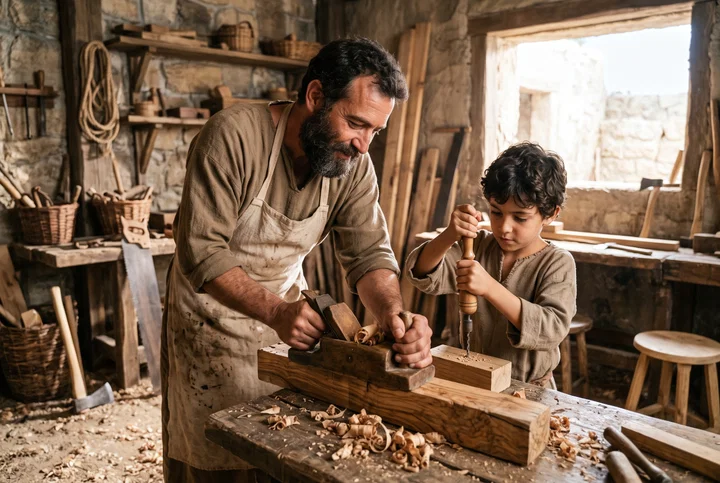
Is not this the carpenter’s son? is not his mother called Mary? and his brethren, James, and Joses, and Simon, and Judas?
Translations
Is not this the carpenter’s son? is not his mother called Mary? and his brothers, James, and Joses, and Simon, and Judas?
King James Version, KJV Cambridge Paragraph Bible
Is not this the carpenter’s son? is not his mother called Mary? and his brethren, James, and Joses, and Simon, and Judas?
Is not this the carpenter's son? is not his mother called Mary? and his brethren, James, and Joses, and Simon, and Judas?
Revised Version, American Standard Version
Is not this the carpenter’s son? is not his mother called Mary? and his brethren, James, and Joseph, and Simon, and Judas?
is not this the carpenter's son? is not his mother called Mary, and his brethren James, and Joses, and Simon, and Judas?
Is not this the son of the carpenter? Is not his mother called Mary, and his brethren James, and Joseph, and Simon, and Judas?
Is not, this one, the carpenter’s, son? Is not, his mother, called Mary, and are not his brethren—James and Joseph, and Simon, and Judas?
“Isn’ t this the carpenter’s son? Isn’ t His mother’s name Mary, and aren’ t His brothers James, Joseph, Simon, and Judas?
“Isn’ t this the carpenter’s son? Isn’ t His mother’s name Mary, and aren’ t His brothers James, Joses, Simon, and Judas?
Isn’ t this the carpenter’s son? Isn’ t his mother called Mary, and his brothers James, Joses, Simon, and Judas?
Is not this the woodworker's son? is not his mother named Mary? and his brothers James and Joseph and Simon and Judas?
Is not this the carpenters sonne? Is not his mother called Marie, and his brethren Iames and Ioses, and Simon and Iudas?
Douay-Rheims (Challoner revision)
Is not this the carpenter’s son? Is not his mother called Mary, and his brethren James, and Joseph, and Simon, and Jude:
Pictures
Cross-references 20 of 25
- Mark 6:3
Is not this the carpenter, the son of Mary, the brother of James, and Joses, and of Juda, and Simon? and are not his sisters here with us? And they were offended at him.
Names Jesus’ brothers and identifies him as a carpenter.
- John 7:5
For neither did his brethren believe in him.
Jesus’ brothers did not believe in him.
- Luke 2:51
And he went down with them, and came to Nazareth, and was subject unto them: but his mother kept all these sayings in her heart.
Jesus returned to Nazareth and was subject to his parents.
- Luke 4:22
And all bare him witness, and wondered at the gracious words which proceeded out of his mouth. And they said, Is not this Joseph’s son?
Both record familiarity with Jesus’ family prompting questions about his identity.
- Luke 8:19-20
Then came to him his mother and his brethren, and could not come at him for the press.
Records Jesus’ mother and brothers seeking him.
- Matthew 12:46
While he yet talked to the people, behold, his mother and his brethren stood without, desiring to speak with him.
Both texts mention Jesus’ mother and brethren.
- John 19:25
Now there stood by the cross of Jesus his mother, and his mother’s sister, Mary the wife of Cleophas, and Mary Magdalene.
Its list distinguishes Jesus’ mother from Mary, the wife of Cleophas.
- Luke 4:16-17
And he came to Nazareth, where he had been brought up: and, as his custom was, he went into the synagogue on the sabbath day, and stood up for to read.
The Sabbath synagogue visit in Nazareth prompted the question about Jesus’ family.
- Galatians 1:19
But other of the apostles saw I none, save James the Lord’s brother.
calls James the Lord's brother
- Mark 3:31
There came then his brethren and his mother, and, standing without, sent unto him, calling him.
Also describes Jesus’ mother and brothers coming to him.
- John 6:42
And they said, Is not this Jesus, the son of Joseph, whose father and mother we know? how is it then that he saith, I came down from heaven?
People who knew Jesus’ family questioned his claim to come from heaven.
- John 2:12
After this he went down to Capernaum, he, and his mother, and his brethren, and his disciples: and they continued there not many days.
also refers to his mother and brethren
- John 7:3
His brethren therefore said unto him, Depart hence, and go into Judæa, that thy disciples also may see the works that thou doest.
Referenced with Matthew 13:55 in the question about Jesus’ mother and brethren.
- Matthew 27:56
Among which was Mary Magdalene, and Mary the mother of James and Joses, and the mother of Zebedee’s children.
Both texts name James and Joses as members of Jesus’ family.
- Mark 15:40
There were also women looking on afar off: among whom was Mary Magdalene, and Mary the mother of James the less and of Joses, and Salome;
Both texts name Mary the mother of James and Joses.
- Matthew 12:47
Then one said unto him, Behold, thy mother and thy brethren stand without, desiring to speak with thee.
Reports that Jesus’ mother and brothers are asking for him.
- Mark 16:1
And when the sabbath was past, Mary Magdalene, and Mary the mother of James, and Salome, had bought sweet spices, that they might come and anoint him.
It is cited in the question about the identity of James and Joses’ mother.
- John 1:46
And Nathanael said unto him, Can there any good thing come out of Nazareth? Philip saith unto him, Come and see.
Both texts question Jesus’ worth or identity because of his origins.
- Matthew 12:50
For who soever shall do the will of my Father which is in heaven, the same is my brother, and sister, and mother.
Extends brotherhood with Jesus to those who do God’s will.
- Luke 2:19
But Mary kept all these things, and pondered them in her heart.
Mary treasures and ponders things concerning Jesus.
Commentary
Each commentary is drawn from primary sources: the writings of Ellen G. White and Adventist pioneers and periodicals. Each commentary is separate. Its own words are not a quotation; follow the references to read the source passages.
Ellen G. White
23 sources
The question was asked in unbelief when Jesus came back to teach in the synagogue of His own town, as the people were astonished at His wisdom and mighty works.Ms 133, 1902, par. 1–10DA 236.1–2 They had known Him from childhood as the son of a carpenter of an obscure family, knew His mother was called Mary, knew His brothers James and Joses and Simon and Judas, and knew His sisters lived among them.Ms 53, 1898, par. 12–13Ms 133, 1902, par. 1–10DA 236.1–2 They stumbled at His humble, unpretending life among the poor and lowly, working for years at a trade with no earthly rank or power, because they expected the Messiah to come with power and kingly splendor.LC1 55.14RED 5.1–2DA 162.1–4 For the greater part of His earthly life He labored with His hands at the carpenter's trade with Joseph in Nazareth, sharing ordinary family duties and helping provide the daily bread.Ms 53, 1898, par. 12–13LC1 55.1COL 345.2CE 164.1–2FE 151.1–2 By precept and example He thereby dignified useful labor and made honest work honorable, showing that faithful service to God includes diligent industry in ordinary tasks.COL 345.2ST Oct 9, 1884RP 26.5–6
Nazareth's Familiarity and Rejection
The question was asked in unbelief when Jesus came back to teach in the synagogue of His childhood home early in His Galilean ministry, while those who heard Him were amazed at His wisdom and mighty works.Ms 133, 1902, par. 1–10DA 236.1–2 They knew Him from childhood as the carpenter's son of an obscure family, knew His mother as Mary and His brothers as James and Joses and Simon and Judas, with His sisters living among them.Ms 53, 1898, par. 12–13Ms 133, 1902, par. 1–10DA 236.1–2DA 162.1–4Lt 8, 1894, par. 12–13 They knew He had never attended school and had not been taught by the wise men, yet His wisdom did not depend on formal education or worldly advantage but came through Joseph and Mary, the Old Testament Scriptures, synagogue worship, temple festivals, nature, communion with God, and access to the tree of life.Ms 53, 1898, par. 12–13Ms 133, 1902, par. 1–10DA 86.2 His brothers named here were the sons of Joseph, who sided with the rabbis and insisted that human traditions be followed as if they were God's requirements above God's word, who resented His ability to distinguish truth from error and condemned His strict obedience to God's law as stubbornness.DA 86.2
Joseph worked as a carpenter and Mary, His mother, was his dignified wife, a Jewish woman of mature dignity.Lt 140, 1896, par. 3–6 They stumbled over His humble, unpretending life among the poor and lowly, working for years at the trade with His father with no earthly rank or power and making no claim to distinction or greatness.LC1 55.14RED 5.1–2DA 162.1–4Lt 8, 1894, par. 12–13 This was because they expected the Messiah to come with power, honor, glory and kingly splendor and to establish David's throne by force, so one so common and familiar could not in their reasoning be the Redeemer of Israel and the Son of God.LC1 55.14RED 5.1–2Ms 14, 1897, par. 6 Though first moved by His authority, dignity, wisdom, gracious words, miracles and divine power, they listened to suggestions of doubt and, blinded by Satan, prejudice, pride and their earlier rejection, refused to receive Him as Messiah and Redeemer.LC1 55.1LC1 57.2
Their question came from jealous curiosity because they had heard of His miracles elsewhere and were offended He had done no miracle in their city, demanding why He did not heal the afflicted in Nazareth as He had done in Capernaum.Ms 133, 1902, par. 1–10 Jewish leaders and others used His being a carpenter's son to question how He could know more than priests and rulers and to resist His teaching.RH Apr 2, 1901DA 162.1–4 So familiarity obscured His true identity as the Son of God, just as the world failed to recognize His humble, poor and unlearned disciples, yet He spoke with a kingly authority they could not resist.DA 162.1–4Lt 8, 1894, par. 12–13Ms 14, 1897, par. 6
Humble Labor and Example
The carpenter's son grew up in poverty as the child of poor and lowly parents whose table held few luxuries.Ms 53, 1898, par. 12–13CE 164.1–2FE 151.1–2 He chose a humble home among the poor and lived a life of self-denial, privation and diligent industry, dependent with His parents on daily toil for food rather than allotted affluence and indolence.Ms 53, 1898, par. 12–13ST Nov 12, 1885MYP 78.3
For years He worked at the carpenter's trade with Joseph in the shop at Nazareth, laboring with His hands for wages.LC1 55.1ST Oct 9, 1884RP 26.5–6 From His earliest years He lived a life of toil, spending the greater part of His earthly life in patient work without using His divine power to lighten His labor.Ms 53, 1898, par. 12–13COL 345.2ST Oct 9, 1884MYP 214.3–215.1 By that work He took part in ordinary family duties and shared in supporting His family, helping to provide His daily bread.CE 164.1–2FE 151.1–2RP 26.5–6ST Nov 12, 1885Ms 73, 1895, par. 6
He came to build character, and He brought to ordinary labor the same perfection He brings to the characters He transforms by divine power.COL 345.2 Though the Majesty of heaven, He did even a lowly task with the utmost exactitude, and His work was perfect.COL 345.26MR 321.4–322.1
By precept and example He dignified useful labor and made honest work honorable rather than degrading.ST Oct 9, 1884RP 26.5–6MYP 214.3–215.1ST Nov 12, 1885 Faithful service to God includes ordinary labor, physical strength is to be used in practical service to God, people are to be industrious, honest labor is consistent with Christian service, and idleness is not.ST Oct 9, 1884RP 26.5–6ST Nov 12, 1885ST Oct 18, 1899 He is thus a pattern for faithful work.COL 345.2
The Lord of life walked the streets of the little town in the garb of a common laborer, going to and returning from His humble toil side by side with peasants and laborers.MYP 214.3–215.1 Though attended by ministering angels as He walked, He was unrecognized and unhonored.MYP 214.3–215.1 The hard and wearisome path of toil appointed to dwellers on earth is honored by the footprints of the Redeemer, and he is safe who follows in this sacred way.COL 345.2MYP 214.3–215.1
He lived in retirement from corrupting society, keeping His hands employed in useful work and keeping aloof from temptation rather than inviting it.MYP 78.3 He thus walked the most uneven path that children and youth will ever be called to travel.MYP 78.3 His example shows that common work is not degrading and that teaching young people useful trades is part of a good education, giving their energy a useful outlet.MYP 78.3Ms 73, 1895, par. 6
His example at the carpenter's bench requires plain buildings that correspond to the truth proclaimed, with not one dollar invested in needless display or in gratifying desire for display in one place.6MR 321.4–322.1 Actions are thereby made to speak louder than words, bearing witness that means are kept for the great unworked missionary field and for establishing the truth in many places.6MR 321.4–322.1
Sources
Pioneers and periodicals
51 sources
The verse plainly names Mary as the mother of Jesus and James, Joses, Simon and Judas as his brothers, with sisters also living among the people, showing he grew up as one child in a large well-known family, to be taken exactly as written.ST Feb 25, 1897ST Jun 20, 1911ST Dec 16, 1908ST May 22, 1907 The brothers were the older sons of Joseph by a former marriage, so that Mary was Joseph's second wife and Jesus alone was her son, though those who held otherwise taught that Mary was married and had other sons besides Jesus.ST Jun 20, 1911ST Jan 25, 1910 Knowing his humble home and outward circumstances, his own townspeople could not look beyond his familiar boyhood to recognize him as prophet and Son of God, and being offended in him they rejected him, so their unbelief shut out the truth and blessings he would have given.ST Oct 23, 1901ST Apr 8, 1889ST Apr 22, 1889RH Nov 8, 1906RH Dec 17, 1901 That despising of a workman's son fulfilled prophecy that Messiah would be despised and rejected, yet the King came in that humble familiar guise to visit his people in their needs, sorrows and temptations.RH Sep 9, 1902ST Jun 9, 1890RH Apr 21, 1863RH Dec 3, 1867 Jesus himself was a carpenter and a carpenter's son, apprenticed to Joseph, sharing family burdens and working for wages without using divine power to lighten it, thereby showing honest useful labor is honorable and not degrading and dignifying all honest work.ST Oct 9, 1884ST Nov 12, 1885ST Mar 29, 1883RH Jan 16, 1913ST Sep 20, 1883
Chapter Context and Setting
Matthew 13 belongs to teaching about the Christian dispensation, not the Jewish.RH Aug 20, 1872 The kingdom of Heaven there means the arrangement put in operation for the salvation of men, also called the kingdom of grace, which has passed through patriarchal, Jewish, and Christian stages.RH Aug 20, 1872 The kingdom of God was taken from the Jews on their rejection as the especial people of God and given to a nation bringing forth the fruits thereof, fulfilled in giving the gospel to the Gentiles, with the vineyard now in the hands of other husbandmen.RH Aug 20, 1872 The work in their hands is the kingdom just as much as it was in the hands of the Jews, and its work is still in progress, and to this continuing work the parables of the sower, the wheat and tares, the mustard seed, the leaven, and the net of fish apply.RH Aug 20, 1872
The parables of the chapter teach that the word of the kingdom does not bear fruit in everyone who hears it, for human response remains mixed rather than becoming universally receptive.RH Jun 13, 1854 The chapter gives the parallel account to Luke 8:4-15 of speaking to a great multitude in parables on the shore of the Sea of Galilee near Capernaum.ST Nov 26, 1894 It stands as part of a group of eight parables, seven in Matthew and one other in Mark, concerning the kingdom of heaven in various aspects.ST Nov 26, 1894 They mark a stronger enforcement of the truths of his kingdom after earlier simple declaration as in the sermon on the mount.ST Nov 26, 1894
The teaching belongs to long hours of labor with the multitude around the sea that left him weary.ST Jul 19, 1905 After that labor he told his disciples to cross the little sea to the other side.ST Jul 19, 1905
In his own country he taught in their synagogue, and the townspeople who knew his family were astonished at his evident wisdom and mighty works.RH Nov 18, 1862GSAM 64.1–2 They questioned where his wisdom and works came from because they knew his humble family, so that the question expresses amazement at his words and works.RH Nov 18, 1862GSAM 64.1–2 That amazement was joined to the amazed confession of him as the son of David meaning the seed of David the promised Saviour.GSAM 64.1–2 Yet Jews and disciples still struggled to see beyond a Messiah who would break the Roman yoke and restore the kingdom of David as a temporal king.GSAM 64.1–2
Mother and Brothers Named
The naming is specific: his mother is called Mary, his brothers are James and Joses and Simon and Judas, and his sisters are noted as living among the people, so he is seen growing up as one child in a large household with a known mother and many brothers and sisters.ST Jun 20, 1911ST Dec 16, 1908ST May 22, 1907ST Feb 18, 1886RH Jun 19, 1900 The word brothers can be used broadly for members of the same family or household and not only for sons of the same mother, yet Jesus alone in this naming is designated as Mary's son.ST Jun 20, 1911 The statement that he had literal brothers and also sisters is plain and is to be taken exactly as written.ST Feb 25, 1897
The brothers were older sons of Joseph by a former marriage and in law his half-brothers, so that Mary was Joseph's second wife.ST Jun 20, 1911ST Jan 25, 1910ST Jun 3, 1913 They are called sons of Joseph. Even if the brethren were sons of Joseph by a former marriage, they are still rightly reckoned as his brothers.ST Feb 25, 1897
The naming does not establish that James and Joses were Mary's sons, at most her stepsons, since the Mary named as their mother is identified as the wife of Cleophas.ST Feb 14, 1911 Those who held that Mary was married and had other sons besides Jesus Christ drew it from this naming. The naming of Judas among the brothers supports the possibility that Jude was the Judas who was one of the Lord's brothers.ST Dec 16, 1908
The brothers sided with the rabbis and insisted on the priests' traditions, and they were annoyed by his ability to distinguish truth from error. They condemned his strict obedience to God's law as stubbornness, though they recognized his unusual wisdom despite his lack of instruction from the learned without recognizing its source in the tree of life. He was known as the carpenter's son in a humble household where Joseph stood as foster father, and his lowly circumstances exposed him to malicious scorn, but his mother treasured his words and pondered his destiny while grieving as she watched it unfold.RH Dec 15, 1859
Offense Through Familiarity
The people knew him by earthly family and familiar standing, calling him the carpenter's son, naming Mary his mother and his brothers by name, and noting that his sisters were living among them.ST Oct 23, 1901ST Apr 22, 1889 Having watched him grow up and knowing his outward circumstances, they mistook that familiarity with his life for knowledge of who he was.ST Apr 22, 1889 They could not look beyond his humble home and boyhood to recognize him as prophet and Son of God, seeing him only as a man.ST Apr 22, 1889RH Nov 8, 1906RH Dec 17, 1901
Fixing on outward circumstances they could not reconcile with his wisdom and mighty works, they were offended in him and rejected the truth he taught.ST Oct 23, 1901RH Nov 8, 1906 At Nazareth that unbelief took the form of proud, perverted fanaticism.ST Aug 4, 1881 Their question carried the thought that one known since childhood could have nothing to teach them.ST Apr 8, 1889 Envy, jealousy, and other evil passions displaced their first response, and familiarity became prideful doubt that kept them from recognizing and coming to the Savior they longed for.ST Apr 8, 1889
Aroused to jealousy because a man of humble birth worked wonders they could not explain away and taught truths they could not contradict, they spoke scornfully of his life as a Galilean laborer and uneducated carpenter and of his family as poor and lowly.ST Oct 1, 1896 Having no official standing, he offended those who judged authority by a teacher's position rather than by the truth and righteousness of what was taught, and they declared his lofty claims should at once be repudiated.ST Oct 1, 1896 On that ground they questioned whether he could know more than the priests and rulers and resisted his teaching, though the heart must be enlightened by the Spirit of God before it can feel its need of a Saviour.RH Apr 2, 1901ST Oct 1, 1896 Because they saw him merely as the carpenter's son whose family they knew, they failed to receive him as Messiah and Savior.ST Apr 8, 1889RH Dec 17, 1901 Their unbelief shut out the truth and kept them from blessings he could have given.ST Apr 8, 1889 That rejection was rooted in prejudice and a carnal understanding that favored a powerful, honored deliverer over the suffering, despised Messiah revealed in prophecy.RH Dec 27, 1853
Prophecy and True Identity
The question about the carpenter's son with his mother and brothers and sisters living among the people shows the fulfillment of the prophecy that Messiah would be despised and rejected, looked down on for his lowly and familiar family while his wisdom was questioned and offense was taken at him.RH Sep 9, 1902 The King came in that humble guise of a carpenter's son to visit his people and help them in their needs, sorrows, and temptations.ST Jun 9, 1890 That humble, familiar identity underscores the contrast between him and the world that opposed him, for though Jewish leaders and rulers disapproved of his course and he was left without a friend willing to come near at the cross, he was right.RH Apr 21, 1863
He was born as a babe in an obscure and lonely village of a remote and despised province of the Roman empire, whose reputed parents were poor Jewish peasants, without culture, without social position, without political power.RH Dec 3, 1867 Despite that lowly origin he uttered words that have ever since moulded the lives of the greatest, the most powerful, the best, the wisest, and the vilest of the most enlightened continents.RH Dec 3, 1867 History since his death has been a mere record of struggles either to assist or resist his dominion, and though he left no written word the human race has bowed before the reports of his sayings by the waysides of Galilee and the deserts of Judea to a group of fishermen and crowds of the despised of the earth.RH Dec 3, 1867 That contrast answers who this man is who can do these wonderful things and proves him to be the Christ, the Son of the living God.RH Dec 3, 1867
His familiar appearance gave his neighbors, who knew him through his family as the carpenter's son and named his mother and brothers, no reason by itself to recognize him as the Son of God, and their doubts about who he was led them to question his words and take offense at him.RH Nov 8, 1906 That same familiar, ordinary appearance could lead people to think of him and Scripture as merely human, though he is the Word who came in human flesh.RH Sep 28, 1905 Though he had lived among them in loving ministry and seemed an ordinary man from Nazareth whose earthly brothers were known, he persistently declared himself the Son of God, and for this claim he was condemned to death as a blasphemer.
That he was known as the carpenter's son means Joseph's occupation was a carpenter, and that his mother was called Mary, and these family facts belong with the star of the East, the Magi, the child in the stable, the virgin birth, the flight into Egypt, the baptism, the transfiguration, the Last Supper, the number of the twelve apostles, and the titles and symbols of Christ as the principal events and details connected with his life.RH Jan 18, 1912 He is identified as the carpenter's son and his mother is named as Mary and his brothers as James, Joses, Simon, and Judas, and the carpenter's trade is associated with the familiar tools of hammer, saw, plane, and wood, which picture the same materials that later formed the cross on which he was crucified.RH Sep 7, 1916 The cross was not truly made or driven by wood, hammer, and nails, but by human hatred and sin, while his love held him there.RH Sep 7, 1916
Carpenter Home and Labor
Joseph, called his foster father, was a carpenter by trade, and the family home stood in Nazareth at his humble bench, where the simple workingman led Jesus as a child among working people.ST Jul 27, 1882RH Dec 15, 1859ST Mar 24, 1881ST Mar 8, 1910RH Jan 18, 1912 To be known as the carpenter's son means Joseph's occupation was that of a carpenter and Mary was his mother, facts that stand among the principal events and details of his life.ST Mar 24, 1881ST Mar 8, 1910RH Jan 18, 1912 Jesus himself was both a carpenter and a carpenter's son, apprenticed to the trade and helping his father in the shop at home in Nazareth.ST Mar 29, 1883RH Jan 16, 1913ST Dec 14, 1904ST May 12, 1914 While growing up he shared the family's duties and burdens and obeyed his parents until his heavenly Father's time for ministry began, and he probably worked at the trade before his public ministry.ST Sep 20, 1883ST May 12, 1914RH Feb 24, 1910
He treated the work as real labor and not play, working for wages and not disdaining the laborer's hire.ST Oct 9, 1884ST Jul 27, 1882 He did not use his divine power to lighten his labor at the humble trade in Nazareth.ST Oct 9, 1884ST Jul 27, 1882 He followed Joseph's trade at Nazareth for at least fifteen years, fashioning wood with common tools.ST Jan 17, 1900 He took care that no finishing touch of perfection was lacking, casting away a day's labor if faulty, carrying finished work to houses, asking for his wage to relieve Mary's care, and leaving without it to come back another day.ST Jan 17, 1900 His not studying in the schools of the rabbis at Jerusalem was no loss but cause for thankfulness, because instead he worked with his hands.ST Jan 17, 1900
He grew up in a poor working family in an ordinary humble home rather than a privileged or scholarly one.RH Nov 5, 1872RH Feb 7, 1907ST Feb 8, 1905 His brothers and sisters were not people of distinction, and his humble background stands in contrast to the wealth and fashion prized by the worldly.RH Nov 5, 1872RH Feb 7, 1907ST Feb 8, 1905 His daily work at the bench beside his earthly father displayed devotion and integrity, without sacrifice of principle, loyal to his heavenly Father and honoring his earthly parents.ST Nov 14, 1906 That faithfulness included sharing the household burdens and a care for his mother shown even in his suffering.ST Nov 14, 1906RH Feb 24, 1910
Honor and Example of Work
The son of a carpenter worked at a humble trade for wages without using divine power to lighten his labor, choosing a humble home among the poor and working for his daily bread in Joseph's carpenter shop.ST Oct 9, 1884ST Nov 12, 1885 He followed Joseph's trade at Nazareth for at least fifteen years, fashioning wood with common tools, taking care that no finishing touch of perfection was lacking and casting away a day's labor if faulty, carrying finished work to houses, asking for his wage to relieve Mary's care and leaving without it to come back another day.ST Jan 17, 1900 His not studying in the schools of the rabbis at Jerusalem was no loss but cause for thankfulness, because instead he worked with his hands.ST Jan 17, 1900 That life at the bench and in Joseph's shop shows honest useful labor is honorable and not degrading, and his manual labor set a wholesome example for all his disciples, making him one with all generations who toil and sweat and dignifying and sanctifying honest work of every kind from that of the hand laborer to that of the poet.ST Oct 9, 1884ST Nov 12, 1885ST Jan 17, 1900
With tools at Joseph's humble bench in Nazareth he treated the work as real labor and not play, and did not disdain the laborer's hire.ST Jul 27, 1882 Humble ordinary work done in obedience to the Father can be done faithfully and well, and work done for him receives his blessing.RH Mar 27, 1900ST Jul 27, 1882 He grew up in a poor working family whose brothers and sisters were not people of distinction, and the people of his own country used that humble family and ordinary background to question his wisdom and works and were offended in him.RH Nov 5, 1872 His life of poverty and labor in this way shared the hardships of working people, and as the gentle, meek and lowly Nazarene his example and spirit are the influence that can overcome conflict between labor and capital.RH Nov 5, 1872ST Jan 17, 1900
Joseph's example of working steadily at his bench with Jesus helping him shows skilled manual labor is honorable and compatible with Christian faith and contentment.ST Mar 29, 1883 Christ worked at the carpenter's trade with Joseph, giving an example of using physical strength in practical service to God, so that faithful service to God includes ordinary labor and honest labor is consistent with Christian service while idleness is not.ST Oct 9, 1884ST Oct 18, 1899 Coming from an ordinary humble home rather than a privileged or scholarly background, his lowly circumstances make him an example that an ideal life does not depend on outward conditions or opportunities.RH Feb 7, 1907
He himself was apprenticed to a carpenter, showing that manual work carries abundant blessings.RH Jan 16, 1913 His practical trade with Joseph shows useful work at home can prepare children for service elsewhere.RH Nov 11, 1915 That humble working trade gives approval and encouragement for missionaries to earn their living by manual labor such as carpentry while carrying the gospel, following his example in also choosing fishermen to preach the gospel, and it commends the industrial feature in mission schools.RH Jan 16, 1913RH Nov 11, 1915ST Dec 14, 1904
Sources