Matthew 26:60
But found none: yea, though many false witnesses came, yet found they none. At the last came two false witnesses,
Translations
But found none: yes, though many false witnesses came, yet found they none. At the last came two false witnesses,
But found none: yea, though many false witnesses came, yet found they none. At the last came two false witnesses,
but found none: yea, though many false witnesses came, yet found they none. At the last came two false witnesses,
But found none: and, though many false witnesses came, yet found they none. At the last came two false witnesses,
Revised Version, American Standard Version
and they found it not, though many false witnesses came. But afterward came two,
and they did not find; and many false witnesses having come near, they did not find; and at last two false witnesses having come near,
And they found none, though many false witnesses came forward. But at the last two false witnesses came forward
and found not any, though many came forward as false-witnesses. At length, however, there came forward, two,
But they did not find any, though many false witnesses came forward.Finally two came forward
But they did not find any. Even though many false witnesses came forward, they found none. Finally two false witnesses came forward
and they found none. Even though many false witnesses came forward, they found none. But at last two false witnesses came forward
And they were not able to get it, though a number of false witnesses came.
But they founde none, and though many false witnesses came, yet founde they none: but at the last came two false witnesses,
Douay-Rheims (Challoner revision)
And they found not, whereas many false witnesses had come in. And last of all there came two false witnesses:
Pictures
Cross-references 20 of 23
- Mark 14:55-59
And the chief priests and all the council sought for witness against Jesus to put him to death; and found none.
The council seeks testimony against Jesus, but the witnesses give conflicting testimony.
- John 18:19-23
The high priest then asked Jesus of his disciples, and of his doctrine.
Jesus answers questioning about his teaching and challenges an unjust blow.
- John 18:38
Pilate saith unto him, What is truth? And when he had said this, he went out again unto the Jews, and saith unto them, I find in him no fault at all.
Pilate declares Jesus free of fault after examining him.
- Acts 6:11-14
Then they suborned men, which said, We have heard him speak blasphemous words against Moses, and against God.
Stephen, like Christ, faced suborned false testimony at trial.
- Luke 22:54-71
Then took they him, and led him, and brought him into the high priest’s house. And Peter followed afar off.
Another account of Jesus’ arrest and hearing before the council.
- Matthew 27:1
When the morning was come, all the chief priests and elders of the people took counsel against Jesus to put him to death:
Continues the account of Jesus’ trial with the council’s next action.
- Deuteronomy 19:15
One witness shall not rise up against a man for any iniquity, or for any sin, in any sin that he sinneth: at the mouth of two witnesses, or at the mouth of three witnesses, shall the matter be established.
Both require two witnesses to establish a charge.
- Luke 22:66-71
And as soon as it was day, the elders of the people and the chief priests and the scribes came together, and led him into their council, saying,
The council examines Jesus and condemns him after hearing his claim.
- Acts 6:13
And set up false witnesses, which said, This man ceaseth not to speak blasphemous words against this holy place, and the law:
Stephen was opposed through false witnesses.
- Psalms 35:11
False witnesses did rise up; they laid to my charge things that I knew not.
False witnesses accuse the speaker, foreshadowing the false witnesses against Jesus.
- Mark 15:3-5
And the chief priests accused him of many things: but he answered nothing.
Jesus remains silent amid accusations during his trial.
- Exodus 20:16
Thou shalt not bear false witness against thy neighbour.
False testimony violates the commandment against bearing false witness.
- Matthew 26:65-66
Then the high priest rent his clothes, saying, He hath spoken blasphemy; what further need have we of witnesses? behold, now ye have heard his blasphemy.
blasphemy verdict follows testimony
- Daniel 6:4
Then the presidents and princes sought to find occasion against Daniel concerning the kingdom; but they could find none occasion nor fault; forasmuch as he was faithful, neither was there any error or fault found in him.
Both accounts describe opponents finding no real fault.
- John 2:19
Jesus answered and said unto them, Destroy this temple, and in three days I will raise it up.
Jesus’ words about the temple were misrepresented as testimony against him.
- Matthew 27:12-14
And when he was accused of the chief priests and elders, he answered nothing.
Jesus faces accusations but does not answer them.
- Matthew 18:16
But if he will not hear thee, then take with thee one or two more, that in the mouth of two or three witnesses every word may be established.
Sets the two-witness standard for confirming a matter.
- Isaiah 53:7
He was oppressed, and he was afflicted, yet he opened not his mouth: he is brought as a lamb to the slaughter, and as a sheep before her shearers is dumb, so he openeth not his mouth.
Jesus’ silence at his trial fulfills the prophecy of the suffering servant.
- Matthew 27:39-40
And they that passed by reviled him, wagging their heads,
Passersby repeated the false temple charge at the cross.
- Luke 23:4
Then said Pilate to the chief priests and to the people, I find no fault in this man.
Pilate declares that he finds no charge against Jesus.
Commentary
Each commentary is drawn from primary sources: the writings of Ellen G. White and Adventist pioneers and periodicals. Each commentary is separate. Its own words are not a quotation; follow the references to read the source passages.
Ellen G. White
29 sources
He was on trial before Caiaphas and the chief priests and council, pressed for evidence to condemn Him to death.Ms 29, 1909, par. 2–4DA 698ST Jun 13, 1878 Many hired witnesses swore lies under oath against Him, but their contradictory accounts gave no usable charge and condemned their own unlawful proceeding.Ms 29, 1909, par. 2–4DA 698.1–700.55RED 35.3–36.2 At last two came forward whose testimony seemed less contradictory, charging Him with His words about the temple distorted and turned against Him.Ms 45, 1897, par. 1–2Ms 29, 1909, par. 2–45RED 35.3–36.2 Their failure to find anything proves He was innocent and without sin, suffering for His righteousness while His words and motives were twisted to make Him appear in the worst light.SG3 174.2–176.1PP 239.2–4Lt 50, 1889, par. 6–9 If breaking the Sabbath and the law could have been proved, false testimony would not have been needed to create a pretext for killing Him, for His conduct was in harmony with the Sabbath commandment.ST May 1, 1884ST Nov 12, 1894HSFM 234.3–235.2
Trial Setting and Testimony
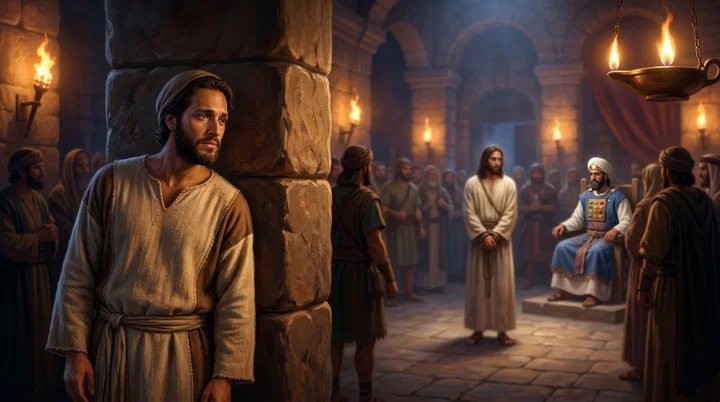
Matthew 26:60 belongs to Jesus pressed for evidence to condemn Him on trial before Annas and the court of Caiaphas, the officiating high priest, before the chief priests and council.Ms 29, 1909, par. 2–4DA 698ST Jun 13, 1878 He was hurried while it was still early morning and very dark to the palace of Caiaphas and into the judgment hall.5RED 27.1 There Caiaphas presided on his throne of judgment, with the judges and those interested in the trial on either side, the Roman soldiers ranged on the platform below the throne, and the multitude watching with wild excitement.3SP 115.3–116.2 The proceeding was held in deliberate secrecy because the Sanhedrin feared that those who knew His mighty works might come forward to testify for Him, condemn the council, prevent His condemnation, and secure His release and renewed honor among the people.5RED 33.1
In that hall Jesus stood at the foot of the throne calm and serene and majestic, with a holy influence emanating from Him, wearing coarse homely garb.3SP 115.3–116.2 His presence stood in strong contrast to the excited and malignant deportment of Annas and Caiaphas, and to Caiaphas robed in gorgeous priestly display with glittering tiara and costly breastplate where the light of God's glory had once flashed, though Jesus had reigned crowned in the courts of heaven in garments of brightness attended by holy angels.3SP 115.3–116.2 Even the hardened multitude questioned whether a man of God-like presence should be sentenced as a common criminal, and Caiaphas perceiving that influence hastened the trial.3SP 115.3–116.2 Caiaphas was struck with admiration for His dignified bearing and convicted that He was akin to God, then banished the thought and in sneering haughty tones demanded that He work a mighty miracle before him, which Jesus heard as though He heard it not.3SP 115.3–116.2 While His persecutors coarsely accused Him, the priest sneeringly questioned Him, and the whole assembly reviled Him so that the proceeding was a mockery of an examination, a keener pang than His enemies could inflict pierced the Saviour's heart when He heard His beloved disciple deny Him with cursing and swearing.5RED 27.1
Many false witnesses were brought and hired to swear to lies under oath, yet their contradictory accounts failed to provide usable evidence or establish a charge.Ms 29, 1909, par. 2–45RED 35.3–36.2ST Jun 13, 1878SG3 174.2–176.1RH Jun 12, 1900 The attempted trial therefore relied on perjury because the accusers could not obtain by fair means what they sought, and their own unlawful procedure stood condemned.DA 698.1–700.5 At last two false witnesses came forward whose testimony seemed less contradictory.Ms 29, 1909, par. 2–4DA 698.1–700.55RED 35.3–36.2ST Jun 13, 1878 This was the only charge brought against Him: His words about the temple misrepresented, distorted and used against Him.Ms 45, 1897, par. 1–2 His enemies later repeated that same distortion as mockery while He hung on the cross.Ms 45, 1897, par. 1–2
Innocence and Sabbath Vindication
The failure to find any charge proves Jesus was innocent, guiltless, without sin and guilty of no wrong, and that He suffered because of His righteousness.SG3 174.2–176.1PP 239.2–4Lt 40, 1890, par. 17 His pure character, teachings, works, and righteous self-denying life rebuked sin yet did not spare Him from reproach.SG3 174.2–176.1PP 239.2–4 His accusers watched Him for grounds to accuse Him, distorted His words and motives, and used false statements to make Him appear in the worst possible light before the people.Lt 50, 1889, par. 6–9Ms 4, 1875, par. 12–14Lt 40, 1890, par. 17
That resort to false witnesses confirms the accusation that He broke the Sabbath and the law could not be substantiated or proved.ST Nov 12, 1894HSFM 234.3–235.2ST Jul 29, 1897ST Sep 16, 1913 His conduct was in harmony with the Sabbath commandment, and He was guiltless.ST Jul 29, 1897ST Sep 16, 1913 If Sabbath-breaking could have been proved, His enemies would not have needed false witnesses to create a pretext for condemning Him to death.ST May 1, 1884ST Nov 12, 1894SLP 213.1ST Jul 29, 1897 They could not prove the charge, so they paid witnesses to lie against Him to carry out their purpose to condemn and crucify Him.Ms 48, 1893, par. 712MR 388.3–4
The same reasoning vindicates Stephen and other Christians who died for their faith and Christ's followers.ST May 1, 1884SLP 213.1 Their exposure to false testimony and the fact that enemies had to seek a pretext rather than condemn them for Sabbath-breaking indicates no Sabbath violation could be charged against them.ST May 1, 1884SLP 213.1 Their careful respect for lesser customs and ceremonies shows that breaking the fourth commandment would have brought the severest penalty.ST May 1, 1884
Like Joseph, Jesus was falsely accused and suffered for righteousness as part of an attempt to condemn Him and prevent Him from ruling and becoming king.ST Feb 5, 18801SP 157.2–158.2PP 239.2–4 His enemies, jealous of His influence and authority and driven by hatred despite the evidence of His miracles and Messiahship, hired witnesses to testify falsely so they could condemn and kill Him.ST Feb 5, 1880GW92 181.3–182.1 God overruled the killing so that His death made Him the Redeemer and ruler and brought about the redemption of the world, without lessening the guilt of those who killed Him.ST Feb 5, 18801SP 157.2–158.2 The priests hiring men to give false testimony under oath so that Jesus would be condemned exposed the corruption of the priesthood.Ms 48, 1893, par. 712MR 388.3–4 Against that perjury stood Christ's own declaration that He was guiltless and the evidence He gave proving His innocence, together with Pilate's declaration that He was without fault and Judas's confession that he had betrayed innocent blood.Ms 48, 1893, par. 712MR 388.3–4
Motives and Present Warning
Despite clear evidence from His miracles and Messiahship, His opponents were driven by hatred to put Him to death, and their rejection of light hardened their consciences until they treated deception as justified in order to condemn and kill Him.GW92 181.3–182.1 Unable to prove the charge that He broke the law, the Pharisees paid witnesses to lie against Him to carry out their fixed purpose of condemning and crucifying the Son of God.Ms 48, 1893, par. 7 This shows how bigotry and prejudice lead people to oppose truth, and how those who reject God's law may bear false witness and oppose those who keep His commandments.GW92 181.3–182.1Lt 40, 1890, par. 17
His enemies watched Him for grounds to accuse Him, distorted His words and motives, and brought many false witnesses against Him, yet no charge was established.Ms 4, 1875, par. 12–14Lt 40, 1890, par. 17 Even His pure character, teachings, and works did not spare Him from reproach and slander, including attacks from people in high places.Ms 55, 1886, par. 8–11 He endured this trial though without sin, even while His own disciples betrayed Him, denied Him, and fled.Lt 40, 1890, par. 17 His experience parallels the unjust treatment His followers endure, who should expect similar false accusations.Ms 4, 1875, par. 12–14Ms 55, 1886, par. 8–11
The same spirit reappears when corrupt men unite to use false witnesses, including people whose wrongdoing has been reproved, and the devil supplies such witnesses.Ms 51, 1897, par. 9 To say that Christ broke the law repeats Satan's suggestion and places the speaker with those Jewish accusers and Pharisees who paid witnesses to lie, even when said by gospel ministers today, and it stands against Christ's own declaration that He was guiltless and the evidence He gave proving His innocence.Ms 48, 1893, par. 7 Likewise ministers do the same thing as the scribes and priests and rulers who falsely accused Christ when they prejudice people by telling them that Seventh-day Adventists do not believe in Christ.Ms 48, 1893, par. 8
Sources
Pioneers and periodicals
48 sources
The council sought false testimony to put Jesus to death, yet though many false witnesses came they found none sufficient until at last two came charging that He claimed power to destroy the temple of God and build it in three days.ST Mar 6, 1901ST Mar 6, 1901RH Oct 27, 1874ST Oct 21, 1930 The witnesses were hired, bribed and instructed to swear lies, but their testimony disagreed and canceled itself out, exposing a mock trial whose death sentence was already determined.ST Feb 5, 1880ST Feb 4, 1897ST Jul 12, 1899ST Jan 19, 1882ST Feb 12, 1902 He was blameless and guiltless with no true fault to be found, and in meek silence like a lamb brought to the slaughter He opened not His mouth.ST Nov 12, 1894ST Nov 19, 1912RH Oct 27, 1874ST Oct 12, 1904 He was at last condemned not on the witnesses but on His own truthful declaration that He was the promised Messiah and the Son of God, which the high priest and council judged blasphemy worthy of death.RH Oct 27, 1874ST Mar 28, 1906ST Dec 1, 1898ST Feb 20, 1901 The failure to find true testimony proves His conduct was in harmony with the Sabbath commandment, for He was condemned for blasphemy and not for Sabbath-breaking, and if He had broken or changed the Sabbath it would have been brought as evidence against Him.ST May 1, 1884ST Nov 12, 1894ST Nov 19, 1912ST Dec 6, 1883RH Jan 21, 1858
Trial Setting And Sequence
The chief priests and the whole council sought false witness against Jesus in order to put Him to death, yet found none sufficient even though many false witnesses came.ST Mar 6, 1901 Their seeking produced nothing, until at last two came charging that He said He was able to destroy the temple of God and to build it in three days.ST Mar 6, 1901ST Mar 6, 1901 This occurred when Jesus was left alone after all the disciples forsook Him and fled, bound with an utterly needless precaution.ST Mar 14, 1906 He was taken first to Annas, the former high priest and father-in-law of Caiaphas who then held the office, because the leaders plotting against Him sought to set aside all jealousy and unite every possible force against Him.ST Mar 14, 1906
He stood as an accused culprit before Caiaphas, who sat as judge as head of the highest court of His own nation and pronounced Him guilty.ST Mar 6, 1901 The hearing was at Caiaphas's house, amid a vindictive assembly that included priests, elders, scribes, Sadducees, and Pharisees.ST Mar 27, 1901ST Mar 6, 1901 The condemnation was not a mere event of a day or incident in the nation's life but an event of world-wide and ages-long import, holding vitally important lessons in the name, the character, the mission, and the end of both Jesus and Caiaphas.ST Mar 6, 1901
The trial sequence brought Him first to Annas, who condemned Him despite having no authority to judge Him and despite the law against condemning a prisoner at night.ST Dec 24, 1912 He was then brought before Caiaphas, who condemned Him for blasphemy but could not enforce a death sentence.ST Dec 24, 1912 Finally Pilate sentenced Him to death, even though he declared that he found no crime in Him.ST Dec 24, 1912 The Jewish leaders sought testimony against Him and false witnesses appeared, but their testimony did not at first provide the accusation they sought, and though the leaders condemned Him and clamored for His crucifixion, the Romans retained the authority to impose and carry out the death sentence, so both Jews and Romans shared responsibility for His death.ST Jun 7, 1877
The verse belongs to the day of betrayal, agony, arrest, and trial before the chief priests and elders.RH Feb 13, 1872 That day is identified as the day of Christ's crucifixion, whose events were more memorable than those of any other day in His history.RH Feb 13, 1872 It was the day on which He showed His love for humanity by giving His life.RH Feb 13, 1872
He was taken from Annas, where Peter denied Him, to Caiaphas the high priest, where hired witnesses gave false testimony against Him.ST Mar 28, 1906 He was seized through betrayal and brought before the high priest's tribunal with His death already determined, and hired false witnesses were brought to testify against Him, but their testimony disagreed and gave no ground for condemnation.ST Mar 28, 1906ST Dec 1, 1898 Two agreeing witnesses were required to condemn Him from something in His past life.ST Dec 1, 1898 At last witnesses came saying they had heard Him say that if the Jerusalem temple were pulled down He could build it up in three days, and others agreed something of that sort had been said, yet even this was not enough to condemn Him.ST Dec 1, 1898 Throughout this false testimony He held His peace and made no attempt to defend Himself, remaining silent until put under oath and required to answer truthfully whether He claimed to be the Son of the Most High.ST Dec 1, 1898
Put under oath He declared Himself the Son of God, for which He was judged guilty of blasphemy and worthy of death.ST Mar 28, 1906 The trial was a great moral crisis and critical moment of the ages in which the rulers of a nation wrote its doom.ST Mar 28, 1906 After the condemnation brutal servants seeking favor with their masters mocked Him, beat Him, spit in His face, blindfolded and struck Him and taunted Him to prophesy who struck Him, and the same spirit has treated His followers the same way in the crises of the centuries that followed.ST Mar 28, 1906
False Testimony And Law
His enemies hired men to swear to lies in order to condemn Him and put Him to death, secretly instructing them in the perjured testimony they were to give and bribing and unlawfully procuring them to that act of wickedness.ST Feb 5, 1880RH Jun 12, 1900ST Feb 4, 1897 To suborn is to bribe or unlawfully procure to wickedness, specifically in law to the giving of false testimony.ST Feb 4, 1897 This hiring of false witnesses is the universal tactic of unprincipled men in defending falsehood.ST Feb 4, 1897
Bearing false witness does not require inventing facts.RH Jun 23, 1868 It includes slander by insinuation even when the general charges agree with the facts, by reporting what was done while leaving out what would show innocence, and by speaking as if it proceeded from malice and conspiracy, though nothing is more contrary to the truth.RH Jun 23, 1868
Many false witnesses came yet could not establish a charge against Him, and only at last did two come forward.ST Jun 13, 1878RH Jun 12, 1900RH Oct 27, 1874RH Apr 14, 1874RH Dec 8, 1859 Their false accusations fulfilled the prophecy that He would be accused by false witnesses.ST Oct 21, 1930 He was ultimately condemned through malice and perjury, the innocent condemned by perjured witnesses.RH Apr 14, 1874RH Dec 8, 1859
The testimony of the many did not agree but contradicted and canceled itself out, failing to establish a case.ST Jul 12, 1899ST Jan 19, 1882ST Dec 1, 1898ST May 27, 1908ST Jul 24, 1879 Such self-contradictory testimony by opponents of the Lord proves they are not speaking truthfully and undermines the case against Him.ST Jul 12, 1899ST May 27, 1908ST Jul 24, 1879 Because their testimony canceled itself out and gave no ground for condemnation, He did not need to answer them.ST Jan 19, 1882ST Dec 1, 1898
Two agreeing witnesses were required to condemn someone to death, and they were sought from something in His past life.ST Jul 14, 1898ST Dec 1, 1898 This was the abuse of legal procedure, where a semblance of lawful testimony could be used to serve evil ends, as was also done against Naboth and Stephen.ST Jul 14, 1898 At last witnesses came saying they had heard Him say that if the Jerusalem temple were pulled down He could build it up in three days, and others agreed something of that sort had been said, yet even this was not enough to condemn Him.ST Dec 1, 1898
His trial was aimed at punishment rather than fair examination, for His death was already determined when He was seized through betrayal.ST Dec 1, 1898RH Oct 27, 1874 It was a mock trial before the Jewish tribunal and council in which men easily induced to swear falsely were hired to give prejudicial false testimony.ST Dec 1, 1898ST Feb 12, 1902ST Feb 19, 1902 That conviction through false witnesses became the pattern copied against Stephen after leaders failed to confuse him by questions and contradictions, hiring men to say they had heard him speak blasphemous words against Moses and against God in order to turn the people against him so elders, scribes and people could seize him and bring him before the Sanhedrin, telling the very same story afterward told against Stephen.ST Feb 12, 1902ST Feb 19, 1902 His rejection there shows how people can condemn someone without testing the charge or the person's claims by Scripture, when the law rightly applied would have acquitted Him.RH Oct 27, 1874RH Oct 27, 1874
The witnesses twisted His warning that the temple would be ruined into a claim that He would destroy it, and the treason charge and the other accusations against Him were false.RH Nov 20, 1900 The accusations of the false witnesses were frivolous and could not ground any condemnation.ST Feb 20, 1901
Innocence And Character Of Christ
Matthew 26:60 shows Jesus to have been blameless and guiltless, with no valid charge or true fault to be found against Him.ST Nov 12, 1894ST Nov 19, 1912RH Oct 27, 1874 A fair application of the law would have acquitted Him, so His accusers had to resort to false testimony to secure His condemnation and death.ST Nov 12, 1894ST Nov 19, 1912RH Oct 27, 1874 The failure to find fault confirms that the charge of Sabbath-breaking was false, for His works of mercy and necessity were lawful and in harmony with Sabbath-keeping.ST Nov 12, 1894ST Nov 19, 1912
When oppressed and afflicted before many false witnesses He opened not His mouth, showing flawless meekness excelling even that of Moses.ST Oct 12, 1904 In that silence He literally fulfilled the prophecy of one brought as a lamb to the slaughter and as a sheep dumb before its shearers.ST Oct 12, 1904 The frivolous accusations that could not ground any condemnation confirm the perfection of His character even by the judgment of His enemies.ST Oct 12, 1904ST Feb 20, 1901 Even the governor who passed sentence of death upon Him could find no fault in Him, yet in His earthly pilgrimage He did not inherit the earth.ST Oct 12, 1904
He truthfully affirmed that He was Israel's promised Messiah and the Son of God, thereby making Himself equal with God and asserting His divinity, which is the very foundation of hope.RH Oct 27, 1874ST Feb 20, 1901 Yet the high priest and council condemned Him as guilty of blasphemy and worthy of death.RH Oct 27, 1874ST Feb 20, 1901 He was rejected without examination of His claims or test of His fulfillment of prophecy, because He had not come as His judges expected.RH Oct 27, 1874 At last He was condemned not on the witnesses' testimony but on that declaration.RH Oct 27, 1874ST Feb 20, 1901
From jealousy of His influence and authority and from envy His enemies kept pursuing Him until they secured a pretext for condemnation.ST Feb 5, 1880ST Oct 12, 1904 That pretext was sustained only by false witnesses hired to testify falsely so they could condemn and kill Him.ST Feb 5, 1880ST Oct 12, 1904 Their attempt to prevent Him from becoming king instead brought about His redemption of the world, but God's providence did not lessen their guilt.ST Feb 5, 1880 The same pattern is seen with Daniel, where conspirators from envy would not give up finding occasion against the object of their envy, and where Daniel's fidelity to truth became the very means by which they decided to catch him concerning the law of his God.ST Oct 12, 1904
Sabbath Vindication And Doctrine
The seeking of false witnesses shows the leaders knew the Roman power would not put a man to death for keeping the Sabbath according to the commandment, though only hours before He had been put to death for that very keeping.ST Oct 3, 1900 The failure to establish any charge by that false testimony proves He did not break the Sabbath, for if Sabbath-breaking could have been proved there would have been no need to bring false witnesses to invent a pretext for condemning Him.ST May 1, 1884 The same proof holds for Stephen and other Christians who died for faith, since their careful regard for even lesser customs and ceremonies shows that violation of the fourth commandment would have drawn the severest penalty upon them.ST May 1, 1884
No valid charge could be found, so false testimony had to be resorted to in order to secure condemnation and death, and that fruitless search for fault confirms the Sabbath-breaking accusation was false.ST Nov 12, 1894ST Nov 19, 1912ST Jul 29, 1897ST Sep 16, 1913 Many witnesses were brought yet no true fault appeared, because His conduct was in harmony with the Sabbath commandment and He stood guiltless.ST Nov 12, 1894ST Nov 19, 1912ST Jul 29, 1897ST Sep 16, 1913 His works of mercy and necessity were lawful and in keeping with Sabbath observance, not transgressions of it.ST Nov 19, 1912 Before the high priest He was condemned for blasphemy and not for Sabbath-breaking, after many false witnesses came whose testimony established nothing until at last two appeared.ST Dec 6, 1883 If He had changed the Sabbath that change would have been produced as evidence against Him, since violation of the Sabbath carried the death penalty.RH Jan 21, 1858
The coming of many false witnesses whose testimony established nothing, until at last two came forward, furnishes the comparison for two witnesses brought to prove Sunday is the seventh day, whose testimony is no more trustworthy than that given at His trial.ST Jun 19, 1879 Their disagreement likewise matches theologians who agree in a claim yet disagree about the evidence for it, so that no consistent case is made.ST Jul 24, 1879
Prophecy Connections And Discipleship
The many lying accusers who could prove nothing against Jesus fulfilled prophecy that false witnesses would rise against Him.ST Oct 21, 1930 His conviction before the Jewish court by such testimony became the model later used against Stephen.ST Jul 14, 1898ST Feb 12, 1902ST Feb 19, 1902 When leaders could not entangle Stephen by questioning and dispute, they paid men easily led to swear falsely that they had heard him speak blasphemy against Moses and against God, a charge calculated to turn the people against him so that elders, scribes and people could seize him and drag him before the Sanhedrin.ST Feb 12, 1902 The very same story told against Christ in a mock trial before the Jewish council was afterward told against Stephen, as it had also been told against Naboth, with two witnesses required to condemn a man to death and a show of lawful testimony made to serve evil ends.ST Jul 14, 1898ST Feb 19, 1902
The same pattern appears with Daniel, whose envious conspirators would not cease seeking occasion against him until they resolved to trap him over the law of his God, just as the enemies of Christ from envy kept pursuing Him until they gained a pretext for condemnation supported only by false witnesses, with his fidelity to truth itself turned into the means of attack.ST Oct 12, 1904 Rejection at trial before the high priest and his counsel shows condemnation without testing charge or claims by Scripture.RH Oct 27, 1874RH Oct 27, 1874RH Oct 27, 1874 Many witnesses came yet established nothing until at last two came forward, and though Jesus truthfully affirmed He was Israel's promised Messiah, the high priest and council judged Him guilty of blasphemy and worthy of death without examining His claims or His fulfillment of prophecy because He had not come as His judges expected, when a fair application of the law and an examination of the Scriptures to which He appealed would have acquitted Him and could have convinced them of His Messiahship, since His trial aimed at punishment rather than fair inquiry.RH Oct 27, 1874RH Oct 27, 1874RH Oct 27, 1874
The judgment-hall trial where false testimony was brought teaches close following of Christ in every circumstance, in the judgment hall and toiling up Calvary no less than on the Mount of Transfiguration and in the triumphal entry, for following afar off leads to denying the Master, and it is better to be with Him in suffering like hell than without Him in blessing like paradise.ST Mar 14, 1906 Hollow words of honor toward Christ can give way to open abuse, and following Him means taking up the cross through suffering and injustice before Caiaphas along the path He trod.RH Dec 29, 1863RH Jul 30, 1867RH Aug 14, 1860 Sin drove His opponents on the night of betrayal and arrest to bear false witness and press forward a mock trial and death sentence despite His innocence.RH Apr 16, 1867 Hiring witnesses to accuse Sabbathkeepers of teaching insubordination repeats that use of false testimony against men on trial, and the same religious condemnation by the Sanhedrin with false witnesses continues in the Vatican, which punishes toleration and condemns dissent as heresy, so that if Christ returned He would receive from the Vatican the same treatment He met from the Sanhedrin.RH Jul 23, 1914RH Dec 13, 1906
Sources