Matthew 27:58
He went to Pilate, and begged the body of Jesus. Then Pilate commanded the body to be delivered.
Translations
American King James Version, King James Version, Webster Bible
He went to Pilate, and begged the body of Jesus. Then Pilate commanded the body to be delivered.
he went to Pilate, and begged the body of Jesus. Then Pilate commanded the body to be delivered.
Revised Version, American Standard Version
this man went to Pilate, and asked for the body of Jesus. Then Pilate commanded it to be given up.
he having gone near to Pilate, asked for himself the body of Jesus; then Pilate commanded the body to be given back.
He, going to Pilate, begged the body of Jesus. Then Pilate commanded the body to be given up.
The same, going unto Pilate, claimed the body of Jesus. Then, Pilate commanded it to be given up.
He went to Pilate to ask for the body of Jesus, and Pilate ordered that it be given to him.
He went to Pilate to ask for the body of Jesus, and Pilate ordered that the body be given to him.
This man went to Pilate and asked for Jesus’ body. Then Pilate commanded the body to be given up.
This man went in to Pilate, and made a request for the body of Jesus. Then Pilate gave orders for it to be given to him.
He went to Pilate, and asked ye body of Iesus. Then Pilate commanded ye body to be deliuered.
Douay-Rheims (Challoner revision)
He went to Pilate, and asked the body of Jesus. Then Pilate commanded that the body should be delivered.
Pictures
Cross-references
- Mark 15:43-46
Joseph of Arimathaea, an honourable counsellor, which also waited for the kingdom of God, came, and went in boldly unto Pilate, and craved the body of Jesus.
Joseph asks Pilate for Jesus’ body, receives it, and lays it in a tomb.
- John 19:38-42
And after this Joseph of Arimathaea, being a disciple of Jesus, but secretly for fear of the Jews, besought Pilate that he might take away the body of Jesus: and Pilate gave him leave. He came therefore, and took the body of Jesus.
Joseph obtains Jesus’ body, and he and Nicodemus prepare and bury it.
- Luke 23:52-53
This man went unto Pilate, and begged the body of Jesus.
Joseph requests Jesus’ body and lays it in a tomb.
- Matthew 28:6
He is not here: for he is risen, as he said. Come, see the place where the Lord lay.
The angel announces that Jesus, whose body was buried, has risen from the dead.
- Isaiah 53:9
And he made his grave with the wicked, and with the rich in his death; because he had done no violence, neither was any deceit in his mouth.
Jesus’ burial in a rich man’s tomb fulfills the prophecy.
- Matthew 27:62-66
Now the next day, that followed the day of the preparation, the chief priests and Pharisees came together unto Pilate,
The priests refer to Jesus’ burial and ask Pilate to secure the tomb.
- Matthew 28:1
In the end of the sabbath, as it began to dawn toward the first day of the week, came Mary Magdalene and the other Mary to see the sepulchre.
The women visit Jesus’ tomb at dawn after the Sabbath ended.
- Mark 15:43
Joseph of Arimathaea, an honourable counsellor, which also waited for the kingdom of God, came, and went in boldly unto Pilate, and craved the body of Jesus.
Both describe Joseph boldly asking Pilate for Jesus’ body.
- Luke 23:55-56
And the women also, which came with him from Galilee, followed after, and beheld the sepulchre, and how his body was laid.
The women witness Jesus’ burial, prepare spices, and rest on the Sabbath.
- Matthew 27:66
So they went, and made the sepulchre sure, sealing the stone, and setting a watch.
The tomb was sealed and guarded after Jesus was buried.
- Matthew 28:2-4
And, behold, there was a great earthquake: for the angel of the Lord descended from heaven, and came and rolled back the stone from the door, and sat upon it.
The angel rolls away the stone, and the guards fall as dead.
- Matthew 28:11-15
Now when they were going, behold, some of the watch came into the city, and shewed unto the chief priests all the things that were done.
The guards and priests spread a false story that Jesus’ disciples stole his body.
- Mark 16:1
And when the sabbath was past, Mary Magdalene, and Mary the mother of James, and Salome, had bought sweet spices, that they might come and anoint him.
Women bring spices to Jesus’ tomb after the Sabbath.
- John 19:38
And after this Joseph of Arimathaea, being a disciple of Jesus, but secretly for fear of the Jews, besought Pilate that he might take away the body of Jesus: and Pilate gave him leave. He came therefore, and took the body of Jesus.
secret discipleship for fear of Jews
- Mark 15:46
And he bought fine linen, and took him down, and wrapped him in the linen, and laid him in a sepulchre which was hewn out of a rock, and rolled a stone unto the door of the sepulchre.
Describes Jesus being taken down and laid in a tomb.
- John 19:42
There laid they Jesus therefore because of the Jews’ preparation day; for the sepulchre was nigh at hand.
Jesus was buried before the Sabbath on the preparation day.
- John 19:31
The Jews therefore, because it was the preparation, that the bodies should not remain upon the cross on the sabbath day, ( for that sabbath day was an high day,) besought Pilate that their legs might be broken, and that they might be taken away.
Both texts place Jesus’ body and its removal on the preparation before the Sabbath.
- John 19:30
When Jesus therefore had received the vinegar, he said, It is finished: and he bowed his head, and gave up the ghost.
finished cry placed just before burial
- Luke 23:46
And when Jesus had cried with a loud voice, he said, Father, into thy hands I commend my spirit: and having said thus, he gave up the ghost.
Jesus committed his life into his Father’s hands on the cross.
- Matthew 27:52-53
And the graves were opened; and many bodies of the saints which slept arose,
Saints came from their graves with Jesus.
Commentary
Each commentary is drawn from primary sources: the writings of Ellen G. White and Adventist pioneers and periodicals. Each commentary is separate. Its own words are not a quotation; follow the references to read the source passages.
Ellen G. White
20 sources
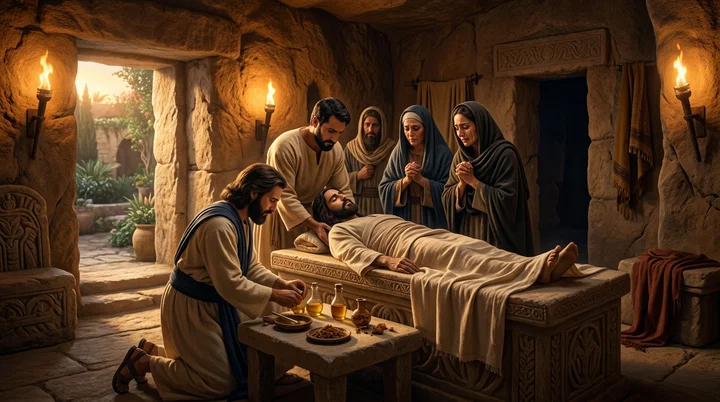
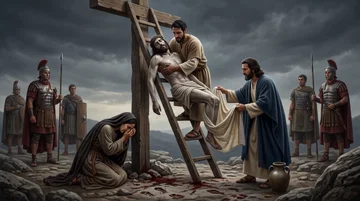
Joseph of Arimathea, a wealthy and honored counsellor of the Sanhedrin and a true though hitherto concealed disciple, went privately yet boldly to Pilate, with whom he was acquainted, to beg the body of Jesus.SG1 64.1EW 148.2ST Aug 1, 1878DA 772.4–773.1 He acted with Nicodemus to secure an honored resting place because Jesus had been executed under charge of treason against Rome and would otherwise have been buried in a dishonored grave for condemned criminals, a favor the poor and powerless disciples who loved Him could not obtain.SG1 64.1ST Aug 1, 1878DA 773.3–4DA 772.4–773.1COS 166.1–2 Pilate did not grant the request at once, for he learned for the first time from Joseph that Jesus was really dead, and having been warned against deception he sent for the centurion at the cross to hear for a certainty that He was dead and to hear the fearful scenes of Calvary, being surprised that He died when the darkness passed away since crucified men often lingered for days.ST Aug 1, 1878DA 773.2ST Aug 1, 1878 Then, believing more firmly that Jesus was innocent and no ordinary man, Pilate commanded the body to be delivered to Joseph, enabling Joseph and Nicodemus to gently take it down and reverently prepare it and lay it in Joseph's own new tomb near Calvary before the Sabbath began.EW 148.2ST Aug 1, 1878COS 166.3–5ST Aug 1, 18783SP 186.3–187.1 The taking down was in renewed sorrow and deep anguish over blighted hopes that Jesus would deliver Israel, yet He came forth from that tomb on the resurrection morning as a triumphant conqueror, restoring their hope.SG1 64.1EW 206.4Ms 80, 1886, par. 3–5Ms 81, 1909, par. 23–24Ms 11, 1893, par. 1
Securing an Honorable Burial
Joseph of Arimathea went privately yet boldly to Pilate to beg the body of Jesus, acting privately because hatred was so great that open action was feared to bring an effort to prevent an honored resting place.SG1 64.1EW 148.2 He was an honorable counsellor and true disciple, a wealthy and honored member of the Sanhedrin acquainted with Pilate.SG1 64.1ST Aug 1, 1878DA 772.4–773.1COS 166.3–5 He acted together with Nicodemus, another influential member of the Sanhedrin who knew Pilate.ST Aug 1, 1878DA 772.4–773.1COS 166.3–5
Joseph and Nicodemus had kept their attachment to Jesus concealed while He lived, but now openly helped Him after His death on behalf of the disciples.DA 773.3–4DA 772.4–773.1 Their wealth and influence helped protect them from the priests and rulers.DA 773.3–4DA 772.4–773.1 The disciples loved Jesus and counted His body very precious, but did not know how to obtain it and could obtain no favors from the Jewish authorities.SG1 64.1DA 772.4–773.1 John with the women from Galilee remained at the cross, and John dreaded the thought of unfeeling soldiers handling the body, yet he had no influence with Pilate to prevent it and the poor disciples could not provide the needed care.DA 773.3–4DA 772.4–773.1COS 166.1–2
Intervention was needed because Jesus had been executed under the alleged charge of treason against Rome, and those put to death for that crime were ordinarily buried in a place reserved for condemned criminals in a dishonored grave.ST Aug 1, 1878DA 772.4–773.1COS 166.1–2 Joseph and Nicodemus were determined to prevent such a dishonored burial and secure honorable treatment.ST Aug 1, 1878DA 772.4–773.1COS 166.1–2 Pilate granted the request and officially commanded the body to be delivered to Joseph, which enabled Joseph to care for and prepare it for burial.EW 148.2ST Aug 1, 1878COS 166.3–5 Joseph and Nicodemus then gently took the body down and reverently prepared it, and Joseph laid it in his own new tomb near Calvary, while Nicodemus made ready for the burial while Joseph was gone to Pilate and the women watched and grieved nearby.5RED 95.2COS 166.3–5
Pilate Verifies Jesus' Death
Pilate did not grant Joseph's request for the body at once, because the priests and rulers had charged him and his officers to guard against any deception the disciples might attempt with the body of their Master.ST Aug 1, 1878DA 773.2 It was from Joseph that Pilate learned for the first time that Jesus was really dead, for knowledge of Christ's death had been purposely kept from him even though conflicting reports about the crucifixion and its strange events had reached him.DA 773.2ST Aug 1, 1878 At Joseph's request Pilate sent for the centurion in command of the soldiers at the cross and heard for a certainty from him that Jesus was dead.ST Aug 1, 1878DA 773.2 At Pilate's earnest request the centurion recounted the fearful scenes of Calvary, and his account corroborated Joseph's testimony.ST Aug 1, 1878DA 773.2
Joseph told Pilate that Jesus died at the very moment the mysterious darkness over the earth passed away.ST Aug 1, 1878 Pilate was surprised at this, because crucified men often lingered for days on the cross.ST Aug 1, 1878 He speedily granted the request because he firmly believed Jesus innocent, and what he heard made him believe more firmly that Jesus was no ordinary man.ST Aug 1, 1878 The testimony left him strangely agitated and keenly regretting his part in condemning Jesus.ST Aug 1, 1878
Grief, Sabbath, and Resurrection
The body was taken down from the cross in renewed sorrow and deep anguish over blighted hopes.SG1 64.1 The disciples had believed Jesus would deliver Israel, so His crucifixion killed their hopes and His burial left them in terrible anguish feeling they had lost their Lord.Ms 80, 1886, par. 3–5 They saw Him treated as a sinner and as a criminal despite being undeserving, and in their grief they felt the loss of a living Saviour whose worth they had not fully appreciated.Ms 80, 1886, par. 3–5Ms 11, 1893, par. 1 The verse belongs to the account of the disciples following Jesus to Calvary, witnessing His death, and laying Him in the tomb.EW 206.4 Their hopes were not fulfilled as they expected, and their grief seemed complete.EW 206.4
The body was placed in Joseph's tomb before the Sabbath began so the disciples could keep the Sabbath according to the commandment.3SP 186.3–187.1 The two Marys remained at the tomb, and the Sabbath was marked by grief for the disciples.3SP 186.3–187.1 The burial took place while the Passover was being observed, after the antitypical Lamb had been slain.3SP 186.3–187.1 While Jesus lay in Joseph's tomb after His execution, the afflicted mourned the loss of the healer they had hoped to see.6RED 9.1–2ST Nov 8, 1883 Those who had come hoping for healing could no longer seek help from Him, so the sick suffered and died without the healing touch they had hoped to receive.6RED 9.1–2
The body laid in Joseph's tomb is connected with the priests' fear that Jesus would rise, because they had witnessed Him raise Lazarus from the dead.6RED 3.1 Jesus rose from the dead and appeared to the disciples, restoring their hope.EW 206.4 Finding the tomb empty amazed them after their anguish over losing their Lord.Ms 80, 1886, par. 3–5 He came forth on the morning of the resurrection as a triumphant conqueror, and a multitude of saints came from their graves with Him to testify to the power of the risen Saviour.Ms 81, 1909, par. 23–24
Sources
Pioneers and periodicals
65 sources
Joseph of Arimathea went to Pilate and begged the body of Jesus, and Pilate commanded it to be handed over to him, enabling him to take Jesus down from the cross and prepare him for burial.ST Aug 1, 1878ST Mar 20, 1901RH Oct 4, 1870 The requester was a rich counsellor and disciple, a wealthy and influential member of the Sanhedrin who knew Pilate, since Jesus had no tomb of his own.ST Aug 1, 1878RH Nov 18, 1862RH Oct 29, 1914 He laid Jesus with honor in his own new unused rock-cut tomb nearby, sparing him the shameful burial of criminals and fulfilling Isaiah 53:9 that he would be with the rich in his death.RH Nov 18, 1862RH Sep 16, 1902ST Jul 4, 1905ST Feb 1, 1899 This was done hastily on Friday evening at eventide as the Sabbath began, with the body placed in the tomb to rest until the resurrection while the followers kept the Sabbath according to the commandment.RH Apr 7, 1868ST Aug 21, 1907ST Jul 7, 1914ST Aug 12, 1880RH Apr 7, 1851 The prison house of death could not hold him, for he rose triumphant as conqueror, and Joseph's bold stand in the darkest hour remains the pattern of fidelity for believers to imitate.RH Oct 29, 1914RH Dec 9, 1858RH Feb 4, 1915RH Jul 1, 1902
Language and Historical Setting
The word rendered as commanding the body to be delivered carries the sense of handing something over.RH Jul 10, 1860 That same word is used for God's promised reward of secret prayer, meaning He returns requests abundantly and makes their answers manifest, sometimes before people and fully before people and angels at the great day.RH Jul 10, 1860 The release of the body at the request of a friend, Joseph of Arimathea, was in keeping with the law or custom by which Roman governors allowed the bodies of criminals who were not infamous to be buried.RH Feb 11, 1862
The verse belongs to the account of the day of the crucifixion, marked by trial, condemnation, mocking, scourging, and death.RH Feb 13, 1872 That day on which He died for sinful people was more memorable than any other day in His history.RH Feb 13, 1872 His crucifixion and burial present His death as the great sacrifice for human sin.
Joseph Asks, Pilate Orders
Joseph of Arimathea went to Pilate and asked for and begged the body of Jesus, and Pilate commanded and ordered it to be handed over to him.ST Aug 1, 1878ST Mar 20, 1901RH Oct 4, 1870ST Jan 31, 1911 That order enabled Joseph to take Jesus down from the cross and to care for and prepare the body for burial.ST Aug 1, 1878ST Mar 20, 1901RH Oct 4, 1870 Joseph together with Nicodemus then took him down with tenderness and reverence and laid him in Joseph's tomb.RH Oct 4, 1870ST Jan 31, 1911
The one who made the request was Joseph of Arimathea, a rich counsellor and disciple, a wealthy ruler of Israel and influential member of the Sanhedrin who knew Pilate and had great influence with him.ST Aug 1, 1878RH Nov 18, 1862RH Oct 29, 1914ST Sep 7, 1904 Jesus had no friendly tomb of his own, but was laid in a rich man's tomb.RH Nov 18, 1862ST Oct 11, 1899 That man was not Christ's father.ST Sep 4, 1901
Pilate did not grant the request at once, because the priests and rulers had charged him and his officers to guard against any deception the disciples might attempt with the body.ST Aug 1, 1878 He first sent for the centurion in command of the soldiers at the cross and heard for a certainty from him that Jesus was dead.ST Aug 1, 1878 At Pilate's earnest request the centurion recounted the fearful scenes of Calvary, corroborating Joseph's testimony.ST Aug 1, 1878
Joseph went boldly to take his stand for the crucified Saviour in the darkest hour for Christ's followers, and Pilate speedily and readily gave permission.ST Aug 1, 1878RH Oct 29, 1914 Pilate did so because he firmly believed Jesus innocent and was conscience-stricken over the weak and wicked part he had acted in condemning him.ST Aug 1, 1878RH Oct 29, 1914 Joseph's report was how Pilate first learned that Jesus was really dead, news purposely kept from him though conflicting reports about the strange events at the crucifixion had reached him.ST Aug 1, 1878 Joseph told him Jesus died at the very moment the mysterious darkness over the earth passed away, and Pilate was surprised because crucified men often lingered for days on the cross.ST Aug 1, 1878 What he heard made him believe more firmly that Jesus was no ordinary man, leaving him strangely agitated and keenly regretting his part in condemning Jesus.ST Aug 1, 1878
The disciples lacked influence with Pilate to secure a decent burial and were scattered, so Joseph stepped forward in the crisis following the crucifixion.RH Feb 26, 1901 He used his wealth, standing, and influence with Pilate to care for Jesus' body, secure honorable burial, and support Christ's cause.RH Feb 26, 1901 His decisive stepping forward when influence was needed helped fulfill the prophecy that Jesus would be buried with the rich.
Laid With Honor Buried
Pilate's order allowed Joseph and Nicodemus to take Jesus down gently and tenderly from the cross between the two thieves amid contempt and execration, wrap him in linen, and carry him from Calvary to the tomb with reverence and love.ST Aug 1, 1878RH Oct 4, 1870RH Jul 1, 1902 Joseph took the dead Son of God into his arms and smoothed his thorn-pierced brow, an act of tender love to do him honor whose closeness in death was holy privilege and tearful delight.RH Apr 16, 1867 They were the only men in Jerusalem who dared this burial, laying him as first occupant in a tomb Joseph had prepared for himself and would have refused to a stranger.RH Jul 1, 1902
Jesus was thus spared the shameful burial assigned to Jewish criminals and to those executed under the alleged charge of treason against Rome in a place reserved for condemned criminals.ST Aug 1, 1878ST Feb 1, 1899 Joseph and Nicodemus, influential men who knew Pilate, braved public opinion to prevent such dishonor and to give him decent, honorable burial.ST Aug 1, 1878ST Feb 1, 1899RH Oct 29, 1914 He was laid in Joseph's own new, unused, rock-cut tomb nearby, prepared as a family tomb, where loving hands laid him tenderly and where he was the first occupant.ST Feb 1, 1899RH Jul 1, 1902RH Aug 21, 1866
Two wealthy friends came late on crucifixion day, bought a linen cloth and about a hundred pounds of aloes, myrrh and other aromatics, wrapped the body in them, and laid it in the rock-hewn tomb belonging to one of the rich men.ST Apr 8, 1903 A great stone was rolled to the entrance and the tomb was closed.ST Apr 8, 1903ST Nov 15, 1910 It was then officially sealed with the Roman seal under Roman guard and carefully watched, so that his death seemed forever closed when in fact his work had only just begun.ST Apr 8, 1903ST Jan 31, 1911ST Oct 6, 1914ST Feb 17, 1898
He was left there to rest in dreamless sleep until called to life again.ST Aug 21, 1907 His followers mourned and wept as they reverently laid him to rest, remembering how he had blessed them and saved them from sin and sorrow.ST Nov 8, 1883ST Jul 7, 1914ST Sep 9, 1930 Their weeping shows the strong bonds of love he had formed with his followers then and in every age since.ST Sep 9, 1930
Joseph's tomb is thus identified as the place where Jesus was laid after the crucifixion and where his body rested.ST Jan 31, 1911ST Feb 26, 1885 It was the place from which he would rise after burial amid the darkness surrounding Calvary.ST Jan 24, 1911
Prophecy of Rich Burial
He went to Pilate as a rich counsellor and asked for the body, and when it was delivered he laid Jesus in a rich man's tomb, fulfilling the prediction of the Messiah's burial.RH Nov 18, 1862RH Sep 16, 1902ST Dec 7, 1882 That rich disciple was Joseph of Arimathea, who placed the body in his own new tomb cut in the rock, so that the Servant who was counted among the wicked though innocent was with the rich in his death.RH Nov 18, 1862RH Sep 16, 1902ST Jul 4, 1905 The tomb had been prepared by Joseph, a wealthy Jew, and the burial there thwarted the purpose of giving him a dishonorable burial.ST Jul 4, 1905ST Dec 7, 1882
That burial literally fulfilled Isaiah 53:9.ST Oct 21, 1930 It stands as one of at least twenty-four Old Testament prophecies of his betrayal, trial, death and burial, spoken by several different prophets between about 1000 and 500 B.C. and all fulfilled within twenty-four hours on the day of his crucifixion, making Calvary a wonderful climax and crisis in God's plan for the earth.ST Oct 21, 1930
The granting of the body foiled the design to make his grave with the wicked by casting him out without burial with criminals.RH Oct 29, 1914RH Oct 29, 1914ST Dec 7, 1882 The enemies planned disgraceful treatment reserved for criminals and intended dishonor, but they were frustrated while the Father protected the body.RH Oct 29, 1914RH Oct 29, 1914ST Dec 7, 1882 Joseph, a wealthy ruler of Israel with great influence with Pilate, stepped out boldly in the darkest hour for Christ's followers to take his stand for the crucified Saviour and begged permission to take the body from the cross for honorable burial.RH Oct 29, 1914 Pilate, conscience-stricken over the weak and wicked part he had acted, readily gave permission, opening the way for tender, loving hands to bear the body to the new, rock-hewn tomb that had never before been used.RH Oct 29, 1914RH Oct 29, 1914 Although poor in life, in death Jesus was laid in the tomb of the wealthy ruler, and no greater honor could have been shown to the dead than Joseph and Nicodemus accorded him, acting promptly as wealthy rulers of Israel.RH Oct 29, 1914RH Oct 29, 1914
The burial belongs to the time of pagan Roman rule, after the Roman governor authorized the crucifixion and the body was laid in a rock tomb of stone.ST Nov 7, 1906ST Oct 25, 1905ST Oct 6, 1914 The sepulcher was sealed with the Roman seal and watched by a Roman guard.ST Nov 7, 1906ST Oct 6, 1914 That sealing was Satan's final effort through Roman power to destroy Jesus, but it failed.ST Oct 25, 1905ST Oct 6, 1914 God's power broke the seal, and the Prince of Light conquered even in death, rising triumphant to end Satan's hope of victory and being caught up to God and his throne.ST Nov 7, 1906ST Oct 25, 1905ST Oct 6, 1914
At his resurrection many of the saints that slept arose and came out of their graves.RH Nov 26, 1861 This gives more than an intimation that a number of saints have already been redeemed from the earth.RH Nov 26, 1861 They supply the company with which the twenty-four elders are most naturally and probably identified, as a portion led up on high when captivity was led captive.RH Nov 26, 1861
Sabbath Timing Demonstrated
Jesus was buried hastily on Friday evening at eventide just after sunset as the Sabbath began at sundown, during the preparation time before the evening when the Sabbath began.RH Apr 7, 1868ST Aug 12, 1880RH Apr 7, 1851 The body was taken from the cross and laid in the tomb in that brief interval before the holy day opened.RH Apr 7, 1868RH Apr 7, 1851
His most intimate disciples petitioned Pilate to deliver the body before the seventh-day Sabbath out of regard for that day.ST Jul 28, 1898 They would not use the Sabbath for burial preparations but placed the body in the tomb intending to return and complete the burial on Sunday morning.ST Aug 12, 1880 This timing left the holy women about three hours to prepare spices and ointments before they rested on the Sabbath.RH Apr 7, 1851
The request made on the preparation day just before the Sabbath drew on proves the Sabbath that followed the burial, kept according to the commandment in Exodus 20:8-11, is identical with the Old Testament Sabbath.ST Aug 27, 1885 Because that Sabbath immediately preceded the first day of the week it is the seventh day of the week.ST Aug 27, 1885 The Hebrew, Greek, and English words for Sabbath all have one meaning.ST Aug 27, 1885
It is held by some that Jesus lay dead there for a full day that was omitted from God's reckoning of time, making the first day of the week when he rose the successor to the seventh-day Sabbath and its anniversary.RH May 7, 1872
As Jesus was crucified between thieves and buried yet lives, so the seventh-day Sabbath may be trampled and treated as dead but remains enduring because it belongs to God and rests on his Word.ST Oct 11, 1899
Death, Resurrection and Hope
Jesus the Maker of the world truly entered death when his body was given over to be laid in Joseph's tomb, and he lay there cold, silent and lifeless for three days in dreamless sleep while night covered the land and tumult ceased.ST Mar 29, 1899ST Mar 7, 1906 His soul, that is his life, went into the tomb with him and ceased, and his finished work ended with his body laid alone there for us as the Prince of Light wrapped in gloom.ST Mar 7, 1906RH Nov 12, 1872 The marks of the mocking crown remained in his flesh, and the hands that had blessed youth and age, the feet wearied on mountains and shores, and the lips that had made the worlds and given life to Adam were all lifeless.ST Mar 29, 1899 In this he showed man dead in type, with the dreary night of sin fulfilled and sin enthroned triumphant in type while earth tottered on the verge of ruin.ST Mar 29, 1899 His death was the sacrifice for human sin.ST Mar 7, 1906
The tomb as a prison house of death could not hold him, for he rose triumphant over death and the grave.RH Dec 9, 1858RH Feb 4, 1915 He appeared to Mary declaring that death could no longer master him, and he came forth from the tomb as conqueror over it all.RH Dec 9, 1858RH Feb 4, 1915 He now lives and remains on board as Pilot with his hand on the helm to carry his people safely through danger.RH Feb 4, 1915 The one buried is the same Jesus who rose, ascended and will come again, and those who have known and loved him will recognize him and need not fear to meet him, trusting he will save them.ST Apr 15, 1897RH Mar 21, 1912
Joseph's possession of the body for burial made it available to be laid in Joseph's tomb, from which he later rose, and the disciples' later surprise at the empty tomb with their preparations to embalm him shows they had not arranged to steal it.ST Aug 26, 1880ST Aug 12, 1880 That tomb became the starting point for the women's ministry of telling the story of his resurrection.ST Aug 26, 1880 Their spices show that gifts offered out of love for him are not wasted even when he does not need them, for such loving service brings joy and leaves a lasting mark.ST Aug 26, 1880
The verse records Jesus making his grave among the sinful people of the earth, and agrees with the other Gospel testimonies to his death and burial.RH Aug 21, 1866ST Sep 10, 1896 After crucifixion Joseph of Arimathea, a wealthy man, took responsibility for the body and laid it in his own new tomb, and at that time Jesus had not taken the earthly kingdom his disciples expected, yet they were blessed by receiving the truths they had heard.ST Jul 27, 1882RH Aug 21, 1866 His body taken down for burial shows his apparent defeat in death did not mean his earthly mission had failed, its success being measured by eternal outcome rather than immediate appearance.ST Feb 4, 1913
Faithful Example for Believers
The account of the sufferings that includes the begging of the body reminds readers to subdue pride and cast out discontent.ST Apr 17, 1879 Joseph's decisive stepping forward when the disciples lacked influence with Pilate to secure a decent burial is an example of acting promptly when an important work is needed. By asking for the body he helped fulfill the prophecy that Jesus would be buried with the rich, and his action exemplified a sacrificial spirit in service to God's work.
His coming forward with influence and means when the cause was in disrepute exemplifies wealthy believers sustaining the gospel.ST Jul 19, 1883 Their reward is to come when the dead are raised and the saints receive immortality.ST Jul 19, 1883 Love and faith controlled Joseph, though he was once reserved and cautious and thought timid from fear of men and regard for reputation.RH Jul 1, 1902RH Jul 1, 1902 With Nicodemus he dared, as the only men in Jerusalem, to take the body from the shame of the cross between two thieves amid execration and contempt and to lay it as first occupant in his own new family tomb prepared for himself, which he would have refused to a stranger.RH Jul 1, 1902
Walking according to light already received leads to acts of love for the Saviour that fill the doer with wonder and joy.RH Jul 1, 1902 The bold and faithful course of Joseph joined with Nicodemus, both cautious conservative men, manifests clearness of faith, boldness of conviction and fidelity of character at the close of their career.RH Jul 1, 1902 It is set forth for contemplation and emulation, for present believers will be called to imitate such boldness and fidelity before the end of their own experience.RH Jul 1, 1902 In the darkest hour for Christ's followers Joseph boldly took his stand for the crucified Saviour by begging permission to take the body from the cross to give it honorable burial.RH Oct 29, 1914
Taking the dead Son of God into his arms and smoothing his thorn-pierced brow was tender love to do him honor.RH Apr 16, 1867 To hold him so closely in death was a holy privilege and a tearful delight, showing the blessedness of being face to face with the Lord in person.RH Apr 16, 1867 Through betrayal and the temptations of satanic artifice and deception, and through every onslaught of satanic hatred unto death, he never swerved from the eternal principle that eternal righteousness is eternal life and might.ST Feb 17, 1898 His little weeping band took him from the cross of Calvary and laid him in the rock-hewn charity tomb, saw the door rolled in place, and returned on the morning of the first day to embalm the body.ST Feb 17, 1898
The triumph of satanic hatred and malignity was satisfied only when the rock grave was sealed under Roman law above his lifeless body, for he who was the Desire of nations had come unto his own and his own received him not.ST Feb 17, 1898 Two wealthy friends went late on crucifixion day to beg the body, bought a linen cloth and a hundred pounds of aloes, myrrh and other aromatics, wrapped the body in them, laid it in the rock-hewn tomb belonging to one of the rich men, and closed it with a great stone officially sealed with the government seal under Roman guard.ST Apr 8, 1903 There, guarded and sealed while Caiaphas believed it would keep him there, the death seemed forever closed.ST Apr 8, 1903ST Feb 7, 1911 In fact it had only just begun, with the resurrection to follow.ST Apr 8, 1903
Sources