Matthew 27:60
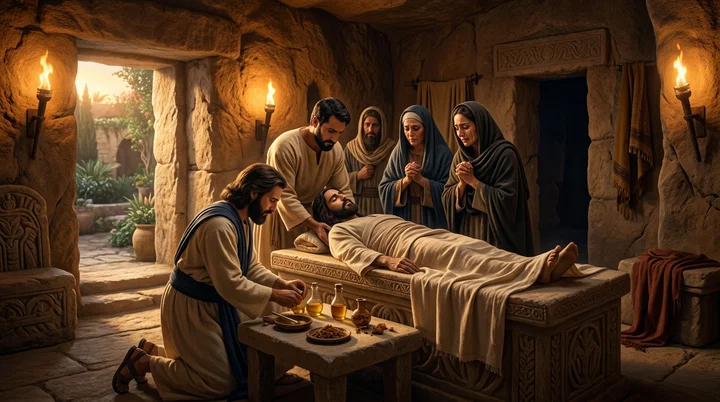
And laid it in his own new tomb, which he had hewn out in the rock: and he rolled a great stone to the door of the sepulchre, and departed.
Translations
And laid it in his own new tomb, which he had hewn out in the rock: and he rolled a great stone to the door of the sepulcher, and departed.
And laid it in his own new tomb, which he had hewn out in the rock: and he rolled a great stone to the door of the sepulchre, and departed.
and laid it in his own new tomb, which he had hewn out in the rock: and he rolled a great stone to the door of the sepulchre, and departed.
And laid it in his own new tomb, which he had hewn out in the rock; and he rolled a great stone to the door of the sepulcher, and departed.
Revised Version, American Standard Version
and laid it in his own new tomb, which he had hewn out in the rock: and he rolled a great stone to the door of the tomb, and departed.
and laid it in his new tomb, that he hewed in the rock, and having rolled a great stone to the door of the tomb, he went away;
and laid it in his new tomb which he had hewn in the rock; and having rolled a great stone to the door of the tomb, went away.
and laid it in his new tomb, which he had hewn in the rock, and, rolling near a large stone unto the door of the tomb, departed.
Berean Standard Bible, Majority Standard Bible
and placed it in his own new tomb that he had cut into the rock. Then he rolled a great stone across the entrance to the tomb and went away.
and laid it in his own new tomb, which he had cut out in the rock. Then he rolled a large stone against the door of the tomb, and departed.
And put it in the resting-place which had been cut out of the rock for himself; and after rolling a great stone to the door of it he went away.
And put it in his new tombe, which he had hewen out in a rocke, and rolled a great stone to the doore of the sepulchre, and departed.
Douay-Rheims (Challoner revision)
And laid it in his own new monument, which he had hewed out in a rock. And he rolled a great stone to the door of the monument, and went his way.
Pictures
Cross-references 20 of 46
- Matthew 28:6
He is not here: for he is risen, as he said. Come, see the place where the Lord lay.
The angel declares that Jesus has risen and is no longer in the tomb.
- John 19:38-42
And after this Joseph of Arimathaea, being a disciple of Jesus, but secretly for fear of the Jews, besought Pilate that he might take away the body of Jesus: and Pilate gave him leave. He came therefore, and took the body of Jesus.
Describes Joseph and Nicodemus preparing Jesus’ body and placing it in a new tomb.
- Luke 23:53
And he took it down, and wrapped it in linen, and laid it in a sepulchre that was hewn in stone, wherein never man before was laid.
Joseph lays Jesus in a rock-hewn tomb where no one had been laid.
- Mark 15:46
And he bought fine linen, and took him down, and wrapped him in the linen, and laid him in a sepulchre which was hewn out of a rock, and rolled a stone unto the door of the sepulchre.
Both describe Jesus being laid in a rock-hewn tomb and its entrance closed with a stone.
- Isaiah 53:9
And he made his grave with the wicked, and with the rich in his death; because he had done no violence, neither was any deceit in his mouth.
Jesus’ burial in a rich man’s tomb fulfills the prophecy of his grave.
- Luke 23:55-56
And the women also, which came with him from Galilee, followed after, and beheld the sepulchre, and how his body was laid.
The women saw where Jesus was laid, then rested on the Sabbath.
- Revelation 1:18
I am he that liveth, and was dead; and, behold, I am alive for evermore, Amen; and have the keys of hell and of death.
The risen Christ declares that he lives forever and holds the keys of death.
- Romans 6:4
Therefore we are buried with him by baptism into death: that like as Christ was raised up from the dead by the glory of the Father, even so we also should walk in newness of life.
Burial with Christ in baptism leads to rising to new life.
- John 19:41-42
Now in the place where he was crucified there was a garden; and in the garden a new sepulchre, wherein was never man yet laid.
Describes Jesus being laid in the nearby new tomb before the Sabbath.
- Matthew 27:66
So they went, and made the sepulchre sure, sealing the stone, and setting a watch.
The tomb was sealed and guarded after Jesus’ burial.
- Matthew 28:2-4
And, behold, there was a great earthquake: for the angel of the Lord descended from heaven, and came and rolled back the stone from the door, and sat upon it.
An angel rolls away the tombstone, and the guards fall in fear.
- Mark 16:1-6
And when the sabbath was past, Mary Magdalene, and Mary the mother of James, and Salome, had bought sweet spices, that they might come and anoint him.
Women bring spices to Jesus’ tomb and find it empty; the angel announces he has risen.
- John 19:31
The Jews therefore, because it was the preparation, that the bodies should not remain upon the cross on the sabbath day, ( for that sabbath day was an high day,) besought Pilate that their legs might be broken, and that they might be taken away.
Identifies Jesus’ death and burial as occurring on the preparation day before the Sabbath.
- Colossians 2:12
Buried with him in baptism, where in also ye are risen with him through the faith of the operation of God, who hath raised him from the dead.
Baptism portrays burial with Christ and rising with him.
- Mark 15:42-43
And now when the even was come, because it was the preparation, that is, the day before the sabbath,
Places Jesus’ burial on the preparation day before the Sabbath.
- Luke 24:2-6
And they found the stone rolled away from the sepulchre.
The stone is rolled away, and the women learn that Jesus has risen.
- John 20:5-7
And he stooping down, and looking in, saw the linen clothes lying; yet went he not in.
The linen burial cloths are found in Jesus’ tomb.
- Matthew 12:40
For as Jonas was three days and three nights in the whale’s belly; so shall the Son of man be three days and three nights in the heart of the earth.
States how long Jesus was to remain in the tomb.
- 1 Corinthians 15:4
And that he was buried, and that he rose again the third day according to the scriptures:
It affirms Christ’s burial and resurrection on the third day.
- Matthew 28:11-15
Now when they were going, behold, some of the watch came into the city, and shewed unto the chief priests all the things that were done.
The guards were bribed to claim that Jesus’ disciples stole his body.
Commentary
Each commentary is drawn from primary sources: the writings of Ellen G. White and Adventist pioneers and periodicals. Each commentary is separate. Its own words are not a quotation; follow the references to read the source passages.
Ellen G. White
35 sources
Joseph laid Jesus in his own new tomb hewn from rock near Calvary, in which no one had ever lain, and rolled a great stone to close its door.COS 167.1–168.4EW 148.23SP 176.1EW 148.3ST Aug 1, 1878 Joseph of Arimathea and Nicodemus reverently cleansed the bruised body, wrapped it in fine linen with about a hundred pounds of myrrh and aloes, and thus spared Him the dishonored burial of criminals executed for treason.COS 167.1–168.43SP 176.1ST Aug 1, 18785RED 95.2COS 166.1–2 The burial was hurried because the Sabbath was near, and He rested in the tomb over the Sabbath as the slain Passover Lamb before rising on the morning of the third day.DA 773.5RH Jan 14, 19093SP 186.3–187.1 Though the stone was sealed and guarded by Roman soldiers, a mighty angel rolled it back as a pebble and He came forth glorified, whom no earthly barrier could hold.COS 171.1–3RH Jan 14, 1909ST Jan 13, 1887Ms 80, 1886, par. 3–5Ms 86, 1894, par. 3–5 His lying there paid the redemption price for a fallen world, and because He is risen and lives to intercede, those who look to Him need not mourn without hope as though He were still shut in the tomb.8T 128.1ST Jan 13, 1887DA 794.5Ms 111, 1897, par. 35–3612MR 411.1–2
Honored Burial in New Tomb
The tomb was Joseph of Arimathea's own new tomb, hewn out of rock near Calvary, which he had built and reserved for himself and in which no one had ever lain, now given and prepared for Jesus.COS 167.1–168.43SP 176.1ST Aug 1, 18785RED 95.2DA 773.5 It had never before held a body, and after the body was wrapped with spices in linen it was laid there.3SP 176.1ST Aug 1, 1878 This honored burial spared Jesus the dishonored burial given to those put to death for treason against the Roman government.ST Aug 1, 1878COS 166.1–2 Their bodies were handled by unfeeling soldiers and consigned to a burial ground set apart for such criminals, and John shuddered at the thought of his beloved Master being treated in that way and buried in a dishonored grave, though he had no influence with Pilate to prevent it.COS 166.1–2
The burial was carried out by Joseph of Arimathea and Nicodemus, rich and honored rulers and members of the Sanhedrim, men of wealth and influence acquainted with Pilate, whose means enabled them to act when the poor disciples loved Jesus and honored His body but did not know how to obtain it.COS 167.1–168.4SG1 64.1COS 166.3–5DA 773.3–4 Joseph was an honorable counsellor and secret disciple made bold, who openly and boldly begged Pilate for the body despite the danger from the hatred of the Jews lest they prevent an honored resting place.COS 167.1–168.4SG1 64.1COS 166.3–5 Pilate granted the request after learning that Christ was really dead, and while Joseph was gone Nicodemus made ready for the burial.SG1 64.1COS 166.3–5 With tears of sympathy they themselves gently and reverently took down the bruised and torn body from the cross, bathed and cleansed it from blood, straightened the mangled limbs and folded the bruised hands upon the breast, upon the pulseless breast.COS 167.1–168.45RED 95.2DA 773.5 They wrapped it in fine linen with spices according to the Jewish custom of wrapping the bodies of the dead in linen cloths with precious ointments and sweet spices as a method of embalming.SG1 64.13SP 176.15RED 95.2DA 773.5COS 166.3–5
Nicodemus brought a costly gift of about a hundred pounds weight of myrrh and aloes, showing more respect in death than could have been shown to the most honored in all Jerusalem, which astonished the humble followers to see these wealthy rulers taking such an interest in the burial of their Master.COS 167.1–168.4COS 166.3–5 The body then lay in state as it was borne to the tomb.COS 167.1–168.4DA 773.5ST Nov 8, 1883 A heavy stone of great weight was rolled to the door of the sepulchre to close it, intended to keep enemies from obtaining the body, and Jesus was left at rest, the Son of God at rest, the Saviour left at rest.SG1 64.13SP 176.1EW 148.35RED 95.2DA 773.5 The Galilean women, including Mary Magdalene and the other Marys who had humbly followed Jesus in life, would not leave until they saw the sacred body laid there and the stone placed.EW 148.2SG1 64.1EW 148.35RED 95.2 Last at the cross and last at the tomb, they drew near to see that all had been done that could be done for their Teacher, lingering weeping about the resting-place as evening gathered and shedding tears of sorrow over Him whom they loved.5RED 95.2DA 773.5
The burial was hurried because the Sabbath was near, so the work was done before the Sabbath began.3SP 186.3–187.1 Jesus rested in the tomb over the Sabbath while the disciples and the women returned and rested according to the commandment.DA 773.5RH Jan 14, 19093SP 186.3–187.1 He lay there while the Passover was being observed, having been slain as the Lamb prefigured by the Passover, and rose on the morning of the third day.RH Jan 14, 19093SP 186.3–187.1 The disciples had forgotten His words foretelling His death, and seeing Him die and be laid in the tomb left them without hope, with renewed sorrow and anguish over blighted hopes.COS 167.1–168.4SG1 64.1EW 206.4 They grieved as if their hopes of an earthly kingdom had died with Him, not yet grasping the worth of the living Saviour, until His resurrection and appearance revived their hope.EW 206.4Ms 11, 1893, par. 1 Joseph and Nicodemus, by contrast, remembered His words and were convinced He was the true Messiah.COS 167.1–168.4
Sealed Tomb and Resurrection
The tomb was closed with a great stone at its entrance and guarded with the greatest care, the Roman seal being placed upon the stone in such a way that it could not be moved without breaking the seal.COS 171.1–3ST Jan 13, 18875T 754.3Ms 86, 1894, par. 3–5 A watch of Roman soldiers was set around it to keep strict watch lest the body be stolen or molested, some constantly pacing to and fro before it while others rested on the ground nearby.COS 171.1–3RH Jan 14, 1909Ms 80, 1886, par. 3–5 The priests feared the body would come forth to life, a fear sharpened by having seen Jesus raise Lazarus from the dead.6RED 3.1
That fear of men taking the body was needless, for the angelic host watched the resting place with untold interest and guarded the sepulchre.EW 148.2SG1 64.1EW 148.3 Mighty angels from heaven also guarded it, earnestly awaiting the command to act their part in liberating the King of glory from His prison house.EW 148.2SG1 64.1EW 148.3COS 171.1–3 Any one of them by putting forth his power could have stricken down the whole Roman army.COS 171.1–3Ms 80, 1886, par. 3–5
On the morning of the third day the angel of God came and rolled back the stone as though it were a pebble, heaven's glory lighting the tomb, and a voice from heaven woke the Sleeper, and Christ walked forth a triumphant conqueror.RH Jan 14, 1909Ms 80, 1886, par. 3–5Ms 86, 1894, par. 3–5ST Mar 26, 1894 When the Roman guards saw the angel they dropped as dead men to the ground because they could not endure his glory.Ms 80, 1886, par. 3–5Ms 86, 1894, par. 3–5 Fallen humanity could not endure even an angel's glory, which shows why Christ veiled His divinity in humanity so that people could draw near to Him.Ms 86, 1894, par. 3–5
No earthly barrier could hold Him, for the decree of heaven loosed Him and He came forth from the tomb glorified.DA 780.3Ms 203, 1898, par. 1–2 Even mountains piled upon mountains over His sepulchre could not have prevented Him from coming forth.DA 780.3Ms 203, 1898, par. 1–2 The glorified one who left the tomb is the same prisoner seen crowned with thorns standing unresisting before Pilate and Herod, lacerated by the scourge, nailed to the cross and mocked by priests and rulers, whom the Roman guard beheld and recognized risen.DA 780.3
The guards went into the city and told that Christ had risen and the disciples had not stolen Him away.Ms 80, 1886, par. 3–5 The priests and rulers bribed them to testify to a lie for fear the people would stone them.Ms 80, 1886, par. 3–5 A multitude arose with Christ and went into the city testifying that Christ was risen and they were risen with Him, so the lying report had little effect.Ms 80, 1886, par. 3–5Ms 81, 1909, par. 23–24
Redemption Finished and Applied
The Prince of life was taken by wicked hands and slain, killed in spotless purity as a disturber of the peace and customs of the people, and then lay in Joseph's new tomb.Ms 111, 1897, par. 35–3612MR 411.1–2 He descended into the grave as the Sin-bearer, opening a grave for the sins of all who accept Him as their personal Saviour.Ms 111, 1897, par. 35–3612MR 411.1–2 The night He lay there was the darkest night the church had ever known, yet His lying there meant the redemption price for a fallen world had been paid, the sacrifice for sin had been offered, and all heaven was triumphant.Ms 111, 1897, par. 35–3612MR 411.1–2
He came forth from that prison of death after three days as a triumphant conqueror, proclaiming Himself the resurrection and the life.ST Mar 26, 1894Ms 81, 1909, par. 23–24RH Nov 19, 1901 His victory made freedom from sin and death possible for those who believe in Him.ST Mar 26, 1894 He also brought a multitude of saints out of their graves to testify to the power of the risen Saviour.Ms 81, 1909, par. 23–24
He is no longer lying in Joseph's tomb, for He is risen and reigns as Saviour and King.8T 128.1ST Jan 13, 18875T 754.3DA 794.5GW92 467.4 He has ascended to heaven, where He lives to make intercession on behalf of His people.8T 128.1GW92 467.4 The tomb is therefore not a place for hopeless mourning.DA 794.5
Because He so loved and died, those who look to Him as Redeemer need not despair or mourn as those without hope.8T 128.1GW92 467.4 To act as though He were still shut in the tomb denies Him as the risen, living Saviour and Head of the Church.STOM 44.1–45.2STBk 55.1–56.1 They can instead be cheerful and rejoice and not be cast down and oppressed when trials come, even the hardest trials from brethren and familiar friends, which may be borne with patience.8T 128.1 Through Him they may have hope and strength and courage and a place with Him upon His throne, for He is able and willing to help whenever they call upon Him.8T 128.1
Sources
Pioneers and periodicals
117 sources
Joseph of Arimathea laid Jesus in his own new tomb cut out of rock near Calvary in a garden, then rolled a great stone to the entrance and departed.ST Aug 1, 1878ST Apr 17, 1879RH Apr 12, 1860ST Feb 16, 1882ST May 24, 1905 Being laid with the rich in death while counted among the wicked fulfilled Isaiah 53:9, after a tender, costly burial in haste on preparation evening before the Sabbath.RH Nov 18, 1862RH May 5, 1874RH Sep 16, 1902ST Jul 4, 1905ST Aug 1, 1878 The Lord of the Sabbath then lay at rest in the tomb on the Sabbath after finishing redemption, joining creation's memorial to redemption's memorial before rising on the third day.STRH Apr 7, 1851RH Dec 21, 1911RH Oct 23, 1866ST Aug 27, 1885 Sealed and guarded under Roman authority, the tomb could not hold him, for he broke death's bars, took the keys of death and the grave, and came forth proclaiming himself the resurrection and the life.ST Aug 1, 1878ST Jul 7, 1914ST Oct 25, 1905RH Nov 28, 1912RH Jun 20, 1912 His resting there blessed the grave and removed its dread, assuring that those who sleep in Jesus will rise immortal at his voice, a hope pictured in baptism's burial and rising with him to new life.RH Jul 1, 1873RH Jul 9, 1857ST Aug 16, 1905ST Mar 27, 1893ST Oct 15, 1912
Tomb Place and Words
Joseph laid Jesus in his own new tomb that he had cut out of rock, then rolled a great stone to the door of the sepulchre and departed.ST Apr 17, 1879RH Apr 12, 1860ST Feb 16, 1882ST Mar 20, 1901ST Aug 12, 1880 The laying was done at evening on the preparation day before the ceremonial high Sabbath began, fixing the start of an interval of three days and three nights that ended at evening on the seventh day before the first day began.RH Apr 12, 1860ST Aug 12, 1880 It was a tender, costly burial done in haste before the Sabbath by a good and righteous council member looking for God's kingdom, who obtained the body from Pilate, wrapped it in linen, and laid it where no one had yet been buried.ST Feb 16, 1882ST Mar 20, 1901RH Oct 4, 1870 The haste came because the Sabbath began at sundown on Friday, so the disciples meant to return on Sunday morning to finish the preparations, while the women wished to do more for the body though the tomb was already prepared.ST Feb 16, 1882ST Aug 12, 1880 The act was love and reverence toward Jesus, left there until God's summons would awaken him from death, and as part of Christ's suffering this chapter can be read to subdue pride and discontent and encourage a Christlike spirit.ST Apr 17, 1879RH Oct 4, 1870
The tomb was new and never before used, so Jesus was its first occupant.ST Aug 1, 1878ST Feb 1, 1899RH Jul 1, 1902RH Oct 13, 1874 It was Joseph's own tomb hewn from stone near Calvary and the crucifixion site, reserved for himself and lying in a fair garden near enough for friends to carry the body there before the Sabbath drew them home.ST Aug 1, 1878ST May 24, 1905ST Feb 1, 1899ST Jan 31, 1911 After wrapping with spices and clean white linen the entrance was closed with a heavy stone and Jesus was left at rest.ST Aug 1, 1878ST Feb 1, 1899 Mary thought this only a temporary resting place and supposed the gardener might know where the body had been moved, intending to find a permanent resting place.ST May 24, 1905 The body taken from a cross between two thieves and subjected to the contempt of the city was thus spared burial with the ignominy assigned to Jewish criminals, through Joseph's request and the care of friends in a hurried but decent burial.ST Feb 1, 1899RH Jul 1, 1902
The Greek word for rock in the verse means a rock or rock formation, in contrast to a small movable stone.ST Aug 26, 1880 The tomb hewn out of rock was a monument, not a place beneath the earth's surface.RH Apr 7, 1851 Being physically in that tomb is distinct from being in the heart of the earth, which means being held under the power and control of wicked people and the Devil from betrayal until resurrection, including standing before Pilate and hanging on the cross.RH Apr 7, 1851
The tomb belonged to Joseph of Arimathea, who placed Jesus in his own tomb and who was not Christ's father.ST Dec 9, 1880ST Feb 26, 1885ST Sep 4, 1901 Its claimed site in Jerusalem is honored within the Church of the Holy Sepulchre built over the place believed to contain it, though the identification of the tomb in Palestine is uncertain.RH Dec 25, 1856ST Mar 16, 1915ST Feb 26, 1885
The grave was borrowed, lonely, and given by a stranger, and was not his own.ST Aug 23, 1883ST Oct 11, 1899ST Dec 17, 1912ST May 19, 1881 From a manger for his infant bed to a ministry with nowhere to lay his head, earth yielded its Maker no resting spot, and even his grave was borrowed, showing he owned so little and had no earthly inheritance during his life.ST May 19, 1881RH Dec 11, 1916ST Jun 6, 1916 Though heaven was his home he lay in a human tomb after the world gave him a cross of shame, among hardships he knew awaited him yet confidently foretold his message would reach all nations.ST Aug 23, 1883ST Oct 11, 1899ST Jun 6, 1916 His lack of worldly goods means a poor believer with plain clothing and scant food still has as much as the Master had and need not seek rest or honor below.ST May 19, 1881
After death Jesus truly died, his life ceased and was committed to his Father as the result of human sin, and he lay cold and silent in death for three days, his body and thus his soul as the word is used laid in Joseph's tomb.ST Mar 7, 1906 There his body lay in state after the crucifixion, laid out on his back.ST Nov 8, 1883 His grave was made among the sinful people of this sin-cursed earth, and his death on the cross and burial here make this world, especially Gethsemane and Calvary, memorable and significant throughout God's universe.ST Sep 10, 1896
Burial Acts and Guard
Joseph with Nicodemus gave Jesus a tender, costly and reverent burial in haste before the Sabbath, washing the dark stains from his head and bathing his wounds, gently removing the nails from his hands, loosing the cruel cords and bands, taking the rough crown from his pale bleeding temple, straightening the mangled body and folding the hands over the pulseless still heart.RH May 5, 1874ST Feb 16, 1882ST Aug 1, 1878 He was wrapped in soft pure fine linen with a mixture of myrrh and aloes of about one hundred pounds weight, with a linen napkin bound about his head, and then tenderly borne away from Calvary's hill to rest in the tomb where a heavenly Watcher waited to call him to life again.ST Aug 1, 1878RH May 5, 1874ST Aug 1, 1878 The tomb was Joseph's own new tomb hewn from rock near Calvary and reserved for himself, never before holding a body, belonging to a man who loved him, and the burial was carried out with loving care by devoted disciples as a tender act of love and reverence until God's summons would awaken him.ST Aug 1, 1878ST Feb 16, 1882RH Oct 4, 1870 That decent burial already fulfilled every act of necessity, so the further anointing the women desired was unnecessary work of love and tenderness for the dead body, not mercy to the suffering.RH May 5, 1874
The burial took place at evening on the preparation day before the Sabbath began, hurried because the Sabbath began at sundown on Friday, yet decent and secured when Joseph boldly begged the body from Pilate.ST Feb 1, 1899ST Aug 12, 1880ST Nov 15, 1910RH Apr 7, 1851 Joseph of Arimathea was a rich man who had worshiped Jesus in secret and came boldly after Jesus died literally of a broken heart to lay him in his own new tomb hewn out of rock and roll a great stone to the door and depart, after the disciples had fled or shrunk back from the cross.ST Jan 13, 1898ST Apr 6, 1888 The tomb was near enough for his friends to carry him there before the Sabbath, and they left him there when the Sabbath drew them home, intending to return on Sunday morning to complete the burial preparations.ST Feb 1, 1899ST Aug 12, 1880 The timing places the burial at the preparation before the Sabbath, with the women having the remaining time before evening to prepare spices and ointments and then resting, supporting that Jesus was crucified on Friday the sixth day and the following day was the Lord's Sabbath.RH Apr 7, 1851
Mary Magdalene and the other women followed the burial, watched where Joseph and Nicodemus laid him after taking him down from the cross, and noted the tomb's location so they could return after the Sabbath.ST Apr 10, 1901RH Jan 12, 1860 Mary supposed the garden tomb near the crucifixion site was only a temporary resting place and thought the gardener might know where the body had been moved, intending to find a permanent resting place for Jesus.ST May 24, 1905 Their spices were loving gifts offered in his service to honor him, not wasted even though he did not need them.ST Aug 26, 1880ST Aug 26, 1880
The honorable burial spared Jesus the ignominy assigned to Jewish criminals and consignment to the burial ground reserved for executed criminals.ST Aug 1, 1878ST Feb 1, 1899 It was in keeping with Roman law and custom, which gave the body of the executed to friends for burial unless the criminal was infamous, one small particular told with minute, circumstantial, natural and undesigned accuracy together with being brought to Pontius Pilate as governor whose sentence was necessary because the power of life and death rested in the Roman governor, being treated with derision as customary before and during executions, being scourged before crucifixion, bearing the cross, and having the accusation affixed in three languages as public notices were written at Jerusalem, all fully consistent with the manners and institutions of that period and hazardous for an inventor to fabricate.RH Feb 11, 1862 Though his enemies intended his body to be denied burial and burned in the Valley of Hinnom and to give him a dishonorable burial among the wicked, the Father protected his body, and the prompt action of Joseph and Nicodemus frustrated that plan and gave him the burial of a king.RH Oct 29, 1914ST Dec 7, 1882 His lifeless body taken from the cross by weeping disciples was laid in the rock-hewn tomb offered in charity by Joseph, with the door rolled into place and sealed under Roman law above him, which satisfied Satanic hatred yet he never swerved from the eternal principle that eternal righteousness is eternal life and might.ST Feb 17, 1898
Joseph was a rich counsellor and secret worshiper, naturally cautious, conservative and thought timid through fear of men and regard for reputation, who with Nicodemus stepped forward in great perplexity when the cause was in disrepute to give Jesus a decent burial.ST Jan 13, 1898RH Jul 1, 1902 By burying Jesus in his own prepared family tomb, which no one had yet used so that Jesus became its first occupant, Joseph fulfilled that the Messiah would be with the rich in his death, and his faithful act was recorded in heaven.RH Jul 1, 1902 When the disciples' influence could not have secured a burial, Joseph provided it and with Nicodemus used wealth, influence and means to support the gospel, exemplifying sacrificial spirit and showing the importance of acting when God's work is needed rather than waiting for difficulties to disappear, for reward when the dead are raised and God gives immortality to the saints.ST Jul 19, 1883 His course with that of Nicodemus is presented for contemplation and emulation as manifesting clearness of faith, boldness of conviction and fidelity of character at the close of his career, which believers of the present day will be called upon to imitate, showing love and faith overcoming former reserve and caution even as the body taken from a cross between two thieves and subjected to the contempt of the city was honored.RH Jul 1, 1902RH Jul 1, 1902
The entrance closed with a heavy great stone was afterward sealed and guarded by the Jews, sealed with the government and Roman seal under pagan Roman rule and set with a watch of soldiers at the priests' demand, while Roman sentinels kept the silent tomb.ST Jul 16, 1912ST Jan 31, 1911RH Nov 28, 1912 Matthew 27 must be read with Matthew 28 with no chapter break: the Jews anxious to make Christ's words about rising after three days false went to Pilate on the Sabbath to have the sepulcher made sure, Pilate gave them a guard, and they sealed the stone and set the watch in the end of the Sabbath in its very closing part before dawn toward the first day when Mary Magdalene and the other Mary came, proving the Sabbath closed at sunset with the light part of the next day then drawing near, not at daybreak.ST Jul 16, 1912 The rock-hewn tomb wrapped in linen with aromatic spices and closed with a great stone thus appeared final, and though Jesus was sealed out of sight under Roman authority the sealing did not prevent his resurrection and exaltation to God's throne.ST Apr 8, 1903ST Oct 25, 1905 The tomb later guarded and sealed by hope of the chief priests to keep him there could not keep the sacrificed Redeemer in the grave, for the seal and all Satan's power could not hold him and he rose guaranteeing eternal life to everyone who believes and accepts him.ST Feb 7, 1911RH Nov 28, 1912
The body laid in Joseph's own new tomb cut out of rock behind the great rolled stone was the same real, material body that came forth at the resurrection bearing the marks of the crucifixion so he could be identified as the one who had died, supporting that the price of redemption remains an enduring reality.ST Sep 18, 1884ST Jan 18, 1877 His body did not see corruption but rose immediately before corruption, an exception to the general decree that people return to dust, like the change living saints will experience at Christ's second coming.ST Jan 18, 1877
Prophecy Fulfilled by Burial
Being laid in his own new tomb hewn out of rock by Joseph of Arimathea, a rich counsellor and rich disciple, fulfilled Isaiah 53:9 that the Messiah would make his grave with the wicked and be with the rich in his death.RH Nov 18, 1862RH Sep 16, 1902ST Jul 4, 1905RH Oct 29, 1914RH Aug 21, 1866 Though crucified between criminals and counted among the wicked, he was innocent and received an honorable burial with the rich rather than with criminals.ST Jul 4, 1905RH Oct 29, 1914RH Aug 21, 1866 Joseph stepped forward in a time of great perplexity when the disciples' influence could not have secured a burial, and boldly provided a decent burial from his own resources. His faithful act in giving his own tomb was recorded in heaven and exemplifies acting when God's work needs it rather than waiting for difficulties to disappear, with a sacrificial spirit in service.
That burial with a rich man is one of at least twenty-four Old Testament prophecies concerning betrayal, trial, death, and burial.ST Oct 21, 1930 Those prophecies were spoken by several different prophets between about 1000 and 500 B.C. and were all literally fulfilled within twenty-four hours on the day of crucifixion.ST Oct 21, 1930 That concentration of fulfillment makes that day a great and decisive climax in God's plan for the earth.ST Oct 21, 1930
The word spoken by Isaiah 700 years before was exactly fulfilled when the one crucified between two thieves was then laid in a rich man's tomb, with the entrance closed by a great stone.RH Sep 16, 1902RH Aug 21, 1866 This perfect agreement between Isaiah and Matthew stands together with the agreement of all the other writers on his sorrow, temptation without sin, rejection, weeping, meek suffering, crucifixion, burial, resurrection on the third day, and the parting of his garments.RH Aug 21, 1866 Such exact agreement proves the Bible a true and connected record.RH Aug 21, 1866
The burial at the request of friends was in keeping with Roman law and custom, which gave the body of the executed to friends for burial unless the criminal was infamous.RH Feb 11, 1862 It belongs with being brought to Pontius Pilate as governor of Judea whose sentence was necessary because the power of life and death rested in the Roman governor, being treated with derision as was customary before and during executions, being scourged before crucifixion, bearing the cross, and having the accusation affixed to the cross in three languages as public notices were written at Jerusalem.RH Feb 11, 1862 These small particulars in the history of trial, execution, and burial are told with minute accuracy in a circumstantial, natural, and undesigned manner, with nothing forced, fetched, or out of place, and in full consistency with the manners and institutions of that period.RH Feb 11, 1862 No inventor of a fabricated story would hazard so many circumstances each giving another chance of detection, nor blend truth so artfully with falsehood, and this proves the truth of the Gospel history.RH Feb 11, 1862
Sabbath Rest and Timing
The laying in the new rock-hewn tomb took place at the time of preparation as the Sabbath drew on, beheld by the women from Galilee who saw how the body was laid, and the remaining time before evening was used to prepare spices and ointments before resting on the Sabbath according to the commandment.RH Apr 7, 1851ST Aug 27, 1885 That Sabbath following the burial came immediately before the first day of the week, proving the Sabbath of the New Testament identical with the Sabbath of the Old Testament, the seventh day of the week, even though the Hebrew word and the Greek word differ.ST Aug 27, 1885 The burial therefore supports the conclusion that Jesus was crucified on Friday, the sixth day of the week, and that the following day was the Lord's Sabbath.RH Apr 7, 1851 The Son of God and Lord of the Sabbath lay cold, lifeless and at rest in Joseph's new tomb on that Sabbath day after offering himself as the great sacrifice and opening a fountain for sin and uncleanness, with the marks of suffering on his face and his heart that had bled for others now still, while his disciples rested according to the commandment and mourned over his death.STRH Oct 23, 1866 His rest there after completing the work of redemption joined the Sabbath's memorial of creation to its memorial of redemption, for Christ could redeem because he was the Creator, and his death secured salvation and the promise of a restored creation.ST His rest in death is a divine mark on the seventh day alongside the day's rest, blessing and sanctification at creation, honoring Christ's work of redemption finished on the sixth day and remaining in force.RH Dec 21, 1911
Joseph with Nicodemus gave Jesus a decent burial in haste before the Sabbath, performed tenderly and with great expense, washing and wrapping the body in soft pure fine linen with a mixture of myrrh and aloes about one hundred pounds weight and binding a linen napkin about his head.RH May 5, 1874 That burial already fulfilled every act of necessity, so the further anointing the women desired was unnecessary work of love and tenderness for the dead body, not mercy to the suffering.RH May 5, 1874 With the Sabbath standing directly in the way of even that work for the Son of God, the burial teaches the sacredness of the Sabbath rest just as the crucifixion teaches the sacredness of the law.RH May 5, 1874 Matthew 27 must be read in connection with Matthew 28 with no chapter break, for the great stone rolled to the door of the hewn rock tomb was afterward sealed and guarded.ST Jul 16, 1912 The Jews, anxious to make Christ's words about rising after three days false, went to Pilate on the Sabbath day to have the sepulcher made sure, and Pilate gave them a guard, so they sealed the stone and set the watch in the end of the Sabbath, right down in the very closing part of the Sabbath day before the dawn toward the first day of the week when Mary Magdalene and the other Mary came.ST Jul 16, 1912 This proves the Sabbath closed at sunset and the light part of the next day then drew near, not that the Sabbath ended at daybreak.ST Jul 16, 1912
The laying at evening on the preparation day before the high ceremonial Sabbath began is held to locate the start of the burial interval on the fourth day of the week, starting the count of three days and three nights that ended at evening on the seventh day, so that Jesus rose before the first day of the week began.RH Apr 12, 1860RH Apr 12, 1860 The proposed explanation that Jesus lay dead in the tomb for a full day which therefore dropped out of God's record of time, so that time resumed at his resurrection on Sunday and made Sunday the successor to the Sabbath without a new command, is an absurd argument and not a sound account of the Sabbath's change.RH May 7, 1872 The tomb hewn out of rock was a monument above ground, not a place beneath the earth's surface, supporting the distinction between being physically in the tomb and being in the heart of the earth.RH Apr 7, 1851 Being in the heart of the earth means being held under the power and control of wicked people and the Devil from betrayal until resurrection, including while standing before Pilate and hanging on the cross.RH Apr 7, 1851 The single seventh day the Lord lay dead in the new tomb over eighteen hundred years ago does not mean that those who keep the seventh day now have a dead Saviour before them.RH Mar 21, 1865
Resurrection Victory and Hope
The tomb was only a temporary resting place, where a heavenly Watcher waited to call the sleeper back to life again.ST Aug 1, 1878ST Jul 7, 1914ST Aug 21, 1907 Friends laid him there with reverent hands and mourned him in the quiet tomb, and he rested there until resurrection morning.ST Jul 7, 1914ST Sep 9, 1930 On the morning of the third day an angel rolled back the stone and Jesus rose from the dead, coming forth from the prison of death proclaiming himself the resurrection and the life and leaving the tomb empty.RH Jan 14, 1909ST Mar 29, 1899ST Sep 9, 1930 His body had been laid there at eventide with weeping by disciples and women, but its later removal of the stone and triumphant emergence proclaimed victory over death and the grave.RH Jan 14, 1909ST Sep 9, 1930
Though shut in a rock tomb with a great stone and sealed out of sight under pagan Roman rule and Roman authority, the sealing did not prevent resurrection and exaltation to God's throne.ST Oct 25, 1905RH Nov 28, 1912ST Nov 7, 1906 The seal and all Satan's power could not keep the sacrificed Redeemer in the grave, for Jesus rose and thereby guarantees eternal life to everyone who believes and accepts him.RH Nov 28, 1912ST May 13, 1908 The tomb left under Roman guard could not hold him who held the key of death and hell, and when the guard's power reached its limit an angel opened the tomb and led him forth victorious over death.RH Jun 20, 1912ST Oct 6, 1914 The sealed cave with its Roman guard made the burial the setting for Satan's final apparent triumph, yet God broke the seal and Jesus conquered even in death, coming forth alive and breaking the enemy's power.ST Nov 7, 1906ST Oct 6, 1914ST May 13, 1908
His death satisfied the law broken by mortals, though no sin was found in him, and he slept in death in Joseph's tomb.ST Mar 29, 1899 He was laid alone there after finished work on the cross, wrapped in gloom as the Prince of Light, and he lay there for those he came to save.ST Aug 15, 1916RH Nov 12, 1872 The grave bound him in vain and death barred its gate in vain, because for his people he rose and burst death's chain, and the open tomb at dawn marked resurrection and completion of the atonement.ST Aug 15, 1916RH Nov 12, 1872
The same one who healed the sick and lame and brought blessings wherever he came tasted death for man and entered the portals of the grave so that those he bled and died to save might learn salvation's plan.RH Oct 13, 1874 He who was laid in Joseph's new tomb hewn from rock and closed with a great stone is no longer there but is risen and reigns as Saviour, alive in heaven at the Father's right hand ready to give light and help to those who trust him.ST Jan 13, 1887RH Jun 13, 1912RH Aug 3, 1905 His death won complete victory and his continuing presence and power in glory, where he intercedes and has ascended to heaven, are grounds for rejoicing, while living as though he were still dead leaves people in darkness.ST Sep 16, 1889RH Jun 13, 1912 Though he died and was laid there, he lives again and will soon come on earth to reign to bring sweet release, when sin and death shall be no more but righteousness from shore to shore and everlasting peace.RH Oct 13, 1874
His coming forth in triumph from Joseph's sepulcher assured his victory over Satan and made the end of Satan's reign on earth certain.ST Mar 12, 1894ST Jul 9, 1912 The empty tomb through resurrection brings freedom from death, sin, and human religious control, and freedom to worship and obey God.ST Mar 29, 1899
Resting in the grave he made the grave blessed and gave hope that the dead will rise to a nobler, eternal life, taking away the tomb's dread.RH Jul 1, 1873RH Jul 9, 1857 His emergence is the pattern for being buried with Christ in baptism and rising to live anew to God.RH Jul 1, 1873 His resurrection grounds the certainty that the dead will live again, and at his coming the dead will rise at his voice appearing with the vigor and freshness of youth and clothed with immortality.ST Oct 15, 1912RH Feb 19, 1901 Christ's resurrection gives hope that all who are in Christ and have died will also be raised, so the living saints will not have final advantage over them, for dead and living will be gathered together when the Lord descends, to join the living faithful to meet the Lord and be together with him forever.RH Dec 19, 1854ST Feb 27, 1879
When Christ died he slept in Joseph's new tomb on earth and not in heaven, locked in the tomb as in Satan's prison-house.ST Apr 12, 1899 Death is therefore sleep in the tomb, so those who sleep in Jesus likewise sleep in the tomb and not in the skies, waiting until Christ's mighty voice calls them to arise from the dust of the earth at his coming.ST Apr 12, 1899
Without that resurrection Christ in the tomb would have been powerless to save, for even with the Roman seal upon it the grave could not defeat him on the appointed day.ST May 13, 1908ST Mar 29, 1899 By coming forth he proved his power over hades and took the keys of the grave, so the gates of that dark sleeping place can no more hold its righteous occupants on the great resurrection day than Joseph's tomb could hold him.ST Mar 29, 1899 His resurrection was essential to the plan of salvation and made possible the hope of resurrection for others, guaranteeing eternal life to believers.RH Nov 28, 1912ST May 13, 1908
The body placed in Joseph's new tomb was the same body that came forth bearing the marks of crucifixion so he could be identified as the one who had died.ST Jan 18, 1877 His body did not see corruption, and his immediate resurrection before corruption was an exception to the general decree that people return to dust, like the change living saints will experience at Christ's second coming.ST Jan 18, 1877
The burial marked bitter disappointment, for the only throne to which he went was the cross instead of taking the kingdom and being hailed as king in a royal palace as the disciples expected when they shouted before him riding into Jerusalem.ST Jul 27, 1882RH Aug 26, 1915 Having expected him to redeem Israel by breaking Rome's rule and restoring the kingdom, his grieving followers turned away a few hours later with hopes dimmed when he was slain by those he came to save, leaving supporters exposed to public scorn, and hopes of an earthly kingly throne were replaced by grief and despair.RH Aug 26, 1915ST Feb 8, 1899 His being laid lifeless in Joseph's new tomb marks that disappointment of those who expected restoration of the kingdom of Israel, just as disappointment followed the passing of the prophetic period in 1844 without his appearing.RH Nov 19, 1872 The crucifixion at the last Passover he attended, in A.D. 31, closed a public ministry of three and one-half years begun when he was thirty about six months before a spring Passover, so counting back places his birth in autumn in the season of fruitage, not on December 25.ST Dec 23, 1897
The sealed tomb with a great stone rolled across its entrance appeared to end his work, and his earthly mission laid in a tomb sealed by stone appeared defeat by human standards but was not defeat in light of eternal issues.RH May 15, 1856ST Feb 4, 1913 His death became the beginning of life and triumph, for he rose, ascended to heaven, and sat at God's right hand, marking the end of earthly life before triumphant resurrection.RH May 15, 1856ST Jan 24, 1911 The church, personified as Ekklesia, lamented at the closed grave and felt forever bereft of him.ST
The very person buried there is the same who had glory with the Father before the world was and was born as a human being, who was condemned and crucified, buried in Joseph's new tomb, then rose the third day and was exalted in heaven.RH Nov 14, 1854 He is the same Pilot who directed and steadied the ark through the deluge to safe landing and whose feet walked storm-tossed Galilee, the same who faced Gethsemane and Calvary and the prison house and tomb and came forth conqueror, and that conquering Pilot is on board today not as passenger but as pilot with hand on the helm.RH Feb 4, 1915 The same Jesus who lay dead awaiting burial in Joseph's new tomb rose and ascended and will soon appear in the heavens, and those who knew and loved him on earth will recognize and love him still and need not fear to meet him.RH Feb 4, 1915RH Mar 21, 1912
Baptism and Moral Lessons
Christ laid in a newly made tomb takes away the tomb's dread, and his burial and his emergence from it form the pattern for being buried with Christ in baptism and rising to live anew to God.RH Jul 1, 1873ST Aug 16, 1905ST Mar 27, 1893 His laying there followed submission to God's will as when he drank the bitter cup in Gethsemane, and baptism means the believer is buried with Christ into his death and rises to walk in newness of life.ST Aug 16, 1905ST Mar 27, 1893 That burial is beneath water and not by sprinkling, and the rising publicly acknowledges faith in the buried and risen Lord.ST Aug 16, 1905ST Mar 27, 1893
He was laid out decently upon his back in a horizontal position in death, and baptism is to imitate that very posture and to show faith in his death, burial, and resurrection.ST Jan 17, 1878ST Aug 15, 1878RH Jun 29, 1869RH Apr 24, 1866 The administrator leads the candidate down into water to a suitable depth, lays him backward until he is buried beneath the water in a liquid grave in likeness of Christ in the sepulcher, and raises him up out of the water in likeness of his resurrection.ST Aug 15, 1878RH Jun 29, 1869 This burial and raising alone is Christian baptism, by immersion and not by sprinkling or merely pouring upon, and not by plunging in face foremost, a likeness plain to any child who has read the New Testament and witnessed it, by which a good conscience about baptism is known through agreement with that death, burial, and resurrection.ST Jan 17, 1878ST Aug 15, 1878RH Jun 29, 1869RH Apr 24, 1866 The account does not state that he was laid face downward, and therefore it gives no support for face-down burial practice.RH Jan 1, 1875
As part of the account of his suffering, with the new tomb cut into rock and the great stone rolled to its entrance, this chapter can be read to help subdue pride and discontent and to encourage a Christlike spirit.ST Apr 17, 1879 Joseph of Arimathea stepping forward in great perplexity to give Jesus a decent burial in his own tomb fulfilled that the Messiah would be with the rich in his death, and his faithful act was recorded in heaven. That act with that of Nicodemus is set forth as two beautiful courses for contemplation and emulation, manifesting clearness of faith, boldness of conviction, and fidelity of character at the close of a career, though naturally cautious, conservative, and thought timid through fear of men and regard for reputation.ST Jul 19, 1883RH Jul 1, 1902 Their example shows the importance of acting when God's work needs it rather than waiting for difficulties to disappear, and how wealthy men of means and influence can use their resources to sustain God's cause in crisis when it is in disrepute, with reward when the dead are raised and God gives immortality to the saints.RH Feb 26, 1901ST Jul 19, 1883RH Jul 1, 1902
From a manger for his infant bed to a ministry with nowhere to lay his head, earth yielded its Maker no resting spot because she did not know him, so that even his grave was borrowed.ST May 19, 1881 His lack of worldly goods means a poor believer with plain clothing and scant food still has as much as his Master had and need not seek rest or honor below.ST May 19, 1881 His burial also supplies the image of liberty buried in a cold tomb after being persecuted, deserted, and crucified by tyranny, yet not ended there but rising to triumph over tyranny and be carried to the skies.ST Mar 14, 1906ST Sep 4, 1907 It supplies the image of laying faith in God in a new tomb out of sight and sealing it with scientific-looking seals to make sure it stays buried, with the same false certainty as those who buried Christ.ST Dec 11, 1928 In the same way the Sabbath is pictured as buried beneath tradition and locked away by papal authority, trampled, falsely accused, and treated as dead as Christ was crucified and buried, as though it had perished; yet it cannot be destroyed by human opposition any more than Christ could be destroyed, for it lives because it belongs to God, rests on his eternal throne and enduring Word and is grounded in eternal fact, needing no human laws to revive, protect, or preserve it.ST Jul 26, 1910ST Oct 11, 1899
Sources