John 19:41
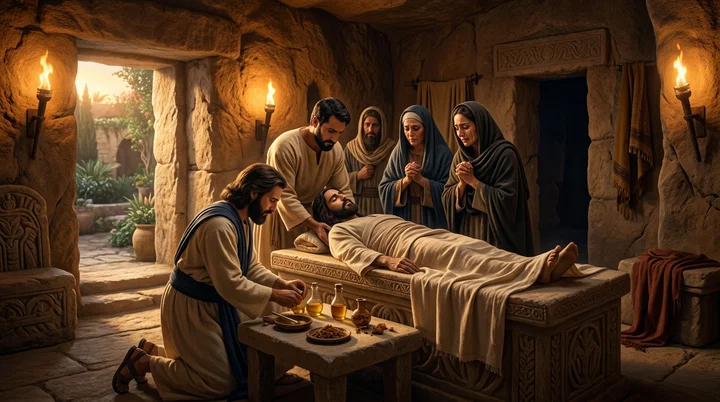
Now in the place where he was crucified there was a garden; and in the garden a new sepulchre, wherein was never man yet laid.
Translations
Now in the place where he was crucified there was a garden; and in the garden a new sepulcher, wherein was never man yet laid.
King James Version, KJV Cambridge Paragraph Bible
Now in the place where he was crucified there was a garden; and in the garden a new sepulchre, wherein was never man yet laid.
Now in the place where he was crucified, there was a garden; and in the garden a new sepulcher, in which was never man yet laid.
Revised Version, American Standard Version
Now in the place where he was crucified there was a garden; and in the garden a new tomb wherein was never man yet laid.
and there was in the place where he was crucified a garden, and in the garden a new tomb, in which no one was yet laid;
But there was in the place where he had been crucified a garden, and in the garden a new tomb in which no one had ever been laid.
Now there was, in the place where he was crucified, a garden; and, in the garden, an unused tomb, wherein, as yet, no one had been laid.
Berean Standard Bible, Majority Standard Bible
Now there was a garden in the place where Jesus was crucified, and in the garden a new tomb in which no one had yet been laid.
Now in the place where he was crucified there was a garden. In the garden was a new tomb in which no man had ever yet been laid.
Now there was a garden near the cross, and in the garden a new place for the dead in which no man had ever been put.
And in that place where Iesus was crucified, was a garden, and in the garden a newe sepulchre, wherein was neuer man yet laid.
Douay-Rheims (Challoner revision)
Now there was in the place where he was crucified, a garden; and in the garden a new sepulchre, wherein no man yet had been laid.
Pictures
Cross-references 20 of 21
- Matthew 27:60
And laid it in his own new tomb, which he had hewn out in the rock: and he rolled a great stone to the door of the sepulchre, and departed.
Joseph lays Jesus in a new tomb.
- Luke 23:50-53
And, behold, there was a man named Joseph, a counsellor; and he was a good man, and a just:
Joseph places Jesus’ body in a tomb where no one had been laid.
- Mark 15:46
And he bought fine linen, and took him down, and wrapped him in the linen, and laid him in a sepulchre which was hewn out of a rock, and rolled a stone unto the door of the sepulchre.
Joseph lays Jesus in a rock-hewn tomb.
- Luke 23:55-56
And the women also, which came with him from Galilee, followed after, and beheld the sepulchre, and how his body was laid.
The women saw where Jesus was laid, then rested on the Sabbath.
- John 20:5-7
And he stooping down, and looking in, saw the linen clothes lying; yet went he not in.
Records the burial cloths found in the tomb.
- Isaiah 53:9
And he made his grave with the wicked, and with the rich in his death; because he had done no violence, neither was any deceit in his mouth.
Jesus was buried in a rich man’s new tomb, fulfilling the prophecy.
- Matthew 27:63-64
Saying, Sir, we remember that that deceiver said, while he was yet alive, After three days I will rise again.
The priests ask Pilate to secure Jesus’ tomb after his burial.
- 1 Corinthians 15:20
But now is Christ risen from the dead, and become the firstfruits of them that slept.
Christ’s resurrection is identified with the firstfruits.
- John 19:34
But one of the soldiers with a spear pierced his side, and forthwith came there out blood and water.
The poem recalls Jesus’ pierced side and the blood and water flowing from it.
- John 20:1-2
The first day of the week cometh Mary Magdalene early, when it was yet dark, unto the sepulchre, and seeth the stone taken away from the sepulchre.
Mary seeks Jesus and finds the tomb empty.
- John 20:15
Jesus saith unto her, Woman, why weepest thou? whom seekest thou? She, supposing him to be the gardener, saith unto him, Sir, if thou have borne him hence, tell me where thou hast laid him, and I will take him away.
Mary mistakes the risen Jesus for the gardener.
- Luke 24:1
Now upon the first day of the week, very early in the morning, they came unto the sepulchre, bringing the spices which they had prepared, and certain others with them.
The women came to the tomb after the Sabbath, on the first day of the week.
- Psalms 16:10
For thou wilt not leave my soul in hell; neither wilt thou suffer thine Holy One to see corruption.
His body was not to see corruption.
- John 19:17
And he bearing his cross went forth into a place called the place of a skull, which is called in the Hebrew Golgotha:
The garden tomb was located where Jesus was crucified.
- Mark 16:1-2
And when the sabbath was past, Mary Magdalene, and Mary the mother of James, and Salome, had bought sweet spices, that they might come and anoint him.
Both describe the women’s dawn visit to Jesus’ tomb with spices.
- Luke 24:5-6
And as they were afraid, and bowed down their faces to the earth, they said unto them, Why seek ye the living among the dead?
The angels announce that Jesus has risen and is no longer among the dead.
- John 19:31
The Jews therefore, because it was the preparation, that the bodies should not remain upon the cross on the sabbath day, ( for that sabbath day was an high day,) besought Pilate that their legs might be broken, and that they might be taken away.
The crucified men were to be removed before the Sabbath.
- Acts 2:24
Whom God hath raised up, having loosed the pains of death: because it was not possible that he should be holden of it.
Connects Jesus’ rest in the tomb with his being raised to life.
- John 18:1
When Jesus had spoken these words, he went forth with his disciples over the brook Cedron, where was a garden, into the which he entered, and his disciples.
Jesus enters a garden before his arrest, echoing the garden at his burial place.
- Luke 23:54
And that day was the preparation, and the sabbath drew on.
The burial took place as the Sabbath drew on after the preparation day.
Commentary
Each commentary is drawn from primary sources: the writings of Ellen G. White and Adventist pioneers and periodicals. Each commentary is separate. Its own words are not a quotation; follow the references to read the source passages.
Ellen G. White
17 sources
In the place where He was crucified there was a garden holding a new tomb in which no one had ever been laid, Joseph's own tomb near Calvary reserved for himself, where His followers laid His body after burial preparations and closed it.ST Aug 1, 18783SP 176.1SG1 64.1EW 148.25RED 95.2 That burial secured Him an honorable burial instead of being taken down by soldiers and cast into the dishonored ground reserved for executed criminals and traitors against Rome.ST Aug 1, 1878EW 148.25RED 93.1COS 166.1–25RED 92.2 Joseph of Arimathea and Nicodemus obtained the body, brought myrrh and aloes and wrapped it with spices, and rulers whose sympathy had been secret now openly mourned over Him and stood by Him in danger.5RED 93.12SP 134.3–135.14RED 18.3–19.2ST Jan 11, 1877 The unused tomb made His burial distinct and certain, fulfilling that He would be with the rich in His death though His body would not see corruption.Ms 103, 1897, par. 19 Angelic hosts watched and waited at that tomb where He lay dead beyond the reach of the sick, but He is not still dead there, for He has risen and lives as the resurrection and the life in victory over Satan to reclaim the kingdom.SG1 64.118MR 54.1–3ST Nov 8, 1883
Garden Tomb Near Calvary
At the place where he was crucified there was a garden, and in that garden a new sepulchre in which no man had yet been laid.ST Aug 1, 18783SP 176.1EW 148.25RED 95.23SP 173.2 His body was laid in that unused tomb as an honored burial, honorable rather than in the dishonored burial place reserved for executed criminals.EW 148.23SP 173.2ST Jan 11, 1877 Joseph of Arimathea and Nicodemus performed the final burial rites and laid him there, with Nicodemus bringing myrrh and aloes and the body wrapped with spices, and both men mourning together over his body.5RED 95.2ST Jan 11, 1877
The tomb belonged to Joseph, lay near Calvary, and had been prepared and reserved for his own burial before he prepared it for Jesus.ST Aug 1, 18783SP 176.15RED 95.2 He had made it ready for himself, then made it ready for Jesus, so that Jesus was laid in Joseph's own unused tomb close to the cross.ST Aug 1, 18783SP 176.1
After Jesus was taken down from the cross, his followers laid his body in that tomb after the burial preparations were completed.ST Aug 1, 1878SG1 64.15RED 95.2 The women stayed until the tomb was closed.SG1 64.1
Honorable Burial by Disciples
John 19:41 belongs to the securing of an honorable burial for Jesus, rather than consigning His body to the burial ground reserved for executed criminals, for Joseph and Nicodemus were determined to provide that honorable burial.ST Aug 1, 1878EW 148.25RED 93.13SP 173.2 The tomb is identified as a garden tomb near the place of crucifixion, new with no one previously buried in it, and Jesus' body laid in Joseph's new sepulcher was an honored burial.EW 148.23SP 173.2 Those executed for treason against Rome were ordinarily taken down by soldiers and buried in that criminals' burial ground.5RED 92.2 The burial was at risk of dishonor because Jesus had been condemned for opposing the Roman government, with fear that soldiers would handle His body and bury Him in the place set apart for criminals.COS 166.1–2
Joseph of Arimathea and Nicodemus secured the body so it could receive that honorable burial rather than be placed in the dishonored burial ground used for executed criminals.5RED 93.1 They performed the final burial rites and placed Him in the tomb, with Nicodemus bringing myrrh and aloes and the body wrapped with spices.2SP 134.3–135.14RED 18.3–19.2ST Jan 11, 1877ST Apr 15, 1886Ms 103, 1897, par. 19 In doing so the rulers whose sympathy had been secret now openly cared for Jesus and mourned together over His body.2SP 134.3–135.1ST Jan 11, 1877 Their care made these formerly cautious, secret disciples publicly stand by Him at a time of danger.4RED 18.3–19.2
Prophecy and Resurrection Victory
The tomb was new and set in a garden near the place of crucifixion, where no one had ever been buried.Ms 103, 1897, par. 19 That unused state made His burial distinct and gave the clearest evidence that He had truly been laid there.Ms 103, 1897, par. 19 His body was wrapped with spices, yet it was not to see corruption, and in being laid there He fulfilled the prophetic detail that He would be with the rich in His death.Ms 103, 1897, par. 19 The tomb where His followers placed Him after taking Him down from the cross became the place where the angelic host watched and waited to act in freeing Him from death.SG1 64.1
He lay dead in Joseph's tomb, beyond the reach of the sick who had come hoping for His healing.ST Nov 8, 1883 That tomb of Joseph is identified as the place where Christ was laid after His crucifixion, but Christ is not still dead in that tomb.18MR 54.1–3 He has risen and lives as the resurrection and the life.18MR 54.1–3 His resurrection marks His victory over Satan and His work of reclaiming the kingdom.18MR 54.1–3
Sources
Pioneers and periodicals
48 sources
In the place where He was crucified there was a garden holding a new sepulchre in which no one had ever been laid.RH Mar 10, 1859ST Feb 16, 1882ST Nov 6, 1901 It was Joseph of Arimathea's own new tomb cut from rock near Calvary, which he surrendered for Jesus, so that though crucified with thieves and destined by His enemies for a criminals' grave, He was given honorable burial in a rich man's unused tomb.ST Aug 1, 1878ST May 24, 1905RH Oct 29, 1914RH Oct 29, 1914 Joseph and Nicodemus boldly begged the body of Pilate, took it down with tender care, wrapped it in many folds of white linen with about a hundred pounds of myrrh and aloes, laid it in the tomb, and closed it with a great stone under seal and guard.ST May 27, 1897ST Apr 8, 1903RH Oct 4, 1870RH Oct 29, 1914ST Jun 3, 1908 The burial was finished on the preparation day because the tomb was near, the women saw where and how He was laid and then rested on the Sabbath according to the commandment, and near dawn on the first day He was called forth by the Father's authority as Conqueror over death.RH Mar 10, 1859ST Feb 16, 1882RH May 5, 1874ST Apr 8, 1903ST Sep 12, 1900 He was truly dead in the tomb and not merely swooned, and the same Jesus who was buried there came out changed from mortal to immortal, turning the garden of defeat into victory as the first-fruits of those who sleep.ST Feb 7, 1900ST Feb 24, 1887ST Jun 3, 1908ST Apr 8, 1903
Garden Tomb Described
In the place where he was crucified there was a garden, and in that garden a new tomb in which no one had yet been laid, and there Jesus was buried.ST Aug 1, 1878RH Mar 10, 1859ST Feb 16, 1882RH May 5, 1874ST Feb 1, 1899 The burial was in a garden near the place of crucifixion, identifying the scriptural setting of where he was laid.ST Feb 16, 1882ST Nov 6, 1901RH May 5, 1874 The tomb was new and unused, cut from rock, in which no one had previously been buried.ST Aug 1, 1878RH Mar 10, 1859ST Feb 1, 1899
It was Joseph of Arimathea's own new tomb, which he had prepared for himself and his family near Calvary.ST Aug 1, 1878RH Oct 29, 1914RH Jul 1, 1902 It was a rock-hewn tomb of the wealthy ruler that had never before been used, belonging to Joseph and holding Jesus after his death.RH Oct 29, 1914ST Feb 1, 1899ST Jan 31, 1911 Giving it to Jesus meant surrendering a place no family member had occupied, and the contrast between this honored burial and his shameful death shows the depth of love and faith in the gift.RH Oct 29, 1914RH Jul 1, 1902 The tomb was understood as Joseph's new tomb in the garden near the crucifixion.ST May 24, 1905RH Jul 1, 1902ST Jan 31, 1911
The burial site lay very near where he was crucified, on a skull-like hill on the mountainside near the city.ST Apr 8, 1903ST Jan 31, 1911 After he was taken down from the cross and laid in Joseph's new tomb, a great stone was rolled to the door so the tomb was closed.ST Apr 8, 1903ST Jan 31, 1911ST Nov 15, 1910 The grave was closed by a great stone and officially sealed with the government seal of Rome and guarded by soldiers.ST Apr 8, 1903ST Jan 31, 1911 The burial included wrapping the body in many folds of linen, in snow-white linen, with abundant aromatic spices, chiefly myrrh and aloes.ST May 27, 1897ST Apr 8, 1903RH Oct 4, 1870 About a hundred pounds of aloes, myrrh and other aromatic substances were bought and the body wrapped in them, with the face covered, then borne away and lowered into the tomb.ST Apr 8, 1903RH Oct 4, 1870RH Jul 1, 1902
The tomb served as only a temporary accommodation for Jesus.ST May 24, 1905 Mary thought the gardener, likely Joseph's servant, would know where the body had been placed, and she intended to find a permanent resting place for her Friend.ST May 24, 1905 The verse identifies the burial setting but does not declare the place holy.ST Nov 6, 1901 It records his being laid in the tomb but does not show the position of his body, and it cannot prove he was laid on his face, so it gives no argument for burying people face downward.ST Nov 6, 1901RH Jan 1, 1875
Honorable Burial Provided
After Jesus died Joseph of Arimathea and Nicodemus came to receive His body and bury it, and the burial followed the crucifixion in which God gave His Son in sacrifice for the world.ST Jan 11, 1877ST Apr 15, 1886ST Jul 8, 1913RH Jul 1, 1902 They boldly asked for the body and prepared linen and spices for its burial, performing the last rites and laying Him in Joseph's new tomb with mourning.ST Jan 11, 1877ST Apr 15, 1886ST Jul 8, 1913RH Jul 1, 1902 His death in that burial marked the end of the typical system that had pointed forward to it. Nicodemus brought myrrh and aloes for the laying of the body in the new sepulchre in the garden where no one had previously been laid.ST Jan 11, 1877ST Apr 15, 1886
Two wealthy men of His own nation begged the governor for His body as the day wore to its close, and Pilate, conscience-stricken over the weak and wicked part he had acted, readily granted permission to take it down from the cross.ST Apr 8, 1903RH Oct 29, 1914 With that permission He was taken down from the cross, for He was not merely resuscitated from a deep swoon to retire to solitary life and die months later from broken hopes and wounds, but truly died and truly rose, as nearly nineteen centuries of work in His name demonstrate.ST Jun 3, 1908 Tender loving hands bought a linen cloth and a hundred pounds of aloes, myrrh and other aromatic substances, wrapped the body in them, and bore it to the new rock-hewn tomb of the wealthy ruler Joseph which had never before been used.ST Apr 8, 1903RH Oct 29, 1914
Joseph and Nicodemus were determined to secure an honorable burial rather than consigning the body to the burial ground reserved for executed criminals.ST Aug 1, 1878ST Feb 1, 1899 The tomb provided a decent burial near the place of crucifixion before the Sabbath began, rather than the ignominious burial given to Jewish criminals in the Valley of Hinnom.ST Feb 1, 1899 Although Jesus was crucified with thieves whose bodies as criminals were refused burial and burned in the Valley of Hinnom, and His enemies intended that same shameful treatment for Him and designed to cast Him out without burial with criminals, the Father carefully protected the sacred body of His Son and frustrated the murderers' design through the prompt action of the wealthy rulers Joseph and Nicodemus.RH Oct 29, 1914RH Oct 29, 1914 So though poor in life He was given honorable burial in death with the greatest honor that could be shown to the dead, His grave appointed with the wicked but His tomb with the rich man.RH Oct 29, 1914RH Oct 29, 1914
The burial was a tender, holy task and rich privilege of love.RH Oct 4, 1870RH Oct 4, 1870 The body was taken down carefully from the cross, the nails drawn, the blood washed, the hair combed, the still hands folded, the form wrapped in snow-white linen with spices and the face covered, then borne away and lowered into the tomb.RH Oct 4, 1870 Almighty Love kept the holy sleeper, and cherubim visited the King lying in state until the summons of God should wake Him to ascend and sit on the throne.RH Oct 4, 1870 Those who loved and handled the dead Lamb in His shame will be remembered by Him when He comes again in glory and in His kingdom, will receive a crown that fadeth not away, and will meet Him face to face in immortality.RH Oct 4, 1870RH Oct 4, 1870
While He was dying on the cross no friend dared appear, but after His death Joseph of Arimathea and Nicodemus found courage to perform the sacred burial rites, acting boldly despite earlier caution and fear of people.ST Jul 1, 1880RH Jul 1, 1902 Their conduct shows growing faith, boldness, and fidelity, and that even when it seems no one will stand by the condemned, people may still act with sympathy and courage.ST Jul 1, 1880RH Jul 1, 1902 Jesus had no grave of His own and owned nothing to be buried in, so after the cross His body had to be laid for three days and three nights in Joseph's own new tomb.RH Nov 4, 1873 Joseph won immortal honor not because he was rich and not because he was an honorable counselor, but because he begged the body of Jesus and gave it room, and this borrowed burial crowns a whole life without covetousness, from the manger and carpenter's toil to a destitute ministry dependent on ministering women, with no money for tax, no home like foxes and birds, a borrowed colt into Jerusalem and a borrowed room for the Passover, and only a seamless garment and vesture left at the cross, giving force to the command to take heed and beware of covetousness.RH Nov 4, 1873
Burial and Sabbath Timing
Jesus and those crucified with Him died on the day of the crucifixion before the Sabbath and were then taken down and buried.RH Dec 4, 1855RH Mar 10, 1859ST Apr 21, 1914 Jesus was crucified on the day before the Sabbath, and He was buried in a nearby tomb on the preparation day so that the burial could be completed before the Sabbath began at evening.RH Dec 4, 1855RH Mar 10, 1859ST Apr 21, 1914 In the place of crucifixion there was a garden containing a new tomb in which no one had yet been laid, and that was the place of burial.RH Dec 4, 1855RH Mar 10, 1859ST Apr 21, 1914
His body was taken from the cross and placed there as the Sabbath drew on, and the next day was the Sabbath.ST Feb 16, 1882RH May 5, 1874ST Sep 12, 1900ST Nov 15, 1910 The women who had followed Him from the crucifixion saw where and how He was laid.ST Feb 16, 1882ST Sep 12, 1900 The tomb was then closed with a great stone rolled to the door.ST Nov 15, 1910
The women returned to prepare spices and ointments but stopped their work and rested on the Sabbath according to the commandment.ST Feb 16, 1882RH May 5, 1874ST Sep 12, 1900 The work of embalming could not be done on the Sabbath, so it was deferred until the next convenient day, Sunday.ST Feb 16, 1882RH May 5, 1874ST Jan 31, 1911 In this the Sabbath was observed even while they wished to perform acts of love for Jesus, mourning the death of the Lord of the Sabbath.RH May 5, 1874ST Sep 12, 1900RH Oct 23, 1866
That He lay dead in Joseph's new tomb during one seventh day does not mean that those who keep the seventh day now have a dead Saviour before them.RH Mar 21, 1865 The Sabbath occurring between burial and resurrection did not disappear from the reckoning of the week or cease to be mentioned in the sacred record.ST Mar 4, 1889 The account means death really occurred that day, so the thief did not go alive to paradise.RH Mar 10, 1859
Those who held for a first-day Sabbath taught that Christ was buried in His own tomb and rested there on Saturday, ending the Jewish Sabbath's place in the week and helping explain a return to an original first-day Sabbath.ST Nov 12, 1885
Death Resurrection and Prophecy
While He was dead He lay in Joseph's tomb, taken down from the cross after His death was proved and laid dead within a dark tomb, hung dead upon a Roman cross before the eyes of those who crucified Him.ST Feb 7, 1900ST Aug 8, 1878ST May 25, 1904 His death was no promotion to higher life, and His exaltation came not by translation at death but through resurrection.ST Feb 7, 1900
He did not merely revive from a deep swoon to be persuaded by His disciples to withdraw, nor retire to solitary life to die months later of broken hopes and wounds, but truly rose from the dead, as nearly nineteen centuries of work in His name demonstrate.ST Jun 3, 1908 After the night passed and the Sabbath waned to its close, near dawn on the first day a mighty angel lit the darkness, struck down the Roman guard by the holiness of his presence, and by the Father's authority called the sleeping Son forth as Conqueror over sin and death for all.ST Apr 8, 1903 The grave had been closed with a great stone and officially sealed, yet the burial did not end the story.ST Apr 8, 1903
The One who came forth is the same Jesus who was crucified and buried there, His body coming out of the grave changed from mortal to immortal while preserving His identity and individuality.ST Apr 8, 1903 The garden where the tomb lay first represented defeat and death, but His resurrection changed it into triumph and victory over the grave.ST Feb 24, 1887 He rose to everlasting life as the first-fruits of those who sleep, guaranteeing that His people will also be raised.ST Feb 24, 1887
That honorable burial in the wealthy ruler's unused, never-before-occupied rock-hewn tomb literally fulfilled that He would make His grave with the rich in His death.RH Oct 29, 1914RH Oct 29, 1914 Though crucified with thieves whose bodies as criminals were refused burial and burned in the Valley of Hinnom, and though His enemies intended that same shameful casting out for Him, the Father protected the sacred body and frustrated the design through the prompt action of Joseph and Nicodemus, so His grave was appointed with the wicked but His tomb was with the rich man.RH Oct 29, 1914RH Oct 29, 1914 Tender hands bore Him there with the greatest honor that could be shown to the dead, though poor in life, after permission was begged from Pilate and readily granted.RH Oct 29, 1914
Christ our Passover was sacrificed on the fourteenth day of the first month, fulfilling the Passover type exactly as to time.RH Oct 30, 1855 His death marked the end of the typical system that had pointed forward to it. The new, never-used burial place parallels His virgin birth from a womb where no child had been conceived before, giving the crucified One a new burial place as He had a new birthplace.RH Feb 8, 1915 This newness belongs to the whole economy of grace where all things are made new, including new covenant, new name, new song, New Jerusalem, new earth and new heaven, proving the redeemed must receive a new heart and new nature to fit that new creation.RH Feb 8, 1915
While He lay dead in Joseph's tomb the sick who had come hoping for His healing could no longer reach Him.ST Nov 8, 1883 Yet death did not end the power in His name.ST May 25, 1904 To the astonishment of His killers that power still held a large number of His followers, His faithful ones hearing again His gracious words, and it kept winning believers to the truth.ST May 25, 1904
Faithful Living and Application
The crucifixion that led to the garden burial belongs to how Nicodemus became a Christian, for he came to understand it as God giving His Son in sacrifice for the world.ST Jul 8, 1913 Reading that account of Christ's sufferings and death can help a fretful, gloomy, or discontented Christian overcome pride and discontent through the power of the Gospel.ST Apr 17, 1879 The contrast between the honored burial in a new family tomb where no one had yet been laid and the shameful death shows the depth of Joseph's love and faith in surrendering his own prepared place, which no family member had occupied.RH Jul 1, 1902
At the crucifixion the followers were scattered with blasted hopes and poverty, giving them little or no influence to turn the tide, so that defeat seemed inevitable from a human standpoint.RH Feb 26, 1901 In that crisis Joseph of Arimathea and Nicodemus, men of wealth and influence, came boldly to the front and used their talents and means to provide for His burial and to sustain His cause and tide it over a crisis its enemies had hoped would prove fatal.RH Aug 27, 1901RH Feb 26, 1901ST Mar 24, 1887 Their action shows that the Lord never leaves His cause without faithful men to stand in the breach, and that threatened disaster is permitted to test loyalty and develop real character.RH Feb 26, 1901 Their example means that those with means today should come forward in the same way to relieve financial distress, wiping out debts and placing money in the Lord's regularly authorized agencies to carry forward His work in strength and power, instead of turning a deaf ear, hoarding, or investing in houses and lands or worldly enterprises.RH Feb 26, 1901 While He was dying no friend dared appear, but after His death they found courage to perform the sacred burial rites, showing that even when it seems no one will stand by the condemned, people may still act with sympathy and courage.ST Jul 1, 1880 Their service makes them noble examples of men who devoted themselves and their means to God's work, especially at an important crisis.ST Mar 24, 1887
Those who loved and handled the dead Lamb in His shame performed a tender, holy task and rich privilege of love, and though death was lord for the moment, Almighty Love kept the holy sleeper while cherubim might visit the King lying in state until the summons of God should wake Him to ascend and sit on the throne.RH Oct 4, 1870 They will be remembered by Him when He comes again in glory and will receive a crown that fadeth not away, meeting Him face to face in immortality.RH Oct 4, 1870 Those who wish they had been near to anoint the Saviour for His burial or to take Him down cannot bury the dead Christ but can live for the living Christ and do the same kind deeds to Him by believing, serving, loving and obeying Him.RH Oct 4, 1870 They do this by comforting, caring for, blessing and burying His poor friends, because head and body are one in all interests and so are Christ and the church, so doing for them is doing for Him.RH Oct 4, 1870 The three women who came at break of day by a shadowy way, the two Marys and Salome, each carried a burden of fragrant store, the purest, richest, best spices and pungent nards and aloes searched out from Jerusalem's costliest marts from the East to imbue the dead sepulchre with vital odors.ST Aug 26, 1880 Christ did not need their gifts, so their aloes and spices went unused, yet neither Mary regretted her offering nor did Salome fret over them, and they did not count as waste what they had brought for their Lord, going home as on the path to heaven with the clinging perfume everywhere about the robes they wear.ST Aug 26, 1880 The garden with its flowers and sweet air frames the tomb as a place of beauty, and the image is applied inwardly: the heart is made a tomb that holds the memory of Christ's death, and thoughts of Him bring sweetness to the heart.RH Jan 17, 1865
Sources