2 Kings 18:19
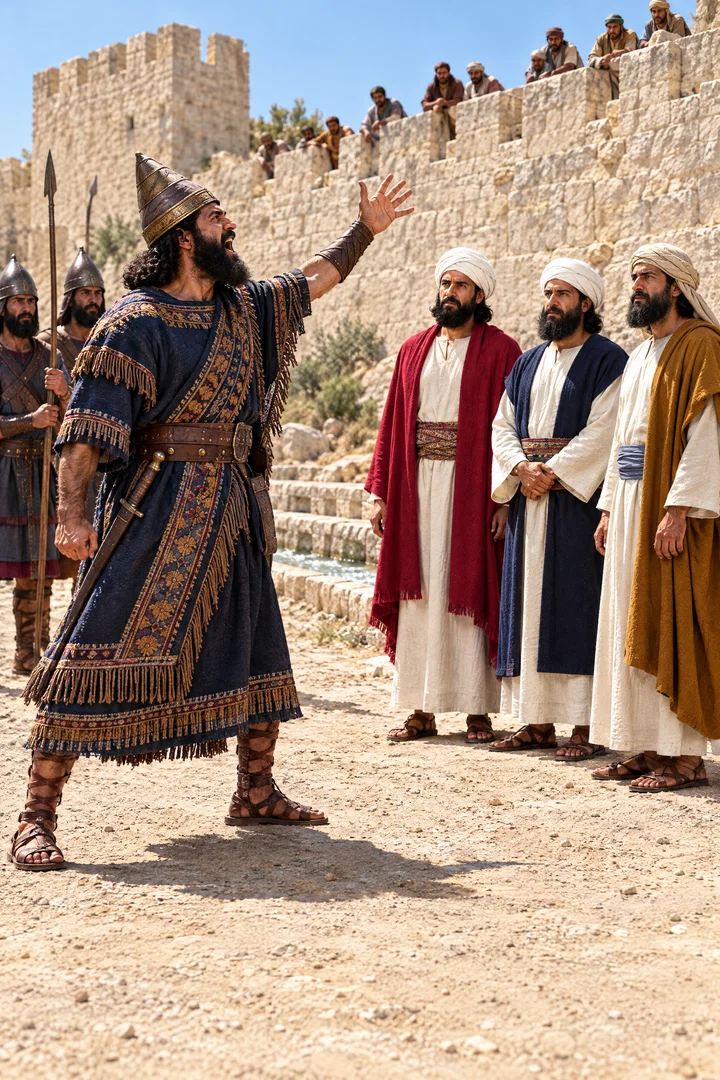
And Rab-shakeh said unto them, Speak ye now to Hezekiah, Thus saith the great king, the king of Assyria, What confidence is this wherein thou trustest?
Translations
And Rabshakeh said to them, Speak you now to Hezekiah, Thus says the great king, the king of Assyria, What confidence is this wherein you trust?
And Rab-shakeh said unto them, Speak ye now to Hezekiah, Thus saith the great king, the king of Assyria, What confidence is this wherein thou trustest?
And Rab-shakeh said unto them, Speak ye now to Hezekiah, Thus saith the great king, the king of Assyria, What confidence is this where in thou trustest?
And Rab-shakeh said to them, Speak ye now to Hezekiah, Thus saith the great king, the king of Assyria, What confidence is this in which thou trustest?
Revised Version, American Standard Version
And Rabshakeh said unto them, Say ye now to Hezekiah, Thus saith the great king, the king of Assyria, What confidence is this wherein thou trustest?
And the chief of the butlers saith unto them, 'Say, I pray you, unto Hezekiah, Thus said the great king, the king of Asshur, What [is] this confidence in which thou hast confided?
And Rab-shakeh said to them, Say now to Hezekiah, Thus says the great king, the king of Assyria: What confidence is this wherein thou trustest?
And Rab-shakeh said unto them—Pray you, say unto Hezekiah,—Thus, saith the great king, the king of Assyria, What trust is this wherewith thou dost trust?
Berean Standard Bible, Majority Standard Bible
The Rabshakeh said to them, “ Tell Hezekiah that this is what the great king, the king of Assyria, says: What is the basis of this confidence of yours?
Rabshakeh said to them, “Say now to Hezekiah, ‘ The great king, the king of Assyria, says, “ What confidence is this in which you trust?
And the Rab-shakeh said to them, Say now to Hezekiah, These are the words of the great king, the king of Assyria: In what are you placing your hope?
And Rabshakeh sayde vnto them, Tell ye Hezekiah, I pray you, Thus saith the great King, euen the great King of Asshur, What confidence is this wherein thou trustest?
Douay-Rheims (Challoner revision)
And Rabsaces said to them: Speak to Ezechias: Thus saith the great king, the king of the Assyrians: What is this confidence, wherein thou trustest?
Pictures
Cross-references
- 2 Kings 19:35
And it came to pass that night, that the angel of the LORD went out, and smote in the camp of the Assyrians an hundred fourscore and five thousand: and when they arose early in the morning, behold, they were all dead corpses.
Records the destruction of the Assyrian army at Jerusalem.
- Isaiah 37:10-13
Thus shall ye speak to Hezekiah king of Judah, saying, Let not thy God, in whom thou trustest, deceive thee, saying, Jerusalem shall not be given into the hand of the king of Assyria.
Sennacherib’s message belittles God’s power to deliver Jerusalem.
- 2 Chronicles 32:19
And they spake against the God of Jerusalem, as against the gods of the people of the earth, which were the work of the hands of man.
The Assyrians equate Jerusalem’s God with handmade idols.
- 2 Kings 19:36-37
So Sennacherib king of Assyria departed, and went and returned, and dwelt at Nineveh.
Records Sennacherib’s return to Nineveh and his death there.
- Isaiah 36:13-20
Then Rabshakeh stood, and cried with a loud voice in the Jews’ language, and said, Hear ye the words of the great king, the king of Assyria.
Records Rabshakeh’s taunts against Hezekiah and the Lord.
- Isaiah 36:5
I say, sayest thou, (but they are but vain words) I have counsel and strength for war: now on whom dost thou trust, that thou rebellest against me?
Records the same challenge to Hezekiah’s trust.
- Isaiah 37:21-35
Then Isaiah the son of Amoz sent unto Hezekiah, saying, Thus saith the LORD God of Israel, Whereas thou hast prayed to me against Sennacherib king of Assyria:
The Lord answers Assyria’s challenge and promises to save Jerusalem.
- 2 Kings 19:10-13
Thus shall ye speak to Hezekiah king of Judah, saying, Let not thy God in whom thou trustest deceive thee, saying, Jerusalem shall not be delivered into the hand of the king of Assyria.
Records the Assyrian threat against Hezekiah’s trust in God.
- 2 Chronicles 32:20-22
And for this cause Hezekiah the king, and the prophet Isaiah the son of Amoz, prayed and cried to heaven.
God delivers Hezekiah and Jerusalem from the Assyrian king.
- 2 Kings 19:32-34
Therefore thus saith the LORD concerning the king of Assyria, He shall not come into this city, nor shoot an arrow there, nor come before it with shield, nor cast a bank against it.
The LORD promises to defend Jerusalem and save it from Assyria.
- Isaiah 37:36
Then the angel of the LORD went forth, and smote in the camp of the Assyrians a hundred and fourscore and five thousand: and when they arose early in the morning, behold, they were all dead corpses.
Records the destruction of the Assyrian army after its blasphemy.
- 2 Kings 18:31-35
Hearken not to Hezekiah: for thus saith the king of Assyria, Make an agreement with me by a present, and come out to me, and then eat ye every man of his own vine, and every one of his fig tree, and drink ye every one the waters of his cistern:
continues Rabshakeh's demand for submission
- 2 Kings 19:15-19
And Hezekiah prayed before the LORD, and said, O LORD God of Israel, which dwellest between the cherubims, thou art the God, even thou alone, of all the kingdoms of the earth; thou hast made heaven and earth.
Hezekiah prays to God in response to the Assyrian challenge.
- Isaiah 30:1-7
Woe to the rebellious children, saith the LORD, that take counsel, but not of me; and that cover with a covering, but not of my spirit, that they may add sin to sin:
The Egyptian alliance Judah trusted in is the one Sennacherib challenged.
- Isaiah 31:1-3
Woe to them that go down to Egypt for help; and stay on horses, and trust in chariots, because they are many; and in horsemen, because they are very strong; but they look not unto the Holy One of Israel, neither seek the LORD!
Condemns trusting Egypt for help, the alliance challenged by Assyria.
- 2 Kings 19:7
Behold, I will send a blast upon him, and he shall hear a rumour, and shall return to his own land; and I will cause him to fall by the sword in his own land.
Says the Assyrian king returned to his own land.
- Psalms 115:9
O Israel, trust thou in the LORD: he is their help and their shield.
Calls Israel to trust in the Lord as help and shield.
Commentary
Each commentary is drawn from primary sources: the writings of Ellen G. White and Adventist pioneers and periodicals. Each commentary is separate. Its own words are not a quotation; follow the references to read the source passages.
Ellen G. White
2 sources
Because Israel and Judah had grown weak and apostate, God's name was no longer feared among the nations but had become a subject of continual blasphemy.RH May 27, 1915 In that condition Assyria pressed its demand that Judah surrender, and Rabshakeh confronted Hezekiah with a demand to state the basis of his confidence in resisting.PK 352.3–354.1RH May 27, 1915
The challenge called into question both Hezekiah's own military strength and his trust in the Lord.PK 352.3–354.1 Its words were a blasphemous taunt and reviling against God.PK 352.3–354.1RH May 27, 1915 They were spoken loudly in the Jewish language so that the people on Jerusalem's wall could hear them.PK 352.3–354.1
Sources
Pioneers and periodicals
12 sources
Rabshakeh, the Assyrian envoy and commander, tauntingly challenges Hezekiah to explain the confidence behind his trust as Assyria demands the surrender of Jerusalem under threat of siege.RH May 27, 1915ST Dec 9, 1897RH Nov 14, 1912 The question exposes Hezekiah's reliance on an alliance with Egypt, which Sennacherib had discovered and sought to cut off by advancing to Lachish before sending his officers to Jerusalem.ST Nov 19, 1885RH Jun 11, 1857 The challenge is blasphemous reviling that speaks of the God of Jerusalem as merely one of the powerless gods made by human hands and boasts that no god can save any nation from Assyrian power.RH May 27, 1915ST Jun 21, 1905RH May 21, 1908 Against human reliance on earthly powers Hezekiah trusts in the God of Israel, and God shows himself mightier than Assyria by saving Jerusalem through direct, miraculous intervention.RH Nov 14, 1912RH May 21, 1908RH Aug 6, 1861
Siege Setting and Challenge
Rabshakeh, the Assyrian envoy and commander, tauntingly challenged Hezekiah to explain the confidence behind his trust in the face of danger and threat, while Assyria demanded the surrender and submission of the city of Jerusalem.RH May 27, 1915ST Dec 9, 1897RH Nov 14, 1912RH Aug 6, 1861RH Nov 16, 1916 The challenge confronted Hezekiah with the question of what he trusted in when the king of Assyria threatened Judah.RH Nov 14, 1912RH Aug 6, 1861RH Nov 16, 1916 The verse falls within the history of Judah after the ten tribes were swept away.ST Dec 9, 1897 It stands in the closing record of Kings that follows the utter breaking up of the northern kingdom of Samaria in the seventeenth chapter and hastens to the Babylonian captivity of Judah. It belongs to the eight chapters covering the reign of seven kings — Hezekiah, Manasseh, Amon, Josiah, Jehoahaz, Jehoiakim, Jehoiachin, and Zedekiah — five chapters of which are given to the two good kings Hezekiah and Josiah.
The verse is part of the account of Sennacherib's invasion of Palestine and siege of Jerusalem, an event also recorded on Sennacherib's cylinder. That account includes his wars against Israel and Judah, including the capture of cities, the siege of Lachish, and the tribute Hezekiah paid to the Assyrian king.RH Jun 11, 1857 Rabshakeh's question about what confidence Hezekiah trusted in exposes his reliance on an alliance with Egypt against Assyria, which Sennacherib had discovered.ST Nov 19, 1885 Because of that discovery Sennacherib advanced to Lachish to place himself between Hezekiah's forces and the king of Egypt's forces and cut off their union.ST Nov 19, 1885 He then sent Rabshakeh with Rabsaris and Tartan from Lachish to Jerusalem to demand Hezekiah's submission.ST Nov 19, 1885
Jerusalem in Hezekiah's time was the city of the Great King, yet it was not exempt from coming evil.ST May 8, 1879 The warning that it would be destroyed and Israel led captive proved more true than confidence that harm could not reach it.ST May 8, 1879 The chapter, considered with the following chapter and related accounts, does not support the claim that the king of Assyria or his army fulfilled Isaiah 30:33 by perishing in Tophet.RH Jun 15, 1869 The account places the army with the king at Libnah when the angel struck down 185,000, and says the king returned to his own land and died there.RH Jun 15, 1869
Trust, Blasphemy, and Deliverance
The taunting question put to Hezekiah sets human reliance on earthly powers against trust in God, for Hezekiah trusts in the God of Israel in the face of danger and is victorious.RH Aug 6, 1861 The threat that confronts him shows that God's people can turn to Him when threatened and trust Him in trouble.RH Nov 14, 1912
The demand for surrender was part of blasphemous reviling against God, boasting that no god could save any nation from Assyrian power.RH May 27, 1915RH May 21, 1908 The Assyrians spoke of Jerusalem's God as though He were merely one of the powerless gods made by human hands, no more than the idols of the nations, and used that claim to frighten and discourage the people during the siege.ST Jun 21, 1905RH May 21, 1908 This blasphemy had become continual because Israel and Judah had grown weak and apostate, so that God's name was no longer feared among the nations.RH May 27, 1915
The subsequent deliverance showed that the God of heaven was mightier than Assyria and saved Jerusalem by direct, miraculous intervention.RH May 21, 1908 Hezekiah himself was a devoted man of God notwithstanding his mistakes, yet his mistake exalted man, aroused the cupidity of Babylon, and brought captivity upon his own seed.
Through Rabshakeh's challenge to Hezekiah's trust, Sennacherib set himself against the word of God.ST Jul 15, 1908 He lifted a puny hand against God's mighty plans and precepts, striking against the Rock of the word.ST Jul 15, 1908 His name and fate are written in hopeless doom on the pages of history, and his name would have been lost in oblivion had it not been associated with opposition to truth, so that now it lives only in infamy; the man is dead, but the Rock stands.ST Jul 15, 1908
Sources