Exodus 12:7
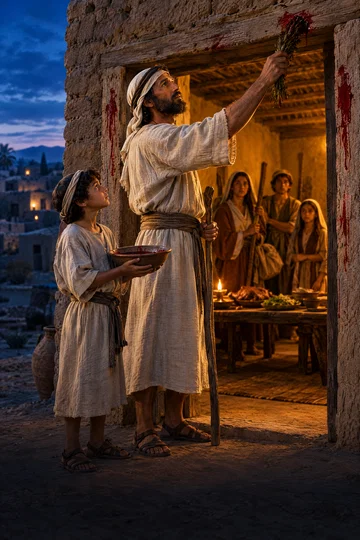
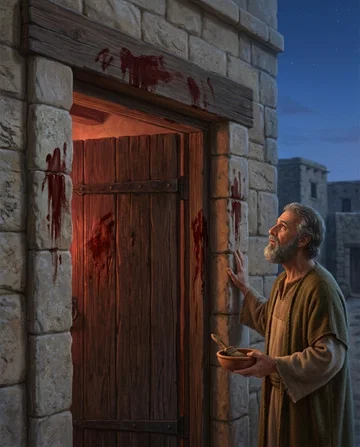
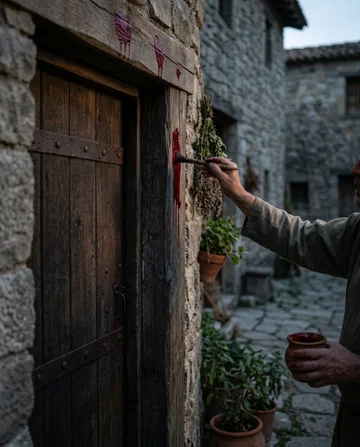
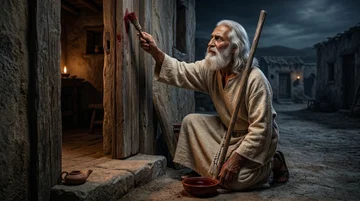
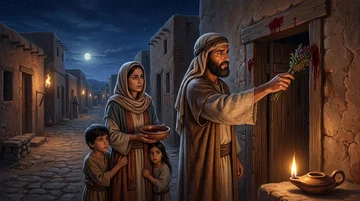
And they shall take of the blood, and strike it on the two side posts and on the upper door post of the houses, wherein they shall eat it.
Translations
American King James Version, King James Version, KJV Cambridge Paragraph Bible
And they shall take of the blood, and strike it on the two side posts and on the upper door post of the houses, wherein they shall eat it.
And they shall take of the blood, and strike it on the two side-posts, and on the upper door-post of the houses, in which they shall eat it.
And they shall take of the blood, and put it on the two side posts and on the lintel, upon the houses wherein they shall eat it.
And they shall take of the blood, and put it on the two side-posts and on the lintel, upon the houses wherein they shall eat it.
and they have taken of the blood, and have put on the two side-posts, and on the lintel over the houses in which they eat it.
And they shall take of the blood, and put [ it] on the two door-posts and on the lintel of the houses in which they eat it.
And they shall take of the blood, and put upon the two door-posts and upon the upper-beam,—upon the houses wherein they are to eat it.
Berean Standard Bible, Majority Standard Bible
They are to take some of the blood and put it on the sides and tops of the doorframes of the houses where they eat the lambs.
They shall take some of the blood, and put it on the two door posts and on the lintel, on the houses in which they shall eat it.
Then take some of the blood and put it on the two sides of the door and over the door of the house where the meal is to be taken.
After, they shall take of the blood, and strike it on the two postes, and on the vpper doore post of the houses where they shall eate it.
Douay-Rheims (Challoner revision)
And they shall take of the blood thereof, and put it upon both the side posts, and on the upper door posts of the houses, wherein they shall eat it.
Pictures
Cross-references 20 of 59
- Exodus 12:13
And the blood shall be to you for a token upon the houses where ye are: and when I see the blood, I will pass over you, and the plague shall not be upon you to destroy you, when I smite the land of Egypt.
The blood is a sign by which the Lord passes over and spares the houses.
- 1 Corinthians 5:7
Purge out therefore the old leaven, that ye may be a new lump, as ye are unleavened. For even Christ our passover is sacrificed for us:
Christ is the Passover sacrifice, fulfilling the Passover type.
- Exodus 12:23
For the LORD will pass through to smite the Egyptians; and when he seeth the blood upon the lintel, and on the two side posts, the LORD will pass over the door, and will not suffer the destroyer to come in unto your houses to smite you.
The Lord sees the blood and keeps the destroyer from entering.
- John 1:29
The next day John seeth Jesus coming unto him, and saith, Behold the Lamb of God, which taketh away the sin of the world.
The Passover lamb prefigures Christ, the Lamb of God who takes away sin.
- 1 Peter 1:19
But with the precious blood of Christ, as of a lamb without blemish and without spot:
Christ’s precious blood is pictured by the Passover lamb’s saving blood.
- Exodus 12:11
And thus shall ye eat it; with your loins girded, your shoes on your feet, and your staff in your hand; and ye shall eat it in haste: it is the LORD’s passover.
Both describe eating the Passover meal in haste before Israel’s deliverance from Egypt.
- Hebrews 11:28
Through faith he kept the passover, and the sprinkling of blood, lest he that destroyed the firstborn should touch them.
Faith led Israel to keep the Passover and mark their doors with blood for protection.
- Luke 22:19-20
And he took bread, and gave thanks, and brake it, and gave unto them, saying, This is my body which is given for you: this do in remembrance of me.
Jesus’ Passover supper connects the cup to his blood and institutes a memorial of his death.
- John 6:51
I am the living bread which came down from heaven: if any man eat of this bread, he shall live for ever: and the bread that I will give is my flesh, which I will give for the life of the world.
The Passover lamb eaten points to Christ giving his flesh for the life of the world.
- John 6:53-54
Then Jesus said unto them, Verily, verily, I say unto you, Except ye eat the flesh of the Son of man, and drink his blood, ye have no life in you.
Partaking of Christ gives life and resurrection.
- Ezekiel 9:4-6
And the LORD said unto him, Go through the midst of the city, through the midst of Jerusalem, and set a mark upon the foreheads of the men that sigh and that cry for all the abominations that be done in the midst thereof.
Both use a mark to distinguish those spared from slaughtering judgment.
- Exodus 12:29-30
And it came to pass, that at midnight the LORD smote all the firstborn in the land of Egypt, from the firstborn of Pharaoh that sat on his throne unto the firstborn of the captive that was in the dungeon; and all the firstborn of cattle.
marked houses spared while firstborn slain
- Exodus 12:14
And this day shall be unto you for a memorial; and ye shall keep it a feast to the LORD throughout your generations; ye shall keep it a feast by an ordinance for ever.
Commands Passover as a lasting memorial of deliverance.
- Matthew 26:27-28
And he took the cup, and gave thanks, and gave it to them, saying, Drink ye all of it;
Christ’s blood in the Supper fulfills the Passover sacrifice.
- Exodus 12:26-27
And it shall come to pass, when your children shall say unto you, What mean ye by this service?
Children are to be taught that the service recalls Israel’s deliverance.
- Deuteronomy 16:1-6
Observe the month of Abib, and keep the passover unto the LORD thy God: for in the month of Abib the LORD thy God brought thee forth out of Egypt by night.
gives later temple form with added injunctions
- John 18:28
Then led they Jesus from Caiaphas unto the hall of judgment: and it was early; and they themselves went not into the judgment hall, lest they should be defiled; but that they might eat the passover.
The rulers avoid defilement so they can eat the Passover lamb.
- Exodus 12:42
It is a night to be much observed unto the LORD for bringing them out from the land of Egypt: this is that night of the LORD to be observed of all the children of Israel in their generations.
Identifies the Passover night as a memorial of Israel’s deliverance.
- Leviticus 23:5
In the fourteenth day of the first month at even is the LORD’s passover.
Dates the Passover instituted in Exodus.
- Exodus 4:23
And I say unto thee, Let my son go, that he may serve me: and if thou refuse to let him go, behold, I will slay thy son, even thy firstborn.
The threatened death of Egypt’s firstborn is averted by the Passover blood.
Commentary
Each commentary is drawn from primary sources: the writings of Ellen G. White and Adventist pioneers and periodicals. Each commentary is separate. Its own words are not a quotation; follow the references to read the source passages.
Ellen G. White
57 sources
On the night of the last and most terrible plague on Egypt, each household was to slay a lamb without blemish and strike its blood with hyssop on the two side posts and upper post of the house where it was eaten roasted inside, while at midnight the angel passed through to slay the firstborn of man and beast.PP 274.1–2SG3 222.2SG3 244.2 The blood outside was a token upon the house, so the destroying angel would recognize the marked dwelling, pass over it and not enter, and the plague would not destroy those inside.5RED 48.1ST Jul 4, 1878DA 51.2–3 The blood on the doorposts is the symbol of the blood of Christ, the sinless Lamb of God slain for the sins of the world, which alone cleanses the believing sinner from sin and shelters him from the wrath of God upon the impenitent.1RED 30.1LC1 29.2–30.13SP 128.12SP 36.1ST Jul 4, 1878 No one is benefited by that provision without doing his appointed part, for protection required exact obedient faith, gathering the whole family inside and remaining there, so that a household disregarding the command or leaving children outside would not be spared.1RED 30.1LC1 29.2–30.1HSFM 216.4–217.22SP 36.1Ms 59, 1895, par. 40–44 The marked homes provide the pattern for the sealing of God's saints for protection in the coming judgment, and give parents their charge to bring their children inside under the blood, separate from the world and familiar with God's law, that believing parents' mark may cover their little ones when the scourge passes.HSFM 216.4–217.2RH Sep 19, 1854MH 403.3WLF 3.11–13Ms 5, 1854, par. 2–3
Passover Night in Egypt
Each family, alone or joined with another, was to slay a lamb or kid without blemish and sprinkle its blood with hyssop on the two side posts and upper door post of the house where it was to be eaten.PP 274.1–2 The direction was given for preservation from the coming judgment on Egypt, with the blood as a token upon the house so that the destroying angel coming at midnight would not enter that dwelling and the plague smiting the firstborn would not destroy those inside.PP 274.1–2
The ordinance belonged to the night of the last plague upon Egypt, which was the most severe of all and came after the plagues of locusts and of oppressive darkness in which the Hebrews still had pure air and light in their dwellings.SG3 244.21SP 217.2 Moses made known the nature and effect of that final plague beforehand to Pharaoh and to the people of Egypt as well as to the Israelites, while the king and his idolatrous priests still opposed letting Israel go though the people desired their departure.SG3 244.21SP 217.2 That night was terrible to the Egyptians and glorious to the people of God.SG3 244.21SP 217.2
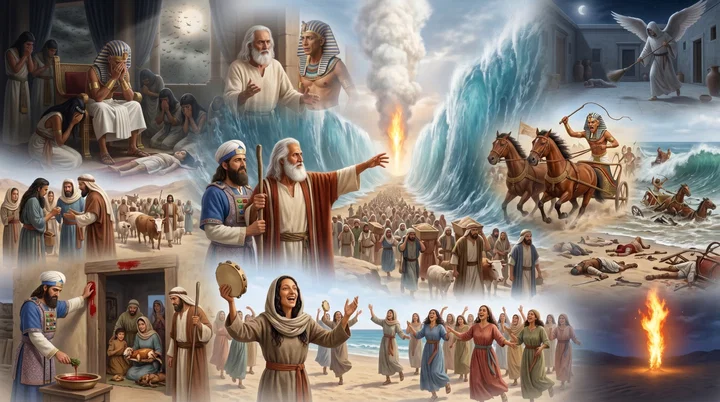
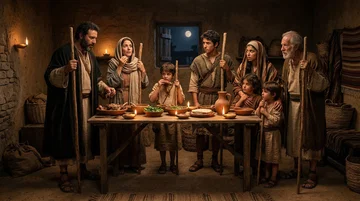
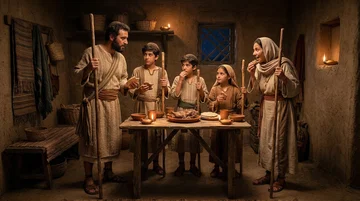
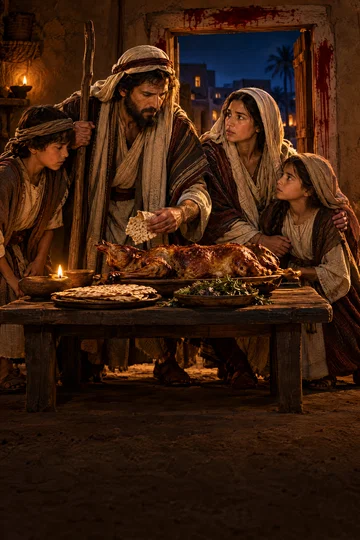
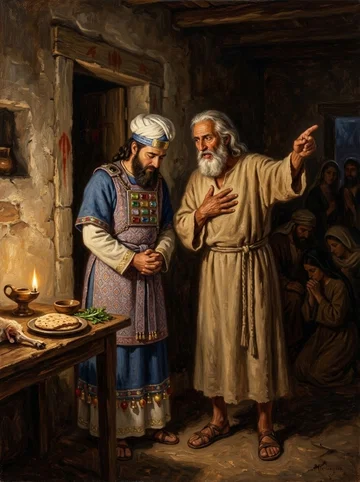
The blood was put outside as a token for a sign while the lamb was eaten roasted whole with bitter herbs inside, as the angel of God passed through Egypt at midnight to slay the firstborn of man and beast.SG3 222.2 It was placed on the sides and top of each household's doorway, on the two doorposts and lintel of every house where the Passover was eaten.ST Sep 9, 1875PP 275 The doorway was marked with blood by a robed figure while the destroying angel swept across the sky above the buildings, belonging together with the Passover supper gathered around the table inside, the passing of the destroying angel, and the slaying of the firstborn mourned by the Egyptians.ST Sep 9, 1875PP 275
The blood token marking the Israelite homes was seen and ridiculed by the Egyptians before the firstborn were slain.SG3 246.11SP 219.1 When the plague came the firstborn of Egypt from the king upon his throne down to the lowliest servant were slain and wailing filled all Egypt, while the houses with the blood were passed over.1SP 219.1 The stroke humbled proud Pharaoh, who went in haste with his counselors and rulers to Goshen, bowed before Moses and Aaron, bade Israel go and serve God with flocks and herds, implored them to leave lest all Egypt be as dead men, and entreated a blessing from Moses to protect him from further plague.1SP 219.1
The marking took place on the night of Israel's release from slavery in Egypt, on the night of the final judgment on Egypt.COS 103.1–4DA 76.1 The Passover observance with its marked houses commemorated God's deliverance of Israel from bondage.COS 103.1–4DA 76.1 In the later Passover service the lamb, the unleavened bread, the bitter herbs, and the story of the sprinkled blood recalled that deliverance from bondage, with the blood joined to the death-dealing angel and to the grand march from the land of bondage.ED 42.2ST Nov 2, 1915 It was rehearsed in solemn silence in the night assembly at Jerusalem, in the hasty meal of lamb, unleavened bread and bitter herbs eaten by men with girded loins, shoes on feet and staff in hand, to make the event vivid, stir the imagination, impress the heart, and fix the deliverance forever in the memory of children and youth.ED 42.2ST Nov 2, 1915
Blood as Protecting Sign
The blood was a token set upon the house, so that the destroying angel coming on his mission of death to slay the firstborn of man and beast would recognize the marked dwelling, pass over it and not enter it, and the plague smiting Egypt would not destroy those inside.5RED 48.1ST Jul 4, 1878DA 51.2–3Ms 5, 1889, par. 14–16 The blood of the slain lamb placed on the lintel and doorposts marked each Israelite house where the lamb was eaten and marked their deliverance.5RED 48.1DA 51.2–3Ms 5, 1889, par. 14–16 It was a sign of their connection with God.Ms 5, 1889, par. 14–16 It was a sign of safety and protection for the Hebrews when the firstborn of their enemies were slain in Egypt.ST Mar 15, 18774RED 91.1–22SP 278.1–279.1
The blood struck on the doorposts was a signature of blood declaring that the Israelites were God's property and a witness that they were His denominated people.Lt 47, 1905, par. 1–8Ms 39, 1899, par. 15–16 Houses thus marked were not visited by the destroying angel and were preserved from general ruin.Lt 47, 1905, par. 1–8Ms 39, 1899, par. 15–16 The blood therefore identified the households that obeyed God's instructions and were spared when judgment struck Egypt.Ms 59, 1895, par. 40–44 Each family was to gather inside with its children, ready to depart, and the angel passed over the houses marked with blood, while the blood offered no protection to a household that disregarded the command or left its children outside.Lt 47, 1905, par. 1–8Ms 59, 1895, par. 40–44
Christ Foreshadowed in Lamb
The blood struck on the side posts and lintel was the symbol of the blood of Christ.1RED 30.1LC1 29.2–30.12SP 36.1ST Oct 4, 1877ST Dec 9, 1880 That blood is efficacious for the believing sinner to cleanse him from sin and to shelter him from the wrath of God that is to come upon the impenitent and unbelieving world, just as the wrath of God fell upon the Egyptians while sheltered Israel was spared.1RED 30.1LC1 29.2–30.12SP 36.1ST Oct 4, 1877 The yearly ordinance was given to keep the deliverance from Egypt in memory and to turn minds from world-loving interests and temporal cares and anxieties to review God's works, miracles, mercies, and loving-kindness, so that love and reverence for Him would increase and lead to continual looking to Him and trusting Him in trial and not turning to other gods.LC1 29.2–30.1ST Oct 4, 1877
The slaying of the lamb was to be associated with the future death of the Son of God.1RED 30.1LC1 29.2–30.1 The lamb to be eaten was a symbol of Christ's body, and the slain lamb points to Christ's own death for the sins of the world as the only true propitiation, whose blood preserves sinners from the wrath of a sin-hating God.1RED 30.1LC1 29.2–30.14RED 94.22SP 280.2–281.2 The ordinance thus carried a mournful interest because it pointed forward to His approaching death.4RED 94.2ST Oct 4, 1877
The lamb and its blood prefigured Christ, the sinless Lamb of God.3SP 128.15RED 48.1ST Jul 4, 18784RED 91.1–2 His merits alone avert judgment and condemnation for fallen humanity, and His blood alone has power to save the world and redeem believers from sin and eternal death.3SP 128.15RED 48.1ST Jul 4, 18782SP 278.1–279.1 Sinful people continually depend on its merits for safety from Satan's power and for final redemption, and Israel's deliverance was a type of the great salvation He brought.3SP 128.11SP 201.1 The blood on the doorposts was a sign of safety when the firstborn were slain, because it represented Christ's blood shed for the sins of the world.4RED 91.1–22SP 278.1–279.1
Those who by faith eat Christ's flesh and drink His blood will finally be raised from the dead, and this spiritual food gives a well-founded hope of resurrection to immortal life in the kingdom of God.ST Mar 15, 1877DA 388.2–389.2 God desired Israel to behold in the paschal lamb Him who gave Himself for the life of the world and through the symbol to receive Him, for only through dying could He impart life to men and His death is the means of salvation.DA 388.2–389.2 The same truth symbolized in the paschal service is taught when Christ says the bread He gives is His flesh for the life of the world and that eating His flesh and drinking His blood gives eternal life.DA 388.2–389.2
The Passover cannot be understood apart from Christ, for its blood and ceremonies represented Him and pointed to the Messiah revealed in the Old Testament.4RED 94.23SP 388.1–2SLP 82.1–2ST Jul 17, 1879 He is the key that unlocks its meaning and gives access to its treasures, proving His identity with the Messiah through Moses and the prophets.SLP 82.1–2ST Jul 17, 1879 All such religious services and ceremonies are valueless if the Saviour they represent is rejected.4RED 94.2SLP 82.1–2ST Jul 17, 1879 Yet the Jews made the symbol all-important while its significance went unnoticed, discerning not the Lord's body even while Christ Himself stood in their midst presenting Himself as Saviour and they refused His offers of mercy.4RED 94.2DA 388.2–389.2
Christ identified Himself as the Passover's great antitype when He connected the Lord's Supper with the Passover.3SP 128.15RED 48.1 The Passover lamb prefigured Christ the antitypical Lamb whose death fulfilled that symbol, so that at His trial type was meeting antitype.ST Aug 8, 1878Ms 104, 1897, par. 8–919MR 163.2–3 The ceremony had been instituted by Christ Himself before His incarnation, and its meaning was bound up with His own life and mission to save the covenant people, for He is the foundation of the whole Jewish economy.IRCUP 10.1Ms 104, 1897, par. 8–919MR 163.2–3 Yet the priests, scribes, and rulers were exact about their own maxims and traditions not to enter the judgment hall lest they be defiled and be kept from eating the Passover, while they condemned to death the One who gave it.Ms 104, 1897, par. 8–919MR 163.2–3
Faith Shown by Obedience
No one is benefited by God's provision for salvation unless he performs the work God leaves him to do, doing his appointed part and manifesting by his own acts his faith in that provision.1RED 30.1LC1 29.2–30.12SP 36.1ST Oct 4, 1877ST Dec 9, 1880 The blood struck on the doorposts was the symbol of the blood of Christ, which is efficacious for the believing sinner to cleanse him from sin and to shelter him from the wrath of God that will come upon the impenitent and unbelieving world, just as the wrath of God fell upon the Egyptians while sheltered Israel was spared.1RED 30.1LC1 29.2–30.1ST Oct 4, 1877ST Dec 9, 1880 The slaying of the lamb was to be associated with the future death of the Son of God for the sins of the world, and the yearly ordinance was given to keep the deliverance from Egypt in memory and to turn minds from world-loving interests and temporal cares to review God's miracles, mercies and loving-kindness, so that love and reverence would increase and lead to continual looking to Him and trusting Him in trial instead of turning to other gods.1RED 30.1LC1 29.2–30.12SP 36.1ST Oct 4, 1877
Protection required exact obedience, for God tested faith by giving His people some part to act in connection with His interposition in their behalf.HSFM 216.4–217.215MR 224.3–225.2Ms 59, 1895, par. 40–44 An Israelite neglecting the blood on the plea that God could distinguish Hebrews from Egyptians would not have had heavenly sentinels guard that dwelling, and without that response even the firstborn in a Hebrew household would not be spared.HSFM 216.4–217.215MR 224.3–225.2 The blood offered no protection to a household that disregarded the command or left its children outside, for each family was to gather inside, ready to depart, and the angel passed over only the houses marked with blood.HSFM 216.4–217.215MR 224.3–225.2Ms 59, 1895, par. 40–44
The blood on the houses was a sign of faith in God's promised deliverance and a visible mark of trusting in the only begotten Son, so that the destroying angel would pass over.1SP 199.1–200.1PP 278.2–279.1Lt 16e, 1892, par. 38–40 The sign was not enough apart from obeying the other directions, for the people had to keep their families separate from the Egyptians, gather with their children inside their own houses and remain there, thereby showing faith through action.1SP 199.1–200.1Ms 59, 1895, par. 40–44PP 278.2–279.1Lt 16e, 1892, par. 38–40 Believing Egyptians were welcomed into those houses, and without the blood mark Israelites received no distinction from the Egyptians.RH Sep 19, 18541SP 199.1–200.1ST Sep 9, 1875Ms 5, 1854, par. 2–3 The blood points to salvation through Christ's merits, while the people's obedience demonstrates faith; obedience does not earn salvation, but faith must be shown by turning from sin and obeying God's requirements.PP 278.2–279.1
The blood prefigured the slaying of the Son of God and the efficacy of His blood shed for the salvation of the sinner, and the mark was a sign that the household accepted Christ as the promised Redeemer and showed faith in Jesus the great Sacrifice.2MR 147.2–148.1Ms 26, 1885, par. 28–34 The parents evidenced their faith by implicitly obeying the directions given, and their obedient faith covered themselves and their children.2MR 147.2–148.1Ms 26, 1885, par. 28–34 The house so marked was shielded from the destroyer's power, and the destroying angel passed over every house that had the mark.2MR 147.2–148.1Ms 26, 1885, par. 28–34 The faith of believing parents thus extends to and covers their little children who have had no test of character, protecting them from the destroying angel.2MR 147.2–148.1
Final Judgment Foreshadowed
The blood on the two side posts and upper door post was a sign of God's protection of Israel during the night of judgment in Egypt, when without that prescribed act Israel was not distinguished from Egypt.WLF 3.11–13Ms 5, 1854, par. 2–3 That marking foreshadows the sealing of God's saints, who will be protected in the time of trial and divine wrath when Christ rules the nations.WLF 3.11–13 The blood-marked homes provide the pattern for a coming judgment in which the destroying angel will kill those who do not have the mark.Ms 5, 1854, par. 2–3 The mark or seal of believing parents will cover their children when the parents separate them from wicked influences, discipline them, teach them obedience, and bring them to God for His blessing.Ms 5, 1854, par. 2–3
The destroying angel is again to pass through the land, and a mark, the keeping of His holy Sabbath, is to be placed upon God's people.HSFM 216.4–217.2 Those who comply with the conditions receive His promises, but all who follow their own will and judgment and depart from His instructions to come to their own terms will perish with the wicked when His judgments visit the earth.HSFM 216.4–217.2 The command then to bring the children into the house, to strike the blood on the doorpost, and for none to go out, was because all found among the Egyptians would be destroyed with them.HSFM 216.4–217.2
Just as truly as the blood struck on the posts was a signature of blood declaring that the Israelites were God's property and a mark that preserved them from general ruin, so a mark is placed upon every child of God in this age.Ms 39, 1899, par. 15–16RH Feb 6, 1900 That signature is borne by placing himself in harmony with God's holy law.Ms 39, 1899, par. 15–16RH Feb 6, 1900 The Sabbaths are given as the sign between God and His people that He sanctifies them and identifies them as belonging to Him.Ms 39, 1899, par. 15–16RH Feb 6, 1900
Its lesson for Christians is to gather their families under the protection of the Lamb of God amid deception and false teaching.Ms 116, 1894, par. 14Ms 77, 1902, par. 34–35 The judgment will reveal the character formed in the home and shown in relationships with family, neighbors, and the world.Ms 116, 1894, par. 14 The blood means faith in the blood of Christ, and the same gathering and marking is needed today to save children from the destructive power of the evil one.Ms 77, 1902, par. 34–35 The conflict between Christ and Satan will increase in intensity until the end of this earth's history, and faith in the blood of Christ is what will bring God's people safely through the perilous times just before them.Ms 77, 1902, par. 34–35
Home and Parental Charge
When the destroying angel was about to smite the firstborn of man and beast, Israel was commanded to bring the children into the house, to strike the blood on the doorpost, and for none to go out of the house, because all found among the Egyptians would be destroyed with them.HSFM 216.4–217.2RH Sep 19, 18541SP 199.1–200.1MH 403.3Lt 47, 1905, par. 1–8 The households were to remain gathered inside their own houses within the protection signified by the blood, and the blood-marked house was a place of safety and separation.1SP 199.1–200.1MH 403.3ST Nov 24, 1914Lt 47, 1905, par. 1–8Lt 244, 1903, par. 14 Without the blood mark Israel received no distinction from the Egyptians, but houses thus marked as a witness that they were God's denominated people were not visited by the destroying angel, and believing Egyptians were welcomed into those houses.RH Sep 19, 18541SP 199.1–200.1Lt 47, 1905, par. 1–8Ms 5, 1854, par. 2–3Lt 12, 1886, par. 2–3
At the birth of Israel as a nation God gave this object-lesson to impress all hearts with guarding the associations of children, preserving them from harmful companionship and making them from their earliest years familiar with the precepts and principles of God's law.MH 403.3ST Nov 24, 1914 Parents who love and fear God are now to keep their children under the bond of the covenant, within the protection of those sacred influences made possible through Christ's redeeming blood, bringing them out from the influence of the world.MH 403.3ST Nov 24, 1914Lt 47, 1905, par. 1–8Lt 12, 1886, par. 2–3 They must not break down the barriers that truth builds as a fortress about them, since it is unsafe to permit children to associate with unbelievers as freely as with Christians.Lt 47, 1905, par. 1–8Lt 12, 1886, par. 2–3Lt 244, 1903, par. 14 Whether youth who have received wise instruction and training from godly parents will continue to be sanctified through the truth depends largely upon the influences they meet after leaving their homes among those to whom they look for Christian instruction.Lt 244, 1903, par. 14
If parents allow their children to receive an education with the world and make the Sabbath a common day the seal of God cannot be placed upon them and they will be destroyed with the world with their blood resting upon the parents.HSFM 216.4–217.2 But if parents faithfully teach God's commandments, separate children from wicked influences, bring them into subjection to parental authority, discipline them, teach them obedience, and by faith and prayer commit them to God, He will work with their efforts and when the overflowing scourge passes they with their children may be hidden.HSFM 216.4–217.2Ms 5, 1854, par. 2–3 The mark or seal of believing parents will cover their children when they are separated from wicked influences, disciplined, taught obedience, and brought to God for His blessing.HSFM 216.4–217.2RH Sep 19, 1854Ms 5, 1854, par. 2–3
Every family is to mark the doorposts of its house with the blood of Jesus Christ as its safeguard.Ms 7, 1908, par. 7 The marking is done by lives of consecration and obedience lived in the home by parents and children in their special work for the home church.Ms 7, 1908, par. 7 Model homes formed in this way produce a perfect church.Ms 7, 1908, par. 7
Sources
Pioneers and periodicals
115 sources
The verse commands putting the blood of the slain Passover lamb on the two side posts and the upper door post of the houses where it is eaten.RH Feb 19, 1901ST May 28, 1894ST Dec 11, 1901 The blood was the token by which God would pass over the house, so that when He saw it the destroying angel would not enter to strike the firstborn inside.ST Mar 29, 1899ST May 28, 1894 The lamb and its blood point forward to Christ as the true Passover Lamb, whose blood alone turns away righteous vengeance, cleanses from sin and shelters from wrath.ST Oct 4, 1877RH Feb 19, 1901ST Apr 13, 1904RH Apr 23, 1908 That saving power must be personally applied to the very portals of the heart and kept continually applied by obedient faith, confessing and forsaking sin, for mere identity as God's people could not save without the mark.ST Mar 25, 1880ST Mar 25, 1880ST Mar 29, 1899ST Dec 25, 1901RH Oct 5, 1905 The blood-marked houses spared in Egypt illustrate the sealing of God's servants before trouble is loosed, when Christ's blood and truth will shield the faithful remnant in the time of trouble and final plagues.ST May 8, 1879ST Jul 19, 1905RH Aug 5, 1851RH Aug 15, 1854ST Jul 18, 1878
Instructions and Historical Setting
The command required taking some of the lamb's blood and striking it on the two side posts and on the upper door post or lintel of the houses in which the lamb was eaten.RH Feb 19, 1901ST May 28, 1894ST Dec 11, 1901ST Feb 11, 1903RH Jan 14, 1862 The blood so placed marked the house as the sign by which God would pass over it, sparing its occupants and its firstborn from the plague when He struck Egypt's firstborn.RH Feb 19, 1901ST May 28, 1894ST Dec 11, 1901ST Feb 11, 1903ST May 22, 1907 The lamb to be used was without blemish, a yearling lamb or goat taken by each family alone or joined with others, and it was slain between the two evenings, between three and six o'clock, after three o'clock and before sunset.ST Mar 25, 1880RH Jan 16, 1913RH Feb 5, 1914ST Feb 4, 1889 Its blood was applied after darkness came with a bunch of hyssop dipped in the blood to the lintel and the two side posts of the door, and then its flesh was eaten that night, roasted with fire with bitter herbs and unleavened bread, with loins girded, shoes on feet, and staff in hand, in haste, no later than midnight.ST Mar 25, 1880RH Jan 16, 1913RH Feb 5, 1914ST Feb 4, 1889 That eating took place in the houses where the blood had been struck, and the people had to remain inside for the mark to protect them.RH Feb 19, 1901ST May 22, 1907RH Dec 10, 1867
The direction stands in Exodus 11-13, which cover the last plague, the Passover, and the going out of Egypt, and in Exodus 9 to 12 dealing with the plagues, immediately before the first Passover, the leading by fire and by cloud, the passage through the Red Sea, and the song of triumph in Exodus 13 to 15.ST Jan 25, 1910RH Jan 20, 1916 It belongs to the original Passover given to Israel just before liberation from long servitude, and the sacrifice had to be slain before the people left the land of bondage and eaten before they were delivered on the night Israel left Egypt.ST Oct 7, 1930ST Oct 7, 1930 The further directions about the blood follow the instructions about when the lamb was to be selected and slain.ST Oct 7, 1930 The Passover celebrated that night was the fitting memorial of their deliverance from Egypt.
It belongs to the history told in Exodus 1 to 12 of God's call to the kingdoms of earth, when Egypt three and one-half millenniums ago ruled the world as its greatest kingdom in might and power and skill and wisdom in statecraft, made fruitful by its river and by the sun which it deified and worshiped.ST Nov 14, 1906 The descendants of the nomadic patriarch Abraham had come to Egypt for supplies from its granaries stored under Joseph the captive slave become prime minister, whose storing of grain in plenteous years and whose land-law with easy rental and taxes brought prosperity and freedom from oppression while his memory was honored.ST Nov 14, 1906 The oppression of Israel in Egypt involved not merely physical bondage but the right to worship the true God as Creator of heaven and earth and to keep His commandments, particularly the Sabbath, which became a direct issue and crisis during the latter part of their stay.RH Mar 25, 1909 Pharaoh's power was broken and the people were delivered only through terrible plagues and God's direct intervention and miraculous power, after Pharaoh in blindness and stubborn resistance refused to let Israel go until his land was laid waste and the angel of death visited every family so that there was not a house where there was not one dead.RH Mar 25, 1909ST Apr 4, 1911RH Oct 1, 1861 That deliverance demonstrated His wisdom, love, power, and right to rule, and God's acts against Egypt showed that Jehovah alone was all-embracing, all-powerful, and all-wise, while Egypt's gods were powerless before Him, with God's word through Moses turning Egypt's rivers to blood and bringing plagues on the land.ST Mar 7, 1906ST Apr 4, 1911ST Nov 1, 1899
It gives the original institution of the Passover given in Egypt, part of Exodus 12:2-14 and Exodus 12-13, which forms the first form observed in the wilderness on the journey from Egypt to Palestine and for some time later.ST Feb 22, 1899 That original instruction is distinct from the later temple form of celebration, which was materially changed with added injunctions found in Deuteronomy 16:1-6 and Numbers 28:16-25 that were hardly possible to carry out in the wilderness.ST Feb 22, 1899 In the later practice the lamb's blood was drained into bowls, passed along a line of priests, and poured onto the temple altar.ST Apr 21, 1881 The original directions do not mention wine and did not enjoin the use of wine in the later observances, nor the Hallel of Psalms 113-118, the first two sung at the beginning of the meal and the rest at the close.ST Feb 22, 1899ST Nov 22, 1883 The preparation for and keeping of the festival required that nothing leavened or fermented be permitted, with the heaviest penalty known incurred for using anything leavened at that sacred memorial feast.ST Oct 8, 1894 The command to eat in the houses implies both eating and drinking, with drink optional in wording but made necessary by a seven-day festival, while what drink was to be used was left to circumstances and common sense except for the absolute requirement that it could not be leavened.ST Oct 8, 1894
The lamb was to be killed in the evening of the fourteenth day of the first month Abib or Nisan and eaten that night with unleavened bread at the beginning of the fifteenth day, which began the feast of unleavened bread continuing until the twenty-second day of the month.ST Mar 11, 1886RH Feb 5, 1914 The fifteenth day was the first day of the feast and was a sabbath on which no servile work was to be done, and because leaven was put away on the fourteenth day and eating unleavened bread began on the evening of that day, that evening is sometimes called the first day of unleavened bread, but the fifteenth day is really the first.ST Mar 11, 1886 The preparation of the passover in John 19:14 refers to preparation for eating the lamb, which was eaten on the night following the fourteenth day of the month.RH Jun 24, 1873 Israel's departure from Egypt is fixed on the fifteenth day of the first month, forty-five days before Israel's arrival at Sinai on the first day of the third month, so that with five added days to the giving of the law on Sinai the interval is fifty days to the sixth day of Sivan, the very day of the Feast of Weeks or Pentecost.RH Jan 15, 1914 Abib is identified as the first month of the Jewish sacred year, the seventh month of the civil year reckoned from creation, coming after the Creator's rest-day in Eden in Genesis 1 by a succession of weeks counted from Genesis 1 to Exodus 12.ST Jun 12, 1879RH Nov 7, 1871 The law to roast the lamb in the evening after the fourteenth could occasionally fall on the Sabbath, and the Passover was regularly observed in the land though observed only once during the wilderness journey.RH Jan 7, 1862
The exodus account happened under Moses' direct supervision, and it is written as fact in terms as positive as the history of creation.ST Jul 28, 1881 Israel in Egypt still observed God's ordinances, keeping circumcision as necessary for eating the Passover and being ready to eat it, which proves they had not forgotten God's past dealings.RH Sep 24, 1872 The families had prepared the lamb and watched in awe and prayer as the threatened midnight visitation approached, with the night terrible to the Egyptians but glorious to God's people, and the act instituted the solemn ordinance named for the angel passing by Israel's dwellings, to be kept as a memorial in all future generations, with unleavened bread eaten for seven days.ST Mar 25, 1880RH Dec 10, 1867ST Dec 7, 1904 Israel's deliverance from Egyptian bondage preceded God's instruction to build a sanctuary as an object lesson of salvation and a place where He would dwell among them.
Blood as Protecting Sign
The blood was the token and sign by which the house would be passed over and spared from the plague.ST May 28, 1894ST Dec 11, 1901ST Feb 11, 1903RH Jan 16, 1913 When He saw the blood He would pass over that house, and the destroyer would not enter to strike its people, so that the firstborn inside was safe.ST Mar 29, 1899ST Dec 11, 1901ST Feb 11, 1903RH Jan 16, 1913 The destroyer was an angel commissioned by God, not Lucifer. Egypt was struck because its people had chosen sin and stood with oppression of Israel. The lamb was killed between the two evenings, between three and six o'clock, and after darkness came the blood was applied with a bunch of hyssop dipped in the blood to the lintel and the two side posts of the door of the house where its flesh was eaten that night.RH Jan 16, 1913 As the literal door was touched with blood, so the door of the heart is touched for all who willingly heed His knocking, and the destroying angel acknowledges the sign so that those inside are safe.ST Mar 29, 1899RH Jan 16, 1913
Protection required remaining inside the blood-marked house for it to protect them.RH Sep 19, 1854RH Feb 19, 1901STST Aug 7, 1884ST Apr 19, 1883 Mere Israelite identity or being acknowledged as God's people could not save, and without the mark Israelites received no distinction from Egyptians and would have been destroyed with the firstborn of Egypt.RH Sep 19, 1854ST Dec 11, 1901ST Aug 7, 1884ST Apr 19, 1883 The blood had to be placed on the doorway of every house as a sign of faith in God's word, and each person had to eat the lamb, so salvation required this personal response of obedient faith and not merely belonging to the nation.RH Feb 19, 1901ST Dec 11, 1901 Having the blood on the doorposts means being in a saved condition through the plan of salvation before the storm bursts.RH Jul 7, 1903 Fathers and mothers must see to it themselves that the blood is on the doorposts of their own houses and for their children, and not trust another to do it for them, nor be satisfied to enter safety themselves while their children remain outside unsaved.ST Mar 29, 1899RH Jul 7, 1903
The lamb's death alone did not protect a household.ST Dec 25, 1901ST May 28, 1894ST Dec 11, 1901 The blood, which represented life and Christ's life given for sinners, had to be applied to the doorposts and lintel to mark the house for protection from the angel of death.ST Dec 25, 1901ST May 28, 1894ST Dec 11, 1901 Without that application by faith to the penitent person, Christ's death does not avail for that individual.ST Dec 25, 1901 This marking of the houses where Israel ate the lamb identified God's people to be passed over and saved when the firstborn died, for the lamb without blemish typified Jesus the perfect offering whose blood brings salvation.ST May 28, 1894ST The applied blood therefore calls for the personal question whether sins are washed away and one is ready if God's decision comes tonight or death visits.ST
Safety depended on acting in faith on God's command, trusting that the destroying angel would pass over.ST Apr 2, 1894 The blood itself gave no reason by experience or human judgment to expect protection.ST Apr 2, 1894 Obedience to that newly revealed requirement of sprinkling the blood on the lintel of the doorpost was the dividing line between life and death on the night of deliverance, with not one family without the blood escaping, illustrating present truth as further revelation of the gospel that becomes a test with salvation depending on walking in advancing light.RH Oct 26, 1905 God's chosen people continued to enjoy His favor only through continued obedience, for the firstborn Israelites would have been destroyed with the firstborn of Egypt if they had not stayed in their houses and sprinkled blood on their doorposts.ST Aug 7, 1884ST Apr 19, 1883 The sprinkling avails nothing if sin is not repented of, for all in Israel who identify themselves with sin will share the doom of Egypt's firstborn, and the salvation from Egyptian bondage commemorated here means salvation from the heavier and more accursed bondage of sin.ST Aug 20, 1912
Type of Christ's Sacrifice
The lamb slain in Egypt and the blood put on the houses where it was eaten point forward to the death of Christ as the true Passover Lamb, the sinless and blameless offering freely shed for sinners whose sacrifice reconciles sinners to God and defends the soul.RH Feb 19, 1901ST Apr 13, 1904ST Jun 11, 1894RH Jan 14, 1862ST Sep 30, 1886 That deliverance from Egyptian bondage was instituted as a memorial of God's act in Egypt and as a type of His greater deliverance from the bondage of sin, and its antitype is Christ the Passover sacrificed for believers.ST Jun 11, 1894RH Jan 14, 1862ST Aug 13, 1885 By virtue of that blood God passes over transgressions so His people are not cut off, pointing to pardon and the blotting out of sin.ST Apr 13, 1904 The blood on the doorway is the symbol of Christ's blood, which alone is efficacious to turn away God's righteous vengeance, cleanse the believing sinner from sin, redeem from sin, and shelter from the wrath coming upon the impenitent and unbelieving world, as wrath fell upon the Egyptians.ST Oct 4, 1877ST Dec 9, 1880ST Mar 15, 1877ST Mar 25, 1880RH Apr 23, 1908 That shelter was shown when the blood marked the homes to be passed over by the angel of death at the slaying of the enemies' firstborn, and it figures continual dependence on Christ's merits for safety from Satan's power and for final redemption.ST Dec 9, 1880ST Mar 15, 1877ST Mar 25, 1880RH Apr 23, 1908ST Sep 1, 1881 None are benefited by God's provision for salvation unless by their acts they manifest faith in it and do their appointed part.ST Oct 4, 1877ST Dec 9, 1880 This protection is needed daily.ST Mar 25, 1880
The sinless Lamb of God's merits alone avert the judgment and condemnation of fallen man, and by faith His blood is placed over the believer so that death cannot harm.ST Jul 4, 1878ST Sep 30, 1886 The Passover predicted the month and the day and the time of the crucifixion more than fifteen hundred years beforehand as the fourteenth day of the first month between the two evenings, and the crucifixion in the midst of the seventieth week fulfills it exactly, showing God is particular in fulfilling His word.RH Jun 17, 1915ST Aug 13, 1874RH Mar 31, 1874 The paschal lamb slain on that same day met its antitype in the death of Jesus as the Lamb of God on that same day, proving God honors the feast antitype rather than the first day of the week.ST Aug 13, 1874RH Mar 31, 1874 Jesus and His disciples prepared and ate the Passover according to these instructions on the night after the slaying, the lamb having been slain on the fourteenth of Abib or Nisan between the two evenings after three o'clock and before sunset and then roasted with fire and eaten in the houses where its blood was struck, in the night following and no later than midnight.ST Sep 20, 1910RH Feb 5, 1914 That night eating shows He ate His last Passover with His disciples on the night after the Thursday slaying, and in that same night in which He was betrayed He instituted the Lord's Supper after eating the Passover.RH Feb 5, 1914 In place of the Passover meal that preceded His death He established a service to memorialize His own sacrifice and His betrayal and crucifixion for the sins of the world, a far greater event than the deliverance from Egypt, and for that reason it was to be observed more frequently than the annual Passover.ST Mar 25, 1880ST Sep 30, 1886ST Oct 7, 1930 By connecting the Lord's Supper with the Passover He identified Himself as the great antitype of the paschal lamb.ST Sep 30, 1886
The Passover cannot be explained without Christ, for He is the key that unlocks its meaning and gives access to its treasures, Moses wrote of Him, and the exodus must be understood in order to understand Jesus as God manifest in the flesh, the fulfillment of Moses and the prophets and the embodiment of the written Word.ST Jul 17, 1879RH Nov 8, 1906RH Jun 10, 1915RH May 1, 1913 All such religious services and ceremonies are valueless if the Saviour revealed in them is rejected, and rejection defiles the soul.ST Jul 17, 1879ST Sep 30, 1886 Made plain as revealing Christ, the Passover supper belongs to the plan of salvation from Adam to the present and provides gospel lessons pointing to Jesus as Messiah and Saviour of Jew and Gentile.RH Jun 10, 1915RH May 1, 1913 Deliverance from Egypt was a type of deliverance from the bondage of sin and this wicked world to the heavenly Canaan, for the saving from Egyptian bondage means salvation from the heavier, more accursed bondage of sin.ST Mar 18, 1889ST Aug 20, 1912 Redemption from earthly foes celebrated in the song of Moses points to redemption from all sin celebrated in the song of the Lamb, so that the redeemed at last will sing both.ST Jan 30, 1912 The Passover as the first of the three principal feasts kept at the beginning of the year reminds of every phase of the Christian life from deliverance from sin to final rest in the kingdom, with Egypt representing sin and the feast teaching conversion and a call to new life at the start of the Christian life.ST Jul 2, 1902 The institution in Egypt with the destroying angel pictures Christ our Passover crucified and belongs to the great principles centering at the resurrection of the Saviour, connecting the springtime Passover with the springtime of His resurrection.ST Apr 5, 1899
Faith and Personal Application
The blood had to be put on the very portals of the heart and soul, not merely known in theory, and each person must anxiously make sure for himself that the blood of Christ is upon himself and his own house and trust no other to do it for him.ST Mar 29, 1899RH Oct 5, 1905ST Jun 13, 1916 The lamb's death alone did not protect a household, for the blood which represented life had to be applied to the doorposts, and without that application by faith to the penitent person Christ's death does not avail for that individual.ST Mar 29, 1899ST Dec 25, 1901ST Dec 11, 1901 Only those truly under the blood on the two side posts and upper door post of the house where the lamb was eaten were safe when the destroying angel passed on passover night, and that blood points to the saving blood of Jesus sprinkled on the heart which alone gives the way of escape from destruction.RH Oct 5, 1905RH May 27, 1875ST May 13, 1875 The blood placed on the doorway was the sign marking those ready to depart, and applied to the end of the world it means people prepared to leave must be marked by the blood of Christ at the door of the heart where the crucified Christ dwells.RH Oct 5, 1905ST Jun 13, 1916RH May 27, 1875 In Christ as an open ark of mercy there is safety and full deliverance from the coming strange and fearful judgment on workers of iniquity, the day of darkness and gloominess and thick clouds before eternal bliss and recovered beauty and holiness dawn for the children of God, so that whoever believes and builds on Him as foundation and Rock of ages is securely sheltered for eternity and rain and wind and floods beating on the house cannot make it fall.RH Oct 5, 1905RH May 27, 1875ST May 13, 1875
The blood had to be in three places, on both side posts and above the door on the upper post, as the token that holds back the passing avenging angel on that dark night in Egypt when Hebrew households waited dressed for hasty flight for the midnight stroke on the firstborn and for deliverance to Canaan.ST Feb 4, 1889 Having blood both beside and above the door gave security and rest from fear, because if a hungry dog licks one mark from its place the others remain to protect the house.ST Feb 4, 1889 Salvation depends upon continual dependence on that cleansing blood and continually keeping it applied to the heart for safety from Satan's power and for final redemption, which is the lesson of keeping the blood upon the lintels by continuing to trust in that protection.ST Mar 25, 1880ST Mar 25, 1880RH Jan 7, 1904 That blood and the deliverance from Egypt were typical of the great atonement made by the sacrifice of Christ's own life for the final redemption of His people, an event far greater than the deliverance from Egypt and therefore commemorated more frequently in the Lord's Supper than in the annual passover.ST Mar 25, 1880ST Mar 25, 1880
Israelite identity alone could not save anyone from the threatened judgment, for the blood was a sign of faith in God's word and each person had to eat the Passover lamb in personal obedient response and not merely by belonging to the nation.ST Mar 15, 1877ST Dec 11, 1901ST Sep 1, 1881 Those who by faith eat Christ's flesh and drink His blood receive spiritual food that gives a well-founded hope of resurrection to immortal life in the kingdom of God when they shall finally be raised from the dead.ST Mar 15, 1877ST Sep 1, 1881 Those who know the way of escape must make sure the blood is applied and must make it known at once to the spiritually needy and to Christless millions over whom the destroying angel is still hovering, while the door of opportunity to give the gospel still stands open, for waiting for a more convenient season can leave a precious soul lost.RH Oct 5, 1905ST That personal lesson asks whether sins are washed away and whether one is ready if God's decision comes tonight or death visits.RH Oct 5, 1905ST
The Passover was a divinely appointed feast full of meaning, both a type of Christ and a memorial of deliverance from Egyptian bondage, later observed by some believers from Jewish backgrounds as a sacred custom for the Lord's sake but not as a means of justification since its types are fulfilled in Christ.ST Apr 1, 1889ST Apr 23, 1896 The passage by itself does not explain every detail of the doorpost rite.ST Apr 23, 1896 The command to put blood on the doorposts was a positive and not a moral law, typical and limited and local, founded on transgression of moral law as a means of averting its penalty and carrying no penalty of its own.RH Apr 15, 1873RH Aug 6, 1857 Though called perpetual, its appointed period could expire, and like the other enactments of the past dispensation it ceased to bind when its purpose was accomplished and it reached its antitype, having been a shadow pointing to Christ and the great work of human redemption through the seed of the woman bruising the serpent's head and efficacious only as a remembrance of sin founded on broken moral law.RH Apr 15, 1873RH Aug 6, 1857
End-Time Sealing and Judgment
The going out from Egypt to Canaan is the type of the deliverance of God's people from the dark Egypt of this earth to final deliverance.ST The plagues visited upon Egypt just before Israel's deliverance were real and literal, known in Egypt and not doubted in Philistia, and they foreshadow the seven last plagues of Revelation 16 just before the final deliverance of the saints.STRH Dec 23, 1851 Those ten plagues falling on Egypt before ancient deliverance are the pattern for seven terrible plagues that will sweep over the world before final deliverance.ST Oct 28, 1930 As the deceptive power of Satan was shown by the magicians who withstood Moses just before and in connection with the plagues of Egypt, so the worshippers of the beast will be deceived by wonders and miracles just before and in connection with the last plagues.RH Dec 23, 1851 The marking of Israelite doorposts with blood before the firstborn of Egypt were slain shadows the sealing of God's people before judgment, for Israel was safe because God protected them and the true Israel of God will likewise be protected when Christ rules the nations with a rod of iron.RH Aug 5, 1851
The blood of the paschal lamb struck on the doorposts and lintels was a distinguishing mark that caused the houses of the Israelites to be spared as the destroying angel passed over to slay the firstborn of the Egyptians.ST May 8, 1879RH Sep 9, 1862 It illustrates the sealing of the servants of God, the 144,000, before the four winds of war and trouble are let loose, when that restraining work holds back trouble until a preparatory work is done for them.ST May 8, 1879 God delivers His people in judgment by giving them a distinguishing mark that separates them from the wicked falling around them, and it gives the pattern for the last work before redemption when the saints will likewise be sealed for exemption in the time of trouble.RH Sep 9, 1862 The seal of God placed on His servants is therefore some distinguishing mark or religious characteristic through which they will be exempted from the judgments of God that fall on the wicked around them.ST May 8, 1879 God's law is their sign or seal, marking them so that destruction will not come near them, as the blood on the doorposts marked houses for protection so the destroying angel passed over and did not destroy them.RH Aug 15, 1854 As Israel faced the plagues in Egypt under the protection of blood marked on the houses where the Passover was eaten, so God's people will face the end-time plagues on the earth under the protection of the living seal.ST Jul 18, 1878
The lamb's blood placed on the Israelites' doorways was a sign that shielded God's people when the angel brought the final plague on Egypt, a type of Christ's blood shielding God's faithful people during the last time of trouble and the final plagues.ST Jul 19, 1905 God will thereby make known those who belong to Him.ST Jul 19, 1905 The blood of the Passover placed upon the doorposts defended the Israelites in Egypt when the destroying angel passed through, and the truth restored to the remnant of the church will be the same defense in the hour of temptation and time of trouble.ST May 1, 1884RH Mar 31, 1874 That same defense is now given to the remnant church by the whole restored truth, which seals them and shields them in the hour of temptation and time of trouble that introduces the great day of wrath, when the winds of war are loosed and pleading for sin has ceased.RH Mar 31, 1874 The verse means deliverance in judgment by a divinely appointed covering over the house.RH Mar 31, 1874
The blood on the doorposts is the sign of the blood of Christ, the Passover, freely shed for sinners, by virtue of which God passes over transgressions so His people are not cut off, pointing to pardon and the blotting out of sin.ST Apr 13, 1904 The remnant living when probation closes will have a thrilling experience of this deliverance.ST Apr 13, 1904 On the night of Israel's deliverance every Israelite family had to have the blood of the paschal lamb sprinkled on the lintel of the doorpost, and not one family without the blood escaped when the destroying angel passed through, so obedience to that newly revealed requirement was the dividing line between life and death, illustrating present truth as further revelation of the gospel that becomes a test to God's people, with salvation depending on walking in advancing light.RH Oct 26, 1905 Israel's firstborn were not protected merely by being acknowledged as God's people, for the lamb's blood had to be put on the doorposts or they would suffer the same judgment as the Egyptians, providing the pattern for a special work of preparation before the Lord's coming so God's people can stand when His wrath comes.RH Nov 24, 1874 The blood of the Lamb, Christ, placed upon the lintels of the soul by making Christ friend through confessing and forsaking sin is the protection required to stand in the heavenly court in the cleansing of the true sanctuary begun in 1844, when the record of life passes under the scrutiny of the Ancient of Days and the cases of the living soon come in review.ST Nov 23, 1904 When the avenging angel passes over he will see the blood and spare, but those without it will be cut off and numbered among the transgressors when the door of mercy is shut forever.ST Nov 23, 1904
The deliverance of Israel from Egypt belongs to the theme of Bible history that illustrates the severe conflict between good and evil going on for nearly six thousand years, showing where it originated, what progress is being made, and what the outcome will be, with new significance that opens new beauties in the Scriptural record.RH Apr 13, 1905
Memorial Sabbath and Family
The blood-marked houses belong to the Passover institution ordained to commemorate the passing over of Israel when the Egyptian firstborn were smitten and to commemorate deliverance from bondage in Egypt.RH Apr 28, 1853RH Dec 17, 1857RH Jul 28, 1904ST May 31, 1905RH Jan 7, 1862 That Passover day was appointed as a memorial and feast to be kept, perfectly calculated to call that rescue by divine power from a powerful nation to mind, and it was to be explained when sons asked what the service means.RH Apr 28, 1853RH Jul 28, 1904ST May 31, 1905RH Apr 30, 1872RH Jan 7, 1862 Israel therefore already has a divinely given, sufficient and plainly declared memorial of bondage and deliverance, with its office described in Exodus 12.RH Apr 28, 1853RH Dec 17, 1857ST May 31, 1905 For that reason the weekly Sabbath was given for some other purpose than only to remember bondage in Egypt and deliverance from it, and it is and always has been the memorial of the Creator's rest after making heaven and earth, not a memorial of the Exodus.RH Apr 28, 1853RH Dec 17, 1857ST May 31, 1905 One memorial does not commemorate two different events, nor do two memorials commemorate the same event, unless that one deliverance needed two memorials lest it be forgotten.RH Apr 28, 1853RH Dec 17, 1857 The memorial of coming out of Egypt is the Passover night itself to be observed, marked by striking the blood on the two side posts and upper door post, standing as its own memorial separate from the Sabbath.RH Apr 28, 1853RH Apr 30, 1872RH Jan 7, 1862
The Passover so instituted is the first of the seven annual ceremonial sabbaths, distinct from the weekly Sabbath.ST Mar 23, 1915 It required the killing of a lamb and putting its blood on the doorposts, pointing forward to Christ the Lamb of God who alone takes away sin and passes over the sins of the world.ST Mar 23, 1915 As a ceremonial sabbath associated with offerings of blood and introduced as the result of the fall, it pointed forward to the cross where it ceased by limitation.ST Mar 23, 1915
The calendar arrangement shown in Exodus 12 is at most for that one year, and it does not prove that weeks began with the year or that the Sabbath began on a certain day of every month. The holy days connected with Passover did not necessarily always fall on the weekly Sabbath. The Passover law required each family to roast the lamb and eat it on the evening after the fourteenth day of the first month, a meal that could occasionally fall on the Sabbath.RH Jan 7, 1862RH Mar 21, 1865RH May 27, 1873 That regular observance in the promised land, observed only once during the wilderness journey, would conflict with a lasting ban on lighting fires if that ban applied permanently in Canaan, showing the fire prohibition was limited to the wilderness years and not permanent in Canaan.RH Jan 7, 1862RH Mar 21, 1865RH May 27, 1873
A memorial cannot be moved to another day, for celebrating the Passover in another month such as the sixth month would be as out of place as celebrating it in winter on the fourth of July.RH Jun 2, 1851 Setting Easter, a yearly day of pagan origin with not one precept of Scripture for its observance, above the divinely appointed Passover full of meaning to the children of faith replaces God's explicit appointment with a merely human ordinance, and such elevation of human institutions above God's appointments is a sign of apostasy.ST Dec 9, 1897 God honors the feast antitype rather than the first day of the week, as proved when the slaying of the paschal lamb on the fourteenth day of the first month met its antitype in the death of the Lamb of God on that same day.ST Aug 13, 1874 The Passover it institutes occupied a night, as the Sabbath occupied a day, and the deliverance it calls to mind is a past event whose beneficent fruits abide still.ST Apr 7, 1909
As the blood on the doorposts was a sign marking houses for protection so the destroying angel passed over those homes and did not destroy them in the general ruin, showing they belonged to God.RH Feb 6, 1900RH Aug 15, 1854 In the same way God's law is the sign or seal of His people, marking them so that destruction will not come near them in the final plagues.RH Aug 15, 1854 His Sabbath identifies them as belonging to Him and as being sanctified by Him, and His people in every age are to live in harmony with His holy law.RH Feb 6, 1900
The blood on the doorposts marked homes as under God's protection before the judgment on Egypt's firstborn, and the people including their children were to remain within those homes, for any Hebrew child found in an Egyptian habitation was destroyed and without the mark Israelites received no distinction from Egyptians.RH Sep 19, 1854STRH Feb 7, 1907RH Aug 20, 1857 That experience was written for the instruction of those who live in the last days, providing a lesson for parents to keep their children within the protection of the covenant and the sacred influences made possible through Christ's redeeming blood, whose blood alone saved the Hebrew firstborn from the curse.RH Sep 19, 1854STRH Feb 7, 1907 Before the overflowing scourge comes upon dwellers of the earth, all who are Israelites indeed must prepare, and the Passover is near at hand again so that those who heed the call will be gathered out and sheltered behind blood-sprinkled portals before the death angel flies over the land, presenting a present choice between Egyptian darkness and the light of the Eternal One.RH Feb 7, 1907ST May 31, 1899 Having the blood on the doorposts means being in a saved condition through the plan of salvation before the storm bursts, and fathers and mothers must see to it themselves that the blood is on the doorposts of their own houses and for their children and not trust someone else to put it there.RH Jul 7, 1903 They must not be satisfied to enter safety themselves while their dear children remain outside unsaved, for only a brief period of probation remains.RH Feb 7, 1907RH Jul 7, 1903
Sabbath-keeping parents must therefore gather their families inside their dwellings as Israel did, gather their children into their own houses and godly homes, unite in morning and evening prayer, and place the protecting mark upon them.RH Sep 19, 1854RH Feb 7, 1907RH Aug 20, 1857 They must gather them away from those who disregard God's commandments and teach and practice evil, separate them from the poisonous associations of common schools and streets and from the world and fallen churches and fallen influences, get out of the large cities as fast as possible, and gather them into separate schools with pious teachers and parental teaching and establish church-schools.STRH Feb 7, 1907RH Aug 20, 1857 Those so sheltered will be spared when the destroying angels soon go out to slay utterly old and young, both maids and little children and women, but come not near any man upon whom is the mark.RH Aug 20, 1857 Parents who push their children into channels of vice or leave them behind in Babylon bring God's displeasure on themselves and the blood of their children on their own heads.RH Aug 20, 1857
The Jewish Passover marking of houses with blood was perpetuated in pagan form when the ancient Egyptians for a long time marked their houses, sheep, trees and lands with red once a year.RH Mar 26, 1861 The offerings of the North American Indians bear great resemblance to those of the old Israelites, and the slaying of the Paschal Lamb is commemorated in their annual Feast of the White Dog.RH Mar 26, 1861
Sources