Genesis 27:21
And Isaac said unto Jacob, Come near, I pray thee, that I may feel thee, my son, whether thou be my very son Esau or not.
Translations
And Isaac said to Jacob, Come near, I pray you, that I may feel you, my son, whether you be my very son Esau or not.
King James Version, KJV Cambridge Paragraph Bible, Revised Version, American Standard Version
And Isaac said unto Jacob, Come near, I pray thee, that I may feel thee, my son, whether thou be my very son Esau or not.
And Isaac said to Jacob, Come near, I pray thee, that I may feel thee, my son, whether thou art my very son Esau, or not.
And Isaac saith unto Jacob, 'Come nigh, I pray thee, and I feel thee, my son, whether thou [art] he, my son Esau, or not.'
And Isaac said to Jacob, Come near, I pray thee, that I may feel thee, my son, whether thou be really my son Esau or not.
Then said Isaac unto Jacob. Come near, I pray thee, that I may feel thee my son—whether, thou thyself, art my son Esau, or not.
Berean Standard Bible, Majority Standard Bible
Then Isaac said to Jacob, “ Please come closer so I can touch you, my son. Are you really my son Esau, or not?”
Isaac said to Jacob, “ Please come near, that I may feel you, my son, whether you are really my son Esau or not.”
And Isaac said, Come near so that I may put my hand on you, my son, and see if you are truly my son Esau or not.
Againe sayde Izhak vnto Iaakob, Come neere nowe, that I may feele thee, my sonne, whether thou be that my sonne Esau or not.
Douay-Rheims (Challoner revision)
And Isaac said: Come hither, that I may feel thee, my son, and may prove whether thou be my son Esau, or not.
Pictures
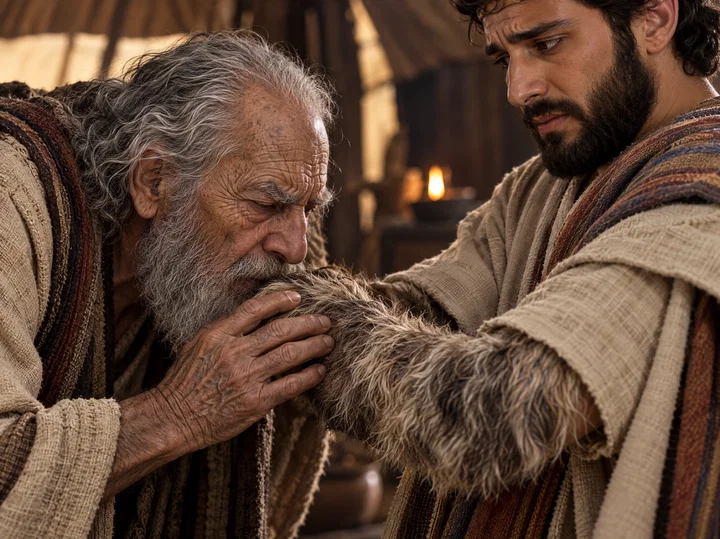
Cross-references
- Genesis 25:29-34
And Jacob sod pottage: and Esau came from the field, and he was faint:
Jacob had earlier obtained Esau’s birthright before deceiving him for the blessing.
- Genesis 25:23
And the LORD said unto her, Two nations are in thy womb, and two manner of people shall be separated from thy bowels; and the one people shall be stronger than the other people; and the elder shall serve the younger.
God foretold that the elder would serve the younger, underlying the blessing conflict.
- Hebrews 12:16-17
Lest there be any fornicator, or profane person, as Esau, who for one morsel of meat sold his birthright.
Esau later sought the blessing after selling his birthright and was rejected.
- Genesis 27:41-45
And Esau hated Jacob because of the blessing wherewith his father blessed him: and Esau said in his heart, The days of mourning for my father are at hand; then will I slay my brother Jacob.
Esau’s anger over the stolen blessing leads Jacob to flee.
- Genesis 32:28
And he said, Thy name shall be called no more Jacob, but Israel: for as a prince hast thou power with God and with men, and hast prevailed.
Jacob’s name is changed to Israel after wrestling with God.
- Genesis 37:31-33
And they took Joseph’s coat, and killed a kid of the goats, and dipped the coat in the blood;
Jacob’s sons deceive him as he had deceived Isaac.
- Malachi 1:2-3
I have loved you, saith the LORD. Yet ye say, Wherein hast thou loved us? Was not Esau Jacob’s brother? saith the LORD: yet I loved Jacob,
Contrasts God’s treatment of Jacob and Esau.
- Genesis 28:5
And Isaac sent away Jacob: and he went to Padan-aram unto Laban, son of Bethuel the Syrian, the brother of Rebekah, Jacob’s and Esau’s mother.
Jacob leaves home after deceiving his father.
- Hosea 12:4
Yea, he had power over the angel, and prevailed: he wept, and made supplication unto him: he found him in Beth-el, and there he spake with us;
Jacob’s struggle for God’s blessing is recalled as prevailing through weeping and supplication.
- Genesis 27:35
And he said, Thy brother came with subtilty, and hath taken away thy blessing.
Isaac identifies Jacob’s deception.
- Hebrews 11:20
By faith Isaac blessed Jacob and Esau concerning things to come.
Isaac’s blessing of his sons concerns things to come.
- Hebrews 12:17
For ye know how that afterward, when he would have inherited the blessing, he was rejected: for he found no place of repentance, though he sought it carefully with tears.
Esau later sought the lost blessing with tears but could not undo its loss.
- Genesis 25:27-28
And the boys grew: and Esau was a cunning hunter, a man of the field; and Jacob was a plain man, dwelling in tents.
explains why Isaac favored Esau and Rebekah favored Jacob
- Romans 9:13
As it is written, Jacob have I loved, but Esau have I hated.
Declares God’s contrasting love for Jacob and Esau.
- Genesis 27:43-45
Now therefore, my son, obey my voice; and arise, flee thou to Laban my brother to Haran;
Rebekah’s deception brings grief and separation from Jacob.
- Genesis 48:14
And Israel stretched out his right hand, and laid it upon Ephraim’s head, who was the younger, and his left hand upon Manasseh’s head, guiding his hands wittingly; for Manasseh was the firstborn.
Jacob deliberately crosses his hands to bless the younger son over the firstborn.
- Genesis 32:9-12
And Jacob said, O God of my father Abraham, and God of my father Isaac, the LORD which saidst unto me, Return unto thy country, and to thy kindred, and I will deal well with thee:
Jacob later prayed for protection because he feared meeting Esau.
- Genesis 32:6
And the messengers returned to Jacob, saying, We came to thy brother Esau, and also he cometh to meet thee, and four hundred men with him.
Jacob hears that Esau is approaching with four hundred men.
- Genesis 33:4
And Esau ran to meet him, and embraced him, and fell on his neck, and kissed him: and they wept.
A genuine kiss contrasts with a deceptive display of affection.
Commentary
Each commentary is drawn from primary sources: the writings of Ellen G. White and Adventist pioneers and periodicals. Each commentary is separate. Its own words are not a quotation; follow the references to read the source passages.
Ellen G. White
18 sources
Isaac was old with failing sight and about to give the deathbed blessing to Esau as the firstborn whom he favored, and doubting who stood before him he called him to come near so touch could tell whether he was truly his very son Esau.1SP 107.1SG3 115.1ST Apr 17, 1879SG3 114.1GC 616.2–3 It was the testing moment of the joint fraud by which Rebekah and Jacob passed Jacob off as Esau to seize the blessing meant for Esau, though God had already promised the birthright to Jacob.1SP 107.1SG3 115.1ED 147.1–2 They should have trusted God to fulfill His purpose in His own time and way without deceit, for His purposes never justify conniving and He could have provided for Jacob by His own methods.1SP 107.1SG3 115.1Ms 139, 1899, par. 17–21 The fraud cost Jacob his honesty and brought guilt before God with ground for Satan to accuse him, and it reaped its harvest in Esau's hatred and death threats, flight for life, twenty years of exiled wrong and fraud, and evils repeated in his sons, proving every deed reacts upon the doer.ST Apr 17, 1879ED 147.1–24SP 432.3PP 201.3–202.2 Jacob afterward repented, confessed the fraud and cast himself on mercy, and he was pardoned and renamed from Jacob to Israel in token of forgiveness and victory, so reconciled to God he no longer feared to meet Esau.SG3 133.2GC 619.2–620.14SP 437.2
Isaac's Test and Deception
Isaac was aged, his sight grown dim even to blindness, and as he prepared before his death to give the blessing he intended it for Esau as the firstborn out of partiality and preference for him.1SP 107.1ST Apr 17, 1879SG3 114.1 His failing eyes left him unable to recognize by sight the son who stood before him, so that the bestowal of the firstborn's blessing turned upon discerning which son was present.ST Apr 17, 1879SG3 114.1 Doubting the identity of that son, he asked him to come near so that he might feel him by touch and determine whether he was truly his very son Esau or not.SG3 115.1ST Apr 17, 1879GC 616.2–34SP 437.2Lt 7, 1896, par. 1–4 The request to come close and be felt was a direct test of identity, born of suspicion that the voice and form before him might not be Esau.GC 616.2–34SP 437.2Lt 7, 1896, par. 1–4Ms 139, 1899, par. 17–21
The moment belongs to the joint deception in which Rebekah and Jacob posed Jacob as Esau to obtain by fraud the blessing and birthright blessing intended for Esau.1SP 107.1SG3 115.14SP 432.3SG3 133.2SG3 114.1 Jacob presented himself as Esau before his father, and by that impersonation secured what Isaac meant to give to the elder son.SG3 115.1ED 147.1–24SP 432.3SG3 133.2SG3 114.1 The birthright so seized by fraud was already his by God's promise, yet it was taken through deceit rather than left for God to bestow.1SP 107.1SG3 115.1ED 147.1–2
Harvest, Repentance, and Warning
Rebekah and Jacob should have trusted God to carry out His purpose in His own time and way instead of resorting to deceit to secure the promised blessing, for their effort to obtain it by their own scheming showed lack of faith in His ability to fulfill what He had promised.1SP 107.1SG3 115.1Ms 139, 1899, par. 17–21PP 197.2–198.1ST Jan 29, 1880 God could have provided for Jacob by His own methods without any conniving, and His purposes never justify deceit or crooked dealing.Ms 139, 1899, par. 17–21PP 197.2–198.1ST Jan 29, 1880 The blessing itself could not guarantee prosperity, since God would bless or bring adversity according to the conduct of the recipient, and He could have blessed either son according to conduct.1SP 107.1SG3 115.1 Jacob could have prospered through God by righteous love and reverence even without the privileges usually given to the firstborn.1SP 107.1SG3 115.1
The fraud cost Jacob his honesty and brought guilt before God with self-condemnation, giving Satan ground to accuse him and claim the right to destroy him.ST Apr 17, 1879PP 201.3–202.2 That deception reaped its harvest in his brother's hatred and deadly threats, in flight for his life to escape Esau's anger, and in twenty years of exile as a fugitive in which he was himself wronged and defrauded until forced to find safety in flight.ST Apr 17, 1879ED 147.1–24SP 432.3GC88 616.1–2GC 616.2–3 It brought a second harvest as the evils of his own character cropped out in his sons, proving that what a person does is the result of what he is and every deed reacts upon the doer, with lifelong consequences of later danger, anxiety, misgivings and self-reproach because he recognized his own sin had caused it.ED 147.1–2GC88 616.1–2GC 616.2–3 When after twenty years he left Padan-aram in obedience to God and retraced the fugitive road, the memory of the deception was ever before him with the reproaches of an accusing conscience day and night that made the journey very sad, and as the hills of his native land appeared the past rose vividly before him with the memory of sin joined to the thought of God's favor and promises of help and guidance.PP 195.1
Jacob afterward repented of that fraud, remembered God's mercy, confessed it and cast himself upon mercy, and the sin was pardoned.SG3 133.2GC 619.2–620.14SP 437.2PP 197.2–198.1PP 201.3–202.2 His name was changed from Jacob to Israel as evidence of forgiveness and victory, the crisis past with doubt, perplexity and remorse replaced by the peace of reconciliation with God, so he no longer feared to meet Esau because God who forgave him could move Esau's heart to accept his humiliation and repentance.PP 197.2–198.1 God heard his prayer in the night of wrestling and mercifully saved and preserved his life from Esau only because he had previously repented, and had he not repented God could not have heard his prayer.SG3 133.2GC 619.2–620.14SP 437.2PP 201.3–202.2 Unconfessed, concealed wrong cuts off faith and confidence to plead for deliverance and leaves the sinner overwhelmed without confidence in the time of trouble, while sins already confessed and forgiven are blotted out by the atoning blood of Christ and no longer brought to mind to remember with despair.4SP 437.2PP 201.3–202.2
Even such wrongdoing is not without hope, for God will not contend forever nor be always wroth, but sees the ways of the covetous and froward, heals him, leads him, and restores comfort and peace to him that is far off and to him that is near.ED 147.1–2 The act was deceptive reasoning, partiality and hypocrisy that turned a man from his rights in order to grasp what belonged to another.Lt 7, 1896, par. 1–417MR 196.2–197.1 The episode illustrates the same deception practiced by men standing in high places of trust who suppose their councils stand as the voice of God while they turn away from obeying God's Word, grasping all they possibly can irrespective of their own agreements and of the disappointment and wrong done to others, which God will in no case justify or excuse.17MR 196.2–197.1
Sources
Pioneers and periodicals
60 sources
Isaac is old and blind and near death, preparing to give the covenant blessing and birthright to Esau his elder firstborn son, and unsure of the son before him he calls him to come near so he can feel him by touch and know whether he is his very son Esau or not.ST Jul 31, 1901ST Sep 22, 1898ST Jan 3, 1911ST Mar 30, 1888ST Mar 31, 1881 The test comes because Jacob stands disguised in his brother's place, with Esau away hunting to prepare his father's food while Rebekah has covered Jacob's smooth hands and neck with goatskins and put Esau's garments on him so he will feel hairy like Esau.ST Jul 31, 1901ST Sep 22, 1898ST It is fraud to obtain the blessing intended for his brother, done in conspiracy with his mother at her urging, and it is disobedience and sinful coveting that must not be imitated or excused.ST Jan 3, 1911ST Jan 9, 1912ST May 17, 1910ST Feb 28, 1906RH Oct 4, 1864 Rebekah and Jacob act from lack of faith that God could fulfill His promise to Jacob unless they secured it by their own wisdom, when they should have trusted God and quietly waited to receive it in an honorable manner in His own time and way.ST Feb 24, 1887ST Jul 31, 1884ST Jul 31, 1901STST Feb 17, 1914 Though God had designed the birthright and blessing for Jacob for his superior faith and character, Jacob obtains it not because of the deception but in spite of it.ST Mar 31, 1881ST Feb 26, 1894ST Oct 4, 1905 The coveted blessing is gained for the moment but at great cost in flight from Esau's wrath, more than twenty years of exile and hardship, retribution in kind at Laban's hands and from his own children, and deep repentance until the true spiritual blessing is really won when his scheming is forgiven on the night of wrestling and he becomes Israel.ST Jul 31, 1901STST Jan 9, 1912ST Jan 9, 1912
Setting and Identity Test
Isaac was old, his sight grown dim and blind, and near death when he arranged to give to Esau, the elder and firstborn son, the blessing of the covenant and birthright, the blessing Heaven had decreed upon Abraham and Isaac, the sacred covenant inheritance and priestly blessing with its double share, rulership and promise that Jacob would be a prince in Israel.ST Apr 17, 1879ST Jul 31, 1901ST Mar 31, 1881ST Nov 21, 1906 It was his final blessing of his sons and his intended blessing of Esau, yet Jacob received it instead, and this later became the occasion when Esau sought to inherit the blessing and was rejected because he could not undo his deliberate sale of the birthright.ST Mar 30, 1888ST Mar 31, 1881 God approved and sanctified the blessing to Jacob because he had already purchased the claim, though the deception used to obtain it was wrong and unnecessary and an honest presentation would have been enough.ST Apr 17, 1879ST Mar 31, 1881 The fraud obtained the blessing for the moment but did not bring lasting success, bringing only trouble, delay, self-condemnation, loss of honesty and lifelong consequences.ST Apr 17, 1879ST Jul 31, 1901ST Nov 21, 1906
Unsure of the son before him, Isaac asked him to come near so he might feel him by touch and know whether he was his very son Esau or not, testing him before pronouncing the blessing.ST Jul 31, 1901ST Sep 22, 1898ST Jan 3, 1911ST Jan 6, 1909 His dim sight left him unable to identify his son by looking, so he doubted the identity and revealed his uncertainty by calling the disguised Jacob close to be felt.ST Sep 22, 1898ST Jan 3, 1911ST Jan 14, 1913 The request belongs within Jacob's unsatisfactory experience of obtaining the blessing through deception, amid the parents' divided affection and the family's material pursuit of the promise that would come through Jacob.ST Jan 6, 1909ST Jan 14, 1913
The test was the proving of Jacob's disguise while Esau was away in the fields hunting venison to prepare savory food for his father before receiving the blessing.ST Jul 31, 1901STST Oct 1, 1902 Rebekah had covered Jacob's smooth hands and neck with goat skins, kids' skins put on to imitate his brother's hairy skin so he would feel hairy like Esau, and had put Esau's garments on him for him to come near in.ST Sep 22, 1898STST Dec 13, 1883ST Oct 1, 1902 As far as deceiving Isaac was concerned the feeling answered its purpose for the moment, allowing the personating of Esau to pass.ST Jul 31, 1901ST Oct 1, 1902
The home was divided by favoritism, whose fruit is bitter, with Isaac favoring Esau because he was a cunning and skillful hunter whose savory dishes appealed to his appetite, while Rebekah favored Jacob, her constant companion and best-loved son, a handsome young man humored and petted with great love for home and especially for his mother.ST Jan 14, 1913STST Feb 11, 1913 Isaac sent Esau to the field for venison to prepare before giving the blessing, and Rebekah overheard the plan and interfered with deceit and double-dealing so her favored son would receive the blessing instead.STST Feb 11, 1913RH Oct 3, 1907 Though the coveted blessing was so obtained, it came under sad circumstances and at great cost.ST Jan 14, 1913ST
Fraud and Its Wrongness
Genesis 27:21 belongs to Jacob's obtaining by fraud the blessing Isaac designed and intended for Esau the firstborn, placing the younger ahead of the elder.ST Feb 24, 1887ST Jan 3, 1911RH Aug 17, 1869 It is the moment when Isaac, unsure of the son before him, asks him to come near to be felt by touch to test whether he is really Esau before pronouncing the blessing.ST Jul 31, 1901ST May 17, 1910RH Sep 27, 1870 Jacob presents himself as Esau to be felt and blessed, pretending to be his brother while Esau is away, in selfish plotting to deceive his father.ST Jul 31, 1901ST Jan 9, 1912RH Sep 27, 1870 The chapter is part of the troubled experiences of Jacob and Esau in which Jacob overreaches and later suffers from being overreached in turn.ST Jan 9, 1912 The episode is another example of an outward act masking a false purpose, obtaining the father's blessing through guile and dissimulation.RH Sep 27, 1870RH Aug 17, 1869
Jacob was at first unwilling to deceive his father but consented to his mother's plan to obtain the blessing by fraud.ST Feb 24, 1887 The deception was carried out at Rebekah's urging and by conspiracy with his mother, with Jacob siding with her and joining her in selfishness and double-dealing toward Isaac and Esau.ST Jul 31, 1901ST Feb 11, 1913ST Oct 6, 1914 Rebekah interfered so her favored son would receive the blessing, persuading Jacob despite his scruples and leading him by her influence into error and exile.RH Nov 16, 1916RH Oct 3, 1907ST Oct 6, 1914ST Apr 12, 1883 Her desire for the promised blessing led her to take matters into her own hands rather than trust God's timing, helping Jacob deceive Isaac in order to obtain it.RH Nov 16, 1916ST Feb 17, 1914 The story presents Isaac's uncertainty about whether Jacob was Esau as setting the scene for that failure of faith, with Rebekah trying to secure the outcome herself instead of trusting God to resolve the circumstances.ST Feb 17, 1914
The act fulfills Jacob's God-given name, for Jacob means supplanter and describes his overreaching, mercenary and covetous character as Isaac's younger son.ST Apr 1, 1897 Taking advantage of Esau's appetite he purchased the birthright, and then by fraud he obtained the father's blessing designed for his brother.ST Apr 1, 1897ST Jul 27, 1904 Though better than Esau in principle he was still selfish and sinful, taking advantage of his brother's hunger to buy his birthright for a mess of pottage and then through his mother's connivance deceiving his father and stealing his brother Esau's blessing.ST Jul 27, 1904 In his role as supplanter he seeks the Lord's blessing through fraud and selfish advantage, representing people who pursue religious privilege or temporal reward by sacrificing principle and relying on expedience rather than spiritual faithfulness.ST Nov 18, 1897 As his mother's best-loved son, humored and petted, he joined her in that deed of selfishness and fraud toward Isaac and Esau.ST Feb 11, 1913
The deception was disobedience and transgression among God's chosen people, unbrotherly conduct toward his brother and wicked deception of his father that brought prolonged sorrow and trouble upon his own life.ST Feb 28, 1906RH Apr 26, 1870 It was a sin, not a practice others may imitate or excuse because a godly person committed it, for the sins of good people do not authorize deliberate wrongdoing.RH Aug 17, 1869 Jacob took an unrighteous course to secure Esau's birthright and blessing because he coveted them, and that coveting was idolatry and a transgression of the first and second commandments, proving the law against covetousness was already in force before Moses. His deception in obtaining the blessing was not approved by God, and he was favored with a view of its direful effect upon his posterity to the latest generation, being shown how as centuries passed his descendants would become more and more deceitful and covetous and wicked until the end, and in this way was made to discover more clearly than ever the heinousness of his sin, which even then could not have been put away had he not repented of it previously.RH Oct 4, 1864ST Mar 30, 1888
Esau had foolishly sold his birthright which he never duly appreciated, showing himself a worldly man who traded its lasting benefits for immediate gratification for food, while Jacob valued what it offered and longed to know and do God's will.ST May 17, 1910ST The birthright included a double share of property, inheritance, family rulership and the priesthood, and in this case it also carried the place in the line through whom Christ would come and the resulting hope of salvation for the race.ST May 17, 1910 The blessing of the firstborn accompanied the birthright which Esau had sold to Jacob, and this was the later occasion when Esau sought to inherit the blessing and was rejected, for he could not undo his deliberate sale.ST Mar 30, 1888 The blessing went with the birthright Jacob had already selfishly purchased from his brother, and God meant both for Jacob because Jacob was greatly superior to Esau in morality, integrity and faith in God, but God meant to bestow them in His own way.ST Feb 26, 1894 Advised by his mother, Jacob in his unregenerate state deliberately deceived his father to cheat Esau out of the blessing Isaac designed for Esau, using his own wisdom instead, and he obtained the blessing in spite of his deception, not because of it.ST Feb 26, 1894
Unbelief and God's Purpose
Rebekah and Jacob acted from lack of faith that God could fulfill His promises unless they took a hand in it, trying to secure by their own wisdom what God had promised to Jacob.ST Feb 24, 1887ST Jul 31, 1884ST Jan 29, 1880STST Feb 17, 1914 Instead of trusting God to resolve the circumstances in His own way and time, they tried to secure the blessing themselves by deception.ST Feb 24, 1887ST Jul 31, 1884ST Jan 29, 1880ST Feb 17, 1914 When the Lord promises a thing He will perform it at the proper time and in His own way, and His blessings are to be quietly waited for until ready to receive them.ST Feb 24, 1887ST Jul 31, 1884ST Jul 31, 1901 Jacob should have trusted God and quietly waited to receive the blessing in a more honorable manner instead of taking his case into his own hands.ST Feb 24, 1887ST Jul 31, 1884ST Jan 29, 1880RH Apr 8, 1875
The scheming was human interference in God's plans for the Promised Seed and the channels through which that Seed should come.ST Jul 31, 1901ST It was an attempt to supplement the Lord's promise with human works, for Rebekah, fearing God's word that the elder should serve the younger would be frustrated, supposed she must do something.ST Jul 31, 1901STST Oct 1, 1902 That same lack of faith was first manifest in Abraham and is nearly always found at the basis of all union of church and state.ST Human ingenuity to help God fulfill His promise brought life-long separation of mother and son and many long years of exile, difficulties, hardships, distresses and trials and victories for Jacob.ST Jul 31, 1901STST Oct 1, 1902
God designed both birthright and blessing for Jacob because of his superior character, morality, integrity and faith, and meant to bestow them in His own way.ST Mar 31, 1881ST Feb 26, 1894ST Feb 26, 1894 The blessing went with the birthright, and God approved and sanctified the blessing to Jacob, though an honest presentation of his claim would have been enough and the deception was wrong and unnecessary.ST Mar 31, 1881ST Feb 26, 1894ST Feb 26, 1894 Jacob obtained the blessing not because of the deception but in spite of it, while his desire for God's promise was valued though his method was not approved.ST Feb 26, 1894ST Oct 4, 1905ST Feb 26, 1894 His crude, uninstructed faith still gave God a way to work toward his complete moral reformation, and his repentance is regarded.ST Oct 4, 1905ST Mar 30, 1888 The chapter's lessons include Isaac's impaired spiritual discernment, the wrong course taken by Rebekah and Jacob, and the contrast between spiritual and carnal desire, while Isaac's words of blessing are prophetic.ST Sep 22, 1898
Consequences and Retribution
The blessing sought by touch and disguise is gained, but only for the moment and under sad circumstances and at great cost.ST Apr 17, 1879ST Jul 31, 1901ST Feb 26, 1894 Jacob must flee from Esau's wrath and hatred to escape death, leaving the home he loved for a strange country and distant Padan-aram.ST Feb 26, 1894ST Oct 4, 1905ST Jul 27, 1904ST Feb 26, 1894 Rebekah is separated from her darling son and loses the comfort of his companionship in her old age, never seeing him again on earth.ST Jul 31, 1901STRH Nov 16, 1916ST Apr 20, 1888ST Feb 26, 1894
Human ingenuity to help God fulfill His promise brings Jacob many long years of exile with difficulties, hardships, distresses, sorrow, care, anxiety, trouble and delay.ST Jul 31, 1901RH Apr 26, 1870ST Nov 21, 1906ST Apr 20, 1888 Anger and vengeance are aroused, and more than twenty years pass before even a formal reconciliation, while animosity lives on in Esau's descendants for hundreds of years.ST Jan 9, 1912ST Jan 9, 1912 Guilt makes Jacob a coward who lies down feeling utterly forsaken of God and man, with his sins like a great gulf separating him from heaven.ST Jul 27, 1904ST Feb 26, 1894
Overreaching brings retribution, for Jacob who greatly deceived his father is overreached in turn.ST Jan 9, 1912ST Jan 9, 1912ST Apr 20, 1888 His wrong toward Esau and deceit toward Isaac bring suffering back upon him, including flight from home and later deceit and cruelty at Laban's hands, with lasting misery in his family.ST Jan 9, 1912ST Jan 9, 1912ST Mar 31, 1881 The circle of recompense continues when Jacob himself is deceived by Laban and later is deceived and tricked in turn by his own children, illustrating that people may suffer consequences resembling the harm they caused.ST Apr 20, 1888ST Jul 27, 1915ST Nov 10, 1881
Jacob's suffering demonstrates God's abhorrence of deception.ST Jun 9, 1881RH Mar 30, 1869RH Mar 30, 1869 Though he repented and was forgiven, his fraud brought severe and bitter consequences later in life.ST Jun 9, 1881RH Mar 30, 1869ST Apr 20, 1888RH Mar 30, 1869 Forgiveness does not always remove painful consequences in this life, because consequences set in motion can be impossible to stop and others remember past sins and continue to use them against the sinner, even while God accepts repentance and grants eternal life.RH Mar 30, 1869ST Apr 20, 1888RH Mar 30, 1869
The fraud costs honesty and brings self-condemnation, self-reproach, guilty fear, and condemnation.ST Apr 17, 1879RH Nov 16, 1916RH May 27, 1902 Isaac's suspicion at the feeling by touch remains vivid in Jacob's memory years later, and a lasting sense of guilt is repeatedly brought back to conscience with sorrow and anxiety while he flees hated by Esau and troubled within.RH May 27, 1902ST Oct 4, 1905ST Jul 27, 1904 That guilt brings deep remorse, penitence, confession with weeping and humiliation, loss of all confidence in himself, and fear that the God of his fathers had cast him off.ST Apr 17, 1879RH Nov 16, 1916ST Feb 26, 1894
Repentance and True Blessing
Jacob did not enter the fraud without struggle, for he felt scruples about deceiving his blind father yet yielded and consented to his mother's plan to take by deceit the blessing meant for Esau.ST Feb 24, 1887RH Jul 4, 1865 Afterward his wrong brought him deep remorse, penitence, confession with weeping and humiliation, loss of all confidence in himself, and deep humility before God.ST Feb 26, 1894RH Jul 4, 1865 In his unregenerate state he had deliberately cheated his brother while seeking what he valued by worldly means, and his sin left him fearing that the God of his fathers had cast him off and feeling utterly forsaken of God and man.ST Oct 6, 1914ST Feb 26, 1894 His conscience repeatedly brought the departure from integrity back to mind, leaving a lasting sense of guilt vivid in memory years later.ST Nov 20, 1879RH Oct 4, 1864
That sin brought long-continued afflictions upon him as God's chastisement, and he suffered grievously for what was not approved by God.ST Jul 21, 1881ST Mar 30, 1888 The fraud called for thorough repentance and perfect trust to be developed in him until the error was remitted, so he was subjected to a number of perplexing trials to work that repentance.RH Apr 8, 1875ST Jul 21, 1881 Yet even his crude, uninstructed faith gave God a way to work toward his complete moral reformation.RH Apr 8, 1875ST Mar 30, 1888
The greatest of those trials was wrestling with the angel, in which his sin was kept continually before him and which brought him to deep humility.RH Apr 8, 1875RH Jul 4, 1865 There he prevailed with God through faith and prayer, and the blessing seized by deceit did not itself confer the true spiritual blessing.RH Dec 30, 1915RH Apr 8, 1875 The true blessing he really obtained later on the night of wrestling, when his sinful scheming and supplanting were forgiven and pardon was sought and he won the name Israel.RH Dec 30, 1915ST Oct 6, 1914
Through those trials and victories his heart was completely changed, turning failure and obstacle into victory.STRH Apr 8, 1875 Jacob the supplanter was thus placed among the Israel of God and among the heroes of faith.STRH Apr 8, 1875 His sojourn in Egypt was the time appointed for his ripening for the kingdom of God, when his afflictions were closed forever and God's rod was withdrawn, and his life ended in heavenly brightness.RH Apr 8, 1875ST Jul 21, 1881
First views of sin are necessarily imperfect, for though he had already repented deeply, when he wrestled for deliverance the deception was continually held up before his mind.RH Oct 4, 1864RH Jul 4, 1865 As he progressed in holiness the hatefulness and exceeding sinfulness of the wrong appeared more clearly, bringing renewed and deeper sorrow over it.RH Oct 4, 1864RH Oct 4, 1864 He was even favored with a view of its direful effect upon his posterity to the latest generation, being shown how as centuries passed his descendants would become more and more deceitful and covetous and wicked until the end, and in this way was made to discover more clearly than ever the heinousness of his sin, which even then could not have been put away had he not repented of it previously.RH Oct 4, 1864RH Oct 4, 1864 His experience teaches that God hears and delivers those who have confessed their sins, while concealed, unconfessed wrongs would destroy confidence in prayer during the time of trouble.RH Oct 4, 1864RH Nov 14, 1912
Prophecy Doctrine and Application
Isaac's words of blessing are prophetic, pronouncing over the son before him what would shape his future and his line.ST Sep 22, 1898 The birthright and blessing at stake carried a double share of property and inheritance together with family rulership and the family priesthood.ST May 17, 1910 In this case they carried still more, the place in the line through whom Christ would come and with it the hope of salvation for the race.ST May 17, 1910 That inheritance meant manifold temporal blessings and a home in the kingdom of God, involving the choice of obedience to God, denying sinful worldly pleasures, humble confession, and wrestling with God until sinful scheming and supplanting were forgiven.RH Dec 30, 1915 Esau showed himself worldly, trading its lasting benefits for immediate gratification and selling it for food, never duly appreciating it, while Jacob valued what it offered and longed to know and do God's will.ST Mar 30, 1888ST May 17, 1910 When Esau afterward sought to inherit the blessing he was rejected, for he could not undo his deliberate sale of the birthright.ST Mar 30, 1888 The blessing seized by deceit did not itself confer the true spiritual blessing, which Jacob really obtained later when he prevailed with God through faith and prayer on the night of wrestling with the angel and won the name Israel.RH Dec 30, 1915 The chapter sets Isaac's impaired spiritual discernment beside the wrong course taken by Rebekah and Jacob and the contrast between spiritual and carnal desire.ST Sep 22, 1898
In his role as supplanter Jacob stands for those who seek the Lord's blessing through fraud and selfish advantage rather than spiritual faithfulness.ST Nov 18, 1897 He represents people who pursue religious privilege or temporal reward by sacrificing principle and relying on expedience.ST Nov 18, 1897ST Sep 1, 1909 In this he portrays those who seek the blessing by dishonest or expedient means, sacrificing principle for worldly position and temporal gain.ST Sep 1, 1909 They stand in contrast with those who humble themselves before God and seek victory through Him.ST Sep 1, 1909
The scene in which Jacob comes near wearing Esau's garments to receive his father's blessing illustrates how believers receive blessing from the Father.ST Dec 13, 1883 They come clothed in Christ's righteousness, their elder Brother.ST Dec 13, 1883
Isaac through dimness of sight could not tell Jacob from Esau, so that he blessed Jacob and passed Esau by.RH Nov 4, 1858 In this, love and knowledge in the creature can be estranged by ignorance and forgetfulness.RH Nov 4, 1858 No time, place, speech, or apparel can obscure or darken God's eye or ear, for the Lord knows who are His and His eye is always over them.RH Nov 4, 1858 Human schemes cannot hide the truth of the heart from God, who knows the heart.ST Jun 9, 1881
When old and near death Isaac was arranging to give to Esau the blessing Heaven had decreed upon Abraham and Isaac and the Lord had promised to Jacob, that he would be a prince in Israel.ST Jul 31, 1901 The home was divided by favoritism, Isaac favoring Esau because he was a skillful hunter whose savory dishes appealed to his appetite, while Rebekah favored Jacob, the handsome young man who was her constant companion.ST Though Esau had foolishly sold his birthright, he hoped by ministering to his father's appetite to still secure the coveted blessing, and Isaac sent him to the field for venison to prepare before giving the blessing.ST Rebekah overheard and at her urging Jacob practiced gross deception upon his father and pretended to be Esau while Esau was in the fields hunting, and Isaac's feeling him was part of the test of identity before pronouncing the blessing.ST Jul 31, 1901ST When the Lord promises a thing He will perform it at the proper time and in His own way, and His blessings are to be quietly waited for until ready to receive them in a more honorable manner instead of taking the case into human hands.ST Jul 31, 1901 The deception obtained the blessing for Jacob for the moment, but human ingenuity to help God fulfill His promise brought many long years of exile, difficulties, hardships and distresses.ST Jul 31, 1901 Rebekah was separated from her darling son and yearned through long years for him whom she never saw again on earth, showing that the fruit of favoritism is bitter.ST Jul 31, 1901ST Jacob's siding with his mother in deceiving Isaac was a wrong act arising from sympathy on the wrong side, gathering not with Christ but scattering abroad.RH Jan 7, 1873 Its influence did not end with the act but lived on, obliging Jacob to flee for his life to a stranger's land and in after years nearly proving his ruin and the ruin of his family and his substance.RH Jan 7, 1873 The full result will be made manifest at the Judgment, where even if the wrongdoer is saved through pardoning love there remains loss of what might have been eternal gain.RH Jan 7, 1873
Sources