Jeremiah 19:2
And go forth unto the valley of the son of Hinnom, which is by the entry of the east gate, and proclaim there the words that I shall tell thee,
Translations
And go forth to the valley of the son of Hinnom, which is by the entry of the east gate, and proclaim there the words that I shall tell you,
And go forth unto the valley of the son of Hinnom, which is by the entry of the east gate, and proclaim there the words that I shall tell thee,
and go forth unto the valley of the son of Hinnom, which is by the entry of the east gate, and proclaim there the words that I shall tell thee,
And go forth to the valley of the son of Hinnom, which is by the entry of the east gate, and proclaim there the words that I shall tell thee,
and go forth unto the valley of the son of Hinnom, which is by the entry of the gate Harsith, and proclaim there the words that I shall tell thee:
and go forth unto the valley of the son of Hinnom, which is by the entry of the gate Harsith, and proclaim there the words that I shall tell thee;
and thou hast gone forth unto the valley of the son of Hinnom, that [is] at the opening of the gate of the pottery, and hast proclaimed there the words that I speak unto thee,
and go forth unto the valley of the son of Hinnom, which is by the entry of the pottery-gate, and proclaim there the words that I shall tell thee,
Then shalt thou go forth into the valley of Ben-hinnom, which is at the opening of the gate of potsherds; and proclaim there the words which I shall speak unto thee;
Berean Standard Bible, Majority Standard Bible
and go out to the Valley of Ben-hinnom near the entrance of the Potsherd Gate.Proclaim there the words I speak to you,
and go out to the valley of the son of Hinnom, which is by the entry of the gate Harsith, and proclaim there the words that I will tell you.
And go out to the valley of the son of Hinnom, by the way into the door of broken pots, and there say in a loud voice the words which I will give you;
And goe forth vnto the valley of Ben-hinnom, which is by the entrie of the East gate: and thou shalt preache there the wordes, that I shall tell thee,
Douay-Rheims (Challoner revision)
And go forth into the valley of the son of Ennom, which is by the entry of the earthen gate: and there thou shalt proclaim the words that I shall tell thee.
Pictures
Cross-references
- Jeremiah 7:31-32
And they have built the high places of Tophet, which is in the valley of the son of Hinnom, to burn their sons and their daughters in the fire; which I commanded them not, neither came it into my heart.
Both name the Valley of Hinnom, where Tophet’s child sacrifices lead to its renaming as the Valley of Slaughter.
- 2 Kings 23:10
And he defiled Topheth, which is in the valley of the children of Hinnom, that no man might make his son or his daughter to pass through the fire to Molech.
Both locate Topheth in the valley of Hinnom, associated with Moloch worship.
- Jeremiah 19:6
Therefore, behold, the days come, saith the LORD, that this place shall no more be called Tophet, nor The valley of the son of Hinnom, but The valley of slaughter.
Names the Valley of Hinnom as the place of judgment and condemned sacrifices.
- Jeremiah 32:35
And they built the high places of Baal, which are in the valley of the son of Hinnom, to cause their sons and their daughters to pass through the fire unto Molech; which I commanded them not, neither came it into my mind, that they should do this abomination, to cause Judah to sin.
Both identify the valley of Hinnom, associated with child sacrifice.
- Joshua 15:8
And the border went up by the valley of the son of Hinnom unto the south side of the Jebusite; the same is Jerusalem: and the border went up to the top of the mountain that lieth before the valley of Hinnom westward, which is at the end of the valley of the giants northward:
Both texts identify the Valley of Hinnom and describe its location.
- 2 Chronicles 28:3
Moreover he burnt incense in the valley of the son of Hinnom, and burnt his children in the fire, after the abominations of the heathen whom the LORD had cast out before the children of Israel.
Both texts identify the valley of Hinnom as a place of child sacrifice.
- 2 Chronicles 33:6
And he caused his children to pass through the fire in the valley of the son of Hinnom: also he observed times, and used enchantments, and used witchcraft, and dealt with a familiar spirit, and with wizards: he wrought much evil in the sight of the LORD, to provoke him to anger.
Both texts connect the valley of Hinnom with child sacrifice.
- Joshua 18:16
And the border came down to the end of the mountain that lieth before the valley of the son of Hinnom, and which is in the valley of the giants on the north, and descended to the valley of Hinnom, to the side of Jebusi on the south, and descended to En-rogel,
Both texts identify the valley of Hinnom and locate it.
- Mark 9:43-48
And if thy hand offend thee, cut it off: it is better for thee to enter into life maimed, than having two hands to go into hell, into the fire that never shall be quenched:
Gehenna evokes the Valley of Hinnom and its worm and unquenchable-fire imagery.
- Jeremiah 19:11-12
And shalt say unto them, Thus saith the LORD of hosts; Even so will I break this people and this city, as one breaketh a potter’s vessel, that cannot be made whole again: and they shall bury them in Tophet, till there be no place to bury.
The broken vessel enacts judgment against the people and makes the city like Tophet.
- Jeremiah 7:32
Therefore, behold, the days come, saith the LORD, that it shall no more be called Tophet, nor the valley of the son of Hinnom, but the valley of slaughter: for they shall bury in Tophet, till there be no place.
Both speak of the valley of Hinnom as a place of retribution.
- Jeremiah 19:12
Thus will I do unto this place, saith the LORD, and to the inhabitants thereof, and even make this city as Tophet:
Continues the judgment against the place called Topheth.
- Nehemiah 11:30
Zanoah, Adullam, and in their villages, at Lachish, and the fields thereof, at Azekah, and in the villages thereof. And they dwelt from Beer-sheba unto the valley of Hinnom.
Both texts mention the Valley of Hinnom.
- Isaiah 30:33
For Tophet is ordained of old; yea, for the king it is prepared; he hath made it deep and large: the pile thereof is fire and much wood; the breath of the LORD, like a stream of brimstone, doth kindle it.
Both identify Tophet as a place of retribution.
- Matthew 5:22
But I say unto you, That whosoever is angry with his brother without a cause shall be in danger of the judgment: and whosoever shall say to his brother, Raca, shall be in danger of the council: but whosoever shall say, Thou fool, shall be in danger of hell fire.
Gehenna is associated with the Valley of Hinnom.
- Jeremiah 7:30
For the children of Judah have done evil in my sight, saith the LORD: they have set their abominations in the house which is called by my name, to pollute it.
Both concern Judah’s abominations and punishment associated with the Valley of Hinnom.
- Mark 9:48
Where their worm dieth not, and the fire is not quenched.
The worm and unquenched fire echo Jeremiah’s warning of judgment.
- Jeremiah 7:9-11
Will ye steal, murder, and commit adultery, and swear falsely, and burn incense unto Baal, and walk after other gods whom ye know not;
Condemns idolatry and wickedness hidden behind temple worship.
Commentary
Each commentary is drawn from primary sources: the writings of Ellen G. White and Adventist pioneers and periodicals. Each commentary is separate. Its own words are not a quotation; follow the references to read the source passages.
Ellen G. White
1 source
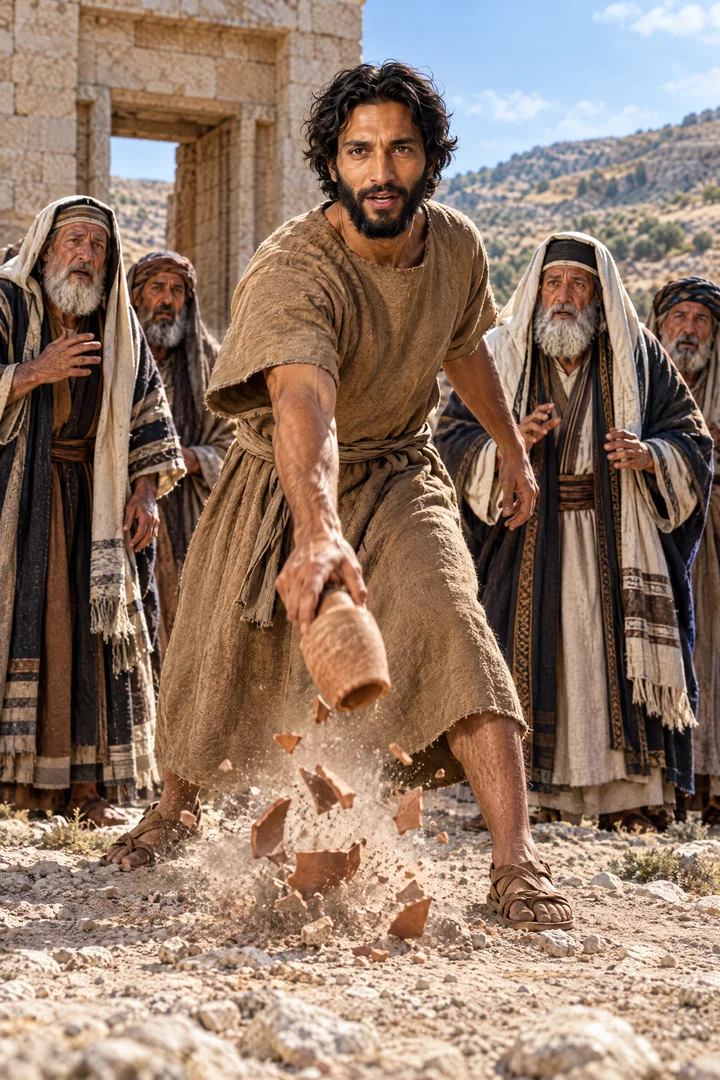
The command sent Jeremiah out to the Valley of the son of Hinnom by the entry of the east gate, taking with him the elders of the people and the priests, to proclaim there exactly the words God would give him.PK 431.1–3 The chosen place and company made the warning public and authoritative, confronting the leaders with the message at the very scene associated with Judah's guilt.PK 431.1–3 There he was to speak not his own thoughts but the divinely appointed proclamation for that hour.PK 431.1–3
That proclamation reviewed the apostasy of Judah and set forth plainly the sentence of doom upon Judah and Jerusalem.PK 431.1–3 Such plainness was necessary because the multitudes scarcely understood the awful import of the judgment hanging over them.PK 431.1–3 To illustrate the nature of the swift-coming judgments, he was to break a potter's earthen bottle as a sign that God would break the people and the city as a potter's vessel is broken so that it cannot be made whole again.PK 431.1–3 That same message of irreversible breaking he then repeated to all the people in the court of the temple.PK 431.1–3
Sources
Pioneers and periodicals
12 sources
The valley of the son of Hinnom lay by the entry of the east gate, to the south and south-east of Jerusalem on the border of Judah and Benjamin, by the torrent Kidron, a deep narrow glen near Jerusalem.RH Jan 17, 1856RH Jun 12, 1860RH Jun 15, 1869ST Sep 9, 1930RH Aug 29, 1871 The Hebrew words rendered the valley of Hinnom are spelled in Greek Gehenna, which is rendered hell in the common version.RH Jun 12, 1860ST May 22, 1879RH Aug 29, 1871 The phrase occurs ten times in the Old Testament and twelve times in the New Testament, always translated hell.ST May 22, 1879 The valley is also called Tophet or Topheth, meaning detestation and abomination, either from vomiting with loathing or from drum, because drums were beaten to drown the shrieks of burned infants.RH Jun 12, 1860 Tophet and Gehenna are two names for the same place, with Tophet included as part of that valley.ST Jul 28, 1909RH Jun 15, 1869ST Sep 9, 1930
The valley was once a delightful vale planted with trees and watered by fountains.RH Jun 12, 1860 After the introduction of the worship of the fire-gods under Ahaz it became celebrated for the horrid worship of Moloch.RH Jan 17, 1856RH Jun 15, 1869ST May 22, 1879 The apostate and idolatrous kings of Judah placed there a brazen image with the face of a calf and the body of a man with extended arms, and there Jews sacrificed doves, rams, calves, bulls, and often their own children to Moloch.RH Jun 12, 1860ST Nov 2, 1915 After idolatry was put away the pious king Josiah polluted the valley and made it a place of desecration, loathing and horror.RH Jun 12, 1860 It became a depository for all the filth and refuse of the city together with carcasses of beasts and the unburied bodies of executed criminals and malefactors.RH Jan 17, 1856RH Jun 12, 1860ST Jul 28, 1909ST May 22, 1879ST May 22, 1879
Continual fires were kept burning to consume them lest putrefaction infect the air and cause pestilence.RH Jan 17, 1856RH Jun 12, 1860ST May 22, 1879 Worms always fed on what was left out of the fire, giving two agents of destruction and giving rise to the expression about the worm that dieth not and the fire not quenched.RH Jun 12, 1860ST May 22, 1879 God surnamed the valley the Valley of Slaughter, marking it as a valley of cruelty, wickedness and idolatry and a place of dreadful crime and terrible retribution.RH Jun 12, 1860RH Jun 15, 1869 The verse sends Jeremiah to that valley to proclaim the words God would tell him before the people's elders and priests.ST Jul 28, 1909ST Aug 18, 1909ST May 22, 1879 There he was to proclaim judgment against Israel's idolatry and the abominations of Topheth, exposing their treachery and shamelessness and the uselessness of mere temple worship to the ungodly.ST Jul 22, 1913
The setting prepared for the acted parable of the potter's vessel, which he would break there to show that persistent disobedience and willful sin would bring irretrievable ruin on the people and Jerusalem.ST Aug 18, 1909 Their willful sin would soon be punished by the swift avenger Babylon.ST Jul 22, 1913 This background explains Gehenna as Jesus' repulsive and forcible illustration of how God will finally destroy the wicked by casting them into fire to be consumed, a symbol of death and complete and utter destruction.ST Jul 28, 1909ST May 22, 1879 It is not a place where the wicked are now being punished nor where they will ever be kept alive in perpetual torments, for to affirm they will live there forever charges God with naming it inappropriately.RH Jun 12, 1860
Sources