Translations
American King James Version, Webster Bible
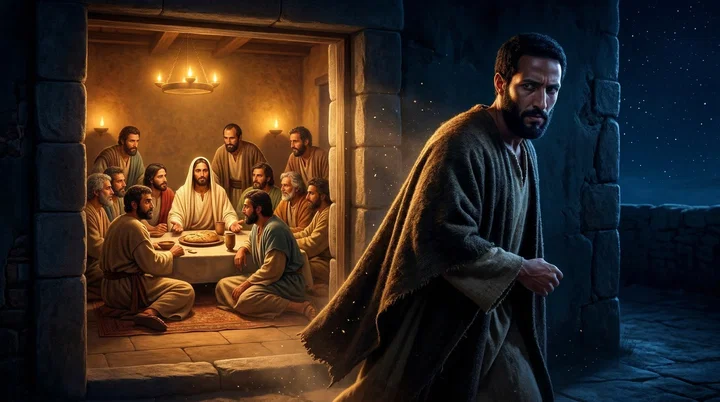
Now no man at the table knew for what intent he spoke this to him.
King James Version, KJV Cambridge Paragraph Bible, Revised Version, American Standard Version
Now no man at the table knew for what intent he spake this unto him.
and none of those reclining at meat knew for what intent he said this to him,
But none of those at table knew why he said this to him;
But, as to this, none of them who were reclining with him knew respecting what, he said it to him.
Berean Standard Bible, Majority Standard Bible
But no one at the table knew why Jesus had said this to him.
Now nobody at the table knew why he said this to him.
Now it was not clear to anyone at table why he said this to him.
But none of them that were at table, knew, for what cause he spake it vnto him.
Douay-Rheims (Challoner revision)
Now no man at the table knew to what purpose he said this unto him.
Pictures
Cross-references
- Matthew 26:20-25
Now when the even was come, he sat down with the twelve.
At the Passover supper, Jesus announces his betrayal and identifies Judas.
- John 13:5
After that he poureth water into a bason, and began to wash the disciples’ feet, and to wipe them with the towel wherewith he was girded.
Jesus washes Judas’s feet despite knowing he will betray him.
- Mark 14:17-21
And in the evening he cometh with the twelve.
Jesus announces at the supper that one of the disciples will betray him.
- Luke 22:21-23
But, behold, the hand of him that betrayeth me is with me on the table.
The meal account includes Jesus’ announcement that one of the diners will betray him.
- John 13:21
When Jesus had thus said, he was troubled in spirit, and testified, and said, Verily, verily, I say unto you, that one of you shall betray me.
Jesus is troubled as he tells the disciples that one of them will betray him.
- John 13:10-11
Jesus saith to him, He that is washed needeth not save to wash his feet, but is clean every whit: and ye are clean, but not all.
Judas was present at the foot washing, though Jesus said not all were clean.
- John 13:2
And supper being ended, the devil having now put into the heart of Judas Iscariot, Simon’s son, to betray him;
Sets the meal’s timing and places the foot washing during the meal.
- John 13:18
I speak not of you all: I know whom I have chosen: but that the scripture may be fulfilled, He that eateth bread with me hath lifted up his heel against me.
Jesus announces that one at the table will betray him.
- John 13:22
Then the disciples looked one on another, doubting of whom he spake.
quoted together as disciples doubting who it was
- John 13:1
Now before the feast of the passover, when Jesus knew that his hour was come that he should depart out of this world unto the Father, having loved his own which were in the world, he loved them unto the end.
Jesus’ foot washing memorializes his humiliation before the Supper.
- John 13:14-15
If I then, your Lord and Master, have washed your feet; ye also ought to wash one another’s feet.
Christ’s example and command call his disciples to serve one another.
- 1 Corinthians 11:23
For I have received of the Lord that which also I delivered unto you, That the Lord Jesus the same night in which he was betrayed took bread:
Paul recounts the supper on the night Jesus was betrayed.
Commentary
Each commentary is drawn from primary sources: the writings of Ellen G. White and Adventist pioneers and periodicals. Each commentary is separate. Its own words are not a quotation; follow the references to read the source passages.
Ellen G. White
10 sources
This verse belongs to Jesus' final Passover meal with His disciples, when He revealed that Judas would betray Him.Ms 189, 1898, par. 6–9Ms 120, 1897, par. 9 In its immediate setting the disciples looked at one another doubting of whom He spoke when He said one of them would betray Him, and even after He dipped the sop and gave it to Judas Iscariot and Satan entered into him and He told him to act quickly, they still did not understand as Judas immediately went out into the night.RH Nov 4, 1902 No one at the table knew for what intent He spoke to Judas or understood that He was telling Judas to go out to betray Him.Ms 189, 1898, par. 6–9RH Nov 4, 1902Ms 35, 1897, par. 11–12 Jesus alone read Judas's secret purpose to betray Him, while the other disciples could not read his heart or distinguish him from the rest.3SP 86.1COS 110.7–9Ms 19, 1897, par. 56–5720MR 149.2–4
Judas himself knew that Jesus had exposed his purpose and was alarmed, yet he did not repent but became more determined to carry out his betrayal.3SP 86.1 The other disciples were relieved when he left, and Jesus' face brightened as the shadow lifted from them.COS 110.7–9 Jesus' dealings with Judas showed mercy by including him in loving service and giving him a final appeal and opportunity to repent with convincing proof that He knew his thoughts and plans.3SP 86.1Ms 120, 1897, par. 9 When Judas rejected it his course was decided and Satan took control of his heart and mind.Ms 120, 1897, par. 9
Though He knew Judas would betray Him and would leave that table to act his part in betraying Him, Jesus gave him no rebuke and did not expose him, but continued to treat him with goodness, humility and love as through all their association.Ms 19, 1897, par. 56–57Ms 35, 1897, par. 11–12 He washed the feet of Judas first of all, which thrilled his heart with an impulse to confess then and there, and He did not refuse him a place at the table to partake of the sacrament.Ms 19, 1897, par. 56–57Ms 35, 1897, par. 11–1220MR 149.2–4 Judas had let himself become a channel of darkness by bracing his soul against light he knew better, fighting away from Jesus under Satan's claim that He was not the Son of God, giving up hope of temporal preferment and seeking to blot out what he had heard despite deep impressions of the Holy Spirit until he became traitor and betrayer.Ms 19, 1897, par. 56–57 Yet to the other disciples he did not appear villainous but was numbered among the apostles as a false believer esteemed as a man of great capability with breadth of knowledge whose qualifications would have been valuable if sanctified to God's service.Ms 19, 1897, par. 56–57ST Feb 9, 1915
Because human beings cannot read the secrets of the soul and cannot tell who is worthy and who is not, the presence of one considered unworthy is no reason to defer or refuse the ordinance of feet-washing preceding the Lord's supper, and it is not left to man to say who shall come to it.Ms 35, 1897, par. 11–1220MR 149.2–4 Judas's experience shows Christ's long patience with perverse human nature and teaches His followers to bear patiently with false brethren rather than hastily reject them.ST Feb 9, 1915 As part of the account of Judas betraying his Master, the verse calls youth and all believers to work out their own salvation with fear and trembling, keeping religious influence genuine and faith in Christ as a personal Saviour unwavering, so they will never betray Christ as Judas did.Ms 102, 1904, par. 39
Sources
Pioneers and periodicals
25 sources
No one reclining with Jesus at the table grasped why He spoke as He did to Judas, not knowing His words pointed to the betrayal close at hand even after the announcement that one would betray Him, the giving of the dipped sop to Judas Iscariot, Satan entering into him, and his going out at once into the night.ST Oct 31, 1878ST Oct 5, 1882RH May 3, 1864 It was the Passover meal eaten in the upper room at Jerusalem on the night before the crucifixion, when Jesus ate the Passover with His disciples and then instituted the Lord's Supper.ST Jan 10, 1900ST Nov 4, 1897ST May 21, 1896 Because Judas kept the money bag, those present supposed Jesus had told him to buy what was needed for the feast or to give something to the poor.ST The same history institutes feet-washing, for Jesus washed the feet of all His disciples and bade them do as He had done, to be kept in connection with communion immediately before the Lord's Supper as the rite of humility. In it Jesus dealt with Judas patiently and mercifully, giving him a final convincing proof of divine knowledge and one last chance to repent before it was too late, yet Judas stayed alarmed rather than repentant and grew more determined in his treachery, reaching his final decision to abandon Jesus that last night when, after three and one-half years of following for earthly honor and temporal gain, he took the lowly washing of his feet to mean Jesus could never become a king.ST Aug 12, 1886RH Jan 4, 1906
Supper Setting and Misunderstanding
The verse belongs to the Passover meal eaten in the upper room at Jerusalem on the night before the crucifixion, at which Jesus ate the Passover with His disciples and then instituted the Lord's Supper.ST Jan 10, 1900ST Nov 4, 1897ST May 21, 1896ST Nov 19, 1912
The foot washing took place during or near the beginning of the meal while the disciples were still reclining and eating, after the washing they were still at supper and still eating.ST Nov 15, 1883RH Jul 21, 1868ST Jul 30, 1885
It took place after the Passover supper was ended but before the bread and wine of the Lord's Supper, as proved by their still being at table instead of singing a hymn and going out, so the meal eaten afterward was the bread and wine as memorials of His broken body and shed blood.ST Nov 15, 1883RH Jul 21, 1868ST Jul 30, 1885
No one at the table understood for what intent Jesus spoke to Judas; they only partly grasped the significance of the events and did not know His words concerned the impending betrayal.ST Oct 31, 1878ST Oct 5, 1882RH May 3, 1864RH May 18, 1869
They did not realize Judas was the betrayer even after Jesus announced one would betray Him and the disciples doubted of whom He spoke, and they did not fully understand that Judas was going to betray Him or that he would do so immediately.ST Oct 5, 1882RH May 3, 1864RH May 18, 1869ST Nov 22, 1883
He gave the dipped sop to Judas Iscariot, Satan entered into him, and Judas went out straightway into the night while the others remained.ST Oct 5, 1882ST
Because Judas kept the money bag, some supposed Jesus meant for him to buy what was needed for the feast or to give something to the poor when He told him to act quickly.
Right after this misunderstood word Judas went out straightway, and it was night, while those who remained with Jesus afterward joined in the solemn hymn.ST
The verse stands immediately before Jesus addressed the disciples as little children and told them He would be with them only a little while longer and where He went they could not come.ST Jan 10, 1900ST Aug 18, 1881
He told Peter he could not follow now but should follow afterwards, and promised He goes to prepare a place in His Father's house and will come again to receive them unto Himself that where He is they may be also, which means His people are with Him at His second coming and the resurrection, not at death.ST Aug 18, 1881
The verse is part of a chapter showing Jesus troubled in spirit and enduring the announcement of betrayal with sorrow yet calm, kingly dignity, unshaken love, and tender consideration even as He faced suffering and death, a grief the disciples shared without knowing its cause.ST Aug 28, 1879ST Aug 12, 1886
Footwashing Ordinance Established
John 13:28 belongs to the history in John 13 that institutes feet-washing as an ordinance, showing Jesus washed the feet of all His disciples at the last supper and instructed them to do as He had done to them. It is to be practiced in connection with communion, immediately before the Lord's Supper, as the rite of humility. That single testimony in John 13 is enough to establish foot-washing as a plain and binding ordinance, as valid as if repeated fifty times.ST Jul 15, 1886 It is stronger proof than can be found for Sunday-keeping or infant baptism.ST Jul 15, 1886 The proceedings are minutely described as a very literal transaction emblematic of humility that enjoins literal obedience to the example given of washing one another's feet.ST Jul 15, 1886ST Jan 3, 1884
The verse occurs as Jesus establishes the foot-washing ordinance amid alienation and dispute over rank among the disciples at the table who did not understand why He spoke to Judas.RH Jun 23, 1910 The act was meant to remove such feelings and prepare them for communion, enforcing a great moral lesson by an act suited to the surrounding circumstances.RH Feb 24, 1859RH Jun 23, 1910 It is not a lesson of hospitality, for the disciples showed no inhospitality needing rebuke and were in no need of hospitality being shown them.RH Feb 24, 1859 To make it hospitality leaves it without any occasion calling it forth and makes it a strange digression from the course of events then transpiring.RH Feb 24, 1859 It is rather like setting a little child among the disciples to teach humility and equality when they had disputed who should be greatest in the kingdom of heaven.RH Feb 24, 1859
Judas Tested and Disciples Taught
At that table Jesus dealt with Judas patiently and mercifully, making clear that He knew his thoughts and purposes.ST Aug 12, 1886 The word to Judas was a final convincing proof of divine knowledge and divinity, and one last chance to repent before it was too late to turn back from betrayal.ST Aug 12, 1886 Judas was only alarmed and not repentant, and he went on more determined to carry out his treachery.ST Aug 12, 1886 None of the others at the table understood for what intent the word was spoken to him.ST Aug 12, 1886
It was on that last night before the crucifixion, when Jesus washed his feet, that Judas reached his final decision to abandon Jesus.RH Jan 4, 1906 He had followed through three and one-half years of earnest earthly work with no higher motive than earthly honor and temporal gain.RH Jan 4, 1906 When the great Commander of heaven, the glorious Son of God clothed with humanity, stooped in the humble menial act of a servant to wash his feet, Judas misinterpreted that condescension to mean Jesus could never become a king.RH Jan 4, 1906 He concluded that no honor, exaltation, or personal gain would come from following Him further, and decided then and there to go.RH Jan 4, 1906 He left the presence of his Redeemer with his sins unconfessed, going out into the gloom of eternal night as a lost soul forever and sealing his doom.RH Jan 4, 1906
Judas remained with Jesus and the disciples through the events at the supper, including the washing of feet and the Lord's Supper.ST Jul 12, 1905 The account is therefore examined for the timing of his receiving a portion from Christ and going out, whether he left before or after the Lord's Supper was instituted.RH Jul 29, 1873 That timing determines whether he partook of the memorial.RH Jul 29, 1873
His presence there, numbered among the apostles despite being a false believer, shows Christ's long patience with perverse human nature.ST Feb 9, 1915 That patience teaches His followers to bear patiently with false brethren rather than hastily reject them.ST Feb 9, 1915
Sources