John 13:27
And after the sop Satan entered into him. Then said Jesus unto him, That thou doest, do quickly.
Translations
And after the sop Satan entered into him. Then said Jesus to him, That you do, do quickly.
King James Version, KJV Cambridge Paragraph Bible
And after the sop Satan entered into him. Then said Jesus unto him, That thou doest, do quickly.
And after the sop Satan entered into him. Then said Jesus to him, What thou doest, do quickly.
And after the sop, then entered Satan into him. Jesus therefore saith unto him, That thou doest, do quickly.
And after the sop, then entered Satan into him. Jesus therefore saith unto him, What thou doest, do quickly.
And after the morsel, then the Adversary entered into that one, Jesus, therefore, saith to him, 'What thou dost — do quickly;'
And, after the morsel, then entered Satan into him. Jesus therefore says to him, What thou doest, do quickly.
And, after the morsel, then, entered, Satan, into that man. Jesus, therefore, saith unto him—What thou art doing, do quickly!
Berean Standard Bible, Majority Standard Bible
And when Judas had taken the morsel, Satan entered into him.Then Jesus said to Judas, “ What you are about to do, do quickly.”
After the piece of bread, then Satan entered into him.Then Jesus said to him, “ What you do, do quickly.”
And when Judas took the bread Satan went into him. Then Jesus said to him, Do quickly what you have to do.
And after the soppe, Satan entred into him. Then sayd Iesus vnto him, That thou doest, doe quickly.
Douay-Rheims (Challoner revision)
And after the morsel, Satan entered into him. And Jesus said to him: That which thou dost, do quickly.
Pictures
Cross-references 20 of 24
- Luke 22:3
Then entered Satan into Judas surnamed Iscariot, being of the number of the twelve.
Satan enters Judas as he sets out to betray Jesus.
- Matthew 26:21
And as they did eat, he said, Verily I say unto you, that one of you shall betray me.
Jesus identifies Judas as the betrayer during the supper.
- John 13:4-5
He riseth from supper, and laid aside his garments; and took a towel, and girded himself.
Jesus washes Judas’s feet before identifying the betrayer.
- Mark 14:17-25
And in the evening he cometh with the twelve.
Another Gospel account considered in the question of the supper’s timing and Judas’s presence.
- John 13:10-11
Jesus saith to him, He that is washed needeth not save to wash his feet, but is clean every whit: and ye are clean, but not all.
Jesus says Judas is not clean, though He has washed the disciples’ feet.
- Luke 22:14-23
And when the hour was come, he sat down, and the twelve apostles with him.
Its account is part of the Gospel testimony about whether Judas partook.
- John 6:70-71
Jesus answered them, Have not I chosen you twelve, and one of you is a devil?
Jesus had already identified Judas, the betrayer, as a devil among the Twelve.
- Psalms 41:9
Yea, mine own familiar friend, in whom I trusted, which did eat of my bread, hath lifted up his heel against me.
Judas’s betrayal fulfills the Scripture about a close companion who shared bread and turned against Jesus.
- John 13:18-19
I speak not of you all: I know whom I have chosen: but that the scripture may be fulfilled, He that eateth bread with me hath lifted up his heel against me.
Jesus identifies Judas’s betrayal as fulfilling Scripture and foretells it so the disciples will believe.
- John 13:21
When Jesus had thus said, he was troubled in spirit, and testified, and said, Verily, verily, I say unto you, that one of you shall betray me.
Jesus announces that one disciple will betray him.
- Matthew 26:14-16
Then one of the twelve, called Judas Iscariot, went unto the chief priests,
Judas agrees with the priests to betray Jesus for silver.
- Luke 22:48
But Jesus said unto him, Judas, betrayest thou the Son of man with a kiss?
Jesus confronts Judas for betraying him with a kiss.
- John 12:4-6
Then saith one of his disciples, Judas Iscariot, Simon’s son, which should betray him,
Judas used concern for the poor as a pretext to conceal his greed.
- 1 Corinthians 11:23-26
For I have received of the Lord that which also I delivered unto you, That the Lord Jesus the same night in which he was betrayed took bread:
Recounts the Lord’s Supper instituted on the night Jesus was betrayed.
- John 13:2
And supper being ended, the devil having now put into the heart of Judas Iscariot, Simon’s son, to betray him;
Satan prompted Judas to betray Jesus before the meal’s events.
- Matthew 26:50
And Jesus said unto him, Friend, wherefore art thou come? Then came they, and laid hands on Jesus, and took him.
Jesus addresses Judas as he approaches to betray him.
- Matthew 26:24
The Son of man goeth as it is written of him: but woe unto that man by whom the Son of man is betrayed! it had been good for that man if he had not been born.
Jesus pronounces woe on Judas for betraying him.
- Luke 22:21-23
But, behold, the hand of him that betrayeth me is with me on the table.
The betrayer is present at the meal with Jesus.
- Matthew 27:3-5
Then Judas, which had betrayed him, when he saw that he was condemned, repented himself, and brought again the thirty pieces of silver to the chief priests and elders,
Judas confesses his betrayal, returns the silver, and hangs himself.
- Matthew 26:47-49
And while he yet spake, lo, Judas, one of the twelve, came, and with him a great multitude with swords and staves, from the chief priests and elders of the people.
Describes Judas betraying Jesus with a kiss.
Commentary
Each commentary is drawn from primary sources: the writings of Ellen G. White and Adventist pioneers and periodicals. Each commentary is separate. Its own words are not a quotation; follow the references to read the source passages.
Ellen G. White
37 sources
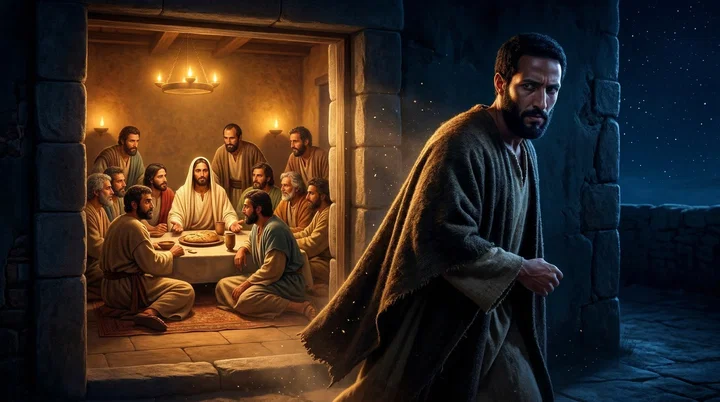
At the final Passover meal when the memorial of the coming sacrifice was instituted, the betrayer was pointed out by giving the dipped sop to Judas Iscariot, after which Satan entered him, he was told to carry out his deed quickly, and he went out at once into the night while the other disciples misunderstood the command.ST Dec 23, 1908DA 652.1–2DA 717.2RH Nov 4, 1902 Satan's entering means the adversary himself took possession of one of Christ's own followers to lead him to hand over the Lord of life to His enemies to be crucified.Ms 113, 1899, par. 24SG1 100.1EW 173.1ST Jun 6, 1878 That control came only after persistent resistance to divine influence, as Judas cherished covetousness, selfish ambition and revengeful passions, refused to confess and forsake wrong, rejected teaching and warnings, and let avarice poison his spiritual life until he became a channel of darkness and a representative of the enemy.6T 264.2–265.1DA 294.5–295.4AA 557.2–558.1ST Mar 5, 1912Ms 47, 1897, par. 5 Though Jesus knew his secret purpose He kept him near, washed his feet, bore with him in love, and in exposing his hidden thoughts gave a final merciful warning and call to repentance, which remained possible until he left the presence of Christ and passed the boundary beyond return.DA 654.3–655.1ST May 23, 18783SP 86.1STGC 86.2–87.1DA 720.2 The verse therefore warns against acting the part of Judas by yielding to the enemy instead of turning to Christ in humble repentance, teaching that even one cherished departure from righteousness can open the way until selfishness overmasters the mind, yet faulty and false-hearted persons are still to be borne with in patience and are not to be barred by human judgment from the table.Lt 117, 1897, par. 8–10MH 493.3–4Ms 35, 1897, par. 11–126T 264.2–265.1RCNBP 6.1
Supper Setting and Command
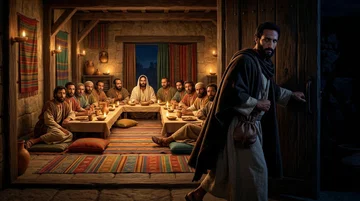
The setting is the final Passover meal Jesus ate with His disciples, at which He instituted the Lord's Supper as the memorial of His coming sacrifice.DA 652.1–2 In troubled testimony He declared that one of the disciples looking on in doubt would betray Him.RH Nov 4, 1902 He identified the betrayer by dipping the sop and giving it to Judas Iscariot the son of Simon, and after the sop Satan entered into Judas.RH Nov 4, 1902 Jesus then directed him to carry out his deed quickly, and Judas went out immediately while it was night.ST Dec 23, 1908RH Nov 4, 1902 The words came after Jesus had exposed Judas's purpose and offered him a final call to repent, yet Judas instead became more determined and left to complete the betrayal.ST Dec 23, 1908
The other disciples mistook the command to Judas as an instruction to buy what was needed for the feast or to give money to the poor.DA 717.2 As treasurer Judas had been given opportunities to serve others and develop an unselfish spirit.DA 717.2 Instead he indulged covetousness and used small sums for himself, excusing actions that were theft.DA 717.2
Satan's entering means Satan himself entered one of Christ's own followers and led him on to betray Jesus into the hands of His enemies that they might crucify the Lord of life and glory.Ms 113, 1899, par. 24SG1 100.1EW 173.1 This was part of Satan's work that first blinded the eyes of the Jews so they would not receive Jesus as their Saviour.EW 173.1 Then, through envy because of His mighty works, it moved them to desire His life.EW 173.1 Judas had given himself over to Satan's control so that he could not resist him.ST Jun 6, 1878 The betrayal came through a kiss, even as Jesus addressed him with sorrow and received the kiss with forbearance, love, and pity.ST Jun 6, 1878
The command to act quickly comes as the exposed Judas hurries to leave and depart to carry out the betrayal.ST Dec 23, 19083SP 85.1–2 It is not approval of his deed.3SP 85.1–2 The following events show he was not moved to repent.3SP 85.1–2
Judas Under Satan's Control
Satan gained control of Judas only after long, persistent resistance to divine influence, as Judas cherished evil desires, covetousness, revengeful passions, dark thoughts, selfish ambition and self-seeking, refused to confess and forsake his wrongdoing, rejected teaching and warnings and means provided to change his character, and let settled habits leave him blind and deceived until Satan had full control and he became a representative of the enemy and a traitor and betrayer.6T 264.2–265.1DA 294.5–295.4AA 557.2–558.1ST May 12, 1898 Association with Christ did not make him one with Christ or cultivate sympathy for others, and his self-seeking led him outside of Christ and under temptation.6T 264.2–265.1 Neglect of Christlike love and even one departure from righteousness opened the way to further wrongdoing until selfishness overmastered the mind.6T 264.2–265.1
He let himself become a channel of darkness, bracing his soul against light he knew better about, listening to the enemy's claim that Jesus was not the Son of God but a pretense, fighting away from Jesus and off the deep impressions of the Holy Spirit, trying to obliterate what he had heard, and giving up hope of temporal preferment until he became traitor and betrayer.Ms 19, 1897, par. 56–57 Jesus alone knew his secret purpose, yet gave him no word of rebuke and did not expose him to the disciples.Ms 19, 1897, par. 56–57 The disciples knew nothing of his purposes and saw nothing villainous in his appearance or deportment, but esteemed him a man of great capabilities, breadth of knowledge, and qualifications valuable if sanctified.Ms 19, 1897, par. 56–57
Covetousness corrupting his character repeatedly let Satan overcome him and find expression, even using concern for the poor and objections to waste as excuses for greed.ST Mar 5, 1912 After a more direct reproof than before in defending Mary's anointing as anticipation of death and burial, which provoked him, he opened the door through which Satan entered to control his thoughts, and cherished avarice poisoned his spiritual life.Ms 47, 1897, par. 5 When Jesus washed his soiled feet first with His own hands and wiped them with the towel, that treatment thrilled his heart through and through with an impulse to confess then and there.DA 645.1Ms 19, 1897, par. 56–57 He hardened his heart against repentance, resented that Jesus did a servant's work, lost hope of worldly honor and of being made king, and with anger at implied rebuke and disappointment in hopes for power let former impulses take control again, becoming more determined and leaving in anger, though Jesus continued to feel deep love and concern for him.COS 110.7–9DA 645.1ED 92.1–2
Though Jesus knew Judas would betray Him, He did not dismiss him from the disciples but kept him by His side so He could counteract the harmful influence Judas might otherwise exert, showing him goodness, humility, and enduring love through His whole association.STGC 86.2–87.1Ms 19, 1897, par. 56–57 In exposing that He knew his hidden thoughts and purpose and telling him to carry out his plan at once, Jesus showed wonderful longsuffering and gave a final, merciful warning and convincing evidence of divinity by reading his heart.DA 654.3–655.1ST May 23, 18783SP 86.15RED 6.2–7.2 The appeal came even after Judas had twice agreed to betray his Lord, with every appeal mercy and subduing love could make, as the last call to repentance, and that foreknowledge continued into Gethsemane without taking away opportunity to repent.DA 654.3–655.1Ms 149, 1904, par. 13–15 Even after rejecting that light he could still have been saved and freely forgiven if he had yielded and confessed his traitor work when Jesus met him.Ms 149, 1904, par. 13–15
Until Judas acted and left the presence of Christ and his fellow disciples repentance was still possible, but by going out from the supper to complete the betrayal he made the final decision and passed the boundary line beyond repentance.DA 654.3–655.1Ms 106, 1903, par. 37–38 After the final loving appeal was rejected his decision was settled: after receiving the sop Satan took control of his heart and mind, and by going out he came fully under Satan's control and crossed into outer darkness, so that it became night to the traitor.DA 654.3–655.1DA 720.2Ms 120, 1897, par. 9Ms 106, 1903, par. 37–38 Although surprised and alarmed at the discovery of his guilt, he did not repent or fear or turn, but became only more determined and firmly set on his plan and went out to carry it out.DA 654.3–655.1ST May 23, 18783SP 86.1 He left the Passover chamber and the light of Christ's presence for the darkness of a life without hope, his departure relieved the others, and Jesus' face brightened.COS 110.7–9ED 92.1–2
Warning and Instruction Today
John 13:27 stands as a warning not to play the part of Judas and betray Christ, exposing the peril of giving in to the enemy instead of turning to Christ in humble repentance and dependence on God.Lt 117, 1897, par. 8–10 To avoid his course is to work out salvation with fear and trembling, with a religious influence so genuine and a faith in Christ as a personal Saviour so unwavering that betrayal never occurs, an experience that youth especially, and all alike, need to gain.Ms 102, 1904, par. 39 Judas had defects of character yet was accepted as a disciple and given the same opportunities and privileges as the others, so he was without excuse, and he could have become a doer of the Word and been converted rather than clinging to his defects.RCNBP 6.1 His association with Christ did not make him one with Christ nor cultivate sympathy for others, and his self-seeking led him outside of Christ and under Satan's temptations.6T 264.2–265.1 The verse therefore warns that neglecting Christlike love and allowing even one departure from righteousness can open the way to further wrongdoing until selfishness overmasters the mind.6T 264.2–265.1
Jesus knew Judas would betray Him and still bore patiently with him, and that example teaches patience toward false-hearted or faulty people among His workers.MH 493.3–4 Even as the betrayal advanced Jesus bore with Judas, giving an example of forbearance toward perverse human nature and of how believers should bear with false brethren.ST Feb 9, 1915 Though Jesus knew Judas would leave the supper table to act his part in betraying his Lord, yet He washed Judas's feet and did not refuse him a place at the table or the sacrament.Ms 35, 1897, par. 11–1220MR 149.2–4 Human beings cannot read the secrets of the soul and cannot tell who is worthy and who is not, nor distinguish the tares from the wheat, so feet-washing and the Lord's supper are not to be deferred because someone is considered unworthy, no one is to stay away because such a one is present, and it is not left to man to say who shall take part.Ms 35, 1897, par. 11–1220MR 149.2–4 Unseen messengers of darkness attend those who refuse the Holy Spirit, while heavenly angels are also present and witness the service, including the washing of Judas's feet.20MR 149.2–4
The chapter to which John 13:27 belongs plainly expresses God's will for His people, and its instruction, read with Christ's prayer for unity, is meant to cure dissension and lead to unity with one another and with Christ.Lt 131, 1900, par. 1–3 The words are echoed in the urgent call to do what must be done quickly because time is almost finished.8MR 222.3–4 That call urges readiness and earnest prayer for the Lord's power to be revealed without delay.8MR 222.3–4
Sources
Pioneers and periodicals
65 sources
On the night of the Passover supper in the upper chamber in Jerusalem when He was betrayed and afterward crucified, Jesus gave the dipped sop to Judas Iscariot the son of Simon to mark him as the betrayer, and after the sop Satan entered Judas and Jesus told him to carry out without delay what he had already chosen to do.RH Feb 24, 1859RH May 3, 1864ST Nov 4, 1897ST Apr 2, 1912 Satan's entering was not the beginning of yielding, for Judas had already coveted gain and bargained with the priests, and by cherishing evil desires and repeatedly rejecting counsel and light he opened his heart step by step until at his exposure he yielded himself and came under Satan's full control so he could not resist him.ST Jun 5, 1884RH Aug 2, 1906RH Dec 7, 1916RH Jul 29, 1862 Jesus' exposure and command was a final merciful warning giving convincing evidence of divine foresight, yet Judas did not repent but became more determined, rose and left the room at once into night as a ruined soul turning into spiritual darkness.ST Dec 23, 1908RH Nov 4, 1902ST May 23, 1878RH Aug 2, 1906 He left immediately before the farewell discourse and before Jesus instituted the Lord's Supper and therefore did not partake of that memorial, while those who held he remained taught that he whose heart was not right nevertheless partook on his own responsibility.ST Feb 4, 1903ST May 26, 1909ST May 19, 1898RH May 27, 1873ST Mar 20, 1907 The command to act quickly warns what happens when a person clings to sin past a final urgent opportunity to repent, and urges preaching, winning souls, and returning to allegiance without delay because time is short.ST Apr 9, 1902ST Nov 9, 1915RH Jul 29, 1862RH Aug 26, 1873
Setting and Sequence
John 13:27 belongs to the Passover supper in the upper chamber in Jerusalem on the night Jesus was betrayed, taken, and afterward crucified.ST Nov 4, 1897ST Apr 2, 1912ST May 21, 1896 That same night included the dispute over who would be greatest, the washing of feet, the Lord's Supper, prayer in Gethsemane, and Judas coming with a mob to deliver Him to His enemies, a deed fitting the darkness of night.RH Feb 24, 1859ST Nov 4, 1897ST Jul 12, 1905 The foot-washing transaction on the eve of the paschal sacrifice does not teach hospitality, for no surrounding circumstances called for such a lesson, the disciples had shown no inhospitality needing correction, and they were not themselves in need of hospitality being shown to them.RH Feb 24, 1859 The supper was where Jesus ate the Passover with His disciples and afterward instituted the Lord's Supper, with the rite of humility or washing of feet, observances to continue until His return to remind followers of His humiliation in taking human nature, His humble work of salvation, and His freely given body and blood.ST May 21, 1896ST Nov 19, 1912
Foot washing and the supper belonged to the same evening meal and the same ordinance service, for the words to Judas were spoken during the evening meal at which Jesus washed the disciples' feet and instituted the Lord's Supper.RH Aug 19, 1858RH May 7, 1872ST May 12, 1898 Obeying those instructions in the church's ordinance service brought humility and blessing.RH May 7, 1872 The betrayal by Judas takes place as part of that parallel account of the Lord's Supper.ST May 12, 1898
The disciples had been disputing about which should have the highest place in the kingdom, and alienation and dissension were among them, so they were not clean of heart nor fit to receive the bread and the wine, the emblems of true communion, which they were not really enjoying.RH Jun 23, 1910 The mention of Satan entering Judas is part of the account of Judas's work that night, which shows that he was not clean in the inner person.ST Jul 26, 1883 Jesus desired to wash all this alienation away, and at the same time to establish an ordinance for the church that would always take away similar feelings and conditions and prepare the participants for the communion service.RH Jun 23, 1910
The washing took place during or near the beginning of the meal while the disciples were still at supper and reclining at table, after which they had not yet sung a hymn and gone out.ST Jul 30, 1885RH Dec 23, 1858 After Judas received the dipped sop he left immediately, and this sequence shows that foot washing preceded the supper.RH Dec 23, 1858 Those who held otherwise taught that the Passover supper had ended before foot washing, and that the meal eaten afterward with the sop and the betrayal charge, with the disciples still reclined at table and eating instead of singing a hymn and going out, was the Lord's Supper.RH Jul 21, 1868
After receiving the sop Judas left at once to carry out the betrayal, coming after the institution of the ordinance of humility and before the farewell discourse to the disciples.ST Feb 4, 1903ST May 26, 1909ST May 19, 1898 His departure occurred on the night of the Lord's Supper, before the arrest, and the instruction recorded in John 13:31-17 followed it.ST May 19, 1898 Though he could remain for the meal, he did not stay to sing with them, for the disciples sang a solemn hymn after he had gone.ST
Jesus faced the betrayal with sorrow yet calm, kingly self-control and enduring love, bearing the traitor's presence without resentment.ST Aug 28, 1879 Foreseeing the events soon to come in the upper-chamber scene, He was troubled in spirit and grieved over the ingratitude and cruelty of those He came to save and the fate awaiting them, which the disciples sensed without knowing its cause.ST Aug 12, 1886ST Aug 12, 1886 The quiet hours before Gethsemane were devoted to the disciples, as He was soon to suffer and the Passover type was about to meet its fulfillment in the Lamb of God dying for the sins of the world.ST Aug 12, 1886
The verse stands where Jesus announces that the prince of this world is coming, declares that this enemy has nothing in Him, and acts as the Father commanded so the world may know His love for the Father.ST Jan 10, 1900 It stands also in the farewell discourse where Jesus tells His disciples that where He goes they cannot come now but shall follow Him afterward, and then promises many mansions in His Father's house and that He will go to prepare a place and come again and receive them unto Himself that where He is they may be also.ST Aug 18, 1881 This shows that Christ's people get to be with Him at His second coming and the resurrection, not immediately at death, since death is an unconscious sleep that is as an instant to the dead whether one year or four thousand years.ST Aug 18, 1881 The Gospel writers record the last supper and betrayal as events of the same night, and the agreement of their accounts alongside Paul's account of the supper evidences that these events were factual.RH Jan 28, 1862
Betrayer Exposed and Dismissed
Jesus pointed out the betrayer by dipping the sop and giving it to Judas Iscariot the son of Simon, in fulfillment of His troubled testimony that one of the disciples looking on in doubt would betray Him.RH Nov 4, 1902RH May 3, 1864 The disciples did not suspect Judas, and each asked whether he himself was the one.RH May 18, 1869 After Judas received the sop Satan entered into him.RH May 3, 1864ST May 19, 1898
Jesus then made clear that He knew the treachery and told Judas to carry out without delay what he had already chosen and determined to do.ST Oct 5, 1882RH May 3, 1864ST May 19, 1898ST Aug 12, 1886 He spoke with gentleness rather than reproach, asking Judas to leave so that his presence would not disturb the harmony and love of what was to follow.ST Nov 29, 1883 The exposure of his purpose and the command to act quickly was a final merciful warning and last chance to turn back before the treachery was finished.ST Dec 23, 1908ST May 23, 1878ST Aug 12, 1886
By laying open all of Judas's thoughts and purposes as fully known to the Son of God, Jesus gave him convincing evidence of divine knowledge and foresight and one final proof of divinity by which he might turn from his purpose before repentance was too late.ST May 23, 1878ST Aug 12, 1886 Judas was surprised and alarmed but was not moved to repentance.ST May 23, 1878ST Aug 12, 1886 That Jesus was not surprised or deceived strengthened the trust of the faithful disciples in His divine foresight during His humiliation.
Instead Judas became more determined and settled more firmly in his plan, rose and hastily left the room at once to complete the betrayal work he had engaged to do.ST Dec 23, 1908ST May 23, 1878ST Aug 12, 1886 His rising and immediate departure came in response to Jesus telling him to act quickly after his guilt had been exposed.ST Aug 12, 1886RH Nov 20, 1913 Jesus meant the command to bring about Judas's departure before the Lord's Supper that followed, so that the traitor would not remain for the ordinance, although the other disciples did not yet understand that Judas was to betray Him immediately.ST Nov 22, 1883 Judas went out immediately while it was night, and that going out from Jesus into night represents turning into spiritual darkness as a ruined, lost soul.RH Nov 4, 1902RH Aug 2, 1906RH Nov 20, 1913
Satan's Control of Judas
Satan's entering after the sop was not the start of yielding, for before the supper coveting of the money spent on the anointing had already led to bargaining with the priests to betray for gain. At the supper offers of mercy and warning were rejected. Afterward there was acknowledgment of having betrayed innocent blood, with no accusation to bring.
The heart had been opened step by step by cherishing evil desires, revengeful passions, dark and covetous thoughts, selfish ambition, and love of vanity.ST Jun 5, 1884ST Mar 5, 1912RH Dec 7, 1916RH Jul 29, 1862 Counsel repeatedly given and light that could have led to reform were rejected, and the means provided to change character were refused.ST Jun 5, 1884ST Mar 5, 1912ST May 12, 1898 Settled habits and resistance to truth left blindness and deception.ST May 12, 1898 Concern for the poor and objections to waste were used as excuses for greed corrupting the character, while the heart remained unclean and unsanctified and the influence repeatedly overcoming gave expression to covetousness.ST Mar 5, 1912 By hardening and pursuing selfish ambition there was becoming a representative of the enemy and unfitting for service as an apostle.RH Dec 7, 1916 Filling of the heart in this way warns what may happen when vanity continues to be loved and mercy resisted.RH Jul 29, 1862
The humble washing of the feet nearly softened, but rebellion chose no longer to acknowledge Him.RH Jun 23, 1910 That humble service was misread as proof there would be no kingship and no earthly honor or gain in following, and on that final night the final decision was made with sins unconfessed and doom sealed.RH Jan 4, 1906
When treachery was exposed by the sop there was yielding to the enemy and coming under full control so that resistance was no longer possible and separation was no longer possible.ST Dec 24, 1894ST Jun 6, 1878RH Aug 2, 1906RH Dec 7, 1916 There had been a period of influence through insinuations causing falls at times, and then complete surrender followed by betrayal and then despair and suicide.RH Dec 7, 1916 What resulted was wholly aligning with the enemy, becoming His agent in bringing about His death, a representative of that enemy, unfitted for apostolic service.ST Dec 24, 1894RH Dec 7, 1916 Yet while hope of repentance remained there had been seeking to save, with treachery already known.
The betrayal was a deliberate bargain expecting profit whether crucifixion or escape resulted, with an offer to help the priests find Him.ST Dec 24, 1894 It came through a kiss addressed with sorrow and received with forbearance, love, and pity.ST Jun 6, 1878 Though one of the intimate apostles treated like the others, betrayal was for gain, and afterward there was acknowledgment of betraying innocent blood with no accusation to bring.
Up to that crucial moment there was still passing as one of the Twelve with none suspecting disloyalty.RH Aug 2, 1906 There could still have been breaking down, humbling, confessing, and receiving life and forgiveness, but by refusing repentance and hardening the heart the door was closed behind and shutting forever away from pardoning love followed, going out into night as darkness of a ruined, lost soul.RH Aug 2, 1906
Sin becomes unforgivable when yielding is so full that there is no desire to repent or godly sorrow. Eating and drinking unworthily does not itself put beyond forgiveness, because unworthily concerns the manner of taking part, not character.
Later remorse shows conscience was not yet dead, but lessons of meekness, humility, and faith had not been learned, and the end was despair rather than repentance that restores.ST Dec 24, 1894RH Dec 7, 1916
Satan in the verse is a real, distinct being, not Judas or Peter nor a mere evil principle.RH Jun 26, 1856 Putting Peter in place of Satan makes the account absurd, since both are human beings.RH Jun 26, 1856
Belonging to the immediate household did not determine character, yet evil deeds were among the worst in human history.ST Jul 1, 1889 One of the chosen intimate associates failed to yield to holy influence and became the agent in bringing about death, but failure did not mean God had stopped leading His work.RH Jan 18, 1912 Betrayal does not discredit Christianity nor erase the faithful lives of the other disciples.
Even as betrayal advanced there was long patience and bearing with, giving an example of forbearance toward perverse human nature and of how to bear with false brethren.ST Feb 9, 1915
Ordinance and Doctrine
John 13 is the true record of what was done and said when Christ washed the disciples' feet and charged them to wash one another's feet because He had given them an example, and though stated only once it carries full authority as a binding yet humiliating ordinance that must not be rejected.ST Jul 15, 1886ST Jan 3, 1884 Its proceedings are minutely described and show a very literal transaction, instituting an ordinance emblematic of His humility as a literal emblem of a literal event, and His own example in observing it proves it must be literally kept, for His injunction to do as He had done can be done only in a literal manner.ST Jan 3, 1884 Foot washing is a memorial of the humility of the Lord and Master, the Prince of glory, just as the bread and wine are a memorial of His death and baptism is a memorial of His resurrection.RH Jun 16, 1868 With the Lord's Supper and the rite of humility instituted in the upper room in Jerusalem at the Passover to continue until His return, they remind followers of His humiliation in taking human nature, His humble work of salvation, and His freely given body and blood.RH Jun 16, 1868ST May 21, 1896 The ordinance was practiced in the earlier and purer ages of this dispensation until Rome laid polluting hands on the ordinances of the church and abolished or perverted them, and it must be restored to its appropriate place as the age closes with as pure a gospel as that with which it began.RH Jun 16, 1868
After giving the dipped sop Satan entered Judas and he was told to carry out his deed quickly, and he then left immediately before the Lord's Supper was instituted and therefore did not partake of that memorial.RH May 27, 1873RH Jul 29, 1873 The teaching held by others is that Judas, whose heart was not right, nevertheless partook of the Lord's Supper, and his participation was his own responsibility and not Christ's nor that of those administering the emblems.ST Mar 20, 1907 The timing of this departure in relation to the institution matters, for if the supper was instituted afterward Judas did not partake, yet the Gospel testimony does not establish that timing and a casual reading of Matthew, Mark, and Luke appears to show Judas present and partaking.RH Jul 29, 1873
Warning and Urgency
The command to act quickly gives urgency to preaching and winning souls because time is short.RH Jun 16, 1868 What remains to be done must be done without delay because the time is short and coming events face the nations.ST Apr 9, 1902 That same urgency applies to preventing crime by spreading truth, calling believers to promptly use their abilities to circulate books and tracts, prepare tracts for translation, pray for the work, and help fund publication because time is short.RH Feb 4, 1873
Delay in responding to the Savior is insulting and dangerous, so the hearer should act at once rather than put off prayer and surrender.RH Feb 26, 1861 Deserters from Christ must return to their allegiance without delay, because the time to return will soon end and death will make repentance too late. Backsliders likewise must repent and return to Christ while the door remains open, because it may soon be shut.RH Aug 26, 1873
The words were spoken to Judas after Satan entered him, telling him to carry out his deed quickly, and when borrowed as a saying about an evil act they carry a dark sarcasm, in contrast with the urgency of doing good without delay.ST Feb 21, 1911 Satan filling the heart of Judas warns what may happen when a person continues to love vanity and resist mercy.RH Jul 29, 1862 Jesus gave Judas a final urgent opportunity to yield his heart to God and repent before it was too late, and Judas passed it by and lost all, showing what it is to cling to sin and go beyond pardon.ST Nov 9, 1915
One who betrays trust is called a Judas after this account, and the example teaches bearing the loss and continuing to trust the Lord.RH Mar 22, 1860 The verse belongs to the final night before the crucifixion, when Jesus washed the feet of Judas, and Judas misread that humble service as proof that Jesus would not become a king and that following Him would bring no earthly honor or gain.RH Jan 4, 1906 Judas then made his final decision, left Jesus with his sins unconfessed, and sealed his doom.RH Jan 4, 1906
Sources