John 18:3
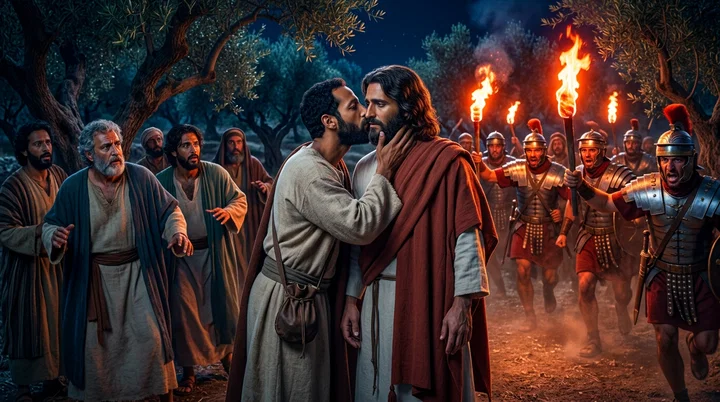
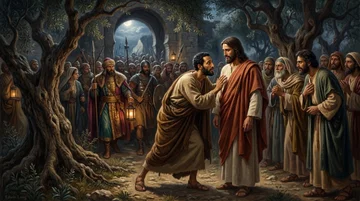
Judas then, having received a band of men and officers from the chief priests and Pharisees, cometh thither with lanterns and torches and weapons.
Translations
Judas then, having received a band of men and officers from the chief priests and Pharisees, comes thither with lanterns and torches and weapons.
Judas then, having received a band of men and officers from the chief priests and Pharisees, cometh thither with lanterns and torches and weapons.
Judas then, having received a band of men, and officers from the chief priests and Pharisees, cometh thither with lanterns and torches and weapons.
Judas then, having received a band of men and officers from the chief priests and Pharisees, cometh thither with lanterns, and torches, and weapons.
Revised Version, American Standard Version
Judas then, having received the band of soldiers, and officers from the chief priests and the Pharisees, cometh thither with lanterns and torches and weapons.
Judas, therefore, having taken the band and officers out of the chief priests and Pharisees, doth come thither with torches and lamps, and weapons;
Judas therefore, having got the band, and officers of the chief priests and Pharisees, comes there with lanterns and torches and weapons.
Judas, therefore, receiving the band, and officers, from among the High-priests and [from among] the Pharisees, cometh thither, with lights and torches and weapons.
Berean Standard Bible, Majority Standard Bible
So Judas brought a band of soldiers and officers from the chief priests and Pharisees. They arrived at the garden carrying lanterns, torches, and weapons.
Judas then, having taken a detachment of soldiers and officers from the chief priests and the Pharisees, came there with lanterns, torches, and weapons.
So Judas, getting a band of armed men and police from the chief priests and Pharisees, went there with lights and with arms.
Iudas then, after hee had receiued a band of men and officers of the high Priests, and of the Pharises, came thither with lanternes and torches, and weapons.
Douay-Rheims (Challoner revision)
Judas therefore having received a band of soldiers and servants from the chief priests and the Pharisees, cometh thither with lanterns and torches and weapons.
Pictures
Cross-references
- Matthew 26:47-56
And while he yet spake, lo, Judas, one of the twelve, came, and with him a great multitude with swords and staves, from the chief priests and elders of the people.
Judas brings an armed crowd to arrest Jesus.
- Mark 14:43-46
And immediately, while he yet spake, cometh Judas, one of the twelve, and with him a great multitude with swords and staves, from the chief priests and the scribes and the elders.
Judas leads the armed crowd to Jesus, identifies him, and they seize him.
- Luke 22:47-53
And while he yet spake, behold a multitude, and he that was called Judas, one of the twelve, went before them, and drew near unto Jesus to kiss him.
Judas leads the crowd to arrest Jesus, who confronts him about the betrayal.
- John 18:10-11
Then Simon Peter having a sword drew it, and smote the high priest’s servant, and cut off his right ear. The servant’s name was Malchus.
Peter draws his sword during the arrest, and Jesus commands him to sheath it.
- John 18:12
Then the band and the captain and officers of the Jews took Jesus, and bound him,
The armed party binds Jesus after arresting him.
- Acts 1:16
Men and brethren, this scripture must needs have been fulfilled, which the Holy Ghost by the mouth of David spake before concerning Judas, which was guide to them that took Jesus.
Identifies Judas in connection with the arresting company.
- Matthew 26:45
Then cometh he to his disciples, and saith unto them, Sleep on now, and take your rest: behold, the hour is at hand, and the Son of man is betrayed into the hands of sinners.
Jesus says he is being betrayed into the hands of sinners.
- Luke 22:47
And while he yet spake, behold a multitude, and he that was called Judas, one of the twelve, went before them, and drew near unto Jesus to kiss him.
Judas approaches Jesus with the crowd.
- Mark 14:48-50
And Jesus answered and said unto them, Are ye come out, as against a thief, with swords and with staves to take me?
Jesus challenges the armed arrest, and the disciples flee.
- Matthew 26:14-16
Then one of the twelve, called Judas Iscariot, went unto the chief priests,
Judas agrees to betray Jesus for thirty pieces of silver.
- Matthew 26:48
Now he that betrayed him gave them a sign, saying, Whomsoever I shall kiss, that same is he: hold him fast.
Judas hands Jesus to killers
- John 18:10
Then Simon Peter having a sword drew it, and smote the high priest’s servant, and cut off his right ear. The servant’s name was Malchus.
Peter strikes the high priest’s servant during Jesus’ arrest.
- Luke 22:38
And they said, Lord, behold, here are two swords. And he said unto them, It is enough.
The passage connects the disciples’ two swords with the arrest scene.
- John 18:9
That the saying might be fulfilled, which he spake, Of them which thou gavest me have I lost none.
Jesus asks that the disciples with him be protected.
- Luke 22:54-62
Then took they him, and led him, and brought him into the high priest’s house. And Peter followed afar off.
Peter denies Jesus while Jesus is held at the high priest’s house.
- Zechariah 11:12
And I said unto them, If ye think good, give me my price; and if not, forbear. So they weighed for my price thirty pieces of silver.
The thirty pieces of silver match the price paid for Jesus.
- John 18:25-27
And Simon Peter stood and warmed himself. They said therefore unto him, Art not thou also one of his disciples? He denied it, and said, I am not.
Peter’s denial brought Jesus a deep pang during the examination.
Commentary
Each commentary is drawn from primary sources: the writings of Ellen G. White and Adventist pioneers and periodicals. Each commentary is separate. Its own words are not a quotation; follow the references to read the source passages.
Ellen G. White
10 sources
The band comes to the garden over the brook Cedron, to Gethsemane, a place Judas knew because Jesus often resorted there with His disciples.Ms 91, 1909, par. 11–15Ms 52, 1904, par. 25–26 Jesus had entered that garden with His disciples that night after the Passover meal.DA 685.1 Judas, having received a band of men and officers from the chief priests and Pharisees, guides and leads them there to betray Jesus.Ms 42, 1897, par. 23–27Ms 91, 1909, par. 11–15Ms 52, 1904, par. 25–26Ms 107, 1893, par. 2 They come to take Him by force under arrest.Ms 42, 1897, par. 23–27
They come equipped with lanterns and torches and weapons, because the seizure takes place in darkness before dawn.Ms 42, 1897, par. 23–27Ms 91, 1909, par. 11–15Ms 52, 1904, par. 25–265RED 27.13SP 107.1 The arrest follows Jesus' long agony in the garden on His final night.Ms 107, 1893, par. 2 That night is one of deep sorrow as He bears humanity's guilt.DA 685.2
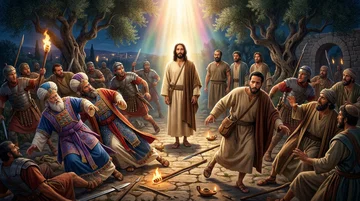
Jesus knows all things that will come upon Him and goes forth to meet the band and ask whom they seek.Ms 42, 1897, par. 23–27Ms 91, 1909, par. 11–15Ms 52, 1904, par. 25–26 When He answers that He is Jesus of Nazareth, the mob goes backward and falls to the ground.Ms 91, 1909, par. 11–15Ms 52, 1904, par. 25–26 They fall because they cannot endure the sight of the bright flash of light from the angels of God present on the ground with Him, a display that should have restrained them from going further but did not.Ms 52, 1904, par. 25–26 Their falling proves He could have delivered Himself from His enemies had He chosen, but having been sent to bear the sins of the world He must pay the penalty of human transgression, so He surrenders to them.Ms 91, 1909, par. 11–15
The armed band seizes Him and leads Him through dark, narrow streets to the high priest's palace, the palace of Caiaphas, where He is accused, questioned, and examined.5RED 27.13SP 107.1 During that humiliating examination His deepest pain comes when Peter denies Him with cursing and swearing.5RED 27.1 The arrest begins the process that leads to His condemnation by the Sanhedrin and His being brought before Pilate for legal judgment, marking the start of the great trial of betrayal, agony, condemnation, humiliation, and death on the cross.4RED 102.2–103.1Ms 107, 1893, par. 2
Jesus foresaw this ordeal and knew who among His followers were unbelieving and weak in faith, so He deliberately brought on an earlier crisis that separated faint-hearted and undecided professed followers from the faithful few while He was still present to comfort and strengthen His chosen.4RED 102.2–103.1 Having already seen the fickleness of those who once followed Him and tested the inconstant favor of the world, the twelve were not overwhelmed with surprise when the multitude turned against Him.4RED 102.2–103.1 They did not hang their faith on the opinions of others or get carried away by apostasy, but were prepared for His betrayal and death.4RED 102.2–103.1 The chapter to which the verse belongs is especially important to believers and should speak to their hearts, since the record of Christ's suffering and death strengthens those who suffer for their faith, enables His followers to keep the faith, and brings His righteousness to those who hold fast.Lt 100, 1910, par. 16
Sources
Pioneers and periodicals
23 sources
On the night after the last Passover supper Jesus went with His disciples across the brook Kidron to Gethsemane, His quiet retreat among the olive trees, to pray in agony under dim starlight while the disciples slept.ST Feb 27, 1901RH Mar 14, 1865RH Jun 25, 1901 Judas knew that place of resort and used that knowledge to lead there a band of men and officers received from the chief priests and Pharisees, both Roman soldiers placed at their disposal and the constant temple guard of Levites under Jewish officers.ST Apr 29, 1897ST Feb 27, 1901ST Mar 27, 1901RH Dec 16, 1862ST They came with lanterns and torches and weapons, swords and staves, and though the Passover moon was full the extra lights showed their determination to search even the most secluded places.ST Apr 29, 1897ST Feb 27, 1901ST Feb 27, 1901 They could not have taken Him if He had not freely surrendered Himself, openly identifying Himself and giving Himself up while shielding His disciples, so that Judas hired to point Him out proved unnecessary, and He allowed this nighttime seizure that Scripture might be fulfilled that the Son of man is betrayed into the hands of sinners.ST Feb 27, 1901ST Mar 27, 1901ST Jun 7, 1899RH Aug 2, 1906 He met their weapons and clamor with calm, kinglike love and commanded the sword to be put back into its sheath, giving the pattern for His followers to renounce violence as the world enters its Gethsemane again on the way through suffering to heaven.ST Mar 14, 1906RH Dec 16, 1862RH Jun 25, 1901ST Jun 4, 1894ST Apr 8, 1903
Arrest Setting and Details
The arrest took place at night in the garden of Gethsemane, the quiet retreat across the brook Kidron or Cedron beneath the olive trees among the mountain trees.ST Feb 27, 1901RH Mar 14, 1865RH Jun 25, 1901ST Jun 4, 1894ST Apr 8, 1903 Jesus had gone there with His little band of disciples in the cool of the evening just after the last Passover supper to enjoy communion with the Father and be strengthened, filled with light from heaven for the conflict.ST Feb 27, 1901ST Oct 13, 1898 There He prayed in deep agony under dim starlight, asking Heaven for strength to bear the punishment for sin while great drops like blood fell from Him to the ground.RH Mar 14, 1865 He prayed alone while the three disciples left to watch with Him slept.RH Mar 14, 1865
Judas knew the place because Jesus often resorted there with His disciples, and he used that knowledge of Jesus' customary place of retreat to lead the men there.ST Apr 29, 1897ST Feb 27, 1901ST Mar 27, 1901ST Jun 7, 1899 He came there with others with him and stood among the mob that met Jesus.ST Apr 29, 1897 The force was a band of men and officers received from and supplied by the chief priests and Pharisees to arrest Jesus.ST Apr 29, 1897RH Dec 16, 1862ST Judas arranged to lead the authorities to Him in Gethsemane, having betrayed Him for payment, and the armed mob was led by a professed minister.STST Jan 10, 1911RH Mar 17, 1853
It comprised two kinds of guards.ST Apr 29, 1897 The band was Roman soldiers stationed chiefly at the tower of Antonia on the northwest side of the temple and placed at the disposal of the chief priests to keep watch at the porches of the temple and repress tumult when great multitudes came to keep the Passover feast.ST Apr 29, 1897 Besides these there were constant guards around the temple composed of Levites, and the captain and officers of the Jews were those who had charge of this temple guard.ST Apr 29, 1897 They came with lanterns and torches and weapons, including swords and staves or clubs.ST Apr 29, 1897RH Dec 16, 1862RH Jun 25, 1901ST Jan 8, 1902 Since the Passover moon was full, the extra lights showed precaution and determination to search even the most secluded places.ST Feb 27, 1901ST Feb 27, 1901
The plan to seize and destroy Jesus had been formed at the palace of the high priest to be carried out that night in utmost secrecy.ST Oct 13, 1898 Judas, absent from the disciples, went with furtive glance and nervous step through the streets and alleys of Jerusalem, received knowledge of that plan and gave himself to its evil purpose terrible in conception and execution.ST Oct 13, 1898 He came along the brook weighed down with guilt and shame to hand the Son of God over to the men waiting nearby to put Him to death, whose cruel voices filled the valley.RH Mar 14, 1865
Meaning and Prophetic Fulfillment
No force on earth could have seized Jesus in the garden unless He freely gave Himself up, for His hour had come and He stood ready for the ordeal.ST Mar 27, 1901 Judas had been hired to point Him out to the armed company, yet that service proved needless, because Jesus stepped forward, openly declared who He was, surrendered Himself, and asked only that the eleven with Him be let go.RH Aug 2, 1906 That fall from an earlier resolve to follow Christ to leading swords and clubs and torches against Him measured how far the betrayer had sunk.RH Aug 2, 1906
He permitted His human enemies this nighttime seizure and seeming triumph in order that Scripture might be seen fulfilled and that they might be convinced He was the Son of God.ST Jun 7, 1899 In this the word was kept that the Son of man is betrayed into the hands of sinners.ST Feb 27, 1901
The arrest belongs to His death as the Passover sacrifice, for Christ the antitype of the Passover was killed on the fourteenth day of the first month.RH Oct 30, 1855RH Dec 15, 1868 That was the very day appointed for the slaying of the Passover sacrifice, and His dying then kept the type.RH Oct 30, 1855RH Dec 15, 1868
Judas led the band supplied by the priests to take Jesus after betraying Him for money.ST That payment was the thirty pieces of silver foretold as the price set upon the rejected Shepherd.ST Jan 10, 1911
Once taken, He was seized by His enemies, forsaken in flight by the disciples, bound, and led to Annas.ST Mar 14, 1906 The binding was a needless precaution against One who had already yielded Himself.ST Mar 14, 1906 Against the clamor of swords and staves and torches beneath the olives came no resistance but a calm and loving answer, as He accepted being led away to die.RH Jun 25, 1901ST Jun 4, 1894 He looked upon the stormy men of death with pitying eyes, remained calm and kinglike, and spoke only with loving word and patient breath.ST Apr 8, 1903
Connections and Present Application
The band of men and officers sent by the chief priests and Pharisees with lanterns and torches and weapons sets the scene for Peter's use of a sword and Jesus' rebuke of violence.RH Dec 16, 1862 The arrest by the brook Cedron beneath the olive trees took place amid armed men carrying torches and weapons, and against that threatening scene Jesus remained calm and loving as He accepted being led away to die.ST Jun 4, 1894ST Apr 8, 1903 He was the bravest hero ever born by Kedron's brook beneath the olive trees, daring a felon's grave and bearing scorn when sword and stave and torch and stormy men of death came with clamor.ST Apr 8, 1903 He looked with pitying eyes on the scene and remained calm and kinglike, speaking only with loving word and patient breath to command the sword to be put away and back into its sheath.ST Jun 4, 1894ST Apr 8, 1903 His courage in commanding peace is the pattern for living and dying, bravely crying for the sword to be put up so that war would end.ST Apr 8, 1903
The arrest belongs to the beginning of Jesus' trials and persecution before the high priest and Pilate, and the events of the chapter are to be pictured vividly and received as lessons for personal life.ST Sep 24, 1912 In the garden He was seized by His enemies, left alone when the disciples fled, bound with an unnecessary precaution, and taken to Annas.ST Mar 14, 1906 Judas brought the mob to Gethsemane, where Jesus was taken after the Passover supper, and this arrest preceded the priests' and soldiers' mistreatment of Jesus and His crucifixion later that same day.ST Mar 14, 1906ST Mar 11, 1886
Jesus was met in Gethsemane by multitudes with swords and lanterns and staves, while many slumbered or betrayed Him and only a few watched with their Lord.ST Jan 8, 1902 His enemies came to seize Him as an armed mob carrying swords and staves and lanterns and torches and led by a professed minister, and their assault was part of the opposition and shameful treatment He endured.ST Jan 8, 1902RH Mar 17, 1853 The world is entering that Gethsemane again, and the way to heaven still lies through Gethsemane's shadow and the cross.ST Jan 8, 1902
Sources