John 18:38
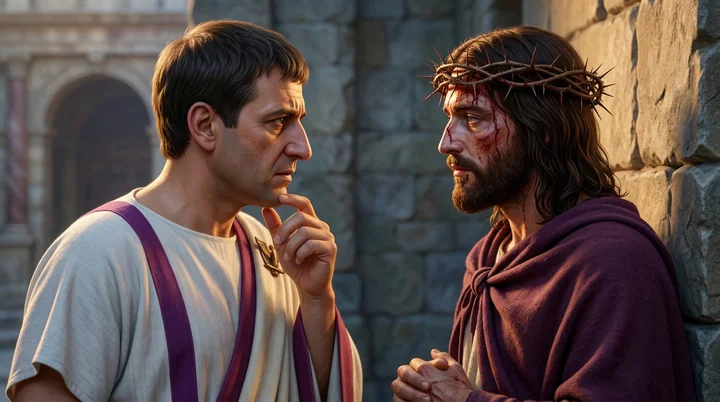
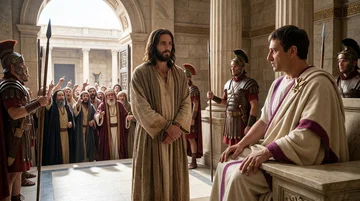
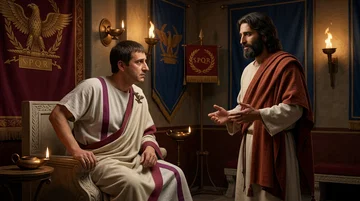
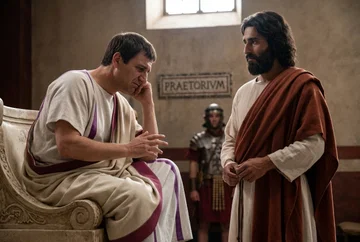
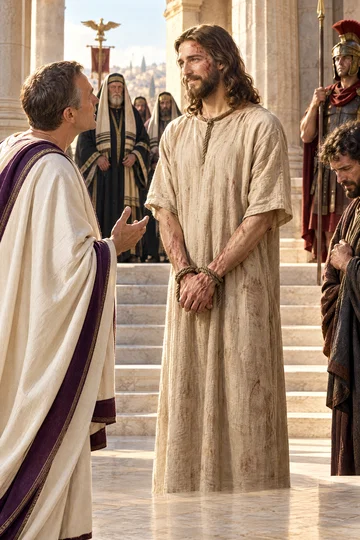
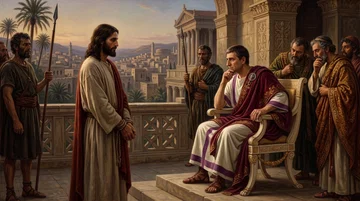
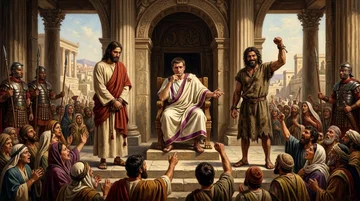
Pilate saith unto him, What is truth? And when he had said this, he went out again unto the Jews, and saith unto them, I find in him no fault at all.
Translations
Pilate says to him, What is truth? And when he had said this, he went out again to the Jews, and said to them, I find in him no fault at all.
King James Version, KJV Cambridge Paragraph Bible
Pilate saith unto him, What is truth? And when he had said this, he went out again unto the Jews, and saith unto them, I find in him no fault at all.
Pilate saith to him, What is truth? And when he had said this, he went out again to the Jews, and saith to them, I find in him no fault.
Revised Version, American Standard Version
Pilate saith unto him, What is truth? And when he had said this, he went out again unto the Jews, and saith unto them, I find no crime in him.
Pilate saith to him, 'What is truth?' and this having said, again he went forth unto the Jews, and saith to them, 'I do find no fault in him;
Pilate says to him, What is truth? And having said this he went out again to the Jews, and says to them, I find no fault whatever in him.
Pilate saith unto him—What, is truth? And, this saying, again, went he out to the Jews, and saith unto them,—I, find in him, not a single fault.
Berean Standard Bible, Majority Standard Bible
“ What is truth?” Pilate asked.And having said this, he went out again to the Jews and told them, “ I find no basis for a charge against Him.
Pilate said to him, “ What is truth?”When he had said this, he went out again to the Jews, and said to them, “ I find no basis for a charge against him.
Pilate said to him, True? what is true? Having said this he went out again to the Jews and said to them, I see no wrong in him.
Pilate said vnto him, What is trueth? And when he had saide that, hee went out againe vnto the Iewes, and said vnto them, I finde in him no cause at all.
Douay-Rheims (Challoner revision)
Pilate saith to him: What is truth? And when he said this, he went out again to the Jews, and saith to them: I find no cause in him.
Pictures
Cross-references 20 of 35
- John 17:17
Sanctify them through thy truth: thy word is truth.
God’s word identifies truth and answers Pilate’s question.
- John 19:4
Pilate therefore went forth again, and saith unto them, Behold, I bring him forth to you, that ye may know that I find no fault in him.
Pilate again declares that he finds no fault in Jesus.
- Luke 23:4
Then said Pilate to the chief priests and to the people, I find no fault in this man.
Pilate declares that he finds no fault in Jesus.
- Matthew 27:19
When he was set down on the judgment seat, his wife sent unto him, saying, Have thou nothing to do with that just man: for I have suffered many things this day in a dream because of him.
Pilate’s wife warned him about condemning the just man.
- John 14:6
Jesus saith unto him, I am the way, the truth, and the life: no man cometh unto the Father, but by me.
Jesus identifies himself as the Truth, answering Pilate’s question.
- Psalms 119:142
Thy righteousness is an everlasting righteousness, and thy law is the truth.
God’s law is identified as truth.
- John 19:6-7
When the chief priests therefore and officers saw him, they cried out, saying, Crucify him, crucify him. Pilate saith unto them, Take ye him, and crucify him: for I find no fault in him.
Pilate declares Christ innocent, but the leaders demand his death under their law.
- Mark 15:3-5
And the chief priests accused him of many things: but he answered nothing.
Jesus remains silent under accusations, and Pilate marvels.
- John 8:32
And ye shall know the truth, and the truth shall make you free.
Jesus says knowing the truth brings freedom, while Pilate questions what truth is.
- Luke 23:14-15
Said unto them, Ye have brought this man unto me, as one that perverteth the people: and, behold, I, having examined him before you, have found no fault in this man touching those things whereof ye accuse him:
Pilate and Herod find no basis for condemning Jesus.
- Matthew 27:22-23
Pilate saith unto them, What shall I do then with Jesus which is called Christ? They all say unto him, Let him be crucified.
The crowd chooses Barabbas and demands Jesus’ crucifixion.
- Psalms 119:151
Thou art near, O LORD; and all thy commandments are truth.
God’s commandments are identified as truth.
- John 19:6
When the chief priests therefore and officers saw him, they cried out, saying, Crucify him, crucify him. Pilate saith unto them, Take ye him, and crucify him: for I find no fault in him.
Pilate repeats that he finds no fault in Jesus.
- Luke 23:22
And he said unto them the third time, Why, what evil hath he done? I have found no cause of death in him: I will therefore chastise him, and let him go.
scourging proposed despite declared innocence
- Matthew 27:24
When Pilate saw that he could prevail nothing, but that rather a tumult was made, he took water, and washed his hands before the multitude, saying, I am innocent of the blood of this just person: see ye to it.
Pilate declared Christ innocent yet washed his hands before the multitude.
- 1 Peter 2:22
Who did no sin, neither was guile found in his mouth:
Jesus is without sin, and no guile is found in his mouth.
- John 19:16-30
Then delivered he him therefore unto them to be crucified. And they took Jesus, and led him away.
Jesus is rejected after Pilate finds no fault in him and is crucified.
- John 1:14
And the Word was made flesh, and dwelt among us, ( and we beheld his glory, the glory as of the only begotten of the Father,) full of grace and truth.
Christ is described as full of grace and truth.
- Matthew 27:4
Saying, I have sinned in that I have betrayed the innocent blood. And they said, What is that to us? see thou to that.
Judas confessed that he had betrayed innocent blood.
- John 18:33
Then Pilate entered into the judgment hall again, and called Jesus, and said unto him, Art thou the King of the Jews?
Pilate's question that leads to What is truth
Commentary
Each commentary is drawn from primary sources: the writings of Ellen G. White and Adventist pioneers and periodicals. Each commentary is separate. Its own words are not a quotation; follow the references to read the source passages.
Ellen G. White
68 sources
Pilate asks what truth is right after Jesus says He came into the world to bear witness to the truth and that all who are of the truth hear His voice, and then without waiting he goes out to the Jews declaring he finds no fault in Him at all.Ms 51, 1897, par. 29–30Lt 290, 1906, par. 6–75RED 52.1–2 He does not wait for an answer because the rising tumult and impatient cries of the crowd jar upon him and recall him to his place as judge outside the hall.COS 140.1–5ST Jul 4, 1878DA 726.5–727.4 His question comes from a stirred heart and real longing to know what truth is and how it may be obtained amid a divided religious world, yet though convinced by overwhelming evidence that Christ is without deception, his pride and fear of the mob overcome conviction and he yields to condemn the One he has pronounced innocent.COS 140.1–5Ms 51, 1897, par. 29–30ST Jul 4, 1878Ms 112, 1897, par. 26–30ST Jul 4, 1878 That public verdict of no fault at all, repeated three times, stands forever as proof of Christ's sinless life and as rebuke to the false charges of rulers who demand His death.COS 140.1–5Ms 111, 1897, par. 16–18Ms 128, 1897, par. 1–4RH Jun 12, 1900 The truth Pilate inquires after is not mere abstract knowledge but saving, practical, present truth bound up with receiving Christ as personal Saviour, obeying His word and keeping God's commandments unto eternal life, revealed clearly in Scripture which must test every creed.Ms 1, 1889, par. 61–64Ms 45, 1900, par. 17–18MH 456.3–48T 317.24SP 196.1
Trial Words and Setting
The question comes immediately after the claim to have come into the world to bear witness to the truth and that everyone who belongs to the truth hears the voice, and it is followed at once by going out to the Jews with the declaration that no fault at all is found in Him.Ms 51, 1897, par. 29–30Lt 290, 1906, par. 6–75RED 52.1–23SP 132.3 Pilate knows He is innocent and that hatred and prejudice moved the leaders to hand Him over, yet that unjust examination foreshadows the experience believers must pass through with Christ in heaven beholding every circumstance and sustaining those who stand for Him on the elevated platform of eternal truth while every false platform is shaken.Ms 51, 1897, par. 29–30Lt 290, 1906, par. 6–7 He longs to know the truth even as Jesus stands arraigned as a criminal claiming it, but he does not wait for an answer to so important a question.COS 140.1–5DA 726.5–727.45RED 52.1–23SP 132.3 The continually increasing tumult, impatient cries, and demands of the excited crowd jar upon him and recall him to his judicial position and the immediate crisis beyond the door of the hall, so he goes out and in an emphatic voice publicly declares Him innocent and faultless.COS 140.1–5ST Jul 4, 1878DA 726.5–727.4ST Jan 24, 1900ST Jun 3, 1889
The examination takes place after the Jewish leaders bring Jesus to the Roman judgment hall, where He is questioned about being a king to determine guilt of sedition.DA 723.1–724.1ST Jul 4, 1878 No sign of guilt appears, but goodness, nobility, and calm dignity under accusation, leading to doubt of the charges, respect for the prisoner, and the decision to ask the leaders what charges they bring.DA 723.1–724.1ST Jul 4, 1878 Jesus probes whether the question about kingship comes from Pilate's own desire for truth or from the accusations of others, and pride then overcomes the conviction stirring in the wavering mind.ST Jul 4, 1878 The declaration that He is innocent of seeking earthly kingship affirms faultlessness, and the later memory that a judge pronounced Jesus innocent yet handed Him to mob rule would make hearers question what power controlled them.3SP 132.3ST Jan 24, 1900ST Jun 3, 1889
The trial is a mock trial from beginning to end, for although the priests try in every way to entrap Christ, their hired, ignorant, coached tools give false testimony that contradicts itself, does not agree, and is worthless, so nothing condemnable is found in Him.Ms 101, 1897, par. 4–5Ms 111, 1897, par. 16–18RH Jun 12, 1900Ms 107, 1893, par. 2 Pilate's declaration of innocence, the first of three such declarations that He is worthy of no condemnation, exposes the accusations as false, undermines the case, enrages the Jews, and fulfills the purpose that those delivering Him to death hear testimony to His innocence.Ms 101, 1897, par. 4–5Ms 111, 1897, par. 16–18RH Jun 12, 1900Ms 107, 1893, par. 2 Yet Jesus cannot be executed without Pilate's legal confirmation after the Sanhedrin has condemned Him, and instead of protecting the innocent man and earning the reputation of a just and considerate ruler, Pilate gives Him up to the mob, exposing a religion of oppression that exalts valueless tradition and rites above the Word of God while rejecting the Light of the world.Ms 111, 1897, par. 16–18Ms 107, 1893, par. 2
That mock trial in the judgment hall is witnessed by God the Father, Satan and his angels, the heavenly universe, and the unfallen worlds, while the accusers have nothing by which to prove guilt.Lt 125, 1902, par. 8–12Ms 128, 1897, par. 1–4 Behind the lawless mob with hearts filled with a violence only Satan can inspire lies Satan's hatred of Christ for His position in the courts of God, hatred increased by Satan's own dethronement for rebellion and by Christ's pledge to redeem a race of sinners.Lt 125, 1902, par. 8–12Ms 72, 1902, par. 15 From the manger to the cross Satan follows Christ striving constantly to gain mastery over Him, filling priests and rulers with hatred and joining his agents disguised in priestly and ruling robes with the lowest and most degraded in the effort to take the life of the Son of God.Ms 72, 1902, par. 15 Under that guidance the trial and crucifixion become a scene of bitter shame and sorrow heaped with all the abuse, ridicule, and malice satanic hate can suggest, exposing how far beings He created and loved so well as to leave heaven for them had fallen in personating Satan against Him.Lt 125, 1902, par. 8–12Ms 72, 1902, par. 15 The crowd that once hailed Him as king now reviles Him and cries for His crucifixion, and this reversal prepares the disciples for the trial of their faith.Ms 128, 1897, par. 1–44RED 102.2–103.1Ms 72, 1902, par. 15
Pilate's Longing and Failure
Pilate's question comes from great longing to know what truth is and how it can be obtained.ST Jul 4, 1878 His mind has been confused by a disturbed and divided religious world where many voices cry, Here is the truth, so he grasps eagerly at Jesus' words about coming into the world to bear witness to the truth.ST Jul 4, 1878 Though Jesus stands arraigned before him as a criminal claiming to have the truth, the claim stirs Pilate's heart.ST Jul 4, 1878 He does not wait for an answer to so important a question, because the continually increasing tumult and impatient cries of the excited crowd jar upon him and recall him to his judicial position beyond the door of the hall.COS 140.1–5ST Jul 4, 1878 He goes out to the Jews and declares in an emphatic voice that he finds no fault in Jesus at all.COS 140.1–5ST Jul 4, 1878
Overwhelming evidence convinces and convicts him that Christ is no pretender, with not a single trace of deception to be found in His words or deportment.Ms 112, 1897, par. 26–30 His wavering mind is wrought upon by unseen influences, and he is compelled to confess before all His accusers that He is entirely faultless and innocent of all crime.Ms 112, 1897, par. 26–30 Yet pride overcomes the conviction stirring in him, leaving him unwilling to yield.Ms 112, 1897, par. 26–30ST Jul 4, 1878 When Jesus probes whether his question about kingship comes from his own desire for truth or from the accusations of others, that pride resists the stirring.ST Jul 4, 1878
He knows Jesus is innocent and that the leaders handed Him over out of hatred, prejudice and envy.Ms 51, 1897, par. 29–30 Fear of a public disturbance and of the mob rather than God keeps him from doing what he knows is right.Ms 51, 1897, par. 29–30Ms 72, 1898, par. 11 Settled conviction requires courage to act by defending Christ before the people, denouncing those seeking His life as murderers, and firmly refusing His crucifixion.Ms 72, 1898, par. 11 Instead his last effort to set Christ free is to plead for the scourge in place of the cross and to appeal to the sympathy of the mob where nothing can be hoped from priests and rulers.Ms 112, 1897, par. 26–30 He publicly declares Him innocent, even three times, yet has Him scourged, condemns Him, and hands the innocent prisoner over to His murderers and to a shameful, cruel death.Ms 72, 1898, par. 11Ms 112, 1897, par. 31–32ST Jul 12, 1899
That first faltering after publicly pronouncing Christ innocent is cruel inhumanity, causing needless pain to gratify satanic enmity and hatred against light, evidence, justice and conviction.Ms 112, 1897, par. 26–30 By moving against light and sacrificing innocence he brings upon himself lasting remorse, guilty conscience and despair, with guilty conscience and lasting infamy.Ms 112, 1897, par. 26–30Ms 72, 1898, par. 11 He leaves an example of unjust judgment that many judges have since followed.Ms 72, 1898, par. 11 Those who heard the declaration still remembered that a judge had pronounced Jesus innocent yet gave Him to mob rule, leading them to question what power controlled them.ST Jan 24, 1900 Both the true declaration and the later act of giving the innocent prisoner to scourging and death are shown to his wife in a vision of the night.Ms 112, 1897, par. 31–32
Verdict of No Fault
Pilate's question about truth is followed at once by his going out without waiting for an answer, drawn back to his judicial place by the tumult and cries of the crowd, and he then declares openly and emphatically that he finds no fault at all in Jesus.3SP 132.3ST Jun 3, 1889 That declaration is the first of three times he pronounces Him innocent and worthy of no condemnation, affirming that no charge can be brought against Him and that He is innocent of seeking earthly kingship.Ms 111, 1897, par. 16–18Ms 128, 1897, par. 1–43SP 132.3ST Jul 12, 1899 Although the priests tried in every way to entrap Christ through hired, ignorant, coached tools whose contradictory testimony proved worthless, nothing condemnable was found in Him.Ms 111, 1897, par. 16–18RH Jun 12, 1900 Pilate knew He was an innocent man, yet instead of protecting Him and earning the reputation of a just and considerate ruler he had Him scourged and gave Him up to the mob and to a cruel death, even the cruelest death devised, proving the trial of the only begotten Son of God a mock trial from beginning to end.Ms 111, 1897, par. 16–18Ms 128, 1897, par. 1–4ST Jul 12, 1899 That course exposes the religion of the Jewish teachers as a religion of oppression unable to reform them, exalting valueless tradition and rites above the Word of God while rejecting and condemning the Light of the world.Ms 111, 1897, par. 16–18
That judgment by a heathen Roman magistrate and Gentile governor rebuked the false accusations of Israel's rulers.COS 140.1–5ST Jul 4, 18785RED 53.1 It will forever stand as proof to the world that the charges brought against Jesus were base perfidy and falsehood, since even a heathen ruler pronounced Him guiltless.ST Jul 4, 18783SP 133.15RED 53.1 His finding Him without fault exposed the hired witnesses and the falsehood of the accusations.RH Jun 12, 19003SP 133.1 It fulfilled God's purpose that those who delivered Jesus to death should hear testimony to His innocence.RH Jun 12, 1900
The verdict proves that from the beginning to the close of His earthly ministry no sin appeared in His life and no selfishness marred His words or acts.Ms 2, 1903, par. 5ST May 13, 1903 His life was marked by self-denial and nobility of purpose in continually doing good, in contrast to an inefficient, do-nothing, self-serving life that leads away from Him and is not accepted.ST May 13, 1903 Because He lived without fault, His life is the standard for how all must live, by denying self, taking up the cross, and following Him along the pathway of sacrifice.ST May 13, 1903
The verdict confirms He is the innocent and sinless Son of God bearing the sin of the world, the divine Son clothed in humanity.Ms 101, 1897, par. 21–23Lt 125, 1902, par. 8–1212MR 413.4–414.2 His humanity so veiled His divine glory that even His disciples struggled to believe in Him and no friend dared speak in His defense.Ms 101, 1897, par. 21–2312MR 413.4–414.212MR 393.1–2 Yet neither Satan nor His accusers could find anything in His sinless character to condemn.Lt 125, 1902, par. 8–12Ms 87, 1894, par. 23–24 His spotless life revealed God's character and fulfilled the law, but His work was more than living without fault, for He voluntarily gave His life as sacrifice, because sin can be forgiven only through the shedding of blood.12MR 395.2–396.1 Despite that verdict the priests and rulers had given themselves over to Satan's control, prompted by the one cast out of heaven for rebellion, and under his guidance made His trial and crucifixion a scene of bitter shame and sorrow, heaping upon Him all the abuse and ridicule and malice that satanic hate could suggest.Lt 125, 1902, par. 8–12
Despite the verdict of faultlessness, human religious authority demanded His death under its law, and the faultless Christ was condemned by it to a cruel death.Ms 65, 1912, par. 29–30Ms 139, 1907, par. 8–912MR 218.2–220.1 Pilate nevertheless handed Him over while the crowd demanded His death, chose Barabbas, and accepted responsibility for His blood.ST May 17, 1899 Men thus rejected Him, the divine Son of God and personification of all human goodness, and chose instead a thief and a murderer.ST May 17, 1899Lt 31, 1898, par. 30–32 This choice testifies to the moral taste of the world and to having no interest in knowing God and being loyal to Him, setting two sides, the side of the world that rejects Christ and the side of Christ, who kept His Father's commandments.Lt 31, 1898, par. 30–32
Nature of Saving Truth
Before Christ men asked in vain what truth is because error, superstition, and falsehood covered the earth and deep spiritual darkness covered the people.Ms 24, 1891, par. 65SCE 8.119MR 252.1 Even Judea was shrouded in gloom although possessing God's oracles, for the truth of God had been silenced by the superstition and traditions of its professed interpreters.FE 238.1SCE 8.1 Contention, jealousy, and prejudice divided the professed children of God, while Satan ever seeks to make obscure the truths that are plain.FE 238.1SCE 8.1
Amid that moral darkness and gloom a Teacher sent from God, who is the Way, the Truth, and the Life, came to reveal heaven's pure truth.FE 238.1SCE 8.1 He presented the pure, rich truth of heaven to shine as spiritual light when God said, Let there be spiritual light, and the light of the glory of God was revealed in the face of Jesus Christ.SCE 8.1 He ever seeks to open the mind to comprehend every essential truth concerning the salvation of fallen man.SCE 8.1
The truth to be sought is not merely abstract knowledge nor speculation about things God has withheld, but practical, saving, present truth to be cherished, loved, honored, and obeyed unto the salvation of the soul.Ms 45, 1900, par. 17–18MH 456.3–48T 317.2 It is bound up with Christ and with receiving Him as a personal Saviour.MH 456.3–4 To learn its answer is to eat the flesh and drink the blood of the Son of God, which means obeying the Word of God and keeping His commandments as the condition of eternal life given by Christ the Son of God and Redeemer.Ms 45, 1900, par. 17–18 His words are spirit and life, brought into the soul through the understanding to give spirit and life and to show itself in religious experience and words by the food given to mind and heart.Ms 45, 1900, par. 17–18 True Bible religion and Christian perfection is therefore a sacred, pure, holy, elevated experience fed on precious present and practical truth, with no chaff, fiction, or human speculation.Ms 45, 1900, par. 17–18 That truth is found in the words of Christ, which are righteousness and truth, and receiving it requires taking His words and humbling the heart in obedience to every requirement.Lt 48, 1909, par. 3
That precious truth is revealed in God's Word, which speaks clearly and with authority rather than with uncertainty or doubt, and whose prophetic word is sure.SPBC 130.3 Truth is not established by how long a creed has been believed; the Bible must define and test that creed, revealing where it falls short, and each person is to search Scripture and accept its teaching on Scripture's own evidence rather than depend on another to interpret it.Ms 1, 1889, par. 61–64 The question of what truth is thus tests the foundation on which Christian belief is built, whether firm like rock or shifting like sand.4SP 196.1 The Word is the test by which character is to be examined for entrance into the kingdom of heaven, requiring human sophistries and sand-like ideas and speculations used to influence others to be put away.Ms 1, 1889, par. 61–644SP 196.1Lt 306, 1903, par. 8
When Christ's teaching stirs people to ask what truth is, even inquiry accompanied by controversy and contention is better than indifference because it can awaken them to search for truth as for hidden treasure.ST Oct 17, 1895 Yet to self-righteous, self-conceited, and self-willed askers He gives no answer and will not undertake to teach them.GW92 366.2–367.13T 448.1–3 Only the meek will He guide in judgment and teach His way.GW92 366.2–367.13T 448.1–3
Seeking and Sharing Truth
The question what is truth is a call to inquire with decided interest into the truth for the present time, to cherish, love, honor and obey it.Ms 124, 1903, par. 27TSSW 31.3 Those who give worldly things their proper place will make that inquiry, following the light as it shines from God's Word, and by daily study of Scripture the light grows ever brighter.Ms 9, 1885, par. 5
Every soul must answer the question by seeking divine wisdom with open Bible and accepting truth as the standard, bracing every nerve and spiritual muscle for the test to come to all, being clothed with Christ's righteousness, and standing on the Rock of Ages with assurance of victory when all has been done.Lt 32, 1906, par. 5 The answer is to be sought by prayerful, careful study of Scripture, whose truth is given in language to be understood, on the evidence of its own teachings calling for full obedience, rather than by depending on another's interpretation.RH May 25, 1876Lt 29, 1893, par. 7 Knowing the truth comes by following Jesus through good and evil report and by walking in the light as it comes without waiting for every mystery to be solved or every doubt removed, and those who do so come to know the doctrine and understand the advantages of entering the strait gate and walking the narrow way.RH Mar 28, 1912 Refusing the first rays leaves one blind to the greater light ahead, while walking in the light received illuminates the path as one advances, and taking a courageous stand for truth may involve loss or hardship.RH Mar 28, 1912Lt 29, 1893, par. 7
Those beginning to inquire about the Bible may find that beliefs long held are mistaken, become perplexed, and raise doubts and objections.4T 263.3–264.1GW92 73.4–74.2GW 190.2 Ministers and workers are to learn their difficulties courteously, then meet them with careful, tender, patient instruction, sympathy and support, answering objections from the Bible and helping step by step.4T 263.3–264.1GW92 73.4–74.2GW 190.2
The question reflects the longing of souls wanting what they have not yet received.Ms 77, 1893, par. 31–32 Those who have received light and truth have the duty to share them earnestly, patiently, perseveringly and lovingly, with hearts softened by God's love, helping spiritually blind people past confusion.Ms 77, 1893, par. 31–32Ms 47, 1893, par. 16 The sharing must not be done in a harsh spirit, nor through personal likes and dislikes, inherited traits, or un-Christlike conduct that drives people away, but workers are to be wise and harmless while ready to take a courageous part when called.Ms 77, 1893, par. 31–32Ms 47, 1893, par. 16 Truth is being revealed while false teachers turn people away from God's commandments, so receiving and sharing the knowledge given is vital to saving souls whose value is shown by Christ's death.3MR 78.1Ms 41, 1886, par. 10
That earnest, perplexed, anxious asking comes from across the broad ocean, from those pale with anxiety and thirsting for living truth.Ms 132, 1897, par. 11–13 Their churches have backslidden from God into pride, selfishness and worldliness, and they want the bread of life, to find the old paths and come back to the simplicity of gospel religion.Ms 132, 1897, par. 11–13 Their cry lays on Christ's followers the God-given responsibility to rouse, to go into all the world and preach the gospel to every creature, to answer who will go, and to give means to send missionaries and multiply publications.Ms 132, 1897, par. 11–13
The unjust trial in which the question was asked foreshadows the very experience believers must pass through.Lt 290, 1906, par. 6–7 Christ is in heaven with every circumstance of life open before Him, and He will sustain those who stand for Him.Lt 290, 1906, par. 6–7 Believers must therefore stand on the elevated platform of eternal truth while every false platform is shaken to pieces, trusting no man and not afflicting their souls over men's words, but clinging to Jesus with full faith.Lt 290, 1906, par. 6–7 His Word is truth and power to every humble soul, and strength comes by steadfastly repeating with assurance the truth as it is in Jesus.Lt 290, 1906, par. 6–7 This life tests whether people obey Christ with love and reverence, and God is fitting those who love Him for the heavenly home He has prepared, for those unwilling to obey Him here would not obey Him in the eternal world.TSSW 31.3
Sources
Pioneers and periodicals
89 sources
After Jesus said he came into the world to bear witness to the truth and that everyone of the truth hears his voice, Pilate asked what truth is and at once went out again to the Jews and declared he found no fault in him.ST May 6, 1897ST Jun 18, 1912RH Dec 4, 1913 The finding means no crime at all, publicly pronouncing Jesus innocent and without blemish like the Passover lamb.ST Jun 3, 1897STRH Feb 8, 1915ST Mar 28, 1906 His question came from an eager longing to know what truth was and how it could be obtained amid confused and divided religious voices, though it is also that he asked in jest and cool indifference without wishing either to destroy Christ or to defend him.ST Jul 4, 1878ST Oct 26, 1882ST Sep 30, 1886RH Jun 16, 1863 The truth he asked about is God's word and law embodied in Jesus himself, who is the Truth, the Life, and the Way.ST May 10, 1905ST May 10, 1905RH Feb 16, 1911ST Feb 7, 1911 The right course is not to turn away as Pilate did without waiting for the answer, but to remain with Jesus, seek humbly and earnestly by Scripture and prayer, and walk in the light as it comes.ST Apr 22, 1913ST Mar 27, 1907ST Aug 25, 1887RH Jun 30, 1863
Trial Before Pilate
The saying belongs to the questioning of Jesus during his trials before the high priest and Pilate, and to Pilate's effort to release him.ST Sep 24, 1912 When plainly challenged about his relationship with God he did not deny it, though affirming it made his death certain, standing as an example of remaining faithful rather than denying faith to escape suffering or death.ST Sep 30, 1886 It closes the examination inside the palace, for after Jesus said he came into the world to bear witness to the truth and that everyone of the truth hears his voice, Pilate asked what truth is and immediately went out again to the Jews and declared he found no crime in him.ST May 6, 1897RH Dec 4, 1913 In that same exchange Jesus told Pilate his kingdom was not of this world and that he had come to bear witness to the truth, and Pilate found no fault in him and acquitted him of the charges.ST Jun 18, 1912 The truth so witnessed to is a mighty weapon that no power can overcome or thwart, for God's word is truth, lives and abides forever, and accomplishes the purpose for which God sends it.RH Dec 4, 1913
Pilate was questioning Jesus about being king while trying to determine whether he was guilty of sedition.ST Jul 4, 1878 Jesus' calm, noble bearing and silence under accusation led Pilate to doubt the charges and respect him, and Jesus asked whether Pilate's question came from his own desire for truth or from the accusations of others.ST Jul 4, 1878 Then Pilate's pride overcame the conviction stirring in him.ST Jul 4, 1878 He came out of the palace with Jesus beside him to face the clamoring multitude, his stern face marked by distress almost like fear, earnestly declaring the man completely without fault.ST Jan 17, 1911 The verdict rested on what Jesus had declared in private that his kingdom is not of this world, meaning he was no earthly rival for Caesar to fear, not even Tiberius Caesar, and on that ground Pilate refused to condemn him and instead sent him to Herod Antipas because he was said to be from Nazareth of Galilee under Herod's rule.ST Jan 17, 1911
After the verdict Pilate used the governors' custom of releasing a Jewish prisoner condemned under Roman law at the Passover to please the people gathered from all parts for their principal feast, offering the crowd a choice between releasing Jesus and releasing a notorious robber.ST Mar 15, 1877ST Aug 17, 1904 He knew the chief priests had delivered Jesus from envy but still hoped to frame the choice so the people would choose Jesus, still having confidence the people could be moved in the interest of justice.ST Mar 15, 1877ST Aug 17, 1904 This showed inconsistency in treating an innocent man as equal to a convicted man and letting Jesus' avowed enemies decide his fate. It virtually conceded condemnation by trying to free him through a pardon instead of acquitting him.ST Aug 17, 1904 The contrast stands between the Jews' demand for Jesus' death and their urging Pilate to release Barabbas, who had been convicted of the same crime they charged against Jesus.
The Jews at that time did not have power to carry out a death sentence, but their leaders declared that by their law Jesus ought to die and by demands and pressure forced Pilate to hand him over to be crucified, saying that to let him go would prove Pilate no friend of Caesar.ST The charge that Jesus had made himself a king and was plotting sedition against the Roman government and Caesar was false, and Pilate knew it was false, having said repeatedly that he found no crime in him and nothing worthy of death.ST Pilate yielded because his career had not been good and he feared being accused to Caesar and being deposed and perhaps killed.ST The people chose Barabbas and accepted responsibility for Jesus' blood, while the guilt for delivering him up and denying the Holy and Righteous One and asking for a murderer instead when Pilate had determined to release him belongs to the leaders of the Jews.ST May 17, 1899ST
Pilate Asks About Truth
Pilate asked what truth is from a great longing to know what it was and how it could be obtained, for his mind had been confused by the disturbed and divided elements of the religious world where he had heard many voices cry here is the truth, and he grasped eagerly at the claim of one standing arraigned as a criminal to have come into the world to bear witness to the truth, so that the claim stirred his heart.ST Jul 4, 1878ST Oct 26, 1882ST Sep 30, 1886 He asked with a troubled conscience at a fitting and decisive hour when duty required him to use his stately power justly. He asked while concerned with keeping Caesar's favor, which kept him from seeking or obeying truth, illustrating how concern for approval or personal advantage can keep people from seeking or accepting an answer when it could cost favor or require giving up cherished habits and friendships, whereas those who truly seek truth act on it even when it calls for self-denial and following Christ.ST Mar 15, 1877RH Jan 31, 1871
He asked in jest and with cool indifference rather than open denial, satisfied with outward ceremony while caring nothing for inward reality, neither wishing to destroy Christ nor to defend him, laughing at his kingship instead of denying it, and that same spirit lives on in most of professing Christendom, which does not deny that the Lord is King but laughs at the mention of the Kingdom.RH Jun 16, 1863 His question indicated disbelief that truth exists and asking without expecting an answer, for a corrupt heart can lead people to deny truth and goodness, while those whose hearts are pure or long for purity can know and value truth, and those willing to do God's will can know the doctrine, since Jesus had already expressed the substance of truth in saying he came to bear witness to it.ST Dec 28, 1888 He answered with a cynical sneer rather than an honest search for understanding, expressing the spirit of skepticism that mocks people seeking truth and more light on intellectual doubts and tells them truth cannot be found.RH Sep 20, 1906 Whether he asked sincerely or in derision, the question matters to every person and must not be put off until there is no love for truth or desire to seek it.ST Feb 17, 1888
He did not wait for a reply because the continually increasing tumult and impatient cries of the excited crowd jarred upon his ears and recalled him to his judicial position and the immediate crisis.ST Jul 4, 1878ST Jan 24, 1900ST Oct 26, 1882ST Sep 30, 1886 He left before Jesus could answer and therefore missed the full meaning of truth, though hearing and heeding that answer mattered to his life and to humanity's eternal welfare, for Jesus knew the truth and alone could give its full meaning.ST Apr 22, 1913ST May 10, 1905 The right course was to remain with Jesus until the question was fully answered, sitting at his feet and hearing his word and by that listening securing the good part that cannot be taken away, instead of turning carelessly away and turning to the world's confusion and pursuit of gain.ST Mar 27, 1907ST May 10, 1905 He then went out to the Jews to seek Jesus' release and declared emphatically to the accusers that he found no fault in him at all.ST Jul 4, 1878ST Jun 3, 1889ST Oct 26, 1882ST Sep 30, 1886
He asked while standing face to face with Truth itself in humble beauty, come from the glorious court on high as incarnate Truth, close enough to touch with his hands and grasp if he would, yet Jesus was crushed and torn and crowned with thorns, bent in form and wan in face, not seeming like royalty, so Pilate did not grasp him.RH Sep 28, 1911 Prejudice turned Pilate away from the truth: although he had just declared Jesus innocent, he listened to the crowd and sent him to the cross as a criminal.ST Aug 20, 1896 He knew Jesus was innocent and should have stayed the mad mob crying for a decision and saved the man from crucifixion, but he denied his conviction and his best friend without repentance and gave the dreaded sentence to scourge and crucify him.
Innocent Verdict Declared
After examining Jesus on the charges brought by the Jewish council, Pilate went out and emphatically and publicly declared to the Jews and to His accusers that he finds no fault at all in Him.RH Feb 8, 1915ST Mar 28, 1906ST Mar 28, 1906ST Oct 31, 1916 That testimony, given even though Jesus claimed to be King of the Jews, affirms His innocence, as does the testimony of Pilate's wife calling Him a just man.RH Feb 8, 1915 The finding is reinforced when Herod sends Jesus back without condemning Him, and it appears again in Pilate's repeated efforts to secure His release despite the crowd's demand for crucifixion.ST Mar 28, 1906ST Mar 28, 1906 Pilate declared Jesus innocent even though he was the one who sentenced Him to death.ST Dec 24, 1912
The word rendered fault means not one, and is more accurately translated crime, so Pilate is stating that he finds no crime at all in Him.ST Jun 3, 1897ST This establishes Jesus as without blemish, corresponding to the Passover lamb which was to be without spot or blemish.ST Jun 3, 1897 Being found without fault at His trial shows He was without sin, though sin was laid on Him.ST Nov 19, 1896
From the beginning to the close of His earthly ministry no sin appeared in His life and no selfishness marred His words or acts.ST May 13, 1903 His life was marked by self-denial and nobility of purpose in continually doing good, in contrast to an inefficient, do-nothing, self-serving life that leads away from Him and is not accepted.ST May 13, 1903 Because He lived without fault, His life is the standard for how all must live by denying self, taking up the cross, and following Him along the pathway of sacrifice.ST May 13, 1903
The verdict stands forever as proof to the world that the charges the Jews brought against Jesus were base perfidy and falsehood, since even a heathen magistrate pronounced Him guiltless.ST Jun 3, 1889ST Jul 4, 1878ST Oct 26, 1882ST Sep 30, 1886 His finding that Jesus was without fault after questioning Him, despite false testimony from hired witnesses, exposed the accusations as false.RH Jun 12, 1900ST Jun 3, 1889ST Oct 26, 1882 It fulfilled God's purpose that those who delivered Jesus to death should hear testimony to His innocence.RH Jun 12, 1900 Pilate declared Jesus innocent three times, though His accusers could prove no guilt.ST Jul 12, 1899
Yet though declaring Him innocent, Pilate pronounced Him guilty to please the Jewish officials, ordered Him scourged and handed Him over to a cruel death.ST Jul 12, 1899ST Jun 7, 1899ST Dec 24, 1912 He virtually conceded condemnation by trying to free Him through a pardon instead of acquitting Him, using the governors' custom of releasing a Jewish prisoner condemned under Roman law at the Passover to please the people gathered from all parts for their principal feast and letting them choose who should be released, hoping to frame the choice so the people would choose Jesus.ST Aug 17, 1904 He knew the chief priests had delivered Jesus from envy, but still had confidence the people could be moved in the interest of justice.ST Aug 17, 1904 His conduct professed justice while doing the opposite, illustrating how a power can speak righteously but act unjustly.RH Mar 19, 1857
Pilate believed Jesus was more than an ordinary man and had been warned not to harm Him, yet his recognition of Jesus' innocence did him no good.ST Oct 28, 1897 People may acknowledge Jesus as faultless while treating Him as an impossible example to imitate, but the needed work is not to shape oneself into His likeness by one's own effort but to behold Him, for as He is beheld the beholder is changed into His image.ST Oct 28, 1897 Jesus' adversaries could find no just cause against Him openly, so they resorted to darkness, force, fear, and perjury to bring about His condemnation, while Jesus met their craft and intrigue with wisdom and spiritual judgment that confounded them.ST Jun 21, 1899
The declaration of innocence followed by the choice against Jesus belongs to Israel's rejection of the Son and fulfills the vineyard parable where the husbandmen seize and kill the householder's last-sent son.ST Feb 5, 1902 The testimony to Jesus' faultlessness is reflected in the claim that He was perfect and that no fault could be found in Him, and no case on which action against Him could be based.ST Jan 20, 1904RH Oct 22, 1903 His blameless character revealed the true character and conception of God.RH Oct 22, 1903 Jesus showed a noble, composed, and cheerful bearing before Pilate while subjected to abuse and disgrace, and His face and bearing showed purity and freedom from evil passion in contrast with Barabbas, as Pilate presented Him to the people and called them to look at Him.RH Apr 2, 1908RH Aug 25, 1859
Kingdom Not Earthly
Jesus stood falsely accused of seeking to establish a rival earthly kingdom, yet he did not deny being born heir to a throne but plainly declared that his kingdom was not of this world.ST Jun 14, 1905ST Jun 18, 1912 After hearing that claim about kingship and witness to truth, Pilate acquitted him of the charges brought against him.ST Jun 14, 1905ST Jun 18, 1912 That kingdom will still be established in the earth in its appointed time, when it will supersede all earthly kingdoms.ST Jun 14, 1905
He made no defense but submitted to undeserved injury and insult, and his refusal to resist, with that of his subjects, shows his kingdom was not of this world.ST Jun 7, 1899 Pilate found no fault in him after examining him and hearing his claims about kingship and mission, because he understood Jesus did not intend to begin a political reformation or interfere with Caesar's government.ST Mar 19, 1896 The Jews nevertheless accused him of such an intention because they expected the Messiah to bring political change, and they rejected Jesus because he did not.ST Mar 19, 1896
What Truth Is
The truth to which Jesus bears witness is in himself, God's saving power embodied in him and shown in a life of love, and his life and words bring light to the world by revealing God's character and righteousness.RH Jul 31, 1900 He came into the world to bear witness to the truth, and everyone who belongs to the truth hears his voice, having already set forth the substance of truth in declaring that mission.ST Jun 18, 1912ST Dec 28, 1888ST Jan 28, 1875
The answer given is that God's word is truth, which lives and abides forever and accomplishes the purpose for which God sends it.RH Dec 4, 1913 Truth is what God has spoken or caused Scripture to record, including his commands and revelations, and to reject or reshape that word by human theories is to deny its truth.RH Oct 4, 1864ST Feb 17, 1888 Christ bears witness to that truth, and his servants are to bear witness to the whole word of God in what they teach and do.ST Jan 29, 1885 Merely knowing the fact is insufficient and theory alone is valueless, for strict adherence to the principles of truth in daily life, aided by the Holy Spirit, leads to a close walk with God and lifts man out of the ditch into which error has plunged him.
Scripture answers the question by identifying God's law and commandments as truth, God's word as truth, and Jesus himself as the Truth.ST May 10, 1905ST May 10, 1905 Truth is what agrees with God's word, and what conflicts with the word is error and must be rejected.RH Dec 8, 1863 All profession and teaching must be brought back, hewed, and tested by God's word in its plain and common-sense meaning, and doctrines must be tested against Scripture by personal searching, for teachings that fail that test have no truth in them.RH Dec 8, 1863 That truth sanctifies, is the only shield amid dangers and perils by the way, and is the anchor when tossed on life's billowy sea, while without it people are driven at the mercy of the winds and left exposed when winds blow and storms beat.RH Jun 23, 1863 It is built upon a rock, shines brighter, clearer and more lovely as winds, storms and dangers increase, is a beacon-light pointing onward and upward to a sure resting-place, and casts its anchor within the veil so it cannot be removed.RH Jun 23, 1863
Christ is the truth, the life, and the way.RH Feb 16, 1911ST Feb 7, 1911 Though truth seems far away, its voice is near, bending low to thrill the hearts of age and youth and proclaiming in the listening ear that it is the Truth, the Life, the Way, which is Jesus.RH Feb 16, 1911ST Feb 7, 1911 The question has a dependable solution, with the correct answer spoken by Christ himself in a threefold application, showing that truth must be known in order to be free from sin and develop Christian character.RH Mar 26, 1914
Truth is a mighty weapon that no power can overcome or thwart.RH Dec 4, 1913 Truth saves, not sincerity, and sincerity can never take the place of truth.ST May 27, 1880 Truth sanctifies, blesses, and makes free, while falsehood damns and brings bonds and shackles, and through that truth Jesus' disciples are sanctified.ST May 27, 1880RH Mar 23, 1852 Truth is God's law and character lived out by the subjects of his kingdom, and such lives represent and recommend the kingdom of God and the free city of truth, so the question is answered by lives that embody truth as Christ did.RH Oct 29, 1901
Seek Truth Earnestly
The question is right to ask, but the right course is to remain with Jesus until it is fully answered, sitting at his feet and hearing his word, and by that listening to secure the good part that cannot be taken away.ST Mar 27, 1907 Truth is to be sought humbly, honestly, earnestly and without prejudice, with patient, affectionate prayer and willingness to follow the plain teachings of Scripture, which lead seekers toward agreement, while prejudice and unwillingness to yield produce discord.RH Apr 19, 1870 The answer is sought by prayerfully and carefully studying Scripture, whose truth is given in language people can understand.RH May 25, 1876 Morning and evening communion with God brings help and comfort through day and night.ST Aug 25, 1887
The closet of secret prayer is the most fitting place to ask what truth is, because those who ask of God are most likely to be taught of God, carrying the question both to the Bible by reading to know truth and to the throne of grace by praying to know it.ST Aug 25, 1887RH Jun 30, 1863 Truth must be followed irrespective of popular theology, whatever it is and wherever it is found, at whatever sacrifice, with tradition never deterring a scrutinizing search and without stopping to ask whether rulers have believed or noted divines have embraced a sentiment.RH Oct 4, 1864 Those who truly seek truth act on it even when it calls for self-denial and following Christ.ST Mar 15, 1877 Concern for approval or personal advantage, as keeping Caesar's favor, can keep people from seeking or obeying truth, and those who truly seek it must accept its demands even when doing so costs friendships or cherished habits.ST Mar 15, 1877RH Jan 31, 1871
Merely knowing the fact is insufficient and theory alone is valueless; strict adherence to the principles of truth in everyday life, aided by the influence of the Holy Spirit, leads to a close walk with God and extricates man from the ditch into which error has plunged him. Truth is known by walking in the light as it comes, without waiting for every mystery to be solved or every doubt removed; those who do so come to know the doctrine and understand the advantages of entering the strait gate and walking the narrow way.RH Mar 28, 1912 Refusing the first rays of light leaves a person unable to see the greater light ahead, while walking in the light received illuminates the path as one advances.RH Mar 28, 1912 Inquiry, even when controversy and contention accompany it, is better than indifference because it can awaken people to search for truth as for hidden treasure.ST Oct 17, 1895
When common workers filled with the love of Jesus speak with heavenly eloquence instead of worldly oratory, those who catch divine rays have fitting words given them that go direct to minds, awaken conviction, and cause listeners to ask what truth is, opening the way to invite them to take Christ's yoke, learn his meekness and lowliness, and find rest.RH Jun 27, 1912 Here his question stands for doubt in the face of conflicting opinions, unlike Abraham who believes God and takes heed to the Bible as a sure word of prophecy, while a person who follows human opinions as a safer guide is driven about by every wind of doctrine or left indifferent.RH Apr 11, 1854 It represents the despair of skepticism in which when people lose hope of finding truth they give up seeking it and become indifferent to the gospel, so asking about truth is not enough and those asking must wait for God's answer instead of leaving as Pilate did.ST Jun 18, 1885RH Aug 7, 1866
Pilate's question has become the actual cry of a great dying world, asked as if it admits of no positive answer and almost in despair.ST Mar 27, 1907 The thousand conflicting answers coming from all parts of Christendom produce the terrible result that mankind everywhere is fast coming to believe there is no such thing as truth, that so-called truth is only a matter of opinion and at best relative, that no one can know anything to be right but can only think himself right, and that error today will be truth tomorrow and truth today will be error tomorrow.ST Mar 27, 1907 That same question is being asked again today with even greater eagerness in an age of change and transformation and revolution marked by unrest and disquietude, as changing emphasis in religious faith and teaching, subtle skepticism, and the invasion of commercialism, federation, and worldliness into the church sweep professed Christians away from old-time faith and primitive simplicity.RH Apr 9, 1914 The repeating of the question means a wide departure from old-time simplicity of faith and a discarding of the Scriptures of truth, belonging to the present spirit of unrest, disquietude and degeneracy, when unbelief fills hearts and minds because men refuse to accept God's truth and resort to almost anything else to satisfy their hearts' longing, with error being easier to obtain.RH Mar 26, 1914RH Nov 10, 1910
The question is especially important in the last days, not because truth is changeable or ever ceases to be truth, but because ideas have become perverted and people fail to understand what it is. It is a momentous inquiry that covers what is true of God, of the Lord Jesus, of the Holy Spirit, of ourselves, of our character, of our duty, of our destiny, and of the future state of eternal retribution, pressing each reader to face the truth that he is an impenitent sinner under God's command to repent.RH May 27, 1862 Among the professed Christian world that question has given place to what is convenient, and this exchange shows the absence of the love of the truth.ST Mar 20, 1907 The verse sets truth above expediency.
The question is fulfilled when seekers endure hardship to learn Bible truth and show they desire the bread of life, as when people in perplexity and anxiety walk thirty-five miles in mud and wade water above the knees in the rainy season, come every Sabbath two to seven miles and return the same day with only a little dry bread, women walking regularly on painful crippled feet, and when inquirers eighty-four miles west send letters petitioning for teaching and others one hundred twenty-seven miles west seek instruction.RH Jun 16, 1910 The people investigating the teaching are described as anxious to know what is true, and in the Sabbath debate the truth was presented so clearly and strongly that honest hearts could recognize it.ST Mar 21, 1878RH Nov 5, 1901 The question is echoed in the hearts of publicans and sinners drawn to Christ: they are awakened to seek truth, and the repenting soul finds hope by following Jesus and hearing his words.ST Jan 1, 1894 The Pharisees stand in contrast, shutting their eyes and ears to truth and refusing the conversion by which they could be saved.ST Jan 1, 1894
The verse points to seeking truth with an open mind and following it, changing one's views and practice as greater knowledge is gained, expressing a sincere desire to discover truth so it can be obeyed and the desire of a true heart.ST Oct 11, 1877RH May 12, 1863 It is a call to seek the right way from God and not refuse the light of truth when it requires sacrifice, leading to earnest investigation and prayerful concern about what God wants people to do, in contrast to trying to escape the force of clear evidence.ST Nov 11, 1875ST Oct 11, 1877RH Mar 14, 1854 People cannot agree on truth through human authority alone; conscience recognizes and enforces God's authority, and truth must be believed to have a divine source to bind the conscience.RH Mar 17, 1859 Rejecting or reshaping God's word through human theories amounts to denying its truth.ST Feb 17, 1888
The verse gives the question to put to those who charge Bible teachers with heresy while admitting their doctrines were founded on the written word and their conduct was Christian, demanding the standard of truth by which heresy is judged and requiring scriptural proof of demoralizing doctrine or disorderly conduct instead of mere name-calling.RH Oct 20, 1874 It contrasts Satan's lying wonders with the Holy Spirit's work in hearts, where some yield to the Spirit's transforming influence while others reject it. His action illustrates how people can turn away from Jesus and miss God's answer by entering the world's confusion and pursuit of gain. It is the repeated cry of weariness, sorrow, perplexity and pain when everything is a great mystery and the soul feels like a poor bird beating its wings against the wires of a cage in a vain attempt to find liberty, marking loss of hold on God and his word, finding no harmony in God's word, with the story of Jesus reduced to a beautiful story alone.ST Jun 2, 1898
The same test comes to every reader, who must also pass sentence and decide whether to take him as leader or condemn him. The same weak Roman act repeats through the passing centuries, when Truth waits for its sentence, its craven friends hide, the rabble cry at the gates, and frightened people finding no fault still yield to Satan's shrieking bands.RH Sep 28, 1911 Pilate's failure to stand by that judgment and refuse to condemn an innocent man binds him to lasting remorse and guilt.ST Jan 24, 1900 Those who heard the declaration later remembered that a judge had pronounced Jesus innocent and still handed him over to mob rule, leading them to question what power controlled them.ST Jan 24, 1900
Sources